

Candida auris Genetics and Emergence
Open accessThe DOI matches its Crossref record; 125 of the 125 references it cites were found in a registry or an index.
Abstract
Candida auris is a multidrug-resistant fungal pathogen that presents a serious threat to global human health. Since the first reported case in 2009 in Japan, C. auris infections have been reported in more than 40 countries, with mortality rates between 30% and 60%. In addition, C. auris has the potential to cause outbreaks in health care settings, especially in nursing homes for elderly patients, owing to its efficient transmission via skin-to-skin contact. Most importantly, C. auris is the first fungal pathogen to show pronounced and sometimes untreatable clinical drug resistance to all known antifungal classes, including azoles, amphotericin B, and echinocandins. In this review, we explore the causes of the rapid spread of C. auris. We also highlight its genome organization and drug resistance mechanisms and propose future research directions that should be undertaken to curb the spread of this multidrug-resistant pathogen.
Overview
The claims and statistics of this paper haven’t been checked yet.
Free: it reads the open-access text and checks the first 5 claims that cite a source we can check. Create a free account to check every claim.
Integrity signals
Registry
Cites
Statistics
Figures
Verification
Claims the paper makes
The claims and statistics of this paper haven’t been checked yet.
Free: it reads the open-access text and checks the first 5 claims that cite a source we can check. Create a free account to check every claim.
Self-check
Percentages, sums and reported differences re-computed from the paper’s own numbers.
The self-check needs the paper’s full text.
Citations
Cites
Hidden Killers: Human Fungal Infections
Brown, G. D., Denning, D. W., Gow, N. A. R., Levitz, S. M., Netea, M. G., & White, T. C. (2012) · Science Translational Medicine · doi:10.1126/scitranslmed.3004404 · Cited by 4,284
Pappas, P. G., Kauffman, C. A., Andes, D. R., Clancy, C. J., Marr, K. A., Ostrosky-Zeichner, L., Reboli, A. C., Schuster, M. G., Vazquez, J. A., Walsh, T. J., et al. (2016) · Clinical Infectious Diseases · doi:10.1093/cid/civ933 · Cited by 4,200
Lockhart, S. R., Etienne, K. A., Vallabhaneni, S., Farooqi, J., Chowdhary, A., Govender, N. P., Colombo, A. L., Calvo, B., Cuomo, C. A., Desjardins, C. A., et al. (2017) · Clinical Infectious Diseases · doi:10.1093/cid/ciw691 · Cited by 1,662
Self-citationSatoh, K., Makimura, K., Hasumi, Y., Nishiyama, Y., Uchida, K., & Yamaguchi, H. (2009) · Microbiology and Immunology · doi:10.1111/j.1348-0421.2008.00083.x · Cited by 1,381
The global problem of antifungal resistance: prevalence, mechanisms, and management
Perlin, D. S., Rautemaa-Richardson, R., & Alastruey-Izquierdo, A. (2017) · The Lancet Infectious Diseases · doi:10.1016/s1473-3099(17)30316-x · Cited by 1,055
The antifungal pipeline: a reality check
Perfect, J. R. (2017) · Nature Reviews Drug Discovery · doi:10.1038/nrd.2017.46 · Cited by 866
Practice Guidelines for Diseases Caused by Aspergillus
Stevens, D. A., Kan, V. L., Judson, M. A., Morrison, V. A., Dummer, S., Denning, D. W., Bennett, J. E., Walsh, T. J., Patterson, T. F., & Pankey, G. A. (2000) · Clinical Infectious Diseases · doi:10.1086/313756 · Cited by 789
Candida auris: a Review of the Literature
Jeffery-Smith, A., Taori, S. K., Schelenz, S., Jeffery, K., Johnson, E. M., Borman, A., Candida auris Incident Management Team, Manuel, R., & Brown, C. S. (2018) · Clinical Microbiology Reviews · doi:10.1128/cmr.00029-17 · Cited by 595
Chowdhary, A., Prakash, A., Sharma, C., Kordalewska, M., Kumar, A., Sarma, S., Tarai, B., Singh, A., Upadhyaya, G., Upadhyay, S., et al. (2018) · Journal of Antimicrobial Chemotherapy · doi:10.1093/jac/dkx480 · Cited by 577
Self-citationFluconazole resistance in Candida species: a current perspective
Berkow, E., & Lockhart, S. (2017) · Infection and Drug Resistance · doi:10.2147/idr.s118892 · Cited by 542
Research works printed but not linked: 4
- Kim SH, Iyer KR, Pardeshi L, Munoz JF, Robbins N, et al. 2019. Genetic analysis of Candida auris implicates Hsp90 in morphogenesis and azole tolerance and Cdr1 in azole resistance. mBio 10:e02529 61. Kordalewska M, Lee A, Park S, Berrio I, Chowdhary A, et al. 2018. Understanding echinocandin resistance in the emerging pathogen Candida auris. Antimicrob. Agents Chemother. 62:e00238
- WHO (World Health Organ.), 2022, WHO Fungal Priority Pathogens List to Guide Research, Development and Public Health Action
- Zamith-Miranda D, Heyman HM, Cleare LG, Couvillion SP, Clair GC, et al. 2019. Multi-omics signature of Candida auris, an emerging and multidrug-resistant pathogen. mSystems 11:e00257 The Brucella Cell Envelope Melene A. Alakavuklar, Aretha Fiebig, and Sean Crosson p p p p p p p p p p p p p p p p p p p p p p p p 233
- Structural Insights into Type III Secretion Systems of the Bacterial Flagellum and Injectisome Liam J. Worrall, Dorothy D. Majewski, and Natalie C.J. Strynadka p p p p p p p p p p p p p p p p p p p p 669 Errata An online log of corrections to Annual Review of Microbiology articles may be found at http://www.annualreviews.org/errata/
Cited by
Items 101–159 of 159
Human keratinocytes and fibroblasts coordinate early cutaneous innate defenses against Candida auris
Seiser, S., Brezovec, H., Penninger, P., Phan-Canh, T., Moser, D., Assen, F. P., Ayub, T., Rademacher, F., Gläser, R., Cerbu, D., et al. (2026) · Journal of Investigative Dermatology · doi:10.1016/j.jid.2026.06.1279 · Cited by 2
Du, X., & Li, L. (2026) · Frontiers in Cellular and Infection Microbiology · doi:10.3389/fcimb.2026.1873741 · Cited by 1
“Candida auris , as a nosocomial pathogen combining multidrug resistance, diagnostic dif fi culty, environmental persistence, and ef fi cient transmission, poses a sustained and formidable challenge to modern medicine (Forsberg et al., 2019; Chowdhary et al., 2023).”
InfluentialAlves, M., Ricardo, E., & Costa‐de‐Oliveira, S. (2026) · Journal of Fungi · doi:10.3390/jof12080603 · Cited by 2
“The concern surrounding this yeast starts with its ability to spread, colonise, and have high transmissibility, therefore being able to cause outbreaks [5,6].”
Zhang, J., Bai, X., He, S., & Xu, Y. (2023) · Korean Society for Structural Biology · doi:10.34184/kssb.2023.11.3.45 · Cited by 1
Electrophysiology of fluoride channels in the yeasts Saccharomyces cerevisiae and Candida albicans
Rivetta, A., & Slayman, C. L. (2024) · Methods in enzymology on CD-ROM/Methods in enzymology · doi:10.1016/bs.mie.2024.01.005 · Cited by 1
Doenças Infecciosas e Parasitárias - Edição XIII
Freitas, G. B. L. D., Gabriel, G. R., CRISCUOLO, G. B., CARVALHO, C. G. D., Passos, T. K. D. C., Felicio, M. V. R. L. M., Castro, A. A. D. N., STEINACHER, F. M., Gerlach, M. P. P., COELHO, C. P., et al. (2024) · doi:10.59290/978-65-6029-142-3
Genomic Innovation and Virulence Evolution in the Emerging Human Fungal Pathogen Candida auris
Gifford, H., Rhodes, J. L., Wilson, D., & Farrer, R. A. (2024) · The mycota · doi:10.1007/978-3-031-75666-5_10 · Cited by 2
Vacuolar Proteases of Candida auris from Clades III and IV and Their Relationship with Autophagy
Clark-Flores, D., Vidal-Montiel, A., Mondragón‐Flores, R., Valentín, E., Hernández-Rodríguez, C., Juárez‐Montiel, M., & Villa‐Tanaca, L. (2025) · Journal of Fungi · doi:10.3390/jof11050388 · Cited by 1
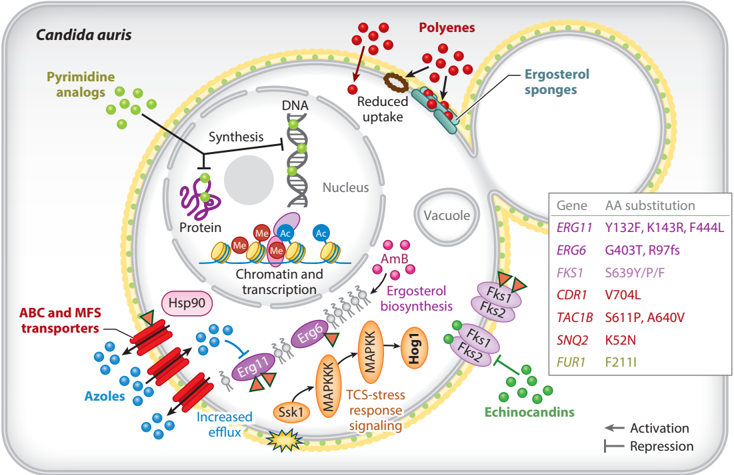
“For example, mutations in the ERG11 gene, such as Y132F and K143R, alter the structure of lanosterol 14-α -demethylase, reducing its affinity for azoles and contributing to antifungal resistance [67].”
Chang, C.-L., Moshi, M. A., Nguyen, Q., Oh, J., Nguyen, H., Paranjape, P. S., Abushanab, M., Tang, A. J., Itorralba, J. Y., Massic, L., et al. (2025) · medRxiv · doi:10.1101/2025.07.29.25332388 · Cited by 1
The Wor2 phenotypic switching regulator controls biofilm formation in Candida auris
Liang, W., Guan, S., Bing, J., Du, H., Zheng, Q., Tao, L., Li, B., Huang, G., & Chu, H. (2026) · npj Biofilms and Microbiomes · doi:10.1038/s41522-026-01043-2
Vitorio, E. O., Moita, M. D. D. C., Marinho, R. B., Branco, R. F. M. E., Vasconcelos, Y. A., Granato, R. R., Pereira, T. D. S., Sato, D. A., Zaffalon, J. R., Costa, P. M., et al. (2023) · doi:10.22533/at.ed.61723191012
Lima, Y. P., Bastos, L. Q. D. A., Bastos, V. Q. D. A., Bastos, R. V., Bastos, Y. S., Bastos, A. N., MACHADO, A. B. F., WATANABE, A. S. A., DINIZ, C. G., da Silva, V. L., et al. (2023) · Editora Pasteur eBooks · doi:10.59290/978-65-6029-048-8.22 · Cited by 2
Silva, V., Silva, C., Silva, C. C. P., Gacitúa, R., Salas, H., Guzmán, N. H., Claudio Alburquenque, O., & Silva-Abello, V. (2024) · Microorganisms · doi:10.3390/microorganisms12091907 · Cited by 1
“Most importantly, C. auris is the first fungal pathogen to show pronounced and sometimes untreatable clinical drug resistance to all known antifungal classes, including azoles, amphotericin B, and echinocandins [5,12].”
BackgroundResultInfluentialIsolate Specific Transcriptome Changes Exerted by Isavuconazole Treatment in Candida auris
Balla, N., Kovács, F., Tóth, Z., Harmath, A., Bozó, A., Majoros, L., Kovács, R., & Jakab, Á. (2024) · Mycopathologia · doi:10.1007/s11046-024-00919-1 · Cited by 2
Dan, M., Zhang, J., Bai, X., Nam, K. H., & Xu, Y. (2025) · Biochemical and Biophysical Research Communications · doi:10.1016/j.bbrc.2025.151573
Biotherapeutic potentials of diverse probiotics of the Himalayan region: A Review
Bahuguna, N., Anand, J., Venugopal, D., Khanduri, A., & Rai, N. (2025) · Environment Conservation Journal · doi:10.36953/ecj.30203155 · Cited by 1
“Most importantly, C. auris is the first known fungal infection to show a severe, sometimes incurable strain that is resistant to available antifungal medication (Chowdhary et al. , 2023).”
Medication Use in Infectious Diseases
Bilder, G. E., & Brown-O’Hara, P. (2025) · Springer eBooks · doi:10.1007/978-3-031-84831-5_6
Ahearn, D. G. (2025) · Microorganisms · doi:10.3390/microorganisms13092007
“(10) Could a hidden strain of C. auris have the potential for a grave co-infection with another yeast strain or virus among various elderly?”
Resistome and Resistance Mechanisms of Candidozyma Auris Clade IV: A Systematic Review
Bonilla-Caballero, M. A., Álvarez, G., & González, Á. F. (2025) · Current Tropical Medicine Reports · doi:10.1007/s40475-025-00353-3
“More than 90% of C. auris isolates are resistant to flucon - azole, although resistance levels vary considerably between clades [60].”
Biochanin A Suppresses Growth and Biofilm Formation of Fluconazole-Resistant Candida auris
Jin, H.-W., & Eom, Y. (2025) · Current Microbiology · doi:10.1007/s00284-025-04579-2 · Cited by 2
“Between 2018 and 2019, 349 cases of C. auris infections were noted in the European Union [8].”
The Rise of Candida auris: A Global Health Threat
Warrier, A. R., & Moses, S. S. (2025) · Infectious diseases · doi:10.5772/intechopen.1012838 · Cited by 1
Bir Üniversite Hastanesi Yoğun Bakım Ünitesinde Candida auris Vakası
Bırıncı, A., Çınar, C., Kuruoğlu, T., Temoçin, F., & Çaycı, Y. T. (2026) · Sağlık Bilimlerinde Değer · doi:10.33631/sabd.1634678
Wu, J., Wang, M., Domakonda, K., Schneider, R., Short, K., Offiong, C., Treangen, T. J., Ensor, K. B., Hopkins, L., & Stadler, L. B. (2026) · medRxiv · doi:10.64898/2026.01.30.26345237
Han, J. S., Lee, D., Yoo, I. Y., Park, Y.-J., Park, S. N., Park, K. H., & Seo, J.-H. (2026) · Journal of Korean Medical Science · doi:10.3346/jkms.2026.41.e71 · Cited by 1
Ouattara, N., Huguenin, A., Magid, A. A., Alanio, A., Yao-Kouassi, P. A., Villena, I., & Voutquenne‐Nazabadioko, L. (2026) · Pharmaceutics and Pharmacology · doi:10.1093/pp/rqag001
Górzyńska, A., Konarska, D., Korzeniowska‐Kowal, A., Wzorek, A., Pencakowski, B., & Nawrot, U. (2026) · Pathogens · doi:10.3390/pathogens15020235
“For instance, Candidozyma auris , a fungal pathogen that exhibits resistance to well-known antifungals, including azoles, amphotericin B and echinocandins, has become a globally emerging pathogen [4].”
Optimizing Infection Prevention in Low-Income and Middle-Income Countries
Mann, Y., Shallal, A. B., Zervos, M. J., & Maki, G. (2026) · Infectious Disease Clinics of North America · doi:10.1016/j.idc.2026.01.009
Molecular insights into Candida auris glycosylphosphatidylinositol transamidase
Ding, X., Hua, Z., Zhang, D., Li, J., Ke, Y., Qi, C., Yang, P. C., Hu, X., Liu, J., Zhang, M., et al. (2026) · Protein & Cell · doi:10.1093/procel/pwag023
Kemmerich, K. K., Alves, L. R., de Almeida, J. N., Colombo, A. L., & Alves, L. R. (2026) · Journal of Medical Microbiology · doi:10.1099/jmm.0.002135
Bastos, R. L. D. L., Barth, P. O., Barth, A. L., Mott, M. P., Bär, K. A., de Brum, G. F., & Vizzotto, B. S. (2026) · Journal of Hospital Infection · doi:10.1016/j.jhin.2026.03.021 · Cited by 1
Fonctions et biosynthèse des β-1,6-glucanes de la paroi cellulaire chez Candida albicans
Bekirian, C. (2024) · theses.fr (ABES) · doi:10.70675/b1028289z0c26z4acaz8f96z18e5c0c94464
Effect of pH on the secretome profile of the human pathogen Candidozyma aurisPreprint
Ramos‐Pardo, A., Quindós, G., Eraso, E., Sevillano, E., & Kaberdin, V. R. (2026) · bioRxiv (Cold Spring Harbor Laboratory) · doi:10.64898/2026.04.14.718400
“The high plasticity of the cell wall and secretome enables C. auris to adapt to different environments and host-pathogen interactions that occur in various anatomical sites differing in nutrient content and pH [45].”
Kopczyk, M. K., Mulroney, K. T., Weaire‐Buchanan, G., Paton, T. F., Salisbury, E., Ho, W. S., Gardam, D. J., Higgins, A., Carson, C. F., Inglis, T. J. J., et al. (2026) · Frontiers in Microbiology · doi:10.3389/fmicb.2026.1813126
“…in hospitals in Europe, the US, India, Pakistan and South Africa (Politi et al., 2024; Zhu et al., 2020; Ashraf et al., 2023; Farooqi et al., 2020; Shuping et al., 2023) with approximately 90% of isolates resistant to the most widely administered antifungal–fluconazole (Chowdhary et al., 2023).”
Gökmen, R., Erdoğan, A., & Cunetoglu, B. (2026) · Cureus · doi:10.7759/cureus.107778
“According to published global reports, C. auris infections have been identified in more than 40 countries worldwide since its first description in 2009 [21].”
Liu, L. L., Niu, T., Zhang, T., Tan, D., Duan, X., & Li, X. (2026) · Microbiological Research · doi:10.1016/j.micres.2026.128542
Cao, J., Wang, X., Qin, C., Gu, D., Zhang, R., Zhou, H., & Li, R. (2026) · Virulence · doi:10.1080/21505594.2026.2667550
“Notably, the 25 study isolates clustered into Clade I and III, consistent with the broader trend observed among Chinese isolates, which primarily belong to these two Clades [12,27].”
Zhang, S., Li, L., Niu, Z., Liu, M., Mao, J., Min, J., Xu, S., Li, R. Y., Zhang, H., Yin, J., et al. (2026) · Frontiers in Cellular and Infection Microbiology · doi:10.3389/fcimb.2026.1779223
“Recent studies have demonstrated that in immunocompromised hosts, infections caused by these two genera constitute the main component of IFD and contribute substantially to incidence and mortality (Giannella et al., 2025; Chowdhary et al., 2023), which is consistent with our results.”
Candidozyma auris utilizes transferrin, but not heme-bound iron for in vivo virulencePreprint
Arekar, T., Katikaneni, D. S., Acharya, T., Horst, K., Zhao, G., Garcia, G., Hernalsteen, S., Weber, C. K., Gour, A., Punshnon, T., et al. (2026) · bioRxiv (Cold Spring Harbor Laboratory) · doi:10.64898/2026.06.09.731159
Raeisi, S., Madhavan, P., & Adisuri, D. S. (2026) · Journal of Fungi · doi:10.3390/jof12060436 · Cited by 1
“Clade I is the most widely distributed lineage and has been most frequently associated with large-scale healthcare-associated outbreaks across multiple continents [7,21].”
InfluentialAmir, O. A., Ali, E., Ali, R. H., Elatafy, J., Amir, A. A., & AlHarkan, K. S. (2026) · Journal of Family and Community Medicine · doi:10.4103/jfcm.jfcm_76_26
“[30] Although medical devices such as catheters and prosthetic devices are intended to support patient care, they often serve as excellent vectors for C. auris spread in hospitals, owing to the fungus’ ability to form robust biofilm on these abiotic devices, and render its eradication exceptionally…”
Candida auris in Europe: Epidemiology and antifungal resistance. A systematic review
Rodríguez‐Cerdeira, C., Martínez-Herrera, E. O., Saunte, D. M. L., Vite-Garín, T., Fuentes‐Venado, C. E., Hay, R. J., Zárate-Segura, P. B., Szepietowski, J. C., Prohić, A., Arabatzis, M., et al. (2026) · Journal of the European Academy of Dermatology and Venereology · doi:10.1111/jdv.70600
Osama, D., Alsedawy, M., Hussein, M. S., Hassan, M. A., Elrefaey, S. M., & Tawfick, M. M. (2026) · Antonie van Leeuwenhoek · doi:10.1007/s10482-026-02393-9
“Moreover, the pathogen’s resistance to commonly used antifungal medications further complicates treatment strategies, presenting a considerable global challenge for public health authorities (Chowdhary et al. 2023).”
Barbosa, S. A., Pinheiro, D. R. S., de Oliveira, L. C., Moreira, L. E. A., Cabral, V. P. D. F., Rodrigues, D. S., de Souza, B. O., Júnior, H. V. N., Sá, L. G. D. A. V., Cavalcanti, B. C., et al. (2026) · Brazilian Journal of Microbiology · doi:10.1007/s42770-026-02038-z
“C. auris is of great clinical relevance due to the increase in cases and because it presents simultaneous resistance to the main classes of antifungals [7 ].”
Baicalein suppresses adhesion and biofilm formation in Candida auris
Li, C., Wu, H., Wang, Y., Wei, W., Wu, D., Feng, X., Wang, T., & Wang, C. (2026) · Microbiology Spectrum · doi:10.1128/spectrum.01097-26
Evaluation of the antifungal potential of N, N chelating iridium(III) complexes
Malta-Luís, C., Mariano, C. V., Arana, Á. J., Sanchez, L., Martins, M. D. F., Royo, B., Lenis-Rojas, O. A., & Pimentel, C. (2026) · JBIC Journal of Biological Inorganic Chemistry · doi:10.1007/s00775-026-02170-z
Xu, T., Wang, R., Gao, Y., & Yang, L. (2026) · Frontiers in Microbiology · doi:10.3389/fmicb.2026.1888683
“Mutant genes linked to antifungal resistance among Chinese C. auris isolates, as summarized in our analysis, matched those documented in international investigations (Chowdhary et al., 2023).”
Parallel evolution under constraint shapes echinocandin resistance in Candida aurisPreprint
Cauldron, N. C., Dort, E. N., Weeks, G., Rogers, P. D., & Cuomo, C. A. (2026) · bioRxiv (Cold Spring Harbor Laboratory) · doi:10.64898/2026.08.30.748140
Penezoğlu, D. N., Arga, G., İnceli, B. H., Akat, H., Havan, M., ÖCAL, D. N., Karahan, Z. C., Özdemir, H., Kendirli, T., & Çiftçi, E. (2026) · Mycopathologia · doi:10.1007/s11046-026-01106-0
Phan-Canh, T., Elbe‐Bürger, A., & Kuchler, K. (2026) · Trends in Microbiology · doi:10.1016/j.tim.2026.08.011
Wang, R., Liu, W., Peng, X., Gong, S., Song, Z., & Yu, H. (2026) · Microorganisms · doi:10.3390/microorganisms14092063
“Invasive fungal infections have become a significant global public health challenge, with Candidozyma auris (formerly Candida auris ) drawing particular attention due to its multidrug resistance, high mortality rate, and potential for nosocomial transmission [1–3].”
Silva, I. G., Inácio, C. P., da Silva, V. P., Veras, D. L., dos Santos, F. A. B., Alves, L. C., dos Santos, M. J., Alves, M. A. R., Lima, J. M., Buonafina, M. D. S., et al. (2026) · Microbial Pathogenesis · doi:10.1016/j.micpath.2026.108851
Emerging therapies for Candidozyma auris ( Candida auris) : current landscape and future directions
Zhang, L., Felix, L. O., & Mylonakis, E. E. (2026) · Expert Review of Anti-infective Therapy · doi:10.1080/14787210.2026.2740114
Candidozyma auris ( Candida auris ) as a harbinger of novel fungal pathogens
Schuh, C., & Gokhale, C. S. (2026) · mSphere · doi:10.1128/msphere.00109-26
Λιάρας, Κ., Roviello, G. N., Petrou, C. C., & Sarigiannis, Y. M. (2026) · Applied Biosciences · doi:10.3390/applbiosci5040091
“While Candida albicans remains the leading cause of candidiasis around the globe, Candidozyma auris (formerly Candida auris ) has recently emerged as a multidrug-resistant pathogen, raising scientific concerns regarding potential outbreaks [17,18].”
Tran, K., King, M. C., Undevia, N. S., Thotapalli, L., Lichota, H., Duffner, L. A., Peterson, A., Medernach, R. L., Cochran, R. L., Froilan, M. C., et al. (2026) · Infection Control and Hospital Epidemiology · doi:10.1017/ice.2026.10548
Kouroupis, D., Papathanasiou, A.-I., Bourtzinakos, K., Sentona, M., Kolaza, M., Vafeidou, K., Ftergioti, A., Gyltidou, S., Gekas, C., Zarras, C., et al. (2026) · Pathogens · doi:10.3390/pathogens15101057
“Because C . auris exhibits near-universal resistance to azoles (ranging from 94% to 96%, particularly within clades I and III) [33–35], echinocandins have become established as the first-line therapy associated with a distinct survival benefit [36].”
Lass‐Flörl, C., & Vahedi‐Shahandashti, R. (2026) · The Lancet Infectious Diseases · doi:10.1016/s1473-3099(26)00424-x
Kamau, E. T. (2026) · Journal of Clinical Microbiology · doi:10.1128/jcm.01106-26
Metadata
- Authors
- Chowdhary, A., Jain, K., & Chauhan, N.
- Affiliations
- University of Delhi (IN)
- Hackensack Meridian Health (US)
- Corresponding author
- Chowdhary, Anuradha
- Venue
- Annual Review of Microbiology
- Publisher
- Annual Reviews
- Published
- 2023-09-15
- Volume
- 77
- Issue
- 1
- Pages
- 583-602
- ISSN
- 0066-4227 (ISSN-L)
- 1545-3251
- OpenAlex
- W4383215700
- Semantic Scholar
- 7f6b4a73f0280aae35abb956d430132029d8576e
- Cited by
- 158
- References
- 123
- Citations by year
- 2026: 53 · 2025: 55 · 2024: 41 · 2023: 9
- FWCI
- 7.49
- Type
- journal article
- Language
- en
- Open access
- hybrid
- doi.org
- Locations
- Annual Review of Microbiology (publishedVersion, cc-by)
- PubMed Central (publishedVersion)
- PubMed (publishedVersion)
- Greater South Information System
- Funders
- Canadian Institute for Advanced Research
- Hackensack Meridian Health
- Council of Scientific and Industrial Research, India (2019-EMR-I)
- National Institutes of Health (1r01ai182977-01a1)
- National Institute of Allergy and Infectious Diseases (R21AI174118, R01 AI182977)
- Topics
- Health Sciences › Medicine › Infectious Diseases › Antifungal resistance and susceptibility
- Life Sciences › Immunology and Microbiology › Microbiology › Yeasts and Rust Fungi Studies
- Life Sciences › Biochemistry, Genetics and Molecular Biology › Molecular Biology › Fungal and yeast genetics research
- Keywords
- Candida auris, multidrug resistance, antifungal resistance, fungal genomics, drug resistance mechanisms, hospital outbreak, nursing homes, azoles, amphotericin B, echinocandins
- MeSH terms
- Candida auris, Aged, Amphotericin B, Antifungal Agents, Candida, Humans, Echinocandins, Candidiasis, Invasive
About these checks
Registry, retraction, Cites and statistics results are computed, not judged, with one exception: a printed reference that no index lists is read once by a model before it counts as a citation error. Claims are extracted by a model and kept only when their quote appears verbatim in the text; each cited source is then checked, with a model’s help, for whether it says what the claim relies on. Those verdicts can be wrong — read the claim’s quote and the cited source before relying on one.
Statistics and arithmetic are recomputed, not judged.
Confidence bands are shown only for fields calibrated on our annotated test set. None is calibrated yet, so no band is shown.
What counts as a claim ›How we measure confidence ›How we check this ›
Are you an author, or do you see a problem with this page? Request a review
Data sources
Bibliographic data: Semantic Scholar, OpenAlex, Crossref.
Contains information from the Semantic Scholar Academic Graph Datasets, made available under the ODC Attribution License (ODC-BY 1.0).
Semantic Scholar’s data is described in: Kinney, R., et al. (2023). The Semantic Scholar Open Data Platform. arXiv:2301.10140.
