

Candida auris: Epidemiology, biology, antifungal resistance, and virulence
Open accessThe DOI matches its Crossref record; 86 of the 86 references it cites were found in a registry or an index.
Abstract
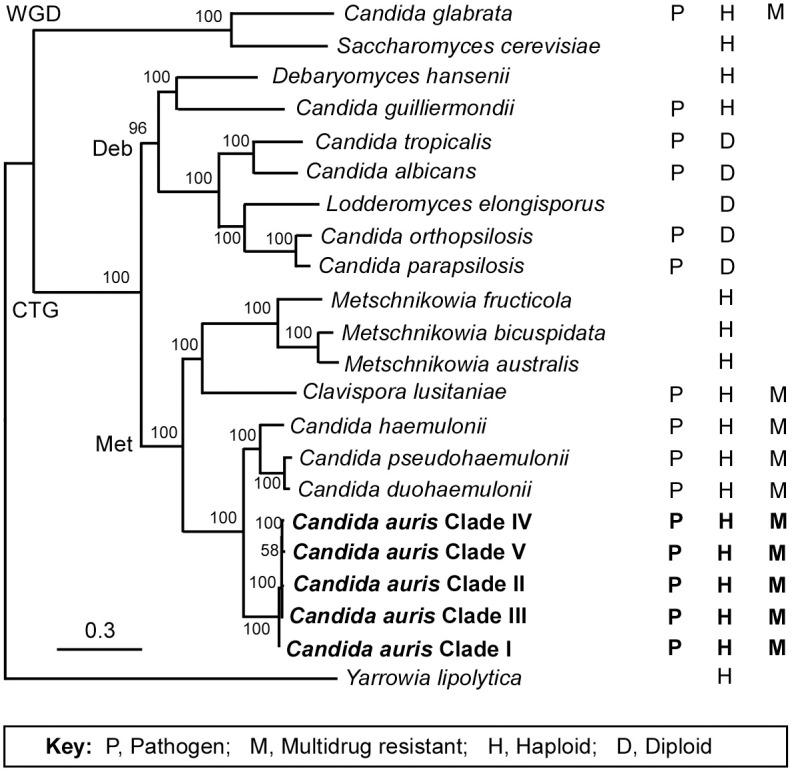
First described in 2009 in Japan, the emerging multidrug-resistant fungal pathogen Candida auris is becoming a worldwide public health threat that has been attracting considerable attention due to its rapid and widespread emergence over the past decade. The reasons behind the recent emergence of this fungus remain a mystery to date. Genetic analyses indicate that this fungal pathogen emerged simultaneously in several different continents, where 5 genetically distinct clades of C. auris were isolated from distinct geographical locations. Although C. auris belongs to the CTG clade (its constituent species translate the CTG codon as serine instead of leucine, as in the standard code), C. auris is a haploid fungal species that is more closely related to the haploid and often multidrug-resistant species Candida haemulonii and Candida lusitaniae and is distantly related to the diploid and clinically common fungal pathogens Candida albicans and Candida tropicalis. Infections and outbreaks caused by C. auris in hospitals settings have been rising over the past several years. Difficulty in its identification, multidrug resistance properties, evolution of virulence factors, associated high mortality rates in patients, and long-term survival on surfaces in the environment make C. auris particularly problematic in clinical settings. Here, we review progress made over the past decade on the biological and clinical aspects of C. auris. Future efforts should be directed toward understanding the mechanistic details of its biology, epidemiology, antifungal resistance, and pathogenesis with a goal of developing novel tools and methods for the prevention, diagnosis, and treatment of C. auris infections.
Overview
The claims and statistics of this paper haven’t been checked yet.
Free: it reads the open-access text and checks the first 5 claims that cite a source we can check. Create a free account to check every claim.
Integrity signals
Registry
Cites
Statistics
Figures
Verification
Claims the paper makes
The claims and statistics of this paper haven’t been checked yet.
Free: it reads the open-access text and checks the first 5 claims that cite a source we can check. Create a free account to check every claim.
Claims other papers make about this one
Each is checked against this paper’s own text: does it say what the citing paper says it does?
The source backs part of the claim, not all of it — or backs it for a different population, condition or comparison.
In the citing paper
“While resistance to FCZ or AmB is frequently observed among clade I isolates, the frequency of ECN resistance remains low at the moment (11, 12, 35).”
From Transcriptomics and Phenotyping Define Genetic Signatures Associated with Echinocandin Resistance in Candida auris (2022) · cites this paper as [35]
Experimental — accuracy not yet measuredThe source backs part of the claim, not all of it — or backs it for a different population, condition or comparison.
In the citing paper
“Since biofilms are often associated with increased persistence on the environmental surfaces and colonization on host skin4,5,11,49, this mutation could contribute to the prevalence and rapid transmission of C. auris.”
From The Wor2 phenotypic switching regulator controls biofilm formation in Candida auris (2026) · cites this paper as [4]
Experimental — accuracy not yet measuredThe cited source says what the claim attributes to it.
In the citing paper
“While resistance to FCZ or AmB is frequently observed among clade I isolates, the frequency of ECN resistance remains low at the moment (11, 12, 35).”
From Transcriptomics and Phenotyping Define Genetic Signatures Associated with Echinocandin Resistance in Candida auris (2022) · cites this paper as [35]
The cited source says what the claim attributes to it.
In the citing paper
“Clinical isolates of C. auris can exhibit different morphotypes such as filamentous, pseudohyphal, and yeast forms (8–14).”
From Yeast and filamentous Candida auris stimulate distinct immune responses in the skin (2024) · cites this paper as [11]
The cited source says what the claim attributes to it.
In the citing paper
“Clinical isolates of C. auris can exhibit different morphotypes, such as yeast, filamentous, and aggregative forms (9–13).”
From Cell aggregation mediated by ACE2 deletion in Candida auris modulates fungal colonization and host immune responses in the skin (2024) · cites this paper as [12]
1 more claim about this paper
Create a free account to see every claim other papers make about this one.
Self-check
Percentages, sums and reported differences re-computed from the paper’s own numbers.
The self-check needs the paper’s full text.
Citations
Cites
Bacterial biofilms: from the Natural environment to infectious diseases
Hall-Stoodley, L., Costerton, J. W., & Stoodley, P. (2004) · Nature Reviews Microbiology · doi:10.1038/nrmicro821 · Cited by 7,143
Wisplinghoff, H., Bischoff, T., Tallent, S. M., Seifert, H., Wenzel, R. P., & Edmond, M. B. (2004) · Clinical Infectious Diseases · doi:10.1086/421946 · Cited by 4,496 · cited 1×
“Candida species are the predominant cause of nosocomial fungal infections and are the fourth leading cause of all hospital-acquired infections [2].”
BackgroundHidden Killers: Human Fungal Infections
Brown, G. D., Denning, D. W., Gow, N. A. R., Levitz, S. M., Netea, M. G., & White, T. C. (2012) · Science Translational Medicine · doi:10.1126/scitranslmed.3004404 · Cited by 4,284
Epidemiology of Invasive Candidiasis: a Persistent Public Health Problem
Pfaller, M. A., & Diekema, D. J. (2007) · Clinical Microbiology Reviews · doi:10.1128/cmr.00029-06 · Cited by 4,174 · cited 1×
“Candida species is Candida albicans; however, the incidence of non-albicans species, such as Candida tropicalis, Candida parapsilosis, and Candida glabrata, has increased over recent decades due to the long-term use and limited options of antifungal drugs [3,4].”
BackgroundEmerging fungal threats to animal, plant and ecosystem health
Fisher, M. C., Henk, D. A., Briggs, C. J., Brownstein, J. S., Madoff, L. C., McCraw, S. L., & Gurr, S. J. (2012) · Nature · doi:10.1038/nature10947 · Cited by 3,310 · cited 1×
“It seems likely that novel fungal pathogens will similarly emerge in the future due to changes in global temperatures, atmospheric CO2 levels, humidity, and other alterations to natural environmental niches [84].”
BackgroundLockhart, S. R., Etienne, K. A., Vallabhaneni, S., Farooqi, J., Chowdhary, A., Govender, N. P., Colombo, A. L., Calvo, B., Cuomo, C. A., Desjardins, C. A., et al. (2017) · Clinical Infectious Diseases · doi:10.1093/cid/ciw691 · Cited by 1,662 · cited 14×
“The genome of C. auris B8441 was sequenced by the CDC [10], and its sequence information and annotation is available on the Candida Genome Database (CGD) database (https://www.candidagenome.org).”
BackgroundMethodInfluentialSatoh, K., Makimura, K., Hasumi, Y., Nishiyama, Y., Uchida, K., & Yamaguchi, H. (2009) · Microbiology and Immunology · doi:10.1111/j.1348-0421.2008.00083.x · Cited by 1,381 · cited 3×
“auris belongs to the Metschnikowiaceae family within the Candida/Clavispora clade (Fig 3) [5,13,14].”
BackgroundThe Fungi: 1, 2, 3 … 5.1 million species?
Blackwell, M. (2011) · American Journal of Botany · doi:10.3732/ajb.1000298 · Cited by 1,324
Candida albicans Biofilms and Human Disease
Nobile, C. J., & Johnson, A. D. (2015) · Annual Review of Microbiology · doi:10.1146/annurev-micro-091014-104330 · Cited by 1,057 · cited 1×
“Biofilms are structured microbial communities that form on abiotic and biotic surfaces and are embedded in an extracellular matrix [64].”
BackgroundSelf-citationFirst hospital outbreak of the globally emerging Candida auris in a European hospital
Schelenz, S., Hagen, F., Rhodes, J. L., Abdolrasouli, A., Chowdhary, A., Hall, A., Ryan, L., Shackleton, J., Trimlett, R., Meis, J. F., et al. (2016) · Antimicrobial Resistance & Infection Control · doi:10.1186/s13756-016-0132-5 · Cited by 768
Cited by
Infectious disease in an era of global change
Baker, R. E., Mahmud, A. S., Miller, I. F., Rajeev, M., Rasambainarivo, F., Rice, B. L., Takahashi, S., Tatem, A. J., Wagner, C. E., Wang, L.-F., et al. (2022) · Nature Reviews Microbiology · doi:10.1038/s41579-021-00639-z · Cited by 2,059
Lass-Flörl, C., Kanj, S. S., Govender, N. P., Thompson, G. R., Ostrosky- Zeichner, L., & Govrins, M. A. (2024) · Nature Reviews Disease Primers · doi:10.1038/s41572-024-00503-3 · Cited by 298
Ahmad, S., & Alfouzan, W. (2021) · Microorganisms · doi:10.3390/microorganisms9040807 · Cited by 269
“However, tentative breakpoints have been suggested by the Centers for Disease Control and prevention (CDC) based on expert opinion and those established for other closely related Candida species [62,72,73,89,155,156].”
BackgroundInfluentialInvasive candidiasis: current clinical challenges and unmet needs in adult populations
Soriano, A., Honore, P. M., Puerta-Alcalde, P., Garcia-Vidal, C., Pagotto, A., Gonçalves-Bradley, D. C., & Verweij, P. E. (2023) · Journal of Antimicrobial Chemotherapy · doi:10.1093/jac/dkad139 · Cited by 190
Diagnosis and Treatment of Invasive Candidiasis
Barantsevich, N., & Barantsevich, E. (2022) · Antibiotics · doi:10.3390/antibiotics11060718 · Cited by 178
Metadata
- Authors
- Du, H., Bing, J., Hu, T., Ennis, C. L., Nobile, C. J., & Huang, G.
- Affiliations
- Fudan University (CN)
- University of California, Merced (US)
- Corresponding author
- Huang, Guanghua
- Venue
- PLOS Pathogens
- Publisher
- Public Library of Science (PLoS)
- Published
- 2020-10-22
- Volume
- 16
- Issue
- 10
- Pages
- e1008921
- ISSN
- 1553-7366 (ISSN-L)
- 1553-7374
- PMC
- PMC7581363
- OpenAlex
- W3093683101
- Cited by
- 609
- References
- 86
- Citations by year
- 2026: 76 · 2025: 105 · 2024: 110 · 2023: 139 · 2022: 126 · 2021: 53
- FWCI
- 3.77
- Type
- journal article
- Language
- en
- Open access
- gold
- doi.org
- Licence
- Locations
- PLoS Pathogens (publishedVersion, cc-by)
- PubMed Central (publishedVersion, cc-by)
- PubMed (publishedVersion)
- eScholarship (California Digital Library) (submittedVersion, cc-by)
- DOAJ (DOAJ: Directory of Open Access Journals) (submittedVersion, cc-by-sa)
- eScholarship (California Digital Library) (submittedVersion)
- Funders
- Natural Science Foundation of Shanghai (19ZR1405100)
- National Natural Science Foundation of China (31625002, 31930005)
- National Institutes of Health
- National Institute of General Medical Sciences (R35GM124594)
- National Institute of Allergy and Infectious Diseases (R21AI125801)
- National Institute of Dental and Craniofacial Research (F31DE028488)
- Topics
- Health Sciences › Medicine › Infectious Diseases › Antifungal resistance and susceptibility
- Life Sciences › Immunology and Microbiology › Microbiology › Yeasts and Rust Fungi Studies
- Health Sciences › Medicine › Infectious Diseases › Fungal Infections and Studies
- Keywords
- Candida auris, multidrug resistance, antifungal resistance, virulence factors, fungal pathogenesis, Candida haemulonii, Candida lusitaniae, Candida albicans, Candida tropicalis, hospital outbreak, fungal epidemiology, environmental survival, fungal identification, emerging fungal pathogens
- MeSH terms
- Antifungal Agents, Candida, Candidiasis, Saccharomycetales, Humans, Virulence, Drug Resistance, Fungal
About these checks
Registry, retraction, Cites and statistics results are computed, not judged, with one exception: a printed reference that no index lists is read once by a model before it counts as a citation error. Claims are extracted by a model and kept only when their quote appears verbatim in the text; each cited source is then checked, with a model’s help, for whether it says what the claim relies on. Those verdicts can be wrong — read the claim’s quote and the cited source before relying on one.
Statistics and arithmetic are recomputed, not judged.
Confidence bands are shown only for fields calibrated on our annotated test set. None is calibrated yet, so no band is shown.
What counts as a claim ›How we measure confidence ›How we check this ›
Are you an author, or do you see a problem with this page? Request a review
How to cite
Cite CoChat for the checks on this page, and the paper for its own findings.
- This page
- CoChat. (2026). Citation check: Candida auris: Epidemiology, biology, antifungal resistance, and virulence. https://app.cochat.ai/papers/10.1371/journal.ppat.1008921
- The paper
- Du, H., Bing, J., Hu, T., Ennis, C. L., Nobile, C. J., & Huang, G. (2020). Candida auris: Epidemiology, biology, antifungal resistance, and virulence. PLOS Pathogens. https://doi.org/10.1371/journal.ppat.1008921
Data sources
Bibliographic data: Semantic Scholar, OpenAlex, Crossref.
Contains information from the Semantic Scholar Academic Graph Datasets, made available under the ODC Attribution License (ODC-BY 1.0).
Semantic Scholar’s data is described in: Kinney, R., et al. (2023). The Semantic Scholar Open Data Platform. arXiv:2301.10140.
