

Interleukin-10: A Key Cytokine in Depression?
Open accessThe DOI matches its Crossref record; 51 of the 51 references it cites were found in a registry or an index.
Abstract
An increasing body of evidence implicates proinflammatory cytokines in psychiatric disorders, namely, in depression. Of notice, recent studies showed that anti-inflammatory cytokines, such as IL-10, also modulate depressive-like behavior. In this article, we propose that the anti-inflammatory cytokine IL-10 is a putative link between two of the most widely reported phenomenon observed in depressed patients: the disruption of the hypothalamic-pituitary-adrenal axis and the imbalanced production of cytokines. If so, IL-10 might represent a novel target for antidepressant therapy.
Overview
The claims and statistics of this paper haven’t been checked yet.
Free: it reads the open-access text and checks the first 5 claims that cite a source we can check. Create a free account to check every claim.
Integrity signals
Registry
Cites
Statistics
Figures
Verification
Claims the paper makes
The claims and statistics of this paper haven’t been checked yet.
Free: it reads the open-access text and checks the first 5 claims that cite a source we can check. Create a free account to check every claim.
Claims other papers make about this one
Each is checked against this paper’s own text: does it say what the citing paper says it does?
The cited source says what the claim attributes to it.
In the citing paper
“IL-10 knockout mice showed learned helplessness in animal depression models, a symptom that could be reverted by application of IL-10, whereas IL-10 administration led to increased motor activity in wild-type mice.”
From Selected biomarkers of depression: what are the effects of cytokines and inflammation (2022) · cites this paper as [109]
In the citing paper
“Yet the literature also yields studies that report increased IL-10 levels in MDD.”
From Selected biomarkers of depression: what are the effects of cytokines and inflammation (2022) · cites this paper as [109]
In the citing paper
“Decreased levels of IL-10 were described in humans with symptoms of depression, anxiety, and increased suicide risk in a population study, as well as in stroke patients who developed the depressive disorder.”
From Selected biomarkers of depression: what are the effects of cytokines and inflammation (2022) · cites this paper as [109]
Self-check
Percentages, sums and reported differences re-computed from the paper’s own numbers.
The self-check needs the paper’s full text.
Citations
Cites
From inflammation to sickness and depression: when the immune system subjugates the brain
Dantzer, R., O'Connor, J. C., Freund, G. G., Johnson, R. W., & Kelley, K. W. (2008) · Nature Reviews Neuroscience · doi:10.1038/nrn2297 · Cited by 7,395 · cited 1×
“Research using these models demonstrated that alteration in the proinflammatory cytokine milieu can lead to behavioral changes overlapping with those found in depressed patients, including anhedonia, decreased activity, cognitive dysfunction, and altered sleep patterns [12].”
BackgroundInterleukin-10 and the Interleukin-10 Receptor
Moore, K. W., de Waal Malefyt, R., Coffman, R. L., & O'Garra, A. (2001) · Annual Review of Immunology · doi:10.1146/annurev.immunol.19.1.683 · Cited by 6,737
Depression, chronic diseases, and decrements in health: results from the World Health Surveys
Moussavi, S., Chatterji, S., Verdes, E., Tandon, A., Patel, V., & Ustun, B. (2007) · The Lancet · doi:10.1016/s0140-6736(07)61415-9 · Cited by 4,070 · cited 1×
“Major depression is a global public-health problem and a leading cause of disability worldwide, representing the fourth contributor to the global burden of disease in 2000 (in terms of DALYs-Disability Adjusted Life Years) [3].”
BackgroundDepression and Pain Comorbidity: A Literature Review
Bair, M. J., Robinson, R. L., Katon, W., & Kroenke, K. (2003) · Archives of Internal Medicine · doi:10.1001/archinte.163.20.2433 · Cited by 3,463 · cited 1×
“Another feature commonly associated with depression is altered pain perception [20].”
BackgroundCytokines sing the blues: inflammation and the pathogenesis of depression
Raison, C. L., Capuron, L., & Miller, A. H. (2006) · Trends in Immunology · doi:10.1016/j.it.2005.11.006 · Cited by 3,009 · cited 1×
“It is possible that IL-10, like other cytokines, acts directly in the brain through regions devoided of blood-brain barrier, such as the circumventricular organs and the choroid plexus, or by activating vagal afferent fibers that can transmit cytokine signals to specific brain nuclei [5].”
BackgroundBelmaker, R. H., & Agam, G. (2008) · New England Journal of Medicine · doi:10.1056/nejmra073096 · Cited by 2,166
Regulation of the Hypothalamic-Pituitary-Adrenal Axis by Cytokines: Actions and Mechanisms of Action
TURNBULL, A. V., & RIVIER, C. L. (1999) · Physiological Reviews · doi:10.1152/physrev.1999.79.1.1 · Cited by 1,297 · cited 1×
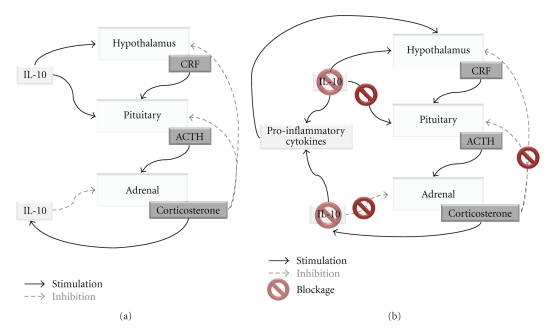
“Paradoxically, in the hypothalamus and pituitary, IL-10 seems to have the same effect already described for some proinflammatory cytokines [45], which is a positive regulation of corticotrophin releasing factor (CRF) and ACTH production, respectively [43, 46].”
BackgroundRaison, C. L., & Miller, A. H. (2003) · American Journal of Psychiatry · doi:10.1176/appi.ajp.160.9.1554 · Cited by 1,197
Barrat, F. J., Cua, D. J., Boonstra, A., Richards, D. F., Crain, C., Savelkoul, H. F., de Waal-Malefyt, R., Coffman, R. L., Hawrylowicz, C. M., & O'Garra, A. (2002) · The Journal of Experimental Medicine · doi:10.1084/jem.20011629 · Cited by 1,161
Paroxetine for the prevention of depression induced by high-dose interferon alfa.
Musselman, D. L., Lawson, D. H., Gumnick, J. F., Manatunga, A. K., Penna, S., Goodkin, R. S., Greiner, K., Nemeroff, C. B., & Miller, A. H. (2001) · New England Journal of Medicine · doi:10.1056/nejm200103293441303 · Cited by 1,120
Cited by
Selected biomarkers of depression: what are the effects of cytokines and inflammation
Harsanyi, S., Kupcova, I., Danisovic, L., & Klein, M. (2022) · International Journal of Molecular Sciences · doi:10.3390/ijms24010578 · Cited by 299
Hiles, S. A., Baker, A. L., de Malmanche, T., & Attia, J. (2012) · Brain, Behavior, and Immunity · doi:10.1016/j.bbi.2012.06.001 · Cited by 274
“IL-10 is also elevated in response to acute immune challenge (Henry et al., 2009) and may be implicated in depression (Mesquita et al., 2008; Roque et al., 2009).”
BackgroundVoorhees, J. L., Tarr, A. J., Wohleb, E. S., Godbout, J. P., Mo, X., Sheridan, J. F., Eubank, T. D., & Marsh, C. B. (2013) · PLoS ONE · doi:10.1371/journal.pone.0058488 · Cited by 236
Ohgi, Y., Futamura, T., Kikuchi, T., & Hashimoto, K. (2013) · Pharmacology Biochemistry and Behavior · doi:10.1016/j.pbb.2012.12.003 · Cited by 207
“IL-10 is a key regulator of depression symptoms (Roque et al., 2009).”
Martin-Subero, M., Anderson, G., Kanchanatawan, B., Berk, M., & Maes, M. (2016) · CNS Spectrums · doi:10.1017/s1092852915000449 · Cited by 196
Metadata
- Authors
- Roque, S., Correia-Neves, M., Mesquita, A. R., Palha, J. A., & Sousa, N.
- Affiliations
- University of Minho (PT)
- Life and Health Sciences Research Institute, School of Health Sciences, University of Minho, Campus Gualtar, 4710-057 Braga, Portugal
- Corresponding author
- Sousa, Nuno
- Venue
- Cardiovascular Psychiatry and Neurology
- Publisher
- Wiley
- Published
- 2009-08-16
- Volume
- 2009
- Pages
- 1-5
- ISSN
- 2090-0163 (ISSN-L)
- 2090-0171
- PMC
- PMC2775686
- OpenAlex
- W2074604677
- Cited by
- 89
- References
- 51
- Citations by year
- 2026: 3 · 2025: 2 · 2024: 8 · 2023: 9 · 2022: 6 · 2021: 9 · 2020: 6 · 2019: 4 · 2018: 3 · 2017: 7 · 2016: 6 · 2015: 6 · 2014: 4 · 2013: 8 · 2012: 3
- FWCI
- 0.87
- Type
- journal article
- Language
- en
- Open access
- hybrid
- doi.org
- Locations
- Cardiovascular Psychiatry and Neurology (publishedVersion, cc-by)
- PubMed Central (publishedVersion, cc-by)
- PubMed (publishedVersion)
- Portuguese National Funding Agency for Science, Research and Technology (RCAAP Project by FCT) (submittedVersion, other-oa)
- Portuguese National Funding Agency for Science, Research and Technology (RCAAP Project by FCT) (submittedVersion, cc-by-nc-nd)
- Funders
- Fundação para a Ciência e a Tecnologia (SFRH/BD/24539/2005, PTDC/SAU-NEU/72699/2006)
- Topics
- Life Sciences › Neuroscience › Biological Psychiatry › Tryptophan and brain disorders
- Life Sciences › Neuroscience › Behavioral Neuroscience › Stress Responses and Cortisol
- Health Sciences › Medicine › Pharmacology (medical) › Treatment of Major Depression
- Keywords
- IL-10, depression, anti-inflammatory cytokines, inflammatory cytokines, hypothalamic-pituitary-adrenal axis, cytokine imbalance, depression-like behavior, antidepressant targets
About these checks
Registry, retraction, Cites and statistics results are computed, not judged, with one exception: a printed reference that no index lists is read once by a model before it counts as a citation error. Claims are extracted by a model and kept only when their quote appears verbatim in the text; each cited source is then checked, with a model’s help, for whether it says what the claim relies on. Those verdicts can be wrong — read the claim’s quote and the cited source before relying on one.
Statistics and arithmetic are recomputed, not judged.
Confidence bands are shown only for fields calibrated on our annotated test set. None is calibrated yet, so no band is shown.
What counts as a claim ›How we measure confidence ›How we check this ›
Are you an author, or do you see a problem with this page? Request a review
Data sources
Bibliographic data: Semantic Scholar, OpenAlex, Crossref.
Contains information from the Semantic Scholar Academic Graph Datasets, made available under the ODC Attribution License (ODC-BY 1.0).
Semantic Scholar’s data is described in: Kinney, R., et al. (2023). The Semantic Scholar Open Data Platform. arXiv:2301.10140.
