

TSH and Thyrotropic Agonists: Key Actors in Thyroid Homeostasis
Open accessThe DOI matches its Crossref record; 434 of the 434 references it cites were found in a registry or an index.
Abstract
This paper provides the reader with an overview of our current knowledge of hypothalamic-pituitary-thyroid feedback from a cybernetic standpoint. Over the past decades we have gained a plethora of information from biochemical, clinical, and epidemiological investigation, especially on the role of TSH and other thyrotropic agonists as critical components of this complex relationship. Integrating these data into a systems perspective delivers new insights into static and dynamic behaviour of thyroid homeostasis. Explicit usage of this information with mathematical methods promises to deliver a better understanding of thyrotropic feedback control and new options for personalised diagnosis of thyroid dysfunction and targeted therapy, also by permitting a new perspective on the conundrum of the TSH reference range.
Overview
The claims and statistics of this paper haven’t been checked yet.
Free: it reads the open-access text and checks the first 5 claims that cite a source we can check. Create a free account to check every claim.
Integrity signals
Registry
Cites
Statistics
Figures
Verification
Claims the paper makes
The claims and statistics of this paper haven’t been checked yet.
Free: it reads the open-access text and checks the first 5 claims that cite a source we can check. Create a free account to check every claim.
Claims other papers make about this one
Each is checked against this paper’s own text: does it say what the citing paper says it does?
The source backs part of the claim, not all of it — or backs it for a different population, condition or comparison.
In the citing paper
“the true nature of TSH referencing is bivariate in relation to an appropriate individual TSH level when combined with a certain FT4 level (101, 186–189).”
From Homeostatic control of the thyroid-pituitary axis: perspectives for diagnosis and treatment (2015) · cites this paper as [101]
Experimental — accuracy not yet measuredThe source backs part of the claim, not all of it — or backs it for a different population, condition or comparison.
In the citing paper
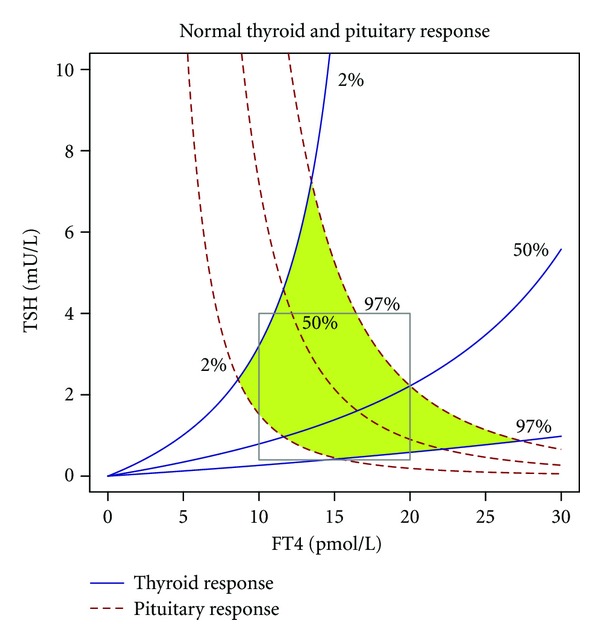
“It is important to appreciate that the homeostatic relationship of TSH and FT4 defines the reference range of TSH in a “kite-shaped” graphical configuration, as opposed to the rectangular area obtained by plotting the two univariate parameters (101).”
From Homeostatic control of the thyroid-pituitary axis: perspectives for diagnosis and treatment (2015) · cites this paper as [101]
Experimental — accuracy not yet measuredThe source backs part of the claim, not all of it — or backs it for a different population, condition or comparison.
In the citing paper
“However, the simple ratios are conceptually incompatible with known kinetic properties of enzyme-mediated processes, as they wrongly assume linear relationships (6).”
From Calculated Parameters of Thyroid Homeostasis: Emerging Tools for Differential Diagnosis and Clinical Research (2016) · cites this paper as [6]
Experimental — accuracy not yet measuredThe source backs part of the claim, not all of it — or backs it for a different population, condition or comparison.
In the citing paper
“A small trial with 20 healthy volunteers revealed the re-test reliability of SPINA-GT to be higher than that of every other parameter (6, 32).”
From Calculated Parameters of Thyroid Homeostasis: Emerging Tools for Differential Diagnosis and Clinical Research (2016) · cites this paper as [6]
Experimental — accuracy not yet measuredThe cited source says what the claim attributes to it.
In the citing paper
“Unfortunately, however, the location of the set point is unknown and inaccessible in the situation of hypothyroidism (6, 19).”
From Calculated Parameters of Thyroid Homeostasis: Emerging Tools for Differential Diagnosis and Clinical Research (2016) · cites this paper as [6]
2 more claims about this paper
Create a free account to see every claim other papers make about this one.
Self-check
Percentages, sums and reported differences re-computed from the paper’s own numbers.
The self-check needs the paper’s full text.
Citations
Cites
Items 401–434 of 434
Regulation of the human trh (htrh) gene by human thyroid hormone receptor β1 (hTRβ1) mutants
Li, Q., Feng, P., Satoh, T., Shi, Z. X., Wang, R., Weintraub, B. D., & Wilber, J. F. (1997) · Endocrine Research · doi:10.1080/07435809709031859 · Cited by 9
Hypothalamic and rate feedback in the thyroid hormone regulation system: An hypothesis
DiStefano, J. J. (1969) · Bulletin of Mathematical Biology · doi:10.1007/bf02477003 · Cited by 9
The role of thyroid hormone therapy in acutely ill cardiac patients.
Wyne, K. L. (2005) · Critical Care · doi:10.1186/cc3738 · Cited by 9
Gelwane, G., de Roux, N., Chevenne, D., Carel, J., & Léger, J. (2009) · The Journal of Clinical Endocrinology & Metabolism · doi:10.1210/jc.2008-2524 · Cited by 8
Conversion of TSH Heterodimer to a Single Polypeptide Chain Increases Bioactivity and Longevity
Azzam, N., Bar‐Shalom, R., & Fares, F. (2012) · Endocrinology · doi:10.1210/en.2011-1856 · Cited by 8
Ikekubo, K., Hino, M., Saiki, Y., Son, C., Iwakura, T., Kobayashi, H., & Ishihara, T. (2005) · Endocrine Journal · doi:10.1507/endocrj.52.61 · Cited by 8
Free thyroxine assays: no going back!
Midgley, J. E. M., & Christofides, N. D. (2009) · American Journal of Obstetrics and Gynecology · doi:10.1016/j.ajog.2009.08.033 · Cited by 8
Bauman, T. R., Anderson, R. R., & Turner, C. W. (1969) · Journal of Dairy Science · doi:10.3168/jds.s0022-0302(69)86537-9 · Cited by 8
Díaz-Londoño, G., & Lallena, A. M. (2011) · Radiation Protection Dosimetry · doi:10.1093/rpd/ncr372 · Cited by 8
Pituitary gland: one site of ultrashort-feedback regulation for control of thyrotropin
KAKITA, T., & Odell, W. D. (1986) · American Journal of Physiology-Endocrinology and Metabolism · doi:10.1152/ajpendo.1986.250.2.e121 · Cited by 7
Thyroid Hormone Binding Inhibition in Critically ill Patients – Who is the Inhibitor?
Schifferdecker, E., Hering, S., Böhm, B. O., Förster, H., Althoff, P.-H., Schulz, F., & Schöffling, K. (2009) · Experimental and Clinical Endocrinology & Diabetes · doi:10.1055/s-0029-1210963 · Cited by 7
Computer simulation for hormones related to primary thyropathy
Hatakeyama, T., & Yagi, H. (1985) · Biological Cybernetics · doi:10.1007/bf00336982 · Cited by 7
Estimation of Dose Absorbed Fraction for 131I-beta rays in Rat Thyroid.
Endo, S., Nitta, Y., Ohtaki, M., Takada, J., STEPANENKO, V., Komatsu, K., Tauchi, H., MATSUURA, S., Яськова, Е. К., & Hoshi, M. (1998) · Journal of Radiation Research · doi:10.1269/jrr.39.223 · Cited by 7
Computer Simulation of Iodine Metabolism by Mammals
Blincoe, C. (1975) · Journal of Animal Science · doi:10.2527/jas1975.402342x · Cited by 7
Kramer, G. H., Chamberlain, M. J., & Yiu, S. (1997) · Physics in Medicine and Biology · doi:10.1088/0031-9155/42/11/012 · Cited by 6
Dangerous Dogmas in Medicine: The Nonthyroidal Illness Syndrome—Author’s Response
DeGroot, L. J. (1999) · The Journal of Clinical Endocrinology & Metabolism · doi:10.1210/jcem.84.6.5809-8 · Cited by 6
Tagami, T., Nakamura, H., Shigekazu, S., Miyoshi, Y., & Nakao, K. (1996) · Metabolism · doi:10.1016/s0026-0495(96)90265-6 · Cited by 6
Hyperthyroidism as a clinical manifestation of a embryonal carcinoma of the testis.
Arrabal‐Polo, M. Á., Jiménez-Pacheco, A., Arrabal-Martı́n, M., Moreno-Jiménez, J., Gutiérrez-Tejero, F., Galisteo, R., & Zuluaga‐Gómez, A. (2012) · PubMed · doi:10.2143/acb.67.3.2062658 · Cited by 5
MBL serum levels in patients with sepsis correlate with thyroid function but not with outcome
Koenig, K., Potluková, E., Müeller, B., Christ‐Crain, M., & Trendelenburg, M. (2012) · Clinical Immunology · doi:10.1016/j.clim.2012.05.002 · Cited by 5
Monte-Carlo simulation of uncertainty in the estimation of 125I in the thyroid
Bhati, S., & Patni, H. K. (2009) · Radiation Protection Dosimetry · doi:10.1093/rpd/ncp143 · Cited by 5
Computer-assisted individual estimation of radioiodine thyroid uptake in Grave's disease
Merlé, Y., Mentré, F., Mallet, A., & Aurengo, A. (1993) · Computer Methods and Programs in Biomedicine · doi:10.1016/0169-2607(93)90047-o · Cited by 5
Sudová, K., Langer, P., & Kindler, E. (1975) · Computers and Biomedical Research · doi:10.1016/0010-4809(75)90007-5 · Cited by 4
Hammes, J., Pietrzyk, U., Schmidt, M. C., Schicha, H., & Eschner, W. (2011) · Zeitschrift für Medizinische Physik · doi:10.1016/j.zemedi.2011.09.002 · Cited by 4
Mathematical model of pituitary thyrotropic function
Seif, F. J. (1977) · Cellular and Molecular Life Sciences · doi:10.1007/bf01922356 · Cited by 3
Interaction Between Iodothyronines and Thyrotropin Receptor in Human Cultured Thyroid Cells
Rotella, C. M., Tanini, A., Zonefrati, R., & Toccafondi, R. (1981) · Journal of Receptor Research · doi:10.3109/107998981809038873 · Cited by 3
Simulation of Measurements of Uptake of 123 I-Iodide in the Thyroid of Fetal Chimpanzees
Noteboom, J. L., Hummel, W. A., Jansen, J. T. M., van Bekkum, D. W., & Broerse, J. J. (1997) · Radiation Research · doi:10.2307/3579481 · Cited by 3
Decreased ratio of serum T3:rT3 in patients with hyperthyroidism.
Banovac, K., Bzik, L., Sekso, M., & Petek, M. (1978) · PubMed · Cited by 2
Über das aus Hühnerharn isolierte Methylhistidin
KAZUYOSHI, H. V. (1963) · The Journal of Biochemistry · doi:10.1093/oxfordjournals.jbchem.a127780 · Cited by 2
[CONCERNING THE ISOLATION OF METHYLHISTIDINE FROM FOWL URINE].
Horisaka, K. (1963) · PubMed · Cited by 2
Schifferdecker, E., Hering, S., Forster, H., Althoff, P.-H., Asskali, F., Schulz, F., & Schöffling, K. (1988) · Journal of Molecular Medicine · doi:10.1007/bf01727518 · Cited by 2
[Serum copper and thyroid activity].
Rechenberger, J. (1957) · PubMed · Cited by 2
Thyroid homeostasis as studied by computer simulation
Blincoe, C. (1981) · International Journal of Bio-Medical Computing · doi:10.1016/0020-7101(81)90001-5 · Cited by 1
FEHER, L., & Hévizy, H. (1962) · PubMed · Cited by 1
Biophysical inputs into the software "MIRDose".
Heřmanská, J., Vosmiková, K., Jirsa, L., Kárný, M., & Šámal, M. (1998) · PubMed · Cited by 1
Research works printed but not linked: 14
- Aron M Action de la préhypophyse sur la thyroïde chez le cobaye Comptes Rendus des Séances de la Société de Biologie 1929 102 682 684
- Dietrich JW Der Hypophysen-Schilddrüsen-Regelkreis. Entwicklung und klinische Anwendung eines nichtlinearen Modells Entwicklung Und Klinische Anwendung Eines Nichtlinearen Modells 2002 Berlin, Germany Logos
- Prummel MF Méduri G Loosfeldt H Human anterior pituitary contains a TSH-receptor Journal of Endocrinological Investigation 1997 20, article 27
- DiStefano JJ Stear EB Neuroendocrine control of thyroid secretion in living systems: a feedback control system model The Bulletin of Mathematical Biophysics 1968 30 1 3 26 2-s2.0-0014257362 4969955 · DOI
- Cohen JL Becker KL Thyroid-stimulation hormone and its disorders Principles and Practice of Endocrinology and Metabolism 1990 Philadelphia, Pa, USA J. B. Lippincott Company 144 152
- Dietrich JW Mitzdorf U Weitkunat R Pickardt CR The pituitary-thyroid feedback control: stability and oscillations in a new nonlinear model Journal of Endocrinological Investigation 1997 20 5
- Dietrich JW Fischer MR Jauch J Pantke E Gärtner R Pickardt CR SPINA-THYR: a novel systems theoretic approach to determine the secretion capacity of the thyroid gland European Journal of Internal Medicine 1999 10 supplement 1 p. S34
- Rothacker K Hadlow NC Wardrop R Walsh JP The relationship between TSH and free T4 is not log-linear and differs between genders and age groups Proceedings of the ASN Events: The Annual Scientific Meeting of the Endocrine Society of Australia and the Society for Reproductive Biology August 2012 Queensland, Australia Gold Coast
- Martino E Pinchera A Braverman LE Utiger RD Central hypothyroidism Werner and Ingbar's the Thyroid 2005 9th edition Philadelphia, Pa, USA Lippincott Williams & Wilkins 754 768
- Grußendorf M Metabolismus der Schilddrüsenhormone 1988 1st edition Stuttgart, Germany Georg Thieme
- Dumont JE Vassart G DeGroot Thyroid regulation Endocrinology 1995 WB Saunders
- Jeyabalan A Urban A Ackermann A Die berechnete Sekretionsleistung der Schilddrüse unterstützt die Differentialdiagnose zwischen latenter Hyperthyreose und Non-Thyroidal-Illness-Syndrom mit thyreotroper Adaptation Kongress Der Deutschen Gesellschaft Für Innere Medizin 2011 117 Wiesbaden, Germany p. PS97
- Cohen RN Wondisford FE Braverman LE Uller RP Chemistry and biosynthesis of thyrotropin Werner and Ingbar's the Thyroid 2005 Philadelphia, Pa, USA Lippincott Williams & Wilkins 159 175
- Heinzeller T Stuttgart GR Entwicklungsgeschichte, Ontogenese und Histologie Schilddrüsenerkrankungen 2004 Wissenschaftliche Verlagsgesellschaft 3 15
Cited by
Bisphenol A and human health: A review of the literature
Rochester, J. R. (2013) · Reproductive Toxicology · doi:10.1016/j.reprotox.2013.08.008 · Cited by 2,018
“The production of 12 thyroid hormones are regulated by negative feedback to the brain [142].”
BackgroundBallesteros, V., Costa, O., Iñiguez, C., Fletcher, T., Ballester, F., & Lopez-Espinosa, M.-J. (2017) · Environment International · doi:10.1016/j.envint.2016.10.015 · Cited by 242
Chatzitomaris, A., Hoermann, R., Midgley, J. E., Hering, S., Urban, A., Dietrich, B., Abood, A., Klein, H. H., & Dietrich, J. W. (2017) · Frontiers in Endocrinology · doi:10.3389/fendo.2017.00163 · Cited by 173
“Thyroid Control Homeostatic control of thyroid function represents a classical example of a hypothalamic–pituitary-mediated endocrine feedback mechanism (Figure 2) (18, 35).”
BackgroundInfluentialDietrich, J. W., Landgrafe-Mende, G., Wiora, E., Chatzitomaris, A., Klein, H. H., Midgley, J. E. M., & Hoermann, R. (2016) · Frontiers in Endocrinology · doi:10.3389/fendo.2016.00057 · Cited by 164
“They found it to be increased in iodine deficiency (41) and other settings of hyperdeiodination (42–44) – possibly accompanied by intrathyroidal hypoiodination and representing an iodine recovery mechanism – and to be decreased in NTIS (45, 46), central hypothyroidism ensuing from thyrotropic insufficiency (47, 48), c…”
BackgroundInfluentialHomeostatic control of the thyroid-pituitary axis: perspectives for diagnosis and treatment
Hoermann, R., Midgley, J. E. M., Larisch, R., & Dietrich, J. W. (2015) · Frontiers in Endocrinology · doi:10.3389/fendo.2015.00177 · Cited by 143
Self-citation
Metadata
- Authors
- Dietrich, J. W., Landgrafe, G., & Fotiadou, E. H.
- Affiliations
- University Hospitals of the Ruhr-University of Bochum (DE)
- Lab XU44, Medical Hospital I, Bergmannsheil University Hospitals, Ruhr University of Bochum (UK RUB), Bürkle-de-la-Camp-Platz 1, 44789 Bochum, NRW, Germany
- Corresponding author
- Dietrich, Johannes W.
- Venue
- Journal of Thyroid Research
- Publisher
- Hindawi Limited
- Published
- 2012
- Volume
- 2012
- Pages
- 1-29
- ISSN
- 2042-0072 (ISSN-L)
- 2090-8067
- PMC
- PMC3544290
- OpenAlex
- W1980687578
- Cited by
- 146
- References
- 431
- Citations by year
- 2026: 2 · 2025: 11 · 2024: 9 · 2023: 11 · 2022: 12 · 2021: 17 · 2020: 16 · 2019: 11 · 2018: 12 · 2017: 9 · 2016: 12 · 2015: 11 · 2014: 9 · 2013: 4
- FWCI
- 6.16
- Type
- journal article
- Language
- en
- Open access
- hybrid
- doi.org
- Locations
- Journal of Thyroid Research (publishedVersion, cc-by)
- Europe PMC (PubMed Central) (publishedVersion, cc-by)
- PubMed Central (publishedVersion, cc-by)
- PubMed (publishedVersion)
- DOAJ (DOAJ: Directory of Open Access Journals) (submittedVersion, cc-by-sa)
- Topics
- Health Sciences › Medicine › Endocrinology, Diabetes and Metabolism › Thyroid Disorders and Treatments
- Health Sciences › Medicine › Endocrinology, Diabetes and Metabolism › Thyroid Cancer Diagnosis and Treatment
- Health Sciences › Medicine › Endocrinology, Diabetes and Metabolism › Growth Hormone and Insulin-like Growth Factors
- Keywords
- thyroid-stimulating hormone, hypothalamic-pituitary-thyroid axis, thyroid homeostasis, feedback control, cybernetics, mathematical modeling, TSH reference range, thyroid dysfunction, personalized diagnosis, targeted therapy
About these checks
Registry, retraction, Cites and statistics results are computed, not judged, with one exception: a printed reference that no index lists is read once by a model before it counts as a citation error. Claims are extracted by a model and kept only when their quote appears verbatim in the text; each cited source is then checked, with a model’s help, for whether it says what the claim relies on. Those verdicts can be wrong — read the claim’s quote and the cited source before relying on one.
Statistics and arithmetic are recomputed, not judged.
Confidence bands are shown only for fields calibrated on our annotated test set. None is calibrated yet, so no band is shown.
What counts as a claim ›How we measure confidence ›How we check this ›
Are you an author, or do you see a problem with this page? Request a review
Data sources
Bibliographic data: Semantic Scholar, OpenAlex, Crossref.
Contains information from the Semantic Scholar Academic Graph Datasets, made available under the ODC Attribution License (ODC-BY 1.0).
Semantic Scholar’s data is described in: Kinney, R., et al. (2023). The Semantic Scholar Open Data Platform. arXiv:2301.10140.
