

The DOI matches its Crossref record; 283 of the 283 references it cites were found in a registry or an index.
Glutathione Homeostasis and Functions: Potential Targets for Medical Interventions
Open accessAbstract
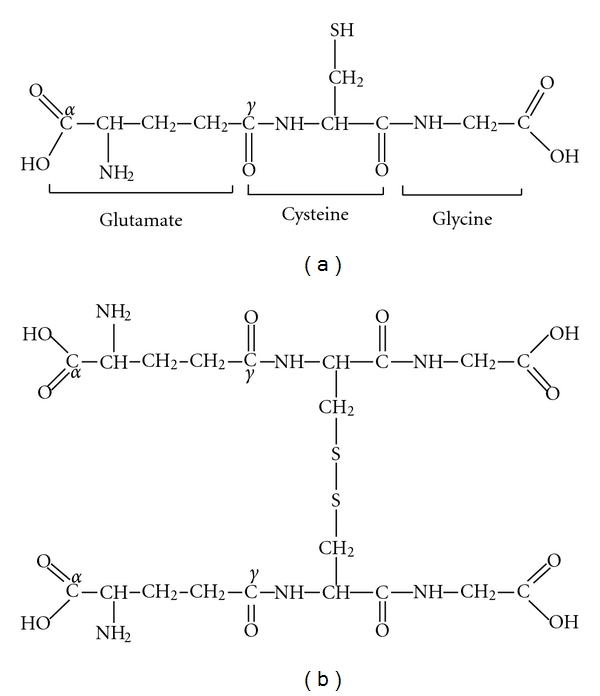
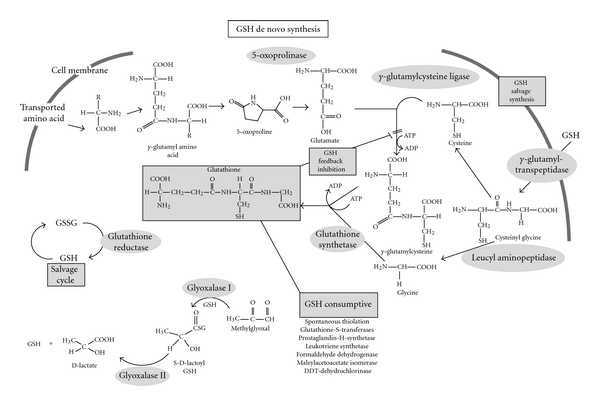
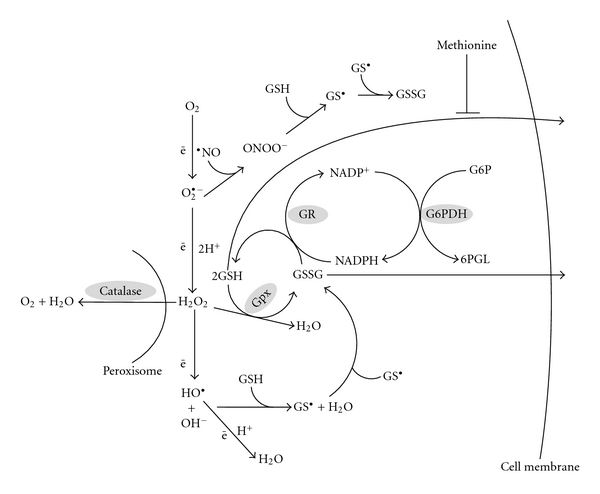
Glutathione (GSH) is a tripeptide, which has many biological roles including protection against reactive oxygen and nitrogen species. The primary goal of this paper is to characterize the principal mechanisms of the protective role of GSH against reactive species and electrophiles. The ancillary goals are to provide up-to-date knowledge of GSH biosynthesis, hydrolysis, and utilization; intracellular compartmentalization and interorgan transfer; elimination of endogenously produced toxicants; involvement in metal homeostasis; glutathione-related enzymes and their regulation; glutathionylation of sulfhydryls. Individual sections are devoted to the relationships between GSH homeostasis and pathologies as well as to developed research tools and pharmacological approaches to manipulating GSH levels. Special attention is paid to compounds mainly of a natural origin (phytochemicals) which affect GSH-related processes. The paper provides starting points for development of novel tools and provides a hypothesis for investigation of the physiology and biochemistry of glutathione with a focus on human and animal health.
Overview
The claims and statistics of this paper haven’t been checked yet.
Run the check — free, no account needed. It reads the open-access text and checks the sources it cites.
Integrity signals
Registry
Cites
Statistics
Figures
Verification
Claims the paper makes
The claims and statistics of this paper haven’t been checked yet.
Run the check — free, no account needed. It reads the open-access text and checks the sources it cites.
Claims other papers make about this one
Each is checked against this paper’s own text: does it say what the citing paper says it does?
In the citing paper
“The abundance of GSH is unusually high, the cytosol concentration is ca 1–11 mM, mitochondria contain 6–10 mM, and nuclei 3–15 mM of GSH.”
From Reactive Oxygen Species, Toxicity, Oxidative Stress, and Antioxidants: Chronic Diseases and Aging (2023) · cites this paper as Lushchak 2012
Self-check
Percentages, sums and reported differences re-computed from the paper’s own numbers.
The self-check needs the paper’s full text.
Citations
Cites
Colowick, S. P., Joshi, M. D., Jagannathan, & KAPLAN, N. O. (1966) · Cited by 26,137
Free radicals in biology and medicine
Gutteridge, J. M. C. (1991) · General Pharmacology The Vascular System · doi:10.1016/0306-3623(91)90478-o · Cited by 17,178
Aging: a theory based on free radical and radiation chemistry
Harman, D. (1956) · Journal of Gerontology · doi:10.1093/geronj/11.3.298 · Cited by 8,567
Metals, Toxicity and Oxidative Stress
Valko, M., Morris, H., & Cronin, M. (2005) · Current Medicinal Chemistry · doi:10.2174/0929867053764635 · Cited by 5,018
Oxidative stress: oxidants and antioxidants
Sies, H. (1997) · Experimental Physiology · doi:10.1113/expphysiol.1997.sp004024 · Cited by 4,577
Environmentally induced oxidative stress in aquatic animals
Lushchak, V. I. (2011) · Aquatic Toxicology · doi:10.1016/j.aquatox.2010.10.006 · Cited by 2,729
Self-citationThe Nrf2-antioxidant response element signaling pathway and its activation by oxidative stress
Nguyen, T., Nioi, P., & Pickett, C. B. (2009) · Journal of Biological Chemistry · doi:10.1074/jbc.r900010200 · Cited by 2,655
Regulation of glutathione synthesis
Lu, S. C.-L. (2008) · Molecular Aspects of Medicine · doi:10.1016/j.mam.2008.05.005 · Cited by 2,131
The Biologic Clock: The Mitochondria?
Harman, D. (1972) · Journal of the American Geriatrics Society · doi:10.1111/j.1532-5415.1972.tb00787.x · Cited by 2,019
The importance of glutathione in human disease
Townsend, D. M., Tew, K. D., & Tapiero, H. (2003) · Biomedicine & Pharmacotherapy · doi:10.1016/s0753-3322(03)00043-x · Cited by 2,009
Research works printed but not linked: 12
- 2007, Cellular & Molecular Immunology, 4, 353
- 2005, Ukrainskii Biokhimicheskii Zhurnal, 77, 35
- 1988, Cancer Research, 48, 2764
- 1996, Pathologie Biologie, 44, 57
- 1994, American Journal of Physiology, 266, R979
- 2009, Reviews on Environmental Health, 24, 129
- 2000, Cellular and Molecular Life Sciences, 57, 1825
- 1967, National Cancer Institute monograph, 27, 81
- 10.3892/ijo-00000475 · DOI
- 2007, International Journal of Molecular Medicine, 19, 165
- 1989, International Journal of Radiation Oncology Biology Physics, 6, 1325
- 2004, The Brazilian Journal of Infectious Diseases, 8, 363
Cited by
Sorted by citations
Reactive Oxygen Species, Toxicity, Oxidative Stress, and Antioxidants: Chronic Diseases and Aging
Jomova, K., Raptova, R., Alomar, S. Y., Alwasel, S. H., Nepovimova, E., Kuca, K., & Valko, M. (2023) · Archives of Toxicology · doi:10.1007/s00204-023-03562-9 · Cited by 2,638
Free radicals, reactive oxygen species, oxidative stress and its classification
Lushchak, V. I. (2014) · Chemico-Biological Interactions · doi:10.1016/j.cbi.2014.10.016 · Cited by 1,665
Self-citationOxidative Stress in Neurodegenerative Diseases
Simonian, N. A., & Coyle, J. T. (1996) · Annual Review of Pharmacology and Toxicology · doi:10.1146/annurev.pa.36.040196.000503 · Cited by 1,377
Mitochondrial energetics in the kidney
Bhargava, P., & Schnellmann, R. G. (2017) · Nature Reviews Nephrology · doi:10.1038/nrneph.2017.107 · Cited by 1,391
Glutathione metabolism in cancer progression and treatment resistance
Bansal, A., & Simon, M. C. (2018) · The Journal of Cell Biology · doi:10.1083/jcb.201804161 · Cited by 1,253
“Apart from the classical antioxidant role, GSH also has several organelle-specific functions discussed in detail by Lushchak (2012).”
Background
Metadata
- Authors
- Lushchak, V. I.
- Affiliations
- Vasyl Stefanyk Carpathian National University (UA)
- Corresponding author
- Lushchak, Volodymyr I.
- Venue
- Journal of Amino Acids
- Publisher
- Wiley
- Published
- 2012-02-28
- Volume
- 2012
- Pages
- 1-26
- ISSN
- 2090-0104 (ISSN-L)
- 2090-0112
- PMC
- PMC3303626
- OpenAlex
- W2043037824
- Cited by
- 1,266
- References
- 283
- Citations by year
- 2026: 70 · 2025: 117 · 2024: 119 · 2023: 126 · 2022: 125 · 2021: 131 · 2020: 110 · 2019: 79 · 2018: 76 · 2017: 93 · 2016: 64 · 2015: 64 · 2014: 52 · 2013: 29 · 2012: 7
- FWCI
- 20.84
- Type
- journal article
- Language
- en
- Open access
- hybrid
- doi.org
- Locations
- Journal of Amino Acids (publishedVersion, cc-by)
- Europe PMC (PubMed Central) (publishedVersion, cc-by)
- PubMed Central (publishedVersion, cc-by)
- PubMed (publishedVersion)
- Funders
- Ministry of Education and Science of Ukraine (0106U002245)
- Topics
- Life Sciences › Biochemistry, Genetics and Molecular Biology › Biochemistry › Sulfur Compounds in Biology
- Life Sciences › Biochemistry, Genetics and Molecular Biology › Molecular Biology › Glutathione Transferases and Polymorphisms
- Life Sciences › Biochemistry, Genetics and Molecular Biology › Molecular Biology › Redox biology and oxidative stress
- Keywords
- glutathione, glutathione homeostasis, reactive oxygen species, reactive nitrogen species, glutathione synthesis, glutathione metabolism, metal homeostasis, glutathionylation, sulfhydryl groups, phytochemicals, disease pathology
About these checks
Registry, retraction, Cites and statistics results are computed, not judged, with one exception: a printed reference that no index lists is read once by a model before it counts as a citation error. Claims are extracted by a model and kept only when their quote appears verbatim in the text; each cited source is then checked, with a model’s help, for whether it says what the claim relies on. Those verdicts can be wrong — read the claim’s quote and the cited source before relying on one.
Statistics and arithmetic are recomputed, not judged.
Confidence bands are shown only for fields calibrated on our annotated test set. None is calibrated yet, so no band is shown.
What counts as a claim ›How we measure confidence ›How we check this ›
Are you an author, or do you see a problem with this page? Request a review
