

The DOI matches its Crossref record; 117 of the 117 references it cites were found in a registry or an index.
Neuroprotective Function of DJ-1 in Parkinson’s Disease
Open accessAbstract
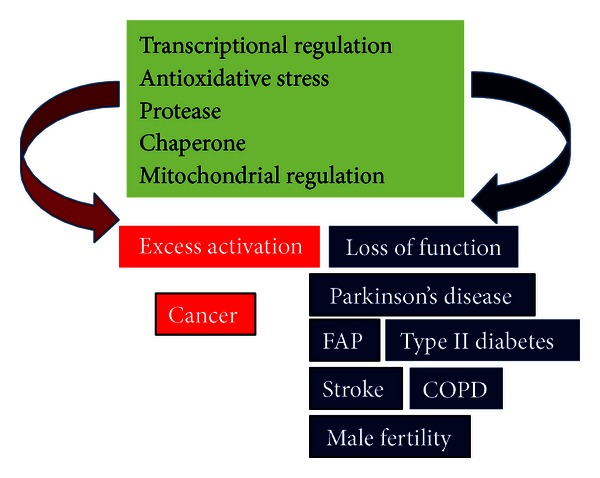
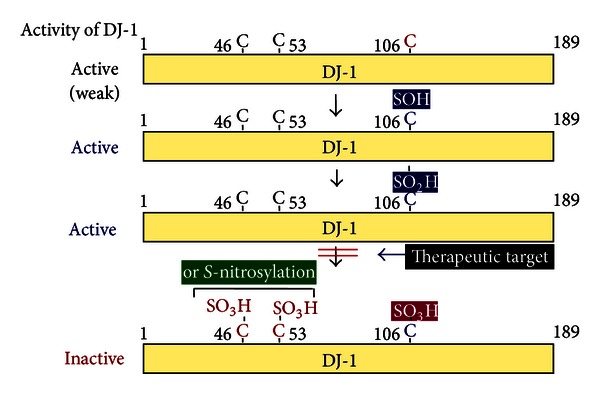
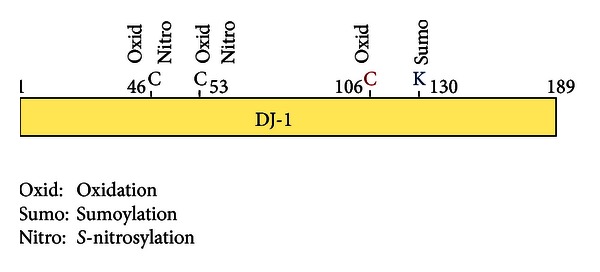
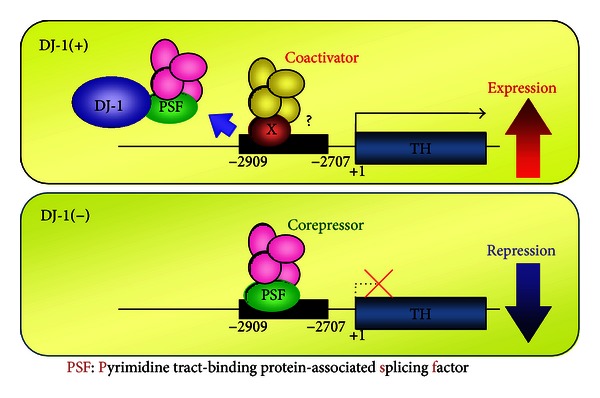
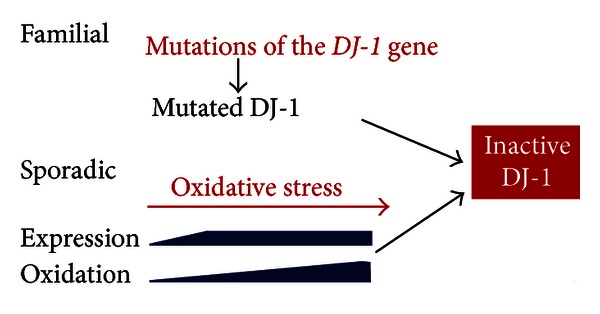
Parkinson’s disease (PD) is caused by dopaminergic neuronal death in the substantia nigra, resulting in a reduced level of dopamine in the striatum. Oxidative stress and mitochondrial dysfunction are thought to be major causes of neurodegeneration in PD. Although genetic and environmental factors are thought to affect the onset of PD, precise mechanisms at the molecular level have not been elucidated. The DJ-1 gene is a causative gene for familial PD ( park7 ) and also an oncogene. DJ-1 has various functions, including transcriptional regulation, antioxidative stress reaction, and chaperone, protease, and mitochondrial regulation, and its activity is regulated by its oxidative status, especially that of cysteine 106 (C106) of DJ-1. Excess oxidation of DJ-1, which renders DJ-1 inactive, has been observed in patients with sporadic PD and Alzheimer’s disease, suggesting that DJ-1 also participates in the onset and pathogenesis of sporadic PD as well as familial PD. DJ-1 is also a stress sensor and its expression is increased upon various stresses, including oxidative stress. In this review, we describe functions of DJ-1 against oxidative stress and possible roles of DJ-1 in the pathogenesis of PD.
Overview
The claims and statistics of this paper haven’t been checked yet.
Run the check — free, no account needed. It reads the open-access text and checks the sources it cites.
Integrity signals
Registry
Cites
Statistics
Figures
Verification
Claims the paper makes
The claims and statistics of this paper haven’t been checked yet.
Run the check — free, no account needed. It reads the open-access text and checks the sources it cites.
Claims other papers make about this one
Each is checked against this paper’s own text: does it say what the citing paper says it does?
The source backs part of the claim, not all of it — or backs it for a different population, condition or comparison.
In the citing paper
“PARK7 is reported to be involved in transcriptional regulation and complexes with processing bodies (P-bodies) suggesting that it may also play a central role in translational regulation as suggested by our PPI network (96,97).”
From Analysis of proteins that rapidly change upon mechanistic/mammalian target of rapamycin complex 1 (mTORC1) repression identifies parkinson protein 7 (PARK7) as a novel protein aberrantly expressed in tuberous sclerosis complex (TSC) (2016) · cites this paper as [96]
Experimental — accuracy not yet measured
Self-check
Percentages, sums and reported differences re-computed from the paper’s own numbers.
The self-check needs the paper’s full text.
Citations
Cites
1 retracted
Malhotra, D., Thimmulappa, R. K., Navas‐Acién, A., Sandford, A. J., Elliott, M., Singh, A., Chen, L., Zhuang, X., Hogg, J. C., Paré, P. D., et al. (2008) · American Journal of Respiratory and Critical Care Medicine · doi:10.1164/rccm.200803-380oc · Cited by 358
RetractedMutations in the DJ-1 Gene Associated with Autosomal Recessive Early-Onset Parkinsonism
Bonifati, V., Rizzu, P., van Baren, M. J., Schaap, O., Breedveld, G. J., Krieger, E., Dekker, M. C. J., Squitieri, F., Ibáñez, P., Joosse, M., et al. (2003) · Science · doi:10.1126/science.1077209 · Cited by 2,854
Mitochondrial Complex I Deficiency in Parkinson's Disease
Schapira, A. H. V., Cooper, J. M., Dexter, D., Clark, J. B., Jenner, P., & Marsden, C. D. (1990) · Journal of Neurochemistry · doi:10.1111/j.1471-4159.1990.tb02325.x · Cited by 2,283
Nishitoh, H., Matsuzawa, A., Tobiume, K., Saegusa, K., Takeda, K., Inoue, K., Hori, S., Kakizuka, A., & Ichijo, H. (2002) · Genes & Development · doi:10.1101/gad.992302 · Cited by 1,372
Canet-Aviles, R., Wilson, M. A., Miller, D. W., Ahmad, R., McLendon, C., Bandyopadhyay, S., Baptista, M. J., Ringe, D., Petsko, G. A., & Cookson, M. (2004) · Proceedings of the National Academy of Sciences · doi:10.1073/pnas.0402959101 · Cited by 1,115
Abnormalities of the electron transport chain in idiopathic parkinson's disease
Parker, W. D., Boyson, S. J., & Parks, J. K. (1989) · Annals of Neurology · doi:10.1002/ana.410260606 · Cited by 1,061
DJ‐1 has a role in antioxidative stress to prevent cell death
Taira, T., Saito, Y., Niki, T., Iguchi‐Ariga, S. M. M., Takahashi, K., & Ariga, H. (2004) · EMBO Reports · doi:10.1038/sj.embor.7400074 · Cited by 866
Self-citationClements, C. M., McNally, R. S., Conti, B. J., Mak, T. W., & Ting, J. P.-Y. (2006) · Proceedings of the National Academy of Sciences · doi:10.1073/pnas.0607260103 · Cited by 818
DJ-1, a Novel Oncogene Which Transforms Mouse NIH3T3 Cells in Cooperation withras
Nagakubo, D., Taira, T., Kitaura, H., Ikeda, M., Tamai, K., Iguchi‐Ariga, S. M. M., & Ariga, H. (1997) · Biochemical and Biophysical Research Communications · doi:10.1006/bbrc.1997.6132 · Cited by 760
Self-citationDeficiencies in Complex I subunits of the respiratory chain in Parkinson's disease
Mizuno, Y., Ohta, S., Tanaka, M., Takamiya, S., Suzuki, K., SATO, T. A., Oya, H., Ozawa, T., & Kagawa, Y. (1989) · Biochemical and Biophysical Research Communications · doi:10.1016/0006-291x(89)91141-8 · Cited by 735
Research works printed but not linked: 11
- 2003, Molecular Cancer Research, 1, 247
- 2005, International Journal of Oncology, 26, 641
- 2007, International Journal of Molecular Medicine, 19, 885
- 2012, PLoS One, 7
- 2001, Clinical Cancer Research, 7, 3328
- 2012, PLoS One, 7
- 2009, Anticancer Research, 29, 4879
- 10.3892/ijo-00000451 · DOI
- 1998, Annals of Neurology, 44, S99
- 2012, PLoS One, 7
- 2013, PLoS One, 8
Cited by
Sorted by citations
Chaudhuri, J., Bains, Y., Guha, S., Kahn, A., Hall, D., Bose, N., Gugliucci, A., & Kapahi, P. (2018) · Cell Metabolism · doi:10.1016/j.cmet.2018.08.014 · Cited by 669
Parkinson's disease: Mechanisms, translational models and management strategies
Raza, C., Anjum, R., & Shakeel, N. U. A. (2019) · Life Sciences · doi:10.1016/j.lfs.2019.03.057 · Cited by 628
Jiang, T., Sun, Q., & Chen, S. (2016) · Progress in Neurobiology · doi:10.1016/j.pneurobio.2016.07.005 · Cited by 605
Maiti, P., Manna, J., & Dunbar, G. L. (2017) · Translational Neurodegeneration · doi:10.1186/s40035-017-0099-z · Cited by 557
Historical Perspective: Models of Parkinson’s Disease
Chia, S. J., Tan, E., & Chao, Y. (2020) · International Journal of Molecular Sciences · doi:10.3390/ijms21072464 · Cited by 438
Metadata
- Authors
- Ariga, H., Takahashi-Niki, K., Kato, I., Maita, H., Niki, T., & Iguchi-Ariga, S. M. M.
- Affiliations
- Hokkaido University (JP)
- Graduate School of Agriculture, Hokkaido University, Kita-ku, Sapporo 060-8589, Japan
- Corresponding author
- Ariga, Hiroyoshi
- ORCID
- Maita, Hiroshi
- Venue
- Oxidative Medicine and Cellular Longevity
- Publisher
- Wiley
- Published
- 2013
- Volume
- 2013
- Pages
- 1-9
- ISSN
- 1942-0994 (ISSN-L)
- 1942-0900
- PMC
- PMC3671546
- OpenAlex
- W1974927898
- Cited by
- 373
- References
- 117
- Citations by year
- 2026: 12 · 2025: 22 · 2024: 24 · 2023: 22 · 2022: 36 · 2021: 30 · 2020: 45 · 2019: 37 · 2018: 27 · 2017: 44 · 2016: 33 · 2015: 21 · 2014: 12 · 2013: 8
- FWCI
- 3.22
- Type
- journal article
- Language
- en
- Open access
- hybrid
- doi.org
- Locations
- Oxidative Medicine and Cellular Longevity (publishedVersion, cc-by)
- Europe PMC (PubMed Central) (publishedVersion, cc-by)
- PubMed Central (publishedVersion, cc-by)
- PubMed (publishedVersion)
- Institutional Repositories DataBase (IRDB) (submittedVersion)
- Hokkaido University Collection of Scholarly and Academic Papers (Hokkaido University) (submittedVersion)
- Funders
- National Institute of Biomedical Innovation
- Japan Society for the Promotion of Science (25830071, 25430059, 24650191, 23790970)
- Topics
- Health Sciences › Medicine › Clinical Neurology › Parkinson's Disease Mechanisms and Treatments
- Life Sciences › Biochemistry, Genetics and Molecular Biology › Molecular Biology › Nuclear Receptors and Signaling
- Life Sciences › Biochemistry, Genetics and Molecular Biology › Molecular Biology › Coenzyme Q10 studies and effects
- Keywords
- DJ-1, Parkinson's disease, neuroprotection, oxidative stress, mitochondrial dysfunction, dopaminergic neuron loss, substantia nigra, familial parkinsonism, sporadic Parkinson's disease, stress sensors, chaperone activity, protease function, transcriptional regulation
- MeSH terms
- Animals, Dopamine, Humans, Mitochondria, Parkinson Disease, Oncogene Proteins, Oxidative Stress, Neuroprotective Agents
About these checks
Registry, retraction, Cites and statistics results are computed, not judged, with one exception: a printed reference that no index lists is read once by a model before it counts as a citation error. Claims are extracted by a model and kept only when their quote appears verbatim in the text; each cited source is then checked, with a model’s help, for whether it says what the claim relies on. Those verdicts can be wrong — read the claim’s quote and the cited source before relying on one.
Statistics and arithmetic are recomputed, not judged.
Confidence bands are shown only for fields calibrated on our annotated test set. None is calibrated yet, so no band is shown.
What counts as a claim ›How we measure confidence ›How we check this ›
Are you an author, or do you see a problem with this page? Request a review
