

Relationship between Repeated Sprint Ability and Aerobic Capacity in Professional Soccer Players
Open accessThe DOI matches its Crossref record; 23 of the 23 references it cites were found in a registry or an index.
Abstract
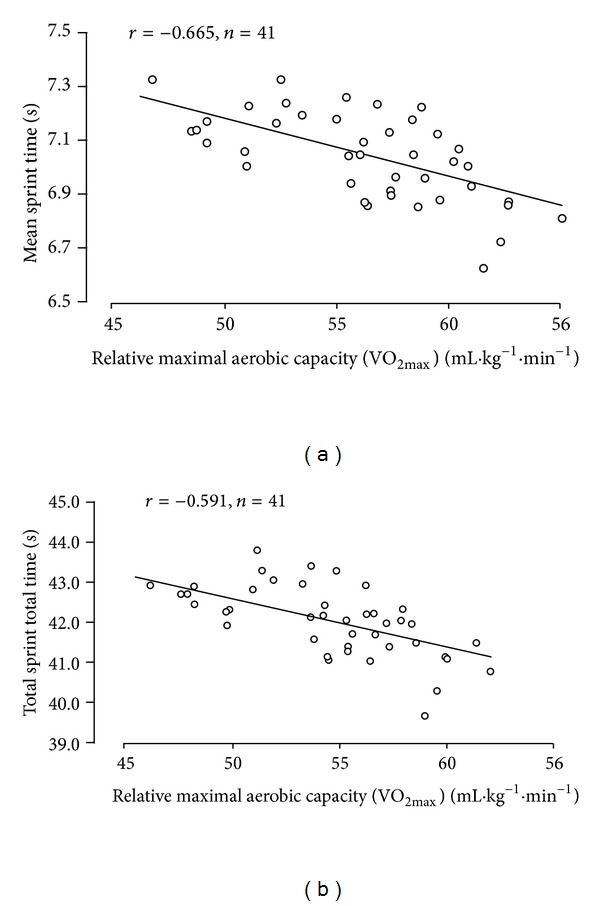
AIM: The aim of the present study was to investigate the relationship between maximal aerobic capacity (VO(2max)) and repeated sprint ability (RSA) in a group of professional soccer players. METHODS: Forty-one professional soccer players (age 23 ± 4 yrs, height 180.0 ± 5.3 cm, weight 79.6 ± 5.3 kg) were required to perform tests to assess RSA and VO(2max) on two separate days with at least 48 hr rest between testing sessions. Each player performed a treadmill test to determine their VO(2max) and a test for RSA involving the players completing 6 × 40 m sprints (turn after 20 m) with 20 s active recovery between each sprint. RESULTS: There was a significant negative correlation between body mass normalised VO(2max) and mean sprint time (RSAmean) (r = -0.655; P < 0.01) and total sprint time (RSAtotal) (r = -0.591, P < 0.01). CONCLUSION: Results of the current study indicate that VO(2max) is one important factor aiding soccer players in the recovery from repeated sprint type activities.
Overview
The claims and statistics of this paper haven’t been checked yet.
Free: it reads the open-access text and checks the first 5 claims that cite a source we can check. Create a free account to check every claim.
Integrity signals
Registry
Cites
Statistics
Figures
Verification
Claims the paper makes
The claims and statistics of this paper haven’t been checked yet.
Free: it reads the open-access text and checks the first 5 claims that cite a source we can check. Create a free account to check every claim.
Claims other papers make about this one
Each is checked against this paper’s own text: does it say what the citing paper says it does?
The cited source says what the claim attributes to it.
In the citing paper
“Recently, Jones et al. (2013) demonstrated that maximal aerobic capacity was an important factor in aiding recovery between intermittent sprinting in professional soccer players.”
From Tracking Changes in Maximal Oxygen Consumption with the Heart Rate Index in Female Collegiate Soccer Players (2014) · cites this paper as Jones et al., 2013
Self-check
Percentages, sums and reported differences re-computed from the paper’s own numbers.
The self-check needs the paper’s full text.
Citations
Cites
Match performance of high-standard soccer players with special reference to development of fatigue
MOHR, M., KRUSTRUP, P., & BANGSBO, J. (2003) · Journal of Sports Sciences · doi:10.1080/0264041031000071182 · Cited by 2,098 · cited 4×
“In addition to the importance of having a good aerobic capacity, players also perform approximately 150–250 brief intense bouts of activity during a game with these bouts of activity contributing to the more crucial moments of the game such as winning possession, shooting, and chasing a player to tackle [5].”
BackgroundInfluentialAdaptations of skeletal muscle to endurance exercise and their metabolic consequences
Holloszy, J. O., & Coyle, E. F. (1984) · Journal of Applied Physiology · doi:10.1152/jappl.1984.56.4.831 · Cited by 1,985 · cited 2×
“Various mechanisms could be proposed; for example, an individual with a higher VO 2max may exhibit an increased mitochondrial number, size, and surface area [19] which may allow greater movement of pyruvate into the mitochondria.”
BackgroundAerobic endurance training improves soccer performance
HELGERUD, J., ENGEN, L. C., WISL??FF, U., & HOFF, J. (2001) · Medicine and Science in Sports and Exercise · doi:10.1097/00005768-200111000-00019 · Cited by 1,186
Spencer, M., Bishop, D., Dawson, B., & Goodman, C. (2005) · Sports Medicine · doi:10.2165/00007256-200535120-00003 · Cited by 820
Bogdanis, G. C., Nevill, M. E., Boobis, L. H., & Lakomy, H. K. (1996) · Journal of Applied Physiology · doi:10.1152/jappl.1996.80.3.876 · Cited by 691 · cited 2×
“The extent to which an individual canmaintain their sprint performance is known as “repeated sprint ability” (RSA) [6] which is largely dependent on the extent of Phosphocreatine (PCr) resynthesis [7] and the removal of hydrogen ions (H) from the muscle during recovery between bouts.”
BackgroundRampinini, E., Bishop, D., Marcora, S., Ferrari Bravo, D., Sassi, R., & Impellizzeri, F. (2007) · International Journal of Sports Medicine · doi:10.1055/s-2006-924340 · Cited by 644
Physical Fitness, Injuries, and Team Performance in Soccer
ARNASON, A., SIGURDSSON, S. B., GUDMUNDSSON, A., HOLME, I., ENGEBRETSEN, L., & BAHR, R. (2004) · Medicine & Science in Sports & Exercise · doi:10.1249/01.mss.0000113478.92945.ca · Cited by 539
The time course of phosphorylcreatine resynthesis during recovery of the quadriceps muscle in man
Harris, R. C., Edwards, R. H. T., Hultman, E., Nordesj�, L. O., Nylind, B., & Sahlin, K. (1976) · Pfl�gers Archiv European Journal of Physiology · doi:10.1007/bf00585149 · Cited by 526 · cited 1×
“It has previously been proposed that an individual’s RSA may be aided by their aerobic capacity [8] as an enhanced aerobic capacity may increase the ability to tolerate, remove, and buffer H from the working muscle [9] and also enhance PCr and adenosine triphosphate (ATP) resynthesis from inorganic phosphates postexer…”
BackgroundSvensson, M., & Drust, B. (2005) · Journal of Sports Sciences · doi:10.1080/02640410400021294 · Cited by 464 · cited 3×
“The amount of high intensity exercise performed (and recovery from it) is one factor that helps distinguish top-class players from players of a lower standard [1].”
BackgroundTextbook of work physiology : physiological bases of exercise
Åstrand, P. (2003) · Cited by 392
Research works printed but not linked: 2
- Dawson B Fitzsimons M Ward D The relationship of repeated sprint ability to aerobic power and performance measures of anaerobic work capacity and power Australian Journal of Science and Medicine in Sport 1993 25 4 88 93 2-s2.0-0027728601
- Ferrari Bravo D Rampinini E Sassi R Ecological validity of a repeated sprint ability test and its reproducibility in soccer Proceedings of the 10th Congress of the European College of Sport Science 2005 Belgrade, Serbia Book of Abstract
Cited by
Dobbs, W. C., Tolusso, D. V., Fedewa, M. V., & Esco, M. R. (2018) · The Journal of Strength and Conditioning Research · doi:10.1519/jsc.0000000000002750 · Cited by 177
“This provides a gap in the literature because recovery has been noted as an aerobic phenomenon (39).”
BackgroundAerobic and anaerobic determinants of repeated sprint ability in team sports athletes
Gharbi, Z., Dardouri, W., Haj-Sassi, R., Chamari, K., & Souissi, N. (2015) · Biology of Sport · doi:10.5604/20831862.1150302 · Cited by 103
“(VO2max) appears to be related to the RSA performance [7-9].”
BackgroundFernandez, A. R., Sánchez-Sánchez, J., Ramírez‐Campillo, R., Nakamura, F. Y., Marroyo, J. A. R., & Villa, G. (2017) · The Journal of Strength and Conditioning Research · doi:10.1519/jsc.0000000000002193 · Cited by 69
“57) (32), although this is the first study to show a correlation between recovery capacity and this RSA index.”
BackgroundMethodInfluentialRadzimiński, Ł., Szwarc, A., Padrón-Cabo, A., & Jastrzębski, Z. (2020) · The Journal of Sports Medicine and Physical Fitness · doi:10.23736/s0022-4707.19.09979-1 · Cited by 66
The soccer season: performance variations and evolutionary trends
Silva, J. R. (2022) · PeerJ · doi:10.7717/peerj.14082 · Cited by 55
Metadata
- Authors
- Jones, R. M., Cook, C. C., Kilduff, L. P., Milanović, Z., James, N., Sporiš, G., Fiorentini, B., Fiorentini, F., Turner, A., & Vučković, G.
- Affiliations
- Swansea University (GB)
- United Kingdom Sport (GB)
- University of Nis (RS)
- Middlesex University London (GB)
- University of Zagreb (HR)
- Grand Canyon University (US)
- University of Split (HR)
- University of Ljubljana (SI)
- Corresponding author
- Vučković, Goran
- Venue
- The Scientific World Journal
- Publisher
- Wiley
- Published
- 2013-01
- Volume
- 2013
- Issue
- 1
- Pages
- 952350-952350
- ISSN
- 1537-744X (ISSN-L)
- 2356-6140
- PMC
- PMC3807849
- OpenAlex
- W2111389728
- Cited by
- 76
- References
- 23
- Citations by year
- 2026: 8 · 2025: 6 · 2024: 6 · 2023: 7 · 2022: 11 · 2021: 8 · 2020: 3 · 2019: 5 · 2018: 5 · 2017: 6 · 2016: 5 · 2015: 4 · 2014: 2
- FWCI
- 3.76
- Type
- journal article
- Language
- en
- Open access
- gold
- doi.org
- Locations
- The Scientific World JOURNAL (publishedVersion, cc-by)
- Europe PMC (PubMed Central) (publishedVersion, cc-by)
- PubMed Central (publishedVersion, cc-by)
- PubMed (publishedVersion)
- Middlesex University Research Repository (Middlesex University Of London) (acceptedVersion)
- DOAJ (DOAJ: Directory of Open Access Journals) (submittedVersion, cc-by-sa)
- Topics
- Health Sciences › Medicine › Orthopedics and Sports Medicine › Sports Performance and Training
- Health Sciences › Medicine › Physiology (medical) › Cardiovascular and exercise physiology
- Health Sciences › Medicine › Orthopedics and Sports Medicine › Sports injuries and prevention
- Keywords
- repeated sprint ability, maximal aerobic capacity, professional football players, VO2max, 40 m sprint, active recovery
- MeSH terms
- Adult, Exercise Test, Humans, Oxygen Consumption, Soccer, Time Factors, Athletic Performance, Young Adult
About these checks
Registry, retraction, Cites and statistics results are computed, not judged, with one exception: a printed reference that no index lists is read once by a model before it counts as a citation error. Claims are extracted by a model and kept only when their quote appears verbatim in the text; each cited source is then checked, with a model’s help, for whether it says what the claim relies on. Those verdicts can be wrong — read the claim’s quote and the cited source before relying on one.
Statistics and arithmetic are recomputed, not judged.
Confidence bands are shown only for fields calibrated on our annotated test set. None is calibrated yet, so no band is shown.
What counts as a claim ›How we measure confidence ›How we check this ›
Are you an author, or do you see a problem with this page? Request a review
How to cite
Cite CoChat for the checks on this page, and the paper for its own findings.
- This page
- CoChat. (2026). Citation check: Relationship between Repeated Sprint Ability and Aerobic Capacity in Professional Soccer Players. https://app.cochat.ai/papers/10.1155/2013/952350
- The paper
- Jones, R. M., Cook, C. C., Kilduff, L. P., Milanović, Z., James, N., Sporiš, G., Fiorentini, B., Fiorentini, F., Turner, A., & Vučković, G. (2013). Relationship between Repeated Sprint Ability and Aerobic Capacity in Professional Soccer Players. The Scientific World Journal. https://doi.org/10.1155/2013/952350
Data sources
Bibliographic data: Semantic Scholar, OpenAlex, Crossref.
Contains information from the Semantic Scholar Academic Graph Datasets, made available under the ODC Attribution License (ODC-BY 1.0).
Semantic Scholar’s data is described in: Kinney, R., et al. (2023). The Semantic Scholar Open Data Platform. arXiv:2301.10140.
