

Relationship between Repeated Sprint Ability and Aerobic Capacity in Professional Soccer Players
Open accessThe DOI matches its Crossref record; 23 of the 23 references it cites were found in a registry or an index.
Abstract
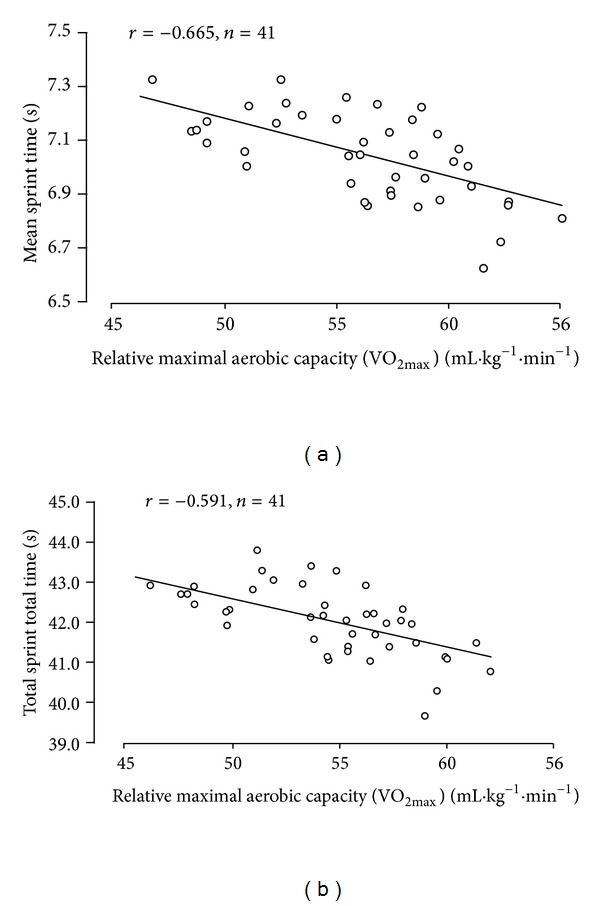
AIM: The aim of the present study was to investigate the relationship between maximal aerobic capacity (VO(2max)) and repeated sprint ability (RSA) in a group of professional soccer players. METHODS: Forty-one professional soccer players (age 23 ± 4 yrs, height 180.0 ± 5.3 cm, weight 79.6 ± 5.3 kg) were required to perform tests to assess RSA and VO(2max) on two separate days with at least 48 hr rest between testing sessions. Each player performed a treadmill test to determine their VO(2max) and a test for RSA involving the players completing 6 × 40 m sprints (turn after 20 m) with 20 s active recovery between each sprint. RESULTS: There was a significant negative correlation between body mass normalised VO(2max) and mean sprint time (RSAmean) (r = -0.655; P < 0.01) and total sprint time (RSAtotal) (r = -0.591, P < 0.01). CONCLUSION: Results of the current study indicate that VO(2max) is one important factor aiding soccer players in the recovery from repeated sprint type activities.
Overview
The claims and statistics of this paper haven’t been checked yet.
Free: it reads the open-access text and checks the first 5 claims that cite a source we can check. Create a free account to check every claim.
Integrity signals
Registry
Cites
Statistics
Figures
Verification
Claims the paper makes
The claims and statistics of this paper haven’t been checked yet.
Free: it reads the open-access text and checks the first 5 claims that cite a source we can check. Create a free account to check every claim.
Claims other papers make about this one
Each is checked against this paper’s own text: does it say what the citing paper says it does?
The cited source says what the claim attributes to it.
In the citing paper
“Recently, Jones et al. (2013) demonstrated that maximal aerobic capacity was an important factor in aiding recovery between intermittent sprinting in professional soccer players.”
From Tracking Changes in Maximal Oxygen Consumption with the Heart Rate Index in Female Collegiate Soccer Players (2014) · cites this paper as Jones et al., 2013
Self-check
Percentages, sums and reported differences re-computed from the paper’s own numbers.
The self-check needs the paper’s full text.
Citations
Cites
Match performance of high-standard soccer players with special reference to development of fatigue
MOHR, M., KRUSTRUP, P., & BANGSBO, J. (2003) · Journal of Sports Sciences · doi:10.1080/0264041031000071182 · Cited by 2,098 · cited 4×
“In addition to the importance of having a good aerobic capacity, players also perform approximately 150–250 brief intense bouts of activity during a game with these bouts of activity contributing to the more crucial moments of the game such as winning possession, shooting, and chasing a player to tackle [5].”
BackgroundInfluentialAdaptations of skeletal muscle to endurance exercise and their metabolic consequences
Holloszy, J. O., & Coyle, E. F. (1984) · Journal of Applied Physiology · doi:10.1152/jappl.1984.56.4.831 · Cited by 1,985 · cited 2×
“Various mechanisms could be proposed; for example, an individual with a higher VO 2max may exhibit an increased mitochondrial number, size, and surface area [19] which may allow greater movement of pyruvate into the mitochondria.”
BackgroundAerobic endurance training improves soccer performance
HELGERUD, J., ENGEN, L. C., WISL??FF, U., & HOFF, J. (2001) · Medicine and Science in Sports and Exercise · doi:10.1097/00005768-200111000-00019 · Cited by 1,186
Spencer, M., Bishop, D., Dawson, B., & Goodman, C. (2005) · Sports Medicine · doi:10.2165/00007256-200535120-00003 · Cited by 820
Bogdanis, G. C., Nevill, M. E., Boobis, L. H., & Lakomy, H. K. (1996) · Journal of Applied Physiology · doi:10.1152/jappl.1996.80.3.876 · Cited by 691 · cited 2×
“The extent to which an individual canmaintain their sprint performance is known as “repeated sprint ability” (RSA) [6] which is largely dependent on the extent of Phosphocreatine (PCr) resynthesis [7] and the removal of hydrogen ions (H) from the muscle during recovery between bouts.”
BackgroundRampinini, E., Bishop, D., Marcora, S., Ferrari Bravo, D., Sassi, R., & Impellizzeri, F. (2007) · International Journal of Sports Medicine · doi:10.1055/s-2006-924340 · Cited by 644
Physical Fitness, Injuries, and Team Performance in Soccer
ARNASON, A., SIGURDSSON, S. B., GUDMUNDSSON, A., HOLME, I., ENGEBRETSEN, L., & BAHR, R. (2004) · Medicine & Science in Sports & Exercise · doi:10.1249/01.mss.0000113478.92945.ca · Cited by 539
The time course of phosphorylcreatine resynthesis during recovery of the quadriceps muscle in man
Harris, R. C., Edwards, R. H. T., Hultman, E., Nordesj�, L. O., Nylind, B., & Sahlin, K. (1976) · Pfl�gers Archiv European Journal of Physiology · doi:10.1007/bf00585149 · Cited by 526 · cited 1×
“It has previously been proposed that an individual’s RSA may be aided by their aerobic capacity [8] as an enhanced aerobic capacity may increase the ability to tolerate, remove, and buffer H from the working muscle [9] and also enhance PCr and adenosine triphosphate (ATP) resynthesis from inorganic phosphates postexer…”
BackgroundSvensson, M., & Drust, B. (2005) · Journal of Sports Sciences · doi:10.1080/02640410400021294 · Cited by 464 · cited 3×
“The amount of high intensity exercise performed (and recovery from it) is one factor that helps distinguish top-class players from players of a lower standard [1].”
BackgroundTextbook of work physiology : physiological bases of exercise
Åstrand, P. (2003) · Cited by 392
Research works printed but not linked: 2
- Dawson B Fitzsimons M Ward D The relationship of repeated sprint ability to aerobic power and performance measures of anaerobic work capacity and power Australian Journal of Science and Medicine in Sport 1993 25 4 88 93 2-s2.0-0027728601
- Ferrari Bravo D Rampinini E Sassi R Ecological validity of a repeated sprint ability test and its reproducibility in soccer Proceedings of the 10th Congress of the European College of Sport Science 2005 Belgrade, Serbia Book of Abstract
Cited by
Dobbs, W. C., Tolusso, D. V., Fedewa, M. V., & Esco, M. R. (2018) · The Journal of Strength and Conditioning Research · doi:10.1519/jsc.0000000000002750 · Cited by 178
“This provides a gap in the literature because recovery has been noted as an aerobic phenomenon (39).”
BackgroundAerobic and anaerobic determinants of repeated sprint ability in team sports athletes
Gharbi, Z., Dardouri, W., Haj-Sassi, R., Chamari, K., & Souissi, N. (2015) · Biology of Sport · doi:10.5604/20831862.1150302 · Cited by 103
“(VO2max) appears to be related to the RSA performance [7-9].”
BackgroundFernandez, A. R., Sánchez-Sánchez, J., Ramírez‐Campillo, R., Nakamura, F. Y., Marroyo, J. A. R., & Villa, G. (2017) · The Journal of Strength and Conditioning Research · doi:10.1519/jsc.0000000000002193 · Cited by 69
“57) (32), although this is the first study to show a correlation between recovery capacity and this RSA index.”
BackgroundMethodInfluentialRadzimiński, Ł., Szwarc, A., Padrón-Cabo, A., & Jastrzębski, Z. (2020) · The Journal of Sports Medicine and Physical Fitness · doi:10.23736/s0022-4707.19.09979-1 · Cited by 66
The soccer season: performance variations and evolutionary trends
Silva, J. R. (2022) · PeerJ · doi:10.7717/peerj.14082 · Cited by 55
Physical Demands in Competitive Ultimate Frisbee
Krustrup, P., & Mohr, M. (2015) · Journal of Strength and Conditioning Research · doi:10.1519/jsc.0000000000000989 · Cited by 25
“The Yo-Yo IR1 test has a more aerobic nature than the Yo-Yo IR2 test, and this finding indicates and confirms findings by others on the importance of aerobic capacity for the ability to perform repeated sprints (16).”
ResultTesting in Football: A Narrative Review
Hall, E. C. R., John, G., & Ahmetov, I. I. (2024) · Sports · doi:10.3390/sports12110307 · Cited by 44
Thapa, R. K., Narvariya, P., Weldon, A., Talukdar, K., & Ramírez‐Campillo, R. (2022) · Montenegrin Journal of Sports Science and Medicine · doi:10.26773/mjssm.220906 · Cited by 40
“However, RSA also relies on aerobic capacity to improve recovery between bouts of maximal sprinting (Jones et al., 2013).”
BackgroundAerobic Capacity is Related to Repeated Sprint Ability with Sprint Distances Less Than 40 Meters.
Sanders, G. J., Turner, Z., Boos, B., Peacock, C. A., Peveler, W. W., & Lipping, A. (2017) · International journal of exercise science · doi:10.70252/gcdn2088 · Cited by 49
Sánchez-Sánchez, J., Ramírez‐Campillo, R., Petisco, C., Gonzalo‐Skok, Ó., Fernandez, A. R., Minano, J. J. M., & Nakamura, F. Y. (2017) · The Journal of Strength and Conditioning Research · doi:10.1519/jsc.0000000000002232 · Cited by 40
“From a metabolic point of view, it is possible that a low V_ O2max may limit resynthesis of high-energy phosphates (44) and elimination of metabolic by-products related to the anaerobic metabolism (26) between RSs.”
BackgroundAnterior Cruciate Ligament Reconstruction Return-to-Sport Decision-Making: A Scoping Review
Golberg, E., Sommerfeldt, M. F., Pinkoski, A. M., Dennett, L., & Beaupré, L. A. (2023) · Sports Health A Multidisciplinary Approach · doi:10.1177/19417381221147524 · Cited by 31
Sanders, G. J., Boos, B., Rhodes, J., Kollock, R. O., Peacock, C. A., & Scheadler, C. M. (2019) · Journal of Sports Sciences · doi:10.1080/02640414.2019.1626559 · Cited by 29
“Previous research has also found aerobically trained athletes can better perform anaerobic work in the form of repeated sprints and jump performance (Jones et al., 2013; Sanders et al., 2017; Tomlin & Wenger, 2001, 2002).”
BackgroundMeasurement Properties and Feasibility of Repeated Sprint Ability Test: A Systematic Review
Lopes‐Silva, J. P., Santos, J. F. D. S., Abbiss, C. R., & Franchini, É. (2019) · Strength and conditioning journal · doi:10.1519/ssc.0000000000000495 · Cited by 27
“(35) M (n 5 41) 23 6 4 Soccer Repeated sprint ability 6 3 40 m, 20 s active recovery TT (s) and STmean”
BackgroundUlupınar, S., Hazır, T., & İŞLER, A. K. (2021) · Research Quarterly for Exercise and Sport · doi:10.1080/02701367.2021.1950902 · Cited by 25
“Hence, in team sports, repeated-sprint ability is considered one of the major factors that distinguish the top elite athletes from the others (Chaouachi et al., 2010; Jones et al., 2013).”
BackgroundCerda‐Kohler, H., Burgos, C., Ramírez‐Campillo, R., Valdés-Cerda, M., Martín, E. B.-S., Zapata-Gómez, D., Andrade, D. C., & Izquierdo, M. (2016) · The Journal of Strength and Conditioning Research · doi:10.1519/jsc.0000000000001368 · Cited by 33
“These data suggest that the capacity to maintain an intense working load for 90 minutes or more could be determined in part by endurance physiological variables (25,29,37).”
BackgroundVigh-Larsen, J. F., Junge, N., Cialdella-Kam, L. A., Tomás, R., Young, L. T., Krustrup, P., Mohr, M., & Nybo, L. (2024) · Medicine & Science in Sports & Exercise · doi:10.1249/mss.0000000000003442 · Cited by 23
Esco, M. R., Snarr, R. L., Flatt, A., Leatherwood, M., & Whittaker, A. (2014) · Journal of Human Kinetics · doi:10.2478/hukin-2014-0065 · Cited by 18
Michailidis, Y. (2024) · Applied Sciences · doi:10.3390/app14083413 · Cited by 18
“High aerobic capacity has been reported to aid in quicker recovery between sprints [7,8], faster resynthesis of phosphocreatine [9], and removal of fatigue-inducing factors such as hydrogen ions [8].”
BackgroundPonce‐González, J. G., Corral‐Pérez, J., Villarreal, E., Gutierrez‐Manzanedo, J. V., Castro‐Maqueda, G. D., & Casals, C. (2021) · Journal of Human Kinetics · doi:10.2478/hukin-2021-0089 · Cited by 16
“…started at 10 km/h and increased in speed by 2 km/h every 2 min with 0% of gradient in step 1 and 2, a 2.5 % of gradient in step 3 and a 5% of gradient in the next steps; this protocol was based on a previous study in professional soccer players (Jones et al., 2013) and is presented in Figure 1.”
InfluentialMcKee, J. R., Girard, O., Peiffer, J. J., & Scott, B. R. (2023) · Strength and conditioning journal · doi:10.1519/ssc.0000000000000771 · Cited by 15
“As such, maximal ̇ 2max ( r 5 0.66) (24) and fatigue indices ( r 0.65) (46) during RSE protocols involving six 40-m .”
InfluentialChiwaridzo, M., Chandahwa, D., Oorschot, S., Tadyanemhandu, C., Dambi, J. M., Ferguson, G. D., & Smits-Engelsman, B. C. M. (2018) · PLoS ONE · doi:10.1371/journal.pone.0207307 · Cited by 18
Rebolé, M., Castillo, D., Cámara, J., & Yanci, J. (2016) · Revista Iberoamericana de Ciencias de la Actividad Física y el Deporte · doi:10.24310/riccafd.2016.v5i3.6141 · Cited by 15
Jiménez-Iglesias, J., Owen, A. L., Cruz-León, C., Vázquez, M. Á. C., Sánchez‐Parente, S., Gonzalo‐Skok, Ó., Cuenca‐García, M., & Castro‐Piñero, J. (2024) · Sport Sciences for Health · doi:10.1007/s11332-024-01230-8 · Cited by 15
“These meth-ods encompass eccentric overload training [8], traditional strength training [13–15], sprint agility and quickness (SAQ) training [4, 16], small-sided games [17–20], complex training [21, 22], and plyometric training (PT) [9, 23–27].”
Gupta, R., Rizvi, M. R., Sharma, A., Sharma, S., Shaik, A. R., Seyam, M. K., Raza, S., Alshahrani, S. M., Alkhamis, B. A., Alnakhli, H. H., et al. (2025) · PLoS ONE · doi:10.1371/journal.pone.0323573 · Cited by 13
“These outcomes suggest that RST effectively improves oxygen uptake and utilization [31] by inducing cardiovascular adaptations such as increased stroke volume, cardiac output, and capillary density [32,33].”
The effects of training on hormonal concentrations and physical performance of football referees
Muscella, A., Stefàno, E., & Marsigliante, S. (2021) · Physiological Reports · doi:10.14814/phy2.14740 · Cited by 14
“In several studies, higher VO2max appears to be related to better sprint test performance (Jones et al., 2013; Rampinini et al., 2009), allowing the replenishment of phosphocreatine reserves during recovery between sprints, thus maintaining high-intensity performance (Bogdanis et al.”
BackgroundJackson, J. (2015) · ERA: Education and Research Archive (University of Alberta) · doi:10.7939/r3804xt18 · Cited by 12
The study of acceleration and deceleration capacity decrease in repeated sprints in soccer
Izzo, R., Bo, C., & Lorenzo, L. C. (2015) · CINECA IRIS Institutional Research information system (University of Urbino) · Cited by 18
Blasco-Lafarga, C., Ricart-Luna, B., Cordellat, A., Roldán, A., Navarro-Roncal, C., & Monteagudo, P. (2021) · International Journal of Sport and Exercise Psychology · doi:10.1080/1612197x.2021.1907762 · Cited by 11
Ulupınar, S., Özbay, S., Gençoğlu, C., & Hazır, T. (2023) · Strength & Conditioning Journal · doi:10.1519/ssc.0000000000000752 · Cited by 7
Manou, V., Dalamitros, A. A., & Kellis, S. (2018) · Human Movement · doi:10.5114/hm.2018.74062 · Cited by 7
Hernández, M. A. C., Tascón, L. J. T., Cohen, D. D., García-Corzo, S. A., Sánchez, A. Q., Povea, C., & Rojas, C. X. T. (2018) · Spring Conferences of Sports Science · doi:10.14198/jhse.2018.13.proc2.24 · Cited by 8
“, 2004) and V̇O2max is correlated with a number of aspects of on-pitch performance such as distance covered, repeated sprint ability and the ability to recovery from repeated sprints (Jones et al., 2013; Gharbi et al., 2015).”
BackgroundRelationship between Repeated Sprint Ability and Aerobic Fitness in College Volleyball Players
Eryılmaz, S. K., & Kaynak, K. (2019) · Universal Journal of Educational Research · doi:10.13189/ujer.2019.070505 · Cited by 7
“The main finding of present study was that the high negative correlation was between VO2max and RSA mean (𝑟𝑟 = −0.736, 𝑃𝑃 0.01).”
BackgroundResultInfluentialEffect of post-activation potentiation on the sports performance of athletes: a systematic reviewPreprint
Li, J., Soh, K. G., Loh, S. P., Luo, S., Bashir, M., & Yu, X. (2023) · medRxiv · doi:10.1101/2023.09.01.23294960 · Cited by 10
Age-Related Differences in Fitness Performance and Technical Skills of Young Soccer Players
Lipecki, K. (2018) · Polish Journal of Sport and Tourism · doi:10.2478/pjst-2018-0021 · Cited by 7
Aerobic power across positions – an investigation into women’s soccer performance
Yang, X., Chamera, T., Chen, L., & Zhang, S. (2023) · Annals of Agricultural and Environmental Medicine · doi:10.26444/aaem/169854 · Cited by 6
“This is essentially the same as the study by Haugen et al. [20].”
ResultReferees' physical performance over a soccer season
Muscella, A., Stefàno, E., Maglie, A., & Marsigliante, S. (2020) · Sport Sciences for Health · doi:10.1007/s11332-020-00655-1 · Cited by 6
“In several studies a higher VO2max appears related to better sprint test performance [34, 35], by allowing the replenishment of phosphocreatine stores during recovery between sprints, thus maintaining performance at high intensity [36].”
BackgroundSánchez-Sánchez, J., Familiar, C. H., Muñoz, V. M., García, A. G., Fernandez, A. R., & González, M. C. (2016) · Retos · doi:10.47197/retos.v0i30.38463 · Cited by 19
MAS and MANS Predicts repeated sprint ability in youth soccer players
Olsen, J. D., Rognhaug, H. R., Kvamme, D., Støren, Ø., & Støa, E. M. (2023) · International journal of exercise science · doi:10.70252/aanf2064 · Cited by 6
Bici, A., & Kasa, A. (2025) · International Journal of Physical Education Sports and Health · doi:10.22271/kheljournal.2025.v12.i3c.3788 · Cited by 3
Usher, A., Babraj, J., & Younger, A. (2025) · Muscles · doi:10.3390/muscles4040054 · Cited by 3
“Likewise, higher aerobic capacity assessed by the VO 2 max score has been associated with lower average and total repeated sprint times [5].”
The Effects of Menstrual Cycle Phases on Running Repeated Sprint Ability
Nicola, S. D., Ferrier, B. K., Florida-James, G. D., & Kavaliauskas, M. (2022) · International Journal of Strength and Conditioning · doi:10.47206/ijsc.v2i1.137 · Cited by 3
Wang, S., Liu, C., Zhang, L., Sun, C., & Yang, S. (2024) · Brain Sciences · doi:10.3390/brainsci14070673 · Cited by 4
“Further studies focusing on the exploration of the psychological impact of BBT interventions alongside their physiological effects based on more comprehensive parameters in different populations are needed to uncover complex interactions that the current study failed to address.”
BackgroundGalantine, P., Sudlow, A., Hays, A., Maso, F., Duché, P., & Bertin, D. (2025) · PLoS ONE · doi:10.1371/journal.pone.0316947 · Cited by 3
Marley, A., Grant, M. C., & Babraj, J. (2026) · Science & Sports · doi:10.1016/j.scispo.2025.11.003 · Cited by 2
Rey‐Mota, J., Álvarez, D. M., Onate-Figuérez, A., Sepulveda, R. A. Y., & Clemente‐Suárez, V. J. (2024) · Applied Sciences · doi:10.3390/app14209604 · Cited by 3
Effectiveness of repeated sprint ability (RSA) development in youth soccer players
Tvrdý, M., Holienka, M., & Babić, M. (2022) · Journal of Physical Education and Sport · doi:10.7752/jpes.2022.10321 · Cited by 5
Hörnlund, E., Hadjispyrou, S., & Theos, A. (2024) · PubMed · doi:10.70252/aipw3683 · Cited by 2
The impact of mental fatigue on repeated sprint and change-of-direction performance in soccer
Yang, W., Chen, T., & Chen, G. (2026) · Frontiers in Psychology · doi:10.3389/fpsyg.2026.1842345 · Cited by 1
Ntaganda, J. M., Minani, F., Banzi, W., Mpinganzima, L., Niyobuhungiro, J., Dusabejambo, V., Kambutse, I., & Rutaganda, E. (2021) · Transactions of the Institute of Measurement and Control · doi:10.1177/01423312211022867 · Cited by 3
“It contributes to repeated sprint ability, total distance covered, and the number of ball contacts made during soccer-play (Dawson et al., 1993; Helgerud et al., 2001; Jones et al., 2013; McMahon and Wenger, 1998).”
BackgroundCorrelation between Repeated Sprint Ability (RSA) and Hoff Test of High School Soccer Plyers
Seon, S., & Park, B. (2022) · Exercise Science · doi:10.15857/ksep.2022.00360 · Cited by 1
“RSA의 능력에 영향을 미치는 3가지 변인(PCr, 수소이온, LT)들은 유 산소성 능력과 상관관계가 있다고 알려져 있으며, 이를 근거로 선행연 구들은 주로 유산소성 능력(예: 최대산소섭취량)과 RSA의 상관관계를 분석하였다[2,17,18].”
InfluentialZúñiga-Vergara, P., Villaseca‐Vicuña, R., & Jair, B. (2022) · Journal of Physical Education and Sport · doi:10.7752/jpes.2022.10313 · Cited by 1
Time Motion Analysis in the South African Premier Soccer League using GPS technology
Melesi, K. Z. (2020) · Cited by 1
Physiological, perceptual and time-motion characteristics of man marking in small-sided soccer games
Aasgaard, M. (2016) · Tuwhera (Auckland University of Technology) · Cited by 1
Enhancing Performance & Preventing Injuries in Team Sport Players
van der Does, H. (2016)
The study of acceleration capacity decrease in repeated 30m sprints
Izzo, R., & Zenatello, V. M. (2016) · CINECA IRIS Institutional Research information system (University of Urbino) · Cited by 3
Kinoshita, N., Takayama, F., & Nabekura, Y. (2017) · International Journal of Sport and Health Science · doi:10.5432/ijshs.201637
Systematische Ansätze zur Optimierung der Laufschnelligkeit
Herdener, L. (2014) · mediaTUM (Technical University of Munich)
BİROL, A., Akalan, C., Akça, F., & Aras, D. (2018) · Ankara Üniversitesi Beden Eğitimi ve Spor Yüksekokulu SPORMETRE Beden Eğitimi ve Spor Bilimleri Dergisi · Cited by 3
Stone, B. L., Minson, K. L., Anderson, E. C., Lockie, R. G., & Dawes, J. J. (2019) · Sports and Exercise Medicine - Open Journal · doi:10.17140/semoj-5-173
An individualised approach to monitoring and prescribing training in elite youth football players
Fitzpatrick, J. F. (2019) · Northumbria Research Link (Northumbria University)
Chiwaridzo, M. (2020) · Open University of Cape Town (University of Cape Town)
Effects of Sodium Pyruvate on Exercise-Induced Lactic Acidosis and Exercise PerformancePreprint
Yang, Y., Qiu, J., Wang, M., Feng, L., Luo, D., Gao, R., & Zhou, F. (2021) · Research Square · doi:10.21203/rs.3.rs-429807/v1
Casimiro-Lopes, G., de Miranda, M. J. C., Boaventura, G., & Fidalgo, T. K. D. S. (2021) · Research Society and Development · doi:10.33448/rsd-v10i12.20049
R., I., C., H. V., S., S., Cejudo, A., A., C., & M., G. (2021) · Journal of Physical Education and Sport · doi:10.7752/jpes.2021.03177
ASSOCIAÇÃO ENTRE CONSUMO ALIMENTAR, COMPOSIÇÃO CORPORAL E DESEMPENHO FÍSICO DE ATLETAS PROFISSIONAIS
de Souza, A. V. O. M., Friozi, M. J. M., Coelho‐Ravagnani, C. D. F., Schutz, A. P. C., & Sanches, F. L. F. Z. (2022) · Editora Científica Digital eBooks · doi:10.37885/230312571
Borges, F. D. S. S., Cavalcante, F. P., Brilhante, F. D. F., Portela, J. G., Costa, L. F. L. D., Fernandes, L. M. C., Fontenele, L. A., Diniz, M. A. N., Sousa, M. D. D. A., Fonseca, M. C. S. D., et al. (2022) · Editora Científica Digital eBooks · doi:10.37885/978-65-5360-320-2
สุนทองห้าว, ป. (2017) · Chula Digiverse · doi:10.58837/chula.the.2017.1230
ANAEROBİK HIZ REZERVİ: GENEL BAKIŞ VE GÜNCEL YAKLAŞIMLAR
Egesoy, H. (2023) · Ankara Üniversitesi Beden Eğitimi ve Spor Yüksekokulu SPORMETRE Beden Eğitimi ve Spor Bilimleri Dergisi · doi:10.33689/spormetre.1336107
Fadhilah, M. A., Imanudin, I., & Hardwis, S. (2025) · Jurnal Simki Pedagogia · doi:10.29407/jsp.v8i1.1001
“Nutrisi seperti asupan karbohidrat juga mendukung efisiensi metabolisme aerobik dan anaerobik pemain (Jones et al., 2013) (Yustika, 2018).”
Amar, M., Kebaili, L., & Kessouri, O. (2025) · Scientific Journal of Sport and Performance · doi:10.55860/gtpr7065
Accuracy of Two Metabolic Running Equations for Estimating VO 2peak in Male Youth Soccer Players
Mohammadnabi, M. A., Fields, A., Sinelnikov, O. A., & Esco, M. R. (2025) · Measurement in Physical Education and Exercise Science · doi:10.1080/1091367x.2025.2589881
“…alike, previous research has shown that higher aerobic fitness is associated with improved repeated sprint ability, greater total distance covered, and increased frequency of ball contacts during competition (Helgerud et al., 2001; Jones et al., 2013; Krustrup et al., 2003; McMahon & Wenger, 1998).”
Physical fitness norms for male youth national team football players
Ragnarsdóttir, I. L. (2023) · Skemman
Arteta Baños, A. (2020) · Communities in ADDI (Universidad del Pais Vasco)
de Lucca, L. (2024) · LA Referencia (Red Federada de Repositorios Institucionales de Publicaciones Científicas)
Fields, A., Mohammadnabi, M. A., Sinelnikov, O. A., & Esco, M. R. (2026) · Journal of Functional Morphology and Kinesiology · doi:10.3390/jfmk11010058
“While athletes with superior aerobic fitness may experience better fatigue resistance during repeated high-intensity efforts, single-trial tests such as TT and CMJ do not impose sufficient duration or metabolic demand to meaningfully engage aerobic pathways [4,5,11].”
InfluentialGabrys, T. T., Chruscinski, R., Pilis, A., Stanula, A., & Mikołajec, K. (2026) · Sports · doi:10.3390/sports14030116
“Evidence from research conducted in other sports further indicates that substantial differences in repeated sprint performance may occur despite comparable VO 2max values [35,36].”
Chmura, P., Nassis, G. P., Castagna, C., Mohr, M., Carling, C., Randers, M. B., Wei, X., Fahrenholtz, I. L., Oliva‐Lozano, J. M., Webb, J., et al. (2026) · Football Studies · doi:10.1016/j.footst.2026.100059
Cardiorespiratory Aerobic Fitness and Repeated Sprint Ability in Elite Ice Hockey Players
Malecha, J., Staněk, L., Tuka, V., Sedlář, M., Suchý, J., Jeníšová, A., & Linhart, A. (2026) · Sports · doi:10.3390/sports14070287
“In contrast, other authors have reported that aerobic capacity may significantly influence RSA [2,7,8].”
Laughlin, R. M., Faulkner, M., Connolly, J., & Doherty, R. (2026) · Strength and conditioning journal · doi:10.1519/ssc.0000000000000963
Aerobik Kapasitenin Değerlendirilmesinde Kullanılan Testler ve Uygulama Protokolleri
Yaşa, Ö., & Kıyıcı, F. (2026) · Özgür Yayınları eBooks · doi:10.58830/ozgur.pub1419.c5724
Trend and Development of Soccer Research: An Observation
Islam, M. S. (2023) · JIPES - JOURNAL OF INDONESIAN PHYSICAL EDUCATION AND SPORT
Jamderm, A., Naptheutrong, U., & Boobphachart, D. (2026) · วารสารวิทยาศาสตร์การกีฬาและนวัตกรรมสุขภาพ กลุ่มมหาวิทยาลัยราชภัฏแห่งประเทศไทย
Steidle, T., Meixner, B. J., Lenk, M., Schaffarczyk, M., & Sperlich, B. (2026) · Frontiers in Sports and Active Living · doi:10.3389/fspor.2026.1936767
EFEKTI I PROGRAMIT TË PUNËS BAZUAR NË 36 SEANCA STËRVITORE NË PERFORMANCËN E FUTBOLLISTËVE
Ramadani, B. (2025) · AAB College Repository (AAB College)
Metadata
- Authors
- Jones, R. M., Cook, C. C., Kilduff, L. P., Milanović, Z., James, N., Sporiš, G., Fiorentini, B., Fiorentini, F., Turner, A., & Vučković, G.
- Affiliations
- Swansea University (GB)
- United Kingdom Sport (GB)
- University of Nis (RS)
- Middlesex University London (GB)
- University of Zagreb (HR)
- Grand Canyon University (US)
- University of Split (HR)
- University of Ljubljana (SI)
- Corresponding author
- Vučković, Goran
- Venue
- The Scientific World Journal
- Publisher
- Wiley
- Published
- 2013-01
- Volume
- 2013
- Issue
- 1
- Pages
- 952350-952350
- ISSN
- 1537-744X (ISSN-L)
- 2356-6140
- PMC
- PMC3807849
- OpenAlex
- W2111389728
- Semantic Scholar
- ee47967ca1cc1c4c332a7b8d6ed456ff4799d82c
- Cited by
- 76
- References
- 23
- Citations by year
- 2026: 8 · 2025: 6 · 2024: 6 · 2023: 7 · 2022: 11 · 2021: 8 · 2020: 3 · 2019: 5 · 2018: 5 · 2017: 6 · 2016: 5 · 2015: 4 · 2014: 2
- FWCI
- 3.76
- Type
- journal article
- Language
- en
- Open access
- gold
- doi.org
- Locations
- The Scientific World JOURNAL (publishedVersion, cc-by)
- Europe PMC (PubMed Central) (publishedVersion, cc-by)
- PubMed Central (publishedVersion, cc-by)
- PubMed (publishedVersion)
- Middlesex University Research Repository (Middlesex University Of London) (acceptedVersion)
- DOAJ (DOAJ: Directory of Open Access Journals) (submittedVersion, cc-by-sa)
- Topics
- Health Sciences › Medicine › Orthopedics and Sports Medicine › Sports Performance and Training
- Health Sciences › Medicine › Physiology (medical) › Cardiovascular and exercise physiology
- Health Sciences › Medicine › Orthopedics and Sports Medicine › Sports injuries and prevention
- Keywords
- repeated sprint ability, maximal aerobic capacity, professional football players, VO2max, 40 m sprint, active recovery
- MeSH terms
- Adult, Exercise Test, Humans, Oxygen Consumption, Soccer, Time Factors, Athletic Performance, Young Adult
About these checks
Registry, retraction, Cites and statistics results are computed, not judged, with one exception: a printed reference that no index lists is read once by a model before it counts as a citation error. Claims are extracted by a model and kept only when their quote appears verbatim in the text; each cited source is then checked, with a model’s help, for whether it says what the claim relies on. Those verdicts can be wrong — read the claim’s quote and the cited source before relying on one.
Statistics and arithmetic are recomputed, not judged.
Confidence bands are shown only for fields calibrated on our annotated test set. None is calibrated yet, so no band is shown.
What counts as a claim ›How we measure confidence ›How we check this ›
Are you an author, or do you see a problem with this page? Request a review
Data sources
Bibliographic data: Semantic Scholar, OpenAlex, Crossref.
Contains information from the Semantic Scholar Academic Graph Datasets, made available under the ODC Attribution License (ODC-BY 1.0).
Semantic Scholar’s data is described in: Kinney, R., et al. (2023). The Semantic Scholar Open Data Platform. arXiv:2301.10140.
