

IFN-γ-Secreting-Mesenchymal Stem Cells Exert an Antitumor Effect In Vivo via the TRAIL Pathway
Open accessThe DOI matches its Crossref record; 27 of the 27 references it cites were found in a registry or an index.
Abstract
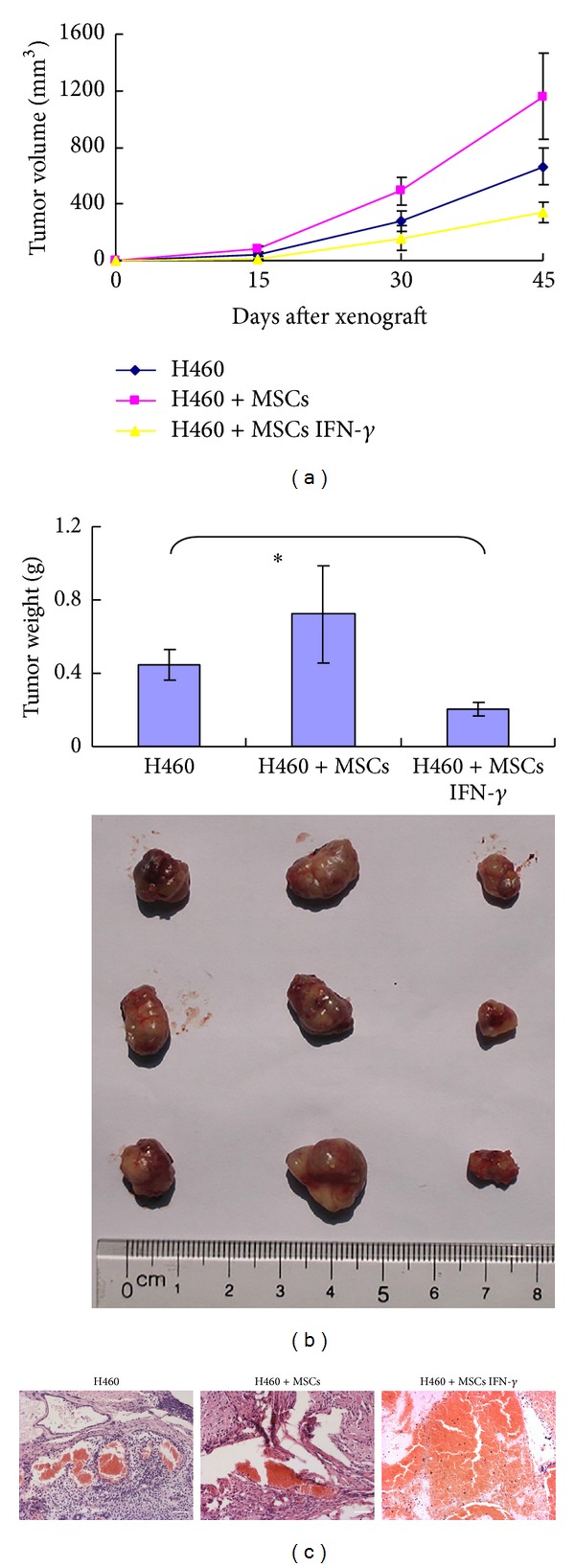
Mesenchymal stem cells (MSCs) can exhibit either prooncogenic or antitumor properties depending on the context. Based on our previous study, we hypothesized that MSCs engineered to deliver IFN-γwould kill cancer cells through persistent activation of the TRAIL pathway. Human bone-marrow (BM-) derived MSCs were isolated, amplified, and transduced with a lentiviral vector encoding the IFN-γgene under the control of the EF1αpromoter. The IFN-γ-modified MSCs effectively secreted functional IFN-γ, which led to long-term expression of TRAIL. More importantly, the IFN-γ-modified MSCs selectively induced apoptosis in lung tumor cells through caspase-3 activation within the target cells. The percentage of activated-caspase-3-positive tumor cells in IFN-γ-modified MSCs cocultures was significantly higher than in control MSCs cocultures. Treatment with anti-TRAIL antibody dramatically suppressed the caspase-3 activation observed in H460 cells. After injection into nude mice, the IFN-γ-modified MSCs inhibited the growth and progression of lung carcinoma compared with control cells. Collectively, our results provide a new strategy for tumor therapy that utilizes IFN-γ-modified MSCs.
Overview
The claims and statistics of this paper haven’t been checked yet.
Free: it reads the open-access text and checks the first 5 claims that cite a source we can check. Create a free account to check every claim.
Integrity signals
Registry
Cites
Statistics
Figures
Verification
Claims the paper makes
The claims and statistics of this paper haven’t been checked yet.
Free: it reads the open-access text and checks the first 5 claims that cite a source we can check. Create a free account to check every claim.
Claims other papers make about this one
Each is checked against this paper’s own text: does it say what the citing paper says it does?
The source backs part of the claim, not all of it — or backs it for a different population, condition or comparison.
In the citing paper
“IFN-γ-expressing MSCs also inhibited leukemic and lung carcinoma cell proliferation in vitro [35], [110], [111].”
From Mesenchymal stromal cells for bone sarcoma treatment: Roadmap to clinical practice (2019) · cites this paper as [111]
Experimental — accuracy not yet measured
Self-check
Percentages, sums and reported differences re-computed from the paper’s own numbers.
The self-check needs the paper’s full text.
Citations
Cites
Multilineage potential of adult human mesenchymal stem cells
Pittenger, M. F., Mackay, A. M., Beck, S. C., Jaiswal, R. K., Douglas, R., Mosca, J. D., Moorman, M. A., Simonetti, D. W., Craig, S., & Marshak, D. R. (1999) · Science · doi:10.1126/science.284.5411.143 · Cited by 21,052
Le Blanc, K., Rasmusson, I., Sundberg, B., Götherström, C., Hassan, M., Uzunel, M., & Ringdén, O. (2004) · The Lancet · doi:10.1016/s0140-6736(04)16104-7 · Cited by 2,734 · cited 1×
“Because MSCs exhibit low expression of MHC I and do not express MHC II molecules, these cells do not cause immunological reaction and rejection after they are infused into an allogenic body [4, 5].”
BackgroundDer, S. D., Zhou, A., Williams, B. R. G., & Silverman, R. H. (1998) · Proceedings of the National Academy of Sciences · doi:10.1073/pnas.95.26.15623 · Cited by 1,816
Waterman, R. S., Tomchuck, S. L., Henkle, S. L., & Betancourt, A. M. (2010) · PLoS ONE · doi:10.1371/journal.pone.0010088 · Cited by 1,238
Lee, R. H., Kim, B., Choi, I., Kim, H., Choi, H. S., Suh, K., Bae, Y. C., & Jung, J. S. (2004) · Cellular Physiology and Biochemistry · doi:10.1159/000080341 · Cited by 931
Kidd, S., Spaeth, E., Dembinski, J. L., Dietrich, M., Watson, K., Klopp, A., Battula, V. L., Weil, M., Andreeff, M., & Marini, F. C. (2009) · Stem Cells · doi:10.1002/stem.187 · Cited by 679
Le Blanc, K., & Ringdén, O. (2005) · Biology of Blood and Marrow Transplantation · doi:10.1016/j.bbmt.2005.01.005 · Cited by 471
Mesenchymal Stem Cell Delivery of TRAIL Can Eliminate Metastatic Cancer
Loebinger, M. R., Eddaoudi, A., Davies, D., & Janes, S. M. (2009) · Cancer Research · doi:10.1158/0008-5472.can-08-4698 · Cited by 417 · cited 1×
“Several studies have reported that lentiviral vectors can effectively deliver target genes into MSCs [8, 27].”
BackgroundMcLean, K., Gong, Y., Choi, Y., Deng, N., Yang, K., Bai, S., Cabrera, L., Keller, E., McCauley, L., Cho, K. R., et al. (2011) · Journal of Clinical Investigation · doi:10.1172/jci45273 · Cited by 380
Kidd, S., Spaeth, E., Watson, K., Burks, J., Lu, H., Klopp, A., Andreeff, M., & Marini, F. C. (2012) · PLoS ONE · doi:10.1371/journal.pone.0030563 · Cited by 371 · cited 1×
“reported that BM- and adipose-derived MSCs may be recruited by ovarian and breast tumors, are induced to become tumor-associated fibroblasts and vascular stromal cells, and promote tumor progression [16].”
Background
Cited by
Galipeau, J., Krampera, M., Barrett, J., Dazzi, F., Deans, R. J., DeBruijn, J., Dominici, M., Fibbe, W. E., Gee, A. P., Gimble, J. M., et al. (2016) · Cytotherapy · doi:10.1016/j.jcyt.2015.11.008 · Cited by 520
Tumour-associated mesenchymal stem/stromal cells: emerging therapeutic targets
Shi, Y., Du, L., Lin, L., & Wang, Y. (2017) · Nature Reviews Drug Discovery · doi:10.1038/nrd.2016.193 · Cited by 460
Antitumor Activity of cGAMP via Stimulation of cGAS-cGAMP-STING-IRF3 Mediated Innate Immune Response
Li, T., Cheng, H., Yuan, H., Xu, Q., Shu, C., Zhang, Y., Xu, P., Tan, J., Rui, Y., Li, P., et al. (2016) · Scientific Reports · doi:10.1038/srep19049 · Cited by 253
Application of Mesenchymal Stem Cells for Therapeutic Agent Delivery in Anti-tumor Treatment
Chulpanova, D. S., Kitaeva, K. V., Tazetdinova, L. G., James, V., Rizvanov, A. A., & Solovyeva, V. V. (2018) · Frontiers in Pharmacology · doi:10.3389/fphar.2018.00259 · Cited by 171
Mesenchymal stem cells in preclinical cancer cytotherapy: a systematic review
Christodoulou, I., Goulielmaki, M., Devetzi, M., Panagiotidis, M., Koliakos, G., & Zoumpourlis, V. (2018) · Stem Cell Research & Therapy · doi:10.1186/s13287-018-1078-8 · Cited by 122
Lee, M. W., Ryu, S., Kim, D. S., Lee, J. W., Sung, K. W., Koo, H. H., & Yoo, K. H. (2019) · Leukemia · doi:10.1038/s41375-018-0373-9 · Cited by 121
Mesenchymal stem cells: A living carrier for active tumor-targeted delivery
Zhang, T., Lin, R., Wu, H., Jiang, X., & Gao, J. (2022) · Advanced Drug Delivery Reviews · doi:10.1016/j.addr.2022.114300 · Cited by 95
Cheng, S., Nethi, S. K., Rathi, S., Layek, B., & Prabha, S. (2019) · Journal of Pharmacology and Experimental Therapeutics · doi:10.1124/jpet.119.259796 · Cited by 92
Fathi, E., Sanaat, Z., & Farahzadi, R. (2019) · Blood Research · doi:10.5045/br.2019.54.3.165 · Cited by 83
Relation, T., Yi, T., Guess, A. J., La Perle, K., Otsuru, S., Hasgur, S., Dominici, M., Breuer, C., & Horwitz, E. M. (2018) · Stem Cells · doi:10.1002/stem.2801 · Cited by 72
Engineered Mesenchymal Stem Cells as an Anti-Cancer Trojan Horse
Nowakowski, A., Drela, K., Rozycka, J., Janowski, M., & Lukomska, B. (2016) · Stem Cells and Development · doi:10.1089/scd.2016.0120 · Cited by 60
Mesenchymal stem cells as delivery vectors for anti-tumor therapy.
Li, Z., Fan, D., & Xiong, D. (2015) · Europe PMC (PubMed Central) · doi:10.3978/j.issn.2306-9759.2015.03.01 · Cited by 59
Vicinanza, C., Lombardi, E., Ros, F. D., Marangon, M., Durante, C., Mazzucato, M., & Agostini, F. (2022) · World Journal of Stem Cells · doi:10.4252/wjsc.v14.i1.54 · Cited by 48
Lim, S. K., & Khoo, B. Y. (2021) · Oncology Letters · doi:10.3892/ol.2021.13046 · Cited by 46
Jung, P. Y., Ryu, H., Rhee, K., Hwang, S., Lee, C.-G., Gwon, S.-Y., Kim, J., Kim, J., Yoo, B., Baik, S. K., et al. (2018) · Cancer Letters · doi:10.1016/j.canlet.2018.10.017 · Cited by 42
Mesenchymal stromal cells for bone sarcoma treatment: Roadmap to clinical practice
Stamatopoulos, A., Stamatopoulos, T., Gamie, Z., Kenanidis, E., Ribeiro, R. D. C., Rankin, K. S., Gerrand, C., Dalgarno, K., & Tsiridis, E. (2019) · Journal of Bone Oncology · doi:10.1016/j.jbo.2019.100231 · Cited by 37
“IFN-γ-expressing MSCs also inhibited leukemic and lung carcinoma cell proliferation in vitro [35,110,111].”
BackgroundLü, X. Q., Wang, X., Cheng, H., Wang, X., Liu, C., & Tan, X. (2023) · Annals of Medicine · doi:10.1080/07853890.2023.2210845 · Cited by 34
Salmasi, Z., Hashemi, M., Mahdipour, E., Nourani, H., Abnous, K., & Ramezani, M. (2020) · Biotechnology Progress · doi:10.1002/btpr.3025 · Cited by 31
Umbilical cord‐derived mesenchymal stromal/stem cells expressing IL‐24 induce apoptosis in gliomas
Fan, S., Gao, H., Ji, W., Zhu, F., Sun, L., Liu, Y., Zhang, S., Xu, Y., Yan, Y., & Gao, Y. (2019) · Journal of Cellular Physiology · doi:10.1002/jcp.29095 · Cited by 30
The therapeutic potential of mesenchymal stem cells in lung cancer: benefits, risks and challenges
Cortes‐Dericks, L., & Galetta, D. (2019) · Cellular Oncology · doi:10.1007/s13402-019-00459-7 · Cited by 30
Mehralizadeh, H., Nazari, A., Oruji, F., Roostaie, M., Hosseininozari, G., Yazdani, O., Esbati, R., & Roudini, K. (2023) · Pathology - Research and Practice · doi:10.1016/j.prp.2023.154528 · Cited by 29
Donor variability among anti-inflammatory pre-activated mesenchymal stromal cells
Gray, A., Schloss, R. S., & Yarmush, M. L. (2016) · TECHNOLOGY · doi:10.1142/s2339547816500084 · Cited by 28
Stem Cell Therapies: A Way to Promising Cures
Nawab, K., Bhere, D., Bommarito, A., Mufti, M., & Naeem, A. (2019) · Cureus · doi:10.7759/cureus.5712 · Cited by 26
Su, Y., Cheng, R., Zhang, J., Qian, J., Diao, C., Ran, J., Zhang, H., & Li, L. (2015) · Life Sciences · doi:10.1016/j.lfs.2015.10.031 · Cited by 25
Bidirectional and Opposite Effects of Naïve Mesenchymal Stem Cells Ontumor Growth and Progression
Rahmatizadeh, F., Aziz, S. G., Khodadadi, K., Ataei, M. L., Ebrahimie, E., Rad, J. S., & Pashaiasl, M. (2019) · Advanced Pharmaceutical Bulletin · doi:10.15171/apb.2019.063 · Cited by 26
Shen, C., Nethi, S. K., Al‐Kofahi, M., & Prabha, S. (2021) · Pharmaceutics · doi:10.3390/pharmaceutics13010092 · Cited by 24
Mesenchymal Stem Cells Engineered by Nonviral Vectors: A Powerful Tool in Cancer Gene Therapy
Ding, Y., Wang, C., Sun, Z., Wu, Y., You, W., Mao, Z., & Wang, W. (2021) · Pharmaceutics · doi:10.3390/pharmaceutics13060913 · Cited by 24
The Effects of Mesenchymal Stem Cells on Oral Cancer and Possible Therapy Regime
Yang, T., Tang, S., Peng, S., & Ding, G. (2022) · Frontiers in Genetics · doi:10.3389/fgene.2022.949770 · Cited by 22
Taheri, M., Tehrani, H. A., Dehghani, S., Alibolandi, M., Arefian, E., & Ramezani, M. (2024) · Medicinal Research Reviews · doi:10.1002/med.22023 · Cited by 21
Allen, H., Shraga‐Heled, N., Blumenfeld, M., Dego-Ashto, T., Fuchs‐Telem, D., Gilert, A., Aberman, Z., & Ofir, R. (2018) · Scientific Reports · doi:10.1038/s41598-017-18428-1 · Cited by 21
Zeng, Y. C., Li, B., Li, T., Liu, W., Ran, C., Penson, R. T., Poznansky, M. C., Du, Y., & Chen, H. (2019) · Oncotarget · doi:10.18632/oncotarget.27065 · Cited by 19
Stem Cell Therapy for Hepatocellular Carcinoma: Future Perspectives
Elkhenany, H. A., Shekshek, A., Abdel‐Daim, M. M., & El‐Badri, N. (2019) · Advances in experimental medicine and biology · doi:10.1007/5584_2019_441 · Cited by 15
Strategies for treating oesophageal diseases with stem cells
Gao, Y., & Jin, S. (2020) · World Journal of Stem Cells · doi:10.4252/wjsc.v12.i6.488 · Cited by 15
Tunoğlu, E. N. Y., Genç, D., Farooqi, A. A., Tunoğlu, S., Zeybek, Ü., Akkoç, T., & Yaylım, İ. (2020) · Anticancer Research · doi:10.21873/anticanres.14577 · Cited by 15
Engineered drug-loaded cells and cell derivatives as a delivery platform for cancer immunotherapy
Wang, L., & Liu, J. (2020) · Biomaterials Science · doi:10.1039/d0bm01676d · Cited by 14
Biology and Therapeutic Properties of Mesenchymal Stem Cells in Leukemia
Wu, C.-H., Weng, T.-F., Li, J.-P., & Wu, K.-H. (2024) · International Journal of Molecular Sciences · doi:10.3390/ijms25052527 · Cited by 13
“They can also serve as gene therapy carriers, delivering genes and other factors like IL-12, IL-24, and IFN - γ to tumor sites [155,162–165] .”
BackgroundLü, X. Q., Cheng, H., Xu, Q., & Tan, X. (2021) · Cancer Biotherapy and Radiopharmaceuticals · doi:10.1089/cbr.2020.4085 · Cited by 12
Yang, E., Jing, S., Wang, Y., Wang, H., Rodriguez, R., & Wang, Z. (2023) · Stem Cells International · doi:10.1155/2023/7059289 · Cited by 13
Fath, M. K., Banan, Z. M., Barati, R., Mohammadrezakhani, O., Ghaderi, A., Hatami, A., Ghiabi, S., Zeidi, N., Asgari, K., Payandeh, Z., et al. (2023) · Progress in Biophysics and Molecular Biology · doi:10.1016/j.pbiomolbio.2023.02.001 · Cited by 11
Saadh, M. J., Mohamed, A. H., Almoyad, M. A. A., Allela, O. Q. B., Amin, A. H., Malquisto, A. A., Jin, W. T., Sârbu, I., AlShamsi, F., Elsaid, F. G., et al. (2024) · Cell Biochemistry and Function · doi:10.1002/cbf.3962 · Cited by 11
Applications of Modified Mesenchymal Stem Cells as Targeted Systems against Tumor Cells
Garza-Treviño, E. N., Quiroz-Reyes, A. G., González, P. D., Murillo, J. A. R., Islas, J. F., Saavedra-Alonso, S., & González-Villarreal, C. A. (2024) · International Journal of Molecular Sciences · doi:10.3390/ijms25147791 · Cited by 9
Targeted cytokine delivery for cancer therapy through engineered mesenchymal stem cells
Yeganeh, P., Forghani, S., Pouresmaeil, L., Parhizkar, F., & Jafari, D. (2025) · Gene Reports · doi:10.1016/j.genrep.2025.102199 · Cited by 9
Khazdair, M. R., & Boskabady, M. H. (2022) · Frontiers in Medicine · doi:10.3389/fmed.2022.791914 · Cited by 8
Weeratunga, P., Shahsavari, A., Fennis, E. E. M., Wolvetang, E. J., Ovchinnikov, D. A., & Whitworth, D. J. (2019) · Stem Cells and Development · doi:10.1089/scd.2019.0203 · Cited by 7
The Role of Mesenchymal Stem Cells in Cancer Immunotherapy
Zhao, Y., Zhong, X., Du, F., Wu, X., Li, M., Wen, Q., Shen, J., Chen, Y., Zhang, X., Yang, Z., et al. (2023) · Current Stem Cell Research & Therapy · doi:10.2174/1574888x18666230103120302 · Cited by 6
Mante, N., Kheur, S. M., Sanap, A. P., Kharat, A. H., Potdar, P., Suryawanshi, P. V., Badhe, R. V., Undale, V., Monga, N., & Bhonde, R. R. (2025) · Journal of Oral Pathology and Medicine · doi:10.1111/jop.70064 · Cited by 4
Kamal, A. A. S., Fakiruddin, K. S., Bobbo, K. A., Ling, K., Vidyadaran, S., & Abdullah, S. (2024) · Malaysian Journal of Medical Sciences · doi:10.21315/mjms2024.31.5.5 · Cited by 3
Prospect for immunological therapies of the equine malignant melanoma
Cavalleri, J. V., Mählmann, K., Schuberth, H. J., & Feige, K. (2015) · Pferdeheilkunde Equine Medicine · doi:10.21836/pem20150504 · Cited by 3
Mesenchymal Stem Cells as Vectors for Cancer Therapy
Pham, P. V., & Vu, N. B. (2018) · Stem cells in clinical applications · doi:10.1007/978-3-319-98065-2_2 · Cited by 2
Вячеславовна, А. Е., Vorobyova, I. G., Stepanova, I. A., & Roumiantsev, S. A. (2025) · Diabetes Mellitus · doi:10.14341/dm13215 · Cited by 1
Quiroz, R., & Guadalupe, A. (2020) · El Repositorio Academico Digital de la UANL (Universidad Autónoma de Nuevo León) · Cited by 1
Weeratunga, P. (2020) · The University of Queensland · doi:10.14264/uql.2020.749
Chen, T., Hu, J., Shi, Y., Li, X., Wang, Y., Athari, S. S., Nasab, E. M., & Guo, J. (2025) · Allergologia et Immunopathologia · doi:10.15586/aei.v53i4.1348
Lee, N. H., Kim, B., & Yoo, K. H. (2025) · Cancer Research and Treatment · doi:10.4143/crt.2025.583
Quiroz-Reyes, A. G. (2024) · El Repositorio Academico Digital de la UANL (Universidad Autónoma de Nuevo León)
Shamsul Kamal, A. A. (2024) · Universiti Putra Malaysia Institutional Repository (Universiti Putra Malaysia)
Hsu, F., Weng, Y., Yueh, P., Chiang, C.-S., Chiang, I., Liu, Y.-C., Shyu, W., & Jeng, L. (2026) · Research Square · doi:10.21203/rs.3.rs-9490147/v1
Peivandi, M. T., Moallem, S. M. H., Farzad, S. A., Anbiaee, G., Hashemi, M., Jafarian, A. H., & Salmasi, Z. (2026) · Journal of Pharmaceutical Innovation · doi:10.1007/s12247-026-10786-6
Cytokine-based cancer therapy: Materials, strategies, and prospects
Zhou, R., Wang, Z., Li, Z.-H., An, Y., Shan, B., Gong, Q., & Wu, F. (2026) · Nano Today · doi:10.1016/j.nantod.2026.103205
Liao, S., Chiu, Y.-T., Sun, J., Ko, P., Chen, Y., & Tai, C.-K. (2026) · Research Square · doi:10.21203/rs.3.rs-11557030/v1
Metadata
- Authors
- Yang, X., Du, J., Xu, X., Xu, C., & Song, W.
- Affiliations
- First Affiliated Hospital of Xi'an Jiaotong University (CN)
- Guangzhou Medical University (CN)
- Department of Gastrointestinal-Pancreatic Surgery, First Affiliated Hospital of Sun Yat-Sen University, Guangzhou 51800, China
- Corresponding author
- Du, Jingchun
- Venue
- Journal of Immunology Research
- Publisher
- Hindawi Limited
- Published
- 2014
- Volume
- 2014
- Pages
- 1-9
- ISSN
- 2314-7156 (ISSN-L)
- 2314-8861
- PMC
- PMC4058226
- OpenAlex
- W2087092231
- Semantic Scholar
- cac61ae5b7d780dba7c662a067ced684872b5664
- Cited by
- 52
- References
- 27
- Citations by year
- 2026: 1 · 2025: 2 · 2024: 5 · 2023: 5 · 2022: 4 · 2021: 6 · 2020: 5 · 2019: 11 · 2018: 6 · 2016: 4 · 2015: 3
- FWCI
- 1.17
- Type
- journal article
- Language
- en
- Open access
- gold
- doi.org
- Locations
- Journal of Immunology Research (publishedVersion, cc-by)
- Europe PMC (PubMed Central) (publishedVersion, cc-by)
- PubMed Central (publishedVersion, cc-by)
- PubMed (publishedVersion)
- DOAJ (DOAJ: Directory of Open Access Journals) (submittedVersion, cc-by-sa)
- Funders
- Guangzhou Medical University
- National Natural Science Foundation of China (81101730)
- Topics
- Life Sciences › Biochemistry, Genetics and Molecular Biology › Cell Biology › Mesenchymal stem cell research
- Life Sciences › Biochemistry, Genetics and Molecular Biology › Biotechnology › Bacterial Cancer Therapy
- Life Sciences › Immunology and Microbiology › Immunology › Immunotherapy and Immune Responses
- Keywords
- mesenchymal stem cells, interferon-gamma, TRAIL pathway, anticancer activity, gene-modified stem cells, lentiviral vectors, caspase-3 activation, apoptosis, lung cancer, H460 cells, bone marrow-derived stem cells, cancer therapy
- MeSH terms
- Animals, Carcinoma, Enzyme Activation, Genetic Vectors, Humans, Interferon-gamma, Lung Neoplasms, Mice, Nude, Transduction, Genetic, Signal Transduction, Gene Expression, Lentivirus, Apoptosis, Coculture Techniques, Xenograft Model Antitumor Assays, Mesenchymal Stem Cell Transplantation, Cell Line, Tumor, Tumor Burden, Mice, Caspase 3, TNF-Related Apoptosis-Inducing Ligand, Mesenchymal Stem Cells, Cell Engineering
About these checks
Registry, retraction, Cites and statistics results are computed, not judged, with one exception: a printed reference that no index lists is read once by a model before it counts as a citation error. Claims are extracted by a model and kept only when their quote appears verbatim in the text; each cited source is then checked, with a model’s help, for whether it says what the claim relies on. Those verdicts can be wrong — read the claim’s quote and the cited source before relying on one.
Statistics and arithmetic are recomputed, not judged.
Confidence bands are shown only for fields calibrated on our annotated test set. None is calibrated yet, so no band is shown.
What counts as a claim ›How we measure confidence ›How we check this ›
Are you an author, or do you see a problem with this page? Request a review
Data sources
Bibliographic data: Semantic Scholar, OpenAlex, Crossref.
Contains information from the Semantic Scholar Academic Graph Datasets, made available under the ODC Attribution License (ODC-BY 1.0).
Semantic Scholar’s data is described in: Kinney, R., et al. (2023). The Semantic Scholar Open Data Platform. arXiv:2301.10140.
