

The DOI matches its Crossref record; 1 of the 1 references it cites were found in a registry or an index.
A Rare, Recurrent,De Novo 14q32.2q32.31 Microdeletion of 1.1 Mb in a 20-Year-Old Female Patient with a Maternal UPD(14)-Like Phenotype and Intellectual Disability
Abstract
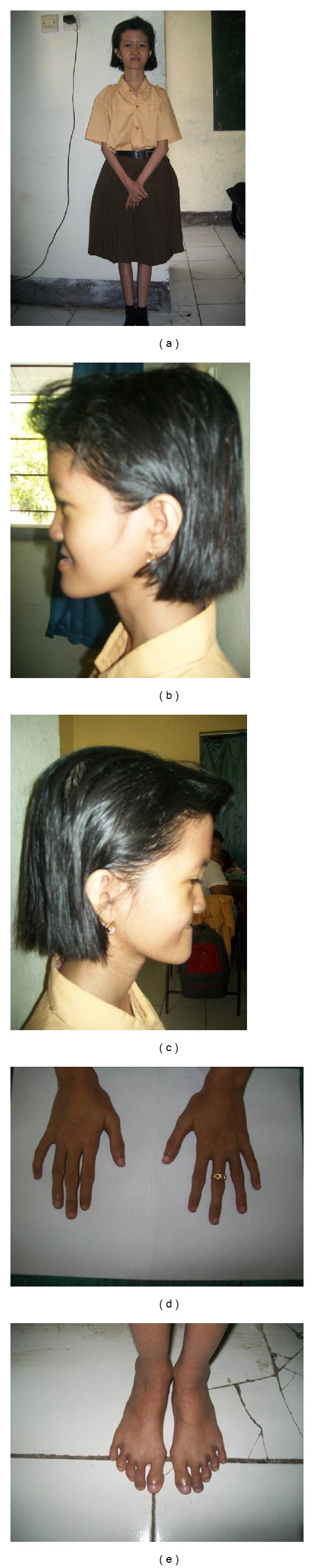
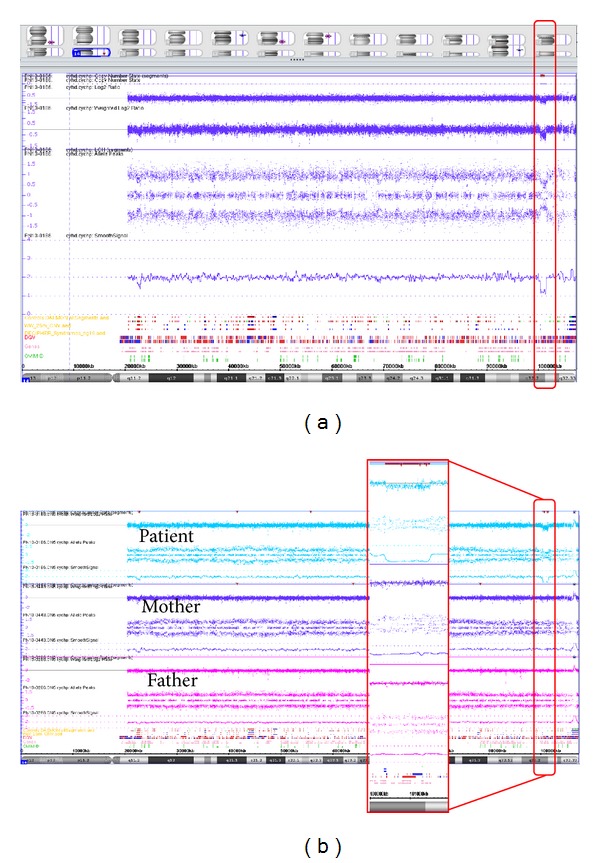
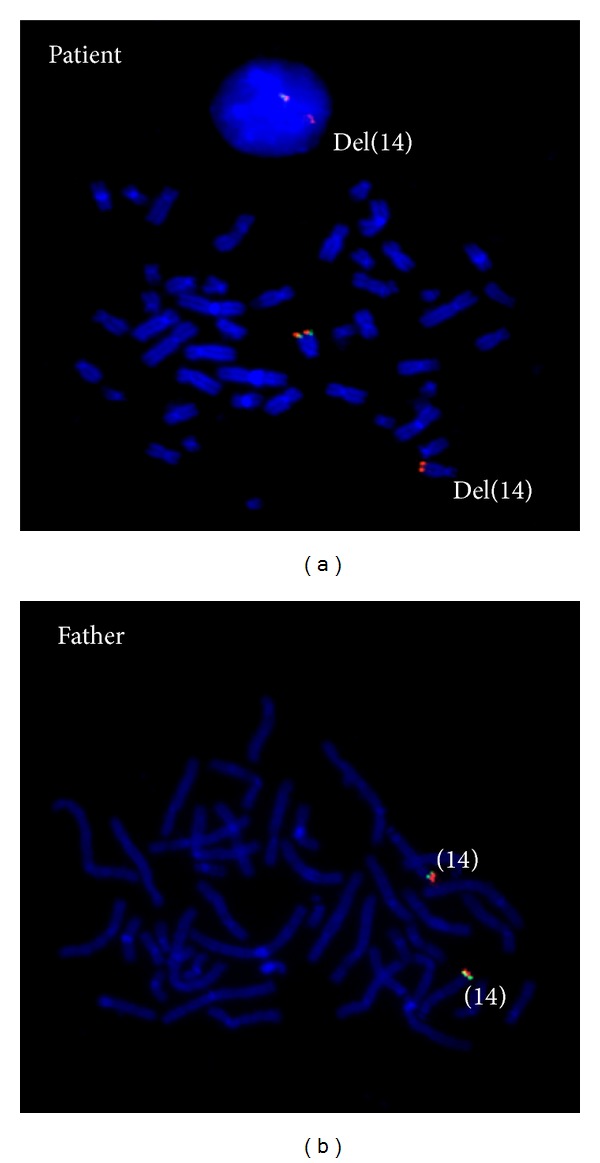
We present a 20-year-old female patient from Indonesia with intellectual disability (ID), proportionate short stature, motor delay, feeding problems, microcephaly, facial dysmorphism, and precocious puberty who was previously screened normal for conventional karyotyping, fragile X testing, and subtelomeric MLPA analysis. Subsequent genome wide array analysis was performed on DNA from blood and revealed a 1.1 Mb deletion in 14q32.2q32.31 (chr14:100,388,343-101,506,214; hg19). Subsequent carrier testing in the parents by array showed that the deletion had occurred de novo in the patient and that her paternal 14q32 allele was deleted. The deleted region encompasses the DLK1/GTL2 imprinted gene cluster which is consistent with the maternal UPD(14)-like phenotype of the patient. This rare, recurrent microdeletion was recently shown not to be mediated by low copy repeats, but by expanded TGG repeats, flanking the 14q32.2q32.21 deletion boundaries, a novel mechanism of recurrent genomic rearrangement. This is another example how the application of high resolution genome wide testing provides an accurate genetic diagnosis, thereby improving the care for patients and optimizing the counselling for family.
Overview
The claims and statistics of this paper haven’t been checked yet.
Run the check — free, no account needed. It reads the open-access text and checks the sources it cites.
Integrity signals
Registry
Cites
Statistics
Figures
Verification
Claims the paper makes
The claims and statistics of this paper haven’t been checked yet.
Run the check — free, no account needed. It reads the open-access text and checks the sources it cites.
Claims other papers make about this one
Each is checked against this paper’s own text: does it say what the citing paper says it does?
The source backs part of the claim, not all of it — or backs it for a different population, condition or comparison.
In the citing paper
“This area is inherently unstable and a 1.1 Mb microdeletion (14q32.2.q32.3, coordinates Chr14: ~100 400 000‐101 500 000) has been reported in a number of patients displaying motor delay, hypotonia, and feeding problems. 43 , 44”
From Validation of differentially expressed brain‐enriched microRNAs in the plasma of PD patients (2020) · cites this paper as [44]
Experimental — accuracy not yet measured
Self-check
Percentages, sums and reported differences re-computed from the paper’s own numbers.
The self-check needs the paper’s full text.
Citations
Cites
Mechanisms of change in gene copy number
Hastings, P. J., Lupski, J. R., Rosenberg, S. M., & Ira, G. (2009) · Nature Reviews Genetics · doi:10.1038/nrg2593 · Cited by 1,316
Research works printed but not linked: 16
- 10.1093/hmg/ddq075 · DOI · Paper page
- 10.1002/humu.20771 · DOI
- 10.1038/ng.2007.56 · DOI
- 1980, American Journal of Medical Genetics, 6, 137, 10.1002/ajmg.1320060207 · DOI
- 2000, American Journal of Medical Genetics, 93, 381, 10.1002/1096-8628(20000828)93:5<381::AID-AJMG7>3.0.CO;2-9 · DOI
- 10.1002/ajmg.a.31414 · DOI
- 10.1038/ejhg.2008.90 · DOI
- 10.1038/sj.ejhg.5201977 · DOI
- 10.1111/j.1399-0004.2008.01116.x · DOI
- 2012, Genetic Test Molecular Biomarkers, 16, 412, 10.1089/gtmb.2011.0157 · DOI
- 2002, Journal of Neuroscience, 22, 5354, 10.1523/JNEUROSCI.22-13-05354.2002 · DOI
- 10.1038/ng.712 · DOI · Paper page
- 10.1111/j.1471-4159.2008.05486.x · DOI
- 1984, Molecular and Cellular Biology, 4, 2253, 10.1128/MCB.4.11.2253 · DOI
- 1988, Molecular and Cellular Biology, 8, 5350, 10.1128/MCB.8.12.5350 · DOI
- 1998, Nucleic Acids Research, 26, 4078, 10.1093/nar/26.17.4078 · DOI
Cited by
Validation of differentially expressed brain‐enriched microRNAs in the plasma of PD patients
Ravanidis, S., Bougea, A., Papagiannakis, N., Koros, C., Simitsi, A. M., Pachi, I., Breza, M., Stefanis, L., & Doxakis, E. (2020) · Annals of Clinical and Translational Neurology · doi:10.1002/acn3.51146 · Cited by 63
Metadata
- Authors
- Zada, A., Mundhofir, F. E. P., Pfundt, R., Leijsten, N., Nillesen, W., Faradz, S. M. H., & de Leeuw, N.
- Affiliations
- Department of Human Genetics, Radboud University Medical Center, The Netherlands Division of Human Genetics, P.O. Box 9101, 6500 HB Nijmegen, The Netherlands
- Center for Biomedical Research (CEBIOR), Faculty of Medicine, Diponegoro University, GSG 2nd Floor, Jl. Dr. Sutomo 14, Semarang 50244, Indonesia
- Venue
- Case Reports in Genetics
- Publisher
- Wiley
- Published
- 2014
- Volume
- 2014
- Pages
- 1-5
- ISSN
- 2090-6544
- 2090-6552
- PMC
- PMC3985205
- Cited by
- 6
- References
- 1
- Language
- en
- Funders
- Excellent Scholarship Program of the Bureau of Planning and International Cooperation
- Ministry of National Education, Government of Indonesia
- Radboud University Medical Centre
About these checks
Registry, retraction, Cites and statistics results are computed, not judged, with one exception: a printed reference that no index lists is read once by a model before it counts as a citation error. Claims are extracted by a model and kept only when their quote appears verbatim in the text; each cited source is then checked, with a model’s help, for whether it says what the claim relies on. Those verdicts can be wrong — read the claim’s quote and the cited source before relying on one.
Statistics and arithmetic are recomputed, not judged.
Confidence bands are shown only for fields calibrated on our annotated test set. None is calibrated yet, so no band is shown.
What counts as a claim ›How we measure confidence ›How we check this ›
Are you an author, or do you see a problem with this page? Request a review
How to cite
Cite CoChat for the checks on this page, and the paper for its own findings.
- This page
- CoChat. (2026). Citation check: A Rare, Recurrent,De Novo 14q32.2q32.31 Microdeletion of 1.1 Mb in a 20-Year-Old Female Patient with a Maternal UPD(14)-Like Phenotype and Intellectual Disability. https://app.cochat.ai/papers/10.1155/2014/530134
- The paper
- Zada, A., Mundhofir, F. E. P., Pfundt, R., Leijsten, N., Nillesen, W., Faradz, S. M. H., & de Leeuw, N. (2014). A Rare, Recurrent,De Novo 14q32.2q32.31 Microdeletion of 1.1 Mb in a 20-Year-Old Female Patient with a Maternal UPD(14)-Like Phenotype and Intellectual Disability. Case Reports in Genetics. https://doi.org/10.1155/2014/530134
Data sources
Bibliographic data: Semantic Scholar, OpenAlex, Crossref.
Contains information from the Semantic Scholar Academic Graph Datasets, made available under the ODC Attribution License (ODC-BY 1.0).
Semantic Scholar’s data is described in: Kinney, R., et al. (2023). The Semantic Scholar Open Data Platform. arXiv:2301.10140.
