

Mechanism and Treatment Strategy of Osteoporosis after Transplantation
Open accessThe DOI matches its Crossref record; 93 of the 93 references it cites were found in a registry or an index.
Abstract
Osteoporosis (OP) has emerged as a frequent and devastating complication of organ solid transplantation process. Bone loss after organ transplant is related to adverse effects of immunosuppressants on bone remodeling and bone quality. Many factors contribute to the pathogenesis of OP in transplanted patients. Many mechanisms of OP have been deeply approached. Drugs for OP can be generally divided into "bone resorption inhibitors" and "bone formation accelerators," the former hindering bone resorption by osteoclasts and the latter increasing bone formation by osteoblasts. Currently, bisphosphonates, which are bone resorption inhibitors drugs, are more commonly used clinically than others. Using the signaling pathway or implantation bone marrow stem cell provides a novel direction for the treatment of OP, especially OP after transplantation. This review addresses the mechanism of OP and its correlation with organ transplantation, lists prevention and management of bone loss in the transplant recipient, and discusses the recipients of different age and gender.
Overview
The claims and statistics of this paper haven’t been checked yet.
Free: it reads the open-access text and checks the first 5 claims that cite a source we can check. Create a free account to check every claim.
Integrity signals
Registry
Cites
Statistics
Figures
Verification
Claims the paper makes
The claims and statistics of this paper haven’t been checked yet.
Free: it reads the open-access text and checks the first 5 claims that cite a source we can check. Create a free account to check every claim.
Claims other papers make about this one
Each is checked against this paper’s own text: does it say what the citing paper says it does?
In the citing paper
“In addition, sudden activation of bone remodeling may induce the progression of bone diseases [140,141,142,143].”
From Bone diseases in patients with chronic liver disease (2019) · cites this paper as [143]
In the citing paper
“Shortly after LT, during the first three to six months, there is a significant and quantitatively substantial increase in bone turnover which is supported by histomorphometric data [142,143]”
From Bone diseases in patients with chronic liver disease (2019) · cites this paper as [143]
In the citing paper
“In a study comparing bone histology before and after LT, this phase of bone turnover exerted a positive effect on bone turnover [142,143].”
From Bone diseases in patients with chronic liver disease (2019) · cites this paper as [143]
Self-check
Percentages, sums and reported differences re-computed from the paper’s own numbers.
The self-check needs the paper’s full text.
Citations
Cites
Pharmacological interventions for somatoform disorders in adults
Kleinstäuber, M., Witthöft, M., Steffanowski, A., van Marwijk, H., Hiller, W., & Lambert, M. J. (2014) · Cochrane Database of Systematic Reviews · doi:10.1002/14651858.cd010628.pub2 · Cited by 11,335
Induced Pluripotent Stem Cell Lines Derived from Human Somatic Cells
Yu, J., Vodyanik, M. A., Smuga-Otto, K., Antosiewicz-Bourget, J., Frane, J. L., Tian, S., Nie, J., Jonsdottir, G. A., Ruotti, V., Stewart, R., et al. (2007) · Science · doi:10.1126/science.1151526 · Cited by 10,310 · cited 1×
“These induced pluripotent human stem cells were first successfully established from the human in 2007 [61].”
BackgroundMacLeod, A. M. (2009) · Kidney International · Cited by 2,219
KDIGO clinical practice guideline for the care of kidney transplant recipients: a summary
Kasiske, B. L., Zeier, M. G., Chapman, J. R., Craig, J. C., Ekberg, H., Garvey, C. A., Green, M. D., Jha, V., Josephson, M. A., Kiberd, B. A., et al. (2010) · Kidney International · doi:10.1038/ki.2009.377 · Cited by 1,735
Special Issue: KDIGO Clinical Practice Guideline for the Care of Kidney Transplant Recipients
Eckardt, K.-U., Kasiske, B. L., & Zeier, M. G. (2009) · American Journal of Transplantation · doi:10.1111/j.1600-6143.2009.02834.x · Cited by 1,499
Embryonic stem cell trials for macular degeneration: a preliminary report
Schwartz, S. D., Hubschman, J.-P., Heilwell, G., Franco-Cardenas, V., Pan, C. K., Ostrick, R. M., Mickunas, E., Gay, R., Klimanskaya, I., & Lanza, R. (2012) · The Lancet · doi:10.1016/s0140-6736(12)60028-2 · Cited by 1,409 · cited 1×
“A recent report confirmed the efficacious use of ES cells for the replacement of lost tissue, like bone [60].”
BackgroundMatrix-embedded cells control osteoclast formation
Xiong, J., Onal, M., Jilka, R. L., Weinstein, R. S., Manolagas, S. C., & O'Brien, C. A. (2011) · Nature Medicine · doi:10.1038/nm.2448 · Cited by 1,304 · cited 1×
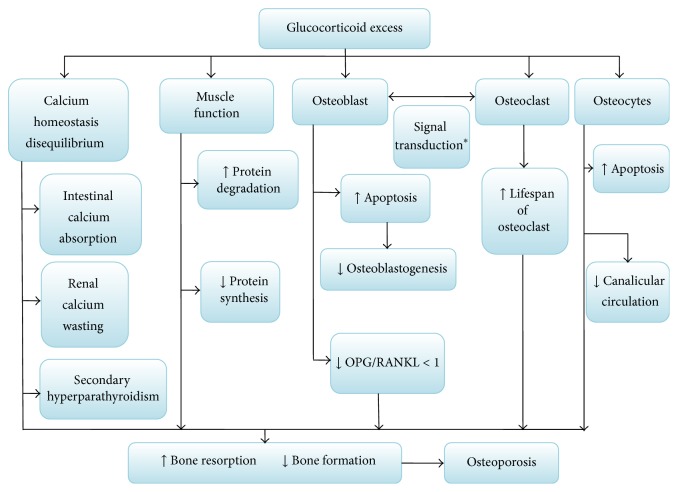
“Several studies [22, 23] indicated that these actions include a decrease in the ratio of OPG/RANKL, which increased bone resorption and reduced bone formation, and also demonstrated that the Wnt signaling pathway may be involved in the GC-induced suppression of OPG.”
BackgroundEckardt, K.-U., & Kasiske, B. L. (2009) · Kidney International · doi:10.1038/ki.2009.188 · Cited by 1,167
Glucocorticoid-induced osteoporosis: pathophysiology and therapy
Canalis, E., Mazziotti, G., Giustina, A., & Bilezikian, J. P. (2007) · Osteoporosis International · doi:10.1007/s00198-007-0394-0 · Cited by 1,114
Bolland, M. J., Avenell, A., Baron, J. A., Grey, A., MacLennan, G. S., Gamble, G. D., & Reid, I. R. (2010) · BMJ · doi:10.1136/bmj.c3691 · Cited by 1,099 · cited 1×
“A daily intake of 1200mg of calcium is recommended for all women with osteoporosis, but high doses of calcium supplementationmay cause increased kidney stone formation [84].”
Background
Research works printed but not linked: 1
- Ebeling P. R. Approach to the patient with transplantation-related bone loss The Journal of Clinical Endocrinology and Metabolism 2009 94 5 1483 1490 10.1210/jc.2009-0205 2-s2.0-66149146642 19420272 · DOI · Paper page
Cited by
Velleca, A., Shullo, M. A., Dhital, K., Azeka, E., Colvin, M., DePasquale, E., Farrero, M., García-Guereta, L., Jamero, G., Khush, K., et al. (2023) · The Journal of Heart and Lung Transplantation · doi:10.1016/j.healun.2022.10.015 · Cited by 645
Chitosan and gelatin-based electrospun fibers for bone tissue engineering
Ranganathan, S., Balagangadharan, K., & Selvamurugan, N. (2019) · International Journal of Biological Macromolecules · doi:10.1016/j.ijbiomac.2019.04.115 · Cited by 233
Bone diseases in patients with chronic liver disease
Jeong, H., & Kim, D. (2019) · International Journal of Molecular Sciences · doi:10.3390/ijms20174270 · Cited by 113
“Shortly after LT, during the first three to six months, there is a significant and quantitatively substantial increase in bone turnover which is supported by histomorphometric data [142,143] and an early increase in the levels of biochemical markers of bone resorption that exceeds the levels of bone formation markers…”
BackgroundProspect of Stem Cell Therapy and Regenerative Medicine in Osteoporosis
Arjmand, B., Sarvari, M., Alavi-Moghadam, S., Payab, M., Goodarzi, P., Gilany, K., Mehrdad, N., & Larijani, B. A. (2020) · Frontiers in Endocrinology · doi:10.3389/fendo.2020.00430 · Cited by 100
“Although particular protocols are demanded to direct differentiation of embryonic stem cells (ESCs) (from the inner cell mass of a blastocyst) and induced pluripotent stem cells (iPSCs) (embryonic–like stem cells reprogrammed from adult cells) toward the osteoblasts and osteocyte-like cells (bone-forming cells), some…”
BackgroundKim, T.-H., Singh, R. K., Kang, M. S., Kim, J.-H., & Kim, H. (2015) · Acta Biomaterialia · doi:10.1016/j.actbio.2015.09.035 · Cited by 71
Metadata
- Authors
- Song, L., Xie, X.-B., Peng, L.-K., Yu, S.-J., & Peng, Y.-T.
- Affiliations
- Second Xiangya Hospital of Central South University (CN)
- Center of Organ Transplantation, Second Xiangya Hospital of Central South University, Changsha 410011, China
- Department of Respiratory Medicine, Second Xiangya Hospital of Central South University, Changsha 410011, China
- ORCID
- Song, Lei
- Venue
- International Journal of Endocrinology
- Publisher
- Hindawi Limited
- Published
- 2015
- Volume
- 2015
- Pages
- 1-10
- ISSN
- 1687-8337 (ISSN-L)
- 1687-8345
- PMC
- PMC4530234
- OpenAlex
- W2160839386
- Cited by
- 30
- References
- 93
- Citations by year
- 2025: 1 · 2023: 3 · 2022: 3 · 2021: 6 · 2020: 6 · 2019: 5 · 2018: 2 · 2017: 1 · 2016: 2 · 2015: 1
- FWCI
- 0.33
- Type
- journal article
- Language
- en
- Open access
- gold
- doi.org
- Locations
- International Journal of Endocrinology (publishedVersion, cc-by)
- Europe PMC (PubMed Central) (publishedVersion, cc-by)
- PubMed Central (publishedVersion, cc-by)
- PubMed (publishedVersion)
- DOAJ (DOAJ: Directory of Open Access Journals) (submittedVersion, cc-by-sa)
- Topics
- Health Sciences › Medicine › Orthopedics and Sports Medicine › Bone health and osteoporosis research
- Life Sciences › Biochemistry, Genetics and Molecular Biology › Molecular Biology › Bone Metabolism and Diseases
- Health Sciences › Medicine › Oncology › Bone health and treatments
- Keywords
- organ transplantation, immunosuppressants, bone remodeling, bone loss, bisphosphonates, antiresorptive agents, osteoclasts, osteoblasts, bone marrow-derived stem cells, signaling pathways, osteoporosis prevention and treatment, age and gender differences
About these checks
Registry, retraction, Cites and statistics results are computed, not judged, with one exception: a printed reference that no index lists is read once by a model before it counts as a citation error. Claims are extracted by a model and kept only when their quote appears verbatim in the text; each cited source is then checked, with a model’s help, for whether it says what the claim relies on. Those verdicts can be wrong — read the claim’s quote and the cited source before relying on one.
Statistics and arithmetic are recomputed, not judged.
Confidence bands are shown only for fields calibrated on our annotated test set. None is calibrated yet, so no band is shown.
What counts as a claim ›How we measure confidence ›How we check this ›
Are you an author, or do you see a problem with this page? Request a review
Data sources
Bibliographic data: Semantic Scholar, OpenAlex, Crossref.
Contains information from the Semantic Scholar Academic Graph Datasets, made available under the ODC Attribution License (ODC-BY 1.0).
Semantic Scholar’s data is described in: Kinney, R., et al. (2023). The Semantic Scholar Open Data Platform. arXiv:2301.10140.
