

The DOI matches its Crossref record; 62 of the 62 references it cites were found in a registry or an index.
Inflammation as a Driver of Clonal Evolution in Myeloproliferative Neoplasm
Abstract
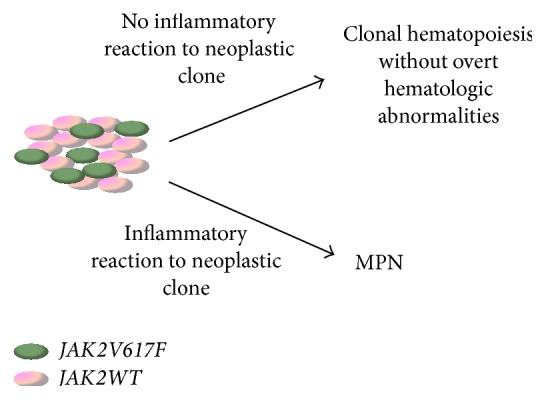
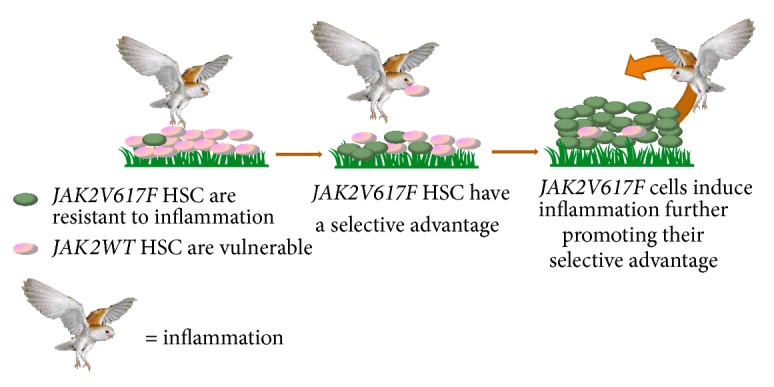
Our understanding of inflammation’s role in the pathogenesis of myeloproliferative neoplasm (MPN) is evolving. The impact of chronic inflammation, a characteristic feature of MPN, likely goes far beyond its role as a driver of constitutional symptoms. An inflammatory response to the neoplastic clone may be responsible for some pathologic aspects of MPN. Moreover, JAK2V617F mutated hematopoietic stem and progenitor cells are resistant to inflammation, and this gives the neoplastic clone a selective advantage allowing for its clonal expansion. Because inflammation plays a central role in MPN inflammation is a logical therapeutic target in MPN.
Overview
The claims and statistics of this paper haven’t been checked yet.
Run the check — free, no account needed. It reads the open-access text and checks the sources it cites.
Integrity signals
Registry
Cites
Statistics
Figures
Verification
Claims the paper makes
The claims and statistics of this paper haven’t been checked yet.
Run the check — free, no account needed. It reads the open-access text and checks the sources it cites.
Claims other papers make about this one
Each is checked against this paper’s own text: does it say what the citing paper says it does?
In the citing paper
“Given that emerging evidence suggests that inflammation very likely plays a causative role in the pathology of MPN (Fleischman, 2015; Koschmieder et al., 2016)”
From Inhibition of Inflammatory Signaling in Tet2 Mutant Preleukemic Cells Mitigates Stress-Induced Abnormalities and Clonal Hematopoiesis (2018) · cites this paper as Fleischman, 2015
Self-check
Percentages, sums and reported differences re-computed from the paper’s own numbers.
The self-check needs the paper’s full text.
Citations
Cites
Age-related clonal hematopoiesis associated with adverse outcomes
Jaiswal, S., Fontanillas, P., Flannick, J., Manning, A., Grauman, P. V., Mar, B. G., Lindsley, R. C., Mermel, C. H., Burtt, N., Chavez, A., et al. (2014) · New England Journal of Medicine · doi:10.1056/nejmoa1408617 · Cited by 4,841
Clonal hematopoiesis and blood-cancer risk inferred from blood DNA sequence
Genovese, G., Kähler, A. K., Handsaker, R. E., Lindberg, J., Rose, S. A., Bakhoum, S. F., Chambert, K., Mick, E., Neale, B. M., Fromer, M., et al. (2014) · New England Journal of Medicine · doi:10.1056/nejmoa1409405 · Cited by 3,531
Age-related mutations associated with clonal hematopoietic expansion and malignancies
Xie, M., Lu, C., Wang, J., McLellan, M. D., Johnson, K. J., Wendl, M. C., McMichael, J. F., Schmidt, H. K., Yellapantula, V., Miller, C. A., et al. (2014) · Nature Medicine · doi:10.1038/nm.3733 · Cited by 1,874
Safety and Efficacy of INCB018424, a JAK1 and JAK2 Inhibitor, in Myelofibrosis
Verstovsek, S., Kantarjian, H., Mesa, R. A., Pardanani, A. D., Cortes-Franco, J., Thomas, D. A., Estrov, Z., Fridman, J. S., Bradley, E. C., Erickson-Viitanen, S., et al. (2010) · New England Journal of Medicine · doi:10.1056/nejmoa1002028 · Cited by 1,164
Quintás-Cardama, A., Vaddi, K., Liu, P., Manshouri, T., Li, J., Scherle, P. A., Caulder, E., Wen, X., Li, Y., Waeltz, P., et al. (2010) · Blood · doi:10.1182/blood-2009-04-214957 · Cited by 843
Exit from dormancy provokes DNA-damage-induced attrition in haematopoietic stem cells
Walter, D., Lier, A., Geiselhart, A., Thalheimer, F. B., Huntscha, S., Sobotta, M. C., Moehrle, B., Brocks, D., Bayindir, I., Kaschutnig, P., et al. (2015) · Nature · doi:10.1038/nature14131 · Cited by 619
Clark, J. D., Flanagan, M. E., & Telliez, J.-B. (2014) · Journal of Medicinal Chemistry · doi:10.1021/jm401490p · Cited by 601
CD169 + macrophages provide a niche promoting erythropoiesis under homeostasis and stress
Chow, A., Huggins, M., Ahmed, J., Hashimoto, D., Lucas, D., Kunisaki, Y., Pinho, S., Leboeuf, M., Noizat, C., van Rooijen, N., et al. (2013) · Nature Medicine · doi:10.1038/nm.3057 · Cited by 433
Cell-fate conversion of lymphoid-committed progenitors by instructive actions of cytokines
Kondo, M., Scherer, D. C., Miyamoto, T., King, A. G., Akashi, K., Sugamura, K., & Weissman, I. L. (2000) · Nature · doi:10.1038/35030112 · Cited by 382
Chronic exposure to a TLR ligand injures hematopoietic stem cells
Esplin, B. L., Shimazu, T., Welner, R. S., Garrett, K. P., Nie, L., Zhang, Q., Humphrey, M. B., Yang, Q., Borghesi, L. A., & Kincade, P. W. (2011) · The Journal of Immunology · doi:10.4049/jimmunol.1003438 · Cited by 319
Cited by
Cai, Z., Kotzin, J. J., Ramdas, B., Chen, S., Nelanuthala, S., Palam, L. R., Pandey, R., Mali, R. S., Liu, Y., Kelley, M. R., et al. (2018) · Cell Stem Cell · doi:10.1016/j.stem.2018.10.013 · Cited by 394
Life histories of myeloproliferative neoplasms inferred from phylogenies
Williams, N., Lee, J., Mitchell, E., Moore, L., Baxter, E. J., Hewinson, J., Dawson, K. J., Menzies, A., Godfrey, A. L., Green, A. R., et al. (2022) · Nature · doi:10.1038/s41586-021-04312-6 · Cited by 285
Inflammation and myeloproliferative neoplasms
Lussana, F., & Rambaldi, A. (2017) · Journal of Autoimmunity · doi:10.1016/j.jaut.2017.06.010 · Cited by 136
Inflammatory Pathophysiology as a Contributor to Myeloproliferative Neoplasms
Fisher, D. A. C., Fowles, J. S., Zhou, A., & Oh, S. T. (2021) · Frontiers in Immunology · doi:10.3389/fimmu.2021.683401 · Cited by 115
Metadata
- Authors
- Fleischman, A. G.
- Venue
- Mediators of Inflammation
- Publisher
- Wiley
- Published
- 2015-01
- Volume
- 2015
- Issue
- 1
- ISSN
- 0962-9351
- 1466-1861
- PMC
- PMC4619974
- Cited by
- 53
- References
- 62
- Language
- en
About these checks
Registry, retraction, Cites and statistics results are computed, not judged, with one exception: a printed reference that no index lists is read once by a model before it counts as a citation error. Claims are extracted by a model and kept only when their quote appears verbatim in the text; each cited source is then checked, with a model’s help, for whether it says what the claim relies on. Those verdicts can be wrong — read the claim’s quote and the cited source before relying on one.
Statistics and arithmetic are recomputed, not judged.
Confidence bands are shown only for fields calibrated on our annotated test set. None is calibrated yet, so no band is shown.
What counts as a claim ›How we measure confidence ›How we check this ›
Are you an author, or do you see a problem with this page? Request a review
Data sources
Bibliographic data: Semantic Scholar, OpenAlex, Crossref.
Contains information from the Semantic Scholar Academic Graph Datasets, made available under the ODC Attribution License (ODC-BY 1.0).
Semantic Scholar’s data is described in: Kinney, R., et al. (2023). The Semantic Scholar Open Data Platform. arXiv:2301.10140.
