

Prognostics of Lithium-Ion Batteries Based on Wavelet Denoising and DE-RVM
Open accessThe DOI matches its Crossref record; 26 of the 26 references it cites were found in a registry or an index.
Abstract
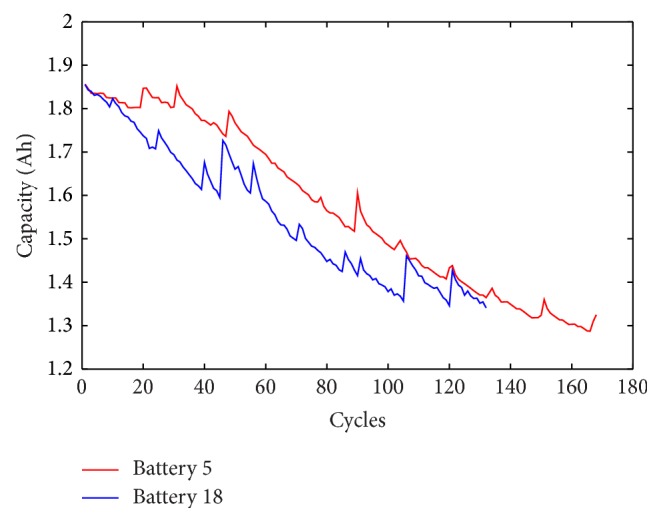
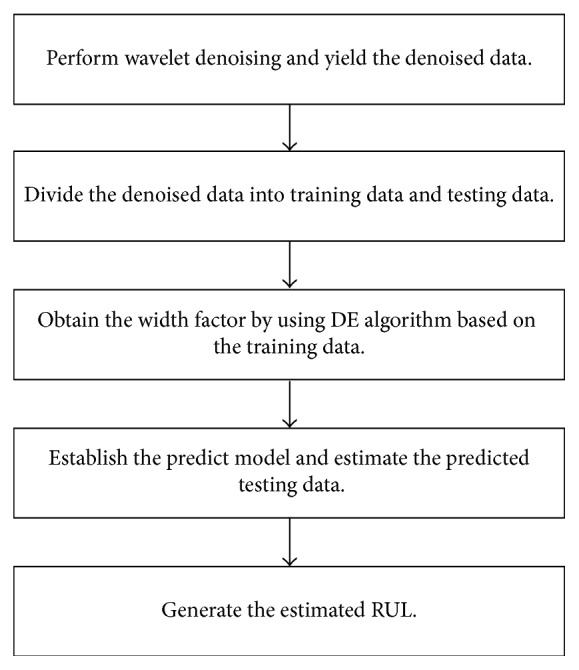
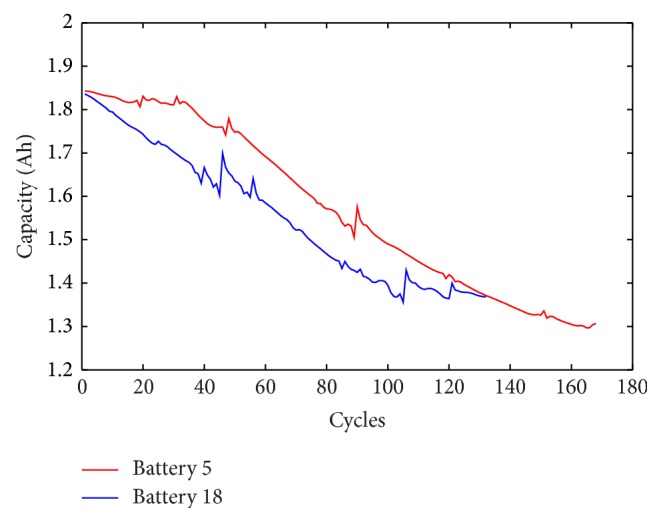
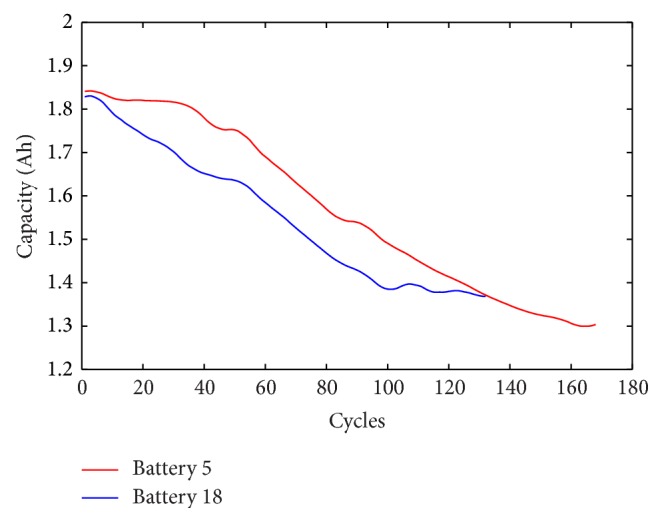
Lithium-ion batteries are widely used in many electronic systems. Therefore, it is significantly important to estimate the lithium-ion battery's remaining useful life (RUL), yet very difficult. One important reason is that the measured battery capacity data are often subject to the different levels of noise pollution. In this paper, a novel battery capacity prognostics approach is presented to estimate the RUL of lithium-ion batteries. Wavelet denoising is performed with different thresholds in order to weaken the strong noise and remove the weak noise. Relevance vector machine (RVM) improved by differential evolution (DE) algorithm is utilized to estimate the battery RUL based on the denoised data. An experiment including battery 5 capacity prognostics case and battery 18 capacity prognostics case is conducted and validated that the proposed approach can predict the trend of battery capacity trajectory closely and estimate the battery RUL accurately.
Overview
The claims and statistics of this paper haven’t been checked yet.
Free: it reads the open-access text and checks the first 5 claims that cite a source we can check. Create a free account to check every claim.
Integrity signals
Registry
Cites
Statistics
Figures
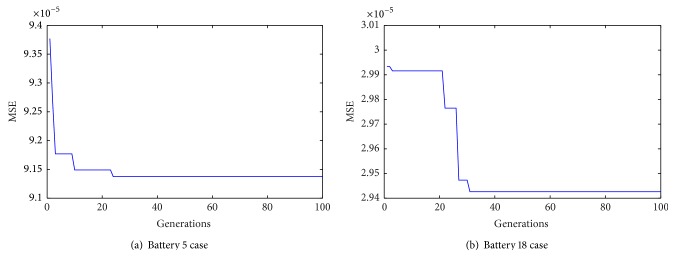
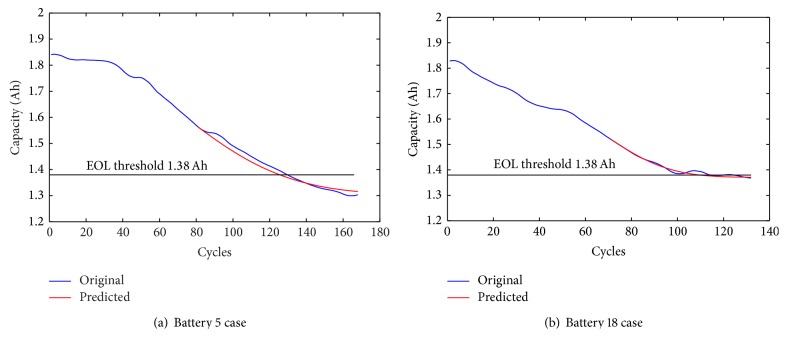
Verification
Claims the paper makes
The claims and statistics of this paper haven’t been checked yet.
Free: it reads the open-access text and checks the first 5 claims that cite a source we can check. Create a free account to check every claim.
Claims other papers make about this one
Each is checked against this paper’s own text: does it say what the citing paper says it does?
In the citing paper
“Studies have shown that RVM can reasonably estimate and predict the current SOH state of the battery with probability characteristics and present the prediction results in the form of probability [116-118].”
From A Review of Lithium-Ion Battery State of Health Estimation and Prediction Methods (2021) · cites this paper as [117]
Self-check
Percentages, sums and reported differences re-computed from the paper’s own numbers.
The self-check needs the paper’s full text.
Citations
Cites
Cortes, C., & Vapnik, V. (1995) · Machine Learning · doi:10.1007/bf00994018 · Cited by 59,421
Cortes, C., & Vapnik, V. (1995) · Machine-mediated learning · doi:10.1023/a:1022627411411 · Cited by 48,445 · cited 1×
“Support vector machine (SVM) is a machine learning tool [13] characterized by the usage of kernel functions and it has been utilized to estimate the battery RUL [9, 10].”
MethodStorn, R., & Price, K. (1997) · Journal of Global Optimization · doi:10.1023/a:1008202821328 · Cited by 29,569 · cited 1×
“DE algorithm is a population-based and stochastic search approach [18] and has shown superior performance on nonlinear, nonconvex, and nondifferentiable optimization problems [19–21].”
Method(2000) · CrossRef Listing of Deleted DOIs · doi:10.1162/15324430152748236 · Cited by 1,819
Prognostics methods for battery health monitoring using a bayesian framework
Saha, B., Goebel, K., Poll, S., & Christophersen, J. (2009) · IEEE Transactions on Instrumentation and Measurement · doi:10.1109/tim.2008.2005965 · Cited by 831 · cited 1×
“Extended Kalman filtering (EKF) [1, 2], nonlinear model [3, 4], and particle filtering (PF) [5, 6] are commonly used model-based methods for the battery capacity estimation.”
MethodDifferential Evolution as Applied to Electromagnetics
Rocca, P., Oliveri, G., & Massa, A. (2011) · IEEE Antennas and Propagation Magazine · doi:10.1109/map.2011.5773566 · Cited by 580 · cited 1×
“DE algorithm is a population-based and stochastic search approach [18] and has shown superior performance on nonlinear, nonconvex, and nondifferentiable optimization problems [19–21].”
MethodMetrics for Offline Evaluation of Prognostic Performance
Saxena, A., Celaya, J., Saha, B., Saha, S., & Goebel, K. (2021) · International Journal of Prognostics and Health Management · doi:10.36001/ijphm.2010.v1i1.1336 · Cited by 449
Bhattacharya, A., & Chattopadhyay, P. K. (2010) · IEEE Transactions on Power Systems · doi:10.1109/tpwrs.2010.2043270 · Cited by 412
Intelligent prognostics for battery health monitoring based on sample entropy
Widodo, A., Shim, M.-C., Caesarendra, W., & Yang, B.-S. (2011) · Expert Systems with Applications · doi:10.1016/j.eswa.2011.03.063 · Cited by 392 · cited 1×
“Support vector machine (SVM) is a machine learning tool [13] characterized by the usage of kernel functions and it has been utilized to estimate the battery RUL [9, 10].”
MethodWang, D., Miao, Q., & Pecht, M. (2013) · Journal of Power Sources · doi:10.1016/j.jpowsour.2013.03.129 · Cited by 351
Research works printed but not linked: 1
- He W. Williard N. Osterman M. Pecht M. Prognostics of lithium-ion batteries using extended Kalman filtering Proceedings of the IMAPS Advanced Technology Workshop on High Reliability Microelectronics for Military Applications May 2011 Linthicum Heights, Md, USA 17 19
Cited by
Hu, X., Xu, L., Lin, X., & Pecht, M. (2020) · Joule · doi:10.1016/j.joule.2019.11.018 · Cited by 1,320
Dai, H., Jiang, B., Hu, X., Lin, X., Wei, X., & Pecht, M. (2021) · Renewable and Sustainable Energy Reviews · doi:10.1016/j.rser.2020.110480 · Cited by 405
Rauf, H., Khalid, M., & Arshad, N. (2022) · Renewable and Sustainable Energy Reviews · doi:10.1016/j.rser.2021.111903 · Cited by 326
Zhao, S., Zhang, C., & Wang, Y. (2022) · Journal of Energy Storage · doi:10.1016/j.est.2022.104901 · Cited by 259
Self-citationA Review of Lithium-Ion Battery State of Health Estimation and Prediction Methods
Yao, L., Xu, S., Tang, A., Zhou, F., Hou, J., Xiao, Y., & Fu, Z. (2021) · World Electric Vehicle Journal · doi:10.3390/wevj12030113 · Cited by 237
Wu, L., Fu, X., & Guan, Y. (2016) · Applied Sciences · doi:10.3390/app6060166 · Cited by 203
“[33] reduced noises in characteristic signals using wavelet decomposition and estimated the battery RUL, which was based on NASA’s lithium-ion battery data and used the RVM degradation model.”
MethodAn Integrated Method of the Future Capacity and RUL Prediction for Lithium-Ion Battery Pack
Zhang, C., Zhao, S., & He, Y. (2022) · IEEE Transactions on Vehicular Technology · doi:10.1109/tvt.2021.3138959 · Cited by 195
“Signal processing methods primarily embrace empirical mode decomposition (EMD) [26], variational modal decomposition (VMD) [27], wavelet transform (WT) [28], and so on.”
MethodSelf-citationA critical review on self-adaptive Li-ion battery ageing models
Lucu, M., Martinez-Laserna, E., Gandiaga, I., & Camblong, H. (2018) · Journal of Power Sources · doi:10.1016/j.jpowsour.2018.08.064 · Cited by 167
SONG, Y., LIU, D., HOU, Y., YU, J., & PENG, Y. (2018) · Chinese Journal of Aeronautics · doi:10.1016/j.cja.2017.11.010 · Cited by 157
Wang, F.-K., & Mamo, T. (2018) · Journal of Power Sources · doi:10.1016/j.jpowsour.2018.08.073 · Cited by 126
Tang, T. H., & Yuan, H. (2021) · Reliability Engineering & System Safety · doi:10.1016/j.ress.2021.108082 · Cited by 135
Capacity Prognostics of Lithium-Ion Batteries using EMD Denoising and Multiple Kernel RVM
Zhang, C., He, Y., Yuan, L., & Xiang, S. (2017) · IEEE Access · doi:10.1109/access.2017.2716353 · Cited by 91
“Empirical mode decomposition (EMD) is a method for analyzing nonlinear and non-stationary signal by adaptively decomposing the signal into a series of zero-mean oscillation modes called intrinsic mode functions (IMFs) [43], and method’s main advantage is that its basis functions are extracted from the signals in contr…”
MethodSelf-citationUnsupervised dynamic prognostics for abnormal degradation of lithium-ion battery
Wang, C., & Chen, Y. (2024) · Applied Energy · doi:10.1016/j.apenergy.2024.123280 · Cited by 90
Ensemble learning based predictive framework for virtual machine resource request prediction
Kumar, J., Singh, A. K., & Buyya, R. (2020) · Neurocomputing · doi:10.1016/j.neucom.2020.02.014 · Cited by 80
Chen, L., Xu, L., & Zhou, Y. (2018) · Energies · doi:10.3390/en11040820 · Cited by 66
“[8] utilized the wavelet denoising technology”
Xu, X., Yu, C., Tang, S., Sun, X., Si, X., & Wu, L. (2019) · IEEE Access · doi:10.1109/access.2019.2923095 · Cited by 64
“This type of methods mainly includes neural networks [37], [38], fuzzy logic [35], [39], support vector regression [31], [40], support vector machines [41], [42], and relevant vector machines [43], [44] etc.”
MethodA review on prognostics approaches for remaining useful life of lithium-ion battery
Su, C., & Chen, H. J. (2017) · IOP Conference Series: Earth and Environmental Science · doi:10.1088/1755-1315/93/1/012040 · Cited by 64
Hu, W., & Zhao, S. (2022) · Frontiers in Energy Research · doi:10.3389/fenrg.2022.969168 · Cited by 51
“The method employed in this study, based on wavelet threshold denoising (WTD) (Zhang et al., 2015), cannot only effectively filter the noise but also maximize the noise and guarantee that the effective signal is not lost.”
MethodDecomposition Based Cloud Resource Demand Prediction Using Extreme Learning Machines
Kumar, J., & Singh, A. K. (2020) · Journal of Network and Systems Management · doi:10.1007/s10922-020-09557-6 · Cited by 45
Acosta, S. M., Amoroso, A. L., Sant’Anna, Â. M. O., & Canciglieri, O. (2021) · Annals of Operations Research · doi:10.1007/s10479-021-04053-9 · Cited by 37
“Zhang et al. (2015) utilized an RVM to estimate the remaining useful life of a lithium-ion battery based on denoised data.”
MethodBi, J., Lee, J., & Liu, H. (2022) · Energies · doi:10.3390/en15072448 · Cited by 36
Novel Lithium-Ion Battery State-of-Health Estimation Method Using a Genetic Programming Model
Yao, H., Jia, X. D., Zhao, Q., Cheng, Z., & Guo, B. (2020) · IEEE Access · doi:10.1109/access.2020.2995899 · Cited by 34
“INTRODUCTION Currently, prognostic and health management (PHM) has been widely studied in industrial management to improve industrial production efficiency and ensure production safety [1], [2].”
BackgroundMa, Y., Li, J., Hu, Y., & Chen, H. (2024) · IEEE Transactions on Intelligent Transportation Systems · doi:10.1109/tits.2024.3355436 · Cited by 24
“Most of the denoising methods use filtering, such as Variation Mode Decomposition [41], Wavelet Threshold Denoising [42], etc. Hu et al. proposed a wavelet-based threshold denoising method to eliminate noise signals in response to the noise sequences embedded in the measured aging data of…”
MethodGao, Y., Li, C., & Huang, L. (2022) · Frontiers in Energy Research · doi:10.3389/fenrg.2022.1032660 · Cited by 22
Pelosi, D., Gallorini, F., Ottaviano, A., & Barelli, L. (2024) · Journal of Power Sources Advances · doi:10.1016/j.powera.2024.100136 · Cited by 18
Darwish, A. (2024) · Sustainable Machine Intelligence Journal · doi:10.61356/smij.2024.661505 · Cited by 16
A multiple heterogeneous kernel RVM approach for analog circuit fault prognostic
Zhang, C., He, Y., Yuan, L., & Xiang, S. (2018) · Cluster Computing · doi:10.1007/s10586-018-2437-z · Cited by 14
Self-citationA Framework for Aircraft Maintenance Strategy including CBM
Adhikari, P. P., & Buderath, M. (2016) · PHM Society European Conference · doi:10.36001/phme.2016.v3i1.1622 · Cited by 14
Xiang, M., He, Y., Zhang, H., Zhang, C., Wang, L., Wang, C., & Sui, C. (2020) · IEEE Access · doi:10.1109/access.2020.3029276 · Cited by 12
“The usual denoising methods are wavelet transform [22], empirical mode decomposition (EMD) [21], and its modifications like variational mode decomposition [23] and complete ensemble EMD [24].”
MethodSelf-citationPelosi, D., Gallorini, F., Ottaviano, A., & Barelli, L. (2024) · Batteries & Supercaps · doi:10.1002/batt.202300551 · Cited by 10
Pelosi, D., Trombetti, L., Gallorini, F., Ottaviano, A., & Barelli, L. (2025) · IEEE Open Journal of Industry Applications · doi:10.1109/ojia.2025.3527721 · Cited by 10
“Moreover, at the best of our knowledge, DWT application to SIBs is not present in literature, while it is limited to only few papers for the estimation of LIB SoH [31], [32], [33], [34], [35].”
Physically enhanced neural network for lithium-ion battery state of health estimation
Zhou, Z., Jiang, Y., Wang, T., Shi, Y., Cai, H., & Jones, C. N. (2025) · Journal of Energy Storage · doi:10.1016/j.est.2025.115959 · Cited by 9
EUStress: A Human Behaviour Analysis System for Monitoring and Assessing Stress During Exams
Gonçalves, F., Carneiro, D. R., Nováis, P., & Pêgo, J. M. (2017) · Studies in computational intelligence · doi:10.1007/978-3-319-66379-1_13 · Cited by 9
A Data-driven Deep Learning Approach for Remaining Useful Life in the ion mill etching Process
Darwish, A. (2024) · Sustainable Machine Intelligence Journal · doi:10.61356/smij.2024.8288 · Cited by 8
An Empirical Investigation on a Multiple Filters-Based Approach for Remaining Useful Life Prediction
Trinh, H.-C., & Kwon, Y. (2018) · Machines · doi:10.3390/machines6030035 · Cited by 7
A multi-model fusion method for state of health estimation of marine lithium-ion batteries
Li, X., Zheng, D., Zhou, M., Zhao, J., Jiang, W., Tang, R., Zhang, Y., & Yang, X. (2025) · Journal of Energy Storage · doi:10.1016/j.est.2025.116668 · Cited by 6
Liu, R. (2020) · Recent Advances in Computer Science and Communications · doi:10.2174/2666255813999201002152742 · Cited by 6
Liu, Y., Li, Q., Zhu, J., Zhang, B., & Guo, J. (2025) · Electronics · doi:10.3390/electronics14193794 · Cited by 4
Darwish, A. (2024) · Information Sciences with Applications · doi:10.61356/j.iswa.2024.2224 · Cited by 3
“Zhang et al. [21] utilized the relevance vector machine (RVM) enhanced by the differential evolution (DE) algorithm to predict the RUL of batteries using denoised data generated by the wavelet denoising algorithm.”
MethodDimensional-noise-aware battery lifetime prediction via an EM-TLS framework
Yu, C., Lu, T., Liu, G., Zhai, X., Deng, W., Wan, J., Yang, L., & Li, X. (2025) · Progress in Natural Science Materials International · doi:10.1016/j.pnsc.2024.11.009 · Cited by 3
Performance Improvement Techniques for Neural Networks in Tool Condition Monitoring
Yodo, N., & Dey, A. (2022) · International Journal of Mechatronics and Manufacturing Systems · doi:10.1504/ijmms.2022.10048836 · Cited by 3
Analog Circuit Fault Prognostic Approach using Optimized RVM
Zhang, C. (2019) · International Journal of Performability Engineering · doi:10.23940/ijpe.19.05.p22.14531461 · Cited by 2
“RVM The RVM algorithm was firstly presented in reference [17], and it has demonstrated superior performance in prognostic works [19-21].”
MethodSelf-citationEfficient Pattern Recognition Using the Frequency Response of a Spiking Neuron
Valadez-Godínez, S., Rangel-González, J. A., & Sossa, H. (2017) · Lecture notes in computer science · doi:10.1007/978-3-319-59226-8_6 · Cited by 2
A new method for estimating lithium-ion battery capacity using genetic programming combined model
Yao, H., Jia, X. D., Wang, B., & Guo, B. (2019) · Prognostics and System Health Management Conference · doi:10.1109/phm-qingdao46334.2019.8942970 · Cited by 2
“[10] used wavelet to denoise the noise during battery testing, and estimated the robustness of the test by differential evolution-optimized RVM.”
MethodPelosi, D., Scarpelli, C., Quilici, F. G., Lutzemberger, G., Gallorini, F., Brunori, E., & Barelli, L. (2026) · IEEE Open Journal of Industry Applications · doi:10.1109/ojia.2026.3718013 · Cited by 1
“Several papers applied DWT directly on voltage profiles [36], [37], [38], [39], [40].”
Long-term Remaining Useful Life Prediction of Lithium Battery based on Grey Theory
Guo, P., & Cheng, Z. (2019) · IEEE International Conference on Advanced Power System Automation and Protection (APAP) · doi:10.1109/apap47170.2019.9224883 · Cited by 1
“Wavelet denoising is performed to weaken the data noise in [15].”
BackgroundLi, S., Zhang, L., Han, D., Li, B., Wang, H., & Kang, R. (2024) · International Conference on System Reliability and Safety (ICSRS) · doi:10.1109/icsrs63046.2024.10927498
“Signal transformation methods, including Empirical Modal Decomposition (EMD) [2]–[6], VMD [7]–[10], Ensemble Empirical Mode Decomposition (EEMD) [11]–[13] and Wavelet Transformation (WT) [14] are also increasingly applied to overcome the negative effect from CPR.”
Artificial Intelligence in Lithium-Ion Battery Predictions: A Comparative Study
Shilpa, R., Periyakaruppan, K., Mithra, U., Thrisha, K., Saratha, R., & Varatharaj, R. (2025) · Advances in computational intelligence and robotics book series · doi:10.4018/979-8-3373-2530-9.ch007
Ma, T., Liu, J., Xu, P., Song, Y. X., & Bai, X. (2025) · Sensors · doi:10.3390/s25164883
“Zhang et al. [24] employed Relevance Vector Machines (RVMs) in conjunction with Differential Algorithms (DE) to predict RUL using denoised data generated by wavelet algorithms.”
Gan, X., Liu, H., Tong, B., Zhu, J., Kong, J., Zhou, H., & Yao, X. (2026) · Journal of Energy Storage · doi:10.1016/j.est.2026.121549
Lai, R., Wu, H., Jiang, F., & Zhao, Y. (2026) · Ionics · doi:10.1007/s11581-026-07403-4
“Zhang et al. [15] adopt the relevance vector machine (RVM) improved by differen - tial evolution algorithm to estimate the battery’s RUL.”
Metadata
- Authors
- Zhang, C., He, Y., Yuan, L., Xiang, S., & Wang, J.
- Affiliations
- Hefei University of Technology (CN)
- Corresponding author
- Zhang, Chaolong
- Venue
- Computational Intelligence and Neuroscience
- Publisher
- Wiley
- Published
- 2015
- Volume
- 2015
- Pages
- 1-8
- ISSN
- 1687-5265 (ISSN-L)
- 1687-5273
- PMC
- PMC4568058
- OpenAlex
- W1694861895
- Cited by
- 50
- References
- 26
- Citations by year
- 2026: 3 · 2025: 7 · 2024: 7 · 2022: 5 · 2021: 5 · 2020: 7 · 2019: 4 · 2018: 5 · 2017: 5 · 2016: 2
- FWCI
- 4.13
- Type
- journal article
- Language
- en
- Open access
- hybrid
- doi.org
- Locations
- Computational Intelligence and Neuroscience (publishedVersion, cc-by)
- Europe PMC (PubMed Central) (publishedVersion, cc-by)
- PubMed Central (publishedVersion, cc-by)
- PubMed (publishedVersion)
- DOAJ (DOAJ: Directory of Open Access Journals) (submittedVersion, cc-by-sa)
- Funders
- National Natural Science Funds of China for Distinguished Young Scholar (50925727, C1120110004, 9140A27020211DZ5102, 313018, 1301022036, 2012HGCX0003, 2014HGCH0012, 61401139, 51407054, 61403115, 1508085QE85)
- Defense Advanced Research Projects Agency (50925727, C1120110004, 9140A27020211DZ5102, 313018, 1301022036, 2012HGCX0003, 2014HGCH0012, 61401139, 51407054, 61403115, 1508085QE85)
- Ministry of Education of the People’s Republic of China (50925727, C1120110004, 9140A27020211DZ5102, 313018, 1301022036, 2012HGCX0003, 2014HGCH0012, 61401139, 51407054, 61403115, 1508085QE85)
- Anhui Provincial Science and Technology Foundation of China (50925727, C1120110004, 9140A27020211DZ5102, 313018, 1301022036, 2012HGCX0003, 2014HGCH0012, 61401139, 51407054, 61403115, 1508085QE85)
- Fundamental Research Funds for the Central Universities (50925727, C1120110004, 9140A27020211DZ5102, 313018, 1301022036, 2012HGCX0003, 2014HGCH0012, 61401139, 51407054, 61403115, 1508085QE85)
- National Natural Science Foundation of China (50925727, C1120110004, 9140A27020211DZ5102, 313018, 1301022036, 2012HGCX0003, 2014HGCH0012, 61401139, 51407054, 61403115, 1508085QE85)
- Natural Science Foundation of Anhui Province (50925727, C1120110004, 9140A27020211DZ5102, 313018, 1301022036, 2012HGCX0003, 2014HGCH0012, 61401139, 51407054, 61403115, 1508085QE85)
- Topics
- Physical Sciences › Engineering › Automotive Engineering › Battery Modeling and Management
- Physical Sciences › Engineering › Control and Systems Engineering › Machine Fault Diagnosis Techniques
- Physical Sciences › Engineering › Electrical and Electronic Engineering › Advancements in Battery Materials
- Keywords
- lithium-ion batteries, remaining useful life prediction, wavelet denoising, relevance vector machine, differential evolution, noise reduction
- MeSH terms
- Algorithms, Biological Evolution, Humans, Lithium, Models, Theoretical, Electric Power Supplies, Wavelet Analysis, Support Vector Machine
About these checks
Registry, retraction, Cites and statistics results are computed, not judged, with one exception: a printed reference that no index lists is read once by a model before it counts as a citation error. Claims are extracted by a model and kept only when their quote appears verbatim in the text; each cited source is then checked, with a model’s help, for whether it says what the claim relies on. Those verdicts can be wrong — read the claim’s quote and the cited source before relying on one.
Statistics and arithmetic are recomputed, not judged.
Confidence bands are shown only for fields calibrated on our annotated test set. None is calibrated yet, so no band is shown.
What counts as a claim ›How we measure confidence ›How we check this ›
Are you an author, or do you see a problem with this page? Request a review
Data sources
Bibliographic data: Semantic Scholar, OpenAlex, Crossref.
Contains information from the Semantic Scholar Academic Graph Datasets, made available under the ODC Attribution License (ODC-BY 1.0).
Semantic Scholar’s data is described in: Kinney, R., et al. (2023). The Semantic Scholar Open Data Platform. arXiv:2301.10140.
