

The DOI matches its Crossref record; 1 of the 1 references it cites were found in a registry or an index.
Methanolic Extract of Dill Leaves Inhibits AGEs Formation and Shows Potential Hepatoprotective Effects in CCl4 Induced Liver Toxicity in Rat
Abstract
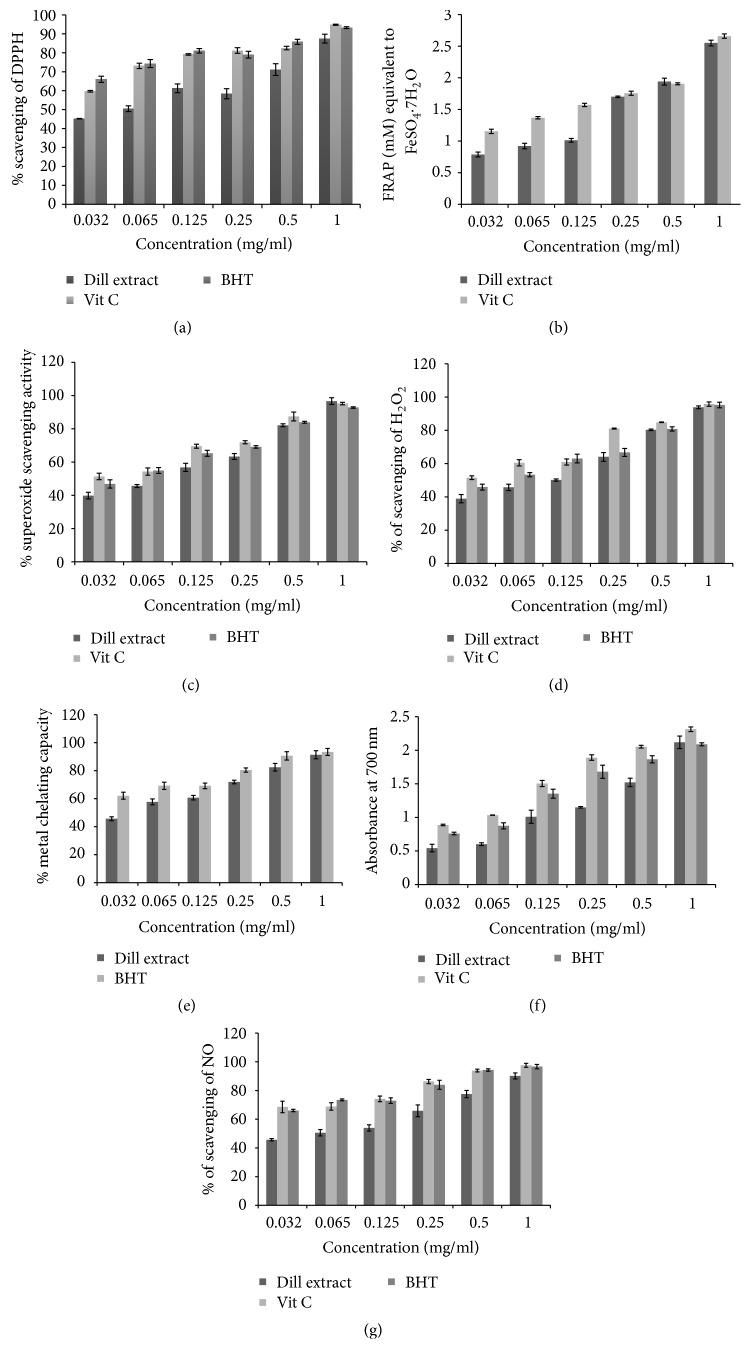
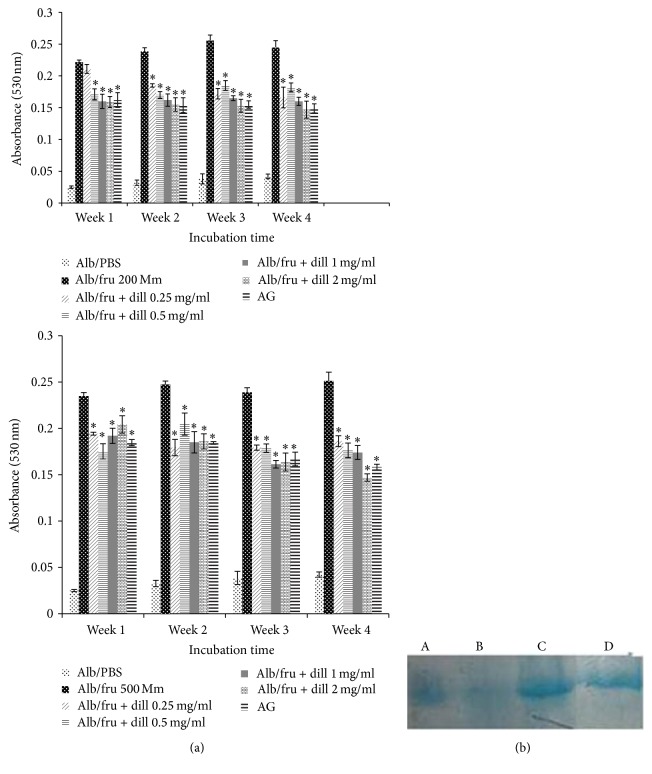
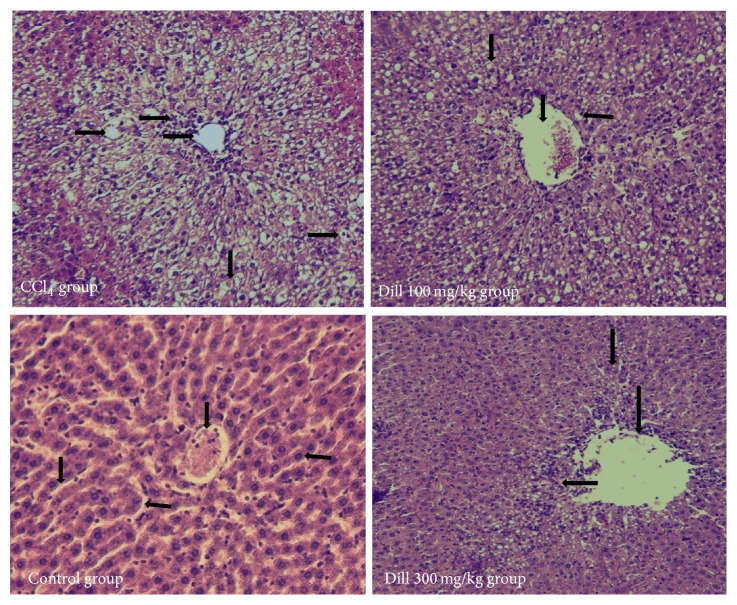
The research was aimed at evaluating the antiglycation, antioxidant, and hepatoprotective properties of methanolic extract of Anethum graveolens (dill). The antioxidant properties, photochemical characteristics, and antiglycation effects of dill extract were measured. Carbon tetrachloride-induced hepatotoxic rats were used to show the hepatoprotective activity of dill leaves. Different concentration of dill extract (0.032, 0.065, 0.125, 0.25, 0.5, and 1 mg/mL) showed potential antioxidant ability. The extract of dill leaves significantly reduced AGEs formation and also fructosamine and protein carbonyl levels in rats’ liver. Thiol groups’ oxidation, amyloid cross-β, and protein fragmentation (P<0.001) significantly reduced in treated rats. Liver damage markers significantly reduced in dill-treated animals (P<0.05). Dill with potential antioxidant, antiglycation, and hepatoprotective effects can be suggested for treatment of diabetes complications.
Overview
The claims and statistics of this paper haven’t been checked yet.
Run the check — free, no account needed. It reads the open-access text and checks the sources it cites.
Integrity signals
Registry
Cites
Statistics
Figures
Verification
Claims the paper makes
The claims and statistics of this paper haven’t been checked yet.
Run the check — free, no account needed. It reads the open-access text and checks the sources it cites.
Claims other papers make about this one
Each is checked against this paper’s own text: does it say what the citing paper says it does?
In the citing paper
“Oshaghi et al. (2017) documented antiglycation, antioxidant, and hepatoprotective activities of dill leaf extract; therefore, they suggested that dill may be applied as a safe source for diabetes problems and liver poisonousness treatment (Oshaghi et al., 2017).”
From Induction role of chitosan nanoparticles to Anethum graveolens extract against food-borne bacteria, oxidant, and diabetic activities in vitro (2023) · cites this paper as Oshaghi et al., 2017
Self-check
Percentages, sums and reported differences re-computed from the paper’s own numbers.
The self-check needs the paper’s full text.
Citations
Cites
Anethum graveolens: An Indian traditional medicinal herb and spice
Shekhawat, G., & Jana, S. (2010) · Pharmacognosy Reviews · doi:10.4103/0973-7847.70915 · Cited by 269
Research works printed but not linked: 35
- 2008, Pharmacologyonline, 2, 219
- 10.5539/ijb.v5n4p14 · DOI
- 10.1016/j.foodchem.2008.12.039 · DOI
- 2005, Iranian Journal of Diabetes and Lipid Disorders, 5, 109
- 2011, Tropical Journal of Pharmaceutical Research, 10, 47
- 10.5455/vetworld.2013.502-507 · DOI
- 2014, Pharmaceutical Sciences, 20, 40
- 2012, Annals of Biological Research, 3, 4313
- 10.1002/ptr.2553 · DOI
- 2013, Avicenna Journal of Medical Biochemistry, 1, 1
- 2014, Journal of Agricultural Science and Technology, 16, 343
- 10.1155/2015/958560 · DOI
- 10.1186/1472-6882-14-130 · DOI
- 2016, Iranian Journal of Medical Sciences, 41, 328
- 10.4103/2229-516x.179019 · DOI
- 10.1016/j.jfca.2005.04.009 · DOI
- 10.3109/13880209.2012.761244 · DOI
- 2013, International Journal of Preventive Medicine, 4, 889
- 10.1016/j.foodres.2011.04.019 · DOI
- 10.1016/S0278-6915(02)00169-2 · DOI
- 10.1254/jphs.FP0030597 · DOI
- 10.1186/s12906-015-0919-6 · DOI
- 10.1016/j.fct.2013.05.053 · DOI · Paper page
- 10.1016/s2213-8587(13)70199-2 · DOI · Paper page
- 10.2337/db11-1120 · DOI
- 10.1515/jbcpp-2012-0017 · DOI
- 10.1016/S0531-5565(03)00004-4 · DOI
- 2002, Kobe Journal of Medical Sciences, 48, 125
- 10.1055/s-0031-1282406 · DOI
- 10.3923/pjn.2014.303.309 · DOI
- 2008, DARU Journal of Pharmaceutical Sciences, 16, 88
- 10.1002/ptr.2329 · DOI
- 10.1155/2016/1098916 · DOI · Paper page
- 2012, Journal of Chemical and Pharmaceutical Research, 4, 1885
- 10.1016/j.apjtb.2015.06.012 · DOI
Cited by
Mashraqi, A. (2023) · Frontiers in Microbiology · doi:10.3389/fmicb.2023.1209524 · Cited by 16
Metadata
- Authors
- Oshaghi, E. A., Khodadadi, I., Mirzaei, F., Khazaei, M., Tavilani, H., & Goodarzi, M. T.
- Affiliations
- Department of Clinical Biochemistry, School of Medicine, Hamadan University of Medical Sciences, Hamadan, Iran
- Student Research Committee, Kermanshah University of Medical Sciences, Kermanshah, Iran
- Fertility and Infertility Research Center, Kermanshah University of Medical Sciences, Kermanshah, Iran
- Venue
- Journal of Pharmaceutics
- Publisher
- Wiley
- Published
- 2017-01-15
- Volume
- 2017
- Pages
- 1-9
- ISSN
- 2090-9918
- 2090-7818
- PMC
- PMC5274678
- Cited by
- 7
- References
- 1
- Language
- en
- Funders
- Hamadan University of Medical Sciences
About these checks
Registry, retraction, Cites and statistics results are computed, not judged, with one exception: a printed reference that no index lists is read once by a model before it counts as a citation error. Claims are extracted by a model and kept only when their quote appears verbatim in the text; each cited source is then checked, with a model’s help, for whether it says what the claim relies on. Those verdicts can be wrong — read the claim’s quote and the cited source before relying on one.
Statistics and arithmetic are recomputed, not judged.
Confidence bands are shown only for fields calibrated on our annotated test set. None is calibrated yet, so no band is shown.
What counts as a claim ›How we measure confidence ›How we check this ›
Are you an author, or do you see a problem with this page? Request a review
Data sources
Bibliographic data: Semantic Scholar, OpenAlex, Crossref.
Contains information from the Semantic Scholar Academic Graph Datasets, made available under the ODC Attribution License (ODC-BY 1.0).
Semantic Scholar’s data is described in: Kinney, R., et al. (2023). The Semantic Scholar Open Data Platform. arXiv:2301.10140.
