

The DOI matches its Crossref record; 150 of the 150 references it cites were found in a registry or an index.
Circular RNAs: Biogenesis, Function, and a Role as Possible Cancer Biomarkers
Open accessAbstract
Circular RNAs (circRNAs) are a class of noncoding RNAs (ncRNAs) that form covalently closed continuous loop structures, lacking the terminal 5 ′ and 3 ′ ends. CircRNAs are generated in the process of back-splicing and can originate from different genomic regions. Their unique circular structure makes circRNAs more stable than linear RNAs. In addition, they also display insensitivity to ribonuclease activity. Generally, circRNAs function as microRNA (miRNA) sponges and have a regulatory role in transcription and translation. They may be also translated in a cap-independent manner in vivo, to generate specific proteins. In the last decade, next-generation sequencing techniques, especially RNA-seq, have revealed great abundance and also dysregulation of many circRNAs in various diseases, suggesting their involvement in disease development and progression. Regarding their high stability and relatively specific differential expression patterns in tissues and extracellular environment (e.g., body fluids), they are regarded as promising novel biomarkers in cancer. Therefore, we focus this review on describing circRNA biogenesis, function, and involvement in human cancer development and address the potential of circRNAs to be effectively used as novel cancer diagnostic and prognostic biomarkers.
Overview
The claims and statistics of this paper haven’t been checked yet.
Run the check — free, no account needed. It reads the open-access text and checks the sources it cites.
Integrity signals
Registry
Cites
Statistics
Figures
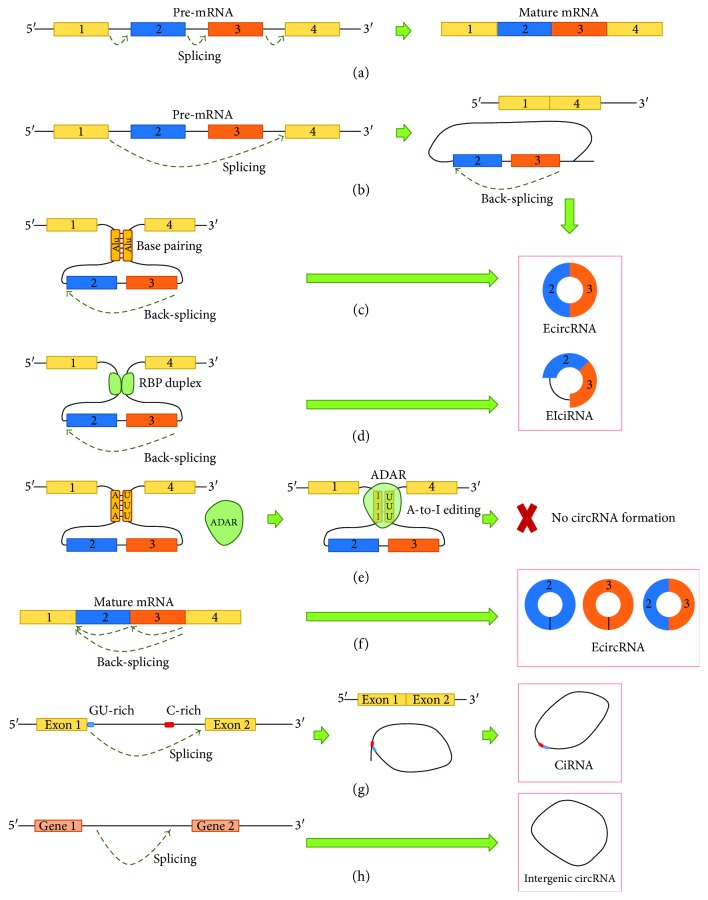
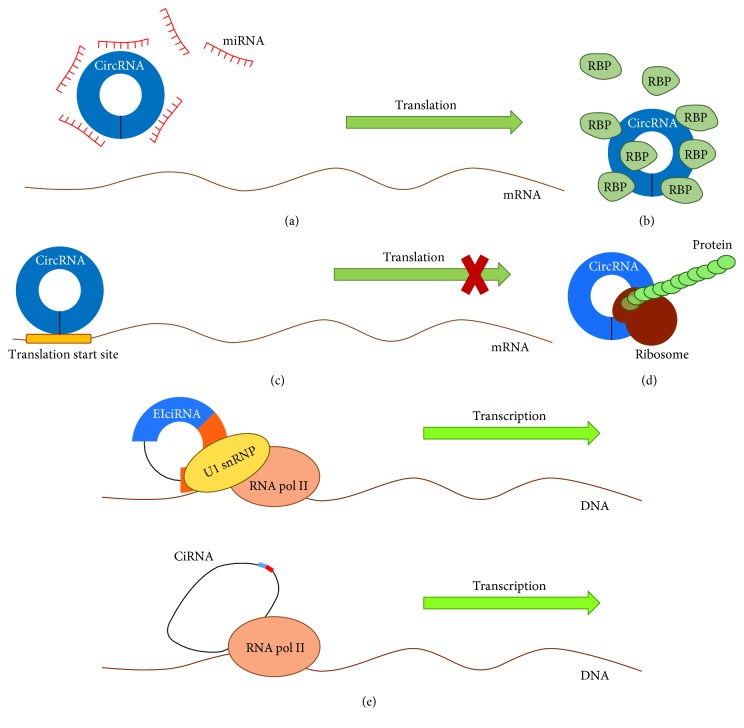
Verification
Claims the paper makes
The claims and statistics of this paper haven’t been checked yet.
Run the check — free, no account needed. It reads the open-access text and checks the sources it cites.
Claims other papers make about this one
Each is checked against this paper’s own text: does it say what the citing paper says it does?
In the citing paper
“Originating from various genomic regions, circRNAs are synthesized by the back-splicing of protein-coding precursor mRNAs (primarily in eukaryotes) [25,26].”
From Circular RNAs in depression: Biogenesis, function, expression, and therapeutic potential (2021) · cites this paper as [26]
Self-check
Percentages, sums and reported differences re-computed from the paper’s own numbers.
The self-check needs the paper’s full text.
Citations
Cites
6 retracted
circRNA_100290 plays a role in oral cancer by functioning as a sponge of the miR-29 family
Chen, L., Zhang, S., Wu, J., Cui, J., Zhong, L., Zeng, L., & Ge, S. (2017) · Oncogene · doi:10.1038/onc.2017.89 · Cited by 391
RetractedYu, L., Gong, X., Sun, L., Zhou, Q., Lu, B., & Zhū, L. (2016) · PLoS ONE · doi:10.1371/journal.pone.0158347 · Cited by 359 · cited 3×
“In addition, knockdown of ciRS-7 in HCC cell lines suppressed cell invasion and proliferation through miR-7 targeting [91].”
BackgroundInfluentialRetractedRETRACTED ARTICLE: Circular RNA 0000096 affects cell growth and migration in gastric cancer
Li, P., Chen, H., Chen, S., Mo, X., Li, T., Xiao, B., Yu, R., & Guo, J. (2017) · British Journal of Cancer · doi:10.1038/bjc.2016.451 · Cited by 228
RetractedTumor suppressor role of miR-217 in human epithelial ovarian cancer by targeting IGF1R
Li, J., Li, D., & Zhang, W. (2015) · Oncology Reports · doi:10.3892/or.2015.4498 · Cited by 43
RetractedThe MicroRNA-217 Functions as a Potential Tumor Suppressor in Gastric Cancer by Targeting GPC5
Wang, H., Dong, X., Gu, X., Qin, R., Jia, H., & Gao, J. (2015) · PLoS ONE · doi:10.1371/journal.pone.0125474 · Cited by 40
RetractedCircular RNA hsa_circ_0001564 facilitates tumorigenesis of osteosarcoma via sponging miR-29c-3p
Li, J., & Song, Y.-Z. (2017) · Tumor Biology · doi:10.1177/1010428317709989 · Cited by 10 · cited 1×
“Hsa_circ_0001564 CANX Osteosarcoma Up NA Sponge: miR-29c-3p [114]”
BackgroundRetractedBartel (2004) · doi:10.1016/s0092-8674(04)00045-5 · Cited by 34,714
MicroRNAs: Target Recognition and Regulatory Functions
Bartel, D. P. (2009) · Cell · doi:10.1016/j.cell.2009.01.002 · Cited by 20,068 · cited 1×
“miRNAs are approximately 22nt long ncRNAs, involved in posttranscriptional regulation of gene expression, which act by direct binding to specific target sites within UTRs of mRNAs [40, 41].”
Circular RNAs are a large class of animal RNAs with regulatory potency
Memczak, S., Jens, M., Elefsinioti, A., Torti, F., Krueger, J., Rybak, A., Maier, L., Mackowiak, S. D., Gregersen, L. H., Munschauer, M., et al. (2013) · Nature · doi:10.1038/nature11928 · Cited by 7,990 · cited 9×
“However, they may be also formed from intronic, noncoding, antisense, 3′ UTR, 5′ UTR, or intergenic genomic regions [9, 17].”
BackgroundInfluentialNatural RNA circles function as efficient microRNA sponges
Hansen, T. B., Jensen, T. I., Clausen, B. H., Bramsen, J. B., Finsen, B., Damgaard, C. K., & Kjems, J. (2013) · Nature · doi:10.1038/nature11993 · Cited by 7,985
Research works printed but not linked: 6
- 2017, American Journal of Cancer Research, 7, 1566
- 2017, International Journal of Clinical and Experimental Pathology, 10, 2997
- 2014, International Journal of Clinical and Experimental Pathology, 7, 2283
- 2015, International Journal of Clinical and Experimental Pathology, 8, 16020
- 2016, American Journal of Translational Research, 8, 932
- 2016, American Journal of Cancer Research, 6, 1167
Cited by
Sorted by citations
Zheng, X., Huang, M., Xing, L., Yang, R., Wang, X., Jiang, R., Zhang, L., & Chen, J. (2020) · Molecular Cancer · doi:10.1186/s12943-020-01183-9 · Cited by 456
Dave, V. P., Ngo, T. A., Pernestig, A.-K., Tilevik, D., Kant, K., Nguyen, T., Wolff, A., & Bang, D. D. (2019) · Laboratory Investigation · doi:10.1038/s41374-018-0143-3 · Cited by 248
Noncoding RNAs in Extracellular Fluids as Cancer Biomarkers: The New Frontier of Liquid Biopsies
Pardini, B., Sabo, A. A., Birolo, G., & Calin, G. A. (2019) · Cancers · doi:10.3390/cancers11081170 · Cited by 204
“cell lines, with a wide range of data reported (as reviewed by [448]).”
BackgroundLi, T., Sun, X.-Z., & Chen, L. (2019) · Journal of Cellular Biochemistry · doi:10.1002/jcb.28239 · Cited by 141
“CircRNAs play multiple physiological and pathological roles in cancer.(5-7) In our study, by circRNA array, it was found that circ_0044516 expression was upregulated in the blood exosomes of prostate cancer and the exosomes of the prostate cancer cells.”
BackgroundXu, Q., Zhou, L., Yang, G., Meng, F., Wan, Y., Wang, L., & Zhang, L. (2020) · Cell Biology International · doi:10.1002/cbin.11444 · Cited by 134
Metadata
- Authors
- Bolha, L., Ravnik-Glavač, M., & Glavač, D.
- Affiliations
- University of Ljubljana (SI)
- Department of Molecular Genetics, Institute of Pathology, Faculty of Medicine, University of Ljubljana, Ljubljana, Slovenia
- Corresponding author
- Glavač, Damjan
- Venue
- International Journal of Genomics
- Publisher
- Wiley
- Published
- 2017
- Volume
- 2017
- Pages
- 1-19
- ISSN
- 2314-436X (ISSN-L)
- 2314-4378
- PMC
- PMC5733622
- OpenAlex
- W2771561127
- Cited by
- 166
- References
- 150
- Citations by year
- 2026: 2 · 2025: 10 · 2024: 22 · 2023: 17 · 2022: 21 · 2021: 21 · 2020: 38 · 2019: 20 · 2018: 15
- FWCI
- 1.89
- Type
- journal article
- Language
- en
- Open access
- gold
- doi.org
- Locations
- International Journal of Genomics (publishedVersion, cc-by)
- PubMed Central (publishedVersion, cc-by)
- PubMed (publishedVersion)
- DOAJ (DOAJ: Directory of Open Access Journals) (submittedVersion, cc-by-sa)
- Topics
- Life Sciences › Biochemistry, Genetics and Molecular Biology › Molecular Biology › Circular RNAs in diseases
- Life Sciences › Biochemistry, Genetics and Molecular Biology › Cancer Research › Cancer-related molecular mechanisms research
- Life Sciences › Biochemistry, Genetics and Molecular Biology › Molecular Biology › RNA Research and Splicing
- Keywords
- circular RNA, circRNA biogenesis, back-splicing, non-coding RNA, microRNA sponge, cap-independent translation, circRNA stability, tumor markers, cancer diagnosis, cancer prognosis
About these checks
Registry, retraction, Cites and statistics results are computed, not judged, with one exception: a printed reference that no index lists is read once by a model before it counts as a citation error. Claims are extracted by a model and kept only when their quote appears verbatim in the text; each cited source is then checked, with a model’s help, for whether it says what the claim relies on. Those verdicts can be wrong — read the claim’s quote and the cited source before relying on one.
Statistics and arithmetic are recomputed, not judged.
Confidence bands are shown only for fields calibrated on our annotated test set. None is calibrated yet, so no band is shown.
What counts as a claim ›How we measure confidence ›How we check this ›
Are you an author, or do you see a problem with this page? Request a review
