

The Expression of AQP5 and UTs in the Sweat Glands of Uremic Patients
Open accessThe DOI matches its Crossref record; 20 of the 20 references it cites were found in a registry or an index.
Abstract
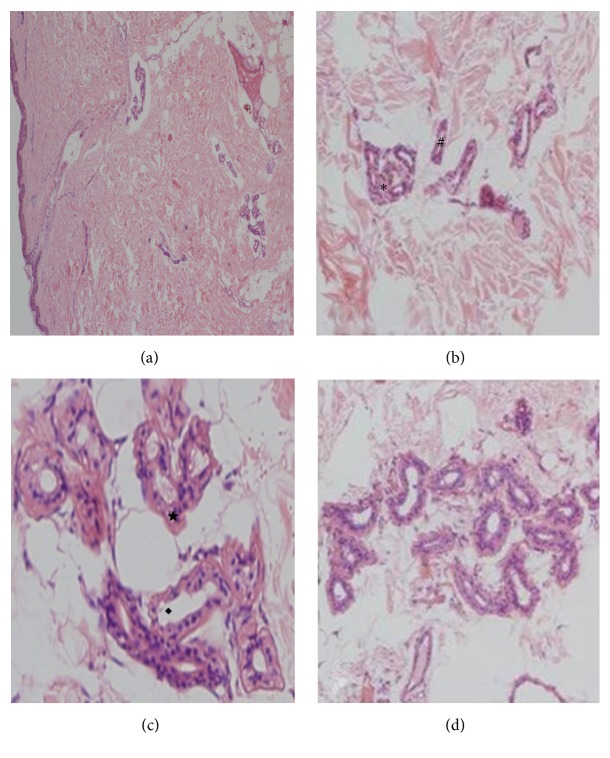
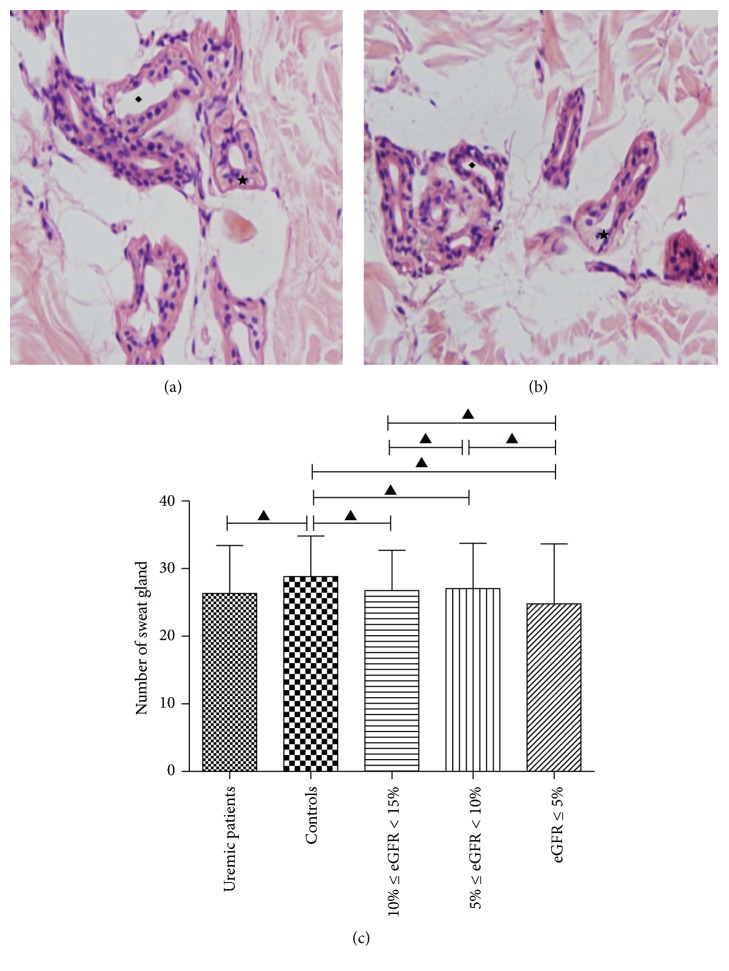
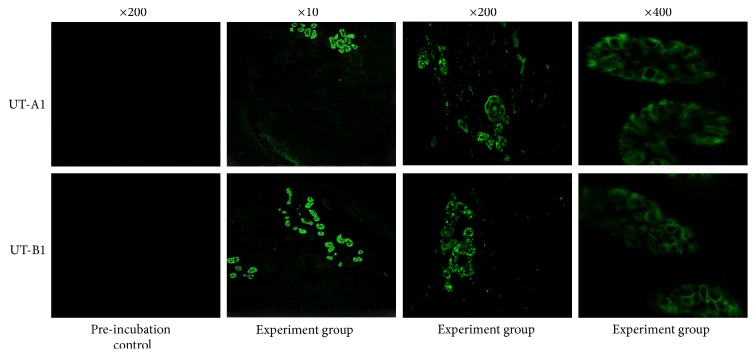
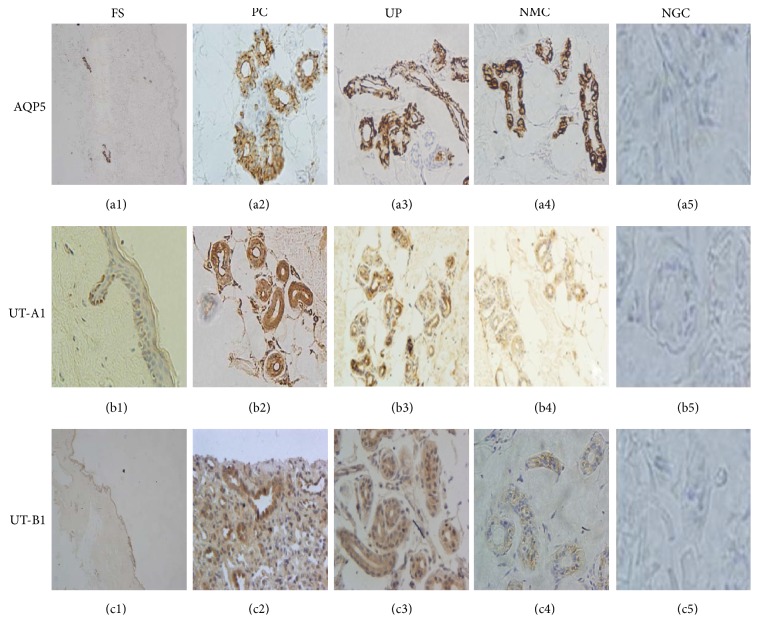
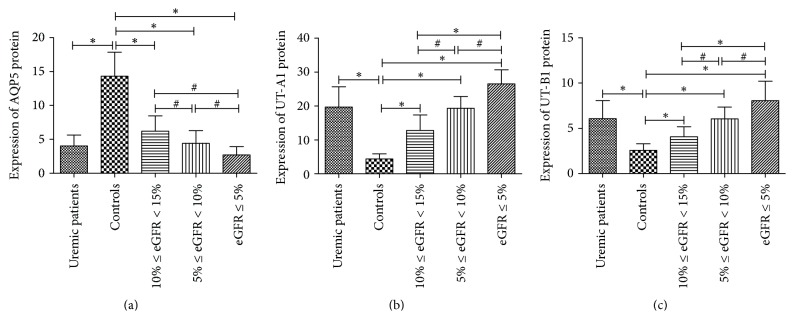
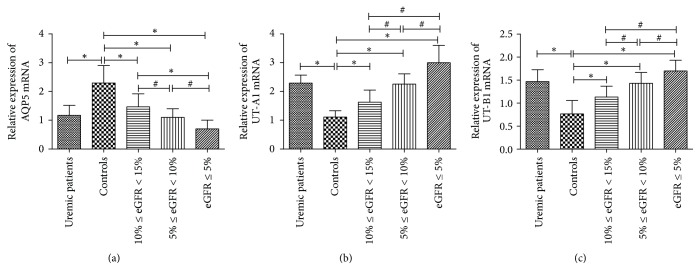
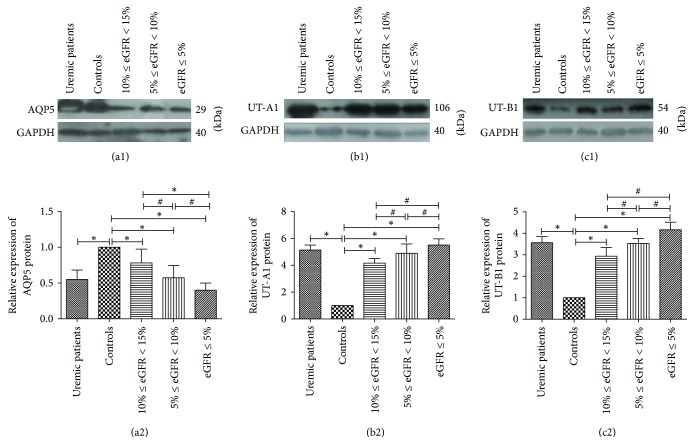
Purpose. To research the distribution and quantitative changes of UT-A1, UT-B1, and AQP5 in uremic skin tissue.Methods.34 cases of uremic patients (UP) and 11 controls were recruited. Immunohistochemistry, immunofluorescence, RT-PCR, and Western Blot were used to identify the proteins in sweat glands.Results. AQP5, UT-A1, and UT-B1 were expressed and localized in human skin basal lines, skin sweat glands, and sweat ducts, both in UP and controls. Compared to controls, AQP5 mRNA abundance was significantly decreased in UP (P<0.01), and, with the decrease of eGFR, the AQP5 expression was significantly decreased (P<0.05). By contrast, UT-A1 and UT-B1 mRNA abundance was significantly increased in the skin of UP compared with the control (P<0.01), and, with the decrease of eGFR, the AQP5 expression was significantly increased (P<0.05). We found that the gene changes were coincident with the corresponding target proteins. The urea transporter subtypes, UT-A1 and UT-B1, were expressed in the skin basal cell layer and exocrine sweat glands. The abundance of UT-A1 and UT-B1 in uremic sweat glands was significantly increased in UP, while the expression of AQP5 was decreased.Conclusion. Elimination of urea through the skin by producing sweat is a potential therapeutic strategy for renal failure patients.
Overview
The claims and statistics of this paper haven’t been checked yet.
Free: it reads the open-access text and checks the first 5 claims that cite a source we can check. Create a free account to check every claim.
Integrity signals
Registry
Cites
Statistics
Figures
Verification
Claims the paper makes
The claims and statistics of this paper haven’t been checked yet.
Free: it reads the open-access text and checks the first 5 claims that cite a source we can check. Create a free account to check every claim.
Claims other papers make about this one
Each is checked against this paper’s own text: does it say what the citing paper says it does?
The source backs part of the claim, not all of it — or backs it for a different population, condition or comparison.
In the citing paper
“The net K+ and Cl− efflux also creates an osmotic gradient for water movement into the lumen via aquaporin-5 channels”
From Physiological mechanisms determining eccrine sweat composition (2020) · cites this paper as Xie et al. 2017
Experimental — accuracy not yet measuredThe source backs part of the claim, not all of it — or backs it for a different population, condition or comparison.
In the citing paper
“These findings suggest that with excess urea production, there may be an active mechanism of urea excretion through sweat.”
From Physiological mechanisms determining eccrine sweat composition (2020) · cites this paper as Xie et al. 2017
Experimental — accuracy not yet measuredThe cited source says what the claim attributes to it.
In the citing paper
“recent literature suggests that eccrine glands may express localized urea transporter subtypes (Keller et al. 2016; Na et al. 2019; Xie et al. 2017).”
From Physiological mechanisms determining eccrine sweat composition (2020) · cites this paper as Xie et al. 2017
The cited source says what the claim attributes to it.
In the citing paper
“with significantly higher mRNA expression in uremic patients compared with normal controls (Xie et al. 2017).”
From Physiological mechanisms determining eccrine sweat composition (2020) · cites this paper as Xie et al. 2017
Self-check
Percentages, sums and reported differences re-computed from the paper’s own numbers.
The self-check needs the paper’s full text.
Citations
Cites
Aquaporins: water channel proteins of the cell membrane
TAKATA, K. (2004) · Progress in Histochemistry and Cytochemistry · doi:10.1016/j.proghi.2004.03.001 · Cited by 408 · cited 1×
“Aquaporin-5 is widely distributed among digestive, renal, respiratory, and reproductive systems as well as integumentary systems, especially in the secretory glands, which plays an essential role in the excretion and formation of sweat, while in pathological conditions the distribution and quantity of AQP5 can be chan…”
BackgroundUric acid and urea in human sweat.
Huang, C.-T., Chen, M.-L., Huang, L., & Mao, I. (2002) · PubMed · Cited by 191
Urea transporters in kidney and erythrocytes
Sands, J. M., Timmer, R. T., & Gunn, R. B. (1997) · American Journal of Physiology-Renal Physiology · doi:10.1152/ajprenal.1997.273.3.f321 · Cited by 135
Sweat urea, uric acid and creatinine concentrations in uraemic patients
Al‐Tamer, Y. Y., Hadi, E. A., & Al-Badrani, I. E. I. (1997) · Urological Research · doi:10.1007/bf01294662 · Cited by 94 · cited 1×
“Therefore, some scholars paid attention to the compensatory effect on renal excretion of sweat function and launched a series of studies [14, 15].”
BackgroundMolecular characterization of a novel UT-A urea transporter isoform (UT-A5) in testis
Fenton, R. A., Howorth, A., Cooper, G. J., Meccariello, R., Morris, I. D., & Smith, C. P. (2000) · American Journal of Physiology-Cell Physiology · doi:10.1152/ajpcell.2000.279.5.c1425 · Cited by 89
Structure and characterization of the mouse UT-A gene (Slc14a2)
Fenton, R. A., Cottingham, C. A., Stewart, G. S., Howorth, A., Hewitt, J. A., & Smith, C. P. (2002) · American Journal of Physiology-Renal Physiology · doi:10.1152/ajprenal.00264.2001 · Cited by 85 · cited 1×
“The renal urea transporters were encoded by the UT-A (Slc14A2) and UT-B (Slc14A1) genes [6, 7].”
BackgroundBagnasco, S. M., Peng, T., Janech, M. G., Karakashian, A., & Sands, J. M. (2001) · American Journal of Physiology-Renal Physiology · doi:10.1152/ajprenal.2001.281.3.f400 · Cited by 80 · cited 1×
“The renal urea transporters were encoded by the UT-A (Slc14A2) and UT-B (Slc14A1) genes [6, 7].”
BackgroundSweat constitutes several natural moisturizing factors, lactate, urea, sodium, and potassium
Watabe, A., Sugawara, T., Kikuchi, K., Yamasaki, K., Sakai, S., & Aiba, S. (2013) · Journal of Dermatological Science · doi:10.1016/j.jdermsci.2013.06.005 · Cited by 75 · cited 2×
“The structure of human sweat glands has some similarity with the convoluted tubules of the kidney and the composition of sweat is very similar with urine, also containing potassium, sodium, urea nitrogen, creatinine, uric acid, and other metabolic waste [1, 2].”
BackgroundYamamura, Y., Motegi, K., Kani, K., Takano, H., Momota, Y., Aota, K., Yamanoi, T., & Azuma, M. (2011) · Journal of Cellular and Molecular Medicine · doi:10.1111/j.1582-4934.2011.01456.x · Cited by 65
Identification and characterization of a Kidd antigen/UT-B urea transporter expressed in human colon
Inoue, H., Jackson, S. D., Vikulina, T., Klein, J. D., Tomita, K., & Bagnasco, S. M. (2004) · American Journal of Physiology-Cell Physiology · doi:10.1152/ajpcell.00443.2003 · Cited by 62
Cited by
Physiology of sweat gland function: The roles of sweating and sweat composition in human health
Baker, L. B. (2019) · Temperature · doi:10.1080/23328940.2019.1632145 · Cited by 732
Skin-Interfaced Wearable Sweat Sensors for Precision Medicine
Min, J., Tu, J., Xu, C., Lukas, H., Shin, S., Yang, Y., Solomon, S. A., Mukasa, D., & Gao, W. (2023) · Chemical Reviews · doi:10.1021/acs.chemrev.2c00823 · Cited by 712
Physiological mechanisms determining eccrine sweat composition
Baker, L. B., & Wolfe, A. S. (2020) · European Journal of Applied Physiology · doi:10.1007/s00421-020-04323-7 · Cited by 367
Quantification of sweat urea in diabetes using electro-optical technique
Sudha, S., Kalpana, R., & Soundararajan, P. (2021) · Physiological Measurement · doi:10.1088/1361-6579/ac1d3a · Cited by 99
Mota‐Rojas, D., Wang, D., Titto, C. G., Gómez-Prado, J., la Fuente, V. C.-D., Ghezzi, M. D., Boscato-Funes, L., Barrios-García, H., Torres-Bernal, F., Casas-Alvarado, A., et al. (2021) · Animals · doi:10.3390/ani11082316 · Cited by 84
Fibers/Textiles-Based Flexible Sweat Sensors: A Review
Zhang, S., Tan, R., Xu, X., Iqbal, S., & Hu, J. (2023) · ACS Materials Letters · doi:10.1021/acsmaterialslett.2c01207 · Cited by 56
Na, C. H., Sharma, N., Madugundu, A. K., Chen, R., Aksit, M. A., Rosson, G. D., Cutting, G. R., & Pandey, A. (2019) · Molecular & Cellular Proteomics · doi:10.1074/mcp.ra118.001101 · Cited by 35
“A prior study has shown that urea transporter subtypes are expressed in sweat glands [30].”
BackgroundRecent omics advances in hair aging biology and hair biomarkers analysis
Adav, S. S., & Ng, K. W. (2023) · Ageing Research Reviews · doi:10.1016/j.arr.2023.102041 · Cited by 32
Adelaars, S., Konings, C. J. A. M., Cox, L. G. E., Boonen, E., Mischi, M., Bouwman, R. A., & van de Kerkhof, D. (2024) · Clinical Chemistry and Laboratory Medicine (CCLM) · doi:10.1515/cclm-2023-1285 · Cited by 33
Nanoarchitectonics of point-of-care diagnostics for sweat biomarkers analysis
Lin, X., Vasanth, A., Ashok, A., Phan, H., Koo, K. M., Amin, M. A., Kaneti, Y. V., Salomón, C., Hossain, M. S. A., Yamauchi, Y., et al. (2024) · Nano Materials Science · doi:10.1016/j.nanoms.2024.01.010 · Cited by 30
Whole genome studies of origin, selection and adaptation of the Russian cattle breeds
Yudin, N. S., & Larkin, D. M. (2019) · Vavilov Journal of Genetics and Breeding · doi:10.18699/vj19.525 · Cited by 26
“В этом списке был и ген аквапорина 5 (AQP5), который представляет интерес с точки зрения адаптации как к холоду, так и к жаре, поскольку он регулирует испарение воды кожным покровом (Xie et al., 2017).”
Nielsen, M. M. K., Aryal, E., Safari, E., Mojsoska, B., Jenssen, H., & Prabhala, B. K. (2021) · Proteomes · doi:10.3390/proteomes9020023 · Cited by 19
“Urea transporters (efflux transporter) have been detected in sweat glands of skin [63], and its presence as a sweat metabolite possibly indicates the role of sweat glands in urea excretion.”
BackgroundKeefe, M. S., Benjamin, C. L., Casa, D. J., & Sekiguchi, Y. (2024) · Applied Sciences · doi:10.3390/app142210103 · Cited by 18
Aquaporin proteins: A promising frontier for therapeutic intervention in cerebral ischemic injury
Mannan, A., Mohan, M., Gulati, A., Dhiman, S., & Singh, T. G. (2024) · Cellular Signalling · doi:10.1016/j.cellsig.2024.111452 · Cited by 16
Yin, Z., & Ren, H. (2023) · Advances in experimental medicine and biology · doi:10.1007/978-981-19-7415-1_15 · Cited by 14
Sweat gland morphology and physiology in diabetes, neuropathy, and nephropathy: a review
Singaram, S., Ramakrishnan, K., Selvam, J., Senthil, M., & Narayanamurthy, V. (2022) · Archives of Physiology and Biochemistry · doi:10.1080/13813455.2022.2114499 · Cited by 14
“Especially deposition of urea on the skin is observed in the advanced stage of renal failure (Xie et al. 2017).”
InfluentialPerspiration interventions for conservative management of kidney disease and uremia
Keller, R. W., Kopple, J. D., & Kalantar‐Zadeh, K. (2019) · Current Opinion in Nephrology & Hypertension · doi:10.1097/mnh.0000000000000569 · Cited by 12
“The kidney also shows distinct changes in urea transport in the setting of advanced CKD [26].”
BackgroundInfluentialBeyond Ca2+ signalling: the role of TRPV3 in the transport of NH4+
Liebe, H., Liebe, F., Sponder, G., Hedtrich, S., & Stumpff, F. (2021) · Pflügers Archiv - European Journal of Physiology · doi:10.1007/s00424-021-02616-0 · Cited by 13
Adelaars, S., Lapré, C. S. M., Raaijmakers, P., Konings, C. J. A. M., Mischi, M., Bouwman, R. A., & van de Kerkhof, D. (2024) · Journal of Chromatography B · doi:10.1016/j.jchromb.2024.124444 · Cited by 11
Singaram, S., Ramakrishnan, K., & Periyasamy, S. (2023) · Proceedings of the Institution of Mechanical Engineers Part H Journal of Engineering in Medicine · doi:10.1177/09544119231184113 · Cited by 6
“This leads to change in absorption properties of the sweat duct and hence variations in sweat constituents.(8) Thus elements in sweat become biomarkers for different diseases are measured through techniques like optics and electrochemical.”
BackgroundChronic kidney disease-associated pruritus: a perspective on skin barrier damage
Zeng, F., Zhu, C., Ding, L., Yang, B., & Liu, N. (2026) · Renal Failure · doi:10.1080/0886022x.2026.2635299 · Cited by 2
“…of urea transporters (ut-a1, ut-B1) and decreased expression of aquaporin-5 (aQP5), lead to enhanced urea excretion and abnormal sweat composition [58]. the excessive accumulation of urea on the skin surface and its subsequent decomposition into ammonia increase the local alkalinity, a phenomenon…”
Zhang, Y., Zhong, B., Yuan, Y., Xu, K., Yu, Y., Lou, Z., & Wang, L. (2026) · Advanced Materials Technologies · doi:10.1002/admt.202502662 · Cited by 3
Sweat components as a promising monitoring tool for systemic diseases
Shi, C., Chen, Z., Zhang, L., Zhang, X., Liang, X., Yan, L., Hao, X., Dong, G., Lu, C., & Huang, L. (2026) · The Journal of Physiological Sciences · doi:10.1016/j.jphyss.2026.100068 · Cited by 2
“…main reason for the increased urea concentration in the sweat of patients with uremia is an increase in the expression of the urea transport proteins UTA1 and UTB1 and a decrease in the expression of AQP5, leading to excessive release of urea and a reduction in urea excretion by the kidneys [96].”
Yin, X., Adelaars, S., Peri, E., Pelssers, E., den Toonder, J. M. J., Bouwman, R. A., van de Kerkhof, D., & Mischi, M. (2025) · Frontiers in Physiology · doi:10.3389/fphys.2025.1547117 · Cited by 3
“Findings by Xie et al. (Xie et al., 2017) suggest a decrease in AQP5 expression in uremic patients compared to healthy individuals, indicating that transport mechanisms for urea and water may vary across populations.”
InfluentialMei, J., Yang, Q., Tian, M., Deng, S., & Gong, Y. (2026) · Journal of Intensive Medicine · doi:10.1016/j.jointm.2026.03.004 · Cited by 1
Urea Transporters in Health and Disease
Klein, J. D., & Sands, J. M. (2020) · Physiology in health and disease · doi:10.1007/978-3-030-55454-5_9 · Cited by 1
Sehgal, T. (2025) · International Journal of Pharmaceutical Sciences and Medicine · doi:10.47760/ijpsm.2025.v10i05.001
Li, F., Gao, J., Ma, Z., Zhang, L., Li, B., & He, J. (2026) · ACS Sensors · doi:10.1021/acssensors.6c03644
Metadata
- Authors
- Xie, L., Jin, L., Feng, J., & Lv, J.
- Affiliations
- First Affiliated Hospital of Xi'an Jiaotong University (CN)
- Corresponding author
- Lv, Jing
- Venue
- BioMed Research International
- Publisher
- Wiley
- Published
- 2017
- Volume
- 2017
- Pages
- 1-10
- ISSN
- 1110-7243 (ISSN-L)
- 2314-6133
- 2314-6141
- PMC
- PMC5723962
- OpenAlex
- W2768328940
- Cited by
- 25
- References
- 20
- Citations by year
- 2026: 2 · 2025: 2 · 2024: 5 · 2023: 5 · 2022: 1 · 2021: 4 · 2020: 2 · 2019: 4
- FWCI
- 0.67
- Type
- journal article
- Language
- en
- Open access
- hybrid
- doi.org
- Locations
- BioMed Research International (publishedVersion, cc-by)
- Europe PMC (PubMed Central) (publishedVersion, cc-by)
- PubMed Central (publishedVersion, cc-by)
- PubMed (publishedVersion)
- DOAJ (DOAJ: Directory of Open Access Journals) (submittedVersion)
- Topics
- Life Sciences › Biochemistry, Genetics and Molecular Biology › Molecular Biology › Ion Transport and Channel Regulation
- Health Sciences › Medicine › Nephrology › Acute Kidney Injury Research
- Health Sciences › Medicine › Nephrology › Dialysis and Renal Disease Management
- Keywords
- aquaporin 5, uremic pruritus, sweat glands, uremic toxins, renal failure, glomerular filtration rate
- MeSH terms
- Urea Transporters, Adult, Aged, Female, Gene Expression Regulation, Humans, Male, Middle Aged, RNA, Messenger, Skin, Sweat, Sweat Glands, Uremia, Membrane Transport Proteins, Aquaporin 5
About these checks
Registry, retraction, Cites and statistics results are computed, not judged, with one exception: a printed reference that no index lists is read once by a model before it counts as a citation error. Claims are extracted by a model and kept only when their quote appears verbatim in the text; each cited source is then checked, with a model’s help, for whether it says what the claim relies on. Those verdicts can be wrong — read the claim’s quote and the cited source before relying on one.
Statistics and arithmetic are recomputed, not judged.
Confidence bands are shown only for fields calibrated on our annotated test set. None is calibrated yet, so no band is shown.
What counts as a claim ›How we measure confidence ›How we check this ›
Are you an author, or do you see a problem with this page? Request a review
Data sources
Bibliographic data: Semantic Scholar, OpenAlex, Crossref.
Contains information from the Semantic Scholar Academic Graph Datasets, made available under the ODC Attribution License (ODC-BY 1.0).
Semantic Scholar’s data is described in: Kinney, R., et al. (2023). The Semantic Scholar Open Data Platform. arXiv:2301.10140.
