

Effects of physical exercise programs on sarcopenia management, dynapenia, and physical performance in the elderly: a systematic review of randomized clinical trials.
Open accessThe DOI matches its Crossref record; 17 of the 17 references it cites were found in a registry or an index.
Abstract
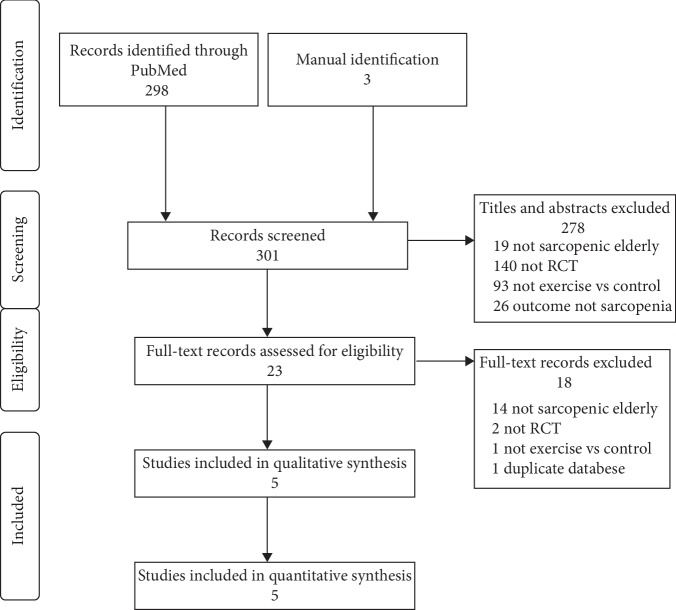
Introduction . Sarcopenia is a prevalent condition in the elderly population, imposing a significant impact over their functional ability as well as their quality of life. Furthermore, it is associated with greater incidence of major geriatric outcomes, as reduced mobility, falls, loss of independence, cognitive impairment, and all-cause mortality. Physical Exercise Programs directed to improve muscle mass and its function may be key to reduce sarcopenia consequences. However, a significant heterogeneity is found in clinical trials, especially as a consequence of different exercise protocols applied to research subjects. Objectives . To access the effects of physical exercise programs compared to no exercise interventions to improve sarcopenia components and its determinants in sarcopenic elder individuals. Methods . A systematic review was conducted in the Pubmed database to identify randomized clinical trials (RCTs) which tested the effects of physical exercise programs to manage sarcopenia components in sarcopenic elder individuals. Two independent reviewers assessed the studies’ eligibility according to specified inclusion criteria in a four-step strategy. Data regarding population characteristics, muscle mass, muscle quality, muscle strength, and muscle function were extracted from each one of the included studies. Assessment of quality and individual studies risk of bias were assessed through Cochrane Risk of Bias Tool®. Assuming theoretical expected heterogeneity among studies, especially regarding different physical exercise programs and different outcome measurements, authors decided to be conservative and present study results in descriptive tables. Results . Search strategy retrieved 298 papers on PubMed database. Three more were identified through manual search, being 301 studies revised for inclusion. 278 were excluded during title/abstract review. After further evaluation of 23 full-texts, 5 RCTs were included. All 5 trials tested the efficacy of isolated exercise programs to improve sarcopenia components in the elderly compared to no physical intervention. Resistance training was the main intervention component in all included trials compared to inactive control groups (health education mainly). Physical training improved muscle strength, muscle quality, and muscle function compared to inactive control groups. Considering muscle mass, no differences were demonstrated. Data meta-analysis was not possible to be performed due to high heterogeneity among trials and small number of studies for each outcome comparison. Conclusion . Heterogeneity among trials and small number of RCTs limited robust conclusions and data meta-analysis. However, resistance training protocols can improve muscle strength and physical performance in elders previously diagnosed with sarcopenia, although its effect size and clinical impact are barely relevant.
Overview
The claims and statistics of this paper haven’t been checked yet.
Free: it reads the open-access text and checks the first 5 claims that cite a source we can check. Create a free account to check every claim.
Integrity signals
Registry
Cites
Statistics
Figures
Verification
Claims the paper makes
The claims and statistics of this paper haven’t been checked yet.
Free: it reads the open-access text and checks the first 5 claims that cite a source we can check. Create a free account to check every claim.
Claims other papers make about this one
Each is checked against this paper’s own text: does it say what the citing paper says it does?
The source backs part of the claim, not all of it — or backs it for a different population, condition or comparison.
In the citing paper
“Compared with CTRL, TUG was impacted by standard RT (30,32,33,36,38,47,50,152,154,156).”
From American College of Sports Medicine Position Stand. Resistance Training Prescription for Muscle Function, Hypertrophy, and Physical Performance in Healthy Adults: An Overview of Reviews (2026) · cites this paper as [47]
Experimental — accuracy not yet measuredThe source backs part of the claim, not all of it — or backs it for a different population, condition or comparison.
In the citing paper
“Compared with CTRL, gait speed was impacted by standard RT (17,30,32,33,36–38,47,53,152–155).”
From American College of Sports Medicine Position Stand. Resistance Training Prescription for Muscle Function, Hypertrophy, and Physical Performance in Healthy Adults: An Overview of Reviews (2026) · cites this paper as [47]
Experimental — accuracy not yet measured
Self-check
Percentages, sums and reported differences re-computed from the paper’s own numbers.
The self-check needs the paper’s full text.
Citations
Cites
Preferred Reporting Items for Systematic Reviews and Meta-Analyses: the PRISMA statement
Moher, D., Liberati, A., Tetzlaff, J., Altman, D. G., & for the PRISMA Group (2009) · BMJ · doi:10.1136/bmj.b2535 · Cited by 83,823
Preferred reporting items for systematic reviews and meta-analyses: The PRISMA statement
Moher, D., Liberati, A., Tetzlaff, J., Altman, D. G., & the PRISMA Group* (2009) · Annals of Internal Medicine · doi:10.7326/0003-4819-151-4-200908180-00135 · Cited by 37,554
RoB 2: a revised tool for assessing risk of bias in randomised trials
Sterne, J. A. C., Savović, J., Page, M. J., Elbers, R. G., Blencowe, N. S., Boutron, I., Cates, C. J., Cheng, H.-Y., Corbett, M. S., Eldridge, S. M., et al. (2019) · BMJ · doi:10.1136/bmj.l4898 · Cited by 34,787
Sarcopenia: revised European consensus on definition and diagnosis
Cruz-Jentoft, A. J., Bahat, G., Bauer, J., Boirie, Y., Bruyère, O., Cederholm, T., Cooper, C., Landi, F., Rolland, Y., Sayer, A. A., et al. (2019) · Age and Ageing · doi:10.1093/ageing/afy169 · Cited by 13,818
Sarcopenia: revised European consensus on definition and diagnosis
Cruz-Jentoft, A. J., Bahat, G., Bauer, J., Boirie, Y., Bruyère, O., Cederholm, T., Cooper, C., Landi, F., Rolland, Y., Sayer, A. A., et al. (2019) · Age and Ageing · doi:10.1093/ageing/afz046 · Cited by 3,803
Cruz-Jentoft, A. J., Landi, F., Schneider, S. M., Zuniga, C., Arai, H., Boirie, Y., Chen, L.-K., Fielding, R. A., Martin, F. C., Michel, J.-P., et al. (2014) · Age and Ageing · doi:10.1093/ageing/afu115 · Cited by 1,963
Influence of Resistance Exercise on Lean Body Mass in Aging Adults: A Meta-Analysis
PETERSON, M. D., SEN, A., & GORDON, P. M. (2011) · Medicine & Science in Sports & Exercise · doi:10.1249/mss.0b013e3181eb6265 · Cited by 558
Kim, H. K., Suzuki, T., Saito, K., Yoshida, H., Kobayashi, H., Kato, H., & Katayama, M. (2012) · Journal of the American Geriatrics Society · doi:10.1111/j.1532-5415.2011.03776.x · Cited by 551
Yoshimura, Y., Wakabayashi, H., Yamada, M., Kim, H., Harada, A., & Arai, H. (2017) · Journal of the American Medical Directors Association · doi:10.1016/j.jamda.2017.03.019 · Cited by 365
Random-effects meta-analysis: The number of studies matters
Guolo, A., & Varin, C. (2017) · Statistical Methods in Medical Research · doi:10.1177/0962280215583568 · Cited by 203 · cited 1×
“)eoretically, only 2 studies are needed to perform a metaanalysis, but it may carry several important biases as well as statistical inferences especially when random effect models are chosen; the number of studies matters, according to Guolo and Varin [15].”
Background
Cited by
Lu, L., Mao, L., Feng, Y., Ainsworth, B. E., Liu, Y., & Chen, N. (2021) · BMC Geriatrics · doi:10.1186/s12877-021-02642-8 · Cited by 252
Talar, K., Hernández-Belmonte, A., Vetrovsky, T., Steffl, M., Kałamacka, E., & Courel-Ibáñez, J. (2021) · Journal of Clinical Medicine · doi:10.3390/jcm10081630 · Cited by 182
“Our results are consistent with previous studies supporting that resistance training is beneficial for the muscular strength and physical function in older adults with frailty or sarcopenia [10,22,24], but they do not combine both syndromes (sarcopenia and frailty) and if they do, they examine the effect of exercise o…”
ResultCURRIER, B. S., D’SOUZA, A. C., SINGH, M. A. F., LOWISZ, C. V., RAWSON, E. S., SCHOENFELD, B. J., SMITH-RYAN, A. E., STEEN, J. P., THOMAS, G. A., TRIPLETT, N. T., et al. (2026) · Medicine & Science in Sports & Exercise · doi:10.1249/mss.0000000000003897 · Cited by 105
“Compared with CTRL, TUG was impacted by standard RT (30,32,33,36,38,47,50,152,154,156).”
Escriche-Escuder, A., Fuentes-Abolafio, I. J., Roldán‐Jiménez, C., & Vargas, A. I. C. (2021) · Experimental Gerontology · doi:10.1016/j.exger.2021.111420 · Cited by 88
South Asian Working Action Group on SARCOpenia (SWAG-SARCO) – A consensus document
Dhar, M., Kapoor, N., Suastika, K., Khamseh, M. E., Selim, S., Kumar, V., Raza, S. A., Azmat, U., Pathania, M., Mahadeb, Y., et al. (2022) · Osteoporosis and Sarcopenia · doi:10.1016/j.afos.2022.04.001 · Cited by 84
Exercise and physical performance in older adults with sarcopenic obesity: A systematic review
Ghiotto, L., Muollo, V., Tatangelo, T., Schena, F., & Rossi, A. P. (2022) · Frontiers in Endocrinology · doi:10.3389/fendo.2022.913953 · Cited by 65
“Limitations that explain the low impact of exercise interventions include lack of standardization of exercise protocols, short duration of interventions, and differences in eligibility criteria (23).”
BackgroundProkopidis, K., & Witard, O. C. (2021) · Nutrition Research Reviews · doi:10.1017/s0954422421000135 · Cited by 74
Chen, P.-J., Hsu, H., Chen, K., & Belcastro, F. P. (2022) · Annals of Physical and Rehabilitation Medicine · doi:10.1016/j.rehab.2022.101702 · Cited by 55
Zhang, Y., Zou, L., Chen, S.-T., Bae, J. H., Kim, D. Y., Liu, X., & Song, W. (2021) · Frontiers in Medicine · doi:10.3389/fmed.2021.649748 · Cited by 48
“For example, a recently published systematic review including five randomized controlled trials (RCTs) suggested that resistant exercise can improve muscle strength, muscle quality, and muscle function in older adults with sarcopenia or dynapenia compared with the controlled group (20).”
BackgroundChang, K. C., Wu, W., Huang, K., & Han, D. (2020) · Clinical Nutrition · doi:10.1016/j.clnu.2020.06.037 · Cited by 48
A Multifactorial Approach for Sarcopenia Assessment: A Literature Review
Supriya, R., Singh, K. P., Gao, Y., Li, F., Dutheil, F., & Baker, J. S. (2021) · Biology · doi:10.3390/biology10121354 · Cited by 48
“examined the effects of physical exercise programs versus no exercise intervention on sarcopenia features and its determinants in sarcopenic elders [152].”
BackgroundEthnic Groups Differences in the Prevalence of Sarcopenia Using the AWGS Criteria
Liu, X., Hao, Q., Hou, L., Xia, X., Zhao, W., Zhang, Y., Ge, M., Liu, Y., Zuo, Z., Yue, J., et al. (2020) · The journal of nutrition health & aging · doi:10.1007/s12603-020-1381-9 · Cited by 44
Effect of Exercise on Secondary Sarcopenia: A Comprehensive Literature Review
Supriya, R., Singh, K. P., Gao, Y., Gu, Y., & Baker, J. S. (2021) · Biology · doi:10.3390/biology11010051 · Cited by 41
“All four studies included in the review indicated that most of the sarcopenic subjects were excluded due to the presence of a comorbidity [8].”
BackgroundInfluentialCan Resistance Exercise Be a Tool for Healthy Aging in Post-Menopausal Women with Type 1 Diabetes?
Momeni, Z., Logan, J. E., Sigal, R. J., & Yardley, J. E. (2021) · International Journal of Environmental Research and Public Health · doi:10.3390/ijerph18168716 · Cited by 35
“As discussed, resistance exercise causes improvements in muscle strength [143], muscle quality [11], and bone density [144].”
BackgroundRedox Control of Signalling Responses to Contractile Activity and Ageing in Skeletal Muscle
Jackson, M. J., Pollock, N., Staunton, C. A., Jones, S., & McArdle, A. (2022) · Cells · doi:10.3390/cells11101698 · Cited by 30
Kim, S. H., Shin, M., Lee, J. M., Huh, S., & Shin, Y. B. (2022) · BMC Geriatrics · doi:10.1186/s12877-022-02828-8 · Cited by 29
“Therefore, various exercises have been proposed to improve physical performance in older individuals [7, 8].”
BackgroundŞen, E. İ., Eyigör, S., Yagli, M. D., Özçete, Z. A., Aydın, T., Kesiktaş, F. N., Aydın, F., Vural, M., Şahin, N., & Karan, A. (2021) · Journal of Aging and Physical Activity · doi:10.1123/japa.2020-0348 · Cited by 28
Abdalla, P. P., Bohn, L., da Silva, L. S. L., dos Santos, A. P., Júnior, M. F. T., Venturini, A. C. R., Carvalho, A. D. S., Martínez‐Gómez, D., Mota, J. A. P. S., & Machado, D. R. L. (2021) · BMC Sports Science Medicine and Rehabilitation · doi:10.1186/s13102-021-00390-1 · Cited by 27
Park, T. S., & Shin, M. (2023) · Annals of Geriatric Medicine and Research · doi:10.4235/agmr.23.0016 · Cited by 25
Jackson, M. J. (2020) · Free Radical Biology and Medicine · doi:10.1016/j.freeradbiomed.2020.10.026 · Cited by 25
Depressive symptoms in older adults: the role of physical activity and social support
Moya, C. A. M., Soares, F. C., Lima, R. A., de Barros, M. V. G., & Bezerra, J. (2021) · Trends in Psychiatry and Psychotherapy · doi:10.47626/2237-6089-2020-0093 · Cited by 24
Santos, I. S. D., Silva, C. D. F. R., Ohara, D. G., Matos, A. P., Pinto, A. C. P. N., & Pegorari, M. S. (2021) · Sao Paulo Medical Journal · doi:10.1590/1516-3180.2020.0546.r1.14122020 · Cited by 23
Takano, S., Yamaguchi, K., Nakagawa, K., Yoshimi, K., Nakane, A., Okumura, T., & Tohara, H. (2021) · Scientific Reports · doi:10.1038/s41598-021-86807-w · Cited by 24
Pedraza-Vázquez, G., Mena‐Montes, B., Hernández-Álvarez, D., Gómez-Verján, J. C., Toledo-Pérez, R., López-Teros, M. T., Königsberg, M., Gómez-Quiroz, L. E., & Luna‐López, A. (2022) · Archives of Gerontology and Geriatrics · doi:10.1016/j.archger.2022.104856 · Cited by 22
Umegaki, H., Bonfiglio, V., Komiya, H., Watanabe, K., & Kuzuya, M. (2020) · Journal of Alzheimer s Disease · doi:10.3233/jad-200169 · Cited by 21
Sung, J. H., Son, S. R., Baek, S., & Kim, B. (2022) · BMC Geriatrics · doi:10.1186/s12877-022-03293-z · Cited by 20
Sivritepe, R., Siyer, Ö. K., Tiril, S. M., & Basat, S. (2024) · Northern Clinics of Istanbul · doi:10.14744/nci.2024.48642 · Cited by 18
“High-intensity interval training and aerobic exercises can be done, but it is suggested that traditional resistance training alone may be more effective in treating dynapenia [33].”
Exploring the Interplay between Bone Marrow Stem Cells and Obesity
Moscatelli, F., Monda, A., Messina, G., Picciocchi, E., Monda, M., di Padova, M., Monda, V., Mezzogiorno, A., Dipace, A., Limone, P., et al. (2024) · International Journal of Molecular Sciences · doi:10.3390/ijms25052715 · Cited by 17
“Third, carrying more weight puts more strain on the heels, impairing balance and postural stability [51].”
BackgroundResearch hotspots and trends of exercise for sarcopenia: A bibliometric analysis
Xiang, Q., Hu, Y., Zheng, J., Liu, W., & Tao, J. (2023) · Frontiers in Public Health · doi:10.3389/fpubh.2023.1106458 · Cited by 17
Peng, D., Zhang, Y., Wang, L., & Zhang, S. (2024) · Geriatric Nursing · doi:10.1016/j.gerinurse.2024.09.016 · Cited by 16
Huang, W.-Y., & Wu, C.-E. R. (2022) · International Journal of Environmental Research and Public Health · doi:10.3390/ijerph19084765 · Cited by 17
Sarcopenia in cardiac surgery: Dual X-ray absorptiometry study from the McGill frailty registry
Joshi, A. J., Mancini, R., Probst, S., Abikhzer, G., Langlois, Y., Morin, J., Rudski, L., & Afilalo, J. (2021) · American Heart Journal · doi:10.1016/j.ahj.2021.04.008 · Cited by 16
Ohinata, H., Yun, S., Miyajima, N., & Yuki, M. (2024) · Annals of Geriatric Medicine and Research · doi:10.4235/agmr.24.0007 · Cited by 15
Bao, F., Zhao, X., You, J., Liu, Y., Zheng, X., Wu, Y., Wu, Y., Xu, Z., Yu, L., Li, J., et al. (2024) · Experimental Gerontology · doi:10.1016/j.exger.2024.112523 · Cited by 12
Yuenyongchaiwat, K., Akekawatchai, C., & Khattiya, J. (2022) · Clinical Gerontologist · doi:10.1080/07317115.2022.2150396 · Cited by 11
Ito, Y., Anan, K., Awano, N., Kataoka, Y., Johkoh, T., Fujimoto, K., Ichikado, K., Tobino, K., Tachikawa, R., Ito, H., et al. (2023) · Respiratory Investigation · doi:10.1016/j.resinv.2023.02.010 · Cited by 10
Prevalence of dynapenia and overlap with disability, depression, and executive dysfunction
Teixeira, I. A., Coutinho, E. S. F., Marinho, V., Costa, E., & Deslandes, A. C. (2023) · Revista de Saúde Pública · doi:10.11606/s1518-8787.2023057004580 · Cited by 10
Hsu, W.-B., Lin, S.-J., Hung, J.-S., Chen, M.-H., Lin, C.-Y., Hsu, W.-H., & Hsu, W.-W. R. (2022) · Bone and Joint Research · doi:10.1302/2046-3758.112.bjr-2021-0079.r2 · Cited by 10
Papamichail, P., Sagredaki, M.-L., Bouzineki, C., Kanellopoulou, S., Lyros, E., & Christakou, Α. (2024) · Journal of Clinical Medicine · doi:10.3390/jcm13144136 · Cited by 8
“Strength exercises programs, i.e., resistance training protocols with the use of weights, can improve muscle strength, physical performance, and endurance in elderly people [31].”
BackgroundExercise as Medicine in Frailty Prevention and Management: Why Now, Why Here, and Making it Happen
Lee, S. Y., Kua, A., Qiu, W., Lai, K. Y., Jumala, J., Yong, L., Tay, E. L., Mah, S. M., & Lim, W. S. (2020) · Annals of the Academy of Medicine Singapore · doi:10.47102/annals-acadmedsg.2019158 · Cited by 7
Luca, V. D., Qbilat, M., Cuomo, A., Bianco, A., Cesaroni, F., Lanari, C., van Berlo, A., Mota, T., Pannese, L., Brandstötter, M., et al. (2025) · Frontiers in Public Health · doi:10.3389/fpubh.2025.1584406 · Cited by 5
Neves, D. D. A., Pereira, L. C., Garcia, K. R., de Santana, F. S., Fujita, R. Y. D. C., Faria, B. D. S., de Oliveira, J. A. A., Filho, C. J. Z. S., & Karnikowski, M. G. D. O. (2025) · Clinics · doi:10.1016/j.clinsp.2025.100586 · Cited by 5
Damasceno, S. D. O., Pizzo, E., Lemos, L. K., Biral, T. M., Cavina, A. P. D. S., & Vanderlei, F. M. (2022) · Frontiers in Physiology · doi:10.3389/fphys.2022.958823 · Cited by 5
“Physical exercise has shown great importance to prevent sarcopenia (Mello et al., 2019) and its association with BFR could be a preventive alternative for this population.”
BackgroundSato, K., Tsuji, H., Yorimitsu, M., Uehara, T., Okazaki, Y., Takao, S., Hata, T., Fukuoka, S., Noda, T., Kanda, H., et al. (2022) · Research Square · doi:10.21203/rs.3.rs-2124540/v1 · Cited by 5
Zhang, M., Shen, Y., Gao, Y., Jiang, X., Yue, J., & Hao, Q. (2026) · Journal of the American Medical Directors Association · doi:10.1016/j.jamda.2025.106038 · Cited by 4
Nascimento, M. D. M., Marques, A., Ferrari, G., Gouveia, É. R., & Ihle, A. (2024) · Journal of Aging and Health · doi:10.1177/08982643241273252 · Cited by 3
“…the planning of early prevention programs or protocols based on randomized clinical trials capable of reversing or neutralizing muscle loss processes (de Mello et al., 2019), such as sar-copenia and dynapenia to mitigate declines in muscle loss and cognitive functions during ageing (Sheoran et…”
Jiawei, C., Zeyun, L., Qianwen, Y., Le, X., Jie, L., Kun, P., & Linan, Z. (2026) · Medical Science Monitor · doi:10.12659/msm.952000 · Cited by 3
“Notably, resistance exercise demonstrates superior efficacy in enhancing muscle mass and strength [9,10].”
Ejercicio terapéutico en la persona adulta mayor. Revisión de alcance
Hernán-Santana, G., Sobrido, M., & Montesdeoca, M. D. P. Q. (2024) · Revista Española de Geriatría y Gerontología · doi:10.1016/j.regg.2024.101515 · Cited by 3
Jensen, G. S. (2020) · Clinical Interventions in Aging · doi:10.2147/cia.s267451 · Cited by 3
“It is a recognized factor and subject for clinical trials in programs to improve mobility and delay risk of frailty in the ageing population,(4) whether by walking(5) or stationary resistance strength exercises.(6) In a 14-year longitudinal study of over 4000 non-institutionalized elderly participants, it was shown th…”
BackgroundShi, Y., Stanmore, E., McGarrigle, L., & Todd, C. J. (2023) · BMJ Open · doi:10.1136/bmjopen-2022-067079 · Cited by 3
Takahashi, R., Yabe, H., Hibino, T., Morishita, S., & Ishikawa, H. (2021) · CEN Case Reports · doi:10.1007/s13730-021-00649-z · Cited by 2
PESSOAS TRANSGÊNERO: BARREIRAS E FACILITADORES PARA A PRÁTICA DE EXERCÍCIOS FÍSICOS
Buosi, B. P., & Rossato, M. F. (2022) · Brazilian Journals Editora eBooks · doi:10.35587/brj.ed.0001723 · Cited by 2
Sarcopenia and dinapenia in elderly individuals participating in a supervised exercise program
Dantas, E. H. M., Dantas, K. B. A., da Costa, L. F. G. R., Melo, A. L. S. N., Leon, D. L. M., Capela, I. S., Cavalcante, L. B. D. A., da Costa, S. S., & de Santana, T. S. R. (2024) · Cuerpo Cultura y Movimiento · doi:10.15332/2422474x.9892 · Cited by 2
“As a result, the importance of recurrent assessment of muscle strength (MS) in individuals over the age of 60 is evident in order to prevent the exacerbation of these risks (de Mello and Dalla Corte, 2019).”
BackgroundDharmansyah, D., Rahayuwati, L., Pramukti, I., & Mutyara, K. (2026) · The journal of nutrition health & aging · doi:10.1016/j.jnha.2026.100862 · Cited by 2
“In the sensitivity analysis (JBI ≥ 4), four additional reviews were included (Lozano-Montoya et al. 2017 [96], JBI 6.0; Gillespie et al. 2012 [97], JBI 6.5; de Mello et al. 2019 [98], JBI 6.5; Lenouvel et al. 2023 [99], JBI 6.5).”
InfluentialShoukat, F., & Rehman, S. S. U. (2026) · JMIR Aging · doi:10.2196/78426 · Cited by 2
Jungreitmayr, S., Venek, V., & Ring‐Dimitriou, S. (2023) · Healthcare · doi:10.3390/healthcare11101514 · Cited by 2
Kalantarhormozi, M., Afshar, A., Hajeb, F., Bahreini, R., & Afshari, N. (2024) · Медицинский журнал Западного Казахстана · doi:10.18502/wkmj.v66i3.16629 · Cited by 2
“Numerous studies have shown that resistance training effectively improves muscle strength, physical function, and body composition in older adults with conditions like frailty and sarcopenia [80].”
BackgroundGurudut, P., Kumar, S., & Patil, A. S. (2023) · Physiotherapy Quarterly · doi:10.5114/pq.2023.133458 · Cited by 2
Santos, R. M., & Ferraz, H. (2021) · Geriatrics Gerontology and Aging · doi:10.5327/z2447-212320202000084 · Cited by 2
GDF5: Un candidat thérapeutique dans la lutte contre la sarcopénie
Piétri‐Rouxel, F., Falcone, S., & Traoré, M. (2023) · médecine/sciences · doi:10.1051/medsci/2023143 · Cited by 2
Pan, S., Li, X., Luo, M.-Q., & Li, Y. (2022) · World Journal of Clinical Cases · doi:10.12998/wjcc.v10.i33.12200 · Cited by 1
Magnani, M. P., Oliveira, B. M. D. M., Bueno, M. D. S., Silva, O. P., Gomes, T. G., da Costa, V. V. P., Matos, M. F., & Bueno, P. C. D. S. (2025) · OBSERVATÓRIO DE LA ECONOMÍA LATINOAMERICANA · doi:10.55905/oelv23n10-090 · Cited by 1
Regular Daily Exercise Improves Sarcopenia in Elderly Patients
Zheng, J., Luo, H., Zheng, Z., Wang, S., Mo, T., & Ma, Y. (2026) · Rejuvenation Research · doi:10.1177/15491684261449707 · Cited by 1
Bai, P., Xiong, Q., & Wu, T. (2026) · Geriatric Nursing · doi:10.1016/j.gerinurse.2026.104220 · Cited by 1
Evans, D. S., Mansfield, T. A., Many, G. M., Sagendorf, T. J., Farsijani, S., Goodpaster, B. H., Sparks, L. M., & Lane, N. E. (2026) · Arthritis & Rheumatology · doi:10.1002/art.70341 · Cited by 1
The effect of social distancing due to the COVID-19 on adult and elderly exercises.
Ritter, A. L. (2022) · Revista Brasileira em Promoção da saúde · doi:10.5020/18061230.2022.12367 · Cited by 1
PEDAGOGIA DO JOGO: CONCEITOS E REFLEXÕES PARA O ENSINO DO FUTEBOL
Júnior, A. L. G., Júnior, J. B., Machado, J. C., & Scaglia, A. J. (2022) · Brazilian Journals Editora eBooks · doi:10.35587/brj.ed.0001713 · Cited by 2
Christakou, Α., Bouzineki, C., Pavlou, M., Stranjalis, G., & Sakellari, V. (2023) · Journal of Frailty Sarcopenia and Falls · doi:10.22540/jfsf-08-060 · Cited by 1
Alu, N. F., Egwuibe, N. C., Echem, S. O., Ogu, J. C., & Uzoagba, C. O. (2023) · IKENGA International Journal of Institute of African Studies · doi:10.53836/ijia/2023/24/1/003 · Cited by 1
Li, M., Kor, P. P. K., Zhang, Z., & Liu, J. Y. W. (2024) · PLoS ONE · doi:10.1371/journal.pone.0302235 · Cited by 1
Physical behaviors, sarcopenia and adverse events in the Toledo study of healthy ageing
Sánchez, S., & Luís, J. (2020) · Academica-e (Universidad Pública de Navarra)
Veiga, A. V. (2020) · RUC (Universidade Da Coruña)
Public service demand assessment of health risks of sport exercise for the elderly in henan province
Li, S., & Dlamini, A. (2021) · Work · doi:10.3233/wor-205349
RetractedShi, Y., Stanmore, E., & Todd, C. J. (2022) · Research Square · doi:10.21203/rs.3.rs-1246504/v1
ESTRATÉGIAS DE RECUPERAÇÃO MUSCULAR PÓSEXERCÍCIO
dos Reis, T. M. P., Aguiar, G. G., & Rossato, M. F. (2022) · Brazilian Journals Editora eBooks · doi:10.35587/brj.ed.0001720
Abrahão, A. A. D. O., Maurício, J. S. D. S., & da Silva, J. N. (2022) · Brazilian Journals Editora eBooks · doi:10.35587/brj.ed.0001722
INFLUÊNCIA DAS PROPRIEDADES MORFOLÓGICAS MIOTENDÍNEAS DO QUADRÍCEPS NA PRODUÇÃO DE FORÇA
Lunardi, M., Bezerra, E. D. S., Sakugawa, R. L., & Diefenthaeler, F. (2022) · Brazilian Journals Editora eBooks · doi:10.35587/brj.ed.0001719
Cavalcanti, V., Estrázulas, J. A., & de Oliveira, C. M. C. (2022) · Brazilian Journals Editora eBooks · doi:10.35587/brj.ed.0001721
A IMPORTÂNCIA DA AVALIAÇÃO E PREVENÇÃO DO RISCO DE QUEDA
Nascimento, R., Figueiredo, J., & Carvalho, A. B. (2022) · Brazilian Journals Editora eBooks · doi:10.35587/brj.ed.0001717
Palheta, C. E., Milistetd, M., & Machado, J. C. (2022) · Brazilian Journals Editora eBooks · doi:10.35587/brj.ed.0001714
FORMAÇÃO ESPORTIVA EM LONGO PRAZO: MACROESTRUTURA DO DESENVOLVIMENTO DE ATLETAS NO BRASIL
Bezerra, E. D. S., Nunes, R. F. H., Machado, J. C., & Milistetd, M. (2022) · Brazilian Journals Editora eBooks · doi:10.35587/brj.ed.0001712
LOCOMOÇÃO DE PESSOAS COM NEUROPATIA DIABÉTICA
Gomes, A. A. (2022) · Brazilian Journals Editora eBooks · doi:10.35587/brj.ed.0001725
ASPECTOS DETERMINANTES NO PROCESSO DE ENVELHECIMENTO
Domingues, W. J. R., Ardengue, M., & Simões, C. F. (2022) · Brazilian Journals Editora eBooks · doi:10.35587/brj.ed.0001716
COMPOSIÇÃO CORPORAL: MÉTODOS, TÉCNICAS E APLICAÇÕES CLÍNICAS
Ribeiro, J. G., Sena, R. M. D. C., & Bezerra, E. D. S. (2022) · Brazilian Journals Editora eBooks · doi:10.35587/brj.ed.0001724
Desempenho humano: vertentes do exercício físico e esporte
Bezerra, E. D. S. (2022) · Brazilian Journals Editora eBooks · doi:10.35587/brj.ed.0001558
EFEITOS DO TREINAMENTO DE POTÊNCIA COM RESISTÊNCIA ELÁSTICA EM IDOSOS
de Oliveira, S. N., & Moro, A. R. P. (2022) · Brazilian Journals Editora eBooks · doi:10.35587/brj.ed.0001718
LABORATÓRIO DE ESTUDO DO DESEMPENHO HUMANO: UMA BREVE HISTÓRIA DE VANGUARDA
Bezerra, E. D. S. (2022) · Brazilian Journals Editora eBooks · doi:10.35587/brj.ed.0001711
TREINAMENTO NO FUTEBOL: MONITORAMENTO DE CARGAS DE TREINO E APLICAÇÃO DE JOGOS REDUZIDOS
Mendonça, R., Alcântara, C. H., Fernandes, J., & Machado, J. C. (2022) · Brazilian Journals Editora eBooks · doi:10.35587/brj.ed.0001715
De kwetsbare oudere met voedingsproblemen en spierzwakte
Sipers, W. M. W. H., & Schols, J. M. G. A. (2022) · Bohn Stafleu van Loghum eBooks · doi:10.1007/978-90-368-2835-2_6
Abdalla, P. P. (2022) · Digital Library of Theses and Dissertations (Universidade de São Paulo) · doi:10.11606/t.83.2022.tde-13052022-120415
Intervention for Treating Sarcopenia Among Older Residents in a Skilled Nursing Facility
Hernandez, D. A., Hueck, S. E., & Lanton, D.-M. P. (2023) · Journal of Social Behavioral and Health Sciences · doi:10.5590/jsbhs.2023.17.1.11
Filho, F. R. C., Clael, S., de Melo, L. M. A. B., & Chaves, S. N. (2023) · Revista Brasileira de Educação Física e Esporte · doi:10.11606/issn.1981-4690.2023e37175141 · Cited by 1
Sarcopenia and frailty: The role of physical activity for better aging
(2024) · Frontiers research topics · doi:10.3389/978-2-8325-3999-6
INFLUÊNCIA DE DIFERENTES MODALIDADES DE EXERCÍCIO FÍSICO NA APTIDÃO FÍSICA FUNCIONAL DE IDOSOS
Helena, D. P. S., Blanco‐Rambo, E., & Dias, C. P. (2022) · Revista Brasileira de Ciências da Saúde · doi:10.22478/ufpb.2317-6032.2022v26n2.61996
HEART FAILURE WITH PRESERVED EJECTION FRACTION (HFpEF): TREATMENT OPTIONS AND PATIENT OUTCOMES
Alyassi, A., Panneerselvam, A., Arshad, A., Alasfour, A., Habib, M. A., Almadani, F., Alaleeli, A., Albreiki, M. S. M., & Salem, H. (2024) · Journal of Population Therapeutics and Clinical Pharmacology · doi:10.53555//nb1fwf58
Provável sarcopenia e sarcopenia entre idosos atendidos em uma clínica escola
Borges, C. L., Mapurunga, M. V., de Vasconcelos, D. J. B., Peixoto, A. A., & Lima, J. W. O. (2024) · Revista Científica Integrada · doi:10.59464/2359-4632.2024.3181
Álvarez-Córdova, L., Arteaga-Pazmiño, C. L., Rivero‐Mendoza, D., Pérez, D. M. F., Giler-Párraga, N., & Frías-Toral, E. (2025) · Retos · doi:10.47197/retos.v65.112778
Cordeiro, M. F. (2025) · Evidência · doi:10.18593/evid.37331
Tabirao, E. F. C., & Malabanan, K. E. T. (2025) · doi:10.38124/ijisrt/25oct509
Metadata
- Authors
- de Mello, R. G. B., Dalla Corte, R. R., Gioscia, J., & Moriguchi, E. H.
- Affiliations
- School of Medicine at the Federal University of Rio Grande do Sul (UFRGS), Department of Internal Medicine, Porto Alegre, Brazil
- Universidade Federal do Rio Grande do Sul (BR)
- Venue
- Journal of Aging Research
- Publisher
- Wiley
- Published
- 2019-11-20
- Volume
- 2019
- Pages
- 1-7
- ISSN
- 2090-2204 (ISSN-L)
- 2090-2212
- PMC
- PMC6886343
- OpenAlex
- W2991646334
- Cited by
- 79
- References
- 16
- Citations by year
- 2026: 7 · 2025: 3 · 2024: 13 · 2023: 12 · 2022: 20 · 2021: 17 · 2020: 7
- FWCI
- 1.30
- Type
- journal article
- Language
- en
- Open access
- gold
- doi.org
- Locations
- Journal of Aging Research (publishedVersion, cc-by)
- PubMed Central (publishedVersion, cc-by)
- PubMed (publishedVersion)
- Americanae (AECID Library) (submittedVersion, other-oa)
- DOAJ (DOAJ: Directory of Open Access Journals) (submittedVersion, cc-by-sa)
- LA Referencia (Red Federada de Repositorios Institucionales de Publicaciones Científicas) (submittedVersion, cc-by-nc-sa)
- Topics
- Health Sciences › Medicine › Physiology (medical) › Nutrition and Health in Aging
- Health Sciences › Medicine › Geriatrics and Gerontology › Frailty in Older Adults
- Life Sciences › Biochemistry, Genetics and Molecular Biology › Molecular Biology › Muscle Physiology and Disorders
- Keywords
- sarcopenia, physical activity, resistance training, older adults, dynapenia, muscle strength, muscle quality, muscle mass, physical performance, exercise intervention
About these checks
Registry, retraction, Cites and statistics results are computed, not judged, with one exception: a printed reference that no index lists is read once by a model before it counts as a citation error. Claims are extracted by a model and kept only when their quote appears verbatim in the text; each cited source is then checked, with a model’s help, for whether it says what the claim relies on. Those verdicts can be wrong — read the claim’s quote and the cited source before relying on one.
Statistics and arithmetic are recomputed, not judged.
Confidence bands are shown only for fields calibrated on our annotated test set. None is calibrated yet, so no band is shown.
What counts as a claim ›How we measure confidence ›How we check this ›
Are you an author, or do you see a problem with this page? Request a review
Data sources
Bibliographic data: Semantic Scholar, OpenAlex, Crossref.
Contains information from the Semantic Scholar Academic Graph Datasets, made available under the ODC Attribution License (ODC-BY 1.0).
Semantic Scholar’s data is described in: Kinney, R., et al. (2023). The Semantic Scholar Open Data Platform. arXiv:2301.10140.
