

The DOI matches its Crossref record; 42 of the 43 references it cites were found in a registry or an index.
In Vitro Evaluation of Probiotic Properties of Lactic Acid Bacteria Isolated from Some Traditionally Fermented Ethiopian Food Products
Open accessPublished version of a preprint
Abstract
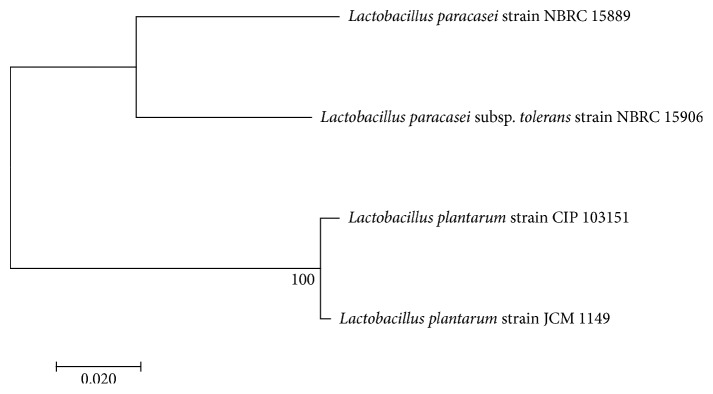
Abstract Probiotics are live microorganisms which when consumed in large number together with a food promote the health of the consumer. The aim of this study was to evaluate in vitro probiotic properties of lactic acid bacteria (LAB) isolated from traditional Ethiopian fermented Teff injera dough, Ergo and Kocho products. A total of 90 LAB were isolated, of which 4 (4.44%) isolates showed 45.35-97.11% and 38.40-90.49% survival rate at pH values (2, 2.5 and 3) for 3 and 6 h in that order. The four acid tolerant isolates were found tolerant to 0.3% bile salt for 24 h with 91.37 to 97.22% rate of survival. The acid-and-bile salt tolerant LAB isolates were found inhibiting some foodborne test pathogenic bacteria to varying degrees. All acid-and-bile tolerant isolates displayed varying sensitivity to different antibiotics. The in vitro adherence to stainless steel plates of the 4 screened probiotic LAB isolates were ranged from 32.75 to 36.30% adhesion rate. The four efficient probiotic LAB isolates that belonged to Lactobacillus species were identified to strain level using 16S rDNA gene sequence comparisons and namely were Lactobacillus plantarum strain CIP 103151, Lactobacillus paracasei subsp. tolerans strain NBRC 15906, Lactobacillus paracasei strain NBRC 15889 and Lactobacillus plantarum strain JCM 1149. The four Lactobacillus strains were found to have potentially useful to produce probiotic products.
Overview
The claims and statistics of this paper haven’t been checked yet.
Run the check — free, no account needed. It reads the open-access text and checks the sources it cites.
Integrity signals
Registry
Cites
Statistics
Figures
Verification
Claims the paper makes
The claims and statistics of this paper haven’t been checked yet.
Run the check — free, no account needed. It reads the open-access text and checks the sources it cites.
Claims other papers make about this one
Each is checked against this paper’s own text: does it say what the citing paper says it does?
The source backs part of the claim, not all of it — or backs it for a different population, condition or comparison.
In the citing paper
“Species belonging to the genera Lactobacillus and Bifidobacterium are most commonly used as probiotics because they play a very important role in maintaining proper intestinal function and stimulating the host immune system [212,221,222].”
From Lactic Acid Bacteria in Raw-Milk Cheeses: From Starter Cultures to Probiotic Functions (2022) · cites this paper as [221]
Experimental — accuracy not yet measured
Self-check
Percentages, sums and reported differences re-computed from the paper’s own numbers.
The self-check needs the paper’s full text.
Citations
Cites
The neighbor-joining method: a new method for reconstructing phylogenetic trees.
Saitou, N., & Nei, M. (1987) · Molecular Biology and Evolution · doi:10.1093/oxfordjournals.molbev.a040454 · Cited by 59,878
Hill (2014) · doi:10.1038/nrgastro.2014.66 · Cited by 9,592
Health benefits of fermented foods: Microbiota and beyond
Marco, M. L., Heeney, D., Binda, S., Cifelli, C. J., Cotter, P. D., Foligné, B., Gänzle, M., Kort, R., Pasin, G., Pihlanto, A., et al. (2017) · Current Opinion in Biotechnology · doi:10.1016/j.copbio.2016.11.010 · Cited by 1,674
Sivapalasingam, S., Friedman, C. R., Cohen, L., & Tauxe, R. V. (2004) · Journal of Food Protection · doi:10.4315/0362-028x-67.10.2342 · Cited by 1,053
Probiotics: an overview of beneficial effects
Ouwehand, A. C., Salminen, S., & Isolauri, E. (2002) · Antonie van Leeuwenhoek · doi:10.1023/a:1020620607611 · Cited by 1,051
Selection of potential probiotic lactic acid bacteria from fermented olives by in vitro tests
Argyri, A. A., Ζουμποπούλου, Γ., Karatzas, K. A. G., Tsakalidou, E., Nychas, G. E., Panagou, E. Ζ., & Tassou, C. C. (2012) · Food Microbiology · doi:10.1016/j.fm.2012.10.005 · Cited by 659
Powers, E. M. (1995) · Applied and Environmental Microbiology · doi:10.1128/aem.61.10.3756-3758.1995 · Cited by 447
Shokryazdan, P., Sieo, C. C., Ramasamy, K., Liang, J. B., Alitheen, N. B., Jahromi, M. F., & Ho, Y. W. (2014) · BioMed Research International · doi:10.1155/2014/927268 · Cited by 331
Dowarah, R., Verma, A. K., Agarwal, N., Singh, P., & Singh, B. R. (2018) · PLoS ONE · doi:10.1371/journal.pone.0192978 · Cited by 248
Laboratory Exercises in Microbiology
Otero, R. B. (1973) · Medical Entomology and Zoology · Cited by 238
Research works printed but not linked: 12
- 2011, International Journal of Probiotics & Prebiotics, 6
- 2005, Internet Journal of Food Safety, 5, 13
- 2002, Antonie Van Leeuwenhoek, 82, 279
- 2011, Probiotics and health claims: challenges for tailoring their efficacy, 49
- 2016, International Food Research Journal, 23, 770
- 2010, Indian Journal of Biotechnology, 9, 166
- 2012, Annals of the Romanian Society for Cell Biology, 17
- 2005, Journal of Culture Collections, 4, 48
- 1987, Molecular Biology and Evolution, 4, 406
- 2006, International Journal of Probiotics and Prebiotics, 1, 27
- 2017, Iranian Journal of Microbiology, 9, 234
- 2012, Life Science Journal, 9
Cited by
Sorted by citations
Lactic Acid Bacteria in Raw-Milk Cheeses: From Starter Cultures to Probiotic Functions
Coelho, M. C., Malcata, F. X., & Silva, C. C. G. (2022) · Foods · doi:10.3390/foods11152276 · Cited by 276
“The most commonly used probiotic lactobacilli species in the food industry are L. acidophilus , L. plantarum, L. rhamnosus, L. paracasei, L. casei, L. gasseri, L. johnsonii, L. reuteri [216,221], L. fermentum, L. salivarius [212], and L. delbrueckii subsp. bulgaricus [201].”
Reuben, R. C., Roy, P. C., Sarkar, S. L., Alam, A. S. M. R. U., & Jahid, I. K. (2019) · Journal of Dairy Science · doi:10.3168/jds.2019-17092 · Cited by 269
Hakim, B. N. A., Xuan, N. J., & Oslan, S. N. H. (2023) · Foods · doi:10.3390/foods12152850 · Cited by 267
Probiotics in the dairy industry—Advances and opportunities
Gao, J., Li, X., Zhang, G., Sadiq, F. A., Simal‐Gandara, J., Xiao, J., & Sang, Y. (2021) · Comprehensive Reviews in Food Science and Food Safety · doi:10.1111/1541-4337.12755 · Cited by 195
Ayyash, M. M., Abdalla, A. K., Alkalbani, N. S., Baig, M. A., Turner, M. S., Liu, S., & Shah, N. P. (2021) · Journal of Dairy Science · doi:10.3168/jds.2021-20398 · Cited by 161
Metadata
- Authors
- Mulaw, G., Sisay Tessema, T., Muleta, D., & Tesfaye, A.
- Affiliations
- Addis Ababa University (ET)
- Institute of Biotechnology, College of Natural and Computational Sciences, Addis Ababa University, Addis Ababa 1176, Ethiopia
- Corresponding author
- Mulaw, Guesh
- Venue
- International Journal of Microbiology
- Publisher
- Wiley
- Published
- 2019-08-25
- Volume
- 2019
- Pages
- 1-11
- ISSN
- 1687-918X (ISSN-L)
- 1687-9198
- PMC
- PMC6732631
- OpenAlex
- W2969997194
- Cited by
- 258
- References
- 43
- Citations by year
- 2026: 34 · 2025: 33 · 2024: 62 · 2023: 46 · 2022: 43 · 2021: 22 · 2020: 15 · 2019: 3
- FWCI
- 16.01
- Type
- journal article
- Language
- en
- Update notices
- corrigendum (2020-07-30)
- Open access
- gold
- doi.org
- Locations
- International Journal of Microbiology (publishedVersion, cc-by)
- bioRxiv (Cold Spring Harbor Laboratory) (acceptedVersion, cc-by)
- PubMed Central (publishedVersion, cc-by)
- PubMed (publishedVersion)
- DOAJ (DOAJ: Directory of Open Access Journals) (submittedVersion, cc-by-sa)
- Greater South Information System
- Funders
- Addis Ababa University
- Helsinki University
- Aksum University
- Ethiopian Public Health Institute
- Topics
- Life Sciences › Agricultural and Biological Sciences › Food Science › Probiotics and Fermented Foods
- Life Sciences › Immunology and Microbiology › Microbiology › Reproductive tract infections research
- Health Sciences › Nursing › Nutrition and Dietetics › Infant Nutrition and Health
- Keywords
- probiotic properties, lactic acid bacteria, traditional fermented foods, ERGO, kocho, acid resistance, bile salt tolerance, antibacterial activity, antibiotic susceptibility, bacterial adhesion, Lactobacillus plantarum, Lactobacillus paracasei, 16S rRNA identification
About these checks
Registry, retraction, Cites and statistics results are computed, not judged, with one exception: a printed reference that no index lists is read once by a model before it counts as a citation error. Claims are extracted by a model and kept only when their quote appears verbatim in the text; each cited source is then checked, with a model’s help, for whether it says what the claim relies on. Those verdicts can be wrong — read the claim’s quote and the cited source before relying on one.
Statistics and arithmetic are recomputed, not judged.
Confidence bands are shown only for fields calibrated on our annotated test set. None is calibrated yet, so no band is shown.
What counts as a claim ›How we measure confidence ›How we check this ›
Are you an author, or do you see a problem with this page? Request a review
