

The DOI matches its Crossref record; 78 of the 79 references it cites were found in a registry or an index; none of the 105 sources its claims cite is checked for support yet.
Nutritional Status and Cardiovascular Health in Female Adolescent Elite-Level Artistic Gymnasts and Swimmers: A Cross-Sectional Study of 31 Athletes
Open accessAbstract
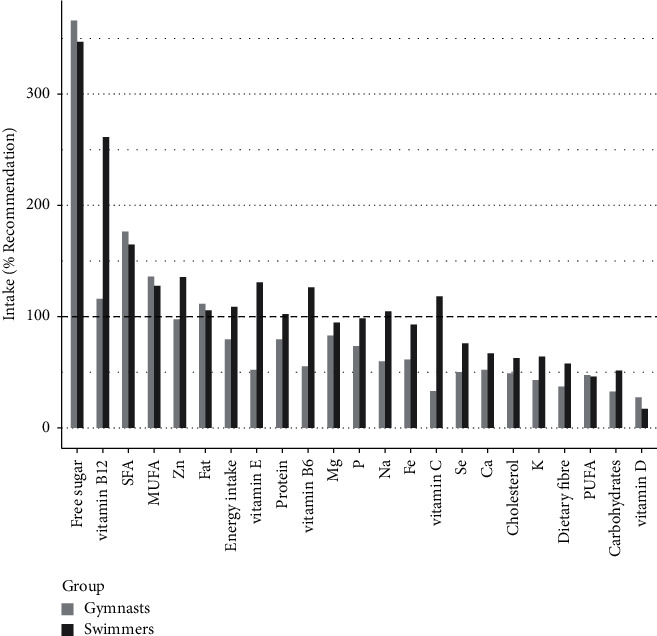
Objective. Nutritional status is important for health and competitive achievement. This area remains understudied among elite-level female athletes and is appropriate for research. We examined nutritional status and cardiovascular health markers of two groups of female athletes of the same age and competition period, involved in weight-bearing and a non-weight-bearing sport: gymnasts (n = 17) and swimmers (n = 14); mean age 17.4 and 16.6 years. Methods. Body composition and dietary intake were assessed by bioelectrical impedance and Food Frequency Questionnaire. The concentrations of serum micronutrients (B12, 25-hydroxyvitamin D (25 (OH) D), calcium, magnesium, phosphorus, potassium, and iron), blood lipids, and blood pressure (BP) were measured. Setting and Participants. A cross-sectional study of 31 athletes from Slovenia. Results. Gymnasts had higher body mass index (21.5 vs. 20.1 kg/m2, p = 0.043 ) and lower fat free mass (42.4 vs. 46.6 kg, p = 0.024 ) than swimmers and comparable body fat percentage (22.5 vs. 22.8%). Both groups had low intake of carbohydrates, fibre, polyunsaturated fats, protein (only gymnasts), and micronutrients (11/13 micronutrients gymnasts and 4/13 swimmers) and high intake of free sugars and saturated fats. Both groups also had significantly lower-than-recommended serum levels of 25 (OH) D. All cardiovascular risk factors were within recommended ranges. Gymnasts had higher LDL cholesterol (2.7 vs. 2.2 mmol/L, p < 0.011 ), and swimmers had higher systolic BP (126 vs. 107 mmHg, p < 0.001 ). Conclusions. Dietary intake especially in gymnasts was suboptimal, which may reflect in anthropometric and cardiovascular marker differences between gymnasts and swimmers.
Overview
CoChat Summary
TL;DR
In a cross-sectional study of 31 Slovenian elite female adolescent athletes, gymnasts had higher BMI and lower fat-free mass than swimmers, and both groups showed suboptimal dietary intake, especially gymnasts. Cardiovascular risk markers were mostly within recommended ranges, but gymnasts had higher LDL cholesterol and swimmers had higher systolic blood pressure.
Key findings
- Gymnasts (n = 17) had higher BMI than swimmers (n = 14) (21.5 vs. 20.1 kg/m², p = 0.043) and lower fat-free mass (42.4 vs. 46.6 kg, p = 0.024), with comparable body fat percentage (22.5% vs. 22.8%).
- Both groups had low intake of carbohydrates, fibre, and polyunsaturated fats; gymnasts also had low protein intake, and micronutrient intake was below recommendations for 11/13 micronutrients in gymnasts and 4/13 in swimmers. Both groups had high free sugar and saturated fat intake and low serum 25(OH)D.
- Gymnasts had higher LDL cholesterol than swimmers (2.7 vs. 2.2 mmol/L, p < 0.011), while swimmers had higher systolic blood pressure (126 vs. 107 mmHg, p < 0.001).
- All cardiovascular risk factors were, on average, within recommended ranges; energy availability was below recommended in both groups (23 ± 3 kcal/kg FFM/day in gymnasts and 33 ± 5 in swimmers vs. recommended 45 kcal/kg FFM/day).
Methods
- Cross-sectional study of 31 elite-level female indoor athletes from Slovenia: 17 artistic gymnasts (mean age 17.4 ± 4.1 years) and 14 swimmers (mean age 16.6 ± 3.1 years), assessed during the competition period within three days (April 4–6, 2018).
- Body composition was assessed by bioelectrical impedance; dietary intake by a 52-item qualitative Food Frequency Questionnaire; serum micronutrients, blood lipids, and blood pressure were measured after overnight fasting.
- Between-group comparisons used Mann–Whitney U tests; intake versus recommendations used one-sample Wilcoxon signed-rank tests; analyses performed in R 3.5.2.
Limitations
- The paper states the sample size was relatively small, results should be interpreted with caution, and replication in larger samples is needed.
- The paper acknowledges FFQ limitations: a planned 3-day weighed dietary protocol was not performed because coaches advised against it; the FFQ had limited items and a one-year recall period, was validated in a Dutch rather than Slovenian population, and dietary assessment may involve under- or misreporting, especially in elite female gymnasts.
- The paper notes blood assays were obtained from two national medical laboratories separately for gymnasts and swimmers, and that a single assessment does not allow definitive conclusions about anthropometry, diet, or cardiovascular health.
Model-written summary. Check it against the paper before relying on it.
Integrity signals
Registry
Cites
Statistics
Figures
Verification
Claims the paper makes
0 Valid · 0 Not valid · 75 Not checked · 98 Own results and interpretations
A result the paper reports from its own data — it cites no other source for it, so there is none to check. The quote shows it is in the paper.
In the paper
“Gymnasts had higher LDL cholesterol (2.7 vs. 2.2 mmol/L, p < 0.011)”
§ Nutritional Status and Cardiovascular Health in Female Adolescent Elite-Level Artistic Gymnasts and Swimmers: A Cross-Sectional Study of 31 Athletes > Abstract > Results
plainstates an association- Asserted: passes — The authors put it forward as true.
- Checkable: passes — It can be checked against evidence.
- Load-bearing: unclear — It is unclear whether the paper’s conclusions depend on it.
- Based: passes — The paper gives a reason why it holds.
A result the paper reports from its own data — it cites no other source for it, so there is none to check. The quote shows it is in the paper.
In the paper
“All blood variables and BP were, on average for both groups, within recommended target ranges.”
§ Nutritional Status and Cardiovascular Health in Female Adolescent Elite-Level Artistic Gymnasts and Swimmers: A Cross-Sectional Study of 31 Athletes > 3. Results > 3.4. Cardiovascular (CV) Health and Safety Factors
plain- Asserted: passes — The authors put it forward as true.
- Checkable: passes — It can be checked against evidence.
- Load-bearing: unclear — It is unclear whether the paper’s conclusions depend on it.
- Based: passes — The paper gives a reason why it holds.
In the paper
“However, only 53% of gymnasts and 79% of swimmers had S-vit B12 above the reference value of 258 pmol/L.”
- Also stated in: § 4.3. Dietary Intake and Serum Micronutrient Status · plain
“Of note, only 53% of gymnasts and 79% of swimmers had S-vit B12 above the reference value of 258 pmol/L [46].”
§ Nutritional Status and Cardiovascular Health in Female Adolescent Elite-Level Artistic Gymnasts and Swimmers: A Cross-Sectional Study of 31 Athletes > 3. Results > 3.3. Serum Micronutrient Status
What the sources say
- Not checked yetcites [46] source
plain- Asserted: passes — The authors put it forward as true.
- Checkable: passes — It can be checked against evidence.
- Load-bearing: unclear — It is unclear whether the paper’s conclusions depend on it.
- Based: passes — The paper gives a reason why it holds.
- Also stated in: § 4.3. Dietary Intake and Serum Micronutrient Status · plain
A result the paper reports from its own data — it cites no other source for it, so there is none to check. The quote shows it is in the paper.
In the paper
“There were no discernible differences between gymnasts and swimmers only for BF%.”
§ Nutritional Status and Cardiovascular Health in Female Adolescent Elite-Level Artistic Gymnasts and Swimmers: A Cross-Sectional Study of 31 Athletes > 4. Discussion > 4.1. Main Findings
plain- Asserted: passes — The authors put it forward as true.
- Checkable: passes — It can be checked against evidence.
- Load-bearing: unclear — It is unclear whether the paper’s conclusions depend on it.
- Based: passes — The paper gives a reason why it holds.
A result the paper reports from its own data — it cites no other source for it, so there is none to check. The quote shows it is in the paper.
In the paper
“Between the studied groups, there were no significant differences in intake of macronutrients (e.g., for free sugars, total fat, saturated fatty acids or protein, expressed as % of daily energy intake, and for cholesterol expressed as mg/day).”
§ Nutritional Status and Cardiovascular Health in Female Adolescent Elite-Level Artistic Gymnasts and Swimmers: A Cross-Sectional Study of 31 Athletes > 3. Results > 3.2. Dietary Intake Status
plain- Asserted: passes — The authors put it forward as true.
- Checkable: passes — It can be checked against evidence.
- Load-bearing: unclear — It is unclear whether the paper’s conclusions depend on it.
- Based: passes — The paper gives a reason why it holds.
62 more claims
Create a free account to see all 173 claims and to verify the 103 references still open.
- It may state two separate claims as one. 70
- Probably not a substantial claim. 55
Self-check
Percentages, sums and reported differences re-computed from the paper’s own numbers.
Each contradiction between two passages listed here was confirmed by an independent check.
Rated minor: it would not touch a result — a value no result rests on, a p-value that stays on the same side of the significance level, or a conflict that is clerical, resolved elsewhere in the paper, or outside its own findings.
In the paper
“in swimmers, it was 54% from carbohydrates, 38% from fat, and 13% from protein.”
§ Nutritional Status and Cardiovascular Health in Female Adolescent Elite-Level Artistic Gymnasts and Swimmers: A Cross-Sectional Study of 31 Athletes > 3. Results > 3.2. Dietary Intake Status
Reported 100 · recomputed 105
Rated minor: it would not touch a result — a value no result rests on, a p-value that stays on the same side of the significance level, or a conflict that is clerical, resolved elsewhere in the paper, or outside its own findings.
In the paper
§ Nutritional Status and Cardiovascular Health in Female Adolescent Elite-Level Artistic Gymnasts and Swimmers: A Cross-Sectional Study of 31 Athletes > 3. Results > 3.3. Serum Micronutrient Status
“whereas for swimmers, S-P and S-Mg were not in reference ranges.”
§ Nutritional Status and Cardiovascular Health in Female Adolescent Elite-Level Artistic Gymnasts and Swimmers: A Cross-Sectional Study of 31 Athletes > 3. Results > 3.3. Serum Micronutrient Status
“S-Mg was found to be within the reference range for all gymnasts and swimmers.”
Rated minor: it would not touch a result — a value no result rests on, a p-value that stays on the same side of the significance level, or a conflict that is clerical, resolved elsewhere in the paper, or outside its own findings.
In the paper
§ Nutritional Status and Cardiovascular Health in Female Adolescent Elite-Level Artistic Gymnasts and Swimmers: A Cross-Sectional Study of 31 Athletes > 5. Conclusion
“Both groups consumed too much of free sugars, total fat, and SFA”
§ Nutritional Status and Cardiovascular Health in Female Adolescent Elite-Level Artistic Gymnasts and Swimmers: A Cross-Sectional Study of 31 Athletes > 4. Discussion > 4.3. Dietary Intake and Serum Micronutrient Status
“Percentages of total fat intake were in the upper recommended range for both groups (40 and 38% of daily energy intake, respectively, for gymnasts and swimmers vs. the recommended 30–40% [40]).”
Rated minor: it would not touch a result — a value no result rests on, a p-value that stays on the same side of the significance level, or a conflict that is clerical, resolved elsewhere in the paper, or outside its own findings.
In the paper
§ Nutritional Status and Cardiovascular Health in Female Adolescent Elite-Level Artistic Gymnasts and Swimmers: A Cross-Sectional Study of 31 Athletes > 4. Discussion > 4.4. Cardiovascular Health
“Higher LDL cholesterol in gymnasts could be associated with dietary patterns, including lower energy intake, higher overall total fat, SFA, and free sugar intake and lower fibre intake.”
§ Nutritional Status and Cardiovascular Health in Female Adolescent Elite-Level Artistic Gymnasts and Swimmers: A Cross-Sectional Study of 31 Athletes > 4. Discussion > 4.3. Dietary Intake and Serum Micronutrient Status
“(65 g/day, 17% of energy in gymnasts and 94 g/day, and 17% of energy in swimmers).”
Citations
Cites
Wickham, H. (2016) · Use R! · doi:10.1007/978-3-319-24277-4 · Cited by 33,115
Mach, F., Baigent, C., Catapano, A. L., Koskinas, K. C., Casula, M., Badimon, L., Chapman, M. J., De Backer, G. G., Delgado, V., Ference, B. A., et al. (2020) · European Heart Journal · doi:10.1093/eurheartj/ehz455 · Cited by 8,961
Health effects of overweight and obesity in 195 countries over 25 years
Collaborators, T. G. 2. O. (2017) · New England Journal of Medicine · doi:10.1056/nejmoa1614362 · Cited by 7,918
Mach, F., Baigent, C., Catapano, A. L., Koskinas, K. C., Casula, M., Badimon, L., Chapman, M. J., De Backer, G. G., Delgado, V., Ference, B. A., et al. (2019) · Atherosclerosis · doi:10.1016/j.atherosclerosis.2019.08.014 · Cited by 4,854
Ultra-processed foods: What they are and how to identify them
Monteiro, C. A., Cannon, G., Levy, R. B., Moubarac, J.-C., Louzada, M. L., Rauber, F., Khandpur, N., Cediel, G., Neri, D., Martinez-Steele, E., et al. (2019) · Public Health Nutrition · doi:10.1017/s1368980018003762 · Cited by 2,964
Dietary fats and cardiovascular disease: a presidential advisory from the American Heart Association
Sacks, F. M., Lichtenstein, A. H., Wu, J. H. Y., Appel, L. J., Creager, M. A., Kris-Etherton, P. M., Miller, M., Rimm, E. B., Rudel, L. L., Robinson, J. G., et al. (2017) · Circulation · doi:10.1161/cir.0000000000000510 · Cited by 1,386
Thomas, D. T., Erdman, K. A., & Burke, L. M. (2016) · Journal of the Academy of Nutrition and Dietetics · doi:10.1016/j.jand.2015.12.006 · Cited by 1,359
Vitamin D Status: Measurement, Interpretation, and Clinical Application
Holick, M. F. (2009) · Annals of Epidemiology · doi:10.1016/j.annepidem.2007.12.001 · Cited by 1,286
Healthful and Unhealthful Plant-Based Diets and the Risk of Coronary Heart Disease in U.S. Adults
Satija, A., Bhupathiraju, S. N., Spiegelman, D., Chiuve, S. E., Manson, J. E., Willett, W., Rexrode, K. M., Rimm, E. B., & Hu, F. B. (2017) · Journal of the American College of Cardiology · doi:10.1016/j.jacc.2017.05.047 · Cited by 991
Williams, B., Mancia, G., Spiering, W., Agabiti Rosei, E., Azizi, M., Burnier, M., Clement, D., Coca, A., De Simone, G., Dominiczak, A., et al. (2018) · Journal of Hypertension · doi:10.1097/hjh.0000000000001961 · Cited by 882
Research works printed but not linked: 6
- Tanita, 2015, Body composition analyzer
- 10.1093/eurpub/cks096 · DOI · Paper page
- German Nutrition Society, 2018, Ergaenzlieferung D-A-CH Referenzwerte für die Nährstoffzufuhr [Reference Values for Nutrient Intake]
- WHO, 2015, Guideline: Sugars Intake for Adults and Children
- FAO, 2003, Food energy–methods of analysis and conversion factors, Food and Agriculture Organization of the United Nations, 29-29, 55
- E. Benedik, 2012, New recommendations for vitamin D intake Nova priporočila za vnos vitamina D, Zdrav Vestn, 82, 154
Cited by
Female Athlete Triad and Relative Energy Deficiency in Sport (REDs): Nutritional Management
Grabia, M., Perkowski, J., Socha, K., & Markiewicz‐Żukowska, R. (2024) · Nutrients · doi:10.3390/nu16030359 · Cited by 73
Chandran, A. S., Roby, P. R., Boltz, A. J., Robison, H. J., Morris, S. N., & Collins, C. L. (2021) · Journal of Athletic Training · doi:10.4085/1062-6050-635-20 · Cited by 41
Jakše, B., Jakše, B., Godnov, U., & Pinter, S. (2021) · International Journal of Environmental Research and Public Health · doi:10.3390/ijerph18115968 · Cited by 34
Self-citationSari, A. P., Bafirman, B., Rifki, M. S., Syafrianto, D., & Kurniawan, R. (2023) · JOURNAL SPORT AREA · doi:10.25299/sportarea.2023.vol8(3).11727 · Cited by 30
Jakše, B., Jakše, B., Čuk, I., & Šajber, D. (2021) · International Journal of Environmental Research and Public Health · doi:10.3390/ijerph18042019 · Cited by 27
Self-citationPlacing a Well-Designed Vegan Diet for Slovenes
Jakše, B. (2021) · Nutrients · doi:10.3390/nu13124545 · Cited by 24
Self-citationΚοντελέ, Ι., Grammatikopoulou, M. G., & Vassilakou, T. (2021) · Children · doi:10.3390/children8121135 · Cited by 16
Parents’ experiences of family food routines in adolescent elite-level swimming
White, H. J., Harwood, C., Wiltshire, G., & Plateau, C. R. (2022) · Psychology of sport and exercise · doi:10.1016/j.psychsport.2022.102237 · Cited by 9
Jakše, B., Gilić, B., Đurović, M., & Šajber, D. (2024) · Journal of Nutrition and Metabolism · doi:10.1155/2024/3037784 · Cited by 7
Self-citationJakše, B., Lipošek, S., Zenić, N., & Šajber, D. (2022) · Sports · doi:10.3390/sports10050063 · Cited by 7
Self-citationDietary Intake and Menstrual Health among Acrobatics and Tumbling NCAA Division I Student-Athletes
Souza, L. C., Moris, J. M., Lee, K. M., Fant, K. H., Gallucci, A. R., & Funderburk, L. (2023) · Journal of the American Nutrition Association · doi:10.1080/27697061.2023.2218458 · Cited by 6
Nutritional Status of Slovene Adults in the Post-COVID-19 Epidemic Period
Jakše, B., Godnov, U., & Pinter, S. (2022) · European Journal of Investigation in Health Psychology and Education · doi:10.3390/ejihpe12120122 · Cited by 5
Self-citationJakše, B., & Jakše, B. (2023) · Science of Gymnastics Journal · doi:10.52165/sgj.15.1.27-46 · Cited by 4
Self-citationKhaledi, A., Imeri, B., Gheitasi, M., & Mirmoezzi, M. (2023) · Asian Journal of Sports Medicine · doi:10.5812/asjsm-136942 · Cited by 2
Podvin, C. C., Morrison, T., Dabis, J., McGinley, J. J., Ellis, H. B., Wilson, P. L., & Ulman, S. M. (2024) · Nutrients · doi:10.3390/nu16121847 · Cited by 2
Çocuklarda Vücut Kompozisyonunun Belirlenmesi: Biyoelektrik İmpedans Analizi
Küçükkubaş, N. (2021) · Türk Spor Bilimleri Dergisi · doi:10.46385/tsbd.887907 · Cited by 1
Jakše, B., & Šajber, D. (2022) · Exercise and Quality of Life · doi:10.31382/eqol.220601 · Cited by 1
Self-citationNutritional interventions for gymnasts: bridging the gap between performance and health
Ahmad, N., Khan, W., Arif, T., & Ahmed, S. (2025) · Pedagogy of Physical Culture and Sports · doi:10.15561/26649837.2025.0405 · Cited by 1
(2022) · International Journal of Sports Technology · doi:10.38007/ijst.2022.030301
Correlation of Magnesium and Calcium Intake with Cardiorespiratory Endurance in Adolescent Athletes
Yasin, Y. K., & Ichsania, N. (2026) · COMPETITOR Jurnal Pendidikan Kepelatihan Olahraga · doi:10.26858/cpjok.v18i1.534
Metadata
- Authors
- Jakše, B., Jakše, B., Mis, N. F., Jug, B., Šajber, D., Godnov, U., & Čuk, I.
- Affiliations
- University of Ljubljana (SI)
- Ljubljana University Medical Centre (SI)
- University of Primorska (SI)
- Corresponding author
- Jakše, Boštjan
- Mis, Nataša Fidler
- Venue
- Journal of Nutrition and Metabolism
- Publisher
- Wiley
- Published
- 2021-01-12
- Volume
- 2021
- Pages
- 1-15
- ISSN
- 2090-0724 (ISSN-L)
- 2090-0732
- PMC
- PMC7815399
- OpenAlex
- W3121009498
- Semantic Scholar
- fdf8d6d4f4a1d39cae6421baf24c3b25d07e0fce
- Cited by
- 21
- References
- 79
- Citations by year
- 2026: 1 · 2025: 2 · 2024: 3 · 2023: 4 · 2022: 5 · 2021: 6
- FWCI
- 2.75
- Type
- journal article
- Language
- en
- Open access
- gold
- doi.org
- Locations
- Journal of Nutrition and Metabolism (publishedVersion, cc-by)
- Europe PMC (PubMed Central) (publishedVersion, cc-by)
- PubMed (publishedVersion)
- PubMed Central (publishedVersion, cc-by)
- DOAJ (DOAJ: Directory of Open Access Journals) (submittedVersion, cc-by-sa)
- Funders
- Javna Agencija za Raziskovalno Dejavnost RS
- Topics
- Health Sciences › Nursing › Nutrition and Dietetics › Nutrition, Health and Food Behavior
- Health Sciences › Medicine › Cardiology and Cardiovascular Medicine › Cardiovascular Effects of Exercise
- Health Sciences › Medicine › Public Health, Environmental and Occupational Health › Nutrition and Health Studies
- Keywords
- nutritional status, cardiovascular health, adolescent female athletes, artistic gymnasts, swimmers, body composition, dietary intake, micronutrient deficiency, vitamin D, serum lipids, blood pressure, cardiovascular risk factors
About these checks
Registry, retraction, Cites and statistics results are computed, not judged, with one exception: a printed reference that no index lists is read once by a model before it counts as a citation error. Claims are extracted by a model and kept only when their quote appears verbatim in the text; each cited source is then checked, with a model’s help, for whether it says what the claim relies on. Those verdicts can be wrong — read the claim’s quote and the cited source before relying on one.
A language model drew the claims from the paper on 2026-11-14, under version 3 of the claim definition (model deepseek-v4.1-flash, prompt extract-v3).
A second model labelled each claim on 2026-11-14 (model jev-1.13-20260917, definition revision gold-guideline-v0.2).
Statistics and arithmetic are recomputed, not judged.
Confidence bands are shown only for fields calibrated on our annotated test set. None is calibrated yet, so no band is shown.
What counts as a claim ›How we measure confidence ›How we check this ›
Are you an author, or do you see a problem with this page? Request a review
Data sources
Bibliographic data: Semantic Scholar, OpenAlex, Crossref.
Contains information from the Semantic Scholar Academic Graph Datasets, made available under the ODC Attribution License (ODC-BY 1.0).
Semantic Scholar’s data is described in: Kinney, R., et al. (2023). The Semantic Scholar Open Data Platform. arXiv:2301.10140.
