

Polyethylene Glycol 3350 in the Treatment of Chronic Idiopathic Constipation: Post hoc Analysis Using FDA Endpoints
Open accessThe DOI matches its Crossref record; 19 of the 19 references it cites were found in a registry or an index.
Abstract
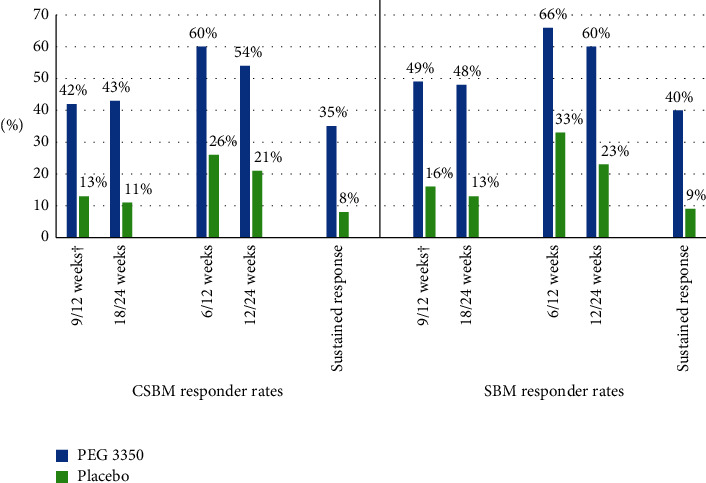
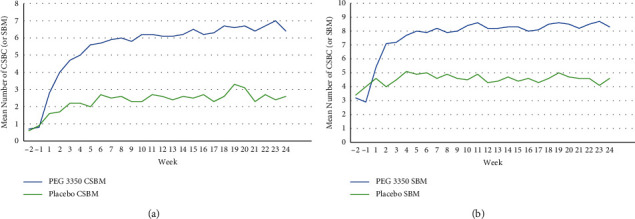
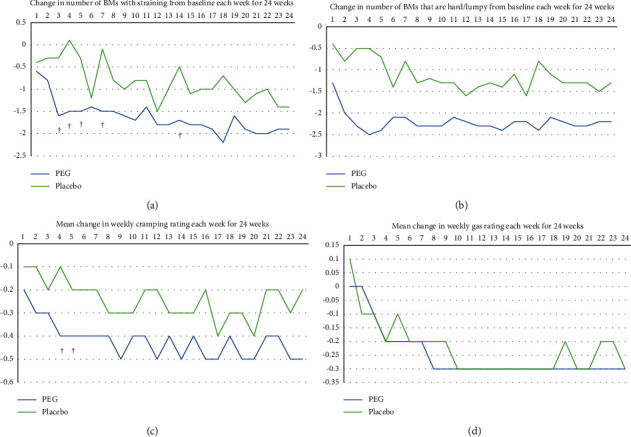
Background & Aims. The efficacy and safety of polyethylene glycol 3350 for chronic idiopathic constipation have been demonstrated in randomized controlled trials. A new US Food and Drug Administration-recommended primary efficacy endpoint for evaluating chronic idiopathic constipation prompted our reevaluation of previously reported clinical data with polyethylene glycol 3350. Methods. This multicenter, double-blind, placebo-controlled, parallel-group trial included adults with chronic idiopathic constipation randomized to polyethylene glycol 3350 17 g (n = 204) or placebo (n = 100) once daily for 24 weeks. Post hoc analyses were performed using the US Food and Drug Administration endpoint (≥3 complete spontaneous bowel movements/week and an increase of ≥1 complete spontaneous bowel movement/week from baseline for ≥9/12 weeks, including 3 of the last 4 weeks) along with additional efficacy and safety outcomes. Results. The proportion of patients meeting the new endpoint was significantly higher with polyethylene glycol 3350 vs placebo (42% vs 13%; P < 0.0001 ). Reductions in the mean number of hard/lumpy stools/week (–2.1 vs –0.9; P = 0 .0014 ) and the weekly mean five-point cramping rating (–0.3 vs –0.1; P = 0 .0272 ) also significantly favored polyethylene glycol 3350. The proportion of subjects with gastrointestinal adverse events decreased markedly after the first week of treatment in the polyethylene glycol 3350 group. Conclusion. Using the current US Food and Drug Administration-recommended responder definition and other secondary outcomes, once-daily polyethylene glycol 3350 demonstrated substantial and sustained efficacy and safety over 24 weeks in patients with chronic idiopathic constipation. Trial Registration. The original trial was registered with https://clinicaltrials.gov Trial: NCT00153153.
Overview
The claims and statistics of this paper haven’t been checked yet.
Free: it reads the open-access text and checks the first 5 claims that cite a source we can check. Create a free account to check every claim.
Integrity signals
Registry
Cites
Statistics
Figures
Verification
Claims the paper makes
The claims and statistics of this paper haven’t been checked yet.
Free: it reads the open-access text and checks the first 5 claims that cite a source we can check. Create a free account to check every claim.
Claims other papers make about this one
Each is checked against this paper’s own text: does it say what the citing paper says it does?
The cited source says what the claim attributes to it.
In the citing paper
“Across 2 studies, a higher rate of individuals met the responder definition, one study defined responder as normalization of bowel moments 37,38 and other defined based on the US Food and Drug Administration (FDA) end points, 40 compared with placebo (RR 3.13, CI 2.00-4.89); PEG was associated with 312 more per 1,000 (from 146 more to 569 more).”
Self-check
Percentages, sums and reported differences re-computed from the paper’s own numbers.
The self-check needs the paper’s full text.
Citations
Cites
Epidemiology of Constipation in North America: A Systematic Review
Higgins, P. D., & Johanson, J. F. (2004) · American Journal of Gastroenterology · doi:10.1111/j.1572-0241.2004.04114.x · Cited by 1,080 · cited 1×
“Chronic constipation is a common multi-symptom condition in the general population with self-reported prevalence estimates ranging from 5% to 27% [1].”
BackgroundSuares, N. C., & Ford, A. C. (2011) · American Journal of Gastroenterology · doi:10.1038/ajg.2011.164 · Cited by 904
American Gastroenterological Association Medical Position Statement on Constipation
Bharucha, A. E., Dorn, S. D., Lembo, A., & Pressman, A. (2013) · Gastroenterology · doi:10.1053/j.gastro.2012.10.029 · Cited by 521 · cited 1×
“Associated symptoms include hard/ lumpy stools, abdominal discomfort, bloating/distension, straining, and feelings of incomplete evacuation [3].”
BackgroundSelf-citationTwo randomized trials of linaclotide for chronic constipation
Lembo, A. J., Schneier, H. A., Shiff, S. J., Kurtz, C. B., MacDougall, J. E., Jia, X. D., Shao, J. Z., Lavins, B. J., Currie, M. G., Fitch, D. A., et al. (2011) · New England Journal of Medicine · doi:10.1056/nejmoa1010863 · Cited by 373
Self-citationDiPalma, J. A., Cleveland, M. V., McGowan, J., & Herrera, J. L. (2007) · The American Journal of Gastroenterology · doi:10.1111/j.1572-0241.2007.01199.x · Cited by 217 · cited 4×
“015) throughout the study, with the difference driven by abdominal distension, diarrhea, loose stools, flatulence, and nausea [5].”
BackgroundMethodInfluentialDiPalma, J. (2000) · The American Journal of Gastroenterology · doi:10.1016/s0002-9270(99)00824-2 · Cited by 211
Miner, P. B., Koltun, W. D., Wiener, G. J., De La Portilla, M., Prieto, B., Shailubhai, K., Layton, M. B., Barrow, L., Magnus, L., & Griffin, P. H. (2017) · American Journal of Gastroenterology · doi:10.1038/ajg.2016.611 · Cited by 141 · cited 1×
“, positive response 3 of the last 4 weeks), plecanatide has been associated with CSBM responses of 20% to 21% [15,16].”
BackgroundYiannakou, Y., Piessevaux, H., Bouchoucha, M., Schiefke, I., Filip, R., Gabalec, L., Dina, I., Stephenson, D., Kerstens, R., Etherson, K., et al. (2015) · American Journal of Gastroenterology · doi:10.1038/ajg.2015.115 · Cited by 104 · cited 1×
“Studies evaluating prucalopride have reported response rates of 25% to 38% using the less stringent definition of achieving at least three CSBMs per week for 12 to 24 weeks [17,18] with one study showing no significant difference vs placebo [18].”
Rao, S. S. C., & Brenner, D. M. (2021) · American Journal of Gastroenterology · doi:10.14309/ajg.0000000000001222 · Cited by 97
Cleveland, M. V., Flavin, D. P., Ruben, R. A., Epstein, R. M., & Clark, G. E. (2001) · PubMed · Cited by 89
Research works printed but not linked: 1
- DiPalma A. MacRae D. H. Reichelderfer M. Braintree polyethylene glycol (PEG) laxative for ambulatory and long-term care facility constipation patients: report of randomized, cross-over trials Online J Dig Health 1999 1 2
Cited by
Chang, L., Chey, W. D., Imdad, A., Almario, C. V., Bharucha, A. E., Diem, S., Greer, K. B., Hanson, B., Harris, L. A., Ko, C., et al. (2023) · Gastroenterology · doi:10.1053/j.gastro.2023.03.214 · Cited by 185
Self-citationChang, L., Chey, W. D., Imdad, A., Almario, C. V., Bharucha, A. E., Diem, S. J., Greer, K. B., Hanson, B., Harris, L. A., Ko, C. W., et al. (2023) · The American Journal of Gastroenterology · doi:10.14309/ajg.0000000000002227 · Cited by 57
“Across 2 studies, a higher rate of individuals met the responder definition, one study defined responder as normalization of bowel moments (37,38) and other defined based on the US Food and Drug Administration (FDA) end points (40), compared with placebo (RR 3.”
BackgroundSelf-citationYang, L., Zong, Y., Meng, F., Wu, Y., & Zhang, S. (2025) · Journal of Gastroenterology and Hepatology · doi:10.1111/jgh.16844 · Cited by 5
Domínguez-Muñóz, A., Bischoff, A., Wehrli, L. A., Judd-Glossy, L., Schneider, L., Merritt, A., Wickham, M., Ketzer, J., Rodriguez, V., Peña, A., et al. (2023) · Pediatric Surgery International · doi:10.1007/s00383-023-05508-9 · Cited by 5
Hu, Y., Sun, X., Wu, W., & Ekenseair, A. K. (2026) · Polymers · doi:10.3390/polym18091127 · Cited by 1
“PEG 3350 is used as an osmotic laxative to treat occasional constipation by drawing water into the bowel [19].”
Metadata
- Authors
- Menees, S. B., Lembo, A. J., & Chey, W. D.
- Affiliations
- University of Michigan (US)
- Beth Israel Deaconess Medical Center (US)
- Corresponding author
- Menees, Stacy B.
- Venue
- Canadian Journal of Gastroenterology and Hepatology
- Publisher
- Wiley
- Published
- 2022-09-09
- Volume
- 2022
- Pages
- 1-8
- ISSN
- 2291-2789 (ISSN-L)
- 2291-2797
- PMC
- PMC9481403
- OpenAlex
- W4295028037
- Cited by
- 6
- References
- 18
- Citations by year
- 2026: 2 · 2024: 1 · 2023: 3
- FWCI
- 0.87
- Type
- journal article
- Language
- en
- Open access
- gold
- doi.org
- Locations
- Canadian Journal of Gastroenterology and Hepatology (publishedVersion, cc-by)
- PubMed Central (publishedVersion, cc-by)
- PubMed (publishedVersion)
- DOAJ (DOAJ: Directory of Open Access Journals) (submittedVersion, cc-by-sa)
- Funders
- Braintree Laboratories
- Topics
- Health Sciences › Medicine › Gastroenterology › Gastrointestinal motility and disorders
- Health Sciences › Medicine › Urology › Pelvic floor disorders treatments
- Health Sciences › Medicine › Surgery › Congenital gastrointestinal and neural anomalies
- Keywords
- polyethylene glycol 3350, chronic idiopathic constipation, spontaneous bowel movements, abdominal cramping, gastrointestinal adverse effects, once-daily dosing
- MeSH terms
- Adult, Chronic Disease, Constipation, Humans, Polyethylene Glycols, United States, United States Food and Drug Administration, Treatment Outcome
About these checks
Registry, retraction, Cites and statistics results are computed, not judged, with one exception: a printed reference that no index lists is read once by a model before it counts as a citation error. Claims are extracted by a model and kept only when their quote appears verbatim in the text; each cited source is then checked, with a model’s help, for whether it says what the claim relies on. Those verdicts can be wrong — read the claim’s quote and the cited source before relying on one.
Statistics and arithmetic are recomputed, not judged.
Confidence bands are shown only for fields calibrated on our annotated test set. None is calibrated yet, so no band is shown.
What counts as a claim ›How we measure confidence ›How we check this ›
Are you an author, or do you see a problem with this page? Request a review
How to cite
Cite CoChat for the checks on this page, and the paper for its own findings.
- This page
- CoChat. (2026). Citation check: Polyethylene Glycol 3350 in the Treatment of Chronic Idiopathic Constipation: Post hoc Analysis Using FDA Endpoints. https://app.cochat.ai/papers/10.1155/2022/3533504
- The paper
- Menees, S. B., Lembo, A. J., & Chey, W. D. (2022). Polyethylene Glycol 3350 in the Treatment of Chronic Idiopathic Constipation: Post hoc Analysis Using FDA Endpoints. Canadian Journal of Gastroenterology and Hepatology. https://doi.org/10.1155/2022/3533504
Data sources
Bibliographic data: Semantic Scholar, OpenAlex, Crossref.
Contains information from the Semantic Scholar Academic Graph Datasets, made available under the ODC Attribution License (ODC-BY 1.0).
Semantic Scholar’s data is described in: Kinney, R., et al. (2023). The Semantic Scholar Open Data Platform. arXiv:2301.10140.
