

Angiotensin Receptor Blocker Is Associated with a Lower Fracture Risk: An Updated Systematic Review and Meta-Analysis
Open accessThe DOI matches its Crossref record; 49 of the 51 references it cites were found in a registry or an index.
Abstract
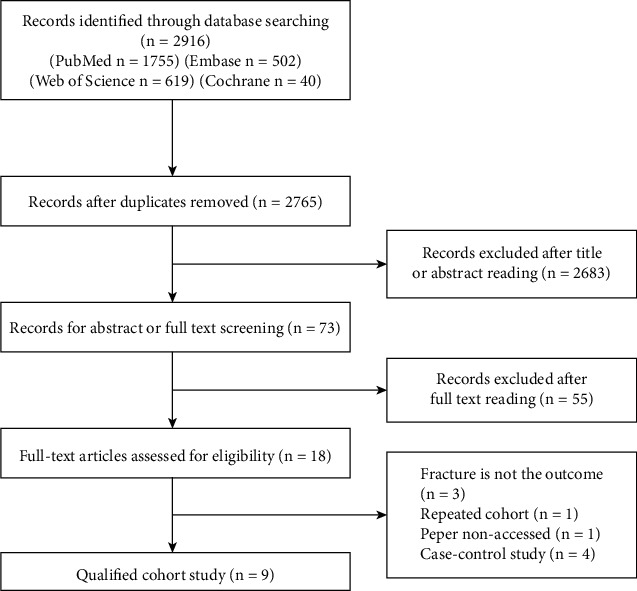
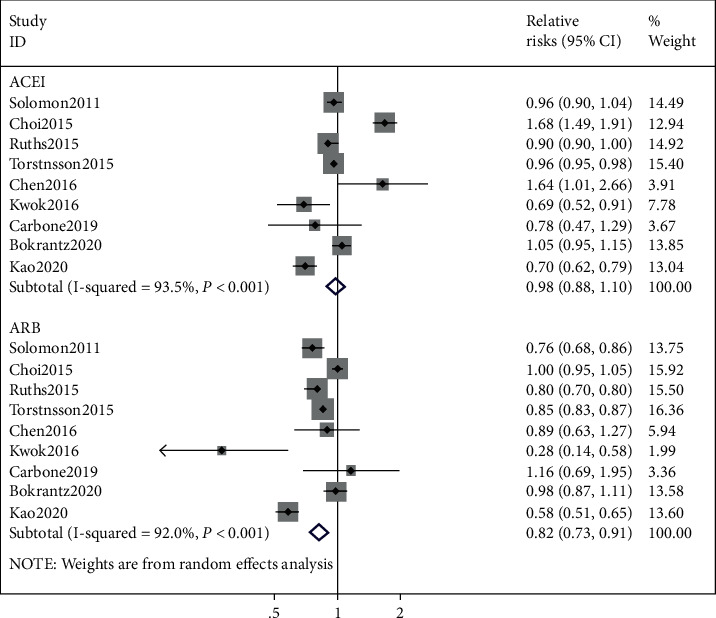
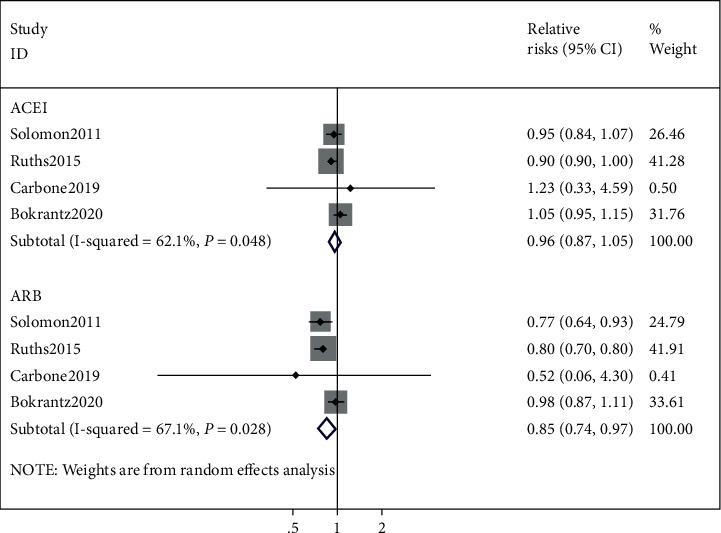
Background. Angiotensin‐converting enzyme inhibitors (ACEIs) and angiotensin receptor blockers (ARBs) are widely used in the treatment of hypertension. Hypertension is often accompanied by osteoporosis. However, the relationship between ACEI/ARB and fractures remains controversial. The purpose of this meta‐analysis was to update the potential relationship between ACEI/ARB and fractures. Methods. This meta‐analysis was identified through PubMed, EMBASE, Cochrane Library, and Web of Science. Related studies about ACEI/ARB with the risk of fracture were published from inception to June 2022. Results. Nine qualified prospective designed studies, involving 3,649,785 subjects, were included in this analysis. Overall, the RRs of ACEI compared with the nonusers were 0.98 (95% CI: 0.88, 1.10; P < 0.001) for composite fractures and 0.96 (95% CI: 0.87, 1.05; P = 0.048) for hip fractures; the RRs of ARB compared to the nonusers were 0.82 (95% CI: 0.73, 0.91; P < 0.001) for composite fractures and 0.85 (95% CI: 0.74, 0.97; P = 0.028) for hip fractures. Furthermore, in the subgroup analysis, male may benefit from ARB (RR = 0.65, 95% CI: 0.49, 0.89, P = 0.028), and the European may also benefit from ARB (RR = 0.86, 95% CI: 0.80, 0.93, P = 0.015). Conclusions. ACEI usage will not decrease the risk of osteoporosis fracture. On the contrary, ARB usage can decrease the risk of total fracture and hip fracture, especially for males and Europeans. Compared with ACEI, for patients at higher risk of fracture in cardiovascular diseases such as hypertension, the protective effect of ARB should be considered.
Overview
The claims and statistics of this paper haven’t been checked yet.
Free: it reads the open-access text and checks the first 5 claims that cite a source we can check. Create a free account to check every claim.
Integrity signals
Registry
Cites
Statistics
Figures
Verification
Claims the paper makes
The claims and statistics of this paper haven’t been checked yet.
Free: it reads the open-access text and checks the first 5 claims that cite a source we can check. Create a free account to check every claim.
Claims other papers make about this one
Each is checked against this paper’s own text: does it say what the citing paper says it does?
The cited source says what the claim attributes to it.
In the citing paper
“The systemic review by Wu et al. [12] reported that lower fracture risk is consistently reported in users of ARB, but not ACEi.”
Self-check
Percentages, sums and reported differences re-computed from the paper’s own numbers.
The self-check needs the paper’s full text.
Citations
Cites
Meta-analysis in clinical trials
DerSimonian, R., & Laird, N. (1986) · Controlled Clinical Trials · doi:10.1016/0197-2456(86)90046-2 · Cited by 39,552 · cited 1×
“For the best explanation of the heterogeneity between these studies, we used a random-effect model to calculate RRs and 95% Cis [18].”
Quantifying heterogeneity in a meta‐analysis
Higgins, J. P. T., & Thompson, S. G. (2002) · Statistics in Medicine · doi:10.1002/sim.1186 · Cited by 36,763 · cited 1×
“Heterogeneity was assessed with both the Q statistic and the I 2 index [19].”
Zhang, J., & Yu, K. F. (1998) · JAMA · doi:10.1001/jama.280.19.1690 · Cited by 4,138 · cited 7×
“In this meta-analysis, both ORs and HRs were transformed into RRs [17, 18].”
MethodInfluentialInternational Union of Pharmacology. XXIII. The Angiotensin II Receptors
de Gasparo, M., Catt, K. J., Inagami, T., Wright, J. W., & Unger, T. (2000) · Pharmacological Reviews · doi:10.1016/s0031-6997(24)01458-3 · Cited by 2,132 · cited 1×
“In some ways, however, the AT2 receptor can counteract several effects initiated by the AT1, though the mechanism remains unclear [45].”
Estimating the Relative Risk in Cohort Studies and Clinical Trials of Common Outcomes
McNutt, L.-A. (2003) · American Journal of Epidemiology · doi:10.1093/aje/kwg074 · Cited by 2,096 · cited 1×
“RRs were used as a common measure of the association between ACEI/ARB use and fracture risk [15].”
1,25-Dihydroxyvitamin D3 is a negative endocrine regulator of the renin-angiotensin system
Li, Y. C., Kong, J., Wei, M., Chen, Z.-F., Liu, S. Q., & Cao, L.-P. (2002) · Journal of Clinical Investigation · doi:10.1172/jci0215219 · Cited by 1,625
Smoking and fracture risk: a meta-analysis
Kanis, J. A., Johnell, O., Oden, A., Johansson, H., De Laet, C., Eisman, J. A., Fujiwara, S., Kroger, H., McCloskey, E. V., Mellstrom, D., et al. (2005) · Osteoporosis International · doi:10.1007/s00198-004-1640-3 · Cited by 999 · cited 1×
“At present, known factors associated with the incidence of fractures include physical age [2], smoking [3], alcohol consumption [4], and physical exercise [5].”
Israili, Z. H., & Hall, W. D. (1992) · Annals of Internal Medicine · doi:10.7326/0003-4819-117-3-234 · Cited by 910 · cited 1×
“ACEI is known to cause dry cough and angioedema [46] as it can inhibit bradykinin degradation [47].”
BackgroundMortality and morbidity after hip fractures.
Keene, G. S., Parker, M. J., & Pryor, G. A. (1993) · BMJ · doi:10.1136/bmj.307.6914.1248 · Cited by 876 · cited 1×
“Hip fractures often result in paralysis and loss of self-care, and there was a twenty percent increase in the mortality rate during the first year [1].”
Hypertension: Renin–Angiotensin–Aldosterone System Alterations
te Riet, L., van Esch, J. H. M., Roks, A. J. M., van den Meiracker, A. H., & Danser, A. H. J. (2015) · Circulation Research · doi:10.1161/circresaha.116.303587 · Cited by 706 · cited 1×
“RAAS blockers have been widely used in patients with hypertension [6], and mainly contain the angiotensin-converting enzyme inhibitor (ACEI) and angiotensin receptor blocker (ARB) in clinical practice.”
Background
Research works printed but not linked: 1
- Wu J. Du X.-Y. Guo M. Angiotensin Receptor Blocker Is Associated with A Lower Fracture Risk: An Updated Systematic Review and Meta-Analysis 2021 Durham, NC, USA Research Square PMC9303078 35910069
Cited by
Advanced Progress of the Relationship Between Antihypertensive Drugs and Bone Metabolism
Zhang, R., Yin, H., Yang, M., Lei, X., Zhen, D., & Zhang, Z. (2023) · Hypertension · doi:10.1161/hypertensionaha.123.21648 · Cited by 43
Huang, X., Zhang, T., Guo, P., Gong, W., Zhu, H., Zhao, M., & Yuan, Z. (2023) · Frontiers in Endocrinology · doi:10.3389/fendo.2023.1164387 · Cited by 26
Mkhize, B. C., Mosili, P., Ngubane, P. S., Sibiya, N. H., & Khathi, A. (2023) · International Journal of Molecular Sciences · doi:10.3390/ijms241511963 · Cited by 23
Michaëlsson, K., Zheng, R., Baron, J. A., Fall, T., Wolk, A., Lind, L., Höijer, J., Brunius, C. F., Lemming, E. W., Titova, O. E., et al. (2025) · EBioMedicine · doi:10.1016/j.ebiom.2025.105580 · Cited by 11
Exploring the Interplay Between Hypertension and Osteoporosis: A Narrative Review
Gutierrez, Y., Shaju, R. A., Sepulveda, A., & Çoban, S. A. (2025) · Cureus · doi:10.7759/cureus.97459 · Cited by 7
“If there are benefits observed, they are less than angiotensin II receptor blockers (ARBs) [60-63].”
Castagna, A., Pujia, C., Mazza, E., Maurotti, S., Ferro, Y., Rizzo, V., Formica, M., Conforto, R., Mercuri, C., Sciacqua, A., et al. (2026) · Nutrients · doi:10.3390/nu18020262 · Cited by 5
“Supporting this, antihypertensive agents that inhibit RAAS—particularly angiotensin receptor blockers (ARBs)—have been shown in systematic reviews and meta-analyses to reduce fracture risk [42].”
Fitzpatrick, D., Laird, E. J., Ward, M., Hoey, L., Hughes, C., McAnena, L. B., Strain, J., Cunningham, C. J., Molloy, A. M., McNulty, H., et al. (2025) · Bone · doi:10.1016/j.bone.2025.117710 · Cited by 4
Fong, S., Pettinelli, N. J., Lee, M. S., MacLeod, J., Gillinov, S. M., Monahan, P. F., Moran, J. T., Jonnalagadda, A., Mahatme, R. J., Apostolakos, J. M., et al. (2025) · JSES International · doi:10.1016/j.jseint.2025.05.007 · Cited by 3
“35 Numerous studies also substantiate sex-based differences in both RAS function and response to ARB.”
Yin, H., Yang, M., Sun, W., Zhang, R., Zhen, D., & Tang, X. (2024) · BMC Musculoskeletal Disorders · doi:10.1186/s12891-024-07909-w · Cited by 3
“However, the beneficial effects of RAAS inhibitors on osteoporosis and fracture could not be proved in clinical studies, whose conclusions were inconsistent [13–17].”
MethodResultChu, Q., Wang, L., & Chu, Q. (2023) · BMC Musculoskeletal Disorders · doi:10.1186/s12891-023-06362-5 · Cited by 1
“Recently, a meta-analysis that enrolled more than 360 million individuals indicated that the use of ACEI and ARB may both face a lower risk for fractures compared to nonusers [45].”
BackgroundAsbi, T., Haim, D., Meinster, I., Cahana, S., Grecco, C. M., Better, H., Almog, R., Zigdon‐Giladi, H., & Shibli, J. A. (2026) · Journal Of Clinical Periodontology · doi:10.1111/jcpe.70162 · Cited by 1
Anticancer Potential of ACEIs/ARBs Administration in Colorectal Cancer
Wang, X., & Jing, H. (2024) · Current Medicinal Chemistry · doi:10.2174/0109298673249782231226101119 · Cited by 1
Stadt, M. M., & Layton, A. T. (2025) · bioRxiv (Cold Spring Harbor Laboratory) · doi:10.1101/2025.05.01.651663
“Given that RAS inhibitors are relatively well tolerated, safe, and are reasonably priced drugs, there has been interest in using RAS inhibitors to prevent osteoporosis in post-menopausal women [10–12].”
Osteoporotic fracture risks of thiazides and dihydropyridines in angiotensin modulator users
Lin, Y.-C., Chiang, P., Huang, J., & Wu, W.-S. (2024) · Osteoporosis International · doi:10.1007/s00198-024-07356-2
Toledo, L. L., Santos, M., Salles, I. B. D. M., Schettino, I. C. C., Gonçalves, T. P., Prates, B. P., Tavares, W. M., & Cordeiro, M. L. L. (2025) · Contribuciones a las Ciencias Sociales · doi:10.55905/revconv.18n.1-430
Boratto, F. M. M., Silva, L. F., Eisenberg, L. P., Salgado, M. C. C., de Souza, L. G. B., Silva, L. I. L., Ricardo, L. N. N., & Mendes, F. A. G. (2025) · Contribuciones a las Ciencias Sociales · doi:10.55905/revconv.18n.2-008
Конради, А. О., Ageev, F. T., Galyavich, A. S., IuA, K., Kobalava, Z. D., Kotovskaya, Y. V., Nedogoda, S. V., Недошивин, А. О., & Ткачева, О. Н. (2025) · Russian Journal of Cardiology · doi:10.15829/1560-4071-2025-6249
Analay, P., Kara, M., Fırat, H. G., Çolak, A. F., Erdoğan, K., Aksakal, M. F., Yalçınkaya, B., Demirel, K., Sevinç, H., Küçüktoksöz, S., et al. (2025) · Journal of Clinical Densitometry · doi:10.1016/j.jocd.2025.101607
The relationship of medications and hyperparathyroidism to bone mineral density in older adults
Fitzpatrick, D. (2025) · Trinity's Access to Research Output (TARA) (Trinity College Dublin)
The «side» effect on bone: how antihypertensive drugs influence osteoporosis?
Kotovskaya, Y. U. V., & Unkovskiy, A. V. (2026) · Russian Journal of Geriatric Medicine · doi:10.37586/2686-8636-2-2026-197-206
이승준, Jayne, C., Kim, M. T., Boufadel, P., Cook, A. E., Uppstrom, T. J., & Li, X. (2026) · Journal of Shoulder and Elbow Surgery · doi:10.1016/j.jse.2026.05.038
Liu, J., LEE, S., Chen, X., Fernández, S., Wu, Q. F., & Zhang, P. (2026) · medRxiv · doi:10.64898/2026.03.20.26348832
Yin, H., Yang, M., Zhang, S., Li, Q., Zhen, D., & Tang, X. (2026) · Frontiers in Pharmacology · doi:10.3389/fphar.2026.1925933
“A recent meta-analysis confirms an association between ARB use and lower fracture risk, but finds no significant link for ACEIs (Wu et al., 2022).”
Wu, H.-M., Wu, W., Tsai, C., Chien, W., Chou, Y., Lin, M., & Chuang, C.-H. (2026) · Calcified Tissue International · doi:10.1007/s00223-026-01630-7
Metadata
- Authors
- Wu, J., Wang, M., Guo, M., Du, X.-Y., Tan, X.-Z., Teng, F.-Y., & Xu, Y.
- Affiliations
- Southwest Medical University (CN)
- Corresponding author
- Teng, Fang-Yuan
- Xu, Yong
- Venue
- International Journal of Clinical Practice
- Publisher
- Wiley
- Published
- 2022-01
- Volume
- 2022
- Issue
- 1
- Pages
- 7581110-7581110
- ISSN
- 1368-5031 (ISSN-L)
- 1742-1241
- PMC
- PMC9303078
- OpenAlex
- W4285494188
- Cited by
- 19
- References
- 51
- Citations by year
- 2026: 6 · 2025: 5 · 2024: 3 · 2023: 4 · 2022: 1
- FWCI
- 0.71
- Type
- journal article
- Language
- en
- Open access
- gold
- doi.org
- Locations
- International Journal of Clinical Practice (publishedVersion, cc-by)
- PubMed Central (publishedVersion, cc-by)
- PubMed (publishedVersion)
- Funders
- National Natural Science Foundation of China (81970676)
- Health Commission of Sichuan Province (21PJ090)
- Southwest Medical University (2021ZKMS032)
- Topics
- Health Sciences › Medicine › Orthopedics and Sports Medicine › Bone health and osteoporosis research
- Health Sciences › Medicine › Cardiology and Cardiovascular Medicine › Renin-Angiotensin System Studies
- Health Sciences › Medicine › Cardiology and Cardiovascular Medicine › Blood Pressure and Hypertension Studies
- Keywords
- angiotensin receptor blockers, ACE inhibitors, fracture risk, hip fracture, osteoporosis, hypertension, sex differences, European populations
- MeSH terms
- Angiotensin-Converting Enzyme Inhibitors, Hip Fractures, Humans, Hypertension, Male, Osteoporosis, Prospective Studies, Angiotensin Receptor Antagonists
About these checks
Registry, retraction, Cites and statistics results are computed, not judged, with one exception: a printed reference that no index lists is read once by a model before it counts as a citation error. Claims are extracted by a model and kept only when their quote appears verbatim in the text; each cited source is then checked, with a model’s help, for whether it says what the claim relies on. Those verdicts can be wrong — read the claim’s quote and the cited source before relying on one.
Statistics and arithmetic are recomputed, not judged.
Confidence bands are shown only for fields calibrated on our annotated test set. None is calibrated yet, so no band is shown.
What counts as a claim ›How we measure confidence ›How we check this ›
Are you an author, or do you see a problem with this page? Request a review
Data sources
Bibliographic data: Semantic Scholar, OpenAlex, Crossref.
Contains information from the Semantic Scholar Academic Graph Datasets, made available under the ODC Attribution License (ODC-BY 1.0).
Semantic Scholar’s data is described in: Kinney, R., et al. (2023). The Semantic Scholar Open Data Platform. arXiv:2301.10140.
