

The DOI matches its Crossref record; 2 of the 2 references it cites were found in a registry or an index.
Recent Advances in the Allergic Cross-Reactivity between Fungi and Foods
Abstract
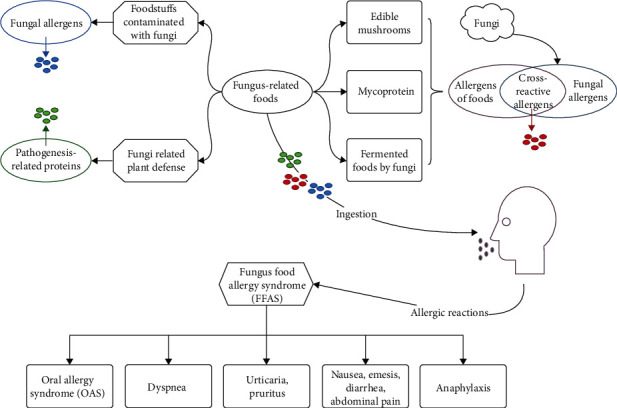
Airborne fungi are one of the most ubiquitous kinds of inhalant allergens which can result in allergic diseases. Fungi tend to grow in warm and humid environments with regional and seasonal variations. Their nomenclature and taxonomy are related to the sensitization of immunoglobulin E (IgE). Allergic cross-reactivity among different fungal species appears to be widely existing. Fungus-related foods, such as edible mushrooms, mycoprotein, and fermented foods by fungi, can often induce to fungus food allergy syndrome (FFAS) by allergic cross-reactivity with airborne fungi. FFAS may involve one or more target organs, including the oral mucosa, the skin, the gastrointestinal and respiratory tracts, and the cardiovascular system, with various allergic symptoms ranging from oral allergy syndrome (OAS) to severe anaphylaxis. This article reviews the current knowledge on the field of allergic cross-reactivity between fungal allergens and related foods, as well as the diagnosis and treatment on FFAS.
Overview
The claims and statistics of this paper haven’t been checked yet.
Run the check — free, no account needed. It reads the open-access text and checks the sources it cites.
Integrity signals
Registry
Cites
Statistics
Figures
Verification
Claims the paper makes
The claims and statistics of this paper haven’t been checked yet.
Run the check — free, no account needed. It reads the open-access text and checks the sources it cites.
Claims other papers make about this one
Each is checked against this paper’s own text: does it say what the citing paper says it does?
In the citing paper
“Fungus-food allergy syndrome (FFAS) is a condition characterized by sensitization to airborne fungal spores, which subsequently leads to allergic reactions to foods containing structurally similar fungal proteins.”
From Pollen–Food Allergy Syndrome: Allergens, Clinical Insights, Diagnostic and Therapeutic Challenges (2024) · cites this paper as [88]
Self-check
Percentages, sums and reported differences re-computed from the paper’s own numbers.
The self-check needs the paper’s full text.
Citations
Cites
A WAO - ARIA - GA²LEN consensus document on molecular-based allergy diagnostics
Canonica, G. W., Ansotegui, I. J., Pawankar, R., Schmid-Grendelmeier, P., van Hage, M., Baena-Cagnani, C. E., Melioli, G., Nunes, C., Passalacqua, G., Rosenwasser, L., et al. (2013) · World Allergy Organization Journal · doi:10.1186/1939-4551-6-17 · Cited by 432
Emerging Antifungal Targets and Strategies
Ivanov, M., Ćirić, A., & Stojković, D. (2022) · International Journal of Molecular Sciences · doi:10.3390/ijms23052756 · Cited by 160
Research works printed but not linked: 100
- 10.1016/j.jaip.2018.08.010 · DOI
- 10.1111/all.14742 · DOI · Paper page
- 10.5662/wjm.v5.i2.31 · DOI · Paper page
- 10.1007/s11882-016-0667-9 · DOI
- 10.1080/10408398.2018.1548429 · DOI
- 10.1016/j.jaci.2010.02.028 · DOI
- 10.1159/000512230 · DOI
- 10.1016/j.anai.2014.10.004 · DOI
- 10.1016/j.foodchem.2021.131803 · DOI
- 10.1128/microbiolspec.funk-0053-2016 · DOI
- 10.1016/j.nbt.2013.05.007 · DOI
- 10.1007/s00253-020-10476-4 · DOI
- 10.1080/1744666X.2017.1324298 · DOI
- 10.1111/ina.12182 · DOI
- 10.1007/s00253-016-7305-2 · DOI
- 10.18176/jiaci.0122 · DOI
- 10.1111/all.12325 · DOI · Paper page
- 10.3109/1040841X.2013.777687 · DOI
- 10.1007/s11046-021-00562-0 · DOI
- 10.1016/j.tim.2021.12.013 · DOI
- 10.1016/j.jmb.2019.05.003 · DOI
- 10.1016/j.biopha.2018.10.075 · DOI
- 10.1016/j.jaip.2016.03.010 · DOI
- 10.1097/MCP.0000000000000740 · DOI
- 10.1016/j.jaip.2016.01.008 · DOI
- 10.2500/aap.2019.40.4258 · DOI
- 10.1007/s12016-017-8601-z · DOI
- 10.1111/jam.14949 · DOI
- 10.1016/j.mib.2020.05.006 · DOI
- 10.1093/femsre/fuab005 · DOI
- 10.1128/microbiolspec.funk-0014-2016 · DOI
- 10.1007/s00018-015-1860-z · DOI
- 10.1016/j.alit.2015.05.007 · DOI
- 10.1128/microbiolspec.FUNK-0049-2016 · DOI
- 10.1007/82_2018_117 · DOI
- 10.1007/s12016-019-08750-z · DOI
- 10.15586/aei.v50i2.491 · DOI
- 10.1186/s12866-021-02205-2 · DOI
- 10.1016/j.jaip.2015.10.015 · DOI
- 10.1016/j.jaip.2015.10.012 · DOI
- 10.1016/j.funbio.2020.02.005 · DOI
- 10.1016/j.anai.2016.05.012 · DOI
- 10.3389/fimmu.2021.790658 · DOI
- 10.1111/all.14639 · DOI
- 10.1126/science.aaw6433 · DOI
- 10.3390/medicina56030111 · DOI
- 10.1111/all.13993 · DOI
- 10.1016/j.jaci.2014.05.013 · DOI · Paper page
- 10.3390/jof7100838 · DOI
- 10.1016/j.riam.2018.01.006 · DOI
- 10.1111/j.1365-2222.2006.02582.x · DOI
- 10.1016/j.copbio.2022.102729 · DOI
- 10.1007/s12016-013-8389-4 · DOI
- 10.13075/ijomeh.1896.01610 · DOI
- I. M. Cunha, 2020, Anaphylaxis to Agaricus bisporus ingestion, Einstein, 18, article p. eRC5478
- 10.2340/00015555-2721 · DOI
- 10.1016/S1081-1206(10)61962-X · DOI
- 10.1034/j.1398-9995.2002.1n3547.x · DOI
- 10.1080/08820130600616599 · DOI
- 10.1016/j.mmcr.2015.02.003 · DOI
- 10.18176/jiaci.0454 · DOI
- 10.18176/jiaci.0700 · DOI
- 10.1007/s11274-019-2723-9 · DOI
- 10.1093/nutrit/nuz077 · DOI
- 10.1093/cdn/nzz021 · DOI
- 10.1016/j.anai.2018.03.020 · DOI
- 10.1067/mai.2003.1339 · DOI
- 10.3390/foods11050647 · DOI
- 10.1017/S0007114520000756 · DOI
- 10.1016/j.anai.2019.05.009 · DOI
- 10.1016/S1081-1206(10)60792-2 · DOI
- 10.1155/2017/7958924 · DOI
- 10.18176/jiaci.0755 · DOI
- 10.1007/s11894-018-0624-y · DOI
- D. Gonzalez-de-Olano, 2012, Different patterns of sensitization in allergy to dry fermented sausage, Journal of Investigational Allergology & Clinical Immunology, 22, 152
- 10.3390/ijms21041474 · DOI
- 10.1016/j.ijfoodmicro.2017.06.006 · DOI
- 10.1097/00000433-200109000-00019 · DOI
- 10.4168/aair.2015.7.5.513 · DOI
- 10.1016/S1081-1206(10)62698-1 · DOI
- S. Lara, 2015, Description of sunflower seed-fungus syndrome, Journal of Investigational Allergology & Clinical Immunology, 25, 449
- 10.1097/ACI.0000000000000533 · DOI
- 10.1155/2014/543195 · DOI
- 10.2174/1389203720666190318164905 · DOI
- 10.3389/fmicb.2017.01451 · DOI
- 10.1016/j.febslet.2014.02.044 · DOI
- 10.1111/myc.12707 · DOI
- 10.1159/000371680 · DOI
- 10.1111/all.12429 · DOI · Paper page
- 10.1111/all.12666 · DOI · Paper page
- 10.1111/all.13124 · DOI
- 10.3390/pathogens10111412 · DOI · Paper page
- 10.1186/s13052-016-0315-y · DOI
- 10.3390/nu12020519 · DOI
- 10.2217/imt-2017-0040 · DOI
- 10.1097/ACI.0000000000000582 · DOI
- 10.1080/14712598.2021.1904888 · DOI
- 10.1039/C9CS00556K · DOI
- 10.1016/j.ccm.2021.12.002 · DOI
- 10.7759/cureus.4538 · DOI
Cited by
Sorted by citations
Pollen–Food Allergy Syndrome: Allergens, Clinical Insights, Diagnostic and Therapeutic Challenges
Haidar, L., Bănărescu, C. F., Uța, C., Moldovan, S. I., Zimbru, E.-L., Zimbru, R.-I., Ciurariu, E., Georgescu, M., & Panaitescu, C. (2024) · Applied Sciences · doi:10.3390/app15010066 · Cited by 21
Metadata
- Authors
- Xing, H., Wang, J., Sun, Y., & Wang, H.
- Affiliations
- Department of Allergy, The Affiliated Yantai Yuhuangding Hospital of Qingdao University, Yantai, Shandong 264000, China
- Department of Pediatric, The Affiliated Yantai Yuhuangding Hospital of Qingdao University, Yantai, Shandong 264000, China
- Department of Allergy, Beijing Shijitan Hospital, Capital Medical University, Beijing 100038, China
- ORCID
- Wang, Hongtian
- Venue
- Journal of Immunology Research
- Publisher
- Wiley
- Published
- 2022-10-07
- Volume
- 2022
- Pages
- 1-10
- ISSN
- 2314-7156
- 2314-8861
- PMC
- PMC9568318
- Cited by
- 92
- References
- 2
- Language
- en
- Funders
- National Natural Science Foundation of China (81371074, 81670901, KZ202110025030)
- Beijing Municipal Natural Science Foundation (81371074, 81670901, KZ202110025030)
- Beijing Municipal Education Commission (81371074, 81670901, KZ202110025030)
About these checks
Registry, retraction, Cites and statistics results are computed, not judged, with one exception: a printed reference that no index lists is read once by a model before it counts as a citation error. Claims are extracted by a model and kept only when their quote appears verbatim in the text; each cited source is then checked, with a model’s help, for whether it says what the claim relies on. Those verdicts can be wrong — read the claim’s quote and the cited source before relying on one.
Statistics and arithmetic are recomputed, not judged.
Confidence bands are shown only for fields calibrated on our annotated test set. None is calibrated yet, so no band is shown.
What counts as a claim ›How we measure confidence ›How we check this ›
Are you an author, or do you see a problem with this page? Request a review
