

The Health-Promoting Effects and the Mechanism of Intermittent Fasting
Open accessThe DOI matches its Crossref record; 98 of the 98 references it cites were found in a registry or an index.
Abstract
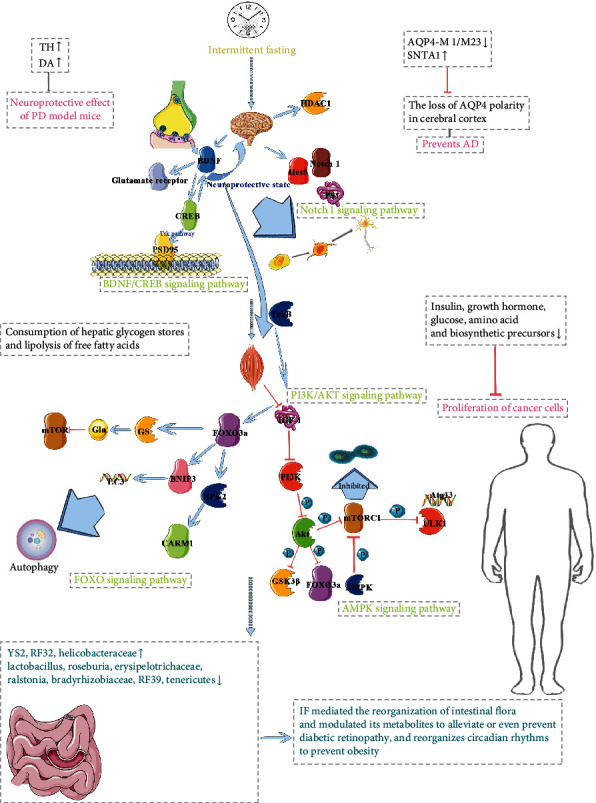
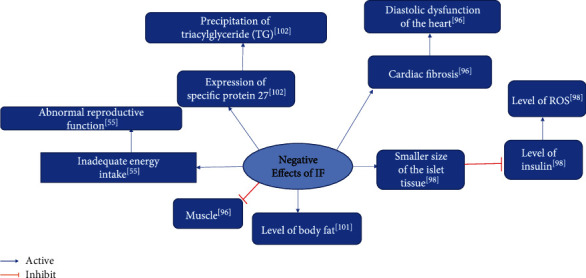
Intermittent fasting (IF) is an eating pattern in which individuals go extended periods with little or no energy intake after consuming regular food in intervening periods. IF has several health-promoting effects. It can effectively reduce weight, fasting insulin levels, and blood glucose levels. It can also increase the antitumor activity of medicines and cause improvement in the case of neurological diseases, such as memory deficit, to achieve enhanced metabolic function and prolonged longevity. Additionally, IF activates several biological pathways to induce autophagy, encourages cell renewal, prevents cancer cells from multiplying and spreading, and delays senescence. However, IF has specific adverse effects and limitations when it comes to people of a particular age and gender. Hence, a more systematic study on the health-promoting effects and safety of IF is needed. This article reviewed the research on the health-promoting effects of IF, providing a theoretical basis, direction for subsequent basic research, and information related to the clinical application of IF.
Overview
The claims and statistics of this paper haven’t been checked yet.
Free: it reads the open-access text and checks the first 5 claims that cite a source we can check. Create a free account to check every claim.
Integrity signals
Registry
Cites
Statistics
Figures
Verification
Claims the paper makes
The claims and statistics of this paper haven’t been checked yet.
Free: it reads the open-access text and checks the first 5 claims that cite a source we can check. Create a free account to check every claim.
Claims other papers make about this one
Each is checked against this paper’s own text: does it say what the citing paper says it does?
The source backs part of the claim, not all of it — or backs it for a different population, condition or comparison.
In the citing paper
“Intermittent fasting, orthorexia, and eating disorders have been associated with body dysmorphic symptoms, with some limitations for specific age and gender groups, especially among women and adolescents [ 17 , 29 , 30 , 31 , 32 ].”
From Examining Associations Between Fasting Behavior, Orthorexia Nervosa, and Eating Disorders (2024) · cites this paper as [17]
Experimental — accuracy not yet measuredThe check wasn’t confident either way, so it gives no verdict — never disputed.
In the citing paper
“The present research is consistent with a large body of research, indicating that fasting can be considered a risk factor for the development of eating disorders”
From Examining Associations Between Fasting Behavior, Orthorexia Nervosa, and Eating Disorders (2024) · cites this paper as [17]
Experimental — accuracy not yet measured
Self-check
Percentages, sums and reported differences re-computed from the paper’s own numbers.
The self-check needs the paper’s full text.
Citations
Cites
Sung, H., Ferlay, J., Siegel, R. L., Laversanne, M., Soerjomataram, I., Jemal, A., & Bray, F. (2021) · CA: A Cancer Journal for Clinicians · doi:10.3322/caac.21660 · Cited by 108,699 · cited 1×
“The increase in cancer incidence and mortality is related to population aging [2], which also has made diseases like sarcopenia and neurodegenerative diseases common [3, 4].”
BackgroundRepertoires of Autophagy in the Pathogenesis of Ocular Diseases
Li, Y.-J., Jiang, Q., Cao, G.-F., Yao, J., & Yan, B. (2015) · Cellular Physiology and Biochemistry · doi:10.1159/000373980 · Cited by 16,304
Sarcopenia: European consensus on definition and diagnosis
Cruz-Jentoft, A. J., Baeyens, J. P., Bauer, J. M., Boirie, Y., Cederholm, T., Landi, F., Martin, F. C., Michel, J.-P., Rolland, Y., Schneider, S. M., et al. (2010) · Age and Ageing · doi:10.1093/ageing/afq034 · Cited by 11,601
Saeedi, P., Petersohn, I., Salpea, P., Malanda, B., Karuranga, S., Unwin, N., Colagiuri, S., Guariguata, L., Motala, A. A., Ogurtsova, K., et al. (2019) · Diabetes Research and Clinical Practice · doi:10.1016/j.diabres.2019.107843 · Cited by 10,792
Abarca-Gómez, L., Abdeen, Z. A., Hamid, Z. A., Abu-Rmeileh, N. M., Acosta-Cazares, B., Acuin, C., Adams, R. J., Aekplakorn, W., Afsana, K., Aguilar-Salinas, C. A., et al. (2017) · The Lancet · doi:10.1016/s0140-6736(17)32129-3 · Cited by 7,482
Body Fatness and Cancer — Viewpoint of the IARC Working Group
Lauby-Secretan, B., Scoccianti, C., Loomis, D., Grosse, Y., Bianchini, F., & Straif, K. (2016) · New England Journal of Medicine · doi:10.1056/nejmsr1606602 · Cited by 3,596 · cited 1×
“Research proves that being overweight increases the risk of many cancers [33].”
Autophagy and the Integrated Stress Response
Kroemer, G., Mariño, G., & Levine, B. (2010) · Molecular Cell · doi:10.1016/j.molcel.2010.09.023 · Cited by 3,506 · cited 1×
“Furthermore, the oncogene chromosome 10 homologous loss of phosphatase gene, tensin, and tuberous sclerosis complex can inhibit the mTOR protein expression [41].”
BackgroundThe AMPK signalling pathway coordinates cell growth, autophagy and metabolism
Mihaylova, M. M., & Shaw, R. J. (2011) · Nature Cell Biology · doi:10.1038/ncb2329 · Cited by 2,923
Chooi, Y. C., Ding, C., & Magkos, F. (2019) · Metabolism · doi:10.1016/j.metabol.2018.09.005 · Cited by 2,737
Damiola, F., Le Minh, N., Preitner, N., Kornmann, B., Fleury-Olela, F., & Schibler, U. (2000) · Genes & Development · doi:10.1101/gad.183500 · Cited by 2,394 · cited 1×
“At the same time, nutrient-sensing pathways can influence the biological clock, which can therefore be affected by changes in the timing of feeding [77, 78].”
Background
Research works printed but not linked: 12
- 1. World Health Statistics, Monitoring health for the SDGs, sus- tainable development goals. WHO, Geneva (2020), Revue Dépidémiologie Et De Santé Publique, 2020.
- 5. X. Jun, Comparison of the effects of intermittent fasting and continuous calorie restriction on weight loss, Nanchang Uni- versity, 2018.
- 15. D. Xiangxiao, Study on the effects of intermittent fasting on lipid and energy metabolism and inflammatory response in high-fat diet-fed mice, Huazhong University of Science and Technology, 2019.
- 26. R. Feng, Intermittent fasting inhibits intestinal lipid absorp- tion and promotes white lipid browning through intestinal microorganisms in mice, Northwest Agriculture and Forestry University, 2020.
- 36. J. Q. Xu and L. S. Wang, "The role of fasting and caloric restriction in oncology prevention and treatment," Oncology, vol. 11, pp. 955-960, 2019.
- 42. F. Chen, Z. Yan-Guang, and Z. Su-Mei, "Nutritional sensing of the mammalian rapamycin target protein complex 1 autophagic signaling pathway," Journal of Animal Nutrition, vol. 31, no. 10, pp. 4502-4508, 2019.
- 47. F. Cui, Z. Ribo, J. Xiaoyuan, X. Kong, and K. Chen, "Effects of intermittent fasting on hepatocarcinoma progress in nude mice," Journal of Zhejiang University of Technology (Natural Science Edition), vol. 41, no. 6, pp. 812-817, 2019.
- 59. Z. Jingzhu, Effect of intermittent fasting on the distribution of cortical water channel protein 4 polarity in Alzheimer's disease and its mechanism of action, China Medical Uni- versity, 2018.
- 60. Z. Bo-ping, Protective effect of alternate day fasting on intesti- nal barrier and brain in Parkinson's disease mice, Jiangnan University, 2020.
- 74. Z. H. Rong, S. C. Liang, J. Q. Lu et al., "Effects of intermittent fasting on intestinal flora and metabolism in pre-elderly obese rats," Journal of Southern Medical University, vol. 37, no. 4, pp. 423-430, 2017.
- 75. X. Hu, Exploring the effect of intermittent fasting on athero- sclerotic plaque and its mechanism, Zhengzhou University, 2020.
- 95. Z. Qian, Effects and mechanisms of intermittent fasting on myocyte renewal, Hunan Normal University, 2020.
Cited by
Adipose tissue as a linchpin of organismal ageing
Nguyen, T., & Corvera, S. (2024) · Nature Metabolism · doi:10.1038/s42255-024-01046-3 · Cited by 127
“Intermittent fasting, which consists of several modalities of periodic food restriction without necessarily decreasing net calorie consumption, has been shown to exert beneficial effects on multiple metabolic parameters in humans and non-human primates 170 .”
Talebi, S., Shab‐Bidar, S., Moini, A., Mohammadi, H., & Djafarian, K. (2024) · Diabetes Obesity and Metabolism · doi:10.1111/dom.15801 · Cited by 38
“48 Unlike our original hypothesis, we found that eTRE alone or eTRE plus probiotics intervention was effective, but not superior to a standard three-meal-per-day DCR diet for losing weight or improving metabolic and hormonal variables.”
Russo, L., Babboni, S., Andreassi, M. G., Daher, J., Canale, P., Turco, S. D., & Basta, G. (2025) · Antioxidants · doi:10.3390/antiox14010099 · Cited by 21
“These strategies encompass various approaches, including intermittent fasting [200], time-restricted feeding [201], ketogenic diets [202–204], and the modulation of specific macronutrients [205,206], such as protein or amino acid restriction.”
Nieto, Á. A. V., Díaz, A. H., Millán, M. H., & Sagredo, D. (2025) · Current Nutrition Reports · doi:10.1007/s13668-025-00666-9 · Cited by 19
“IF, defined as a dietary pattern alternating feeding periods with calorie restriction, has been shown to trigger adaptive metabolic responses, notably the activation of autophagy[4, 5].”
InfluentialEngineering chronological lifespan toward a robust yeast cell factory
Wu, Z., Gao, J., Gao, N., Zhao, Y., & Zhou, Y. J. (2025) · Proceedings of the National Academy of Sciences · doi:10.1073/pnas.2515324122 · Cited by 14
“…product biosynthesis in combination with conventional metabolic engineering, achieving the highest sclareol production of 25.9 g/L. Caloric restriction has been proven to promote human health by effectively reducing weight and blood glucose levels ( 44 , 45 ) and extend longevity in yeast ( 25 ).”
Influential
Metadata
- Authors
- Liu, S., Zeng, M., Wan, W., Huang, M., Li, X., Xie, Z., Wang, S., & Cai, Y.
- Affiliations
- Hubei University of Chinese Medicine (CN)
- Corresponding author
- Wang, Shang
- Cai, Yu
- Venue
- Journal of Diabetes Research
- Publisher
- Wiley
- Published
- 2023-03-03
- Volume
- 2023
- Pages
- 1-15
- ISSN
- 2314-6745 (ISSN-L)
- 2314-6753
- PMC
- PMC10005873
- OpenAlex
- W4323031606
- Cited by
- 27
- References
- 98
- Citations by year
- 2026: 8 · 2025: 13 · 2024: 5 · 2023: 1
- FWCI
- 0.96
- Type
- journal article
- Language
- en
- Open access
- gold
- doi.org
- Locations
- Journal of Diabetes Research (publishedVersion, cc-by)
- PubMed Central (publishedVersion, cc-by)
- PubMed (publishedVersion)
- Digital Commons-TMC (Texas Medical Center) (submittedVersion)
- DOAJ (DOAJ: Directory of Open Access Journals) (submittedVersion, cc-by-sa)
- Funders
- Provincial College Students’ Innovation and Entrepreneurship Training Program (S202210507012, 16Q146)
- Hubei University of Chinese Medicine (S202210507012, 16Q146)
- Hubei Provincial Department of Education (S202210507012, 16Q146)
- Topics
- Health Sciences › Medicine › Physiology (medical) › Dietary Effects on Health
- Life Sciences › Biochemistry, Genetics and Molecular Biology › Cell Biology › Autophagy in Disease and Therapy
- Life Sciences › Biochemistry, Genetics and Molecular Biology › Aging › Genetics, Aging, and Longevity in Model Organisms
- Keywords
- intermittent fasting, weight loss, fasting insulin, blood glucose, anticancer drug sensitivity, neurological disorders, memory impairment, metabolic function, longevity, autophagy, cellular senescence, cancer prevention, adverse effects, dietary habits
- MeSH terms
- Intermittent Fasting, Energy Intake, Diet, Reducing, Fasting, Feeding Behavior, Humans
About these checks
Registry, retraction, Cites and statistics results are computed, not judged, with one exception: a printed reference that no index lists is read once by a model before it counts as a citation error. Claims are extracted by a model and kept only when their quote appears verbatim in the text; each cited source is then checked, with a model’s help, for whether it says what the claim relies on. Those verdicts can be wrong — read the claim’s quote and the cited source before relying on one.
Statistics and arithmetic are recomputed, not judged.
Confidence bands are shown only for fields calibrated on our annotated test set. None is calibrated yet, so no band is shown.
What counts as a claim ›How we measure confidence ›How we check this ›
Are you an author, or do you see a problem with this page? Request a review
Data sources
Bibliographic data: Semantic Scholar, OpenAlex, Crossref.
Contains information from the Semantic Scholar Academic Graph Datasets, made available under the ODC Attribution License (ODC-BY 1.0).
Semantic Scholar’s data is described in: Kinney, R., et al. (2023). The Semantic Scholar Open Data Platform. arXiv:2301.10140.
