

Concordance and Clinical Outcomes Improvement Following Oral Hygiene Motivation: A Systematic Review and Report of the Workshop of the Italian Societies of Dental Hygiene
Open accessThe DOI matches its Crossref record; 70 of the 71 references it cites were found in a registry or an index; 26 of the 91 sources its claims cite were checked for support.
Abstract
Aim: A workshop on concordance and oral hygiene was held in February 2024. To address the topic, a systematic review aimed at investigating the effectiveness of motivational interventions in improving oral hygiene and focusing on periodontal clinical indices outcomes was designed. Materials and Methods: A comprehensive literature search was conducted across PubMed and Scopus electronic databases to identify relevant articles published up to 2024. Inclusion criteria encompassed studies comparing motivational interventions targeting oral hygiene behaviours, with a focus on periodontal clinical indices. Twelve articles meeting the eligibility criteria were selected for analysis. Quality assessment and data extraction were performed systematically. Results: The synthesis of findings from the selected studies revealed a consistent positive effect of motivational interventions on periodontal clinical indices. These interventions encompassed various strategies, including educational sessions, personalized feedback and motivational interviewing. Improvement in indices such as plaque index (PI), gingival index (GI) and periodontal probing depth was observed following motivational interventions, despite the variety of motivational protocols employed. Conclusion: Motivational interventions are effective in enhancing oral hygiene practices and improving periodontal clinical indices. Tailored motivational approaches can serve as valuable tools in promoting oral health behaviours among individuals, potentially reducing the risk of periodontal diseases. Further research is warranted to explore the long‐term sustainability and scalability of motivational interventions in diverse populations and settings.
Overview
CoChat Summary
## TL;DR
This systematic review found that motivational oral-hygiene interventions generally improve periodontal clinical indices, including plaque index, gingival index, probing depth, and bleeding outcomes. The authors conclude that repeated, well-timed, professionally delivered motivation works better than single-session approaches, but the evidence base is heterogeneous and low quality.
## Key findings
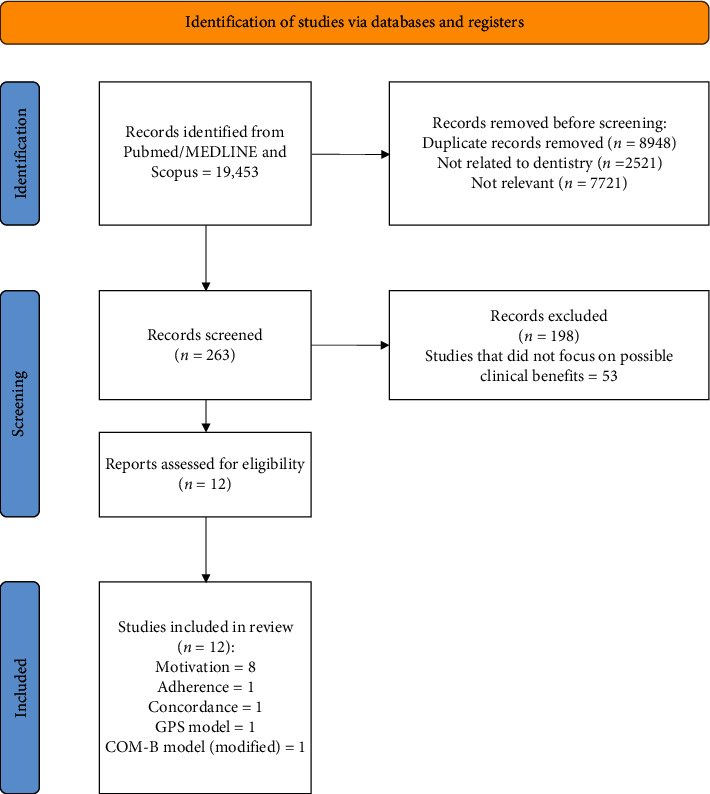
- The search retrieved 19,453 titles; after duplicate removal 8,948 items remained, 263 were full-text screened, and 12 articles were included.
- The included studies covered 763 adult patients (mean age 43.25 years, SD 9.63) and 210 paediatric patients in 3 studies (mean age 12.08 years, SD 1.85).
- Across the included studies, motivational interventions were associated with improvement in plaque index (PI), gingival index (GI), periodontal probing depth, and bleeding on probing.
- The paper reports that single-session motivational interviewing sometimes showed no additional effects, while repeated reinforcement and cognitive behavioural / motivational interviewing approaches were described as more effective.
## Methods
- Systematic review conducted according to the Cochrane Handbook and reported following PRISMA; focused question asked whether concordance between professional and patient improves oral health or whether motivation/compliance/adherence strategies are more effective.
- Searched PubMed and Scopus for studies published 2000–2024 in English; included case-control, cross-sectional, cohort studies, and clinical trials involving dental patients and motivational/relational oral-hygiene techniques.
- Three calibrated reviewers independently screened studies (reported Cohen’s κ > 0.8), extracted data, and synthesized findings in evidence tables; no meta-analysis was performed.
## Limitations
- The paper states that the available literature was limited, the motivational methods were highly diverse, outcomes were reported with substantial variability, and differing recall timepoints made comparison difficult.
- The authors state that they could not perform a meta-analysis because plaque accumulation and gingival inflammation were measured differently across studies.
- Evident from the text: the review is restricted to English-language studies and the included evidence base is small (12 studies), which limits robustness and generalizability.
Model-written summary. Check it against the paper before relying on it.
Integrity signals
Registry
Cites
Statistics
Figures
Verification
Claims the paper makes
16 Valid · 0 Not valid · 21 Not checked · 28 Own results and interpretations
The cited sources support only part of this claim — read each source’s verdict below.
In the paper
“However, the variations in protocol design, research population and follow-up periods hinder the direct comparison between different motivational therapeutic approaches [39].”
§ Concordance and Clinical Outcomes Improvement Following Oral Hygiene Motivation: A Systematic Review and Report of the Workshop of the Italian Societies of Dental Hygiene > 4. Discussion > 4.2. The Role of Motivation
What the sources say
- Partly supportedcites [39] Newton J. T. Asimakopoulou K. Managing Oral Hygiene as a Risk Factor for Periodontal Disease: A Systematic Review of Psychological Approaches to Behaviour Change for Improved Plaque Control in Periodontal Management Journal of Clinical Periodontology 2015 42 S16 S36 46 10.1111/jcpe.12356 2-s2.0-84961289911 25639708 sourceExperimental — accuracy not yet measured
The Synthesis of results says heterogeneity in outcome measures and psychological models prevented meta-analysis, and the Discussion says varied, poorly specified interventions impeded synthesis. The study summaries also show different follow-up periods. Our copy does not identify differences in research populations as a reason direct comparisons were hindered. (LLM, conf=0.82)
plainstates a cause- Asserted: passes — The authors put it forward as true.
- Checkable: passes — It can be checked against evidence.
- Load-bearing: passes — The paper’s conclusions depend on it.
- Based: passes — The paper gives a reason why it holds.
- Partly supported
The cited sources support only part of this claim — read each source’s verdict below.
In the paper
“Indeed, no type of dental treatment, nor oral health itself, can be maintained over time without active collaboration in their upkeep [60].”
§ Concordance and Clinical Outcomes Improvement Following Oral Hygiene Motivation: A Systematic Review and Report of the Workshop of the Italian Societies of Dental Hygiene > 4. Discussion > 4.3. Motivation in Dentistry
What the sources say
- Partly supportedcites [60] Carra M. C. Detzen L. Kitzmann J. Woelber J. P. Ramseier C. A. Bouchard P. Promoting Behavioural Changes to Improve Oral Hygiene in Patients With Periodontal Diseases: A Systematic Review Journal of Clinical Periodontology 2020 47 72 89 31912530 sourceExperimental — accuracy not yet measured
The Discussion (page not provided) says treatment goals depend on patients being motivated to follow therapeutic recommendations, and the Introduction links poor oral hygiene to periodontal treatment failure. These passages support the need for patient participation in periodontal care, but not the categorical claim that no type of dental treatment or oral health can be maintained without it. (LLM, conf=0.86)
plainstates a cause- Asserted: passes — The authors put it forward as true.
- Checkable: passes — It can be checked against evidence.
- Load-bearing: passes — The paper’s conclusions depend on it.
- Based: passes — The paper gives a reason why it holds.
- Partly supported
The cited sources support only part of this claim — read each source’s verdict below.
In the paper
“Although several models have been discussed in dentistry [38–40], limited correlation with periodontal health (PI, bleeding and probing depth) has been provided to date.”
§ Concordance and Clinical Outcomes Improvement Following Oral Hygiene Motivation: A Systematic Review and Report of the Workshop of the Italian Societies of Dental Hygiene > 4. Discussion > 4.2. The Role of Motivation
What the sources say
- Not checked — no full text of the sourcecites [38] Kwon T. H. Salem D. M. Levin L. The Role of Home Care Therapy in Periodontal Disease Treatment and Management Quintessence International 2023 54 4 288 295 10.3290/j.qi.b3773959 36622052 doi:10.3290/j.qi.b3773959
- Partly supportedcites [39] Newton J. T. Asimakopoulou K. Managing Oral Hygiene as a Risk Factor for Periodontal Disease: A Systematic Review of Psychological Approaches to Behaviour Change for Improved Plaque Control in Periodontal Management Journal of Clinical Periodontology 2015 42 S16 S36 46 10.1111/jcpe.12356 2-s2.0-84961289911 25639708 sourceExperimental — accuracy not yet measured
The Study characteristics section (page unavailable) identifies only 15 reports across seven psychological models, supporting the point that evidence is limited. But the review does not establish generally limited correlations for each of plaque index, bleeding, and probing depth; the Theory of planned behaviour section (page unavailable) reports a strong prediction of gingival outcomes for one model. (LLM, conf=0.78)
- Partly supportedcites [40] Michie S. van Stralen M. M. West R. The Behaviour Change Wheel: A New Method for Characterising and Designing Behaviour Change Interventions Implementation Science 2011 6 1 10.1186/1748-5908-6-42 2-s2.0-79955006417 42 PMC3096582 21513547 sourceExperimental — accuracy not yet measured
The paper presents a behaviour-change model (Results > Development of a new framework; page unavailable), supporting its use as an example of a model. It does not discuss dentistry or assess correlations with plaque index, bleeding, or probing depth; its reliability tests concern tobacco control and obesity guidance (Methods > Test the reliability of the framework; page unavailable). (LLM, conf=0.82)
plain- Asserted: passes — The authors put it forward as true.
- Checkable: passes — It can be checked against evidence.
- Load-bearing: passes — The paper’s conclusions depend on it.
- Based: passes — The paper gives a reason why it holds.
The cited sources support only part of this claim — read each source’s verdict below.
In the paper
“Another strategy to promote the oral health of patients is adherence to behavioural instructions on oral hygiene, which allows to reduce periodontal indices [55, 56].”
§ Concordance and Clinical Outcomes Improvement Following Oral Hygiene Motivation: A Systematic Review and Report of the Workshop of the Italian Societies of Dental Hygiene > 4. Discussion > 4.2. The Role of Motivation
What the sources say
- Partly supportedcites [55] Zhou G. Sun C. Knoll N. Hamilton K. Schwarzer R. Self-Efficacy, Planning and Action Control in an Oral Self-Care Intervention Health Education Research 2015 30 4 671 681 10.1093/her/cyv032 2-s2.0-84939608525 26187914 sourceExperimental — accuracy not yet measured
The Introduction says interdental cleaning helps prevent periodontal disease, and the Action control section reports that flossing frequency, dental plaque and bleeding scores improved in another study. Zhou et al.’s own intervention measured self-reported flossing frequency, not periodontal indices (Measures); its copy therefore does not establish that adherence to its oral-hygiene instructions reduced those indices. Page numbers were not available in the indexed passages. (LLM, conf=0.82)
- Not checked — no full text of the sourcecites [56] Sonnenschein S. K. Kohnen R. Ruetters M. Krisam J. Kim T.-S. Adherence to Long-Term Supportive Periodontal Therapy in Groups With Different Periodontal Risk Profiles Journal of Clinical Periodontology 2020 47 3 351 361 10.1111/jcpe.13252 31912538 source
plainstates a cause- Asserted: passes — The authors put it forward as true.
- Checkable: passes — It can be checked against evidence.
- Load-bearing: passes — The paper’s conclusions depend on it.
- Based: passes — The paper gives a reason why it holds.
- Partly supported
The sources with a verdict support this claim; the rest weren’t checked yet, have no full text we could read, or their verdicts aren’t rated yet.
In the paper
“The remaining seven studies [25–31] focused on the motivational approach employed in 540 patients.”
§ Concordance and Clinical Outcomes Improvement Following Oral Hygiene Motivation: A Systematic Review and Report of the Workshop of the Italian Societies of Dental Hygiene > 3. Results > 3.5. Motivational Interventions and Clinical Indices
What the sources say
- Not checked — no full text of the sourcecites [25] Fjellström M. Yakob M. Söder B. A Modified Cognitive Behavioural Model as a Method to Improve Adherence to Oral Hygiene Instructions—A Pilot Study International Journal of Dental Hygiene 2010 8 3 178 182 10.1111/j.1601-5037.2010.00457.x 20624187 source
- Not checked — no full text of the sourcecites [26] Stenman J. Lundgren J. Wennström J. L. Ericsson J. S. Abrahamsson K. H. A Single Session of Motivational Interviewing as an Additive Means to Improve Adherence in Periodontal Infection Control: A Randomized Controlled Trial Journal of Clinical Periodontology 2012 39 10 947 954 10.1111/j.1600-051X.2012.01926.x 2-s2.0-84866141523 22845421 source
- Not checked — no full text of the sourcecites [27] Brand V. S. Bray K. K. MacNeill S. Catley D. Williams K. Impact of Single-Session Motivational Interviewing on Clinical Outcomes Following Periodontal Maintenance Therapy International Journal of Dental Hygiene 2013 11 2 134 141 10.1111/idh.12012 2-s2.0-84876318285 23279918 source
- Not checked — no full text of the sourcecites [28] Oruba Z. Pac A. Olszewska-Czyż I. Chomyszyn-Gajewska M. The Significance of Motivation in Periodontal Treatment: The Influence of Adult Patients’ Motivation on the Clinical Periodontal Status Community Dental Health 2014 31 3 183 187 25300155 doi:10.1922/cdh_3253gajewska05
- Not checked — no full text of the sourcecites [29] Aljabaa A. McDonald F. Newton J. T. A Randomized Controlled Trial to Compare 3 Methods Designed to Enhance Adherence Among Orthodontic Patients JDR Clinical & Translational Research 2016 1 1 59 68 10.1177/2380084415627130 2-s2.0-85050339505 30931694 source
- Supportedcites [30] Asimakopoulou K. Nolan M. McCarthy C. Newton J. T. The Effect of Risk Communication on Periodontal Treatment Outcomes: A Randomized Controlled Trial Journal of Periodontology 2019 90 9 948 956 10.1002/JPER.18-0385 2-s2.0-85072057117 30997690 source
The Materials and Methods section (p. 4) describes this trial’s risk-communication and goal-setting interventions as addressing patients’ motivation. The Results (p. 9) report 97 participants; the cited sentence’s 540 patients refers to the seven studies collectively, not to this trial alone. (LLM, conf=0.88)
- Not checked — no full text of the sourcecites [31] Gunpinar S. Meraci B. Periodontal Health Education Session Can Improve Oral Hygiene in Patients With Gingivitis: A Masked Randomized Controlled Clinical Study Journal of Periodontology 2022 93 2 218 228 10.1002/JPER.21-0034 34048073 source
plainn = 540- Asserted: passes — The authors put it forward as true.
- Checkable: passes — It can be checked against evidence.
- Load-bearing: unclear — It is unclear whether the paper’s conclusions depend on it.
- Based: passes — The paper gives a reason why it holds.
28 more claims · 3 with their cited sources checked
Create a free account to see all 65 claims and to verify the 10 references still open.
- It may state two separate claims as one. 26
- Probably not a substantial claim. 10
Self-check
Percentages, sums and reported differences re-computed from the paper’s own numbers.
Self-check results appear here once an independent check has confirmed them.
Cited works that were retracted
Works this paper cites that were later retracted, from the retraction notices publishers deposit. Major when the notice came out before this paper was published.
Rated major: it would touch a result — a value a result rests on, reported and recomputed p-values on opposite sides of the significance level, two passages that conflict with no sign which is right, or a cited work retracted before this paper was published.
In the paper
“10.1002/14651858.CD005097.pub2”
Cited work 10.1002/14651858.cd005097.pub2 · retracted 2016-02-10 · notice 10.1002/14651858.cd005097.pub3 · this paper published 2024-01
Citations
Cites
1 retracted
Renz, A., Ide, M., Newton, T., Robinson, P., & Smith, D. (2007) · Cochrane Database of Systematic Reviews · doi:10.1002/14651858.cd005097.pub2 · Cited by 164
RetractedPreferred Reporting Items for Systematic Reviews and Meta-Analyses: the PRISMA statement
Moher, D., Liberati, A., Tetzlaff, J., Altman, D. G., & for the PRISMA Group (2009) · BMJ · doi:10.1136/bmj.b2535 · Cited by 83,823
Preferred reporting items for systematic reviews and meta-analyses: the PRISMA Statement.
(2009) · PubMed Central · Cited by 44,859
The Cochrane Collaboration's tool for assessing risk of bias in randomised trials
Higgins, J. P. T., Altman, D. G., Gotzsche, P. C., Juni, P., Moher, D., Oxman, A. D., Savovic, J., Schulz, K. F., Weeks, L., Sterne, J. A. C., et al. (2011) · BMJ · doi:10.1136/bmj.d5928 · Cited by 33,817 · cited 1×
“Handbook and reported according to the PRISMA guidelines [17 – 19].”
Liberati, A., Altman, D. G., Tetzlaff, J., Mulrow, C., Gotzsche, P. C., Ioannidis, J. P. A., Clarke, M., Devereaux, P. J., Kleijnen, J., & Moher, D. (2009) · BMJ · doi:10.1136/bmj.b2700 · Cited by 17,648
Michie, S., van Stralen, M. M., & West, R. (2011) · Implementation Science · doi:10.1186/1748-5908-6-42 · Cited by 13,697
Osterberg, L., & Blaschke, T. (2005) · New England Journal of Medicine · doi:10.1056/nejmra050100 · Cited by 7,974
Hayes, S. C. (2016) · Behavior Therapy · doi:10.1016/j.beth.2016.11.006 · Cited by 785 · cited 1×
“There is no universal formula and success depends on personal variables, including motivation, social support, available resources and the ability to face challenges with self-ef fi cacy [67].”
Journal of Multidisciplinary Healthcare
(2020) · doi:10.2147/jmdh · Cited by 644
Facilitating productive use of feedback in higher education
Jonsson, A. (2013) · Active Learning in Higher Education · doi:10.1177/1469787412467125 · Cited by 414 · cited 2×
“Self-ef fi cacy affects perceived behaviour of the patient as the greater the awareness of being able to carry out a long-term action, the more easily that behaviour will be implemented [59].”
Background
Cited by
Miceli, M., Carli, E., Orciolo, E., et al. (2025) · Dentistry Journal · doi:10.3390/dj13030115 · Cited by 3
“These results align with findings from other studies, emphasizing the role of preemptive oral care in mitigating post-transplant complications [23–26].”
InfluentialSelf-citationSabatini, S., Castaldi, M., Stefano, A. A. D., Galluccio, G., Grassi, R., & Nardi, G. M. (2025) · Oral · doi:10.3390/oral5010009 · Cited by 2
“Biofilm accumulation is better controlled in patients who habitually brush their teeth at least twice a daily, use interdental brushes, floss and attend frequent office visits [24,25].”
Self-citationMazur, M., Vitiello, F., Ndokaj, A., Izzetti, R., Tosco, V., Corridore, D., Mannucci, C., Monterubbianesi, R., Giuca, M. R., Ottolenghi, L., et al. (2025) · Journal of Clinical Medicine · doi:10.3390/jcm14165738 · Cited by 7
“Targeted interventions, such as reminder apps, structured reinforcement, or integration into periodic dental checkups, may be useful strategies to maintain behavior over time [30,31].”
Self-citationAli, O. H., Mohammed, N., & Akram, H. M. (2025) · Annals of dental specialty · doi:10.51847/kyu4ransvk · Cited by 1
Motivational Interviewing in Improving Oral Health: A Literature Review
Farghal, M., & Zaghez, M. (2025) · European Dental Research and Biomaterials Journal · doi:10.1055/s-0045-1811597 · Cited by 1
“A systematic review of 12 studies found MI to improve periodontal clinical measures such as PI, GI, and PD. 27 An randomized controlled trial involving patients with periodontitis also reported signi fi cant improvements in the modi fi ed PI (mPLI) and Sulcus Bleeding Index (mSBI) after MI-based interventions.”
Mihai, D. N., Sîrbu, P. D., Savin, L., Forna, N. C., Topoliceanu, C., Dascălu, C. G., & Forna, N. C. (2025) · Clinics and Practice · doi:10.3390/clinpract15120220
“For a patient scheduled to receive a knee or hip joint prosthesis, this can lead to periprosthetic joint infections with serious postoperative complications [68].”
Fathima, N., Mascarenhas, R., Umar, D., Rekha, P. D., Shetty, S., & Amin, V. (2026) · Journal of Orthodontics · doi:10.1177/14653125251408048 · Cited by 1
“…enhanced oral-hygiene instruction and professional debridement reduce plaque accumulation and gingival inflammation in orthodontic patients (Abbinante et al., 2024; Angjelova et al., 2025; Lin et al., 2022; Matuq Badri et al., 2021), while probiotic loz-enges containing Lactobacillus…”
Lanzetti, J., Ferrati, F., Crupi, A., Gibello, U., Roccuzzo, A., & Pera, F. (2026) · Clinical Oral Investigations · doi:10.1007/s00784-026-06867-y · Cited by 1
Cai, M., Lai, W. X., 彭卫群, Chen, J., & Zou, P. (2026) · BMC Oral Health · doi:10.1186/s12903-026-08527-9 · Cited by 1
“Recent comprehensive systematic reviews confirm that standardized brushing paired with professional scaling yields substantial improvements in both the Plaque Index (PLI) and Gingival Index (GI) [69].”
Yao, X., & Cheng, Z. (2026) · International Dental Journal · doi:10.1016/j.identj.2026.109648
“34,41 Supervised practice with a coach-style nurse who observes technique, gives specific corrective cues, and scaffolds mastery experiences increases self-efficacy an d supports transfer from knowledge to intentional practice.”
InfluentialDonnermeyer, D., Meyer‐Lückel, H., Stähli, A., Cosgarea, R., & Wierichs, R. J. (2026) · Periodontology 2000 · doi:10.1111/prd.70060 · Cited by 1
Abdullah, S. A., Mounes, B. B., Haji, S. A., et al. (2026) · Romanian Journal of Stomatology · doi:10.37897/rjs.2026.2.14
“Oral hygiene practice may also depend on manual dexterity, motivation, consistency, and the use of appropriate hygiene methods during orthodontic treatment [25,26].”
Guidorzi, J., Simonelli, A., Guarnelli, M. E., Secchiati, G., Montemezzo, G., Scapoli, C., Trombelli, L., & Fariña, R. (2026) · International Journal of Dental Hygiene · doi:10.1111/idh.70132
Psychological and clinical factors in periodontal improvement in people with T2DM
Gutiérrez, M. G. S., Pérez-Peralta, L., Velázquez-Jurado, H., Grostieta-Dominguez, J. E., Arcila-Martínez, D., García-Ulloa, A. C., & Hernández-Jiménez, S. C. (2026) · Community Dental Health · doi:10.1177/0265539x261476631
Aravena, M. A. G., Coto, M. A., & Quesada, J. G. (2026) · Odovtos - International Journal of Dental Sciences · doi:10.15517/rrty0g89
Metadata
- Authors
- Abbinante, A., Antonacci, A., Antonioni, M., Butera, A., Castaldi, M., Cotellessa, S., Di Marco, C., Gangale, M., Izzetti, R., Luperini, M., Maiorani, C., Nardi, G. M., Ravoni, A., Sabatini, S., Sestito, S., Virno, A., & Graziani, F.
- Affiliations
- University of Foggia (IT)
- Sapienza University of Rome (IT)
- University of Pavia (IT)
- University of Insubria (IT)
- University of Pisa (IT)
- University of Modena and Reggio Emilia (IT)
- University of Udine (IT)
- Corresponding author
- Graziani, Filippo
- ORCID
- Venue
- International Journal of Dentistry
- Publisher
- Wiley
- Published
- 2024-01
- Volume
- 2024
- Issue
- 1
- Pages
- 8592336-8592336
- ISSN
- 1687-8728 (ISSN-L)
- 1687-8736
- PMC
- PMC11498978
- OpenAlex
- W4403466330
- Cited by
- 16
- References
- 71
- Citations by year
- 2026: 10 · 2025: 6
- FWCI
- 0.91
- Type
- journal article
- Language
- en
- Open access
- gold
- doi.org
- Licence
- cc-by
- creativecommons.org/licenses/by/4.0/ (vor, 289 d)
- doi.wiley.com/10.1002/tdm_license_1.1 (tdm)
- Locations
- International Journal of Dentistry (publishedVersion, cc-by)
- PubMed Central (publishedVersion, cc-by)
- PubMed (publishedVersion)
- CINECA IRIS Institutial research information system (University of Pisa) (submittedVersion)
- DOAJ (DOAJ: Directory of Open Access Journals) (submittedVersion, cc-by-sa)
- IRIS Research product catalog (Sapienza University of Rome) (submittedVersion, other-oa)
- Topics
- Health Sciences › Dentistry › Periodontics › Oral microbiology and periodontitis research
- Health Sciences › Dentistry › General Dentistry › Dental Health and Care Utilization
- Health Sciences › Health Professions › General Health Professions › Dental Education, Practice, Research
- Keywords
- oral hygiene motivation, motivational interventions, oral hygiene behaviour, plaque index, gingival index, probing depth, motivational interviewing, personalized feedback, oral health education, periodontal disease prevention
About these checks
Registry, retraction, Cites and statistics results are computed, not judged, with one exception: a printed reference that no index lists is read once by a model before it counts as a citation error. Claims are extracted by a model and kept only when their quote appears verbatim in the text; each cited source is then checked, with a model’s help, for whether it says what the claim relies on. Those verdicts can be wrong — read the claim’s quote and the cited source before relying on one.
The claim verdicts this report counts are experimental: their accuracy is not yet measured.
A language model drew the claims from the paper on 2026-10-11, under version 3 of the claim definition (model deepseek-v4.1-flash, prompt extract-v3).
A second model labelled each claim on 2026-10-11 (model jev-1.13-20260917, definition revision gold-guideline-v0.2).
Cited sources are checked with a language model’s help (gpt-6-sol).
Statistics and arithmetic are recomputed, not judged.
Confidence bands are shown only for fields calibrated on our annotated test set. None is calibrated yet, so no band is shown.
What counts as a claim ›How we measure confidence ›How we check this ›
Are you an author, or do you see a problem with this page? Request a review
Data sources
Bibliographic data: Semantic Scholar, OpenAlex, Crossref.
Contains information from the Semantic Scholar Academic Graph Datasets, made available under the ODC Attribution License (ODC-BY 1.0).
Semantic Scholar’s data is described in: Kinney, R., et al. (2023). The Semantic Scholar Open Data Platform. arXiv:2301.10140.
