

Longitudinal Undetectable Molecular Residual Disease Defines Potentially Cured Population in Localized Non–Small Cell Lung Cancer
Open accessPublished version of a preprint
The DOI matches its Crossref record; 33 of the 33 references it cites were found in a registry or an index.
Abstract
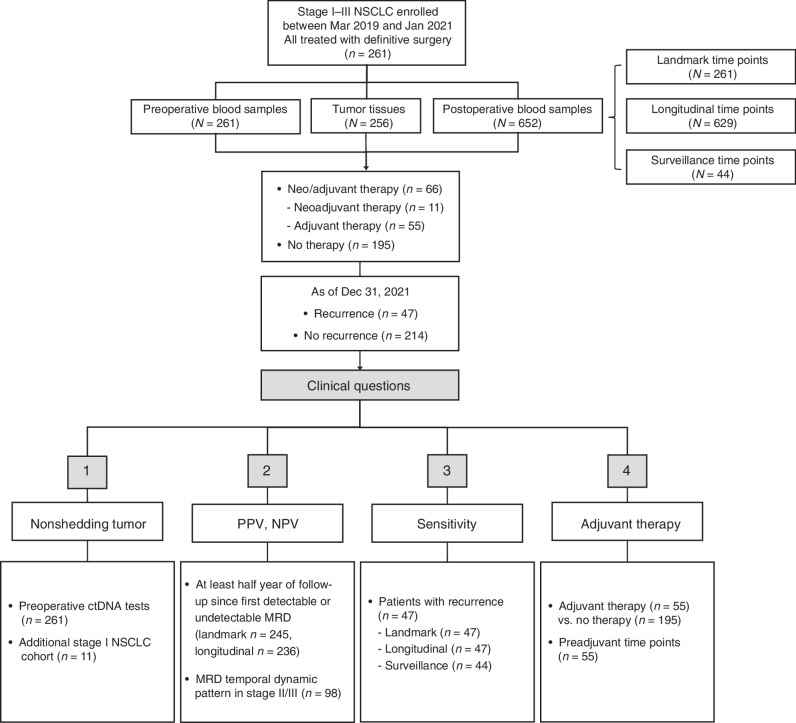
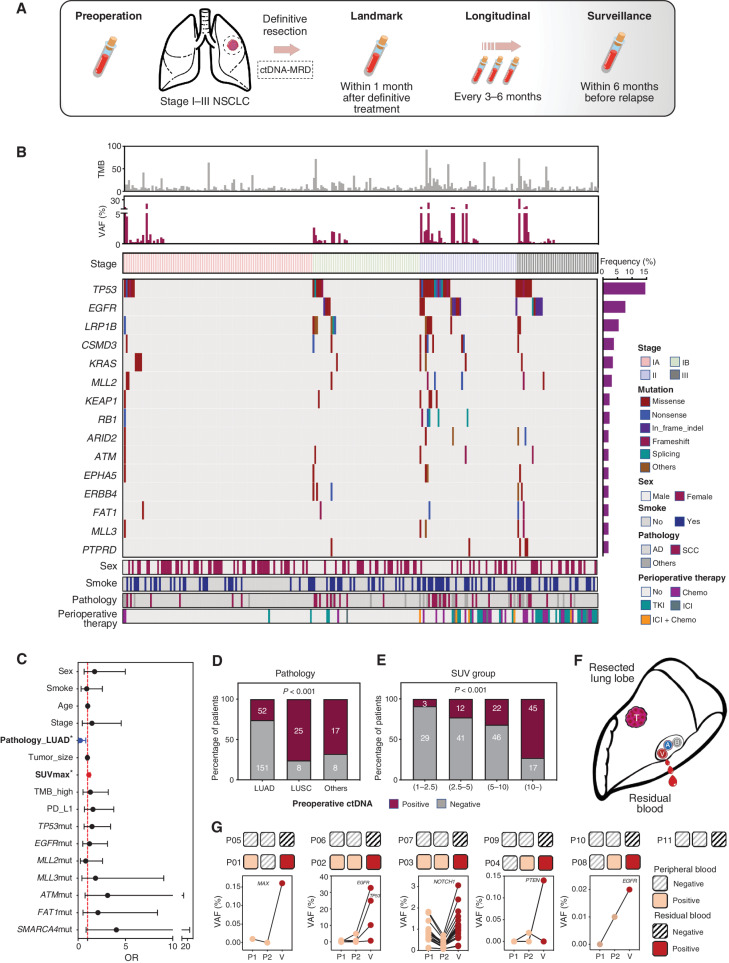
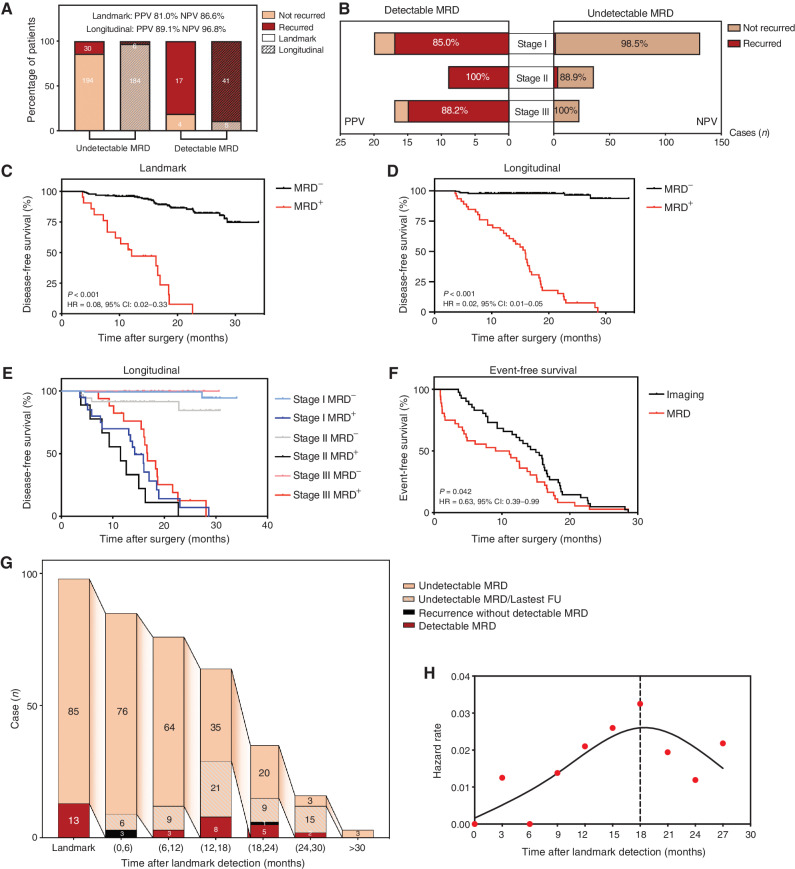
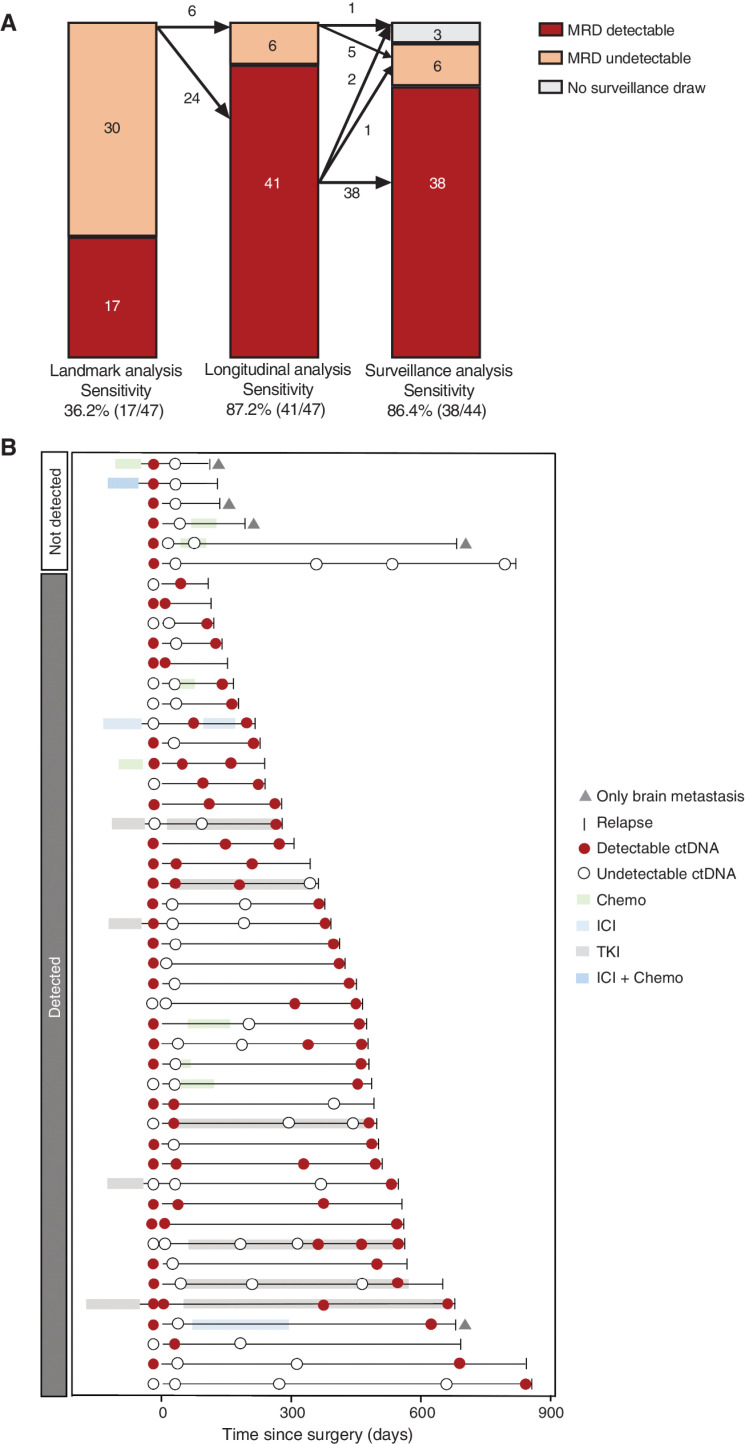
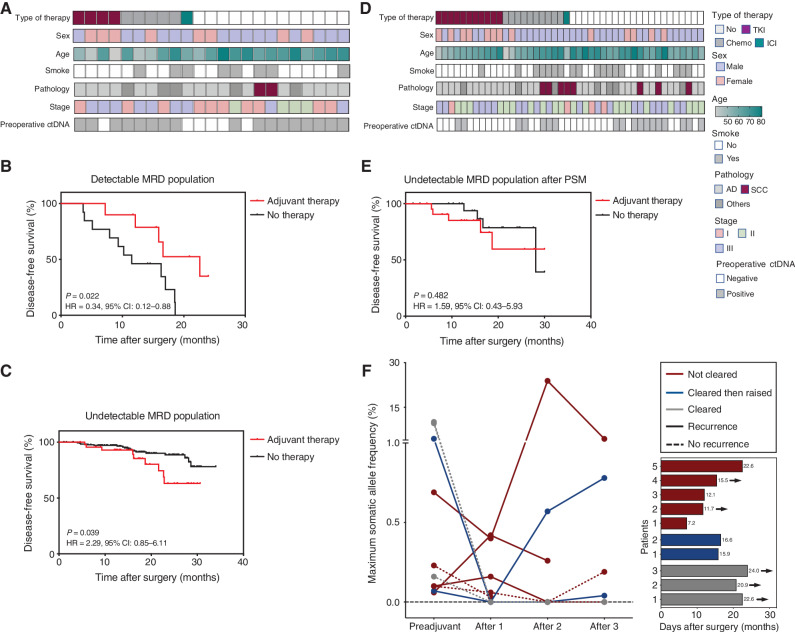
The efficacy and potential limitations of molecular residual disease (MRD) detection urgently need to be fully elucidated in a larger population of non-small cell lung cancer (NSCLC). We enrolled 261 patients with stages I to III NSCLC who underwent definitive surgery, and 913 peripheral blood samples were successfully detected by MRD assay. Within the population, only six patients (3.2%) with longitudinal undetectable MRD recurred, resulting in a negative predictive value of 96.8%. Longitudinal undetectable MRD may define the patients who were cured. The peak risk of developing detectable MRD was approximately 18 months after landmark detection. Correspondingly, the positive predictive value of longitudinal detectable MRD was 89.1%, with a median lead time of 3.4 months. However, brain-only recurrence was less commonly detected by MRD (n = 1/5, 20%). Further subgroup analyses revealed that patients with undetectable MRD might not benefit from adjuvant therapy. Together, these results expound the value of MRD in NSCLC. SIGNIFICANCE: This study confirms the prognostic value of MRD detection in patients with NSCLC after definitive surgery, especially in those with longitudinal undetectable MRD, which might represent the potentially cured population regardless of stage and adjuvant therapy. Moreover, the risk of developing detectable MRD decreased stepwise after 18 months since landmark detection. This article is highlighted in the In This Issue feature, p. 1599.
Overview
The claims and statistics of this paper haven’t been checked yet.
Free: it reads the open-access text and checks the first 5 claims that cite a source we can check. Create a free account to check every claim.
Integrity signals
Registry
Cites
Statistics
Figures
Verification
Claims the paper makes
The claims and statistics of this paper haven’t been checked yet.
Free: it reads the open-access text and checks the first 5 claims that cite a source we can check. Create a free account to check every claim.
Claims other papers make about this one
Each is checked against this paper’s own text: does it say what the citing paper says it does?
The cited source says what the claim attributes to it.
In the citing paper
“Circulating tumor DNA (ctDNA) detection based on next-generation sequencing (NGS) is increasingly employed to monitor minimal residual disease (MRD) in various cancers, including acute myeloid leukemia (AML), breast cancer, and lung cancer.5, 6, 7”
From Tumor-informed deep sequencing of ctDNA detects minimal residual disease and predicts relapse in osteosarcoma (2024) · cites this paper as [7]
Self-check
Percentages, sums and reported differences re-computed from the paper’s own numbers.
The self-check needs the paper’s full text.
Citations
Cites
Clonal hematopoiesis and blood-cancer risk inferred from blood DNA sequence
Genovese, G., Kähler, A. K., Handsaker, R. E., Lindberg, J., Rose, S. A., Bakhoum, S. F., Chambert, K., Mick, E., Neale, B. M., Fromer, M., et al. (2014) · New England Journal of Medicine · doi:10.1056/nejmoa1409405 · Cited by 3,531 · cited 1×
“, DNMT3A, TET2, and PPM1D), as reported in the previous studies (25, 26).”
ResultLung adjuvant cisplatin evaluation: a pooled analysis by the LACE Collaborative Group.
Pignon, J.-P., Tribodet, H., Scagliotti, G. V., Douillard, J.-Y., Shepherd, F. A., Stephens, R. J., Dunant, A., Torri, V., Rosell, R., Seymour, L., et al. (2008) · Journal of Clinical Oncology · doi:10.1200/jco.2007.13.9030 · Cited by 2,642
Tracking the Evolution of Non–Small-Cell Lung Cancer
Jamal-Hanjani, M., Wilson, G. A., McGranahan, N., Birkbak, N. J., Watkins, T. B. K., Veeriah, S., Shafi, S., Johnson, D. H., Mitter, R., Rosenthal, R., et al. (2017) · New England Journal of Medicine · doi:10.1056/nejmoa1616288 · Cited by 2,349 · cited 2×
“Moreover, the tissue local sampling itself cannot represent the whole picture of the tumor, as intratumoral heterogeneity may also contribute to the inconsistency (30).”
BackgroundAn ultrasensitive method for quantitating circulating tumor DNA with broad patient coverage
Newman, A. M., Bratman, S. V., To, J., Wynne, J. F., Eclov, N. C. W., Modlin, L. A., Liu, C. L., Neal, J. W., Wakelee, H. A., Merritt, R. E., et al. (2014) · Nature Medicine · doi:10.1038/nm.3519 · Cited by 2,220 · cited 4×
“Because cerebrospinal fluid (CSF) has been proven to be a comparable or superior detection medium to peripheral blood for central nervous system primary or metastatic tumors (21–23), high-depth ctDNA testing of CSF may be worthwhile, as is the case for the CAPP-seq technique on urine (uCAPP-seq; ref.”
MethodInfluentialPhylogenetic ctDNA analysis depicts early-stage lung cancer evolution
The TRACERx consortium, Abbosh, C., The PEACE consortium, Birkbak, N. J., Wilson, G. A., Jamal-Hanjani, M., Constantin, T., Salari, R., Le Quesne, J., Moore, D. A., et al. (2017) · Nature · doi:10.1038/nature22364 · Cited by 1,874
Osimertinib in Resected EGFR -Mutated Non–Small-Cell Lung Cancer
Wu, Y.-L., Tsuboi, M., He, J., John, T., Grohe, C., Majem, M., Goldman, J. W., Laktionov, K., Kim, S.-W., Kato, T., et al. (2020) · New England Journal of Medicine · doi:10.1056/nejmoa2027071 · Cited by 1,798 · cited 1×
“Encouragingly, substantial progress has been made since the introduction of tyrosine kinase inhibitors and immune-checkpoint inhibitors (ICI), as reported in the ADAURA and IMpower 010 trials (4, 5).”
BackgroundFelip, E., Altorki, N., Zhou, C., Csőszi, T., Vynnychenko, I., Goloborodko, O., Luft, A., Akopov, A., Martinez-Marti, A., Kenmotsu, H., et al. (2021) · The Lancet · doi:10.1016/s0140-6736(21)02098-5 · Cited by 1,486 · cited 1×
“Encouragingly, substantial progress has been made since the introduction of tyrosine kinase inhibitors and immune-checkpoint inhibitors (ICI), as reported in the ADAURA and IMpower 010 trials (4, 5).”
BackgroundLiquid biopsy and minimal residual disease - latest advances and implications for cure
Pantel, K., & Alix-Panabières, C. (2019) · Nature Reviews Clinical Oncology · doi:10.1038/s41571-019-0187-3 · Cited by 1,110
Integrated digital error suppression for improved detection of circulating tumor DNA
Newman, A. M., Lovejoy, A. F., Klass, D. M., Kurtz, D. M., Chabon, J. J., Scherer, F., Stehr, H., Liu, C. L., Bratman, S. V., Say, C., et al. (2016) · Nature Biotechnology · doi:10.1038/nbt.3520 · Cited by 1,099
Chaudhuri, A. A., Chabon, J. J., Lovejoy, A. F., Newman, A. M., Stehr, H., Azad, T. D., Khodadoust, M. S., Esfahani, M. S., Liu, C. L., Zhou, L., et al. (2017) · Cancer Discovery · doi:10.1158/2159-8290.cd-17-0716 · Cited by 1,072 · cited 1×
“Landmark (0,6) (6,12) (12,18) (18,24) (24,30) >30 0 50 100”
Cited by
Overall Survival with Osimertinib in Resected EGFR -Mutated NSCLC
Tsuboi, M., Herbst, R. S., John, T., Kato, T., Majem, M., Grohé, C., Wang, J., Goldman, J. W., Lu, S., Su, W.-C., et al. (2023) · New England Journal of Medicine · doi:10.1056/nejmoa2304594 · Cited by 672
Cancer biomarkers: Emerging trends and clinical implications for personalized treatment
Passaro, A., Al Bakir, M., Hamilton, E. G., Diehn, M., André, F., Roy-Chowdhuri, S., Mountzios, G., Wistuba, I. I., Swanton, C., & Peters, S. (2024) · Cell · doi:10.1016/j.cell.2024.02.041 · Cited by 672
“For example, first generation assays can only detect MRD at the post-treatment landmark in approximately one third of early-stage NSCLC and half of colon cancer patients destined to develop recurrence 159,162,197,204– 206 .”
Alectinib in Resected ALK -Positive Non–Small-Cell Lung Cancer
Wu, Y.-L., Dziadziuszko, R., Ahn, J. S., Barlesi, F., Nishio, M., Lee, D. H., Lee, J.-S., Zhong, W., Horinouchi, H., Mao, W., et al. (2024) · New England Journal of Medicine · doi:10.1056/nejmoa2310532 · Cited by 431
Tracking early lung cancer metastatic dissemination in TRACERx using ctDNA
Abbosh, C., Frankell, A. M., Harrison, T., Kisistok, J., Garnett, A., Johnson, L., Veeriah, S., Moreau, M., Chesh, A., Chaunzwa, T. L., et al. (2023) · Nature · doi:10.1038/s41586-023-05776-4 · Cited by 382
Self-citationMountzios, G., Remon, J., Hendriks, L. E. L., García-Campelo, R., Rolfo, C., Van Schil, P., Forde, P. M., Besse, B., Subbiah, V., Reck, M., et al. (2023) · Nature Reviews Clinical Oncology · doi:10.1038/s41571-023-00794-7 · Cited by 199
The changing treatment landscape of EGFR-mutant non-small-cell lung cancer
Zhou, F., Guo, H., Xia, Y., Le, X., Tan, D. S. W., Ramalingam, S. S., & Zhou, C. (2025) · Nature Reviews Clinical Oncology · doi:10.1038/s41571-024-00971-2 · Cited by 182
Drug-tolerant persister cells in cancer: the cutting edges and future directions
Pu, Y., Li, L., Peng, H., Liu, L., Heymann, D., Robert, C., Vallette, F., & Shen, S. (2023) · Nature Reviews Clinical Oncology · doi:10.1038/s41571-023-00815-5 · Cited by 175
“Examples of such alterations include increased H3K9me3 methylation, resulting in the suppression of long interspersed repeat 1 elements, which is required to maintain DTP cell survival in an EGFR -mutant NSCLC cell line exposed to erlotinib 78 .”
BackgroundManagement of locally advanced non‐small cell lung cancer: State of the art and future directions
Miao, D., Zhao, J., Han, Y., Zhou, J., Li, X., Zhang, T., Li, W., & Xia, Y. (2023) · 癌症:英文版 · doi:10.1002/cac2.12505 · Cited by 188
“There is evidence that ctDNA/MRD is a predictor of postoperative disease recurrence and poor prognosis [21, 22, 126].”
BackgroundInfluentialMinimal residual disease as a target for liquid biopsy in patients with solid tumours
Pantel, K., & Alix-Panabières, C. (2025) · Nature Reviews Clinical Oncology · doi:10.1038/s41571-024-00967-y · Cited by 146
“In another study, Zhang et al. analysed 913 blood samples taken from 261 patients with stage I–III NSCLC after surgery and reported an impressive negative predictive value of 96.8% 44 .”
InfluentialMo, S., Li, Y., Wang, D., Han, L., Zhou, S., Wang, H., Dai, W., Wang, Y., Luo, W., Wang, R., et al. (2023) · JAMA Oncology · doi:10.1001/jamaoncol.2023.0425 · Cited by 146
Chen, K., Yang, F., Shen, H., Wang, C., Li, X., Chervova, O., Wu, S., Qiu, F., Peng, D., Xin, Z., et al. (2023) · Cancer Cell · doi:10.1016/j.ccell.2023.08.010 · Cited by 154
Pan, Y., Zhang, J., Gao, X., Chen, Z., Yan, B., Tan, P., Yang, X., Gao, W., Gong, Y., Tian, Z., et al. (2023) · Cancer Cell · doi:10.1016/j.ccell.2023.09.007 · Cited by 125
Emerging evidence and treatment paradigm of non-small cell lung cancer
Liu, S. M., Zheng, M.-M., Pan, Y., Liu, S. M., Li, Y., & Wu, Y.-L. L. C. (2023) · Journal of Hematology & Oncology · doi:10.1186/s13045-023-01436-2 · Cited by 120
Dong, S., Wang, Z., Zhang, J., Yan, B., Zhang, C., Gao, X., Sun, H., Li, Y.-S., Yan, H., Tu, H.-Y., et al. (2024) · JAMA Oncology · doi:10.1001/jamaoncol.2024.1779 · Cited by 106
Herbst, R. S., John, T., Grohé, C., Goldman, J. W., Kato, T., Лактионов, К. К., Bonanno, L., Tiseo, M., Majem, M., Dómine, M., et al. (2025) · Nature Medicine · doi:10.1038/s41591-025-03577-y · Cited by 106
“Studies in patients with stage I–III NSCLC, such as a prospective study in 261 patients 29 and the LUCID study in 88 patients 28 , showed that MRD detection preceded radiographic progression by a median of 3.4 months and 212.5 days (approximately 7 months), respectively.”
InfluentialPotential clinical utility of liquid biopsy in early-stage non-small cell lung cancer
Shen, H., Jin, Y., Zhao, H., Wu, M., Zhang, K., Wei, Z., Wang, X., Wang, Z., Li, Y., Yang, F., et al. (2022) · BMC Medicine · doi:10.1186/s12916-022-02681-x · Cited by 90
“All of the 9 eligible studies referred to ctDNA detection, with a total of 148 patients suffering disease progression [12, 13, 15, 68, 69, 71, 72, 74, 75].”
BackgroundResultJung, H. A., Ku, B. M., Kim, Y. J., Park, S., Sun, J., Lee, S., Ahn, J. S., Cho, J. H., Kim, H. K., Choi, Y. S., et al. (2023) · Journal of Thoracic Oncology · doi:10.1016/j.jtho.2023.05.027 · Cited by 86
Liquid biopsy into the clinics: Current evidence and future perspectives
Boukovala, M. A., Westphalen, C. B., & Probst, V. (2024) · The Journal of Liquid Biopsy · doi:10.1016/j.jlb.2024.100146 · Cited by 82
Zhu, L., Xu, R., Yang, L., Shi, W., Zhang, Y., Liu, J., Li, X., Zhou, J., & Bing, P. (2023) · Frontiers in Genetics · doi:10.3389/fgene.2023.1172108 · Cited by 81
“A recent study identified a potentially cured population of localized NSCLC by longitudinal MRD detection (Zhang et al., 2022).”
BackgroundAbbosh, C., Hodgson, D., Doherty, G. J., Gale, D. G., Black, J. R., Horn, L., Reis-Filho, J. S., & Swanton, C. (2024) · Trends in cancer · doi:10.1016/j.trecan.2024.04.004 · Cited by 78
Liquid biopsy: Comprehensive overview of circulating tumor DNA (Review)
Ge, Q., Zhang, Z., Li, S.-N., Ma, J., & Zhao, Z. (2024) · Oncology Letters · doi:10.3892/ol.2024.14681 · Cited by 72
“The potential for MRD detection is established in other malignancies, including acute myeloid (143,144) and chronic lymphocytic leukemia (145), NSCLC (146,147), multiple myeloma (148‑151), breast cancer (152), melanoma (153), head and neck squamous cell carcinoma (154), follicular lymphoma (155), urothelial carcinoma…”
BackgroundInfluentialZheng, J., Qin, C., Wang, Q., Tian, D., & Chen, Z. (2024) · EBioMedicine · doi:10.1016/j.ebiom.2024.105109 · Cited by 68
Molecular landscape of ERBB2 alterations in 3000 advanced NSCLC patients
Hong, L., Patel, S., Drusbosky, L. M., Xiong, Y., Chen, R., Geng, R., Heeke, S., Nilsson, M., Wu, J., Heymach, J. V., et al. (2024) · npj Precision Oncology · doi:10.1038/s41698-024-00720-9 · Cited by 55
“NCSV (in-house algorithm 0.2.3) was employed to detect structural variants 46 .”
MethodInfluentialCirculating tumour DNA in early stage and locally advanced NSCLC: ready for clinical implementation?
Normanno, N., Morabito, A., Rachiglio, A. M., Sforza, V., Landi, L. M., Bria, E., Delmonte, A., Cappuzzo, F., & Luca, A. D. (2025) · Nature Reviews Clinical Oncology · doi:10.1038/s41571-024-00985-w · Cited by 78
“bias. ctDNA-based MRD detection generally correlated with disease stage 45,58,72,74,75,80,81 , although, of note, the proportion of patients with stage I–II versus stage III disease varied considerably across studies (Table 3).”
InfluentialLiu, S., Dong, S., Yang, X., Liao, R.-Q., Jiang, B., Wang, Q., Ben, X., Qiao, G., Lin, J., Yan, H., et al. (2023) · Signal Transduction and Targeted Therapy · doi:10.1038/s41392-023-01700-4 · Cited by 58
“36,37 Hence ctDNA-MRD monitoring may bene fi t NSCLC patient management in adjuvant de-escalation treatment. ctDNA studies have been conducted in the neoadjuvant setting, 14,26 with ctDNA clearance associated with higher pCR rates and longer EFS in the CheckMate-816 trial.”
BackgroundMarinello, A., Tagliamento, M., Pagliaro, A., Conci, N., Cella, E., Vasseur, D., Remón, J., Lévy, A., Dall’Olio, F. G., & Besse, B. (2024) · Cancer Treatment Reviews · doi:10.1016/j.ctrv.2024.102791 · Cited by 53
“…with resected stage I-II NSCLC, 36.4% were ctDNA-positive (ctDNA + ), with an average of four mutations per patient and a median variant allele fraction (VAF) of 0.71 % [70]. ctDNA detection before surgery correlated with larger tumor size, tumor stage, and adenocarcinoma histologic subtype [70].”
InfluentialAdjuvant immunotherapy in early-stage resectable non–small cell lung cancer: A new milestone
Tang, W., Ye, H.-Y., Tang, X., Su, J., Xu, K.-M., Zhong, W., & Liang, Y. (2023) · Frontiers in Oncology · doi:10.3389/fonc.2023.1063183 · Cited by 47
“revealed that patients with undetectable MRD might not benefit from adjuvant treatment in subgroup analyses (63).”
BackgroundZhong, R., Gao, R., Fu, W., Li, C., Huo, Z., Gao, Y., Lu, Y., Li, F., Ge, F., Tu, H., et al. (2023) · BMC Medicine · doi:10.1186/s12916-023-02849-z · Cited by 51
“The sensitivity of MRD monitoring was found to be limited in patients with brain-only recurrence [21].”
BackgroundTan, A. C., Lai, G. G. Y., Saw, S. P. L., Chua, K. L. M., Takano, A. M., Ong, B., Koh, T., Jain, A., Tan, W. L., Ng, Q. S., et al. (2024) · Cancer · doi:10.1002/cncr.35263 · Cited by 63
“20 Although these studies had similar sized or smaller cohorts, differences in patient demographics, curative therapies, and inconsistencies with plasma time point collection make cross ‐ study comparisons difficult.”
BackgroundBoukouris, A. E., Michaelidou, K., Joosse, S. A., Charpidou, A. G., Mavroudis, D., Syrigos, K. N., & Agelaki, S. (2025) · npj Precision Oncology · doi:10.1038/s41698-025-00984-9 · Cited by 59
“48 and reported in other solid tumors as well 64 .”
InfluentialOu, W., Li, N., Wang, B.-X., Zhu, T., Shen, Z., Wang, T., Chang, W., Chang, Z.-H., Hu, X., Pu, Y., et al. (2023) · EClinicalMedicine · doi:10.1016/j.eclinm.2023.101839 · Cited by 45
Li, C., Shao, J., Li, P., Feng, J., Li, J., & Wang, C. (2023) · Cancer Letters · doi:10.1016/j.canlet.2023.216365 · Cited by 50
Fu, Y., Xu, Y., Liu, W., Zhang, J., Wang, F., Jian, Q., Huang, G., Zou, C., Xie, X., Kim, A. H., et al. (2024) · eClinicalMedicine · doi:10.1016/j.eclinm.2024.102697 · Cited by 37
Passaro, A., Mok, T. S. K., Attili, I., Wu, Y.-L. L. C., Tsuboi, M., de Marinis, F., & Peters, S. (2023) · JAMA Oncology · doi:10.1001/jamaoncol.2023.0459 · Cited by 42
Dong, Q., Chen, C., Hu, Y., Zhang, W., Yang, X., Qi, Y., Zhu, C., Chen, X., Shen, X., & Ji, W. (2023) · Cancer Biology & Therapy · doi:10.1080/15384047.2023.2274123 · Cited by 43
“22 In another prospective clinical trial, 202-gene panel was used to detect ctDNA in blood samples from 20 patients with hepato-cellular carcinoma.”
BackgroundMethodInfluentialHashimoto, T., Nakamura, Y., Oki, E., Kobayashi, S., Yuda, J., Shibuki, T., Bando, H., & Yoshino, T. (2024) · International Journal of Clinical Oncology · doi:10.1007/s10147-024-02493-4 · Cited by 34
Li, S., Li, Y., Wei, W., Gong, C., Wang, T., Li, G., Yao, F., Ou, J., Xu, Y., Wu, W. D., et al. (2025) · Nature Communications · doi:10.1038/s41467-025-57988-z · Cited by 42
“The analytical validation of this background error fi lter model has been previously described in earlier publications 13,15 .”
InfluentialMa, D.-N., Gao, X., Wang, L., Yin, H., Feng, L.-H., & Zhu, Y. (2025) · Biomarker Research · doi:10.1186/s40364-025-00796-w · Cited by 45
Yan, W., Zhong, W., Liu, Y., Chen, Q., Xing, W., Zhang, Q., Liu, L., Ge, D., Chen, K., Yang, F., et al. (2022) · Journal of Thoracic Oncology · doi:10.1016/j.jtho.2022.09.222 · Cited by 37
Early-Stage Lung Cancer: Using Circulating Tumor DNA to Get Personal
Bestvina, C. M., Garassino, M. C., Neal, J. W., Wakelee, H. A., Diehn, M., & Vokes, E. E. (2023) · Journal of Clinical Oncology · doi:10.1200/jco.23.00258 · Cited by 31
Development of new techniques and clinical applications of liquid biopsy in lung cancer management
Chen, K., He, Y., Wang, W., Yuan, X., Carbone, D. P., & Yang, F. (2024) · Science Bulletin · doi:10.1016/j.scib.2024.03.062 · Cited by 34
Liquid Biopsy in Early-Stage Lung Cancer: Current and Future Clinical Applications
Vandekerckhove, O., Cuppens, K., Pat, K., Pont, B. D., Froyen, G., & Maes, B. (2023) · Cancers · doi:10.3390/cancers15102702 · Cited by 32
“8% were still disease-free at the last follow-up and this predictive ability appears to be disease-stage independent [40].”
BackgroundZheng, M.-M., Zhou, Q. H., Chen, H., Jiang, B., Tang, L.-B., Jie, G., Tu, H.-Y., Yin, K., Sun, H., Liu, S., et al. (2025) · Nature Medicine · doi:10.1038/s41591-025-03538-5 · Cited by 37
Circulating tumor DNA in clinical trials for solid tumors: Challenges and current applications
Parisi, C., Tagliamento, M., Belcaid, L., Aldea, M. D., Bayle, A., Remon-Masip, J., Italiano, A., Planchard, D., Besse, B., & Barlési, F. (2023) · The Journal of Liquid Biopsy · doi:10.1016/j.jlb.2023.100007 · Cited by 31
“…curative surgery showed no bene fi t from adjuvant chemotherapy in a subgroup analysis including patients with undetectable MRD, suggesting once again the utility of ctDNA for the risk strati fi cation [86]. ctDNA has also been tested in the localized setting of NSCLC in pivotal trials testing ICI.”
Wu, X., Chau, Y. F., Bai, H., Zhuang, X., Wang, J., & Duan, J. (2023) · Frontiers in Oncology · doi:10.3389/fonc.2022.1099304 · Cited by 28
Wang, S., Xia, Z., You, J., Gu, X., Meng, F., Chen, P., Tang, W., Bao, H., Zhang, J., Wu, X., et al. (2023) · Cancer Research Communications · doi:10.1158/2767-9764.crc-22-0363 · Cited by 28
“0% specificity for MRD detection at landmark (7).”
BackgroundRemón, J., Saw, S. P. L., Cortiula, F., Singh, P. K., Menis, J., Mountzios, G., & Hendriks, L. E. L. (2023) · Journal of Thoracic Oncology · doi:10.1016/j.jtho.2023.09.1451 · Cited by 29
Fu, R., Huang, J., Tian, X., Liang, C., Xiong, Y., Zhang, J., Jiang, B., Dong, S., Gong, Y., Gao, W., et al. (2023) · Molecular Oncology · doi:10.1002/1878-0261.13387 · Cited by 27
Personalized Cancer Monitoring Assay for the Detection of ctDNA in Patients with Solid Tumors
Zhao, J., Reuther, J., Scozzaro, K., Hawley, M., Metzger, E., Emery, M., Chen, I., Barbosa, M., Johnson, L., O’Connor, A., et al. (2023) · Molecular Diagnosis & Therapy · doi:10.1007/s40291-023-00670-1 · Cited by 32
“Recurrence may be less likely if ctDNA is not detected, allowing for consideration of treatment de-escalation, which can help patients avoid unnecessary treatment if they are measurably disease free and unlikely to relapse [28, 67].”
BackgroundChen, D., Guo, J., Huang, H., Tian, L., Xie, Y., & Wu, Q. (2023) · BMC Medicine · doi:10.1186/s12916-023-03181-2 · Cited by 25
“A total of 8 studies [10–13, 27, 29–31] involving 610 participants were included in the IPD-based DFS analysis (Fig.”
BackgroundMethodInfluentialGristina, V., Mantia, M. L., Peri, M., Iacono, F., Barraco, N., Perez, A., Viscardi, G., Cutaia, S., Russo, T. D. B., Anwar, Z., et al. (2022) · Critical Reviews in Oncology/Hematology · doi:10.1016/j.critrevonc.2022.103899 · Cited by 26
Li, R. Q., Yan, L., Zhang, L., Ma, H. X., Wang, H. W., Bu, P., Xi, Y., & Lian, J. (2024) · Scientific Reports · doi:10.1038/s41598-024-62991-3 · Cited by 30
“The self-developed algorithm NCsv (0.2.3) was used for the assessment of structural variation (SV) 41 .”
MethodInfluentialNielsen, L. R., Guldbrandsen, K. F., Ahlborn, L. B., Bloch, M., Skougaard, K., Albrecht‐Beste, E., Nellemann, H. M., Krakauer, M., Gørtz, P. M., Fledelius, J., et al. (2025) · Lung Cancer · doi:10.1016/j.lungcan.2025.108528 · Cited by 25
Schuurbiers, M. M. F., Smith, C. G., Hartemink, K. J., Rintoul, R. C., Gale, D. G., Monkhorst, K., Mandos, B. L. R., Paterson, A., van den Broek, D. A., Rosenfeld, N., et al. (2025) · PLoS Medicine · doi:10.1371/journal.pmed.1004574 · Cited by 26
Zhang, J., Dong, S., Gu, W., Zhao, N., Liang, Y., Tang, W., Liu, S., Wang, F., Wang, G.-S., Peng, B., et al. (2023) · Clinical Lung Cancer · doi:10.1016/j.cllc.2023.09.008 · Cited by 22
Shu, T., Liang, Y., Zhang, S., Sun, T., Gao, Y., Guo, C., Li, Z., Gao, M., Zhang, N., Song, N., et al. (2024) · Gynecologic Oncology · doi:10.1016/j.ygyno.2024.11.002 · Cited by 19
Toward a cure for lung cancer: important advances in operable non-small cell lung cancer
Liu, S. M., Jie, G., & Wu, Y.-L. L. C. (2022) · 中国科学通报:英文版 · doi:10.1016/j.scib.2022.06.008 · Cited by 17
Mutational profiling of Chinese patients with thyroid cancer
Du, Y., Zhang, S., Zhang, G., Hu, J., Zhao, L., Xiong, Y., Shen, L., Chen, R., Ye, K., & Xu, Y. (2023) · Frontiers in Endocrinology · doi:10.3389/fendo.2023.1156999 · Cited by 17
“Median (min-max) 7 (4-12) 4 (4-21) 8 (4-18) 4 (4-7)”
BackgroundInfluentialZhang, W., Liang, Z., Zhao, Y., Li, Y., Chen, T., Li, W., Chen, Y., Wu, P., Zhang, H., Fang, C., et al. (2024) · Frontiers in Immunology · doi:10.3389/fimmu.2024.1359302 · Cited by 24
Sun, X., Lyu, J., Yang, M., Lin, Y., Wu, K., Liu, K., Li, A., Shuai, X., Cai, K., Wang, Z., et al. (2024) · Annals of Surgical Oncology · doi:10.1245/s10434-024-16041-x · Cited by 18
“43,44 This ambiguity may have contributed to the observed low PFS in our findings, mirroring our outcomes based on preoperative CTC counts in the aforementioned 38 patients.”
Fang, X., Yu, S., Jiang, Y., Xiang, Y., & Lu, K. (2022) · Frontiers in Oncology · doi:10.3389/fonc.2022.1027664 · Cited by 19
Progress and perspectives of perioperative immunotherapy in non-small cell lung cancer
Peng, Y., Li, Z., Fu, Y., Pan, Y., Zeng, Y., Liu, J., Xiao, C., Zhang, Y., Su, Y., Li, G., et al. (2023) · Frontiers in Oncology · doi:10.3389/fonc.2023.1011810 · Cited by 17
“This might represent potentially cured patients regardless of stage and adjuvant therapy (73).”
BackgroundInfluentialFan, W., Xia, Z., Chen, R., Lin, D., Li, F., Zheng, Y., Luo, J., Xiong, Y., Yu, P., Gao, W., et al. (2024) · Therapeutic Advances in Medical Oncology · doi:10.1177/17588359231220607 · Cited by 20
“12 So we used the same strategy to observe the long-term clinical outcomes of CRC patients with postsurgery or longitudinal undetectable MRD in this prospective, multicenter real-world study.”
MethodDynamic ctDNA informs whole-course postoperative precise management of NSCLC (LUNGCA study)
Xia, L. P., Pu, Q., Kang, R., Mei, J., Li, L., Yang, Y., Deng, S., Feng, G., Deng, Y., Gan, F., et al. (2025) · JNCI Journal of the National Cancer Institute · doi:10.1093/jnci/djaf061 · Cited by 25
Circulating tumor DNA: current implementation issues and future challenges for clinical utility
Hu, Q., Chen, L., Li, K., Liu, R. M., Sun, L., & Han, T. (2023) · Clinical Chemistry and Laboratory Medicine (CCLM) · doi:10.1515/cclm-2023-1157 · Cited by 20
“Wu ’ s team studied MRD dynamics post-surgery, categorizing monitoring into two periods: landmark (1 – 3 months post-surgery) and longitudinal (every 3 – 6 months thereafter) [35].”
BackgroundTian, X., Liu, X., Wang, K., Wang, R., Li, Y., Qian, K., Wang, T., Zhao, X., Liu, L., Zhang, P., et al. (2024) · Thoracic Cancer · doi:10.1111/1759-7714.15251 · Cited by 22
“12 Molecular residual disease (MRD) that may persist after initial therapy as a potential source of subsequent metastatic relapse at distant sites cannot be detected by radiological imaging.”
BackgroundInfluentialClinical application of liquid biopsy based on circulating tumor DNA in non-small cell lung cancer
Liu, X., Yue, Y., Zihan, R., Youbin, C., Tianyu, L., & Rui, W. (2023) · Frontiers in Physiology · doi:10.3389/fphys.2023.1200124 · Cited by 17
“In analyzing 85 high-risk stage II-III patients, the hazard rate curve for detectable MRD or disease recurrence reached a peak at the 18th month (Zhang et al., 2022).”
BackgroundResultGenomic landscape of circulating tumor DNA in HER2-low metastatic breast cancer
Yi, Z., Feng, K., Lv, D., Guan, Y., Shao, Y.-C., Ma, F., & Xu, B. (2024) · Signal Transduction and Targeted Therapy · doi:10.1038/s41392-024-02047-0 · Cited by 17
“The somatic SNVs and small InDels of ctDNA sequencing data were analyzed using realDcaller (Geneplus-Beijing) and GATK Mutect2, 45 an internally developed software for reviewing hotspot variants.”
Yang, Y., Wu, Y., Zhao, J., Zhang, T., Fei, K., Zhao, X., Deng, L., Zhang, Z., Jiang, Y., Wang, J., et al. (2025) · Signal Transduction and Targeted Therapy · doi:10.1038/s41392-025-02445-y · Cited by 19
“36 Jun et al. reported that NSCLC patients with detectable ctDNA before consolidation ICI who exhibited an early ctDNA response had signi fi cantly better PFS and OS.”
Molecular residual disease: A new clue for individualized approach in non‐small cell lung cancer
Zhang, J., Zhong, W., & Wu, Y.-L. (2023) · Medicine Advances · doi:10.1002/med4.11 · Cited by 14
Han, Y., Xiong, Y., Lu, T., Chen, R., Liu, Y., Tang, H. J., Geng, R., & Wang, Y. (2023) · Frontiers in Oncology · doi:10.3389/fonc.2023.1121708 · Cited by 13
Wang, Z., Zhang, X., Feng, W., Zhang, L., Liu, X., Guo, W., Deng, Y., Zou, Q.-F., Yang, J., Zhou, Q. H., et al. (2023) · Therapeutic Advances in Medical Oncology · doi:10.1177/17588359231167818 · Cited by 13
Circulating tumor DNA (ctDNA)-based minimal residual disease in non-small cell lung cancer
Tang, L.-B., Li, R., Wen, H., Zhou, Q. H., & Xu, C. (2023) · Chinese Medical Journal - Pulmonary and Critical Care Medicine · doi:10.1016/j.pccm.2023.04.001 · Cited by 16
Aguilar, H., López-Roldán, B., Vilalta, A., Alkorta‐Aranburu, G., Claramunt, R., López‐Guerrero, J. A., Sandiego, S., & Bazo, I. G. (2024) · The Journal of Liquid Biopsy · doi:10.1016/j.jlb.2024.100145 · Cited by 14
“Circulating tumor DNA is a multifaceted biomarker; presurgical ctDNA levels re fl ect relapse risk in early-stage non-small cell lung cancer (NSCLC) [20 – 22] and postoperative ctDNA detection highlights impending NSCLC recurrence [13,21 – 25].”
The Role of ctDNA in the Management of Non-Small-Cell Lung Cancer in the AI and NGS Era
Costa, J., Membrino, A., Zanchetta, C., Rizzato, S., Cortiula, F., Rossetto, C., Pelizzari, G., Aprile, G., & Macerelli, M. (2024) · International Journal of Molecular Sciences · doi:10.3390/ijms252413669 · Cited by 17
Lu, D., Lin, N., Li, S., Jing, Q., Yin, J. C., Shi, L., Zhang, Z., Chen, Z., Wang, Z., Tong, Y., et al. (2025) · JCO Precision Oncology · doi:10.1200/po-25-00489 · Cited by 20
Yang, D., Xu, F., Li, Y., Lai, X., Xian, B., Yu, P., Chen, R., Li, Z., & Ma, D. (2022) · Thoracic Cancer · doi:10.1111/1759-7714.14610 · Cited by 12
“Several studies have demonstrated that compared with radiographic evaluation, serial ctDNA tests could predict treatment failure or recurrence earlier.(14,15) However, as a result of the lack of repeated plasma samples in the present study, we were unable to estimate the detection lead time between mTBI variations and…”
ResultZheng, J., Wang, T., Yang, Y., Huang, J., Feng, J., Zhuang, W., Chen, J., Zhao, J., Zhong, W., Zhao, Y., et al. (2024) · 癌症:英文版 · doi:10.1002/cac2.12524 · Cited by 15
“For patients with resectable NSCLC, the positive predictive value, referring to the recurrence rate of ctDNA-positive samples, was reported to be approximately 90% within 1 month after definitive treatment, indicating reliable predictive performance [25].”
BackgroundA standing platform for cancer drug development using ctDNA-based evidence of recurrence
Medford, A. J., Carmeli, A. B., Ritchie, A., Wagle, N., Garraway, L. A., Lander, E. S., & Parikh, A. R. (2024) · Nature reviews. Cancer · doi:10.1038/s41568-024-00742-2 · Cited by 14
“26–40).”
Annual progress of clinical research on targeted therapy for nonsmall cell lung cancer in 2022
Huang, Y., & Zhang, L. (2023) · Cancer Innovation · doi:10.1002/cai2.56 · Cited by 12
“In the precision ‐ assisted setting, a study conducted by Wu et al. [40] demonstrated that molecular residual disease (MRD) detection can predict the prognosis of NSCLC patients after surgery.”
MethodZhang, J., Liu, S., Gao, X., Liu, S. M., Yan, B., Huang, C., Jiao, Z., Yan, H., Pan, Y., Dong, S. X., et al. (2025) · Clinical Cancer Research · doi:10.1158/1078-0432.ccr-24-2909 · Cited by 21
“In our previous study (7), we investigated the prognostic significance of postoperative ctDNA-MRD in 261 patients with stage I to III NSCLC, revealing a negative predictive value (NPV) of longitudinal MRD at 96.8%.”
InfluentialWang, H., Zhang, X., Zhao, X., Song, C., Deng, W., & Shen, W. (2024) · Frontiers in Immunology · doi:10.3389/fimmu.2023.1330928 · Cited by 11
Lu, J., Feng, Y., Guo, K., Sun, L., Ruan, S., & Zhang, K. (2024) · Journal of Cancer Research and Clinical Oncology · doi:10.1007/s00432-023-05550-z · Cited by 11
Barcellini, L., Nardin, S., Sacco, G., Ferrante, M., Rossi, G., Barletta, G., Bennicelli, E., Dellepiane, C., Tagliamento, M., Pollone, B. R., et al. (2025) · Cancers · doi:10.3390/cancers17040652 · Cited by 14
“…several studies individualized the rapid decay of ctDNA levels after surgery and the ctDNA detection after R0 resection as poor prognostic factors, being related with a decreased EFS, consequently, MRD could be used as surveillance and/or treatment decisions “biomarker” in this setting [98,99,106].”
Hofman, P. M., & Denis, M. G. (2023) · Cytopathology · doi:10.1111/cyt.13246 · Cited by 11
Circulating tumor DNA detection improves relapse prediction in epithelial ovarian cancer
Zhang, Y., Guan, Y., Xiao, X., Xu, S., Zhu, S., Cao, D., Yu, M. Y., Peng, P., Wang, J., Wang, Y., et al. (2024) · BMC Cancer · doi:10.1186/s12885-024-13222-5 · Cited by 12
Geng, Y., Yin, T., Li, Y., He, K., Zou, B., Yu, J., Sun, X., Zhang, T., & Teng, F. (2025) · Molecular Carcinogenesis · doi:10.1002/mc.23883 · Cited by 10
“Recent findings support this methodology for various types of cancers, and studies using highly sensitive techniques have explored the correlation between ctDNA detection and posttreatment outcomes with curative intention of NSCLC undergoing surgery and/or radiotherapy [35, 36].”
Genomic landscape and potential therapeutic targets in alpha-fetoprotein-producing gastric cancer
Zan, L., Zhang, X., Shen, L., Zhao, Q., Tan, D., Peng, X., Jia, Y., Li, J., Liu, J., Zhao, J., et al. (2025) · Gastric Cancer · doi:10.1007/s10120-025-01594-x · Cited by 13
“0.8) and NoahCare structural variations detection (in-house), respectively [11–13].”
InfluentialZhang, X., Zhang, Y., Zhang, S., Wang, S., Yang, P., & Liu, C. (2023) · Frontiers in Oncology · doi:10.3389/fonc.2023.1098128 · Cited by 15
Liu, J., Sun, X.-S., Yin, J.-H., & Xu, X.-E. (2023) · Frontiers in Oncology · doi:10.3389/fonc.2023.1132854 · Cited by 9
Jacobs, S. A., Wang, Y., Abraham, J., Feng, H., Montero, A. J., Lipchik, C., Finnigan, M., Jankowitz, R. C., Salkeni, M. A., Maley, S. K., et al. (2024) · Breast Cancer Research · doi:10.1186/s13058-024-01823-8 · Cited by 9
“Finally, in a subset of patients, we assessed response by RECIST 1.1 with the Guardant Molecular Response score [11, 12].”
MethodInfluentialJin, X., Zhao, W., Li, G., & Jiang, J. (2025) · Cancer Control · doi:10.1177/10732748251334434 · Cited by 11
“79,80 However, investigations into MRD applications in SCLC remain scarce.”
Tan, A. C., Liao, B.-C., Li, M., Lee, D. J., Uehara, Y., Thamlikitkul, L., Zhang, J.-T., Zheng, M., Lee, C. K., Pavlakis, N., et al. (2026) · Journal of Thoracic Oncology · doi:10.1016/j.jtho.2026.103696 · Cited by 17
Mao, S., Yang, S., Liu, X., Li, X., Wang, Q., Zhang, Y., Chen, J., Wang, Y., Gao, G., Wu, F., et al. (2023) · Experimental Hematology and Oncology · doi:10.1186/s40164-023-00417-y · Cited by 13
“Recently, it was found that the presence of nonshedding tumors in the minimal residual disease (MRD) detection was associated with longer relapse-free survival (RFS) and higher possibility of cure [35].”
BackgroundShan, J., Liu, Z., Chen, S., Du, C., Li, B., Ruan, L.-X., Kong, M., Wang, L., Du, M., Shi, S., et al. (2024) · BMC Medicine · doi:10.1186/s12916-024-03462-4 · Cited by 11
Denis, M. G., Herbreteau, G., & Tostivint, E. P. (2023) · Translational Lung Cancer Research · doi:10.21037/tlcr-22-899 · Cited by 11
“Similar conclusions were drawn in recent studies based on the analysis of 88 (11) and 261 (12) stage I–III NSCLC patients.”
Fang, Y., Yan, W., Zhao, Z.-R., Jiang, L., Yu, X., Yang, X., Yu, Z., Luo, Q., Long, H., & Chen, K. (2025) · Journal of Thoracic Disease · doi:10.21037/jtd-2024-2200 · Cited by 8
Yang, Y., Zhang, J., Li, J.-Y., Xu, L., Wang, S.-N., Zhang, J., Xun, Z., Xia, Y., Cao, J.-B., Liu, Y., et al. (2022) · Gland Surgery · doi:10.21037/gs-22-634 · Cited by 8
“All DNA libraries from cases were detected by NGS based on a pan-cancer 1,021-gene panel, which were performed on the Illumina Nextseq CN 500 (Illumina, San Diego, CA, USA) or the Gene + Seq-2000 Sequencing System (GenePlus-Suzhou, Suzhou, China), according to the manufacturer instructions (11).”
BackgroundMethodGuo, K., Lu, J., Lou, Y., & Zheng, S. (2023) · Therapeutic Advances in Medical Oncology · doi:10.1177/17588359231177008 · Cited by 8
Yang, Y., Huang, Z., Yuan, M., Rui, J., Chen, R., Jin, T., Sun, Y., Deng, Z., Shan, H., Niu, X., et al. (2023) · Scientific Reports · doi:10.1038/s41598-023-46857-8 · Cited by 8
Metadata
- Authors
- Zhang, J.-T., Liu, S.-Y., Gao, W., Liu, S.-Y. M., Yan, H.-H., Ji, L., Chen, Y., Gong, Y., Lu, H.-L., Lin, J.-T., Yin, K., Jiang, B.-Y., Nie, Q., Liao, R.-Q., Dong, S., Guan, Y., Dai, P., Zhang, X.-C., Yang, J.-J., Tu, H.-Y., Xia, X., Yi, X., Zhou, Q., Zhong, W.-Z., Yang, X.-N., & Wu, Y.-L.
- Affiliations
- Guangdong Academy of Medical Sciences (CN)
- Jinan University (CN)
- 2Geneplus-Beijing Institute, Beijing, China.
- Corresponding author
- Yang, Xue-Ning
- Wu, Yi-Long
- ORCID
- Venue
- Cancer Discovery
- Published
- 2022-05-11
- Volume
- 12
- Issue
- 7
- Pages
- 1690-1701
- ISSN
- 2159-8274 (ISSN-L)
- 2159-8290
- PMC
- PMC9394392
- OpenAlex
- W4280569356
- Cited by
- 228
- References
- 33
- Citations by year
- 2026: 35 · 2025: 58 · 2024: 61 · 2023: 61 · 2022: 13
- FWCI
- 20.55
- Type
- journal article
- Language
- en
- Open access
- hybrid
- doi.org
- Licence
- Locations
- Cancer Discovery (publishedVersion, cc-by-nc-nd)
- PubMed Central (publishedVersion, cc-by-nc-nd)
- PubMed (publishedVersion)
- Funders
- Guangdong Science and Technology Department Translational Medicine in Lung Cancer (2017B030314120)
- Leading Medical Talents in Guangdong Province (KJ012019426)
- Guangdong Provincial People's Hospital Young Talent Project (GDPPHYTP201902, KY012021189)
- China Postdoctoral Science Foundation (2021M701422)
- Topics
- Life Sciences › Biochemistry, Genetics and Molecular Biology › Cancer Research › Cancer Genomics and Diagnostics
- Health Sciences › Medicine › Pulmonary and Respiratory Medicine › Lung Cancer Diagnosis and Treatment
- Health Sciences › Medicine › Pulmonary and Respiratory Medicine › Lung Cancer Treatments and Mutations
- Keywords
- molecular residual disease, non-small cell lung cancer, localized lung cancer, recurrence prediction, negative predictive value, adjuvant therapy, prognostic factors, postoperative follow-up
- MeSH terms
- Carcinoma, Non-Small-Cell Lung, Humans, Lung Neoplasms, Prognosis, Neoplasm, Residual
About these checks
Registry, retraction, Cites and statistics results are computed, not judged, with one exception: a printed reference that no index lists is read once by a model before it counts as a citation error. Claims are extracted by a model and kept only when their quote appears verbatim in the text; each cited source is then checked, with a model’s help, for whether it says what the claim relies on. Those verdicts can be wrong — read the claim’s quote and the cited source before relying on one.
Statistics and arithmetic are recomputed, not judged.
Confidence bands are shown only for fields calibrated on our annotated test set. None is calibrated yet, so no band is shown.
What counts as a claim ›How we measure confidence ›How we check this ›
Are you an author, or do you see a problem with this page? Request a review
Data sources
Bibliographic data: Semantic Scholar, OpenAlex, Crossref.
Contains information from the Semantic Scholar Academic Graph Datasets, made available under the ODC Attribution License (ODC-BY 1.0).
Semantic Scholar’s data is described in: Kinney, R., et al. (2023). The Semantic Scholar Open Data Platform. arXiv:2301.10140.
