

The DOI matches its Crossref record; 2 of the 2 references it cites were found in a registry or an index.
Dysbiosis of Oral Microbiota Associated with Palmoplantar Pustulosis
Abstract
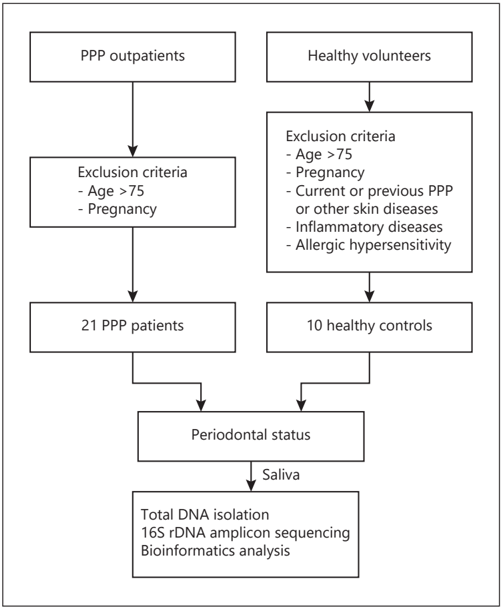
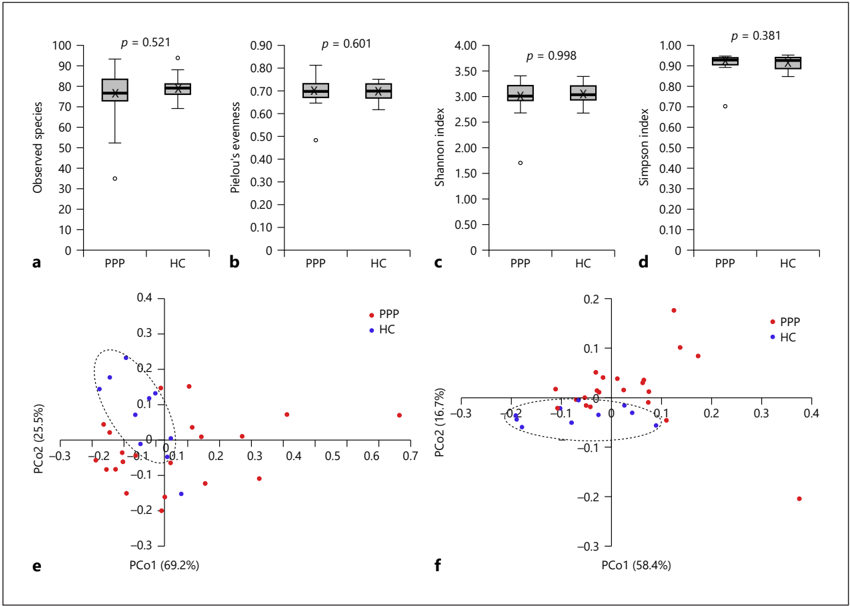
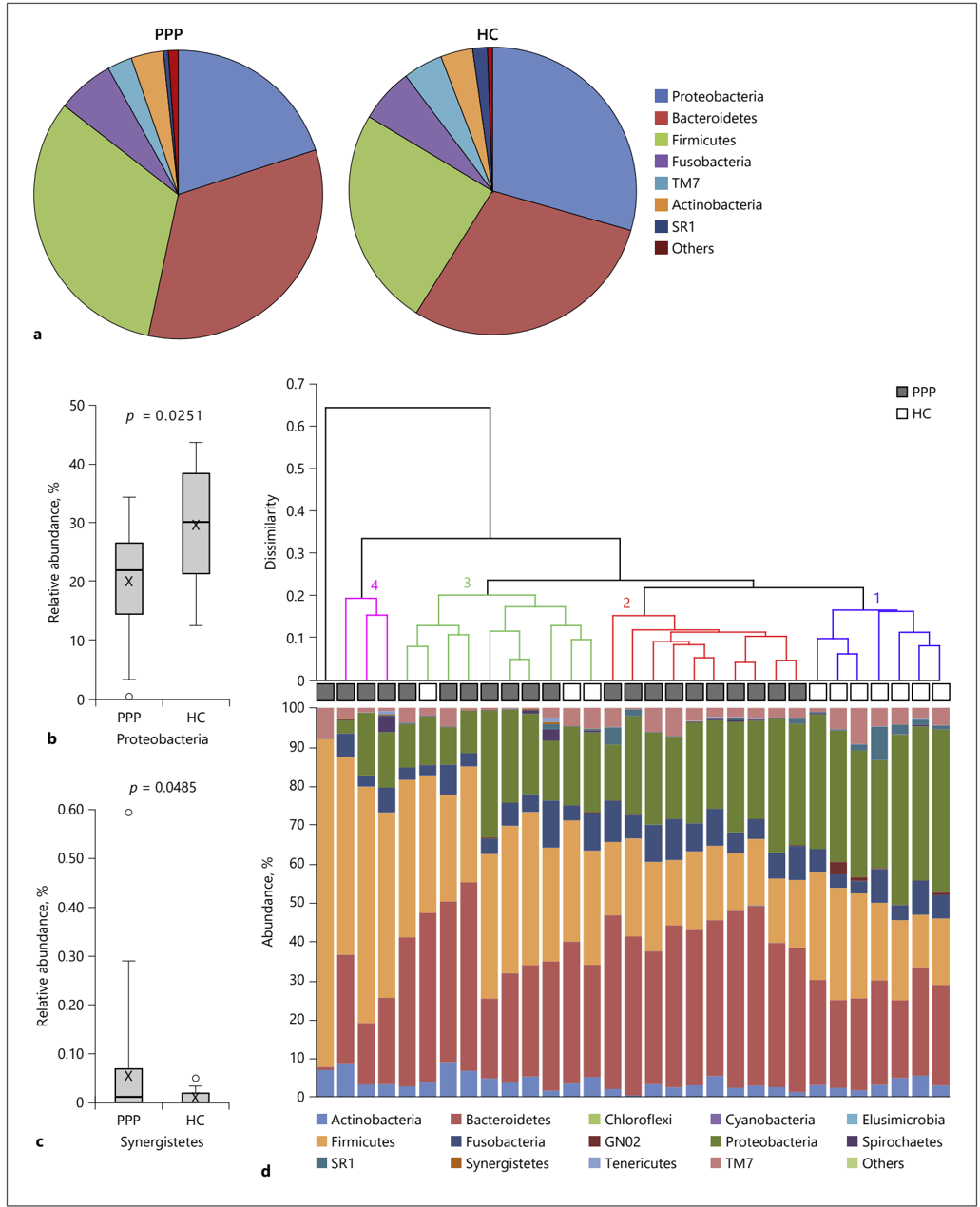
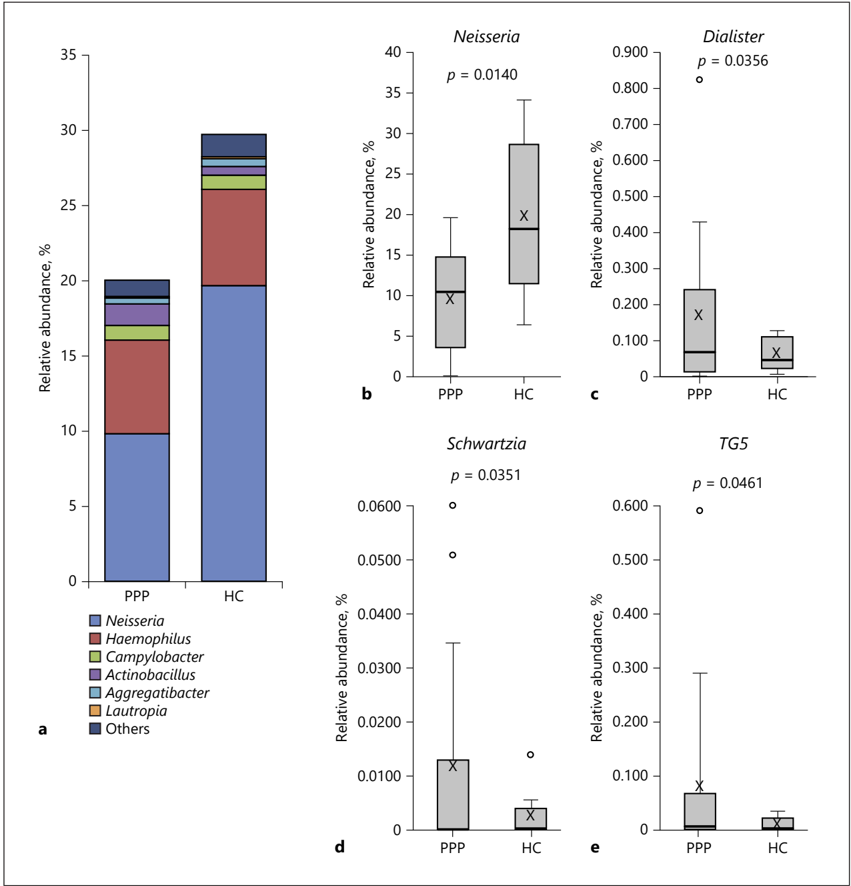
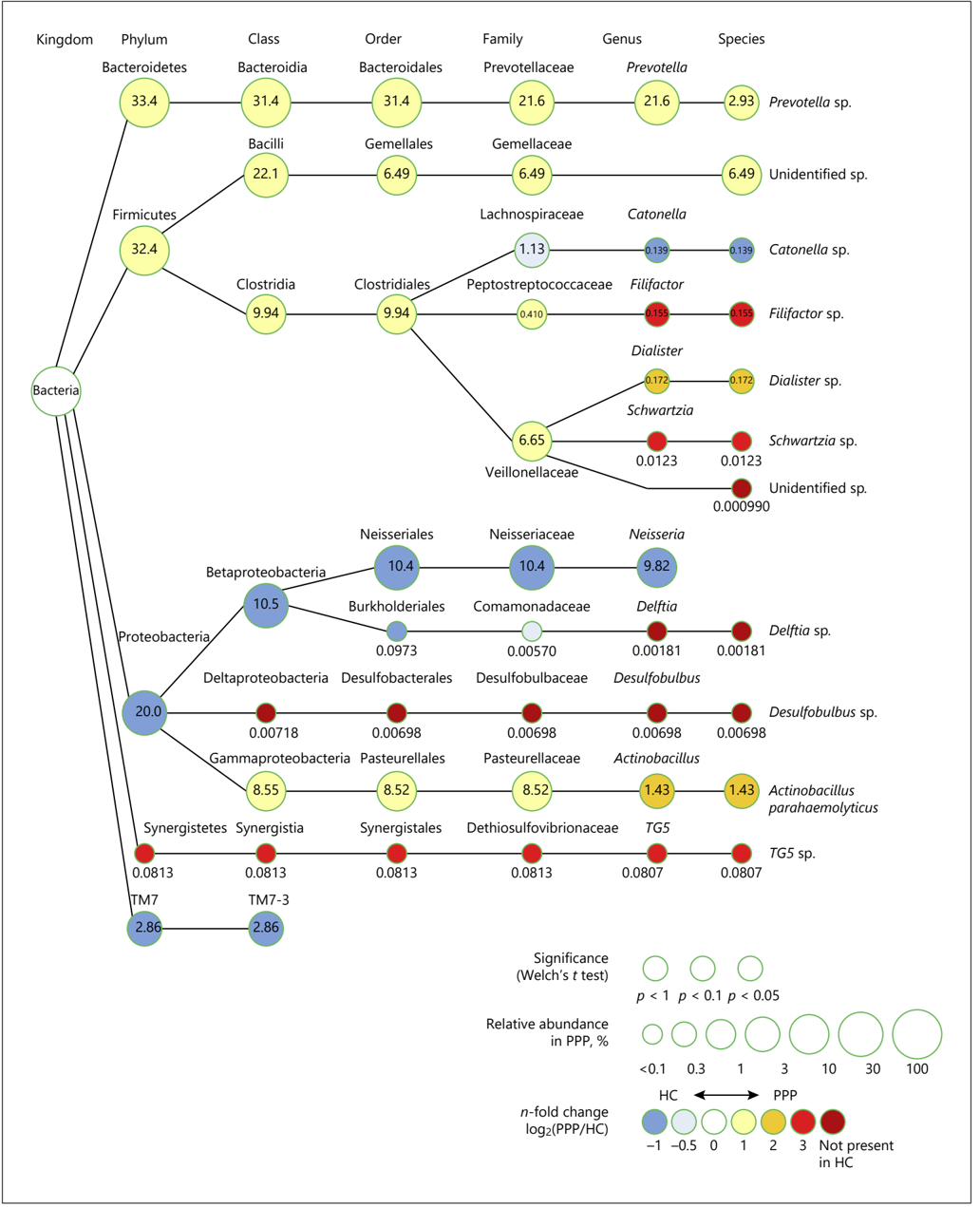
Background: Dysbiosis of oral microbiota is implicated not only in oral inflammatory lesions, but also in a variety of extraoral diseases. The etiology of palmoplantar pustulosis (PPP) remains unclear; however, it has been suggested that chronic inflammation caused by periodontopathic bacterial infection may play a role. Objectives/Methods: To determine whether patients with PPP have altered diversity and composition of oral microbiota, we conducted the 16S rDNA analysis using saliva samples collected from 21 outpatients with PPP and 10 healthy individuals. Results: We found that the proportion of bacteria in the phylum Proteobacteria was significantly lower in PPP patients (p = 0.025). At the genus level, patients with PPP had a significantly lower abundance of Neisseria (p = 0.014), which best accounted for the observed decrease in Proteobacteria. We also identified multiple minor genera and species that were represented at a significantly higher level in the PPP group, several of which have been associated with periodontal diseases. Conclusion: Our results suggest a possible link between PPP and dysbiosis of oral microbiota, particularly the lower abundance of Neisseria, the most predominant genus of Proteobacteria in healthy oral microbiota. Probiotics that improves oral dysbiosis may be beneficial for patients with PPP as an adjunctive therapy.
Overview
The claims and statistics of this paper haven’t been checked yet.
Run the check — free, no account needed. It reads the open-access text and checks the sources it cites.
Integrity signals
Registry
Cites
Statistics
Figures
Verification
Claims the paper makes
The claims and statistics of this paper haven’t been checked yet.
Run the check — free, no account needed. It reads the open-access text and checks the sources it cites.
Claims other papers make about this one
Each is checked against this paper’s own text: does it say what the citing paper says it does?
The source backs part of the claim, not all of it — or backs it for a different population, condition or comparison.
In the citing paper
“prior work has revealed that certain diseases are associated with changes in the α diversity of the microbiome, while others are not [35–38].”
From Saliva microbiome alterations in dental fluorosis population (2023) · cites this paper as [36]
Experimental — accuracy not yet measured
Self-check
Percentages, sums and reported differences re-computed from the paper’s own numbers.
The self-check needs the paper’s full text.
Citations
Cites
Nitrate-responsive oral microbiome modulates nitric oxide homeostasis and blood pressure in humans
Vanhatalo, A., Blackwell, J. R., L’Heureux, J. E., Williams, D. W., Smith, A., van der Giezen, M., Winyard, P. G., Kelly, J., & Jones, A. M. (2018) · Free Radical Biology and Medicine · doi:10.1016/j.freeradbiomed.2018.05.078 · Cited by 256
Koopman, J. E., Buijs, M. J., Brandt, B. W., Keijser, B. J. F., Crielaard, W., & Zaura, E. (2016) · Microbial Ecology · doi:10.1007/s00248-016-0775-z · Cited by 66
Research works printed but not linked: 44
- 10.1038/nrdp.2017.38 · DOI · Paper page
- 10.1177/0022034517742139 · DOI · Paper page
- 10.1177/0022034518805739 · DOI · Paper page
- 10.1038/sj.bdj.2018.217 · DOI
- 10.1111/odi.12589 · DOI
- 10.1111/odi.12472 · DOI
- 10.1016/j.atherosclerosis.2015.10.097 · DOI
- 10.1073/pnas.1011383107 · DOI · Paper page
- 10.1016/j.atherosclerosis.2012.05.021 · DOI
- 10.1111/eos.12423 · DOI
- 10.1111/jre.12432 · DOI
- 10.1371/journal.pone.0204724 · DOI
- 10.1002/art.34539 · DOI
- 10.1038/nm.3914 · DOI · Paper page
- 10.1186/s40168-017-0252-z · DOI
- 10.1016/j.jaut.2018.10.009 · DOI
- 10.1038/srep23561 · DOI
- 10.1093/rheumatology/key215 · DOI
- 10.1111/j.1346-8138.1995.tb03948.x · DOI
- 10.1046/j.1365-2133.1998.02113.x · DOI
- 10.3233/BME-2009-0563 · DOI
- 10.1067/mjd.2000.104305 · DOI
- 10.2340/00015555-1552 · DOI
- 10.1111/1346-8138.13751 · DOI
- 10.3389/fmicb.2015.00119 · DOI
- 10.1902/jop.2012.110566 · DOI
- 10.1186/1472-6831-14-157 · DOI
- 10.1111/jcpe.12470 · DOI
- 10.1038/nmicrobiol.2016.70 · DOI
- 10.1128/AEM.00462-17 · DOI
- 10.1038/ismej.2008.91 · DOI
- 10.3389/fmicb.2017.02244 · DOI
- 10.1002/1097-0215(20001101)88:3<342::AID-IJC4>3.0.CO;2-I · DOI
- 10.1080/20002297.2018.1492316 · DOI
- 10.3402/jom.v2i0.5104 · DOI
- 10.1111/j.1600-0765.2012.01516.x · DOI
- 10.1016/j.micpath.2015.11.029 · DOI
- 10.1111/j.1462-2920.2009.01949.x · DOI
- 10.1111/j.1462-2920.2009.02135.x · DOI
- 10.1177/0022034515594779 · DOI
- 10.1111/j.1600-051X.2009.01392.x · DOI
- 10.1111/j.1600-051X.2012.01914.x · DOI
- 10.3920/BM2017.0139 · DOI
- 10.1080/20002297.2019.1586422 · DOI · Paper page
Cited by
Sorted by citations
Saliva microbiome alterations in dental fluorosis population
Liu, S., Song, Q., Zhang, C., Li, M., Li, Z., Liu, Y., Xu, L., Xie, X., Zhao, L., Zhang, R., et al. (2023) · Journal of Oral Microbiology · doi:10.1080/20002297.2023.2180927 · Cited by 24
Metadata
- Authors
- Kageyama, Y., Shimokawa, Y., Kawauchi, K., Morimoto, M., Aida, K., Akiyama, T., & Nakamura, T.
- Venue
- Dermatology
- Publisher
- S. Karger AG
- Published
- 2020-12-04
- Volume
- 237
- Issue
- 3
- Pages
- 347-356
- ISSN
- 1018-8665
- 1421-9832
- Cited by
- 9
- References
- 2
- Language
- en
About these checks
Registry, retraction, Cites and statistics results are computed, not judged, with one exception: a printed reference that no index lists is read once by a model before it counts as a citation error. Claims are extracted by a model and kept only when their quote appears verbatim in the text; each cited source is then checked, with a model’s help, for whether it says what the claim relies on. Those verdicts can be wrong — read the claim’s quote and the cited source before relying on one.
Statistics and arithmetic are recomputed, not judged.
Confidence bands are shown only for fields calibrated on our annotated test set. None is calibrated yet, so no band is shown.
What counts as a claim ›How we measure confidence ›How we check this ›
Are you an author, or do you see a problem with this page? Request a review
