

The DOI matches its Crossref record; 20 of the 20 references it cites were found in a registry or an index.
Mortality From Ischemic Heart Disease: Analysis of Data From the World Health Organization and Coronary Artery Disease Risk Factors From NCD Risk Factor Collaboration
Open accessAbstract
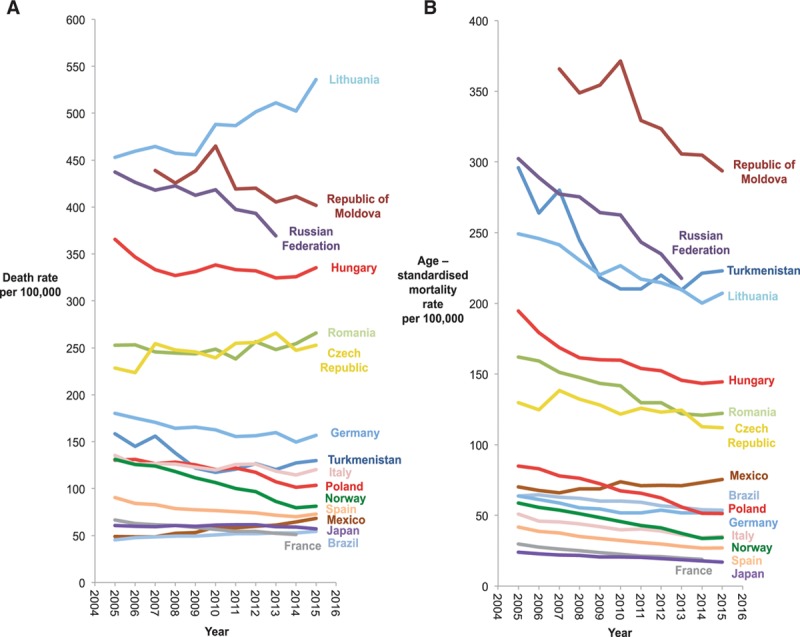
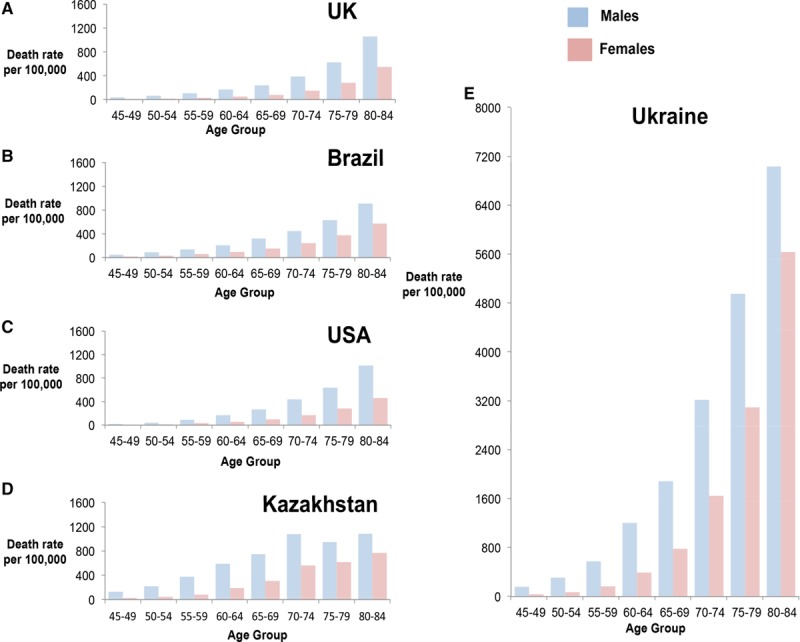
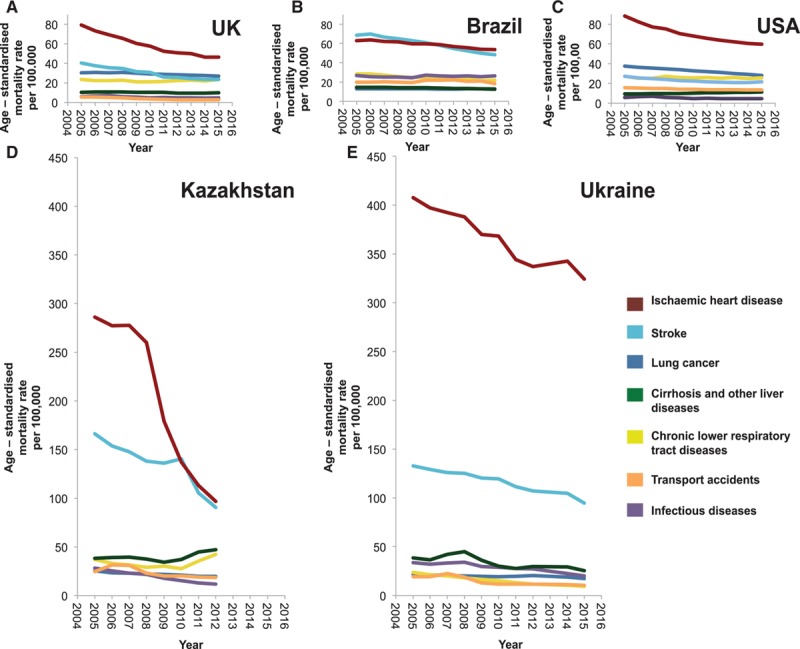
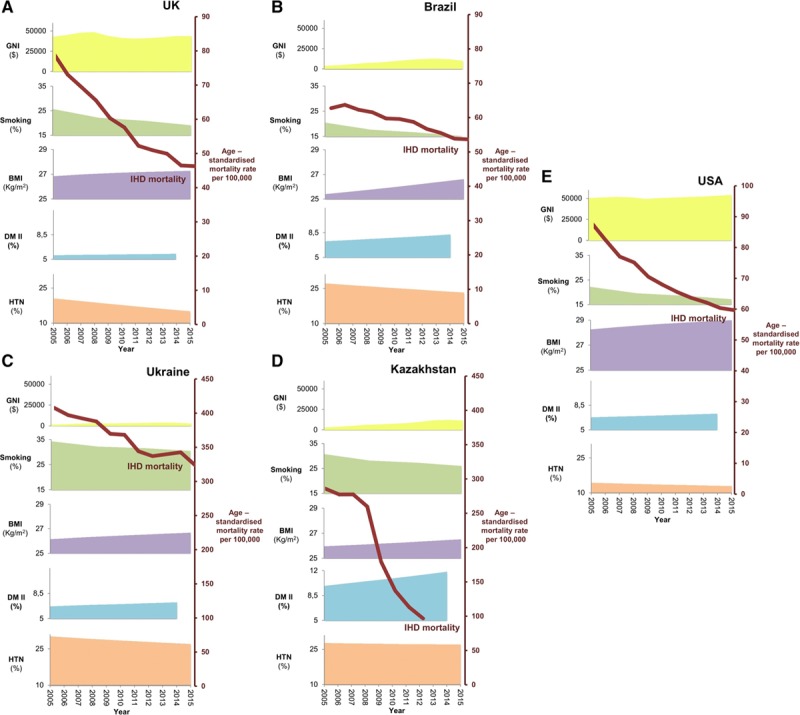
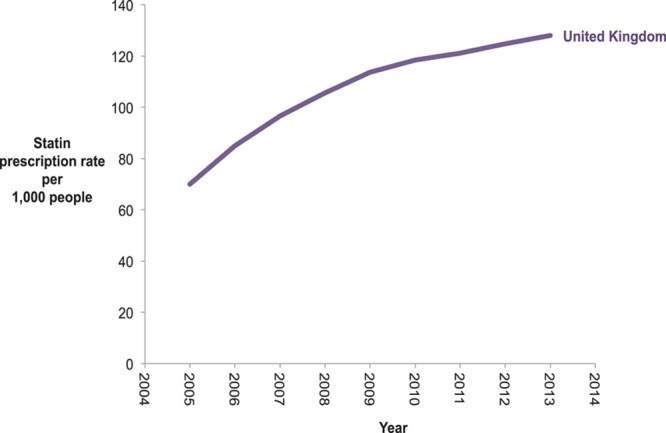
Background: Ischemic heart disease (IHD) has been considered the top cause of mortality globally. However, countries differ in their rates and there have been changes over time. Methods and Results: We analyzed mortality data submitted to the World Health Organization from 2005 to 2015 by individual countries. We explored patterns in relationships with age, sex, and income and calculated age-standardized mortality rates for each country in addition to crude death rates. In 5 illustrative countries which provided detailed data, we analyzed trends of mortality from IHD and 3 noncommunicable diseases (lung cancer, stroke, and chronic lower respiratory tract diseases) and examined the simultaneous trends in important cardiovascular risk factors. Russia, United States, and Ukraine had the largest absolute numbers of deaths among the countries that provided data. Among 5 illustrative countries (United Kingdom, United States, Brazil, Kazakhstan, and Ukraine), IHD was the top cause of death, but mortality from IHD has progressively decreased from 2005 to 2015. Age-standardized IHD mortality rates per 100 000 people per year were much higher in Ukraine (324) and Kazakhstan (97) than in United States (60), Brazil (54), and the United Kingdom (46), with much less difference in other causes of death. All 5 countries showed a progressive decline in IHD mortality, with a decline in smoking and hypertension and in all cases a rise in obesity and type II diabetes mellitus. Conclusions: IHD remains the single largest cause of death in countries of all income groups. Rates are different between countries and are falling in most countries, indicating great potential for further gains. On the horizon, future improvements may become curtailed by increasing hypertension in some developing countries and more importantly global growth in obesity.
Overview
The claims and statistics of this paper haven’t been checked yet.
Run the check — free, no account needed. It reads the open-access text and checks the sources it cites.
Integrity signals
Registry
Cites
Statistics
Figures
Verification
Claims the paper makes
The claims and statistics of this paper haven’t been checked yet.
Run the check — free, no account needed. It reads the open-access text and checks the sources it cites.
Claims other papers make about this one
Each is checked against this paper’s own text: does it say what the citing paper says it does?
The source backs part of the claim, not all of it — or backs it for a different population, condition or comparison.
In the citing paper
“Despite advancements in clinical management, MI and ischemic cardiomyopathy are among the leading causes of heart failure, associated morbidity, and death worldwide 3,4 and continue to impose staggering financial burden on healthcare systems 3,5-8 .”
From Targeting the Immune-Fibrosis Axis in Myocardial Infarction and Heart Failure (2022) · cites this paper as [5]
Experimental — accuracy not yet measured
Self-check
Percentages, sums and reported differences re-computed from the paper’s own numbers.
The self-check needs the paper’s full text.
Citations
Cites
Foreman, K. J., Marquez, N., Dolgert, A. J., Fukutaki, K. G., Fullman, N., McGaughey, M., Pletcher, M. A., Smith, A. E., Tang, K., Yuan, C.-W., et al. (2018) · The Lancet · doi:10.1016/s0140-6736(18)31694-5 · Cited by 3,154
Use of mass media campaigns to change health behaviour
Wakefield, M. A., Loken, B., & Hornik, R. C. (2010) · The Lancet · doi:10.1016/s0140-6736(10)60809-4 · Cited by 2,485
AGE STANDARDIZATION OF RATES: A NEW WHO STANDARD
Ahmad, O. B., Boschi-Pinto, C., López, A. D., Murray, C. J. L., Lozano, R., & Inoue, M. (2000) · Cited by 1,793
Global Health Observatory Data Repository
Vardell, E. (2020) · Medical Reference Services Quarterly · doi:10.1080/02763869.2019.1693231 · Cited by 1,575
Finegold, J. A., Asaria, P., & Francis, D. P. (2012) · International Journal of Cardiology · doi:10.1016/j.ijcard.2012.10.046 · Cited by 880
Self-citationThe Coronary Artery Disease (C4D) Genetics Consortium (2011) · Nature Genetics · doi:10.1038/ng.782 · Cited by 674
Cardiovascular Health in Brazil
Ribeiro, A. L. P., Duncan, B. B., Brant, L. C. C., Lotufo, P. A., Mill, J. G., & Barreto, S. M. (2016) · Circulation · doi:10.1161/circulationaha.114.008727 · Cited by 374
Steel, N., Ford, J. A., Newton, J. N., Davis, A. C., Vos, T., Naghavi, M., Glenn, S., Hughes, A. J., Dalton, A. M., Stockton, D., et al. (2018) · The Lancet · doi:10.1016/s0140-6736(18)32207-4 · Cited by 275
Nowbar, A. N., Howard, J. P., Finegold, J. A., Asaria, P., & Francis, D. P. (2014) · International Journal of Cardiology · doi:10.1016/j.ijcard.2014.04.096 · Cited by 157
Self-citationCentral Asia — twenty-five years after the breakup of the USSR
Batsaikhan, U., & Dąbrowski, M. (2017) · Russian Journal of Economics · doi:10.1016/j.ruje.2017.09.005 · Cited by 148
Cited by
Sorted by citations
Murray, C. J. L., Aravkin, A. Y., Zheng, P., Abbafati, C., Abbas, K. M., Abbasi-Kangevari, M., Abd-Allah, F., Abdelalim, A., Abdollahi, M., Abdollahpour, I., et al. (2020) · The Lancet · doi:10.1016/s0140-6736(20)30752-2 · Cited by 9,854
Global Epidemiology of Ischemic Heart Disease: Results from the Global Burden of Disease Study
Khan, M. A., Hashim, M. J., Mustafa, H., Baniyas, M. M. Y. H., Suwaidi, S. K. B. M. A., AlKatheeri, R., Alblooshi, F. M. K., Almatrooshi, M. E. A. H., Alzaabi, M., Darmaki, R. S. A., et al. (2020) · Cureus · doi:10.7759/cureus.9349 · Cited by 1,140
“As this rise is partly due to population increase and aging (the incidence and prevalence of IHD increase with age), age-standardized rates are more indicative of the underlying trends [16].”
BackgroundRalapanawa, U., & Sivakanesan, R. (2021) · Journal of Epidemiology and Global Health · doi:10.2991/jegh.k.201217.001 · Cited by 683
Alimoradi, Z., Broström, A., Tsang, H. W. H., Griffiths, M. D., Haghayegh, S., Ohayon, M. M., Lin, C., & Pakpour, A. H. (2021) · EClinicalMedicine · doi:10.1016/j.eclinm.2021.100916 · Cited by 415
Ultrasound-Responsive Cavitation Nuclei for Therapy and Drug Delivery
Kooiman, K., Roovers, S., Langeveld, S. A. G., Kleven, R. T., Dewitte, H., O’Reilly, M. A., Escoffre, J., Bouakaz, A., Verweij, M. D., Hynynen, K., et al. (2020) · Ultrasound in Medicine & Biology · doi:10.1016/j.ultrasmedbio.2020.01.002 · Cited by 380
“2015), the current leading causes of death worldwide according to the World Health Organization (Nowbar et al. 2019).”
BackgroundInfluential
Metadata
- Authors
- Nowbar, A. N., Gitto, M., Howard, J. P., Francis, D. P., & Al-Lamee, R.
- Affiliations
- Hammersmith Hospital (GB)
- International Centre for Circulatory Health, National Heart and Lung Institute, Imperial College London, Hammersmith Hospital, London, United Kingdom (A.N.N., M.G., J.P.H., D.P.F., R.A.-L.).
- Corresponding author
- Nowbar, Alexandra N.
- Venue
- Circulation: Cardiovascular Quality and Outcomes
- Published
- 2019-06
- Volume
- 12
- Issue
- 6
- Pages
- e005375-e005375
- ISSN
- 1941-7705 (ISSN-L)
- 1941-7713
- PMC
- PMC6613716
- OpenAlex
- W2950663303
- Cited by
- 860
- References
- 20
- Citations by year
- 2026: 58 · 2025: 121 · 2024: 149 · 2023: 155 · 2022: 147 · 2021: 133 · 2020: 83 · 2019: 12
- FWCI
- 71.55
- Type
- journal article
- Language
- en
- Open access
- hybrid
- doi.org
- Licence
- cc-by
- Locations
- Circulation Cardiovascular Quality and Outcomes (publishedVersion, cc-by)
- Europe PMC (PubMed Central) (publishedVersion, cc-by)
- PubMed Central (publishedVersion, cc-by)
- PubMed (publishedVersion)
- Spiral (Imperial College London) (submittedVersion, cc-by)
- Funders
- Wellcome Trust (212183/Z/18/Z)
- National Institute for Health and Care Research
- Topics
- Health Sciences › Medicine › Epidemiology › Healthcare Systems and Public Health
- Health Sciences › Medicine › Cardiology and Cardiovascular Medicine › Cardiovascular Health and Risk Factors
- Health Sciences › Medicine › Public Health, Environmental and Occupational Health › Global Health and Epidemiology
- Keywords
- ischemic heart disease, mortality trends, age-standardized mortality rates, non-communicable diseases, lung cancer, stroke, cardiovascular risk factors, smoking, hypertension, obesity, type 2 diabetes, income inequality, sex differences, global burden of disease
- MeSH terms
- Adult, Aged, Aged, 80 and over, Cause of Death, Diabetes Mellitus, Female, Humans, Hypertension, Male, Middle Aged, Obesity, Risk Factors, Smoking, Time Factors, Global Health, World Health Organization, Comorbidity, Prevalence, Myocardial Ischemia, Age Distribution, Sex Distribution, Risk Assessment, Health Status Disparities
About these checks
Registry, retraction, Cites and statistics results are computed, not judged, with one exception: a printed reference that no index lists is read once by a model before it counts as a citation error. Claims are extracted by a model and kept only when their quote appears verbatim in the text; each cited source is then checked, with a model’s help, for whether it says what the claim relies on. Those verdicts can be wrong — read the claim’s quote and the cited source before relying on one.
Statistics and arithmetic are recomputed, not judged.
Confidence bands are shown only for fields calibrated on our annotated test set. None is calibrated yet, so no band is shown.
What counts as a claim ›How we measure confidence ›How we check this ›
Are you an author, or do you see a problem with this page? Request a review
