

The DOI matches its Crossref record; 32 of the 33 references it cites were found in a registry or an index.
Effects of Bariatric Surgery in Obese Patients With Hypertension: The GATEWAY Randomized Trial (Gastric Bypass to Treat Obese Patients With Steady Hypertension)
Open accessAbstract
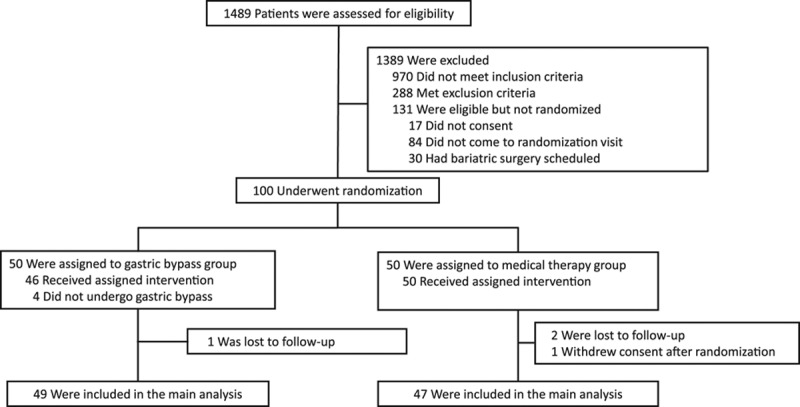
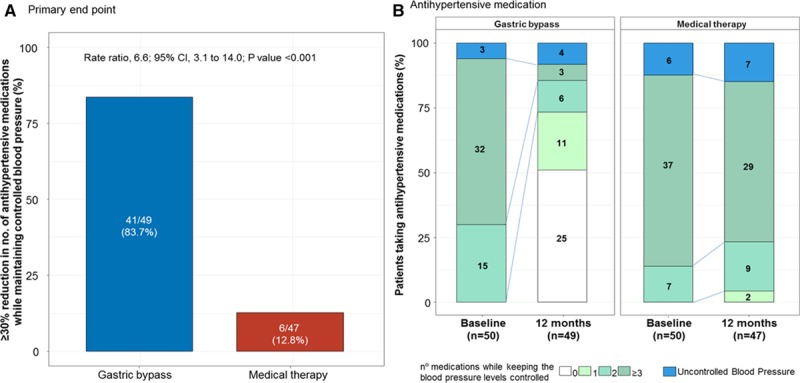
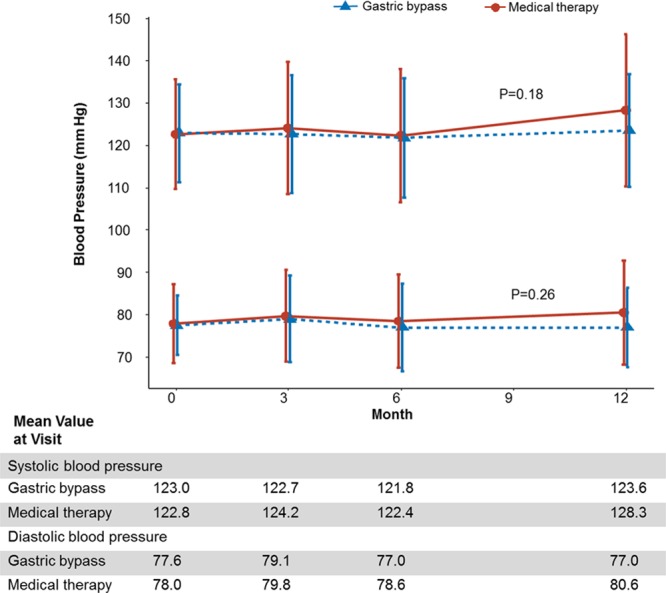
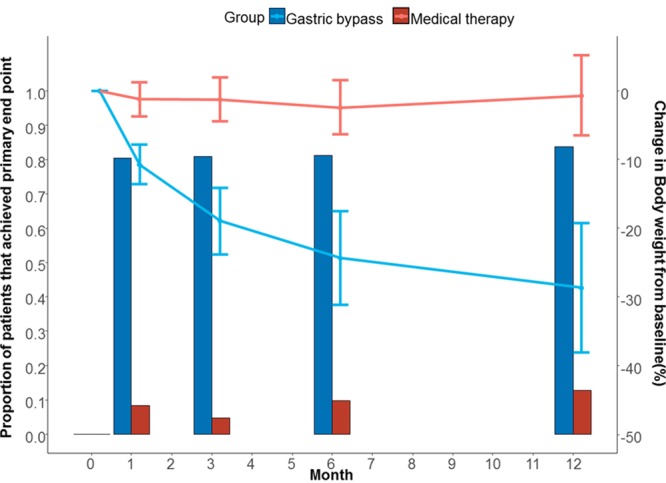
Background: Recent research efforts on bariatric surgery have focused on metabolic and diabetes mellitus resolution. Randomized trials designed to assess the impact of bariatric surgery in patients with obesity and hypertension are needed. Methods: In this randomized, single-center, nonblinded trial, we included patients with hypertension (using ≥2 medications at maximum doses or >2 at moderate doses) and a body mass index between 30.0 and 39.9 kg/m 2 . Patients were randomized to Roux-en-Y gastric bypass plus medical therapy or medical therapy alone. The primary end point was reduction of ≥30% of the total number of antihypertensive medications while maintaining systolic and diastolic blood pressure <140 mm Hg and 90 mm Hg, respectively, at 12 months. Results: We included 100 patients (76% female, mean age 43.8±9.2 years, mean body mass index 36.9±2.7 kg/m2), and 96% completed follow-up. Reduction of ≥30% of the total number of antihypertensive medications while maintaining controlled blood pressure occurred in 41 of 49 patients from the gastric bypass group (83.7%) compared with 6 of 47 patients (12.8%) from the control group with a rate ratio of 6.6 (95% confidence interval, 3.1–14.0; P <0.001). Remission of hypertension was present in 25 of 49 (51%) and 22 of 48 (45.8%) patients randomized to gastric bypass, considering office and 24-hour ambulatory blood pressure monitoring, respectively, whereas no patient submitted to medical therapy was free of antihypertensive drugs at 12 months. A post hoc analysis for the primary end point considering the SPRINT (Systolic Blood Pressure Intervention Trial) target reached consistent results, with a rate ratio of 3.8 (95% confidence interval, 1.4–10.6; P =0.005). Eleven patients (22.4%) from the gastric bypass group and none in the control group were able to achieve SPRINT levels without antihypertensives. Waist circumference, body mass index, fasting plasma glucose, glycohemoglobin, low-density lipoprotein cholesterol, triglycerides, high-sensitivity C-reactive protein, and 10-year Framingham risk score were lower in the gastric bypass than in the control group. Conclusions: Bariatric surgery represents an effective strategy for blood pressure control in a broad population of patients with obesity and hypertension. Clinical Trial Registration: URL: https://clinicaltrials.gov . Unique identifier: NCT01784848.
Overview
The claims and statistics of this paper haven’t been checked yet.
Run the check — free, no account needed. It reads the open-access text and checks the sources it cites.
Integrity signals
Registry
Cites
Statistics
Figures
Verification
Claims the paper makes
The claims and statistics of this paper haven’t been checked yet.
Run the check — free, no account needed. It reads the open-access text and checks the sources it cites.
Claims other papers make about this one
Each is checked against this paper’s own text: does it say what the citing paper says it does?
In the citing paper
“VAT reduction following bariatric surgery (for example, vertical sleeve gastrectomy or Roux-en-Y gastric bypass) rapidly decreases BP16,17.”
From Obesity, kidney dysfunction and hypertension: mechanistic links (2019) · cites this paper as [16]
In the citing paper
“individuals who gain excess adiposity maintain sodium balance at higher BPs than when they were lean, indicating impaired renal-pressure natriuresis16,51.”
From Obesity, kidney dysfunction and hypertension: mechanistic links (2019) · cites this paper as [16]
Self-check
Percentages, sums and reported differences re-computed from the paper’s own numbers.
The self-check needs the paper’s full text.
Citations
Cites
Chobanian, A. V. (2003) · JAMA · doi:10.1001/jama.289.19.2560 · Cited by 25,386
James, P. A., Oparil, S., Carter, B. L., Cushman, W. C., Dennison-Himmelfarb, C., Handler, J., Lackland, D. T., LeFevre, M. L., MacKenzie, T. D., Ogedegbe, O., et al. (2014) · JAMA · doi:10.1001/jama.2013.284427 · Cited by 7,950
Health effects of overweight and obesity in 195 countries over 25 years
Collaborators, T. G. 2. O. (2017) · New England Journal of Medicine · doi:10.1056/nejmoa1614362 · Cited by 7,918
A Randomized Trial of Intensive versus Standard Blood-Pressure Control
The SPRINT Research Group (2015) · New England Journal of Medicine · doi:10.1056/nejmoa1511939 · Cited by 6,325
Bariatric Surgery versus Intensive Medical Therapy for Diabetes — 5-Year Outcomes
Schauer, P. R., Bhatt, D. L., Kirwan, J. P., Wolski, K., Aminian, A., Brethauer, S. A., Navaneethan, S. D., Singh, R. P., Pothier, C. E., Nissen, S. E., et al. (2017) · New England Journal of Medicine · doi:10.1056/nejmoa1600869 · Cited by 2,934
Global Burden of Hypertension and Systolic Blood Pressure of at Least 110 to 115 mm Hg, 1990-2015
Forouzanfar, M. H., Liu, P., Roth, G. A., Ng, M., Biryukov, S., Marczak, L., Alexander, L., Estep, K., Hassen Abate, K., Akinyemiju, T. F., et al. (2017) · JAMA · doi:10.1001/jama.2016.19043 · Cited by 2,381
Bariatric Surgery versus Intensive Medical Therapy in Obese Patients with Diabetes
Schauer, P. R., Kashyap, S. R., Wolski, K., Brethauer, S. A., Kirwan, J. P., Pothier, C. E., Thomas, S., Abood, B., Nissen, S. E., & Bhatt, D. L. (2012) · New England Journal of Medicine · doi:10.1056/nejmoa1200225 · Cited by 2,164
Bariatric Surgery versus Conventional Medical Therapy for Type 2 Diabetes
Mingrone, G., Panunzi, S., De Gaetano, A., Guidone, C., Iaconelli, A., Leccesi, L., Nanni, G., Pomp, A., Castagneto, M., Ghirlanda, G., et al. (2012) · New England Journal of Medicine · doi:10.1056/nejmoa1200111 · Cited by 1,791
Law, M. R., Wald, N. J., Morris, J. K., & Jordan, R. E. (2003) · BMJ · doi:10.1136/bmj.326.7404.1427 · Cited by 1,232
Weight and Metabolic Outcomes 12 Years after Gastric Bypass
Adams, T. D., Davidson, L. E., Litwin, S. E., Kim, J., Kolotkin, R. L., Nanjee, M. N., Gutierrez, J. M., Frogley, S. J., Ibele, A. R., Brinton, E. A., et al. (2017) · New England Journal of Medicine · doi:10.1056/nejmoa1700459 · Cited by 956
Research works printed but not linked: 2
- Sociedade Brasileira de Cardiologia, Sociedade Brasileira de Hipertensão, Sociedade Brasileira de Nefrologia. Arg Bras Cardiol.2010;95:1–51.
- ABESO. Diretrizes Brasileiras de Obesidade. In: ABESO, ed 3rd. Itapevi - SP- Brazil, 2009. http://www.abeso.org.br/pdf/diretrizes_brasileiras_obesidade_2009_2010_1.pdf. Accessed October 24, 2017.
Cited by
Sorted by citations
The Japanese Society of Hypertension Guidelines for the Management of Hypertension (JSH 2019)
Umemura, S., Arima, H., Arima, S., Asayama, K., Dohi, Y., Hirooka, Y., Horio, T., Hoshide, S., Ikeda, S., Ishimitsu, T., et al. (2019) · Hypertension Research · doi:10.1038/s41440-019-0284-9 · Cited by 1,880
Obesity, kidney dysfunction and hypertension: mechanistic links
Hall, J. E., do Carmo, J. M., da Silva, A. A., Wang, Z., & Hall, M. E. (2019) · Nature Reviews Nephrology · doi:10.1038/s41581-019-0145-4 · Cited by 654
Mingrone, G., Panunzi, S., De Gaetano, A., Guidone, C., Iaconelli, A., Capristo, E., Chamseddine, G., Bornstein, S. R., & Rubino, F. (2021) · The Lancet · doi:10.1016/s0140-6736(20)32649-0 · Cited by 577
Five-Year Outcomes of Gastric Bypass in Adolescents as Compared with Adults
Inge, T. H., Courcoulas, A. P., Jenkins, T. M., Michalsky, M. P., Brandt, M. L., Xanthakos, S. A., Dixon, J. B., Harmon, C. M., Chen, M. K., Xie, C., et al. (2019) · New England Journal of Medicine · doi:10.1056/nejmoa1813909 · Cited by 381
Obesity cardiomyopathy: evidence, mechanisms, and therapeutic implications
Ren, J. T., Wu, N. N., Wang, S., Sowers, J. R., & Zhang, Y. (2021) · Physiological Reviews · doi:10.1152/physrev.00030.2020 · Cited by 388
Metadata
- Authors
- Schiavon, C. A., Bersch-Ferreira, A. C., Santucci, E. V., Oliveira, J. D., Torreglosa, C. R., Bueno, P. T., Frayha, J. C., Santos, R. N., Damiani, L. P., Noujaim, P. M., Halpern, H., Monteiro, F. L. J., Cohen, R. V., Uchoa, C. H., de Souza, M. G., Amodeo, C., Bortolotto, L., Ikeoka, D., Drager, L. F., Cavalcanti, A. B., & Berwanger, O.
- Affiliations
- Research Institute (C.A.S., A.C.B.-F., E.V.S., J.D.O., C.R.T., P.T.B., J.C.F., R.N.F., L.P.D., A.B.C., O.B.)
- Surgical Center (P.M.N., H.H., F.L.J.M.)
- Hospital Alemão Oswaldo Cruz (BR)
- Heart Institute, Hypertension Unit, São Paulo, Brazil (C.H.U., L.B., L.F.D.).
- Department of Hypertension, Dante Pazzanese Institute of Cardiology, São Paulo, Brazil (M.G.d.S., C.A.).
- Instituto Dante Pazzanese de Cardiologia (BR)
- Instituto do Coração - HCFMUSP (BR)
- Intensive Unit (D.I.), Heart Hospital, São Paulo, Brazil.
- ORCID
- Venue
- Circulation
- Published
- 2018-03-13
- Volume
- 137
- Issue
- 11
- Pages
- 1132-1142
- ISSN
- 0009-7322 (ISSN-L)
- 1524-4539
- PMC
- PMC5865494
- OpenAlex
- W2770989673
- Cited by
- 308
- References
- 33
- Citations by year
- 2026: 27 · 2025: 37 · 2024: 23 · 2023: 42 · 2022: 25 · 2021: 47 · 2020: 54 · 2019: 29 · 2018: 19
- FWCI
- 29.99
- Type
- journal article
- Language
- en
- Update notices
- correction (2019-09-30)
- Open access
- hybrid
- doi.org
- Licence
- cc-by
- Locations
- Circulation (publishedVersion, cc-by)
- Europe PMC (PubMed Central) (publishedVersion, cc-by)
- PubMed Central (publishedVersion, cc-by)
- PubMed (publishedVersion)
- Topics
- Health Sciences › Medicine › Surgery › Bariatric Surgery and Outcomes
- Health Sciences › Medicine › Cardiology and Cardiovascular Medicine › Blood Pressure and Hypertension Studies
- Health Sciences › Medicine › Surgery › Minimally Invasive Surgical Techniques
- Keywords
- bariatric surgery, Roux-en-Y gastric bypass, obesity, hypertension, antihypertensive medication reduction, hypertension remission, blood pressure control, metabolic surgery, cardiovascular risk factors, body mass index, waist circumference, dyslipidemia, C-reactive protein, Framingham risk score, ambulatory blood pressure monitoring, type 2 diabetes remission
- MeSH terms
- Adult, Antihypertensive Agents, Blood Pressure, Brazil, Female, Humans, Hypertension, Male, Middle Aged, Obesity, Time Factors, Gastric Bypass, Weight Loss, Body Mass Index, Treatment Outcome
About these checks
Registry, retraction, Cites and statistics results are computed, not judged, with one exception: a printed reference that no index lists is read once by a model before it counts as a citation error. Claims are extracted by a model and kept only when their quote appears verbatim in the text; each cited source is then checked, with a model’s help, for whether it says what the claim relies on. Those verdicts can be wrong — read the claim’s quote and the cited source before relying on one.
Statistics and arithmetic are recomputed, not judged.
Confidence bands are shown only for fields calibrated on our annotated test set. None is calibrated yet, so no band is shown.
What counts as a claim ›How we measure confidence ›How we check this ›
Are you an author, or do you see a problem with this page? Request a review
