

The DOI matches its Crossref record; 1 of the 1 references it cites were found in a registry or an index.
Mavacamten in Patients With Hypertrophic Cardiomyopathy Referred for Septal Reduction: Week 128 Results From VALOR-HCM
Abstract
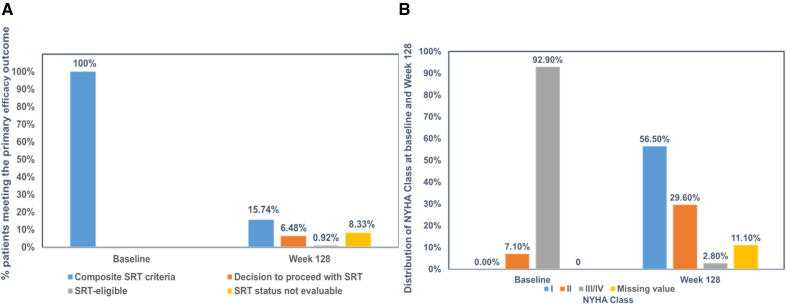
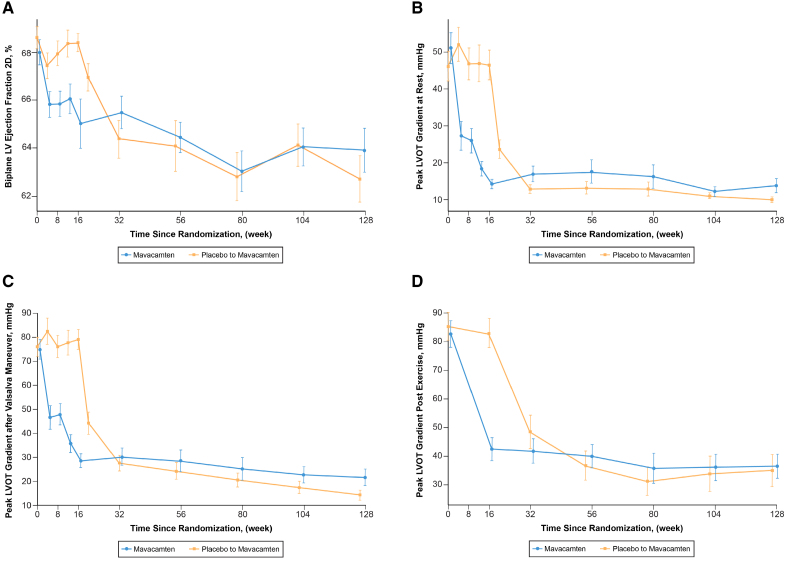
BACKGROUND: In severely symptomatic patients with obstructive hypertrophic cardiomyopathy (HCM), VALOR-HCM trial (Study to Evaluate Mavacamten in Adults With Symptomatic Obstructive HCM Who Are Eligible for Septal Reduction Therapy [URL: https://clinicaltrials.gov ; Unique identifier: NCT04349072]) reported that mavacamten reduced the short-term need for septal reduction therapy (SRT). The current report examined the longer-term effect of mavacamten through end of treatment at week 128. METHODS: A double-blind randomized placebo-controlled multicenter trial at 19 sites in the United States included symptomatic obstructive HCM patients referred for SRT (enrollment July 2020 through October 2021). The group initially randomized to mavacamten continued the drug for 128 weeks and the placebo to mavacamten group from week 16 to 128 (112-week exposure). Dose titrations were performed using echocardiographic left ventricular outflow tract gradient and left ventricular ejection fraction measurements. The principal end point was proportion of patients proceeding with SRT or remaining guideline-eligible at week 128. RESULTS: At week 128, 17 of 108 (15.7%) patients in the total study sample met the composite end point (7 underwent SRT, 1 was SRT-eligible, and 9 SRT-status unevaluable). Additionally, 87 of 108 (80.5%) patients demonstrated ≥1 New York Heart Association class improvement by week 128, and 52 of 108 (48.1%) demonstrated ≥2, with a sustained reduction in resting and Valsalva left ventricular outflow tract gradients of 38.2 mm Hg and 59.4 mm Hg, respectively. Ninety-five of 108 (88%) patients transitioned to commercial mavacamten. Overall, 15 of 108 (13.8%) patients (5.41 per 100 patient-years) had an left ventricular ejection fraction <50% (2 with left ventricular ejection fraction ≤30%; 1 death). Of these, 12 of 15 (80%) continued treatment. New-onset atrial fibrillation occurred in 11 (10.2%) patients (4.55 per 100 patient-years). CONCLUSIONS: In severely symptomatic obstructive HCM patients, sustained freedom from SRT was observed at 128 weeks, with nearly 90% patients remaining on long-term mavacamten. REGISTRATION: URL: https://www.clinicaltrials.gov ; Unique identifier: NCT04349072.
Overview
The claims and statistics of this paper haven’t been checked yet.
Run the check — free, no account needed. It reads the open-access text and checks the sources it cites.
Integrity signals
Registry
Cites
Statistics
Figures
Verification
Claims the paper makes
The claims and statistics of this paper haven’t been checked yet.
Run the check — free, no account needed. It reads the open-access text and checks the sources it cites.
Claims other papers make about this one
Each is checked against this paper’s own text: does it say what the citing paper says it does?
The cited source doesn’t support the claim as written.
In the citing paper
“In EXPLORER-LTE, the number of patients with drop in ejection fraction to <50% was 8.7%, 49 and in VALOR-LTE it was 15.7%, 50 although clinical heart failure was much less common.”
From Current management of hypertrophic cardiomyopathy (2025) · cites this paper as [50]
Checked by a reasoning model — may be wrong.
Experimental — accuracy not yet measuredThe source backs part of the claim, not all of it — or backs it for a different population, condition or comparison.
In the citing paper
“Patients receiving mavacamten experienced improvement in symptoms and reduction in need for SRT from 76.8% of the placebo group to 17.9% of those treated with mavacamten (confidence interval for difference 44 to 74).”
From Current management of hypertrophic cardiomyopathy (2025) · cites this paper as [50]
Experimental — accuracy not yet measuredThe cited source says what the claim attributes to it.
In the citing paper
“This benefit persisted up to 128 weeks and included patients from the placebo arm who crossed over to mavacamten at the end of the randomized study period.50”
From Current management of hypertrophic cardiomyopathy (2025) · cites this paper as [50]
Self-check
Percentages, sums and reported differences re-computed from the paper’s own numbers.
The self-check needs the paper’s full text.
Citations
Cites
Ommen, S. R., Ho, C. Y., Asif, I. M., Balaji, S., Burke, M. A., Day, S. M., Dearani, J. A., Epps, K. C., Evanovich, L., Ferrari, V. A., et al. (2024) · Circulation · doi:10.1161/cir.0000000000001250 · Cited by 807
Self-citation
Research works printed but not linked: 41
- 10.1016/j.jacc.2021.11.021 · DOI
- 10.1093/eurheartj/ehad194 · DOI · Paper page
- 10.1161/01.cir.29.5s4.iv-3 · DOI
- 10.1016/j.jacc.2005.02.090 · DOI
- 10.1016/j.athoracsur.2007.07.063 · DOI
- 10.1161/01.CIR.0000162460.36735.71 · DOI
- 10.1016/j.jacc.2011.08.040 · DOI
- 10.1161/CIRCULATIONAHA.112.000849 · DOI · Paper page
- 10.1161/JAHA.120.016210 · DOI
- 10.1016/j.athoracsur.2020.09.011 · DOI
- 10.1093/eurheartj/eht495 · DOI
- 10.1161/CIRCULATIONAHA.111.076257 · DOI
- 10.1001/jamanetworkopen.2022.7293 · DOI
- 10.1016/j.athoracsur.2024.03.014 · DOI
- 10.1016/j.jacc.2022.10.027 · DOI
- 10.1016/j.amjcard.2014.07.075 · DOI
- 10.1001/jamacardio.2016.0252 · DOI
- 10.1016/j.athoracsur.2022.05.062 · DOI
- 10.1016/j.jacc.2022.04.048 · DOI
- 10.1016/S0140-6736(20)31792-X · DOI · Paper page
- 10.1001/jamacardio.2023.3030 · DOI
- 10.1161/CIRCIMAGING.122.014986 · DOI · Paper page
- 10.1161/CIRCULATIONAHA.122.062534 · DOI
- 10.1001/jamacardio.2023.3342 · DOI
- 10.1016/j.jacc.2021.09.1381 · DOI
- 10.1016/j.jchf.2023.09.028 · DOI
- 10.1016/S0140-6736(21)00763-7 · DOI · Paper page
- 10.1161/CIRCIMAGING.124.017185 · DOI
- 10.1016/j.jacc.2024.06.025 · DOI
- 10.1016/j.jcmg.2024.08.005 · DOI
- 10.1016/j.jcmg.2024.02.014 · DOI
- 10.1016/j.ahj.2021.05.007 · DOI
- 10.1016/j.jacc.2011.06.011 · DOI · Paper page
- 10.1093/eurheartj/ehae579 · DOI · Paper page
- 10.1016/j.pcad.2024.02.001 · DOI
- 10.1016/j.jchf.2024.03.009 · DOI
- 10.1016/j.ijcard.2020.11.055 · DOI
- 10.1016/j.jacc.2015.06.1333 · DOI · Paper page
- 10.1016/j.jtcvs.2016.12.038 · DOI
- 10.1056/NEJMoa2401424 · DOI · Paper page
- 10.1016/j.medj.2024.06.001 · DOI
Cited by
Sorted by citations
Current management of hypertrophic cardiomyopathy
Sikand, N., Stendahl, J., Sen, S., Lampert, R., & Day, S. (2025) · BMJ · doi:10.1136/bmj-2023-077274 · Cited by 26
Metadata
- Authors
- Desai, M. Y., Wolski, K., Owens, A., Geske, J. B., Saberi, S., Wang, A., Sherrid, M., Cremer, P. C., Lakdawala, N. K., Tower-Rader, A., Fermin, D., Naidu, S. S., Smedira, N. G., Schaff, H., Gong, Z., Mudarris, L., Lampl, K., Sehnert, A. J., Nissen, S. E., & for the VALOR-HCM Investigators
- Venue
- Circulation
- Published
- 2025-05-13
- Volume
- 151
- Issue
- 19
- Pages
- 1378-1390
- ISSN
- 0009-7322
- 1524-4539
- PMC
- PMC12063683
- Cited by
- 78
- References
- 1
- Language
- en
- Update notices
- correction (2025-05-12)
- Funders
- Bristol Myers Squibb Foundation
About these checks
Registry, retraction, Cites and statistics results are computed, not judged, with one exception: a printed reference that no index lists is read once by a model before it counts as a citation error. Claims are extracted by a model and kept only when their quote appears verbatim in the text; each cited source is then checked, with a model’s help, for whether it says what the claim relies on. Those verdicts can be wrong — read the claim’s quote and the cited source before relying on one.
Statistics and arithmetic are recomputed, not judged.
Confidence bands are shown only for fields calibrated on our annotated test set. None is calibrated yet, so no band is shown.
What counts as a claim ›How we measure confidence ›How we check this ›
Are you an author, or do you see a problem with this page? Request a review
How to cite
Cite CoChat for the checks on this page, and the paper for its own findings.
- This page
- CoChat. (2026). Citation check: Mavacamten in Patients With Hypertrophic Cardiomyopathy Referred for Septal Reduction: Week 128 Results From VALOR-HCM. https://app.cochat.ai/papers/10.1161/circulationaha.124.072445
- The paper
- Desai, M. Y., Wolski, K., Owens, A., Geske, J. B., Saberi, S., Wang, A., Sherrid, M., Cremer, P. C., Lakdawala, N. K., Tower-Rader, A., Fermin, D., Naidu, S. S., Smedira, N. G., Schaff, H., Gong, Z., Mudarris, L., Lampl, K., Sehnert, A. J., Nissen, S. E., & for the VALOR-HCM Investigators. (2025). Mavacamten in Patients With Hypertrophic Cardiomyopathy Referred for Septal Reduction: Week 128 Results From VALOR-HCM. Circulation. https://doi.org/10.1161/circulationaha.124.072445
