

The DOI matches its Crossref record; 183 of the 189 references it cites were found in a registry or an index.
Effect of Plant Protein on Blood Lipids: A Systematic Review and Meta‐Analysis of Randomized Controlled Trials
Open accessAbstract
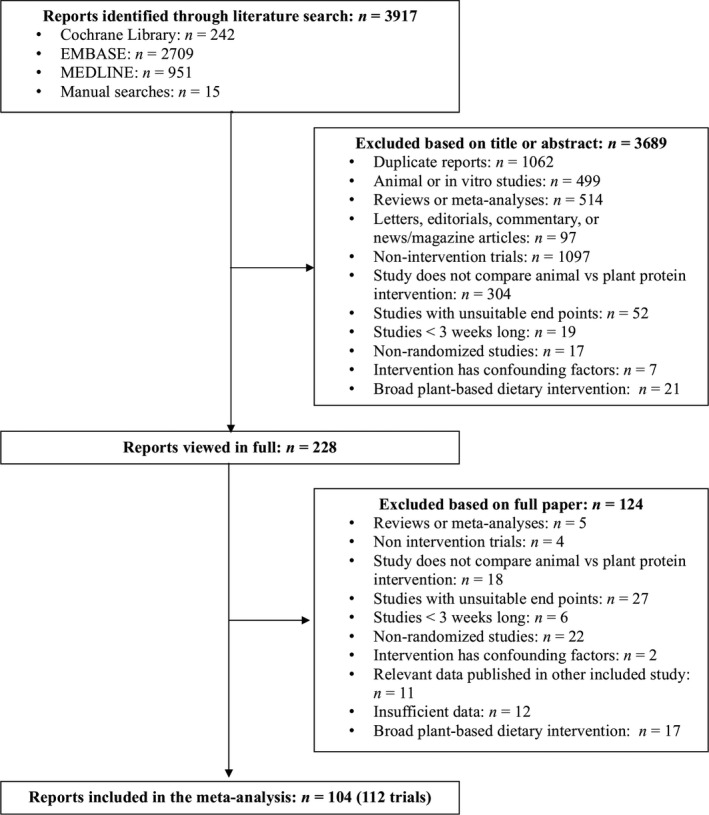
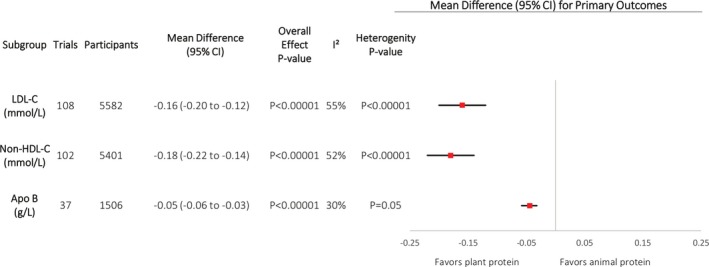
Background: There is a heightened interest in plant‐based diets for cardiovascular disease prevention. Although plant protein is thought to mediate such prevention through modifying blood lipids, the effect of plant protein in specific substitution for animal protein on blood lipids remains unclear. To assess the effect of this substitution on established lipid targets for cardiovascular risk reduction, we conducted a systematic review and meta‐analysis of randomized controlled trials using the Grading of Recommendations Assessment, Development, and Evaluation system. Methods and Results: MEDLINE , EMBASE , and the Cochrane Registry were searched through September 9, 2017. We included randomized controlled trials of ≥3 weeks comparing the effect of plant protein in substitution for animal protein on low‐density lipoprotein cholesterol, non–high‐density lipoprotein cholesterol, and apolipoprotein B. Two independent reviewers extracted relevant data and assessed risk of bias. Data were pooled by the generic inverse variance method and expressed as mean differences with 95% confidence intervals. Heterogeneity was assessed (Cochran Q statistic) and quantified (I 2 statistic). The overall quality (certainty) of the evidence was assessed using the Grading of Recommendations Assessment, Development, and Evaluation system. One‐hundred twelve randomized controlled trials met the eligibility criteria. Plant protein in substitution for animal protein decreased low‐density lipoprotein cholesterol by 0.16 mmol/L (95% confidence interval, −0.20 to −0.12 mmol/L; P <0.00001; I 2 =55%; moderate‐quality evidence), non–high‐density lipoprotein cholesterol by 0.18 mmol/L (95% confidence interval, −0.22 to −0.14 mmol/L; P <0.00001; I 2 =52%; moderate‐quality evidence), and apolipoprotein B by 0.05 g/L (95% confidence interval, −0.06 to −0.03 g/L; P <0.00001; I 2 =30%; moderate‐quality evidence). Conclusions: Substitution of plant protein for animal protein decreases the established lipid targets low‐density lipoprotein cholesterol, non–high‐density lipoprotein cholesterol, and apolipoprotein B. More high‐quality randomized trials are needed to improve our estimates. Clinical Trial Registration: URL : http://www.clinicaltrials.gov . Unique identifier: NCT 02037321.
Overview
The claims and statistics of this paper haven’t been checked yet.
Run the check — free, no account needed. It reads the open-access text and checks the sources it cites.
Integrity signals
Registry
Cites
Statistics
Figures
Verification
Claims the paper makes
The claims and statistics of this paper haven’t been checked yet.
Run the check — free, no account needed. It reads the open-access text and checks the sources it cites.
Claims other papers make about this one
Each is checked against this paper’s own text: does it say what the citing paper says it does?
The cited source says what the claim attributes to it.
In the citing paper
“A larger body of evidence from randomized clinical trials suggests that vegetarian and other plant-based dietary patterns lower weight29,30,31 and improve lipid management,30,32,33 glucose metabolism,33,34 blood pressure,35,36,37 and cardiometabolic health.38”
From Cardiometabolic Effects of Omnivorous vs Vegan Diets in Identical Twins: A Randomized Clinical Trial (2023) · cites this paper as [32]
In the citing paper
“In this systematic review and meta-analysis of 112 randomized clinical trials across adults with and without hyperlipidemia, the authors demonstrated reduced markers of cardiovascular disease in favor of plant protein over animal protein consumption [72].”
From Plant Proteins: Assessing Their Nutritional Quality and Effects on Health and Physical Function (2020) · cites this paper as [72]
Self-check
Percentages, sums and reported differences re-computed from the paper’s own numbers.
The self-check needs the paper’s full text.
Citations
Cites
2 retracted
RETRACTED: Primary Prevention of Cardiovascular Disease with a Mediterranean Diet
Estruch, R., Ros, E., Salas-Salvadó, J., Covas, M.-I., Corella, D., Arós, F., Gómez-Gracia, E., Ruiz-Gutiérrez, V., Fiol, M., Lapetra, J., et al. (2013) · New England Journal of Medicine · doi:10.1056/nejmoa1200303 · Cited by 4,257
RetractedEstruch, R., Ros, E., Salas-Salvadó, J., Covas, M.-I., Corella, D., Arós, F., Gómez-Gracia, E., Ruiz-Gutiérrez, V., Fiol, M., Lapetra, J., et al. (2018) · New England Journal of Medicine · doi:10.1056/nejmc1806491 · Cited by 1,008
RetractedPreferred Reporting Items for Systematic Reviews and Meta-Analyses: the PRISMA statement
Moher, D., Liberati, A., Tetzlaff, J., Altman, D. G., & for the PRISMA Group (2009) · BMJ · doi:10.1136/bmj.b2535 · Cited by 83,823
Preferred Reporting Items for Systematic Reviews and Meta-Analyses: The PRISMA Statement
Moher, D., Liberati, A., Tetzlaff, J., Altman, D. G., & The PRISMA Group (2009) · PLoS Medicine · doi:10.1371/journal.pmed.1000097 · Cited by 64,042
Dermyshi, E., Wang, Y., Yan, C., Hong, W., Qiu, G., Gong, X., & Zhang, T. (2017) · Neonatology · doi:10.1159/000454668 · Cited by 24,586
Wang, G., Ma, R., Qiao, G., Wada, K., Aizawa, Y., & Satoh, T. (2015) · Integrative Medicine International · doi:10.1159/000368408 · Cited by 18,762
Duval, S., & Tweedie, R. (2000) · Biometrics · doi:10.1111/j.0006-341x.2000.00455.x · Cited by 14,099
GRADE guidelines: 1. Introduction—GRADE evidence profiles and summary of findings tables
Guyatt, G., Oxman, A. D., Akl, E. A., Kunz, R., Vist, G., Brozek, J., Norris, S., Falck-Ytter, Y., Glasziou, P., & deBeer, H. (2011) · Journal of Clinical Epidemiology · doi:10.1016/j.jclinepi.2010.04.026 · Cited by 10,681
Prediction of coronary heart disease using risk factor categories
Wilson, P. W. F., D’Agostino, R. B., Levy, D., Belanger, A. M., Silbershatz, H., & Kannel, W. B. (1998) · Circulation · doi:10.1161/01.cir.97.18.1837 · Cited by 9,581
Global status report on noncommunicable diseases 2010.
Alwan, A. (2011) · Cited by 8,494
Research works printed but not linked: 8
- 10.1016/S0025-6196(11)63144-3 · DOI
- Higgins JPT, Green S. Cochrane Handbook for Systematic Reviews of Interventions. Version 510. United Kingdom: The Cochrane Collaboration; 2011.
- Laidlaw M, Mercer NJH. Serum cholesterol, triglyceride and lipoprotein response in hypercholesterolemic males to replacement of cow's milk with a soy beverage. Fed Proc. 1985;44(5):No. 6360.
- Markova MHS, Sucher S, Pivovarova O, Pfeiffer A. Metabolic and molecular effects of a high‐protein diet in subjects with type 2 diabetes. Diabetologia. 2015;58:S335.
- Mercer NJH, Carroll KK, Giovannetti PM. Effects on human plasma lipids of substituting soybean protein isolate for milk protein in the diet. Nutr Rep Int. 1987;35:279–287.
- Steele MG. The effect on serum cholesterol levels of substituting milk with a soya beverage. Aust J Nutr Diet. 1992;49:24–28.
- Wolfe BM, Giovannetti PM. Elevation of VLDL‐cholesterol during substitution of soy protein for animal protein in diets of hypercholesterolemic Canadians. Nutr Rep Int. 1985;32:1057–1065.
- Kohls KJ, Kies C, Fox HM. Blood serum lipid levels of humans given arginine, lysine and tryptophan supplements without food. Nutr Rep Int. 1987;35:5–11.
Cited by
Sorted by citations
Items 101–139 of 139
Hoy, M. K., Murayi, T., Sebastian, R. S., & Moshfegh, A. J. (2025) · Journal of Food Composition and Analysis · doi:10.1016/j.jfca.2025.107559 · Cited by 2
Papaodyssea, I., Lagiou, A., Tzoulaki, I., Valanou, E., & Naska, A. (2025) · Nutrients · doi:10.3390/nu17091408 · Cited by 3
Comparing Soy and Milk Protein Regulation of Hepatic Omega‐3 Fatty Acid Biosynthesis
Gonzalez‐Soto, M., Woods, S. E., MacLeod, B., Smorenburg, J. N., DesOrmeaux, G. J., Holloway, G. P., Rotarescu, R. D., Green, M. R., Metherel, A. H., & Mutch, D. M. (2025) · The FASEB Journal · doi:10.1096/fj.202501283r · Cited by 2
Back, S., Marinangeli, C. P. F., Rossi, A., Elfaki, L., Ahmed, M., Chen, V., Yang, S., Zurbau, A., Duncan, A. M., L’Abbé, M. R., et al. (2025) · Nutrients · doi:10.3390/nu17182987 · Cited by 2
Self-citationNajafi, M., Hariri, Z., Nikpayam, O., Sarvi, A. H., Pasand, M., Noura, P., & Nejad, F. F. (2025) · Diabetes & Metabolic Syndrome Clinical Research & Reviews · doi:10.1016/j.dsx.2025.103352 · Cited by 2
Dietary carbohydrate intake and mortality: reflections and reactions – Authors' reply
Seidelmann, S. B., Folsom, A. R., Rimm, E. B., Willett, W. C., & Solomon, S. D. (2018) · The Lancet Public Health · doi:10.1016/s2468-2667(18)30229-9 · Cited by 2
Kohno, M. (2021) · IntechOpen eBooks · doi:10.5772/intechopen.99955 · Cited by 1
Sualeheen, A., Khor, B., Lim, J.-H., Balasubramanian, G. V., Chuah, K.-A., Yeak, Z.-W., Chinna, K., Narayanan, S. S., Sundram, K., Daud, Z. A. M., et al. (2024) · Scientific Reports · doi:10.1038/s41598-024-70699-7 · Cited by 1
The Impact of Plant-Based Diets on Cardiovascular Disease and Its Risk Factors
Allen, K., Bassin, S. R., & Ostfeld, R. J. (2024) · Springer eBooks · doi:10.1007/978-3-031-63083-5_26 · Cited by 1
Dietary Patterns for Cardiometabolic Risk Reduction: Moving from Evidence to Implementation
Chiavaroli, L., Glenn, A. J., Kavanagh, M. E., Kendall, C. W. C., & Sievenpiper, J. L. (2025) · Springer eBooks · doi:10.1007/978-3-031-82888-1_8 · Cited by 1
Self-citationPlant Based Diets in the Prevention and Management of Chronic Diseases: An updated Review
Aslam, M. M., Ain, Q. U., Amin, J., Fatima, S., Ain, Q. U., Fatima, K., & Suhail, J. (2025) · Journal of Microbiological Sciences · doi:10.38211/jms.2025.04.156 · Cited by 1
Yimam, M. A., Roberts, J., O’Callaghan, A., Holwerda, A. M., Cassidy, Y. M., Luiking, Y. C., van Helvoort, A., & Muscaritoli, M. (2026) · Frontiers in Nutrition · doi:10.3389/fnut.2026.1813846 · Cited by 2
Toward International Dietary Guidance: A Food Guide Pyramid for Human and Planetary Health
Corte, K. W. D., Buyken, A. E., Vecchia, C. L., Vanginkel, M.-A., Salas‐Salvadó, J., Riccardi, G., Trichopoulou, A., Slavin, J. L., Ceriello, A., Bulló, M., et al. (2026) · Advances in Nutrition · doi:10.1016/j.advnut.2026.100738 · Cited by 1
Self-citationNon-pharmacological approaches to obesity – a concise review
Confederat, L. G., Mihailov, L., Rotariu, M., & Condurache, I. (2024) · Balneo and PRM Research Journal · doi:10.12680/balneo.2024.668 · Cited by 1
Protéines animales et végétales : quels effets sur la santé cardio-métabolique ?
Mariotti, F. (2019) · Médecine des Maladies Métaboliques · doi:10.1016/s1957-2557(19)30069-0 · Cited by 1
Jeon, J.-J., Kim, H., Kim, H.-J., Kang, H.-K., Kim, C. H., Kim, H., Kang, B.-S., Kim, S.-H., & Jang, A. (2021) · Food Science of Animal Resources · doi:10.5851/kosfa.2021.e68 · Cited by 1
Liang, Q., Lyu, Q., Fan, M., Mao, Z., Wang, C., Li, Y., Cui, S., Niu, K., Gu, R., & Li, L. (2022) · Journal of Nutritional Science and Vitaminology · doi:10.3177/jnsv.68.399 · Cited by 1
Харчові втручання при надмірній масі тіла та ожирінні
А.М., С. (2022) · Український медичний часопис · doi:10.32471/umj.1680-3051.152.236646
Importance and nutritive value of plant proteins in human diet
Tu, J., Cheng, P., Brennan, M. A., & Brennan, C. S. (2023) · Elsevier eBooks · doi:10.1016/b978-0-323-95052-7.00004-2
Abbasi, H., Fahimfar, N., Nazarzadeh, M., & Azadbakht, L. (2024) · Nutrition and Healthy Aging · doi:10.3233/nha-231519
Chiavaroli, L., Nishi, S., Khan, T. A., Braunstein, C. R., Glenn, A. J., Blanco Mejia, S., Rahelić, D., Kahleová, H., Salas-Salvadó, J., Jenkins, D. J. A., et al. (2024) · doi:10.32920/26521333.v1
Self-citationChiavaroli, L., Nishi, S. K., Khan, T. A., Braunstein, C. R., Glenn, A. J., Mejía, S. B., Rahelić, D., Kahleová, H., Salas‐Salvadó, J., Jenkins, D. J. A., et al. (2024) · doi:10.32920/26521333
Self-citationGesundheit – Ernährung in Prävention und Therapie typisch ernährungsassoziierter Erkrankungen
Kolm, M. (2024) · Springer eBooks · doi:10.1007/978-3-662-68301-9_5
Plant-based diet and cardiovascular health
Reddy, K. R., & Basu‐Ray, I. (2024) · Elsevier eBooks · doi:10.1016/b978-0-323-99645-7.00001-9
The Importance of Dietary Intervention in Obesity Management
Seo, Y. B. (2024) · Korean Journal of Family Practice · doi:10.21215/kjfp.2024.14.4.193
Sievenpiper, J. L., Jenkins, D. J. A., & Chiavaroli, L. (2025) · American Journal of Clinical Nutrition · doi:10.1016/j.ajcnut.2025.07.022
Self-citationLIVER FUNCTION AND LIPID METABOLISM MARKERS IN YOUNG ATHLETES FOLLOWING HIGH-PROTEIN DIETS
Trząsalski, K., Oświeczyńska, K., Sowa, A., Kupisiak, S., & Jędrzejewska-Rzezak, P. (2025) · International Journal of Innovative Technologies in Social Science · doi:10.31435/ijitss.3(47).2025.3573
Gogga, P., Szulc, P., & Janczy, A. (2025) · Nutrients · doi:10.3390/nu17213381
van der Heijden, I., West, S., Monteyne, A. J., Coelho, M. D. F. R., Finnigan, T. J. A., Stephens, F. B., & Wall, B. T. (2025) · The Journal of Nutritional Physiology · doi:10.1016/j.jnphys.2025.100012
Plant-based proteins: beyond meat and beans
Kumar, A., Arushi, A., Rathee, J., Bansal, H., & Mehta, S. K. (2025) · Elsevier eBooks · doi:10.1016/b978-0-443-32920-3.00005-7
Ghazvineh, D., Hosseinpour, A., Basirat, V., & Daneshzad, E. (2025) · Diabetology & Metabolic Syndrome · doi:10.1186/s13098-025-02011-0
Peptides: fascinating, unique, and universal molecules with incredible potentials
Roy, R. K., Soren, K., Khan, D., Goswami, A., Shaw, R., Ghorui, M., Chakraborty, P., Biswas, R., & Bandopadhyay, R. (2026) · Elsevier eBooks · doi:10.1016/b978-0-443-15652-6.00007-2
Sanasam, P., Morya, S., Ramadan, M. F., & Mugabi, R. (2026) · Discover Food · doi:10.1007/s44187-026-00949-2
What Europe should (not) learn from the new Dietary Guidelines for Americans
Standaert, L., Fordel, N., Biesen, W. V., Speeckaert, M. M., & Delrue, C. (2026) · Acta Clinica Belgica · doi:10.1080/17843286.2026.2684730
Maki, K. C., Dicklin, M. R., Kirkpatrick, C. F., & Palacios, O. M. (2026) · Nutrients · doi:10.3390/nu18132207
Leszczyńska, P. M., Muñoz‐Pardeza, J., Miño, C., López-Gil, J. F., & López‐Moreno, M. (2026) · European Journal of Nutrition · doi:10.1007/s00394-026-04054-z
Chan, V. W. K., Gebretsadik, G. G., Tse, M., Lai, G. Z.-Y., Leung, L. Y. L., Glenn, A. J., Kendall, C. W. C., Kavanagh, M. E., Chiavaroli, L., Jenkins, D. J. A., et al. (2026) · Critical Reviews in Food Science and Nutrition · doi:10.1080/10408398.2026.2712865
Self-citationAlternative Protein Sources: Nutritional Value, Environmental Sustainability, and Health Impacts
Luță, G., Israel-Roming, F., Bălan, D., Gherghina, E., Popa, A., & Zugravu, M. (2026) · Applied Sciences · doi:10.3390/app162010154
Metadata
- Authors
- Li, S. S., Blanco Mejia, S., Lytvyn, L., Stewart, S. E., Viguiliouk, E., Ha, V., de Souza, R. J., Leiter, L. A., Kendall, C. W. C., Jenkins, D. J. A., & Sievenpiper, J. L.
- Affiliations
- St. Michael's Hospital (CA)
- Toronto 3D Knowledge Synthesis and Clinical Trials Unit, Clinical Nutrition and Risk Factor Modification Centre, St. Michael's Hospital, Toronto, Ontario, Canada
- Corresponding author
- Sievenpiper, John L.
- ORCID
- Venue
- Journal of the American Heart Association
- Published
- 2017-12-02
- Volume
- 6
- Issue
- 12
- ISSN
- 2047-9980 (ISSN-L)
- PMC
- PMC5779002
- OpenAlex
- W2776826800
- Cited by
- 139
- References
- 189
- Citations by year
- 2026: 12 · 2025: 21 · 2024: 23 · 2023: 20 · 2022: 20 · 2021: 19 · 2020: 10 · 2019: 11 · 2018: 3
- FWCI
- 1.07
- Type
- journal article
- Language
- en
- Open access
- gold
- doi.org
- Licence
- cc-by-nc
- Locations
- Journal of the American Heart Association (publishedVersion, cc-by-nc)
- PubMed Central (publishedVersion, cc-by-nc)
- PubMed (publishedVersion)
- DOAJ (DOAJ: Directory of Open Access Journals) (submittedVersion, cc-by-sa)
- Funders
- PepsiCo
- World Health Organization
- General Mills
- Coca-Cola Foundation
- Danone
- Almond Board of California
- Advanced Foods and Materials Network
- McMaster University
- Saskatchewan Pulse Growers
- Diabetes Canada
- Canadian Nutrition Society
- Canola Council of Canada
- Loblaw Companies Limited
- Danish Cancer Society Research Center
- Peanut Institute
- Government of Canada
- Canadian Foundation for Dietetic Research
- European Foundation for the Study of Diabetes
- European Association for the Study of Diabetes
- International Nut and Dried Fruit Council
- Health Canada
- Canadian Institutes of Health Research (129920)
- Agriculture and Agri-Food Canada
- Institute of Nutrition, Metabolism and Diabetes (129920)
- Topics
- Health Sciences › Medicine › Public Health, Environmental and Occupational Health › Nutritional Studies and Diet
- Health Sciences › Medicine › Cardiology and Cardiovascular Medicine › Lipoproteins and Cardiovascular Health
- Physical Sciences › Environmental Science › Ecology › Agriculture Sustainability and Environmental Impact
- Keywords
- plant proteins, serum lipids, LDL cholesterol, non-HDL cholesterol, apolipoprotein B, cardiovascular disease prevention, plant-based diet, dietary intervention, cardiovascular risk reduction, dyslipidemia, hypertriglyceridemia, hypercholesterolemia, hyperhomocysteinemia, homocysteine
- MeSH terms
- Cardiovascular Diseases, Humans, Lipids, Plant Proteins, Randomized Controlled Trials as Topic
About these checks
Registry, retraction, Cites and statistics results are computed, not judged, with one exception: a printed reference that no index lists is read once by a model before it counts as a citation error. Claims are extracted by a model and kept only when their quote appears verbatim in the text; each cited source is then checked, with a model’s help, for whether it says what the claim relies on. Those verdicts can be wrong — read the claim’s quote and the cited source before relying on one.
Statistics and arithmetic are recomputed, not judged.
Confidence bands are shown only for fields calibrated on our annotated test set. None is calibrated yet, so no band is shown.
What counts as a claim ›How we measure confidence ›How we check this ›
Are you an author, or do you see a problem with this page? Request a review
