

Medial Prefrontal Cortex: Adding Value to Imagined Scenarios
Open accessThe DOI matches its Crossref record; 75 of the 75 references it cites were found in a registry or an index.
Abstract
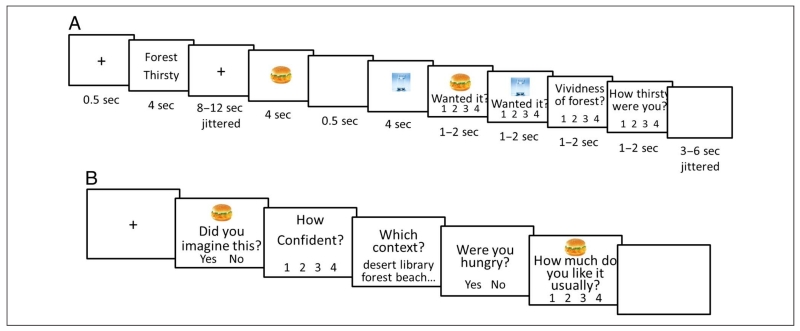
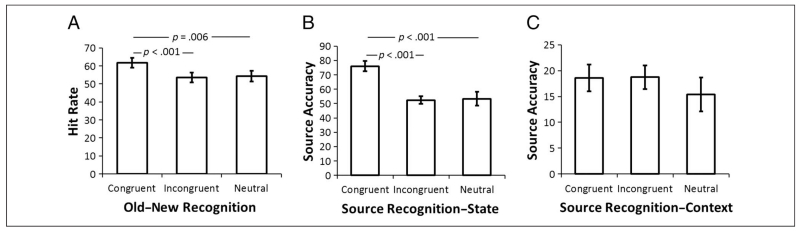
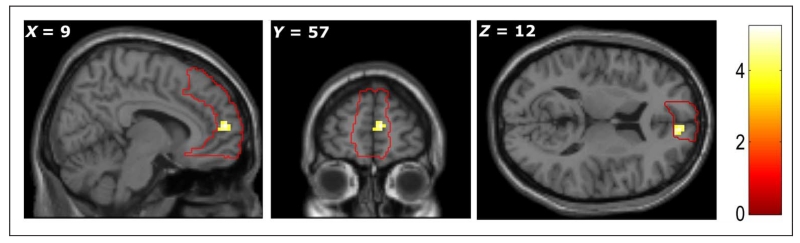
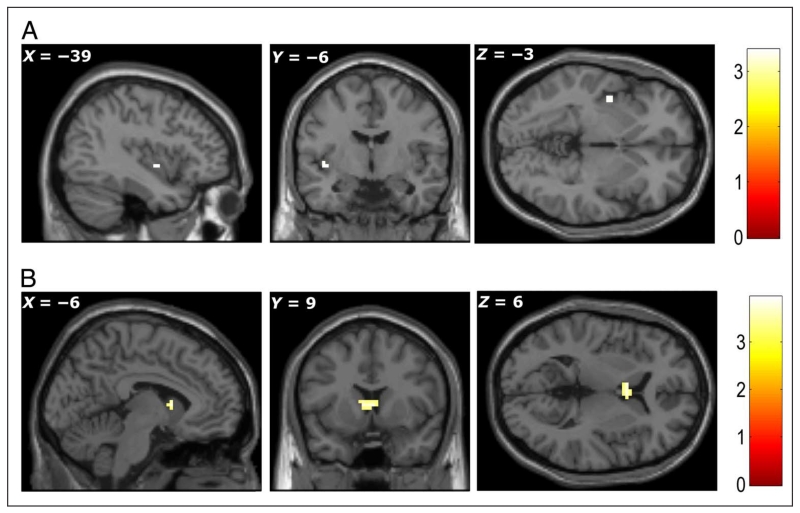
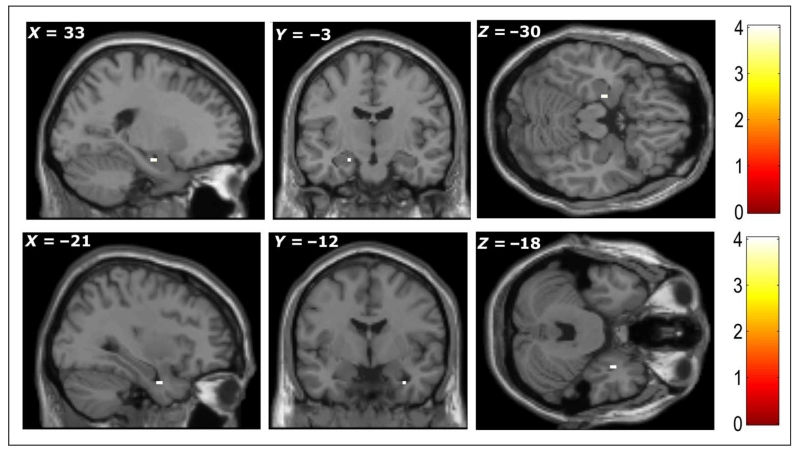
The medial prefrontal cortex (mPFC) is consistently implicated in the network supporting autobiographical memory. Whereas more posterior regions in this network have been related to specific processes, such as the generation of visuospatial imagery or the association of items and contexts, the functional contribution of the mPFC remains unclear. However, the involvement of mPFC in estimation of value during decision-making suggests that it might play a similar role in memory. We investigated whether mPFC activity reflects the subjective value of elements in imagined scenarios. Participants in an MRI scanner imagined scenarios comprising a spatial context, a physiological state of need (e.g., thirst), and two items that could be congruent (e.g., drink) or incongruent (e.g., food) with the state of need. Memory for the scenarios was tested outside the scanner. Our manipulation of subjective value by imagined need was verified by increased subjective ratings of value for congruent items and improved subsequent memory for them. Consistent with our hypothesis, fMRI signal in mPFC reflected the modulation of an item's subjective value by the imagined physiological state, suggesting the mPFC selectively tracked subjective value within our imagination paradigm. Further analyses showed uncorrected effects in non-mPFC regions, including increased activity in the insula when imagining states of need, the caudate nucleus when imagining congruent items, and the anterior hippocampus/amygdala when imagining subsequently remembered items. We therefore provide evidence that the mPFC plays a role in constructing the subjective value of the components of imagined scenarios and thus potentially in reconstructing the value of components of autobiographical recollection.
Overview
The claims and statistics of this paper haven’t been checked yet.
Free: it reads the open-access text and checks the first 5 claims that cite a source we can check. Create a free account to check every claim.
Integrity signals
Registry
Cites
Statistics
Figures
Verification
Claims the paper makes
The claims and statistics of this paper haven’t been checked yet.
Free: it reads the open-access text and checks the first 5 claims that cite a source we can check. Create a free account to check every claim.
Claims other papers make about this one
Each is checked against this paper’s own text: does it say what the citing paper says it does?
The source backs part of the claim, not all of it — or backs it for a different population, condition or comparison.
In the citing paper
“These studies suggest that the vmPFC contributes to both accessing schematic knowledge used in episodic simulations as well signaling their affective value (see Box 2).”
From Episodic Future Thinking: Mechanisms and Functions (2017) · cites this paper as [100]
Experimental — accuracy not yet measuredThe source backs part of the claim, not all of it — or backs it for a different population, condition or comparison.
In the citing paper
“Activation in rostral and ventral mPFC signals the emergent affective value of an imagined episode, and this value signal is difficult to account for by the nominal values of the individual elements that make up the episode (e.g., its location and present people or objects; 99–100).”
From Episodic Future Thinking: Mechanisms and Functions (2017) · cites this paper as [100]
Experimental — accuracy not yet measured
Self-check
Percentages, sums and reported differences re-computed from the paper’s own numbers.
The self-check needs the paper’s full text.
Citations
Cites
Tzourio-Mazoyer, N., Landeau, B., Papathanassiou, D., Crivello, F., Etard, O., Delcroix, N., Mazoyer, B., & Joliot, M. (2002) · NeuroImage · doi:10.1006/nimg.2001.0978 · Cited by 16,319 · cited 1×
“This mask was derived from the AAL atlas (Tzourio-Mazoyer et al., 2002), as implemented in the WFU PickAtlas Tool (Maldjian, Laurienti, Kraft, & Burdette, 2003).”
Method(1978) · UA Campus Repository (The University of Arizona) · Cited by 8,010
LOSS OF RECENT MEMORY AFTER BILATERAL HIPPOCAMPAL LESIONS
Scoville, W. B., & Milner, B. (1957) · Journal of Neurology, Neurosurgery & Psychiatry · doi:10.1136/jnnp.20.1.11 · Cited by 7,322 · cited 1×
“C Funders A uthor M anuscripts E urope PM C Funders A uthor M anuscripts 1991; O’Keefe & Nadel, 1978; Scoville & Milner, 1957), this research has proposed specific functional roles for posterior brain regions.”
BackgroundMaldjian, J. A., Laurienti, P. J., Kraft, R. A., & Burdette, J. H. (2003) · NeuroImage · doi:10.1016/s1053-8119(03)00169-1 · Cited by 5,085
The Medial Temporal Lobe Memory System
Squire, L. R., & Zola-Morgan, S. (1991) · Science · doi:10.1126/science.1896849 · Cited by 3,282
Gusnard, D. A., Akbudak, E., Shulman, G. L., & Raichle, M. E. (2001) · Proceedings of the National Academy of Sciences · doi:10.1073/pnas.071043098 · Cited by 2,997
Buckner, R. L., & Carroll, D. C. (2007) · Trends in Cognitive Sciences · doi:10.1016/j.tics.2006.11.004 · Cited by 2,691
The Medial Temporal Lobe and Recognition Memory
Eichenbaum, H., Yonelinas, A. P., & Ranganath, C. (2007) · Annual Review of Neuroscience · doi:10.1146/annurev.neuro.30.051606.094328 · Cited by 2,580 · cited 2×
“The parahippocampus, retrosplenial cortex, and the rest of Papez’s circuit have been ascribed roles in the generation of visuospatial imagery (Byrne, Becker, & Burgess, 2007), whereas medial-temporal regions have been implicated in storing items and context beyond the spatial domain (Eichenbaum et al., 2007).”
BackgroundInteroception: the sense of the physiological condition of the body
(Bud) Craig, A. (2003) · Current Opinion in Neurobiology · doi:10.1016/s0959-4388(03)00090-4 · Cited by 2,556
The human hippocampus and spatial and episodic memory
Burgess, N., Maguire, E. A., & O'Keefe, J. (2002) · Neuron · doi:10.1016/s0896-6273(02)00830-9 · Cited by 2,401
Self-citation
Research works printed but not linked: 1
- Bartlett FC Remembering 1932 Cambridge University Press Cambridge
Cited by
Episodic Future Thinking: Mechanisms and Functions
Schacter, D. L., Benoit, R. G., & Szpunar, K. K. (2017) · Current Opinion in Behavioral Sciences · doi:10.1016/j.cobeha.2017.06.002 · Cited by 771
Benoit, R. G., & Schacter, D. L. (2015) · Neuropsychologia · doi:10.1016/j.neuropsychologia.2015.06.034 · Cited by 366
“…– training that focuses on recalling specific details of past experiences – enhance both subsequent recollections of past events (e.g., Neshat-Doost et al., 2012) and imaginings of hypothetical future events (Madore et al., 2014; for review and discussion, see Schacter and Madore (in press)).”
BackgroundThe Cognitive Architecture of Spatial Navigation: Hippocampal and Striatal Contributions
Chersi, F., & Burgess, N. (2015) · Neuron · doi:10.1016/j.neuron.2015.09.021 · Cited by 240
Self-citationFineberg, N. A., Apergis-Schoute, A. M., Vaghi, M. M., Banca, P., Gillan, C. M., Voon, V., Chamberlain, S. R., Cinosi, E., Reid, J., Shahper, S., et al. (2018) · International Journal of Neuropsychopharmacology · doi:10.1093/ijnp/pyx088 · Cited by 183
“By contrast, the hyperactivation of caudate and medial prefrontal cortex found in previous studies could represent OCD-related changes in other cognitive domains such as imagery or autobiographical memory recollection, which are also processed in the medial prefrontal cortex (Lin WJ et al., 2015).”
Bulley, A., Henry, J., & Suddendorf, T. (2016) · Review of General Psychology · doi:10.1037/gpr0000061 · Cited by 158
“…in the valuation of imagined possibilities by signaling their affective properties (Benoit et al., 2011; Benoit, Szpunar, & Schacter, 2014; W. Lin et al., 2015; Sasse et al., 2015), and consequently may be critical for attributing emotional value to mental representations of future…”
BackgroundEffects of Prior-Knowledge on Brain Activation and Connectivity During Associative Memory Encoding
Liu, Z.-X., Grady, C., & Moscovitch, M. (2016) · Cerebral Cortex · doi:10.1093/cercor/bhw047 · Cited by 113
“For example, objects (e.g., water) that satisfy imaged physical need (e.g., thirsty) can activate the vmPFC to a larger extent and be remembered better than objects that do not (Lin et al. 2015).”
BackgroundResultInfluentialForming attitudes via neural activity supporting affective episodic simulations
Benoit, R. G., Paulus, P. C., & Schacter, D. L. (2019) · Nature Communications · doi:10.1038/s41467-019-09961-w · Cited by 101
Ventromedial prefrontal cortex, adding value to autobiographical memories
Lin, W., Horner, A. J., & Burgess, N. (2016) · Scientific Reports · doi:10.1038/srep28630 · Cited by 122
Self-citationLudwig, V. U., Nüsser, C., Goschke, T., Wittfoth, D., Wiers, C. E., Erk, S., Schott, B. H., & Walter, H. (2015) · Frontiers in Behavioral Neuroscience · doi:10.3389/fnbeh.2015.00280 · Cited by 52
“Given the role of the mPFC in coding stimulus value and personal preferences (Knutson et al., 2005; Ludwig et al., 2014; Lin et al., 2015), it seems important to consider the outcome phase when investigating the valuation component of delay discounting.”
BackgroundKrönke, K., Wolff, M., Mohr, H., Kräplin, A., Smolka, M. N., Bühringer, G., & Goschke, T. (2020) · Psychological Science · doi:10.1177/0956797619896357 · Cited by 53
“Expanding previous evidence for the involvement of the vmPFC in the computation of subjective value (Lin et al., 2015), our study showed that activity in the vmPFC reflected the subjective value of (imagined) daily behaviors related to a wide range of different goals and desires.”
MethodResultInfluentialThe effects of value on context-item associative memory in younger and older adults.
Hennessee, J. P., Knowlton, B. J., & Castel, A. D. (2018) · Psychology and Aging · doi:10.1037/pag0000202 · Cited by 45
“The item set was shortened from Lin et al. (2015) to avoid overtaxing older adult participants.”
BackgroundMethodInfluentialEmotion in the mind's eye: Imagination for adaptive cognition
Cocquyt, C. M., & Palombo, D. J. (2023) · Annals of the New York Academy of Sciences · doi:10.1111/nyas.15011 · Cited by 44
Gorka, S. M., Teppen, T. L., Radoman, M., Phan, K. L., & Pandey, S. C. (2019) · The International Journal of Neuropsychopharmacology · doi:10.1093/ijnp/pyz057 · Cited by 34
“Cross-talk between the amygdala and mPFC is necessary for effectively coding subjective value (Lin et al., 2015), and decreased functional connectivity between these regions could reflect abnormal salience processing of unpredictable threat cues.”
BackgroundCognition, emotion, and the default mode network
Sambuco, N. (2024) · Brain and Cognition · doi:10.1016/j.bandc.2024.106229 · Cited by 33
Louail, M., Gilissen, E., Prat, S., Garcia, C., & Bouret, S. (2019) · Cortex · doi:10.1016/j.cortex.2019.03.019 · Cited by 36
Mammarella, N., Domenico, A. D., Palumbo, R., & Fairfield, B. (2016) · Cortex · doi:10.1016/j.cortex.2016.11.005 · Cited by 36
San-Galli, A., Varazzani, C., Abitbol, R., Pessiglione, M., & Bouret, S. (2016) · bioRxiv · doi:10.1093/cercor/bhw351 · Cited by 23
Kruschwitz, J., Ludwig, V. U., Waller, L., List, D., Wisniewski, D., Wolfensteller, U., Goschke, T., & Walter, H. (2018) · Frontiers in Behavioral Neuroscience · doi:10.3389/fnbeh.2018.00297 · Cited by 23
“Moreover, activation in the insula correlated with the degree to which participants experienced negative emotions (distress) during anticipation, while activation in the VS, vmPFC and PCC correlated with the degree to which participants experienced positive emotions (pleasure and relief; the former for all three regio…”
BackgroundInfluentialDissociable Contributions of Imagination and Willpower to the Malleability of Human Patience
Jenkins, A. C., & Hsu, M. (2017) · Psychological Science · doi:10.1177/0956797617698133 · Cited by 23
“In turn, studies have implicated these regions in hypothetical value representation (Lebreton et al., 2013; Lin et al., 2015), shown that their activation decreases with temporal distance (D’Argembeau et al.”
Padulo, C., Pizzi, S. D., Bonanni, L., Edden, R. A. E., Ferretti, A., Marzoli, D., Franciotti, R., Manippa, V., ONOFRJ, M. C., Sepede, G., et al. (2016) · Neuroscience · doi:10.1016/j.neuroscience.2016.07.010 · Cited by 19
Kruschwitz, J., Waller, L., List, D., Wisniewski, D., Ludwig, V. U., Korb, F. M., Wolfensteller, U., Goschke, T., & Walter, H. (2018) · NeuroImage · doi:10.1016/j.neuroimage.2018.08.048 · Cited by 18
Brain structure correlates of expected social threat and reward
Crawford, B., Muhlert, N., MacDonald, G., & Lawrence, A. D. (2020) · Scientific Reports · doi:10.1038/s41598-020-74334-z · Cited by 16
Linking the evolution of two prefrontal brain regions to social and foraging challenges in primatesPreprint
Bouret, S., Paradis, E., Prat, S., Castro, L., Pérez, P., Gilissen, E., & Garcia, C. (2024) · eLife · doi:10.7554/elife.87780 · Cited by 16
Read carefully, because this is important! How value-driven strategies impact sentence memory
Chung, Y. M. W., & Federmeier, K. D. (2023) · Memory & Cognition · doi:10.3758/s13421-023-01409-3 · Cited by 12
“…for important information, including not only high value words (Castel et al., 2013; Cohen et al., 2014) but also visual scenes associated with rewards (Adcock et al., 2006) and items of subjective importance (Lin et al., 2015; Friedman et al., 2015; Murphy & Castel, 2021a,b; Murphy et al., 2022).”
BackgroundValue shapes the structure of schematic representations in the medial prefrontal cortexPreprint
Paulus, P. C., Charest, I., & Benoit, R. G. (2020) · bioRxiv (Cold Spring Harbor Laboratory) · doi:10.1101/2020.08.21.260950 · Cited by 9
“Notably, evidence from human neuroimaging (1, 19, 34, 36, 40) and rodent single cell-recordings (20, 22) has shown that representations of memories and of affective value are supported by overlapping parts of the mPFC.”
BackgroundMotivation and prediction-driven processing of social memoranda
Reggev, N. (2024) · Neuroscience & Biobehavioral Reviews · doi:10.1016/j.neubiorev.2024.105613 · Cited by 8
Decoding the emotional valence of future thoughts
Devitt, A. L., Thakral, P. P., & Schacter, D. L. (2021) · Cognitive Neuroscience · doi:10.1080/17588928.2021.1906638 · Cited by 6
“Our findings also align with theories that anterior medial regions like the ACC and vmPFC process reward value (e.g., D’Argembeau, 2013; Roy et al., 2012), and are involved in identifying potential rewarding outcomes of future events (Benoit et al., 2014) and simulations (Lin et al., 2015).”
ResultWhy do people pirate? A neuroimaging investigation
Eres, R., Louis, W. R., & Molenberghs, P. (2016) · Social Neuroscience · doi:10.1080/17470919.2016.1179671 · Cited by 7
Evidence for Spinozan “Unbelieving” in the Right Inferior Prefrontal Cortex
Bernhard, R. M., Frankland, S., Plunkett, D., Sievers, B., & Greene, J. D. (2023) · Journal of Cognitive Neuroscience · doi:10.1162/jocn_a_01964 · Cited by 6
Goal-Directed Sequences in the Hippocampus
Schmidt, B., Wikenheiser, A. M., & Redish, A. D. (2018) · Elsevier eBooks · doi:10.1016/b978-0-12-812098-9.00006-1 · Cited by 6
Linking the evolution of two prefrontal brain regions to social and foraging challenges in primates
Bouret, S., Paradis, E., Prat, S., Castro, L., Pérez, P., Gilissen, E., & Garcia, C. (2024) · eLife · doi:10.7554/elife.87780.4 · Cited by 7
The Brain, Explained: A Comprehensive Theory of Brain FunctionPreprint
Rappoport, A. (2018) · Preprints.org · doi:10.20944/preprints201805.0137.v1 · Cited by 4
Linking the evolution of two prefrontal brain regions to social and foraging challenges in primatesPreprint
Bouret, S., Paradis, E., Prat, S., Castro, L., Pérez, P., Gilissen, E., & Garcia, C. (2024) · eLife · doi:10.7554/elife.87780.2 · Cited by 2
Hennessee, J. P. (2018) · eScholarship (California Digital Library) · Cited by 2
Tartaglia, E. M., Boucly, C. J., Tatur, G., & Arleo, A. (2018) · bioRxiv (Cold Spring Harbor Laboratory) · doi:10.1101/481788
“prefrontal and striatal areas have been suggested to code for the value of the reward associated to mentally planned scenarios (Benoit et al. 2014; Lin et al. 2015).”
BackgroundLinking the evolution of two prefrontal brain regions to social and foraging challenges in primatesPreprint
Bouret, S., Paradis, E., Prat, S., Castro, L., Pérez, P., Gilissen, E., & Garcia, C. (2024) · eLife · doi:10.7554/elife.87780.3
Bouret, S., Paradis, E., Prat, S., et al. (2024) · eLife · doi:10.7554/elife.87780.3.sa1
Bouret, S., Paradis, E., Prat, S., Castro, L., Pérez, P., Gilissen, E., & Garcia, C. (2024) · eLife · doi:10.7554/elife.87780.3.sa0
Xie, A., Liu, P., Zhou, Q., Chen, T., Ding, D., & Zhang, R. (2025) · Brain Imaging and Behavior · doi:10.1007/s11682-025-01002-z
“Schacter et al. (2017) summarized that the ventromedial prefrontal cortex (vmPFC) was engaged in the processing of the representation of the affective value of an imagined event (Benoit et al., 2014; Lin et al., 2015; Schacter et al., 2017) and thus plays a crucial role in AF.”
From Brain to Shopping Cart: Neural Signals of Willingness to Buy Innovative Products
Li, Z., Liu, L., Hu, Y., Zhang, L. L., Xie, X., & Luo, J. (2025) · Neuroscience Bulletin · doi:10.1007/s12264-025-01431-2
“The medial orbitofrontal cortex is thought to be involved in integrating emotions with various factors such as product price and appearance [18–20].”
Mok, J. (2021) · YorkSpace (York University)
Loisel-Fleuriot, L. (2023) · theses.fr (ABES) · doi:10.70675/dd3f1daaza0bbz4347za178z98b7d1899368
Metadata
- Authors
- Lin, W.-J., Horner, A. J., Bisby, J. A., & Burgess, N.
- Affiliations
- University College London (GB)
- Venue
- Journal of Cognitive Neuroscience
- Publisher
- MIT Press
- Published
- 2015-10-01
- Volume
- 27
- Issue
- 10
- Pages
- 1957-1967
- ISSN
- 0898-929X (ISSN-L)
- 1530-8898
- PMC
- PMC4820053
- OpenAlex
- W1693324847
- Cited by
- 40
- References
- 75
- Citations by year
- 2025: 2 · 2024: 8 · 2023: 3 · 2022: 1 · 2021: 1 · 2020: 3 · 2019: 3 · 2018: 6 · 2017: 3 · 2016: 7 · 2015: 3
- FWCI
- 3.81
- Type
- journal article
- Language
- en
- Open access
- hybrid
- doi.org
- Locations
- Journal of Cognitive Neuroscience (publishedVersion, cc-by)
- PubMed (publishedVersion)
- PubMed Central (acceptedVersion, cc-by)
- UCL Discovery (University College London) (submittedVersion)
- Funders
- Wellcome Trust (091593, 095811)
- Medical Research Council
- Topics
- Life Sciences › Neuroscience › Cognitive Neuroscience › Memory Processes and Influences
- Life Sciences › Neuroscience › Cognitive Neuroscience › Memory and Neural Mechanisms
- Social Sciences › Psychology › Developmental and Educational Psychology › Identity, Memory, and Therapy
- Keywords
- medial prefrontal cortex, subjective value, autobiographical memory, need states, insula, caudate nucleus, hippocampus, amygdala, memory reconstruction
- MeSH terms
- Adult, Brain, Female, Humans, Imagination, Magnetic Resonance Imaging, Male, Motivation, Prefrontal Cortex, Young Adult, Memory, Episodic
About these checks
Registry, retraction, Cites and statistics results are computed, not judged, with one exception: a printed reference that no index lists is read once by a model before it counts as a citation error. Claims are extracted by a model and kept only when their quote appears verbatim in the text; each cited source is then checked, with a model’s help, for whether it says what the claim relies on. Those verdicts can be wrong — read the claim’s quote and the cited source before relying on one.
Statistics and arithmetic are recomputed, not judged.
Confidence bands are shown only for fields calibrated on our annotated test set. None is calibrated yet, so no band is shown.
What counts as a claim ›How we measure confidence ›How we check this ›
Are you an author, or do you see a problem with this page? Request a review
Data sources
Bibliographic data: Semantic Scholar, OpenAlex, Crossref.
Contains information from the Semantic Scholar Academic Graph Datasets, made available under the ODC Attribution License (ODC-BY 1.0).
Semantic Scholar’s data is described in: Kinney, R., et al. (2023). The Semantic Scholar Open Data Platform. arXiv:2301.10140.
