

In-Context Retrieval-Augmented Language Models
Open accessThe DOI matches its Crossref record; 53 of the 60 references it cites were found in a registry or an index; 9 of the 26 sources its claims cite were checked for support.
Abstract
Abstract Retrieval-Augmented Language Modeling (RALM) methods, which condition a language model (LM) on relevant documents from a grounding corpus during generation, were shown to significantly improve language modeling performance. In addition, they can mitigate the problem of factually inaccurate text generation and provide natural source attribution mechanism. Existing RALM approaches focus on modifying the LM architecture in order to facilitate the incorporation of external information, significantly complicating deployment. This paper considers a simple alternative, which we dub In-Context RALM: leaving the LM architecture unchanged and prepending grounding documents to the input, without any further training of the LM. We show that In-Context RALM that builds on off-the-shelf general purpose retrievers provides surprisingly large LM gains across model sizes and diverse corpora. We also demonstrate that the document retrieval and ranking mechanism can be specialized to the RALM setting to further boost performance. We conclude that In-Context RALM has considerable potential to increase the prevalence of LM grounding, particularly in settings where a pretrained LM must be used without modification or even via API access.1
Overview
CoChat Summary
TL;DR
In-Context RALM prepends retrieved documents to a frozen LM’s input without architecture changes or training, and off-the-shelf retrievers yield large perplexity gains across model sizes and corpora. Tailoring document ranking via zero-shot or trained rerankers further improves performance, including on open-domain QA.
Key findings
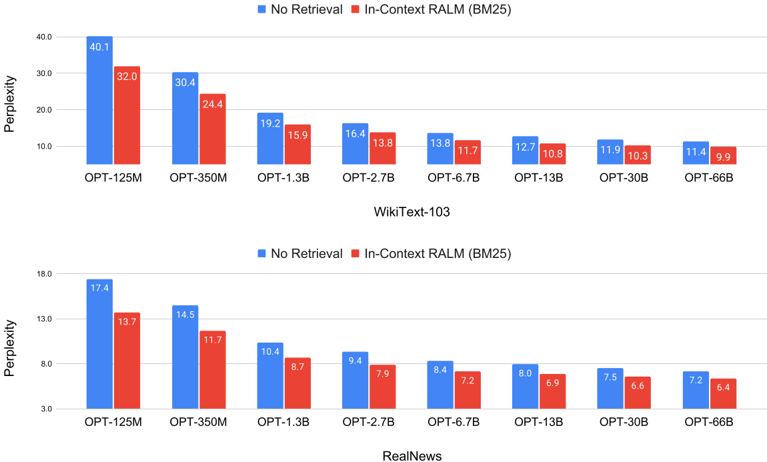
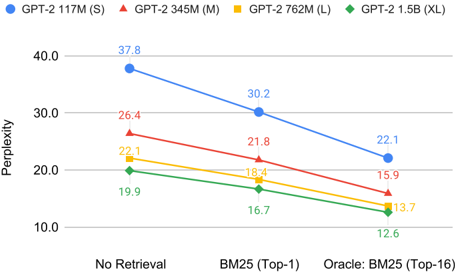
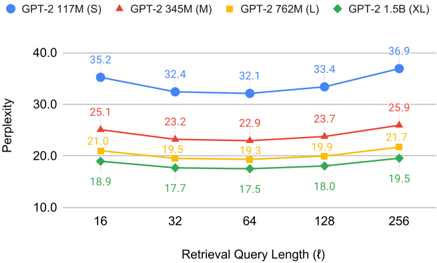
- With BM25 retrieval (`s = 4`, `ℓ = 32`), In-Context RALM improved LM perplexity enough to match a 2–3× larger model; e.g., 6.7B OPT matched 66B OPT, and 345M GPT-2 + BM25 outperformed 762M GPT-2.
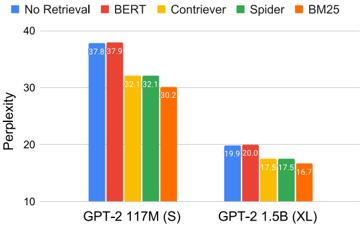
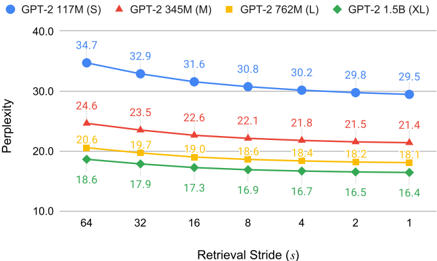
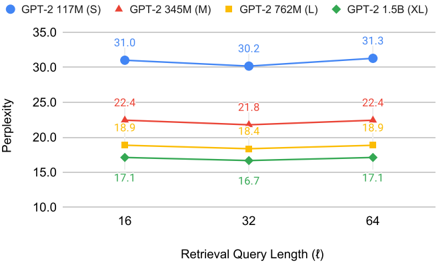
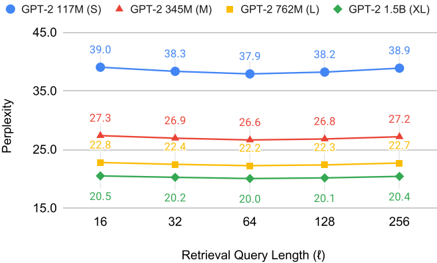
- BM25 outperformed dense retrievers (Contriever, Spider, BERT mean pooling); optimal query length was `ℓ = 32` for BM25 vs. `ℓ = 64` for dense retrievers, and more frequent retrieval (smaller stride) improved performance.
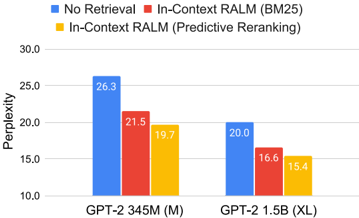
- Predictive reranking improved WikiText-103 word perplexity for GPT-2 110M from 29.6 to 26.8 and GPT-2 1.5B from 16.6 to 15.4; zero-shot reranking also improved over taking the top BM25 document.
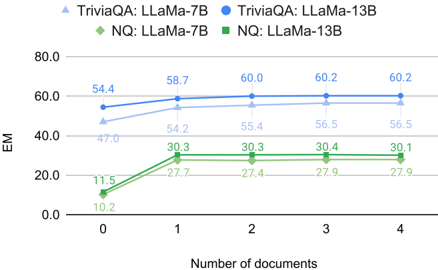
- On ODQA with two DPR documents, LLaMA-13B improved NQ exact match from 12.0% to 31.0% and TriviaQA from 54.8% to 60.1%; LLaMA-33B improved NQ from 13.7% to 32.3% and TriviaQA from 58.3% to 62.7%.
Methods
- Evaluated on five LM datasets (WikiText-103, RealNews, ArXiv, Stack Exchange, FreeLaw) and two ODQA datasets (Natural Questions, TriviaQA), using GPT-2 (110M–1.5B), GPT-Neo/GPT-J (1.3B–6B), OPT (125M–66B), and LLaMA (7B–33B) models with max sequence length 1,024.
- Retrieval corpora: Wikipedia (Dec. 20, 2018) for WikiText-103/ODQA with 120 WikiText dev/test articles removed; training data for other datasets; non-overlapping 100-word passages truncated at 256 tokens. Retrievers: BM25, BERT mean pooling, Contriever, Spider; DPR for ODQA.
- Main analyses measured perplexity on LM datasets and exact match on ODQA; reranking used top-16 BM25 documents, with zero-shot LM reranking and a RoBERTa-base predictive reranker trained for 10,000 steps (peak LR 1e-5, batch 32, 300,000 WikiText-103 examples).
Limitations
- Stated: the paper considers only prepending a single external document; adding more documents could drive further gains. It retrieves every fixed interval of `s` tokens, and future work could retrieve more sparsely (e.g., when a specialized model predicts retrieval is needed) for latency/cost gains.
- Stated: predictive reranking still leaves room compared with top-16 BM25 oracle results; oracle could improve with `k > 16` or stronger RALM-dedicated retrievers.
- Evident: main LM experiments use one document and max sequence length 1,024 despite some models supporting 2,048; the predictive reranker assumes availability of training data from the target corpus and was trained on WikiText-103.
Model-written summary. Check it against the paper before relying on it.
Integrity signals
Registry
Cites
Statistics
Figures

Verification
Claims the paper makes
5 Valid · 4 Not valid · 9 Not checked · 43 Own results and interpretations
The cited sources support only part of this claim — read each source’s verdict below.
In the paper
“Their results are based on training a dedicated retriever for language modeling.”
§ In-Context Retrieval-Augmented Language Models > 1 Introduction
What the sources say
- Partly supportedcites Shi et al., 2023 matched to “REPLUG: Retrieval-augmented black-box language models” (2023) sourceExperimental — accuracy not yet measured
Section 4 describes training a retriever with language-model supervision for REPLUG LSR, and Section 5.2 gives its training procedure. But the ‘Our model’ results also include REPLUG without that retriever training, so training a dedicated retriever underlies only part of the reported results. The indexed passages provide no page numbers. (LLM, conf=0.88)
plainstates a cause- Asserted: passes — The authors put it forward as true.
- Checkable: passes — It can be checked against evidence.
- Load-bearing: passes — The paper’s conclusions depend on it.
- Based: passes — The paper gives a reason why it holds.
- Partly supported
The cited sources support only part of this claim — read each source’s verdict below.
In the paper
“More importantly, they tend to produce factual inaccuracies and errors (Lin et al., 2022;Maynez et al., 2020;Huang et al., 2020).”
§ In-Context Retrieval-Augmented Language Models > 1 Introduction
What the sources say
- Supportedcites Lin et al., 2022 matched to “TruthfulQA: Measuring How Models Mimic Human Falsehoods” (2022) source
The Introduction (p. 1) explicitly says that recent language models have a tendency to generate false statements, ranging from subtle inaccuracies to hallucinations. The Discussion (p. 8) also reports poor performance by the baseline models on truthfulness questions. (LLM, conf=0.94)
- Partly supportedcites Maynez et al., 2020 matched to “On Faithfulness and Factuality in Abstractive Summarization” (2020) sourceExperimental — accuracy not yet measured
Section 5.3 reports that over 90% of hallucinations from the BERTS2S summarization model are erroneous, and the Abstract reports substantial hallucinated content across the evaluated summarization systems. This supports factual errors in those systems, but the claim extends the finding to language models generally, which the paper did not evaluate. (LLM, conf=0.83)
- Partly supportedcites Huang et al., 2020 matched to “Challenges in building intelligent open-domain dialog systems” (2020) sourceExperimental — accuracy not yet measured
Section 2.3 (p. 10) says generation-based dialog methods often produce undesirable responses that are ungrammatical or irrelevant, supporting the general point about errors. Section 3.2 (p. 12) stresses grounding responses in real-world facts, but the passages do not establish that language models tend to produce factual inaccuracies specifically; the paper discusses open-domain dialog systems rather than LMs generally. (LLM, conf=0.78)
plain- Asserted: passes — The authors put it forward as true.
- Checkable: passes — It can be checked against evidence.
- Load-bearing: passes — The paper’s conclusions depend on it.
- Based: passes — The paper gives a reason why it holds.
- Supported
The cited sources support only part of this claim — read each source’s verdict below.
In the paper
“Existing RALM approaches focus on modifying the LM architecture in order to facilitate the incorporation of external information, significantly complicating deployment.”
- Also stated in: § 1 Introduction · plain
“Leading RALM systems introduced recently tend to be focused on altering the language model architecture (Khandelwal et al., 2020;Borgeaud et al., 2022;Zhong et al., 2022;Levine et al., 2022c;Li et al., 2022).”
§ In-Context Retrieval-Augmented Language Models > Abstract
What the sources say
- Not matchedcites Khandelwal et al., 2020
An author–year citation the paper’s reference list doesn’t settle. We don’t search these by name.
- Not matchedcites Borgeaud et al., 2022
An author–year citation the paper’s reference list doesn’t settle. We don’t search these by name.
- Partly supportedcites Zhong et al., 2022 matched to “Training language models with memory augmentation” (2022) sourceExperimental — accuracy not yet measured
The Introduction and §2.2 Memory Augmentation say that several earlier approaches modify Transformer architectures to incorporate memory from previous segments. They do not establish that existing retrieval-augmented language modeling approaches generally focus on architecture changes, or that those changes significantly complicate deployment. (LLM, conf=0.84)
plainstates a cause- Asserted: passes — The authors put it forward as true.
- Checkable: passes — It can be checked against evidence.
- Load-bearing: passes — The paper’s conclusions depend on it.
- Based: passes — The paper gives a reason why it holds.
- Also stated in: § 1 Introduction · plain
The cited sources that could be checked couldn’t confirm or dispute this claim.
In the paper
“All prior work involves training the LM.”
§ In-Context Retrieval-Augmented Language Models > Nearest Neighbor Language Models
What the sources say
- Not matchedcites Lewis et al., 2020
More than one paper fits this citation.
- Could not verifycites Izacard and Grave, 2021 matched to “Leveraging Passage Retrieval with Generative Models for Open Domain Question Answering” (2021) sourceExperimental — accuracy not yet measured
The Related work section (p. 2) describes earlier retrieval-augmented QA systems but does not say whether all of them train the language model. The Experiments section (p. 4) says this paper fine-tunes its own pretrained T5 model; that does not establish the claim about all prior work. I searched for discussion of training or freezing the language model in earlier retrieve-and-read systems. (LLM, conf=0.72)
- Not matchedcites Borgeaud et al., 2022
An author–year citation the paper’s reference list doesn’t settle. We don’t search these by name.
plain- Asserted: passes — The authors put it forward as true.
- Checkable: passes — It can be checked against evidence.
- Load-bearing: passes — The paper’s conclusions depend on it.
- Based: passes — The paper gives a reason why it holds.
- Not matched
The cited sources support only part of this claim — read each source’s verdict below.
In the paper
“While they showed significant gains from kNN-LM, the approach requires storing the representations for each token in the corpus, an expensive requirement even for a small corpus like Wikipedia.”
§ In-Context Retrieval-Augmented Language Models > Nearest Neighbor Language Models
What the sources say
- Partly supportedcites Zhong et al., 2022 matched to “Training language models with memory augmentation” (2022) sourceExperimental — accuracy not yet measured
Section 2.2 defines external memory as context–token pairs from a corpus and says that accessing a memory of roughly 10^8 entries is computationally expensive. The Introduction identifies kNN-LM as using external memory, and Table 2 notes large SSD storage for one retrieval setup. The paper tests on WIKITEXT-103, but these passages do not characterize Wikipedia itself as a small corpus or establish the claimed storage cost for it. (LLM, conf=0.82)
plainstates a cause- Asserted: passes — The authors put it forward as true.
- Checkable: passes — It can be checked against evidence.
- Load-bearing: passes — The paper’s conclusions depend on it.
- Based: passes — The paper gives a reason why it holds.
- Partly supported
42 more claims
Create a free account to see all 61 claims and to verify the 3 references still open.
- Probably not a substantial claim. 9
- The quote only partly states this claim. 3
- It may state two separate claims as one. 4
Claims other papers make about this one
Each is checked against this paper’s own text: does it say what the citing paper says it does?
The source backs part of the claim, not all of it — or backs it for a different population, condition or comparison.
In the citing paper
“or when language models are augmented with external information (relevant documents from a search engine, database query results, etc.; Petroni et al., 2020;Ram et al., 2023;Shi et al., 2023;Mallen et al., 2023;Schick et al., 2023, inter alia).”
From Lost in the Middle: How Language Models Use Long Contexts (2024) · cites this paper as Ram et al., 2023
Experimental — accuracy not yet measuredThe source backs part of the claim, not all of it — or backs it for a different population, condition or comparison.
In the citing paper
“In contrast to fine-tuning, RAG does not seek to adjust the internal parameters (or internal memory) of an LLM.”
From ChatGPT, extended: large language models and the extended mind (2025) · cites this paper as Ram et al., 2023
Experimental — accuracy not yet measuredThe source backs part of the claim, not all of it — or backs it for a different population, condition or comparison.
In the citing paper
“the task of retrieving relevant and precise information from extensive corpora can be computationally demanding and resourceintensive, necessitating continuous updating and modification of knowledge databases to keep pace with the latest information (Chen et al. 2023; Siriwardhana et al. 2023; Ram et al. 2023; Cheng et al. 2024).”
From Large Legal Fictions: Profiling Legal Hallucinations in Large Language Models (2024) · cites this paper as Ram et al. 2023
Experimental — accuracy not yet measuredThe source backs part of the claim, not all of it — or backs it for a different population, condition or comparison.
In the citing paper
“Memory-augmented methods extend this concept by retrieving user-specific information from past interactions. This addresses the challenge of a limited context window and enables the integration of past information into the input prompt [25, 29, 45].”
From CAIM: Development and Evaluation of a Cognitive AI Memory Framework for Long-Term Interaction with Intelligent Agents (2026) · cites this paper as [45]
Experimental — accuracy not yet measuredThe source backs part of the claim, not all of it — or backs it for a different population, condition or comparison.
In the citing paper
“Despite their capabilities, LLMs still have shortcomings, such as a limited context window, which restricts the amount of information that can be processed and thus the ability to understand the ever-changing environment [58, 60] and maintain effective long-term interactions [45, 50].”
From CAIM: Development and Evaluation of a Cognitive AI Memory Framework for Long-Term Interaction with Intelligent Agents (2026) · cites this paper as [45]
Experimental — accuracy not yet measured
9 more claims about this paper
Create a free account to see every claim other papers make about this one.
Self-check
Percentages, sums and reported differences re-computed from the paper’s own numbers.
Each contradiction between two passages listed here was confirmed by an independent check.
Rated minor: it would not touch a result — a value no result rests on, a p-value that stays on the same side of the significance level, or a conflict that is clerical, resolved elsewhere in the paper, or outside its own findings.
In the paper
§ In-Context Retrieval-Augmented Language Models > 8 Discussion
“this paper considers only the case of prepending a single external document to the context”
§ In-Context Retrieval-Augmented Language Models > 7 In-Context RALM for Open-Domain Question Answering
“In the open-book setting, we include the top two documents returned by DPR.”
Rated minor: it would not touch a result — a value no result rests on, a p-value that stays on the same side of the significance level, or a conflict that is clerical, resolved elsewhere in the paper, or outside its own findings.
In the paper
§ In-Context Retrieval-Augmented Language Models > Nearest Neighbor Language Models
“All prior work involves training the LM.”
§ In-Context Retrieval-Augmented Language Models > Nearest Neighbor Language Models
“Levine et al. (2022a) showed competitive open domain question-answering performance by prompt-tuning a frozen LM as a reader.”
Rated minor: it would not touch a result — a value no result rests on, a p-value that stays on the same side of the significance level, or a conflict that is clerical, resolved elsewhere in the paper, or outside its own findings.
In the paper
§ In-Context Retrieval-Augmented Language Models > Model
“Table 3 shows that a small LM (GPT-2 117M) can be used to rerank the documents for all larger GPT-2 models”
§ In-Context Retrieval-Augmented Language Models > Model
“GPT-2 345M (M) GPT-2 110M (S) 20.8 12.1”
Citations
Cites
Vaswani, A., Shazeer, N., Parmar, N., Uszkoreit, J., Jones, L., Gomez, A. N., Kaiser, L., & Polosukhin, I. (2017) · arXiv · doi:10.48550/arxiv.1706.03762 · Cited by 120,404
BERT: Pre-training of Deep Bidirectional Transformers for Language Understanding
Devlin, J., Chang, M.-W., Lee, K., & Toutanova, K. (2019) · Proceedings of the 2019 Conference of the North American Chapter of the Association for Computational Linguistics: Human Language Technologies, Volume 1 (Long and Short Papers) · doi:10.18653/v1/n19-1423 · Cited by 54,325
Language Models are Few-Shot Learners
Brown, T. B., Mann, B., Ryder, N., Subbiah, M., Kaplan, J., Dhariwal, P., Neelakantan, A., Shyam, P., Sastry, G., Askell, A., et al. (2020) · arXiv · doi:10.48550/arxiv.2005.14165 · Cited by 23,372
RoBERTa: A Robustly Optimized BERT Pretraining Approach
Liu, Y., Ott, M., Goyal, N., Du, J., Joshi, M., Chen, D., Levy, O., Lewis, M., Zettlemoyer, L., & Stoyanov, V. (2019) · arXiv · doi:10.48550/arxiv.1907.11692 · Cited by 16,515
Advances in neural information processing systems 7
(1996) · Computers & Mathematics with Applications · doi:10.1016/s0898-1221(96)90463-0 · Cited by 14,281
Advances in Neural Information Processing Systems 29
Teymur, O., Zygalakis, K., & Calderhead, B. (2016) · Cited by 13,887
Transformers: State-of-the-Art Natural Language Processing
Wolf, T., Debut, L., Sanh, V., Chaumond, J., Delangue, C., Moi, A., Cistac, P., Rault, T., Louf, R., Funtowicz, M., et al. (2020) · Proceedings of the 2020 Conference on Empirical Methods in Natural Language Processing: System Demonstrations · doi:10.18653/v1/2020.emnlp-demos.6 · Cited by 8,741
LLaMA: Open and Efficient Foundation Language Models
Touvron, H., Lavril, T., Izacard, G., Martinet, X., Lachaux, M.-A., Lacroix, T., Rozière, B., Goyal, N., Hambro, E., Azhar, F., et al. (2023) · arXiv · doi:10.48550/arxiv.2302.13971 · Cited by 4,602
Billion-scale similarity search with GPUs
Johnson, J., Douze, M., & Jegou, H. (2021) · IEEE Transactions on Big Data · doi:10.1109/tbdata.2019.2921572 · Cited by 4,228 · cited 1×
“For dense retrieval, we applied exact search using FAISS (Johnson et al., 2021).”
MethodBillion-scale similarity search with GPUs
Johnson, J., Douze, M., & Jégou, H. (2017) · arXiv · doi:10.48550/arxiv.1702.08734 · Cited by 4,140 · cited 1×
“For dense retrieval, we applied exact search using FAISS (Johnson et al., 2021).”
Method
Research works printed but not linked: 1
- 17. Yoav Levine, Ori Ram, Daniel Jannai, Barak Lenz, Shai Shalev-Shwartz, Amnon Shashua, Kevin Leyton-Brown, and Yoav Shoham. 2022b. Huge frozen language models as readers for open-domain question answering. In ICML 2022 Workshop on Knowledge Retrieval and Language Models.
Cited by
Items 201–300 of 454
Evaluating Very Long-Term Conversational Memory of LLM Agents
Maharana, A., Lee, D.-H., Tulyakov, S., Bansal, M., Barbieri, F., & Fang, Y. (2024) · arXiv · doi:10.48550/arxiv.2402.17753 · Cited by 3
“Multimodal dialog is enabled with image-sharing and image-response behaviors. techniques (Shuster et al., 2021; Ram et al., 2023; Shi et al., 2023), there is still a need for thorough evaluation of their efficacy in handling very long conversations.”
BackgroundWesthäußer, R., Minker, W., & Zepf, S. (2026) · Proceedings of the 31st International Conference on Intelligent User Interfaces · doi:10.1145/3742413.3789222 · Cited by 1
RAGTraffic: Utilizing Retrieval-Augmented Generation for Intelligent Traffic Signal Control
Zhang, Z., Shen, Z., Yuan, M., Zhu, F., Ali, H., & Xiong, G. (2024) · International Annual Conference on Complex Systems and Intelligent Science (CSIS-IAC) · doi:10.1109/csis-iac63491.2024.10919289 · Cited by 14
“In practice, RAG techniques are feasible and efficient to apply in various generation tasks with simple adaptation of the retrieval component, requiring minimal or even no additional training [11].”
Enhancing Automated Grading with Capabilities of LLMs: Using Prompt Engineering and RAG Techniques
Abeywardana, T., Nandadewa, N., Wickramasinghe, V., Rohanadheera, S., Nadungodage, T., & Hewagamage, P. (2025) · International Conference on Advanced Research in Computing (ICARC) · doi:10.1109/icarc64760.2025.10962827 · Cited by 2
“Revolutionary techniques have been introduced along with the development of LLMs to reduce them such as Rational Augmented Generation (RAG) [4] to provide external knowledge to LLMs.”
Vilar, G. P. I., Rashid, P., & Tonekaboni, N. H. (2025) · IEEE Global Engineering Education Conference (EDUCON) · doi:10.1109/educon62633.2025.11016497 · Cited by 4
Boosting Retrieval-Augmented Generation with Generation-Augmented Retrieval: A Co-Training Approach
Tang, Y., Zhang, R., Guo, J., de Rijke, M., Fan, Y., & Cheng, X. (2025) · International ACM SIGIR Conference on Research and Development in Information Retrieval (SIGIR) · doi:10.1145/3726302.3729907 · Cited by 7
“Large language models (LLMs) have demonstrated strong capabilities across a wide range of natural language processing (NLP) tasks [1, 21, 28, 42, 46, 59, 76, 77], including knowledge-intensive tasks (KILT) [41], such as closed-book question answering and fact verification [23, 60, 66].”
Li, S., Du, Y., & Li, M. (2025) · International ACM SIGIR Conference on Research and Development in Information Retrieval (SIGIR) · doi:10.1145/3726302.3730203 · Cited by 3
Yu, H.-H., Lin, W.-T., Kuan, C.-W., Yang, C.-C., & Liao, K.-M. (2025) · Future Internet · doi:10.3390/fi17090414 · Cited by 5
“This approach often fails to capture the intricate, underlying relationships between different pieces of information, limiting its ability to perform complex, multi-hop reasoning tasks that require synthesizing information across multiple documents or data points [4,19–21].”
A collaborative reasoning framework for large language models in long-context Q&A
Yao, J., He, G., & Xu, X. (2025) · Expert Systems with Applications · doi:10.1016/j.eswa.2025.129960 · Cited by 4
UrbanPlan-GPT: A Specialized AI Model for Human Settlement Design
Muneer, T. A. S. (2025) · International Conference on Smart & Sustainable Technology (INCSST) · doi:10.1109/incsst64791.2025.11210393 · Cited by 3
AI-RAG: Enhancing Language Models with Real-Time Information Retrieval
Kambattan, K. R., & Chowdary, P. S. (2025) · International Conference on Computing and Data Science · doi:10.1109/iccds64403.2025.11209598 · Cited by 1
“…and data scientists but also domain experts and end-users lacking sophisticated technical expertise.AI-RAG systems obtain seamless usability through modularizing their process into distinct, well-defined phases—retrieval and generation—each of which can be tuned or customized separately [2].”
Hierarchical knowledge graph-based QA systems with retrieval-augmented generation
Yang, W.-C., Li, X., Chang, C., & Roy, D. S. (2025) · Enterprise Information Systems · doi:10.1080/17517575.2025.2580477 · Cited by 5
“Previous studies have explored retrieval-augmented methods, such as RALM for interpretability (Guu et al. 2020), RPT for handling long texts (Rubin and Berant 2023), and In-Context RALM for efficient retrieval (Ram et al. 2023).”
DCMI: A Differential Calibration Membership Inference Attack Against Retrieval-Augmented Generation
Gao, X., Meng, X., Dong, Y., Li, Z., & Guo, S. (2025) · ACM SIGSAC Conference on Computer and Communications Security (CCS) · doi:10.1145/3719027.3765103 · Cited by 14
Improving negative rejection ability in language models: A review of fine-tuned LLMs, RAG, and RAFT
Bowen, L., Zhuoqing, Z., Hengyu, Z., Xubin, S., & Ihnaini, B. (2025) · Journal of King Saud University - Computer and Information Sciences · doi:10.1007/s44443-025-00334-6 · Cited by 4
“Similarly, as proposed by Ram et al., RLAIF (Reinforcement Learning with AI Feedback) to align retrieval enhancement models with human rejection behavior, demonstrating significant benefits in both factual correctness and out-of-scope rejection capabilities (Ram et al. 2023).”
Farooq, A., Anuragi, D., Li, Z., Ziat, M., Cooperstock, J. R., & Raisamo, R. (2025) · Human-Intelligent Systems Integration · doi:10.1007/s42454-025-00085-9 · Cited by 3
“Similarly, RAG systems operating on local data repositories are vulnerable to data isolation failures or poisoning (Khomsky et al. 2025; Ram et al. 2023), potentially introduced inadvertently by users unfamiliar with secure data handling practices or maliciously by an insider threat actor – a…”
Privacy protection in RAG: A novel method and evaluation framework
Zhang, Y., Wu, J., Li, R., Zhang, T., Song, Y., Li, C., Wang, S., Shen, H., Yin, J., Ge, J., et al. (2025) · Information Processing & Management · doi:10.1016/j.ipm.2025.104505 · Cited by 10
Luo, X., Chen, Y., Tu, Y., & Qiu, W. (2025) · Knowledge-Based Systems · doi:10.1016/j.knosys.2025.114976 · Cited by 4
Carou‐Senra, P., Rodríguez‐Pombo, L., Alvarez‐Lorenzo, C., & Goyanes, Á. (2026) · International Journal of Pharmaceutics · doi:10.1016/j.ijpharm.2026.126587 · Cited by 3
VectorLiteRAG: Latency-Aware and Fine-Grained Resource Partitioning for Efficient RAG
Kim, J., & Mahajan, D. (2026) · IEEE International Symposium on High-Performance Computer Architecture (HPCA) · doi:10.1109/hpca68181.2026.11408552 · Cited by 19
“Retrieval-Augmented Generation has emerged as a powerful system in natural language processing, particularly for domain-specific question answering and information retrieval tasks [9], [21], [31].”
Awotunde, I., Chitte, D. R., Shan, Y., Sheng, W., & Khaleghian, H. (2026) · Advanced Engineering Informatics · doi:10.1016/j.aei.2026.104560 · Cited by 5
Yuan, H., Sun, Q., Tao, J., Fu, X., & Li, J. (2026) · International World Wide Web Conference (WWW) · doi:10.1145/3774904.3792139 · Cited by 12
Niu, Y., & Rong, X. (2026) · International Conference on Informatics Education and Computer Technology Applications (IECA) · doi:10.1145/3802133.3802307 · Cited by 2
Surface-Based Retrieval Reduces Perplexity of Retrieval-Augmented Language Models
Doostmohammadi, E., Norlund, T., Kuhlmann, M., & Johansson, R. (2023) · Proceedings of the conference - Association for Computational Linguistics. Meeting · doi:10.18653/v1/2023.acl-short.45 · Cited by 12
E2E-AFG: An End-to-End Model with Adaptive Filtering for Retrieval-Augmented Generation
Jiang, Y., Xie, Z., Zhang, W., Fang, Y., & Pan, S. (2025) · Lecture notes in computer science · doi:10.1007/978-981-96-8197-6_8 · Cited by 2
Retrieval-Augmented Multi-Modal Chain-of-Thoughts Reasoning for Large Language Models
Liu, B., Lyu, C., Min, Z., Wang, Z., Su, J., & Wang, L. (2025) · International Joint Conference on Neural Networks (IJCNN) · doi:10.1109/ijcnn64981.2025.11228391 · Cited by 39
CAIM: A Cognitive AI Memory Framework for Long-term Interaction with LLMs
Westhäußer, R., Zepf, S., & Minker, W. (2025) · Companion Proceedings of the 30th International Conference on Intelligent User Interfaces · doi:10.1145/3708557.3716342 · Cited by 2
INMS: Memory Sharing for Large Language Model based Agents
Gao, H., & Zhang, Y. (2024) · arXiv · doi:10.48550/arxiv.2404.09982 · Cited by 2
“…Retrieval-Augmented Generation was proposed, which enhancing LLMs’ capacity for generating accurate and timely content with methodologies for source attribution through direct input integration, attention blending, and output interpolation(Lewis et al., 2020; Ram et al., 2023; Shi et al., 2023).”
BackgroundHuman Kinematics Analysis by Markerless Vision Based on OpenSim
Zhang, C., Li, Y., Ye, W., et al. (2024) · IEEE International Conference on Pattern Recognition and Machine Learning (PRML) · doi:10.1109/prml62565.2024.10779779 · Cited by 1
Enhancing Agriculture QA Models Using Large Language Models
He, X. (2024) · BIO Web of Conferences · doi:10.1051/bioconf/202414201005 · Cited by 2
Wang, X. A., Zhang, L., Zhao, F., Bai, J., Huang, X., Zhang, X., Jin, M., & Cui, D. (2025) · International Conference on Smart Grid and Artificial Intelligence (SGAI) · doi:10.1109/sgai64825.2025.11010033 · Cited by 2
“…capability can be used to generate targeted maintenance strategies, providing scientific and reasonable decision support for maintenance personnel [4-6] This article proposes a method for generating maintenance strategies for substation equipment based on large model retrieval enhancement…”
Enhancing Retrieval-Augmented Generation for Text Completion Through Query Selection
Pogrebinsky, I., Carmel, D., & Kurland, O. (2025) · ACM SIGIR International Conference on Theory of Information Retrieval (ICTIR) · doi:10.1145/3731120.3744610 · Cited by 3
KEFT: Knowledge-Enhanced Fine-Tuning for Large Language Models in Domain-Specific Question Answering
Li, H., Zhang, J.-X., Shen, H., Cheng, K., & Huang, X. (2025) · Transactions of the Association for Computational Linguistics · doi:10.1162/tacl.a.31 · Cited by 1
UniLayDet: Simple Multi-dataset Document Layout Analysis
Srikumar, P., Mondal, A., & Jawahar, C. V. (2025) · Lecture notes in computer science · doi:10.1007/978-3-032-04614-7_3 · Cited by 1
Hierarchical Vision-Language Reasoning for Multimodal Multiple-Choice Question Answering
Zhou, A., Gu, Z., Sun, T., Chen, J., Tu, M., Cheng, Z., Yin, Y., Jiang, Z., & Gu, Q. (2025) · ACM International Conference on Multimedia (ACM MM) · doi:10.1145/3746027.3761997 · Cited by 1
RecipeRAG: Advancing Recipe Generation with Reinforced Retrieval Augmented Generation
Yang, J., Xu, Z., Ma, D., Liu, L., Liu, F., Huang, G., & He, Z. (2025) · ACM International Conference on Multimedia (ACM MM) · doi:10.1145/3746027.3755734 · Cited by 1
Multi-Level Graph Pruning-Based Framework for Graph Retrieval-Augmented Generation
Li, H., Li, X., Su, F., & Guo, Q. (2025) · IEEE International Conference on Multimedia and Expo (ICME) · doi:10.1109/icme59968.2025.11209364 · Cited by 2
“Conventional RAG approaches improve LLM performance by retrieving relevant document fragments and mapping them into vector spaces for similarity-based matching with query vectors [25].”
RAP-RAG: A Retrieval-Augmented Generation Framework with Adaptive Retrieval Task Planning
Ji, X., Luo, X., Gu, L., Ma, J., Zhang, Z., & Jiang, W. T. (2025) · Electronics · doi:10.3390/electronics14214269 · Cited by 4
AI as a shield against cyberattacks - employee awareness in the EU
Żywiołek, J., Matulewski, M., & Frąś, J. (2025) · Procedia Computer Science · doi:10.1016/j.procs.2025.10.019 · Cited by 1
Wang, H., Qi, Z., Wang, N., Yu, Z., Li, Z., & Lv, W. (2025) · International Joint Conference on Neural Networks (IJCNN) · doi:10.1109/ijcnn64981.2025.11227721 · Cited by 3
Li, Z., Zhang, H., & Zhang, J. (2025) · International Joint Conference on Neural Networks (IJCNN) · doi:10.1109/ijcnn64981.2025.11228011 · Cited by 2
Hasegawa, K., Hidano, S., & Fukushima, K. (2025) · Lecture notes in computer science · doi:10.1007/978-981-95-4674-9_18 · Cited by 1
Emotional Dependence in Long-Term Use of Large Language Models
Ramello, S. (2025) · Digital Society · doi:10.1007/s44206-025-00242-2 · Cited by 3
“Architectures that recover fragments generate consistency but also contradiction whenever inherited distributions diverge from imposed instructions (Ram et al., 2023).”
Injecting External Knowledge into the Reasoning Process Enhances Retrieval-Augmented Generation
Tang, M., Ni, S., Guo, J., & Bi, K. (2025) · Annual International ACM SIGIR Conference on Research and Development in Information Retrieval in the Asia Pacific Region (SIGIR-AP) · doi:10.1145/3767695.3769515 · Cited by 10
Yang, Y., Liu, Z., Wu, W., Zhang, Y., Zhang, H., Lin, J., Wu, S., Chen, Z., Sun, Y., Li, R., et al. (2025) · Journal of Chemical Information and Modeling · doi:10.1021/acs.jcim.5c02299 · Cited by 3
ROQuA: A RAG-based opinion question-answering framework for e-commerce reviews
Zhou, S., Qiu, J., Lin, L., Wang, S., & Xu, Y. (2026) · Electronic Commerce Research and Applications · doi:10.1016/j.elerap.2026.101576 · Cited by 1
Liu, Z., Huang, P., Xu, Z., Li, X., Liu, S., Peng, C., Xin, H., Yan, Y., Wang, S., Han, X., et al. (2026) · AI Open · doi:10.1016/j.aiopen.2026.02.002 · Cited by 11
Sanyal, P., Rathore, K., & Arjunan, R. V. (2026) · Scientific Reports · doi:10.1038/s41598-026-38913-w · Cited by 3
Augmenting RAG with nonnegative matrix factorization-driven semantic chunking in embedding space
Abdolinejad, F., & Eftekhari, M. (2026) · The Journal of Supercomputing · doi:10.1007/s11227-026-08370-3 · Cited by 1
Two Shots are Enough: Reliable Constrained Generation with LLMs
Mondal, M., Dolamic, L., Cudré-Mauroux, P., & Audiffren, J. (2025) · IEEE International Conference on Big Data (BigData) · doi:10.1109/bigdata66926.2025.11402199 · Cited by 1
“…an approach. c) In-context learning with few-shot prompting: Few-shot learning is a well-established approach in the field of LLMs [23], [24], and is commonly used to improve model performance on various tasks, such as data augmentation [42], model augmentation [43], or knowledge updating [44].”
Retrieval-augmented Generation of Enhanced Trigger-action Programming Rules in Smart Home
Zhao, Y., Wang, L., & Dong, K. (2026) · Proceedings of the ACM on Interactive Mobile Wearable and Ubiquitous Technologies · doi:10.1145/3789673 · Cited by 2
DRGO:dynamic retrieval and generation optimization based on fine-grained confidence evaluation
Wang, Z., Yang, T., Wang, X., Zhang, Y., Qiu, H., & Feng, J. (2026) · Journal of Intelligent Information Systems · doi:10.1007/s10844-026-01036-9 · Cited by 1
“Another approach is dynamic and iterative retrieval, which aims to refine answer generation by invoking retrieval multiple times (Borgeaud et al., 2022; Ram et al., 2023; Press et al., 2023).”
DACL-RAG: Data Augmentation Strategy With Curriculum Learning for Retrieval-Augmented Generation
Wang, S., Zhang, L., Fu, Z., Mao, Z., & Zhang, Y. (2026) · IEEE Transactions on Audio Speech and Language Processing · doi:10.1109/taslpro.2026.3675775 · Cited by 5
“Using documents retrieved from extended knowledge bases to enhance the capabilities of large language models (LLMs) has been proven effective in NLP tasks, including language modeling [21], [27] and question answering [7], [8], [9], [10], [11], [12], [13], [14], [15], [17].”
Neural Lexical Search with Learned Sparse Retrieval
Yates, A., Lassance, C., Rulli, C., Yang, E., MacAvaney, S., Singh, S. A. K., Nguyen, T. D.-M., & Lei, Y. (2026) · Lecture notes in computer science · doi:10.1007/978-3-032-21321-1_5 · Cited by 1
Trust Me on This: A User Study of Trustworthiness for RAG Responses
Łajewska, W., & Balog, K. (2026) · Lecture notes in computer science · doi:10.1007/978-3-032-21300-6_44 · Cited by 1
Wu, H.-Y., Wang, C., Sun, C., Lu, C., Zhang, Z.-Q., & Chen, Y. (2026) · The Web Conference · doi:10.1145/3774904.3792289 · Cited by 2
Ren, J. F., Li, B., Xu, Z., Zhang, X., Fayek, H. M., & Li, X. (2026) · International World Wide Web Conference (WWW) · doi:10.1145/3774904.3792358 · Cited by 13
A Graph-Enhanced Defense Framework for Explainable Fake News Detection with LLM
Wang, B., Ma, J., Lin, H., Yang, Z., Yang, R., Tian, Y., & Chang, Y. (2026) · ACM Transactions on Information Systems · doi:10.1145/3810244 · Cited by 4
“...”
Ho, T.-L., & Lam, T.-P. (2026) · Applied Sciences · doi:10.3390/app16094400 · Cited by 3
Retrieval-Augmented Diffusion Language Model for Generative Commonsense Reasoning
FANG, Y., Yu, H.-T., Joho, H., & Fujita, S. (2026) · Lecture notes in computer science · doi:10.1007/978-981-92-0369-7_22 · Cited by 3
Reasoning in Trees: Improving Retrieval-Augmented Generation for Multi-Hop Question Answering
Shi, Y., Sun, M., Liu, Z., Yang, M., Fang, Y., Sun, T., & Gu, X. (2026) · International World Wide Web Conference (WWW) · doi:10.1145/3774905.3794658 · Cited by 30
Roumeliotis, K. I., Zestas, O. N., Kyriakou, K. D., Soumis, D. N., Kapellaki, S., Seklou, K., & Tselikas, N. D. (2026) · Array · doi:10.1016/j.array.2026.100933 · Cited by 2
UA-RAG: Uncertainty-aware dynamic retrieval-augmented generation
Niu, M., Su, J., & Tian, C. (2026) · Neurocomputing · doi:10.1016/j.neucom.2026.134357 · Cited by 2
CoRe-DoS: Inference-time denial-of-service attack against retrieval-augmented generation
Sun, H., Yuan, D., Li, M., & Deng, Y. (2026) · Computer Networks · doi:10.1016/j.comnet.2026.112567 · Cited by 1
ExDR: Explanation-driven Dynamic Retrieval Enhancement for Multimodal Fake News Detection
Ding, G., Li, Y., Zhou, Z., Lin, Z., Zha, D., & Li, J. (2026) · International ACM SIGIR Conference on Research and Development in Information Retrieval (SIGIR) · doi:10.1145/3805712.3809648 · Cited by 5
Wang, Q.-Y., Wu, L.-I., & Li, G. (2024) · 2024 IEEE International Conference on Medical Artificial Intelligence (MedAI) · doi:10.1109/medai62885.2024.00051 · Cited by 1
“Consequently, language models require external knowledge to rectify these factual deficiencies, with retrieval-augmented generation (RAG) widely recognized as an effective solution [18], [19].”
Investigating ChatGPT Translation Hallucination from an Embodied-Cognitive Translatology Perspective
Jiao, H., Li, X., Ding, J., & Xiao-jun, Z. (2025) · Lecture notes in computer science · doi:10.1007/978-981-96-2885-8_12 · Cited by 1
Hidayaturrahman, H., & Prawira, I. (2024) · International Conference on Informatics, Multimedia, Cyber and Information System (ICIMCIS) · doi:10.1109/icimcis63449.2024.10956838 · Cited by 2
“Retrieval-Augmented Generation (RAG) is a highly promising solution that leverages external databases to improve the accuracy and reliability of LLM outputs (14).”
URAG: Unified Retrieval-Augmented Generation
Song, Y., Yan, L., Qin, L., Wang, G., Huang, X., Hu, L., & Liu, W. (2024) · International Conference on Communication and Information Processing (ICCIP) · doi:10.1145/3708657.3708763 · Cited by 2
Generative AI voting: fair collective choice is resilient to LLM biases and inconsistencies
Majumdar, S., Elkind, E., & Pournaras, E. (2026) · EPJ Data Science · doi:10.1140/epjds/s13688-025-00612-3 · Cited by 20
“A I ] 31 M a y 2024 models for decision support/recommendations or even direct representation of human voters is a pressing challenge [14, 15, 16, 17].”
Karaarslan, E., Alan, A. Y., Kumbalı, S., & Aydın, Ö. (2024) · SSRN Electronic Journal · doi:10.2139/ssrn.4789423 · Cited by 1
Rag: The Revolution of Retrieval-Augmented Text GenerationPreprint
zhang, L. (2025) · SSRN Electronic Journal · doi:10.2139/ssrn.5252835 · Cited by 3
Externalization in LLM Agents: A Unified Review of Memory, Skills, Protocols and Harness Engineering
Zhou, C., Chai, H., Chen, W., Guo, Z., Shan, R., Song, Y., Xu, T., Yang, Y., Yu, A., Zhang, W., et al. (2026) · arXiv · doi:10.48550/arxiv.2604.08224 · Cited by 1
Exploring Optimal Prefetching Sizes in RaLMSpec to Enhance Retrieval-Augmented Generation Efficiency
Liu, S. (2025) · Highlights in Science, Engineering and Technology · doi:10.54097/hhff9g78
“By incorporating retrieval mechanisms, RaLM can draw from external knowledge sources to supplement generated content to achieve higher accuracy and relevance in responses [4, 5].”
Call Me Dr. Ishmael: Trends in Electronic Health Record Notes Available at ED Visits and AdmissionsPreprint
Patterson, B. W., Hekman, D. J., Liao, F., Hamedani, A. G., Shah, M. N., & Afshar, M. (2024) · medRxiv · doi:10.1101/2024.02.23.24303213
Advancements in Machine Learning and Deep Learning
Darwish, D. A. M. (2024) · Advances in geospatial technologies book series · doi:10.4018/979-8-3693-2913-9.ch006 · Cited by 2
Grounding Language Models for Visual Entity Recognition
Xiao, Z., Gong, M., Cascante-Bonilla, P., Zhang, X., Wu, J., & Ordóñez, V. (2024) · Lecture notes in computer science · doi:10.1007/978-3-031-73247-8_23 · Cited by 18
Oliveira, F., Gomes, L., & Vale, Z. (2024) · Lecture notes in computer science · doi:10.1007/978-3-031-70415-4_18 · Cited by 1
Foundations of Generative Information Retrieval
Ai, Q., Zhan, J., & Liu, Y. (2024) · The information retrieval series · doi:10.1007/978-3-031-73147-1_2 · Cited by 5
Video Understanding based Multiple Entity Collaborative Scheduling for Social Governance
Chen, Y., Wu, J. W., Yang, Y., Xu, R., Cui, W., Li, Y., & Li, R. (2024) · International Congress on Image and Signal Processing (CISP) · doi:10.1109/cisp-bmei64163.2024.10906139
“For example, Ram et al. [8] developed a framework that adds relevant documents to input context without changing the model architecture.”
Conversational Agents in the Legal Domain: A Systematic Review of the Literature
Magni, M., & Milella, F. (2025) · Lecture notes in networks and systems · doi:10.1007/978-3-031-84460-7_12 · Cited by 1
Adaptive Factual Decoding for Hallucination Mitigation with Part-of-Speech Based Critics
Zhao, C., He, S., Xu, H., Liang, P., Zhao, J. L., & Liu, K. (2025) · Communications in computer and information science · doi:10.1007/978-981-96-1809-5_21 · Cited by 1
Enhancing Digital Libraries with Automated Definition Generation
Zielinski, A., Hirzel, S., & Arnold-Keifer, S. (2024) · ACM/IEEE Joint Conference on Digital Libraries · doi:10.1145/3677389.3702536 · Cited by 1
Bornstein, M. M., Staedler, Y. M., & Cattin, P. C. (2025) · Dentomaxillofacial Radiology · doi:10.1093/dmfr/twaf041
“10 In the retrieval phase, the system searches a domain-specific database to identify documents relevant to a user’s query (eg abstracts from Semantic Scholar).”
Are LLMs and RAG Trustworthy Enough for Your Business? A Deep Dive Into AI's Reliability
Emekci, H. (2025) · Advances in computational intelligence and robotics book series · doi:10.4018/979-8-3693-8332-2.ch004 · Cited by 1
EkoBot: Türkçe Destekli Akıllı Sanal Akademik Danışman
Topallı, A. K. (2025) · International Journal of Advances in Engineering and Pure Sciences · doi:10.7240/jeps.1553974
CoMuS-KG: A Collaborative Framework of Multimodal Unstructured Data and Knowledge Graph
Hu, S., Wang, X., Ji, X., Guo, X., Wang, L., & Shen, J. (2025) · International Conference on Computer Supported Cooperative Work in Design (CSCWD) · doi:10.1109/cscwd64889.2025.11033342
“…data mostly fit Retrieval-Augmented Generation(RAG) [8] paradigm: retrieving relevant knowledge from the knowledge base based on the question (retrieval), augmenting the model with the retrieved knowledge (augmentation), and finally generating the answer to the question (generation) [14].”
C3 – Code Commit Collab - A Collaborative Code Editor using Repository Level LLM
Aher, A., Waghode, R. S., Jamsutkar, M., Patil, A. J., Padelkar, U., & Gat, D. (2025) · International Conference on Communication, Security and Artificial Intelligence (ICCSAI) · doi:10.1109/iccsai64074.2025.11064134 · Cited by 1
Multi_semantic RAG: What’s not Important is Important
Jiang, M., Zou, L., Lu, Y., Zhang, H., Tang, Y. D., & Qin, P. (2025) · Communications in computer and information science · doi:10.1007/978-981-96-9994-0_14
LLM-PSO: A Semantically Enhanced UAV Path Planning Algorithm Based on DeepSeek
Wei, J., Yang, W., Zhang, Y., Wei, W., & Ma, Y. (2025) · Communications in computer and information science · doi:10.1007/978-981-96-9955-1_27
Singh, A., Srivastav, J., Banerjee, J., Jindal, S., & Mohapatra, A. K. (2025) · International Conference on Networks and Cryptology (NETCRYPT) · doi:10.1109/netcrypt65877.2025.11102417
“However, even the largest models evaluated in the original paper achieved scores of only 68% for Wiki-Factor and is commonly preferred for retrieval augmented LMs [50].”
How LLM Saved Me from Struggling with Experiment Reproduction: LEO Networking as A Case Study
Wang, Y., Hou, Y., Lai, Z., Li, H., Wu, Q., Liu, J., Li, Y., Xie, X., & Han, Z. (2025) · doi:10.1145/3748749.3749084 · Cited by 2
“…commonly observed in general-purpose LLMs, e.g., generating results that are irrelevant or inconsistent with user input due to the lack of sufficient domain-specific knowledge about LSN during pre-training, LaseR adopts a retrieval-augmented generation (RAG) [10, 16, 19, 23, 31, 37, 38] approach.”
Kalyan Chakravarthy, K. (2025) · SSRN Electronic Journal · doi:10.2139/ssrn.5393117
Leveraging RAG and Mistral 7B for Enhanced Performance on Legal Benchmarks
Kumar, R. (2025) · Lecture notes in networks and systems · doi:10.1007/978-981-96-6297-5_30
Wu, W., Xu, D., Liu, L., Wang, B., Zhao, Y., Cheng, X., & Li, X. (2025) · Applied Sciences · doi:10.3390/app15169226
“However, their application in specific domains still faces challenges such as outdated knowledge and limited retrieval capabilities [9,10].”
Chain-of-Summary: An Efficient Multi-Clustering Framework for Hierarchical Abstraction
Yang, C., Zhu, W., Yang, Z., Liu, C., & Hong, J. (2025) · IEEE Annual International Computer Software and Applications Conference (COMPSAC) · doi:10.1109/compsac65507.2025.00090 · Cited by 1
“Retrieval-Augmented Generation (RAG) is a technology that combines information retrieval and text generation [6], demonstrating powerful capabilities in multiple natural language processing tasks, especially excelling in knowledge-intensive tasks [7].”
General Quality Evaluation Metric Towards Demonstrations for In-Context Learning
Wang, H., Wu, J., Sun, H., Xia, Z., Cheng, D., Wang, J., Qi, Q., & Liao, J. (2025) · IEEE Transactions on Audio Speech and Language Processing · doi:10.1109/taslpro.2025.3606230
“Similarly, Ram et al. [38] focus on the document retrieval task and extend an off-the-shelfretrieverbytrainingasmallrerankermodeltoselect thedocumentmostlikelytoaidinpredictingtheupcomingtext.”
Knowledge Intensive AgentsPreprint
Liu, Z., Liu, Z., Huang, P., et al. (2025) · SSRN Electronic Journal · doi:10.2139/ssrn.5459034
Rethinking Data Use in Large Language Models
Min, S., Hajishirzi, H., & Zettlemoyer, L. (2025) · Computational Linguistics · doi:10.1162/coli.a.573 · Cited by 1
Pan, T., Pu, W., Zhao, L., & Zhou, R. (2025) · Chinese Control Conference (CCC) · doi:10.23919/ccc64809.2025.11178847
Standardizing Intelligence: Aligning Generative AI for Regulatory and Operational Compliance
Imperial, J. M., Jones, M. D., & Madabushi, H. T. (2025) · SuperIntelligence - Robotics - Safety & Alignment · doi:10.70777/si.v2i5.16189 · Cited by 16
Metadata
- Authors
- Ram, O., Levine, Y., Dalmedigos, I., Muhlgay, D., Shashua, A., Leyton-Brown, K., & Shoham, Y.
- Affiliations
- AI21 Labs, Israel. orir@ai21.com
- AI21 Labs, Israel. yoavl@ai21.com
- AI21 Labs, Israel. itayd@ai21.com
- AI21 Labs, Israel. dorm@ai21.com
- AI21 Labs, Israel. amnons@ai21.com
- AI21 Labs, Israel. kevinlb@ai21.com
- AI21 Labs, Israel. yoavs@ai21.com
- Corresponding author
- Ram, Ori
- Levine, Yoav
- Dalmedigos, Itay
- Muhlgay, Dor
- Shashua, Amnon
- Shoham, Yoav
- Venue
- Transactions of the Association for Computational Linguistics
- Publisher
- MIT Press
- Published
- 2023
- Volume
- 11
- Pages
- 1316-1331
- ISSN
- 2307-387X (ISSN-L)
- OpenAlex
- W4388778348
- Cited by
- 449
- References
- 55
- Citations by year
- 2026: 160 · 2025: 189 · 2024: 80 · 2023: 20
- FWCI
- 42.21
- Type
- journal article
- Language
- en
- Open access
- diamond
- doi.org
- Locations
- Transactions of the Association for Computational Linguistics (publishedVersion, cc-by)
- arXiv (Cornell University) (submittedVersion, public-domain)
- DOAJ (DOAJ: Directory of Open Access Journals) (submittedVersion, cc-by-sa)
- arXiv (Cornell University) (public-domain)
- Topics
- Physical Sciences › Computer Science › Artificial Intelligence › Topic Modeling
- Physical Sciences › Computer Science › Information Systems › Information Retrieval and Search Behavior
- Physical Sciences › Computer Science › Artificial Intelligence › Natural Language Processing Techniques
- Keywords
- retrieval-augmented language models, document retrieval, document ranking, factual accuracy, source attribution, pre-trained language models, large language models
About these checks
Registry, retraction, Cites and statistics results are computed, not judged, with one exception: a printed reference that no index lists is read once by a model before it counts as a citation error. Claims are extracted by a model and kept only when their quote appears verbatim in the text; each cited source is then checked, with a model’s help, for whether it says what the claim relies on. Those verdicts can be wrong — read the claim’s quote and the cited source before relying on one.
The claim verdicts this report counts are experimental: their accuracy is not yet measured.
A language model drew the claims from the paper on 2026-10-10, under version 3 of the claim definition (model deepseek-v4.1-flash, prompt extract-v3).
A second model labelled each claim on 2026-10-10 (model jev-1.13-20260917, definition revision gold-guideline-v0.2).
Cited sources are checked with a language model’s help (gpt-6-sol).
Statistics and arithmetic are recomputed, not judged.
Confidence bands are shown only for fields calibrated on our annotated test set. None is calibrated yet, so no band is shown.
What counts as a claim ›How we measure confidence ›How we check this ›
Are you an author, or do you see a problem with this page? Request a review
Data sources
Bibliographic data: Semantic Scholar, OpenAlex, Crossref.
Contains information from the Semantic Scholar Academic Graph Datasets, made available under the ODC Attribution License (ODC-BY 1.0).
Semantic Scholar’s data is described in: Kinney, R., et al. (2023). The Semantic Scholar Open Data Platform. arXiv:2301.10140.
