

In-Context Retrieval-Augmented Language Models
Open accessThe DOI matches its Crossref record; 55 of the 60 references it cites were found in a registry or an index; 9 of the 26 sources its claims cite were checked for support.
Abstract
Abstract Retrieval-Augmented Language Modeling (RALM) methods, which condition a language model (LM) on relevant documents from a grounding corpus during generation, were shown to significantly improve language modeling performance. In addition, they can mitigate the problem of factually inaccurate text generation and provide natural source attribution mechanism. Existing RALM approaches focus on modifying the LM architecture in order to facilitate the incorporation of external information, significantly complicating deployment. This paper considers a simple alternative, which we dub In-Context RALM: leaving the LM architecture unchanged and prepending grounding documents to the input, without any further training of the LM. We show that In-Context RALM that builds on off-the-shelf general purpose retrievers provides surprisingly large LM gains across model sizes and diverse corpora. We also demonstrate that the document retrieval and ranking mechanism can be specialized to the RALM setting to further boost performance. We conclude that In-Context RALM has considerable potential to increase the prevalence of LM grounding, particularly in settings where a pretrained LM must be used without modification or even via API access.1
Overview
CoChat Summary
TL;DR
In-Context RALM prepends retrieved documents to a frozen LM’s input without architecture changes or training, and off-the-shelf retrievers yield large perplexity gains across model sizes and corpora. Tailoring document ranking via zero-shot or trained rerankers further improves performance, including on open-domain QA.
Key findings
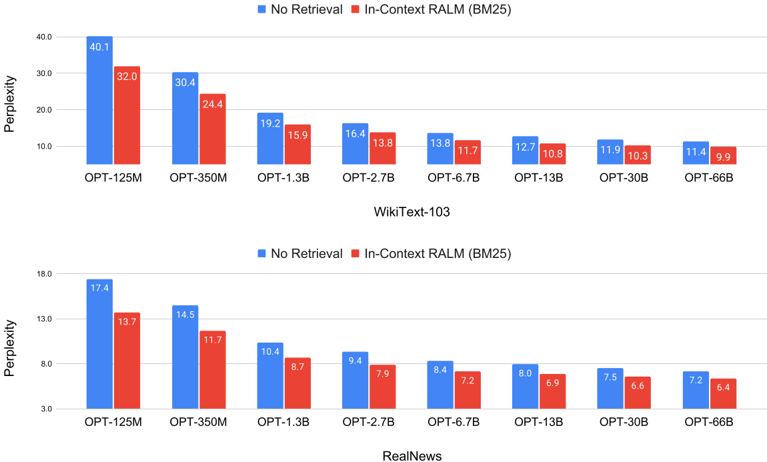
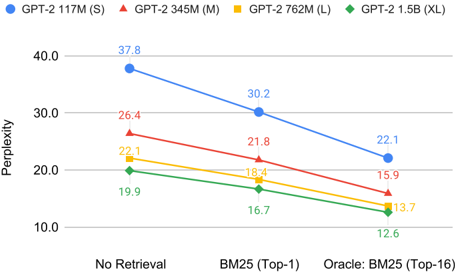
- With BM25 retrieval (`s = 4`, `ℓ = 32`), In-Context RALM improved LM perplexity enough to match a 2–3× larger model; e.g., 6.7B OPT matched 66B OPT, and 345M GPT-2 + BM25 outperformed 762M GPT-2.
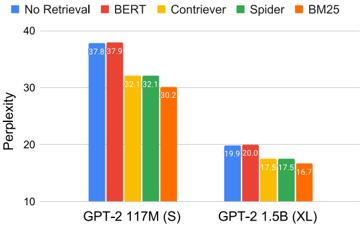
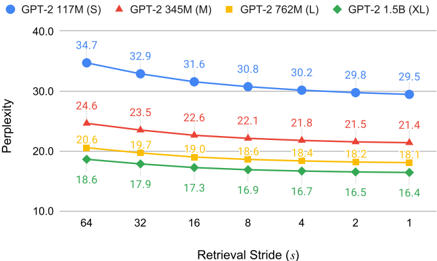
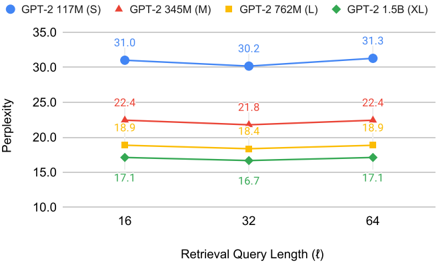
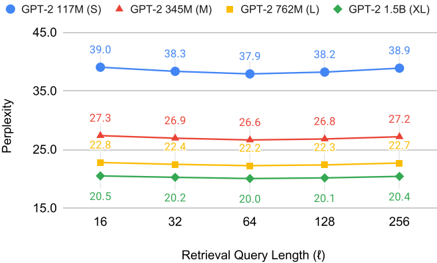
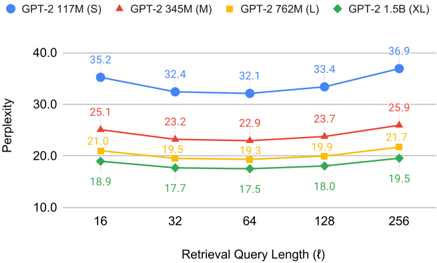
- BM25 outperformed dense retrievers (Contriever, Spider, BERT mean pooling); optimal query length was `ℓ = 32` for BM25 vs. `ℓ = 64` for dense retrievers, and more frequent retrieval (smaller stride) improved performance.
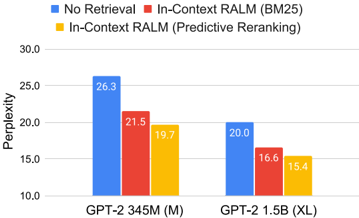
- Predictive reranking improved WikiText-103 word perplexity for GPT-2 110M from 29.6 to 26.8 and GPT-2 1.5B from 16.6 to 15.4; zero-shot reranking also improved over taking the top BM25 document.
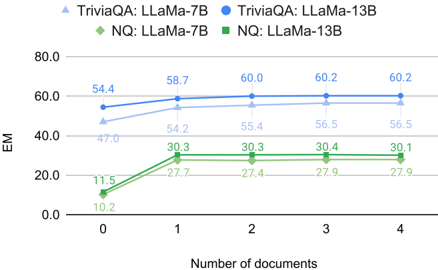
- On ODQA with two DPR documents, LLaMA-13B improved NQ exact match from 12.0% to 31.0% and TriviaQA from 54.8% to 60.1%; LLaMA-33B improved NQ from 13.7% to 32.3% and TriviaQA from 58.3% to 62.7%.
Methods
- Evaluated on five LM datasets (WikiText-103, RealNews, ArXiv, Stack Exchange, FreeLaw) and two ODQA datasets (Natural Questions, TriviaQA), using GPT-2 (110M–1.5B), GPT-Neo/GPT-J (1.3B–6B), OPT (125M–66B), and LLaMA (7B–33B) models with max sequence length 1,024.
- Retrieval corpora: Wikipedia (Dec. 20, 2018) for WikiText-103/ODQA with 120 WikiText dev/test articles removed; training data for other datasets; non-overlapping 100-word passages truncated at 256 tokens. Retrievers: BM25, BERT mean pooling, Contriever, Spider; DPR for ODQA.
- Main analyses measured perplexity on LM datasets and exact match on ODQA; reranking used top-16 BM25 documents, with zero-shot LM reranking and a RoBERTa-base predictive reranker trained for 10,000 steps (peak LR 1e-5, batch 32, 300,000 WikiText-103 examples).
Limitations
- Stated: the paper considers only prepending a single external document; adding more documents could drive further gains. It retrieves every fixed interval of `s` tokens, and future work could retrieve more sparsely (e.g., when a specialized model predicts retrieval is needed) for latency/cost gains.
- Stated: predictive reranking still leaves room compared with top-16 BM25 oracle results; oracle could improve with `k > 16` or stronger RALM-dedicated retrievers.
- Evident: main LM experiments use one document and max sequence length 1,024 despite some models supporting 2,048; the predictive reranker assumes availability of training data from the target corpus and was trained on WikiText-103.
Model-written summary. Check it against the paper before relying on it.
Integrity signals
Registry
Cites
Statistics
Figures

Verification
Claims the paper makes
5 Valid · 4 Not valid · 9 Not checked · 43 Own results and interpretations
The cited sources support only part of this claim — read each source’s verdict below.
In the paper
“Their results are based on training a dedicated retriever for language modeling.”
§ In-Context Retrieval-Augmented Language Models > 1 Introduction
What the sources say
- Partly supportedcites Shi et al., 2023 sourceExperimental — accuracy not yet measured
Section 4 describes training a retriever with language-model supervision for REPLUG LSR, and Section 5.2 gives its training procedure. But the ‘Our model’ results also include REPLUG without that retriever training, so training a dedicated retriever underlies only part of the reported results. The indexed passages provide no page numbers. (LLM, conf=0.88)
plainstates a cause- Asserted: passes — The authors put it forward as true.
- Checkable: passes — It can be checked against evidence.
- Load-bearing: passes — The paper’s conclusions depend on it.
- Based: passes — The paper gives a reason why it holds.
- Partly supported
The cited sources support only part of this claim — read each source’s verdict below.
In the paper
“More importantly, they tend to produce factual inaccuracies and errors (Lin et al., 2022;Maynez et al., 2020;Huang et al., 2020).”
§ In-Context Retrieval-Augmented Language Models > 1 Introduction
What the sources say
- Supportedcites Lin et al., 2022 source
The Introduction (p. 1) explicitly says that recent language models have a tendency to generate false statements, ranging from subtle inaccuracies to hallucinations. The Discussion (p. 8) also reports poor performance by the baseline models on truthfulness questions. (LLM, conf=0.94)
- Partly supportedcites Maynez et al., 2020 sourceExperimental — accuracy not yet measured
Section 5.3 reports that over 90% of hallucinations from the BERTS2S summarization model are erroneous, and the Abstract reports substantial hallucinated content across the evaluated summarization systems. This supports factual errors in those systems, but the claim extends the finding to language models generally, which the paper did not evaluate. (LLM, conf=0.83)
- Partly supportedcites Huang et al., 2020 sourceExperimental — accuracy not yet measured
Section 2.3 (p. 10) says generation-based dialog methods often produce undesirable responses that are ungrammatical or irrelevant, supporting the general point about errors. Section 3.2 (p. 12) stresses grounding responses in real-world facts, but the passages do not establish that language models tend to produce factual inaccuracies specifically; the paper discusses open-domain dialog systems rather than LMs generally. (LLM, conf=0.78)
plain- Asserted: passes — The authors put it forward as true.
- Checkable: passes — It can be checked against evidence.
- Load-bearing: passes — The paper’s conclusions depend on it.
- Based: passes — The paper gives a reason why it holds.
- Supported
The cited sources support only part of this claim — read each source’s verdict below.
In the paper
“Existing RALM approaches focus on modifying the LM architecture in order to facilitate the incorporation of external information, significantly complicating deployment.”
- Also stated in: § 1 Introduction · plain
“Leading RALM systems introduced recently tend to be focused on altering the language model architecture (Khandelwal et al., 2020;Borgeaud et al., 2022;Zhong et al., 2022;Levine et al., 2022c;Li et al., 2022).”
§ In-Context Retrieval-Augmented Language Models > Abstract
What the sources say
- Not matchedcites Khandelwal et al., 2020
Couldn’t be matched to a paper in Crossref, so it can’t be checked.
- Not matchedcites Borgeaud et al., 2022
Couldn’t be matched to a paper in Crossref, so it can’t be checked.
- Partly supportedcites Zhong et al., 2022 sourceExperimental — accuracy not yet measured
The Introduction and §2.2 Memory Augmentation say that several earlier approaches modify Transformer architectures to incorporate memory from previous segments. They do not establish that existing retrieval-augmented language modeling approaches generally focus on architecture changes, or that those changes significantly complicate deployment. (LLM, conf=0.84)
plainstates a cause- Asserted: passes — The authors put it forward as true.
- Checkable: passes — It can be checked against evidence.
- Load-bearing: passes — The paper’s conclusions depend on it.
- Based: passes — The paper gives a reason why it holds.
- Also stated in: § 1 Introduction · plain
The cited sources that could be checked couldn’t confirm or dispute this claim.
In the paper
“All prior work involves training the LM.”
§ In-Context Retrieval-Augmented Language Models > Nearest Neighbor Language Models
What the sources say
- Not matchedcites Lewis et al., 2020
Couldn’t be matched to a paper in Crossref, so it can’t be checked.
- Could not verifycites Izacard and Grave, 2021 sourceExperimental — accuracy not yet measured
The Related work section (p. 2) describes earlier retrieval-augmented QA systems but does not say whether all of them train the language model. The Experiments section (p. 4) says this paper fine-tunes its own pretrained T5 model; that does not establish the claim about all prior work. I searched for discussion of training or freezing the language model in earlier retrieve-and-read systems. (LLM, conf=0.72)
- Not matchedcites Borgeaud et al., 2022
Couldn’t be matched to a paper in Crossref, so it can’t be checked.
plain- Asserted: passes — The authors put it forward as true.
- Checkable: passes — It can be checked against evidence.
- Load-bearing: passes — The paper’s conclusions depend on it.
- Based: passes — The paper gives a reason why it holds.
- Not matched
The cited sources support only part of this claim — read each source’s verdict below.
In the paper
“While they showed significant gains from kNN-LM, the approach requires storing the representations for each token in the corpus, an expensive requirement even for a small corpus like Wikipedia.”
§ In-Context Retrieval-Augmented Language Models > Nearest Neighbor Language Models
What the sources say
- Partly supportedcites Zhong et al., 2022 sourceExperimental — accuracy not yet measured
Section 2.2 defines external memory as context–token pairs from a corpus and says that accessing a memory of roughly 10^8 entries is computationally expensive. The Introduction identifies kNN-LM as using external memory, and Table 2 notes large SSD storage for one retrieval setup. The paper tests on WIKITEXT-103, but these passages do not characterize Wikipedia itself as a small corpus or establish the claimed storage cost for it. (LLM, conf=0.82)
plainstates a cause- Asserted: passes — The authors put it forward as true.
- Checkable: passes — It can be checked against evidence.
- Load-bearing: passes — The paper’s conclusions depend on it.
- Based: passes — The paper gives a reason why it holds.
- Partly supported
42 more claims
Create a free account to see all 61 claims and to verify the 2 references still open.
- Probably not a substantial claim. 9
- The quote only partly states this claim. 3
- It may state two separate claims as one. 4
Claims other papers make about this one
Each is checked against this paper’s own text: does it say what the citing paper says it does?
The source backs part of the claim, not all of it — or backs it for a different population, condition or comparison.
In the citing paper
“or when language models are augmented with external information (relevant documents from a search engine, database query results, etc.; Petroni et al., 2020;Ram et al., 2023;Shi et al., 2023;Mallen et al., 2023;Schick et al., 2023, inter alia).”
From Lost in the Middle: How Language Models Use Long Contexts (2024) · cites this paper as Ram et al., 2023
Experimental — accuracy not yet measuredThe source backs part of the claim, not all of it — or backs it for a different population, condition or comparison.
In the citing paper
“In contrast to fine-tuning, RAG does not seek to adjust the internal parameters (or internal memory) of an LLM.”
From ChatGPT, extended: large language models and the extended mind (2025) · cites this paper as Ram et al., 2023
Experimental — accuracy not yet measuredThe source backs part of the claim, not all of it — or backs it for a different population, condition or comparison.
In the citing paper
“the task of retrieving relevant and precise information from extensive corpora can be computationally demanding and resourceintensive, necessitating continuous updating and modification of knowledge databases to keep pace with the latest information (Chen et al. 2023; Siriwardhana et al. 2023; Ram et al. 2023; Cheng et al. 2024).”
From Large Legal Fictions: Profiling Legal Hallucinations in Large Language Models (2024) · cites this paper as Ram et al. 2023
Experimental — accuracy not yet measuredThe source backs part of the claim, not all of it — or backs it for a different population, condition or comparison.
In the citing paper
“Memory-augmented methods extend this concept by retrieving user-specific information from past interactions. This addresses the challenge of a limited context window and enables the integration of past information into the input prompt [25, 29, 45].”
From CAIM: Development and Evaluation of a Cognitive AI Memory Framework for Long-Term Interaction with Intelligent Agents (2026) · cites this paper as [45]
Experimental — accuracy not yet measuredThe source backs part of the claim, not all of it — or backs it for a different population, condition or comparison.
In the citing paper
“Despite their capabilities, LLMs still have shortcomings, such as a limited context window, which restricts the amount of information that can be processed and thus the ability to understand the ever-changing environment [58, 60] and maintain effective long-term interactions [45, 50].”
From CAIM: Development and Evaluation of a Cognitive AI Memory Framework for Long-Term Interaction with Intelligent Agents (2026) · cites this paper as [45]
Experimental — accuracy not yet measured
9 more claims about this paper
Create a free account to see every claim other papers make about this one.
Self-check
Percentages, sums and reported differences re-computed from the paper’s own numbers.
Each contradiction between two passages listed here was confirmed by an independent check.
Rated minor: it would not touch a result — a value no result rests on, a p-value that stays on the same side of the significance level, or a conflict that is clerical, resolved elsewhere in the paper, or outside its own findings.
In the paper
§ In-Context Retrieval-Augmented Language Models > 8 Discussion
“this paper considers only the case of prepending a single external document to the context”
§ In-Context Retrieval-Augmented Language Models > 7 In-Context RALM for Open-Domain Question Answering
“In the open-book setting, we include the top two documents returned by DPR.”
Rated minor: it would not touch a result — a value no result rests on, a p-value that stays on the same side of the significance level, or a conflict that is clerical, resolved elsewhere in the paper, or outside its own findings.
In the paper
§ In-Context Retrieval-Augmented Language Models > Nearest Neighbor Language Models
“All prior work involves training the LM.”
§ In-Context Retrieval-Augmented Language Models > Nearest Neighbor Language Models
“Levine et al. (2022a) showed competitive open domain question-answering performance by prompt-tuning a frozen LM as a reader.”
Rated minor: it would not touch a result — a value no result rests on, a p-value that stays on the same side of the significance level, or a conflict that is clerical, resolved elsewhere in the paper, or outside its own findings.
In the paper
§ In-Context Retrieval-Augmented Language Models > Model
“Table 3 shows that a small LM (GPT-2 117M) can be used to rerank the documents for all larger GPT-2 models”
§ In-Context Retrieval-Augmented Language Models > Model
“GPT-2 345M (M) GPT-2 110M (S) 20.8 12.1”
Citations
Cites
Vaswani, A., Shazeer, N., Parmar, N., Uszkoreit, J., Jones, L., Gomez, A. N., Kaiser, L., & Polosukhin, I. (2017) · arXiv · doi:10.48550/arxiv.1706.03762 · Cited by 120,404
BERT: Pre-training of Deep Bidirectional Transformers for Language Understanding
Devlin, J., Chang, M.-W., Lee, K., & Toutanova, K. (2019) · Proceedings of the 2019 Conference of the North American Chapter of the Association for Computational Linguistics: Human Language Technologies, Volume 1 (Long and Short Papers) · doi:10.18653/v1/n19-1423 · Cited by 54,325
Language Models are Few-Shot Learners
Brown, T. B., Mann, B., Ryder, N., Subbiah, M., Kaplan, J., Dhariwal, P., Neelakantan, A., Shyam, P., Sastry, G., Askell, A., et al. (2020) · arXiv · doi:10.48550/arxiv.2005.14165 · Cited by 23,372
RoBERTa: A Robustly Optimized BERT Pretraining Approach
Liu, Y., Ott, M., Goyal, N., Du, J., Joshi, M., Chen, D., Levy, O., Lewis, M., Zettlemoyer, L., & Stoyanov, V. (2019) · arXiv · doi:10.48550/arxiv.1907.11692 · Cited by 16,515
Advances in neural information processing systems 7
(1996) · Computers & Mathematics with Applications · doi:10.1016/s0898-1221(96)90463-0 · Cited by 14,281
Advances in Neural Information Processing Systems 29
Teymur, O., Zygalakis, K., & Calderhead, B. (2016) · Cited by 13,887
Transformers: State-of-the-Art Natural Language Processing
Wolf, T., Debut, L., Sanh, V., Chaumond, J., Delangue, C., Moi, A., Cistac, P., Rault, T., Louf, R., Funtowicz, M., et al. (2020) · Proceedings of the 2020 Conference on Empirical Methods in Natural Language Processing: System Demonstrations · doi:10.18653/v1/2020.emnlp-demos.6 · Cited by 8,741
LLaMA: Open and Efficient Foundation Language Models
Touvron, H., Lavril, T., Izacard, G., Martinet, X., Lachaux, M.-A., Lacroix, T., Rozière, B., Goyal, N., Hambro, E., Azhar, F., et al. (2023) · arXiv · doi:10.48550/arxiv.2302.13971 · Cited by 4,602
Billion-scale similarity search with GPUs
Johnson, J., Douze, M., & Jegou, H. (2021) · IEEE Transactions on Big Data · doi:10.1109/tbdata.2019.2921572 · Cited by 4,228 · cited 1×
“For dense retrieval, we applied exact search using FAISS (Johnson et al., 2021).”
MethodBillion-scale similarity search with GPUs
Johnson, J., Douze, M., & Jégou, H. (2017) · arXiv · doi:10.48550/arxiv.1702.08734 · Cited by 4,140
Research works printed but not linked: 1
- Levine, 2022, Huge frozen language models as readers for open-domain question answering
Cited by
Items 301–400 of 452
MARA: A Multimodal Adaptive Retrieval-Augmented Framework for Document Question Answering
Wu, H., Zhai, H., Li, Y., Cai, H., Zhang, P., Zhang, Y., Wang, L., Wang, C., Hou, Y., Wang, S., et al. (2025) · ACM International Conference on Multimedia (ACM MM) · doi:10.1145/3746027.3755390 · Cited by 5
Practical Decisions for Development of Retrieval-Augmented Generation Systems
Deksne, D., & Pinnis, M. (2025) · Lecture notes in networks and systems · doi:10.1007/978-3-032-07986-2_8
Wan, Z., Song, C., Jiao, S., & Luo, X. (2025) · IEEE International Conference on Software Quality, Reliability and Security Companion (QRS-C) · doi:10.1109/qrs-c65679.2025.00055
“Additionally, overly lengthy documents often contain irrelevant or redundant information, introducing noise that negatively impacts the accuracy and robustness of the LMs [2], [3].”
Luo, X., Xu, G., Saroj, A., Yuan, J., Kadav, P., Shao, Y., & Wang, C. R. (2026) · Artificial Intelligence for Transportation · doi:10.1016/j.ait.2026.100057 · Cited by 2
A Visualization System for LLM-based Fault Entity Extraction of Power Equipment
You, L., Guo, X., Wang, D., Zhang, Z., Zhong, K., Chen, N., & Wang, H. (2025) · doi:10.1109/icbdse65491.2025.11220034
RACG-DRT: Retrieval Augumented Code Generation Based on Dynamic Revision of Thoughts
Shang, J., Zhang, C., & Zhang, Y. (2025) · 2025 IEEE 2nd International Conference on Big Data Science and Engineering (ICBDSE) · doi:10.1109/icbdse65491.2025.11220101
“ICRLM [8] performs retrieval at each sentence generated during model reasoning to provide sufficient context for subsequent generations.”
GRAIL: Guided Retrieval via Layer-Wise Discrepancy from Extrapolated Final Distributions
Liu, K., Zhang, H., Liu, Z., & Zhou, S. (2025) · Lecture notes in computer science · doi:10.1007/978-981-95-4384-7_8
Zhang, Y., Zhang, J., Xu, L., Lu, Y., Long, Y., Wang, B., & Jin, P. (2025) · Lecture notes in computer science · doi:10.1007/978-981-95-3349-7_13 · Cited by 1
Puzhou, W., Pan, H., & Bo, J. (2025) · International Joint Conference on Neural Networks (IJCNN) · doi:10.1109/ijcnn64981.2025.11227710
“Compared against instruction-guided RAG baselines such as Retrieval-Augmented Language Modeling (RALM [31]) and Instruction-Guided Few-Shot Demonstration, with Meta’s Llama-3-8B-Instruct as the base model, the instruction de-noising model consistently outperformed other baselines in accuracy.”
Attacking RAG Systems in Multiple Domains with Locally Running and Automatic Procedures
Maio, C. D., & Melacci, S. (2025) · International Joint Conference on Neural Networks (IJCNN) · doi:10.1109/ijcnn64981.2025.11228722
“A Retrieval-Augmented Generation (RAG) system comprises a pipeline of interconnected modules [19], designed to collaboratively generate user responses that extend beyond the pre-training knowledge of a language model (LLM).”
Beyond Similarity: Aligning Retrieval with Generation for Enhanced Image Captioning
Yang, G., Wu, D., An, J., Xiao, S., & Lin, Z. (2025) · International Joint Conference on Neural Networks (IJCNN) · doi:10.1109/ijcnn64981.2025.11227734 · Cited by 1
“Retrieval-augmented generation initially emerged in natural language processing to address key limitations of large language models (LLMs), including their high resource demands, susceptibility to hallucination, and difficulty handling long-tail distributions [23], [24].”
LLM-Driven Information Integrity Preserving Segmentation for Cybersecurity Long DocumentsPreprint
Mei, G., Lin, J., Fu, W., Jian, L., Chen, C., & Wu, Y. (2025) · SSRN Electronic Journal · doi:10.2139/ssrn.5807310
Uncovering Resilient Behavior in the Aviation Safety Reporting System Using Large Language Models
Matthews, B. (2025) · doi:10.1109/dasc66011.2025.11257328
“Additionally, the prompt can be augmented with in-context [13] examples of what the user would like to retrieve from the provided report.”
WITHDRAWN: CCTAgent: Few-Shot Cloaked Chinese Toxic Text Detection with LLM Agents
Guo, B., Liu, M., Tu, C. S., et al. (2025) · Expert Systems with Applications · doi:10.1016/j.eswa.2025.130673
RetractedYapa, P., Liang, Z., & Piumarta, I. (2025) · ACM Transactions on Computing for Healthcare · doi:10.1145/3779213
Knowledge Editing of Large Language Models Unconstrained by Word Order
Ishigaki, R., Suzuki, J., Shuzo, M., & Maeda, E. (2025) · Journal of Natural Language Processing · doi:10.5715/jnlp.32.1062
Retrieval Augmented Thought Process for Private Data Handling in Healthcare
Pouplin, T., Sun, H., Holt, S., & van der Schaar, M. (2025) · IEEE Journal of Biomedical and Health Informatics · doi:10.1109/jbhi.2025.3645636 · Cited by 17
“Alternatively,Retrieval-AugmentedGen-eration[19],[60]leveragesLLMs’in-contextlearningabil- itiestointegrateIRdatawithoutextensiveadditionaltrain-ing, thus avoiding sensitive data leaks.”
InfluentialFalseCoTQA: Adversarial Multi-Hop QA via Knowledge-Grounded False Chains of Thought
Serbanescu, J., Alavi, M. A. A., Ensan, F., & Zarrinkalam, F. (2025) · Annual International ACM SIGIR Conference on Research and Development in Information Retrieval in the Asia Pacific Region (SIGIR-AP) · doi:10.1145/3767695.3769494 · Cited by 2
MRM: Improving Multihop Reasoning Capability for LLMs With Multistage QA Retrieval
Li, W., Zhang, Y., Sun, G., Ma, C., Qiang, J., & Shen, J. (2025) · IEEE Transactions on Emerging Topics in Computational Intelligence · doi:10.1109/tetci.2025.3642285
“RAG and its variants [7], [12], [13], [19] usually decouple the posed question into sub-questions, and then retrieve the documents, based on the decoupled sub-questions.”
InfluentialAuto-prompting with Retrieval Guidance for Frame Detection in Logistics
Do, D. M., Truong, Q. X., Dat, N. T., & Vinh, N. V. (2026) · Communications in computer and information science · doi:10.1007/978-981-92-2597-2_26
Principles and Applications of Prompt Engineering for Industrial Systems
Larraz, R. (2026) · Synthesis lectures on chemical engineering and biochemical engineering · doi:10.1007/978-3-031-99728-0_4
Unlocking In-Context Learning for Natural Datasets Beyond Language Modelling
Bratulić, J., Mittal, S., Hoffmann, D. T., Böhm, S., Schirrmeister, R. T., Ball, T., Rupprecht, C., & Brox, T. (2026) · Lecture notes in computer science · doi:10.1007/978-3-032-12840-9_20 · Cited by 4
“Given its rapid adaptation capabilities, it has become a standard way for humans to interact with language models for everyday use and has found various applications in different domains [1, 40, 43, 46, 52].”
Pavate, A. A., Mourya, V., Digra, M., Kumavat, K., & Jalalov, M. (2026) · Lecture notes in networks and systems · doi:10.1007/978-3-032-10400-7_37
M o N a C o : More Natural and Complex Questions for Reasoning Across Dozens of Documents
Wolfson, T., Trivedi, H. K., Geva, M., Goldberg, Y., Roth, D., Khot, T., Sabharwal, A., & Tsarfaty, R. (2026) · Transactions of the Association for Computational Linguistics · doi:10.1162/tacl.a.64 · Cited by 19
Alabtah, G., Alsaafin, A., Alfasly, S., Shafique, A., Hemati, S., Choudhary, A., Iyer, R. K., DiCaudo, D. J., Nelson, S. A., Stockard, A. L., et al. (2026) · medRxiv · doi:10.64898/2026.01.02.26343356
Mazaheri, S., Dadashzadeh, A., Alankesh, A. N., & Dividino, R. (2025) · IEEE International Conference on Collaborative Advances in Software and Computing (CASCON) · doi:10.1109/cascon66301.2025.00112 · Cited by 1
“Retrieval-Augmented Generation (RAG) [2]–[5] addresses some of these limitations by augmenting LLMs with exter-nal contextual information, which it identifies and retrieves from relevant documents within a vast corpus.”
Spatial-Temporal Multimodal Large Language Model for Generative Recommendation in Alipay
Xu, Y., Yang, Z., Li, Y., Zhu, Z., Weng, Z., Zhao, J., Ma, C., Ye, J., & Zhao, Y. (2026) · IEEE Transactions on Knowledge and Data Engineering · doi:10.1109/tkde.2026.3658153 · Cited by 2
“This flexibility allows system designers to efficiently adapt LLMs to various tasks [5], [6].”
Wang, Y., Wu, J., Jiang, T., Liu, M., Chen, T., Wang, C., Shi, E., Liu, X., Ma, Y., & Zheng, Z. (2025) · IEEE/ACM International Conference on Automated Software Engineering (ASE) · doi:10.1109/ase63991.2025.00070 · Cited by 3
“This approach addresses limitations such as knowledge hallucination and context length constraints, making RAG particularly effective for knowledge-intensive tasks [2], [15], [44].”
Trindade, A. A., Neves, J. P., & de Andrade, T. L. (2025) · doi:10.5753/eri-mt.2025.17250
“Ram et al. (2023) evidenciam que a incorporação de informações recuperadas dinamicamente melhora o desempenho em tarefas de pergunta e resposta em domínios especializados.”
InfluentialA Method for Improving Retrieval Effectiveness in RAG
Zhou, X., Li, Z., Jiang, R., Xu, C., & Shao, C. (2025) · IEEE International Conference on Data Science in Cyberspace · doi:10.1109/dsc67331.2025.00071
“In-Context RALM [12] uses the BM25 algorithm for document retrieval and reordering to select documents relevant to input integration.”
Multi-Modal Requirements Data-based Acceptance Criteria Generation using LLMs
Wang, F., Arora, C., Liu, Y., Huang, K., Tantithamthavorn, C. K., Aleti, A., Sambathkumar, D., & Lo, D. (2025) · IEEE/ACM International Conference on Automated Software Engineering (ASE) · doi:10.1109/ase63991.2025.00275 · Cited by 9
“In our work, we experiment with two different T-RAG alternatives – SentBERT (as discussed above) and ICRALM (In-Context Retrieval-Augmented Language Models) [28].”
Zhao, X., Yang, S., Tang, B., & Jiang, R. (2026) · IEEE Transactions on Affective Computing · doi:10.1109/taffc.2026.3660288 · Cited by 1
“The reference context offered by similar samples can provide more richer information for multimodal feature enhancement compared to intra-sample multimodal interaction learning [17], [18], [19], [20], [21].”
A Method for Enhancing Knowledge Retrieval in Typical Power Scenarios Based on BFS Algorithm
Shao, B., Yao, Y., Zhang, Z., Wang, S., & Zhang, Z. (2025) · International Conference on Electrical Engineering and Control Science (IC2ECS) · doi:10.1109/ic2ecs68700.2025.11362021
“Ram O et al. studied context retrieval enhanced language models, but the complexity of context modeling and retrieval computation is high, resulting in reduced retrieval efficiency [4] .”
From Keywords to Context: An AI Agent for Natural Language Document Lookup in the Enterprise
Ngoc, H. L. (2025) · RIVF International Conference on Computing and Communication Technologies (RIVF) · doi:10.1109/rivf68649.2025.11365175
“This approach dynamically grounds model responses in external, non-parametric knowledge sources, bridging a critical gap for knowledge-intensive NLP tasks [9].”
GraphRAG-V: Fast Multi-hop Retrieval via Text-Chunk Communities
Yu, T., Srinivasan, V., & Thomo, A. (2026) · Lecture notes in computer science · doi:10.1007/978-3-032-14107-1_1
CRAWLDoc: A System for Contextual Ranking and Bibliographic Metadata Extraction from Web Resources
Karl, F., & Scherp, A. (2026) · Information Retrieval Research · doi:10.54195/irrj.23861
Improving Retrieval-Augmented Generation for Medical Literature: A Case Study on Pertussis Research
Takabatake, H., Martono, N. P., Kuwae, A., Iuchi, T., & Ohwada, H. (2025) · International Conference on Information & Communication Technology and System (ICTS) · doi:10.1109/icts67612.2025.11369608
“Recent advances in Retrieval-Augmented Generation (RAG) [2], [3] offer a promising direction.”
Xing, Y., Zhang, Z., Chang, H., Shang, D., & Gupta, B. (2026) · Journal of Knowledge Management · doi:10.1108/jkm-08-2025-1196 · Cited by 1
Darmawan, H., Yudistira, N., Setyawan, G. E., et al. (2026) · SSRN Electronic Journal · doi:10.2139/ssrn.6253709
Adaptive retrieval-enhanced generation system based on query complexity awareness
柴敬尧, CHEN, Z., Li, T., & Zhang, C. (2025) · International Conference on Artificial Intelligence and Computer Engineering (ICAICE) · doi:10.1109/icaice68195.2025.11382483
“The first type consists of single-hop queries [10][11], where the answer is typically contained within a single document.”
Topic Models Meet LLMs: Generating Insightful Questions from User Feedback
Zhang, D., Wang, Y., Nayak, R., & Bashar, M. A. (2026) · Communications in computer and information science · doi:10.1007/978-981-95-6888-8_14
Pardhi, N., Hajare, S., Chute, T., S, M. A. P., Agade, N., & Timande, D. (2025) · DMIHER International Conference on Artificial Intelligence in Healthcare, Education and Industry (IDICAIHEI) · doi:10.1109/idicaihei65991.2025.11378806
“These can be summarized as a low degree of real-world validation, privacy issues, interpretability risks of models, regulation issues, and the threat of producing erroneous and/or misleading results [14], [16], [22], [25].”
Lai, X., Pan, X., Su, Y., & Zhang, G. (2025) · International Conference on Artificial Intelligence, Robotics, and Communication (ICAIRC) · doi:10.1109/icairc68035.2025.11384878
“Jiang et al. [14] compressed external documents to retain only highly relevant content, while Xu et al. [15] demonstrated that models remain robust even with zero-length retrievals.”
Wang, Y., Wang, T., Liu, Q., Fan, W., Jiao, J., Claudel, C., Yan, Y., Gao, B., Wang, J., & Chen, H. (2026) · Communications in Transportation Research · doi:10.26599/commtr.2026.9640012 · Cited by 2
MUATC: Multi-Agent Utilization to Augment Test Coverage
Ma, T., Liu, S., Dong, W., Liu, J., & Zhang, Y. (2025) · Asia-Pacific Software Engineering Conference (APSEC) · doi:10.1109/apsec66846.2025.00028
“In practice, RAG technology is feasible and efficient for various generation tasks, requiring only simple adjustments to the retrieval component with minimal additional training [30].”
Mitigating Privacy Issues in RAG through Causal Disentanglement
Wang, J., Pei, S., Cong, K., & Rodrigues, J. J. P. C. (2025) · IEEE International Conference on Big Data (BigData) · doi:10.1109/bigdata66926.2025.11402042
Evaluating Large Language Models in Retrieval-Augmented Tutoring Systems: Methods and Emerging Tools
Bhat, O., Jeelani, Z., Rabani, S. T., Saif, S. M., & Lone, N. A. (2026) · SN Computer Science · doi:10.1007/s42979-026-04789-w
Towards Self-Evolving Agents: A Dual-Process Framework for Continual Context Refinement
Teng, L., Ni, W., Song, L., Shi, J. F., & Li, Y. (2026) · Electronics · doi:10.3390/electronics15061232 · Cited by 1
Akkaya, A. (2026) · Akıllı Ulaşım Sistemleri ve Uygulamaları Dergisi · doi:10.51513/jitsa.1848120 · Cited by 1
RAG-Driven Framework for Digraph-Based Automated Assembly Process Generation
Tian, S., Yu, D., Liu, Z., Cui, L., Li, Z., & Liu, H. (2025) · IEEE International Conference on Computer and Communications (ICCC) · doi:10.1109/iccc68654.2025.11437599
“Additionally, the frequency of RAG should be appropriately set according to the specific task [17].”
Mbounkap, J., Djigo, H., Masheh, T., Nzooh, A., & Kar, A. (2026) · Advances in computational intelligence and robotics book series · doi:10.4018/979-8-3373-7685-1.ch013 · Cited by 1
Turbocharging Brazilian Mergers and Acquisitions: Questions & Answers Evaluation
Rubin, F. S., Moura, P. N. D. S., & Alvim, A. C. F. (2026) · Journal of the Brazilian Computer Society · doi:10.5753/jbcs.2026.5703
Fadillah, A., Athahirah, N., & Lai, K.-T. (2026) · Data Technologies and Applications · doi:10.1108/dta-03-2025-0195
Noise, Distraction, and Mitigation: An Analysis of RAG Failure Modes in Medical Question Answering
Rahat, M. T. I., Safowan, R., Abir, M., & Rahman, R. M. (2026) · International Conference on Artificial Intelligence in Information and Communication (ICAIIC) · doi:10.1109/icaiic68212.2026.11454362
“Since then, researchers have shown that it is quite useful across a range of tricky NLP tasks, such as, asking a computer to come up with answers to questions on the fly and fact checking [4], [13], [14].”
Cheng, H., Wang, K., Wang, Q., Liu, T., & Sheng, K. (2026) · Engineering Applications of Artificial Intelligence · doi:10.1016/j.engappai.2026.114670 · Cited by 4
Peng, W., Chen, X., Fu, H., He, X., Wen, J., & Xue, Y. (2025) · International Conference on Cyber Resilience and Endogenous Safety & Security (CRESS) · doi:10.1109/cress68073.2025.11452349
“For instance, Ram et al [26] kept the LLM parameters unchanged and directly”
Attribution Techniques for Mitigating Hallucinated Information in RAG Systems: A Survey
Zhao, Y., Liu, Z., Zheng, Y., & Lam, K. (2026) · International Conference on Artificial Intelligence in Information and Communication (ICAIIC) · doi:10.1109/icaiic68212.2026.11454197 · Cited by 5
“Pi-Taxonomy (Azariaand Mitchell,2023); IFL(Leeetal., 2023);Self-CheckGPT (Manakuletal., 2023);RLKF (Liangetal., 2024) VUC (Ji et al., 2025) WebCPM (Qin et al., 2023); SmartBook (Reddyetal., 2023) LLM-Augmenter (Pengetal., 2023);DPR ( .,2020); WebGPT (Nakanoetal., 2021);Web-Brain(Qian etal.,2023a); RAG(Lewis etal.,2020…”
InfluentialJoshi, A., Verma, N. K., & Hadımlıoğlu, İ. A. (2025) · IEEE Uttar Pradesh Section International Conference on Electrical, Electronics and Computer Engineering (UPCON) · doi:10.1109/upcon66414.2025.11453720 · Cited by 1
“RAGs could be described as a dense retrieval system (e.g., FAISS [21]) combined with generative models to reduce the hallucination issues [6], [20].”
Wang, Z., Liu, R., & Fu, J. (2026) · Synthesis lectures on human language technologies · doi:10.1007/978-3-032-06264-2_5
Towards efficient Knowledge Graph-based Retrieval Augmented Generation for conversational agents
Schaeffer, M. (2025) · theses.fr (ABES) · doi:10.70675/d674545fzad62z4631z9327zab503346771d · Cited by 1
Contributions to evaluating and improving the faithfulness for text generation
Zhang, K. (2025) · theses.fr (ABES) · doi:10.70675/28453a20z78f2z4fa2za6edz700065e69e97
Research on Citizen Privacy Risk Assessment Method Based on Retrieval-Augmented GenerationPreprint
Qu, J., & Luo, F. (2026) · Research Square · doi:10.21203/rs.3.rs-9015963/v1
From Symbols to Synapses: The Reemergence of Agency in the Large Language Model Era
An, B. (2026) · IEEE Intelligent Systems · doi:10.1109/mis.2026.3668397
“36,58 The main design questions are what to store, at what granularity, and how to retrieve selectively.”
Auto-Generating Personas from User Reviews in VR App Stores
Wáng, Y. X. J., Cheng, K., Liu, X., et al. (2026) · Extended Abstracts of the CHI Conference on Human Factors in Computing Systems (CHI EA) · doi:10.1145/3772363.3798395
Glanceable Verification Indicators for AI-Assisted Storytelling
Xu, M., Zhao, Z., Zeng, J., Wang, T. Y., Panetta, F., Fiebrink, R. A., Bryan–Kinns, N., & Grierson, M. (2026) · CHI Conference Extended Abstracts on Human Factors in Computing Systems (CHI EA) · doi:10.1145/3772363.3798491
“…Generation (RAG) can mitigate hallucinations by incorporating verified external information into the generation process [13, 19, 21, 28, 29, 36, 38, 43], RAG systems remain vulnerable to ambiguous queries and noisy sources [9, 16, 21], potentially generating unreliable outputs [37, 43].”
Zhang, M., Qin, X., Jia, Z., Wang, S., & Yang, W. (2026) · International Symposium on Computer Applications and Information Systems (ISCAIS) · doi:10.1109/iscait69154.2026.11477468
“Retrieval-Augmented Generation (RAG) has emerged as a promising solution by incorporating external knowledge to enhance answer accuracy and reliability [2].”
Hi-Reader: A Hierarchical Cognitive Framework for Multi-Page Document Visual Question Answering
Liu, Q., Fan, H., Zhang, J., Li, X., Li, C., & Li, B. (2026) · IEEE International Conference on Acoustics Speech and Signal Processing · doi:10.1109/icassp55912.2026.11463322
Intelligent Parsing and Risk Identification for Legal Texts Using Artificial Intelligence
Li, J. (2026) · International Conference on Informatics Education and Computer Technology Applications (IECA) · doi:10.1145/3802133.3802288
“…workflow that unifies four components: (i) layout-and structure-aware segmentation, (ii) clause and entity extraction with legal encoders, (iii) retrieval-augmented evidence alignment to statutes and policy rules [10], and (iv) evidence-aware risk aggregation with reviewer-friendly explanations.”
RAGDiffusion: Faithful Cloth Generation via External Knowledge Assimilation
Li, Y., Tan, X., Shang, W., Wu, Y., Wang, J., Chen, X., Zhang, Y., Zhu, H., & Ni, B. (2025) · IEEE/CVF International Conference on Computer Vision (ICCV) · doi:10.1109/iccv51701.2025.01624 · Cited by 14
“We propose RAGDiffusion, as a Retrieval-Augmented Generation (RAG) [40] paradigm including two processes: information aggregation based on retrieval, and conditional generation with omni-level fidelity, to address the issue of structural and texture distortion respectively.”
LLM-S2KG: LLM-Based Semantic–Structural Dual Knowledge Graph
Jiang, J., & Jiang, X. (2026) · Applied Sciences · doi:10.3390/app16104720 · Cited by 1
Shi, P., Shui, Y., Jin, R., & Pan, Q. (2026) · Journal of King Saud University - Computer and Information Sciences · doi:10.1007/s44443-026-00825-0 · Cited by 1
“Baseline In this paper, we compare our approach against several representative baselines: three pure retrieval-based RAG models–FL-RAG (Ram et”
GPS: Revisiting the Data Layout for Disk-based High-Dimensional Vector Search
Yin, P., Yan, X., Zhou, Q., Li, H., Li, X., Wang, M., Zhang, L., Yao, X., & Cheng, J. S.-C. (2026) · Proceedings of the ACM on Management of Data · doi:10.1145/3802069 · Cited by 12
“ANNS is crucial for many applications, including recommendation [27, 92], content search (e.g., for images and videos) [39, 81], retrieval-augmented generation (RAG) for large language models (LLMs) [4, 43, 56], and bio-informatics [63, 64].”
范琳煊, Li, P. H., Wang, Q., Zhang, J., Wang, S., Liu, Y., & Wan, J. (2026) · Progress in Natural Science Materials International · doi:10.1016/j.pnsc.2026.04.008
Zhang, B.-L. (2026) · Journal of Future Artificial Intelligence and Technologies · doi:10.62411/faith.3048-3719-377 · Cited by 1
Polymeros, K., Zygouris, N. C., Tziritas, N., & Dadaliaris, A. N. (2026) · International Congress on Human-Computer Interaction, Optimization and Robotic Applications (ICHORA) · doi:10.1109/ichora69329.2026.11537083
“[13] More specifically, retrieval-augmented language modeling methods (RALM) such as the In-Context RALM proposed by Ori Ram et al. [24] might both detect grammatical mistakes with safety and create their own authentic text.”
Making Sense of Sensors: Improving LLM Interpretation of Time-Series Data
Rico, A., & Larson, K. (2026) · AI Sensors · doi:10.3390/aisens2020007
MTDW-RAG: A Tree-Structured Medical Q&A Approach Combining Deep Progression and Wide Exploration
Chen, R. (2026) · Lecture notes in electrical engineering · doi:10.1007/978-981-95-4897-2_12
Unlocking In-Context Learning for Natural Datasets Across Modalities
Bratulić, J., Mittal, S., Hoffmann, D. T., Böhm, S., Schirrmeister, R. T., Ball, T., Rupprecht, C., & Brox, T. (2026) · International Journal of Computer Vision · doi:10.1007/s11263-026-02913-0
“…way how humans interact with language models for everyday use (Agarwal et al., 2024; Long et al., 2023; Min et al., 2022; Pawelczyk et al., 2024; Ram et al., 2023), as well as for vision-language models (VLMs) (Alayrac et al., 2022; Laurençon et al., 2023; Sun et al., 2023), and even tabular…”
Legal-TREND: Uncertainty Trend Modeling with Domain-Aware Retrieval for Legal Question Answering
Shu, S., Zhong, J., Fang, J., & Li, J. (2026) · International Seminar on Artificial Intelligence, Networking and Information Technology (AINIT) · doi:10.1109/ainit70033.2026.11557610
“Dynamic methods attempt to retrieve during generation: In-Context RALM [10] at fixed token intervals, IRCoT [11] at sentence boundaries, and FLARE [4] when any token’s probability drops below a threshold.”
Zhai, W., Qiu, J., Wang, Q., Li, B., & Zhang, H. (2026) · AI · doi:10.3390/ai7060229
Balancing Relevance and Diversity in k-Maximum Inner Product Search
Huang, Q., Wang, Y., Sun, Y., et al. (2026) · The VLDB Journal · doi:10.1007/s00778-026-00982-8
“The k -Maximum Inner Product Search ( k MIPS) is a fundamental problem with wide data-intensive applications, such as recommender systems [25, 48, 73, 81, 88, 90], information retrieval [58, 82], and retrieval-augmented generation [10, 39, 55, 77].”
Zhao, Y., Zhang, T., Xing, H., Wong, D. F., Li, J., & Fang, T. (2026) · Information Processing & Management · doi:10.1016/j.ipm.2026.105001 · Cited by 2
Mohsin, H. M. M., Jamil, R., Qazi, F., Agha, D. E. S., Aslam, S., & Kumar, J. (2026) · International Conference on Information Science and Communication Technology (ICISCT) · doi:10.1109/icisct67740.2026.11576401
“Standard RAG has two major drawbacks: • It loses broader context when given a large document[4].”
Glyph formation fused contrastive learning for few-shot ancient Chinese seal recognition
Shi, Y., Wu, T., Liu, J., et al. (2026) · Applied Soft Computing · doi:10.1016/j.asoc.2026.115855
Xian, Y., Hua, L., & Yan, S. (2026) · International Symposium on Computer Technology and Information Science (ISCTIS) · doi:10.1109/isctis70043.2026.11572463
“…evolve from monolithic vector-only pipelines to modular designs that integrate structured knowledge graphs and adaptive routing strategies [1], [4], the evaluation methodology must simultaneously diagnose the contribution of each module and the stability of the overall output distribution [7].”
Pookduang, P., & Chansanam, W. (2026) · Computers · doi:10.3390/computers15070427 · Cited by 1
Sui, Y., Li, C., Zhang, L., Song, D., & Liu, H. (2026) · ACM Transactions on Information Systems · doi:10.1145/3827609
“Early RAG approaches predominantly rely on single-round retrieval, treating the query as an indivisible unit and directly prepending retrieved content to the prompt [3, 23, 29].”
Tang, W., Gui, T., Ma, H., & Chen, M. (2026) · International Conference on Computer Supported Cooperative Work in Design (CSCWD) · doi:10.1109/cscwd68734.2026.11581585
Trust the Eye or the Crowd? Unveiling Conformity in Multimodal Large Language Models
Luo, H., Niu, Y., Liu, H., Sun, Y., Yang, Z., Chen, T., Liu, D., Miao, Y., 周景师, Zhang, H., et al. (2026) · International Conference on Computer Supported Cooperative Work in Design (CSCWD) · doi:10.1109/cscwd68734.2026.11582657
“To address this issue, researchers have proposed methods such as Retrieval-Augmented Generation (RAG) to provide LLMs with real-time external evidence [22]– [24].”
Security Assurance Based on Large Language Models
Radicchi, T., Luzzara, M., Ardagna, C. A., & Anisetti, M. (2026) · Lecture notes on data engineering and communications technologies · doi:10.1007/978-3-032-30573-2_23
MCP Servers for Pyserini and RankLLM: Enabling Agentic Retrieval-Augmented Generation
Ge, Y., Guo, Z., Sharifymoghaddam, S., & Lin, J. (2026) · International ACM SIGIR Conference on Research and Development in Information Retrieval (SIGIR) · doi:10.1145/3805712.3808376 · Cited by 1
“As large language models (LLMs) continue to advance, retrieval-augmented generation (RAG) [16, 20, 34] has emerged as a dominant use case for search technology, incorporating search results as external context to improve grounding.”
Incentivizing Retrieval-Augmented Generation via Inner Adaptive Context Selection
Cui, C., Shen, L., Fan, H., Zhu, S., Dai, F., & Li, B. (2026) · International ACM SIGIR Conference on Research and Development in Information Retrieval (SIGIR) · doi:10.1145/3805712.3809671
AdversarialCoT: Single-Document Retrieval Poisoning for LLM Reasoning
Song, H., Liu, Y.-A., Zhang, R., Guo, J., de Rijke, M., Fan, Y., & Cheng, X. (2026) · International ACM SIGIR Conference on Research and Development in Information Retrieval (SIGIR) · doi:10.1145/3805712.3809838 · Cited by 4
EMS-GL: Adaptive Evict-then-Merge Strategy for KV Cache Compression Based on Global-Local Importance
Li, Y., Li, Y., Meng, Y., Ma, X., Geng, Z., Xia, S., & Wang, Z. (2026) · Lecture notes in computer science · doi:10.1007/978-981-92-2759-4_32
SARAG: Sufficiency-Aware Retrieval Augmented Generation
Zheng, Z., Zhang, Y., Wang, Y., Luo, W., & Zuo, L. (2026) · Lecture notes in computer science · doi:10.1007/978-981-92-3417-2_37
TRACER: Temporal retrieval-augmented contextual evaluator for robustness in ML training
shin, J., Jang, J., Park, S., Lee, J., & Choi, D. (2026) · Expert Systems with Applications · doi:10.1016/j.eswa.2026.133668
Retrieval-Augmented Generation Based Framework for Automated RFP Response Generation
Jamal, S., George, N. J., Menon, R. R., Niranjana, N., & Muhammed, P. A. A. (2026) · International Conference on Computing, Communication, Security and Intelligent Systems (IC3SIS) · doi:10.1109/ic3sis69949.2026.11608289
“Multi-query search and embedding augmentation are advanced methods that help to increase search coverage [15], [20].”
Nguyen, T. N.-B., & Phan, T. H. V. (2026) · Journal of Intelligent & Fuzzy Systems · doi:10.1177/18758967261468810
Swapnil, M. (2026) · Research Square · doi:10.21203/rs.3.rs-10485171/v1
Afisi, O. T., Olabanjo, O. A., & Wusu, A. S. (2026) · Journal of Artificial Intelligence · doi:10.3923/jai.2026.60.71
Metadata
- Authors
- Ram, O., Levine, Y., Dalmedigos, I., Muhlgay, D., Shashua, A., Leyton-Brown, K., & Shoham, Y.
- Affiliations
- AI21 Labs, Israel. orir@ai21.com
- AI21 Labs, Israel. yoavl@ai21.com
- AI21 Labs, Israel. itayd@ai21.com
- AI21 Labs, Israel. dorm@ai21.com
- AI21 Labs, Israel. amnons@ai21.com
- AI21 Labs, Israel. kevinlb@ai21.com
- AI21 Labs, Israel. yoavs@ai21.com
- Corresponding author
- Ram, Ori
- Levine, Yoav
- Dalmedigos, Itay
- Muhlgay, Dor
- Shashua, Amnon
- Shoham, Yoav
- Venue
- Transactions of the Association for Computational Linguistics
- Publisher
- MIT Press
- Published
- 2023
- Volume
- 11
- Pages
- 1316-1331
- ISSN
- 2307-387X (ISSN-L)
- OpenAlex
- W4388778348
- Cited by
- 449
- References
- 55
- Citations by year
- 2026: 160 · 2025: 189 · 2024: 80 · 2023: 20
- FWCI
- 42.21
- Type
- journal article
- Language
- en
- Open access
- diamond
- doi.org
- Locations
- Transactions of the Association for Computational Linguistics (publishedVersion, cc-by)
- arXiv (Cornell University) (submittedVersion, public-domain)
- DOAJ (DOAJ: Directory of Open Access Journals) (submittedVersion, cc-by-sa)
- arXiv (Cornell University) (public-domain)
- Topics
- Physical Sciences › Computer Science › Artificial Intelligence › Topic Modeling
- Physical Sciences › Computer Science › Information Systems › Information Retrieval and Search Behavior
- Physical Sciences › Computer Science › Artificial Intelligence › Natural Language Processing Techniques
- Keywords
- retrieval-augmented language models, document retrieval, document ranking, factual accuracy, source attribution, pre-trained language models, large language models
About these checks
Registry, retraction, Cites and statistics results are computed, not judged, with one exception: a printed reference that no index lists is read once by a model before it counts as a citation error. Claims are extracted by a model and kept only when their quote appears verbatim in the text; each cited source is then checked, with a model’s help, for whether it says what the claim relies on. Those verdicts can be wrong — read the claim’s quote and the cited source before relying on one.
The claim verdicts this report counts are experimental: their accuracy is not yet measured.
A language model drew the claims from the paper on 2026-10-10, under version 3 of the claim definition (model deepseek-v4.1-flash, prompt extract-v3).
A second model labelled each claim on 2026-10-10 (model jev-1.13-20260917, definition revision gold-guideline-v0.2).
Cited sources are checked with a language model’s help (gpt-6-sol).
Statistics and arithmetic are recomputed, not judged.
Confidence bands are shown only for fields calibrated on our annotated test set. None is calibrated yet, so no band is shown.
What counts as a claim ›How we measure confidence ›How we check this ›
Are you an author, or do you see a problem with this page? Request a review
Data sources
Bibliographic data: Semantic Scholar, OpenAlex, Crossref.
Contains information from the Semantic Scholar Academic Graph Datasets, made available under the ODC Attribution License (ODC-BY 1.0).
Semantic Scholar’s data is described in: Kinney, R., et al. (2023). The Semantic Scholar Open Data Platform. arXiv:2301.10140.
