

The DOI matches its Crossref record; 4 of the 4 references it cites were found in a registry or an index.
A Phase 3 Open-Label Study of Elexacaftor/Tezacaftor/Ivacaftor in Children 6 through 11 Years of Age with Cystic Fibrosis and at Least One F508del Allele
Abstract
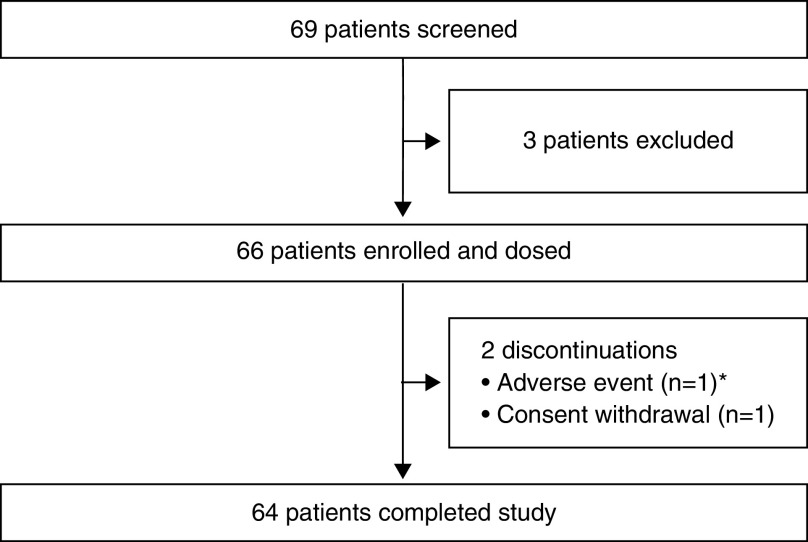
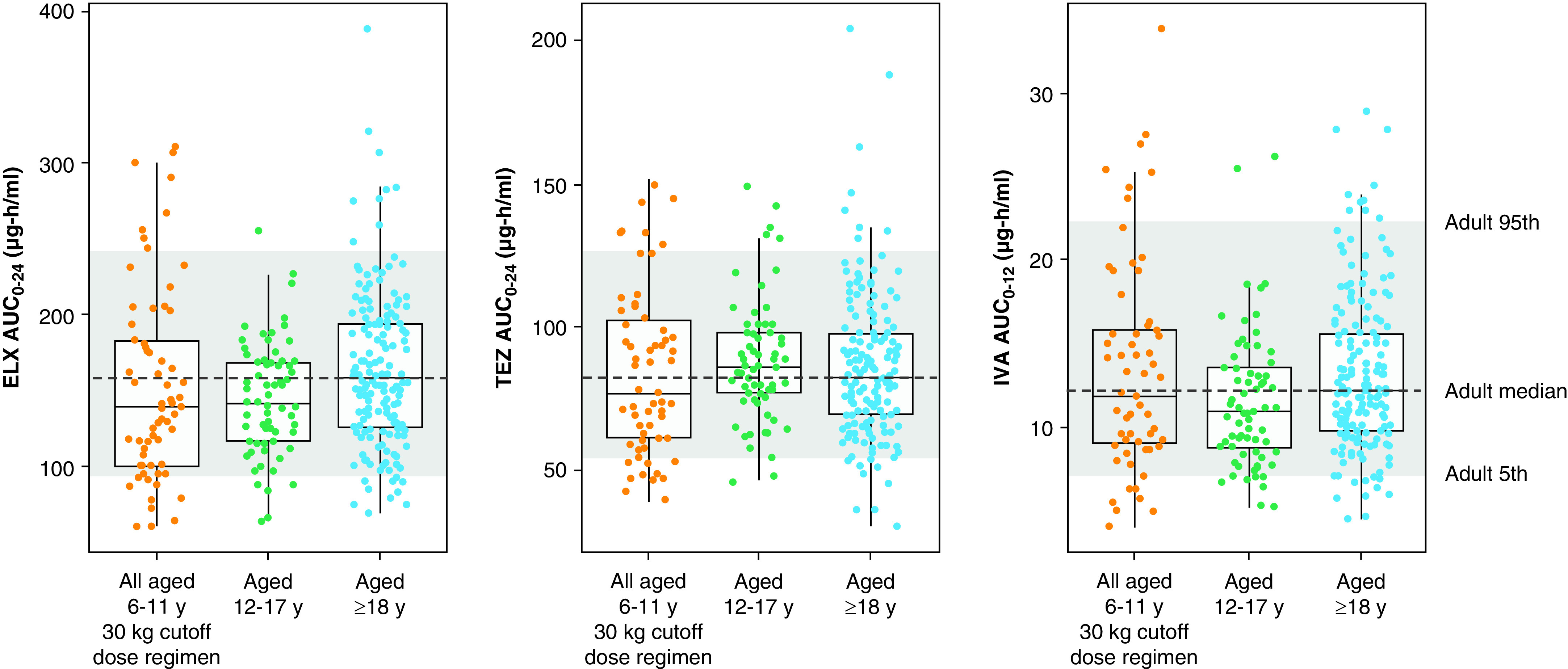
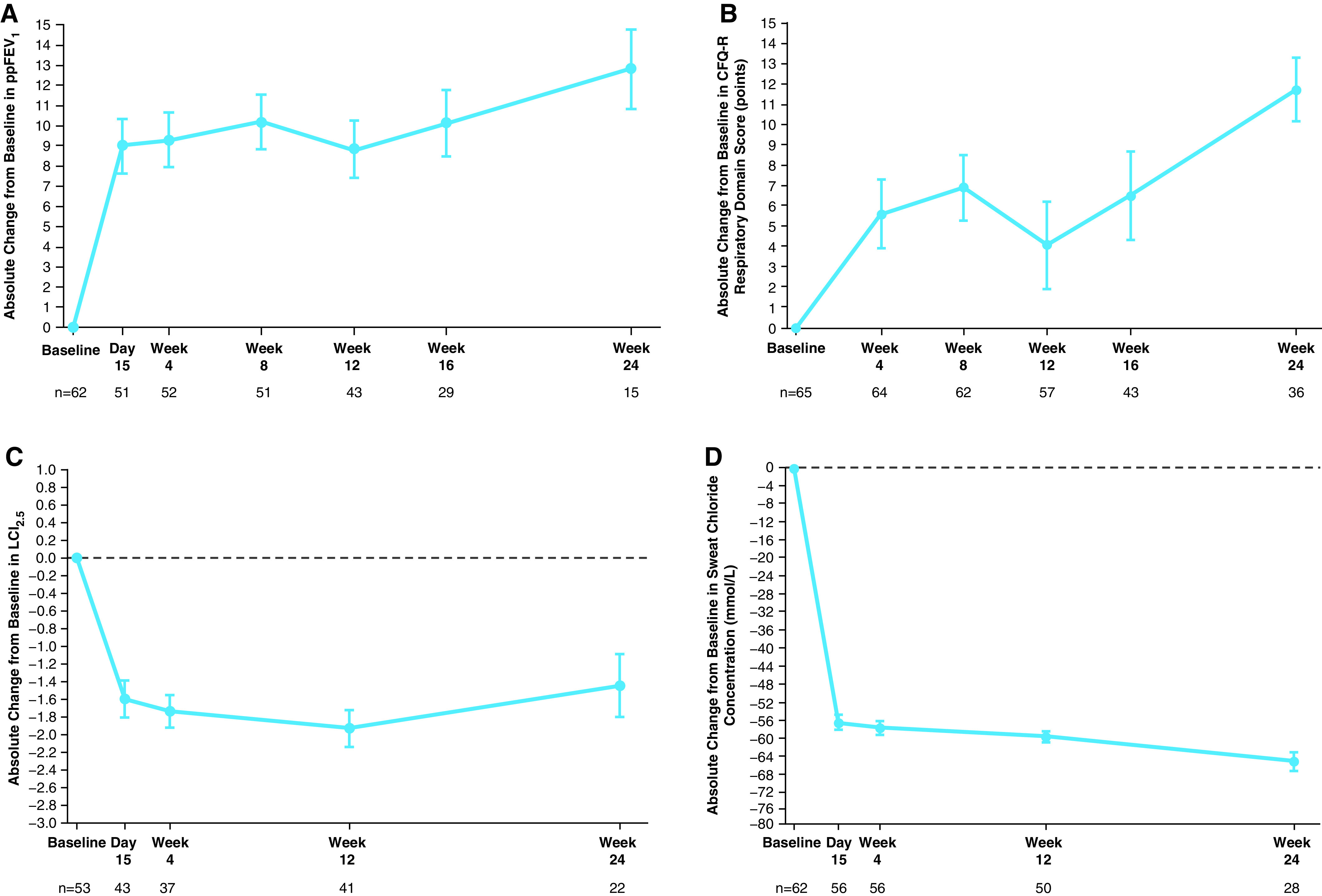
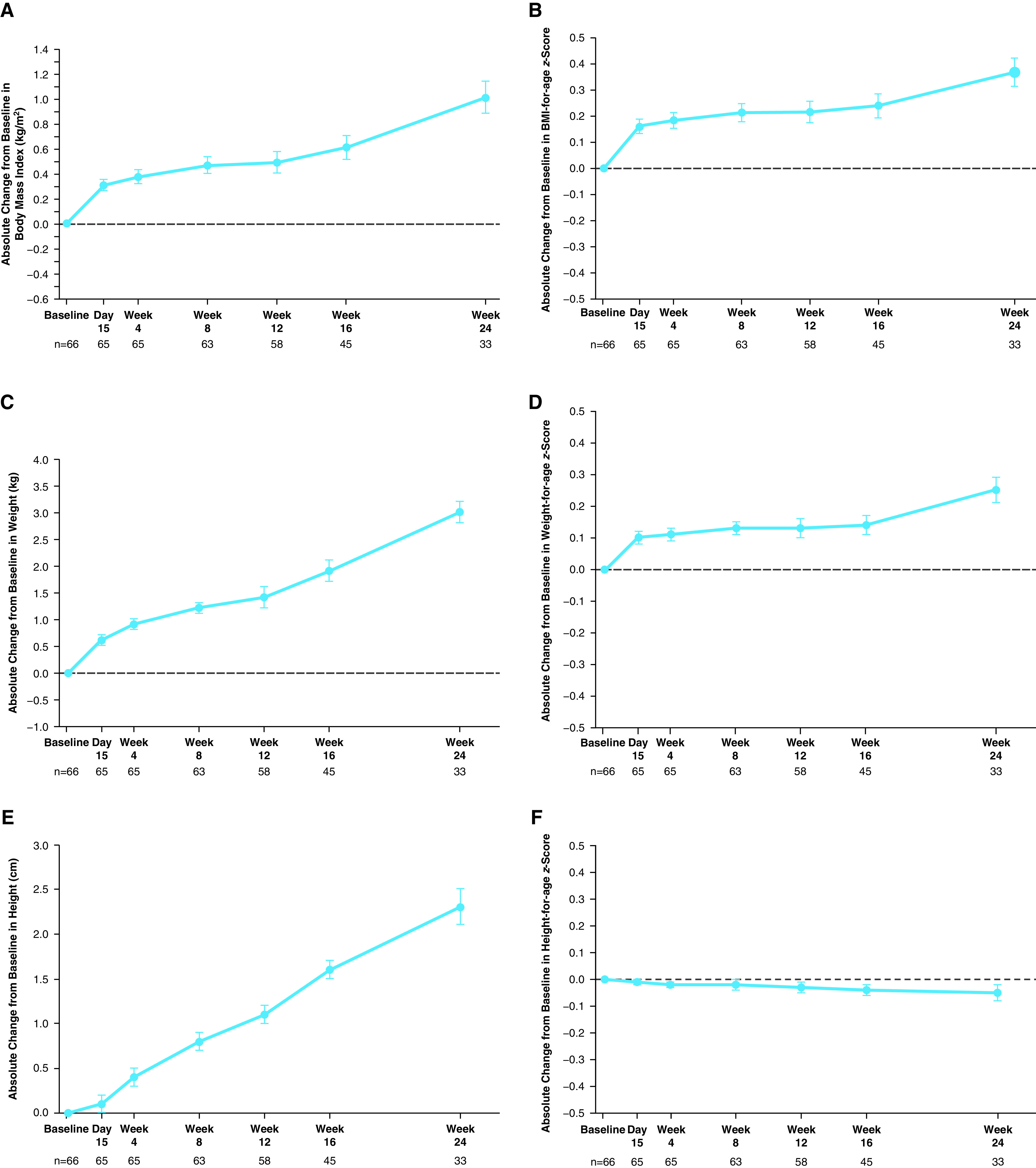
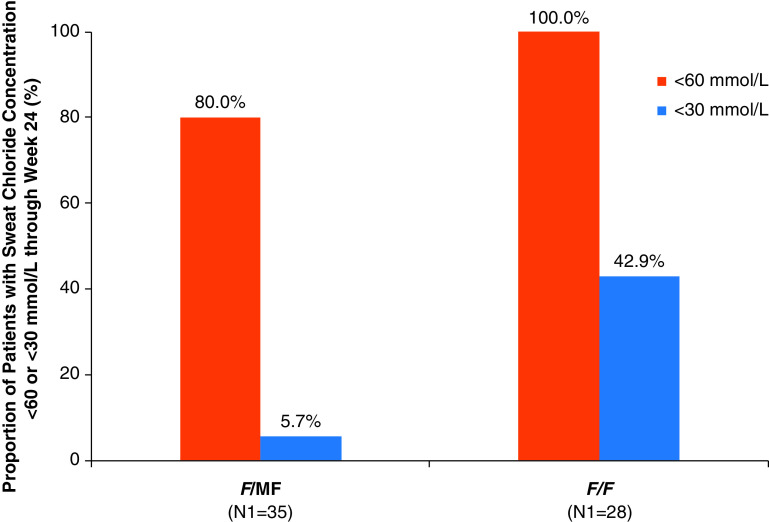
Rationale: Elexacaftor/tezacaftor/ivacaftor (ELX/TEZ/IVA) was shown to be efficacious and safe in patients ≥12 years of age with cystic fibrosis and at least one F508del-CFTR (cystic fibrosis transmembrane conductance regulator) allele, but it has not been evaluated in children <12 years of age. Objectives: To assess the safety, pharmacokinetics, and efficacy of ELX/TEZ/IVA in children 6 through 11 years of age with F508del–minimal function or F508del-F508del genotypes. Methods: In this 24-week open-label phase 3 study, children (N = 66) weighing <30 kg received 50% of the ELX/TEZ/IVA adult daily dose (ELX 100 mg once daily, TEZ 50 mg once daily, and IVA 75 mg every 12 h) whereas children weighing ⩾30 kg received the full adult daily dose (ELX 200 mg once daily, TEZ 100 mg once daily, and IVA 150 mg every 12 h). Measurements and Main Results: The primary endpoint was safety and tolerability. The safety and pharmacokinetic profiles of ELX/TEZ/IVA were generally consistent with those observed in older patients. The most commonly reported adverse events included cough, headache, and pyrexia; in most of the children who had adverse events, these were mild or moderate in severity. Through Week 24, ELX/TEZ/IVA treatment improved the percentage of predicted FEV1 (10.2 percentage points; 95% confidence interval [CI], 7.9 to 12.6), Cystic Fibrosis Questionnaire–Revised respiratory domain score (7.0 points; 95% CI, 4.7 to 9.2), lung clearance index2.5 (−1.71 units; 95% CI, −2.11 to −1.30), and sweat chloride (−60.9 mmol/L; 95% CI, −63.7 to −58.2); body mass index-for-age z-score increased over the 24-week treatment period when compared with the pretreatment baseline. Conclusions: Our results show ELX/TEZ/IVA is safe and efficacious in children 6 through 11 years of age with at least one F508del-CFTR allele, supporting its use in this patient population. Clinical trial registered with www.clinicaltrials.gov (NCT03691779).
Overview
The claims and statistics of this paper haven’t been checked yet.
Run the check — free, no account needed. It reads the open-access text and checks the sources it cites.
Integrity signals
Registry
Cites
Statistics
Figures
Verification
Claims the paper makes
The claims and statistics of this paper haven’t been checked yet.
Run the check — free, no account needed. It reads the open-access text and checks the sources it cites.
Claims other papers make about this one
Each is checked against this paper’s own text: does it say what the citing paper says it does?
The cited source doesn’t support the claim as written.
In the citing paper
“However, clinical studies of ELX/TEZ/IVA completed before the start of the pandemic reported similar robust decreases in the frequency of PEx [ 8-10 , 12 ].”
From Real-world safety and effectiveness of elexacaftor/tezacaftor/ivacaftor in people with cystic fibrosis: Interim results of a long-term registry-based study (2023) · cites this paper as [10]
Checked by a reasoning model — may be wrong.
Experimental — accuracy not yet measuredThe cited source says what the claim attributes to it.
In the citing paper
“Phase 3 clinical trials showed elexacaftor/tezacaftor/ivacaftor (ELX/TEZ/IVA) was safe and efficacious in people with cystic fibrosis (CF) with ≥1 F508del-CFTR allele.”
From Real-world safety and effectiveness of elexacaftor/tezacaftor/ivacaftor in people with cystic fibrosis: Interim results of a long-term registry-based study (2023) · cites this paper as [10]
Self-check
Percentages, sums and reported differences re-computed from the paper’s own numbers.
The self-check needs the paper’s full text.
Citations
Cites
Elexacaftor–Tezacaftor–Ivacaftor for Cystic Fibrosis with a Single Phe508del Allele
Middleton, P. G., Mall, M. A., Dřevínek, P., Lands, L. C., McKone, E. F., Polineni, D., Ramsey, B. W., Taylor-Cousar, J. L., Tullis, E., Vermeulen, F., et al. (2019) · New England Journal of Medicine · doi:10.1056/nejmoa1908639 · Cited by 2,198
Self-citationA CFTR Potentiator in Patients with Cystic Fibrosis and the G551D Mutation
Ramsey, B. W., Davies, J., McElvaney, N. G., Tullis, E., Bell, S. C., Dřevínek, P., Griese, M., McKone, E. F., Wainwright, C. E., Konstan, M. W., et al. (2011) · New England Journal of Medicine · doi:10.1056/nejmoa1105185 · Cited by 2,195
Self-citationHeijerman, H. G. M., McKone, E. F., Downey, D. G., Van Braeckel, E., Rowe, S. M., Tullis, E., Mall, M. A., Welter, J. J., Ramsey, B. W., McKee, C. M., et al. (2019) · The Lancet · doi:10.1016/s0140-6736(19)32597-8 · Cited by 1,414
Self-citationGrowth and nutritional indexes in early life predict pulmonary function in cystic fibrosis
Konstan, M. W., Butler, S. M., Wohl, M. E. B., Stoddard, M., Matousek, R., Wagener, J. S., Johnson, C. A., & Morgan, W. J. (2003) · The Journal of Pediatrics · doi:10.1067/mpd.2003.152 · Cited by 393
Research works printed but not linked: 25
- Riordan, 1989, Identification of the cystic fibrosis gene: cloning and characterization of complementary DNA, Science, 245, 1066, 10.1126/science.2475911 · DOI · Paper page
- Elborn, 2016, Cystic fibrosis, Lancet, 388, 2519, 10.1016/S0140-6736(16)00576-6 · DOI · Paper page
- Bell, 2020, The future of cystic fibrosis care: a global perspective, Lancet Respir Med, 8, 65, 10.1016/S2213-2600(19)30337-6 · DOI
- Ratjen, 2015, Cystic fibrosis, Nat Rev Dis Primers, 1, 15010, 10.1038/nrdp.2015.10 · DOI
- Schlüter, 2019, Impact of cystic fibrosis on birthweight: a population based study of children in Denmark and Wales, Thorax, 74, 447, 10.1136/thoraxjnl-2018-211706 · DOI
- VanDevanter, 2016, Cystic fibrosis in young children: a review of disease manifestation, progression, and response to early treatment, J Cyst Fibros, 15, 147, 10.1016/j.jcf.2015.09.008 · DOI
- Farrell, 2001, Early diagnosis of cystic fibrosis through neonatal screening prevents severe malnutrition and improves long-term growth, Pediatrics, 107, 1, 10.1542/peds.107.1.1 · DOI
- Lopes-Pacheco, 2020, CFTR modulators: the changing face of cystic fibrosis in the era of precision medicine, Front Pharmacol, 10, 1662, 10.3389/fphar.2019.01662 · DOI
- Boyle, 2013, A new era in the treatment of cystic fibrosis: correction of the underlying CFTR defect, Lancet Respir Med, 1, 158, 10.1016/S2213-2600(12)70057-7 · DOI
- Mall, 2020, Cystic fibrosis: emergence of highly effective targeted therapeutics and potential clinical implications, Am J Respir Crit Care Med, 201, 1193, 10.1164/rccm.201910-1943SO · DOI
- Davies, 2013, Efficacy and safety of ivacaftor in patients aged 6 to 11 years with cystic fibrosis with a G551D mutation, Am J Respir Crit Care Med, 187, 1219, 10.1164/rccm.201301-0153OC · DOI
- Walker, 2019, A phase 3 study of tezacaftor in combination with ivacaftor in children aged 6 through 11 years with cystic fibrosis, J Cyst Fibros, 18, 708, 10.1016/j.jcf.2019.06.009 · DOI
- Milla, 2017, Lumacaftor/ivacaftor in patients aged 6–11 years with cystic fibrosis and homozygous for F508del-CFTR, Am J Respir Crit Care Med, 195, 912, 10.1164/rccm.201608-1754OC · DOI
- Taylor-Cousar, 2017, Tezacaftor-ivacaftor in patients with cystic fibrosis homozygous for Phe508del, N Engl J Med, 377, 2013, 10.1056/NEJMoa1709846 · DOI · Paper page
- Wainwright, 2015, Lumacaftor-ivacaftor in patients with cystic fibrosis homozygous for Phe508del CFTR, N Engl J Med, 373, 220, 10.1056/NEJMoa1409547 · DOI · Paper page
- Ratjen, 2017, Efficacy and safety of lumacaftor and ivacaftor in patients aged 6-11 years with cystic fibrosis homozygous for F508del-CFTR: a randomised, placebo-controlled phase 3 trial, Lancet Respir Med, 5, 557, 10.1016/S2213-2600(17)30215-1 · DOI
- Frauchiger, Longitudinal course of clinical lung clearance index in children with cystic fibrosis, Eur Respir J
- Bessonova, 2018, Data from the US and UK cystic fibrosis registries support disease modification by CFTR modulation with ivacaftor, Thorax, 73, 731, 10.1136/thoraxjnl-2017-210394 · DOI · Paper page
- Sawicki, 2015, Sustained Benefit from ivacaftor demonstrated by combining clinical trial and cystic fibrosis patient registry data, Am J Respir Crit Care Med, 192, 836, 10.1164/rccm.201503-0578OC · DOI · Paper page
- Stallings, 2008, Evidence-based practice recommendations for nutrition-related management of children and adults with cystic fibrosis and pancreatic insufficiency: results of a systematic review, J Am Diet Assoc, 108, 832, 10.1016/j.jada.2008.02.020 · DOI
- Wilschanski, 2006, Mutations in the cystic fibrosis transmembrane regulator gene and in vivo transepithelial potentials, Am J Respir Crit Care Med, 174, 787, 10.1164/rccm.200509-1377OC · DOI
- Farrell, 2017, Diagnosis of cystic fibrosis: consensus guidelines from the Cystic Fibrosis Foundation, S4
- McKone, 2015, Association of sweat chloride concentration at time of diagnosis and CFTR genotype with mortality and cystic fibrosis phenotype, J Cyst Fibros, 14, 580, 10.1016/j.jcf.2015.01.005 · DOI
- Davies, 2021, A phase 3, double-blind, parallel-group study to evaluate the efficacy and safety of tezacaftor in combination with ivacaftor in participants 6 through 11 years of age with cystic fibrosis homozygous for F508del or heterozygous for the F508del-CFTR mutation and a residual function mutation, J Cyst Fibros, 20, 68, 10.1016/j.jcf.2020.07.023 · DOI
- McGarry, 2021, Cystic fibrosis patients of minority race and ethnicity less likely eligible for CFTR modulators based on CFTR genotype, Pediatr Pulmonol, 56, 1496, 10.1002/ppul.25285 · DOI
Cited by
Sorted by citations
CFTR modulator therapy: Transforming the landscape of clinical care in cystic fibrosis
Taylor-Cousar, J. L., Robinson, P. D., Shteinberg, M., & Downey, D. G. (2023) · The Lancet · doi:10.1016/s0140-6736(23)01609-4 · Cited by 173
Self-citationBower, J. K., Volkova, N., Ahluwalia, N., Sahota, G., Xuan, F., Chin, A., Weinstock, T. G., Ostrenga, J., & Elbert, A. (2023) · Journal of Cystic Fibrosis · doi:10.1016/j.jcf.2023.03.002 · Cited by 140
Self-citationPutman, M. S., Norris, A. W., Hull, R. L., Rickels, M. R., Sussel, L., Blackman, S. M., Chan, C. L., Ode, K. L., Daley, T., Stecenko, A. A., et al. (2023) · Diabetes Care · doi:10.2337/dc23-0380 · Cited by 35
Metadata
- Authors
- Zemanick, E. T., Taylor-Cousar, J. L., Davies, J., Gibson, R. L., Mall, M. A., McKone, E. F., McNally, P., Ramsey, B. W., Rayment, J. H., Rowe, S. M., Tullis, E., Ahluwalia, N., Chu, C., Ho, T., Moskowitz, S. M., Noel, S., Tian, S., Waltz, D., Weinstock, T. G., Xuan, F., Wainwright, C. E., & McColley, S. A.
- Affiliations
- Department of Pediatrics, University of Colorado Anschutz Medical Campus and Children’s Hospital Colorado, Aurora, Colorado
- Department of Medicine and
- National Heart and Lung Institute, Imperial College London, National Institute for Health Research Imperial Biomedical Research Centre and Royal Brompton and Harefield National Health Service Foundation Trust, London, United Kingdom
- University of Washington/Seattle Children’s Hospital, Seattle, Washington
- Department of Pediatric Pulmonology, Immunology and Intensive Care Medicine, Charité–Universitätsmedizin Berlin, Berlin, Germany
- St. Vincent’s University Hospital and University College, Dublin, Ireland
- Children’s Health Ireland and Royal College of Surgeons in Ireland University of Medicine and Health Sciences, Dublin, Ireland
- British Columbia Children’s Hospital, Vancouver, British Columbia, Canada
- University of Alabama at Birmingham, Birmingham, Alabama
- St. Michael’s Hospital, Toronto, Ontario, Canada
- Vertex Pharmaceuticals Incorporated, Boston, Massachusetts
- University of Queensland, Brisbane, Queensland, Australia
- Ann and Robert H. Lurie Children’s Hospital of Chicago, Chicago, Illinois; and
- Venue
- American Journal of Respiratory and Critical Care Medicine
- Publisher
- Oxford University Press (OUP)
- Published
- 2021-06
- Volume
- 203
- Issue
- 12
- Pages
- 1522-1532
- ISSN
- 1073-449X
- 1535-4970
- PMC
- PMC8483230
- Cited by
- 305
- References
- 4
- Language
- en
About these checks
Registry, retraction, Cites and statistics results are computed, not judged, with one exception: a printed reference that no index lists is read once by a model before it counts as a citation error. Claims are extracted by a model and kept only when their quote appears verbatim in the text; each cited source is then checked, with a model’s help, for whether it says what the claim relies on. Those verdicts can be wrong — read the claim’s quote and the cited source before relying on one.
Statistics and arithmetic are recomputed, not judged.
Confidence bands are shown only for fields calibrated on our annotated test set. None is calibrated yet, so no band is shown.
What counts as a claim ›How we measure confidence ›How we check this ›
Are you an author, or do you see a problem with this page? Request a review
