

Global, Regional, and National Levels and Trends in Burden of Oral Conditions from 1990 to 2017: A Systematic Analysis for the Global Burden of Disease 2017 Study
Open accessThe DOI matches its Crossref record; 38 of the 39 references it cites were found in a registry or an index; 6 of the 19 sources its claims cite were checked for support.
Abstract
This Global Burden of Disease analysis estimated 3.5 billion cases of oral conditions worldwide in 2017, highlighting the scale of unmet oral-health need.
Overview
CoChat Summary
TL;DR
This GBD 2017 systematic analysis estimated the global, regional, and national burden of oral conditions in 195 countries and territories from 1990 to 2017. It found oral diseases remained a major public health challenge, with 3.5 billion cases globally in 2017 and marked socioeconomic patterns: untreated caries and severe periodontitis were lowest in more developed countries, while tooth loss was highest there.
Key findings
- In 2017, there were 3.5 billion global cases of oral conditions, including 2.3 billion untreated caries in permanent teeth, 796 million severe periodontitis cases, 532 million untreated caries in deciduous teeth, 267 million total tooth loss cases, and 139 million other oral conditions.
- Untreated caries in permanent teeth had an age-standardized prevalence of 29.4% in 2017 and increased in number of prevalent cases by 35.9% from 1990 to 2017, while age-standardized prevalence declined by 8.8%.
- Severe periodontitis had an age-standardized prevalence of 9.8% in 2017 and showed large growth from 1990 to 2017: 90.1% increase in prevalent cases and 90.2% increase in YLDs.
- Total tooth loss had an age-standardized prevalence of 3.3% in 2017; its number of prevalent cases increased by 75.5% from 1990 to 2017, even as age-standardized prevalence declined by 10.4%.
Methods
- This was a systematic analysis within the GBD 2017 study, covering 195 countries and territories and estimating prevalence, incidence, and YLDs for oral conditions from 1990 to 2017 by sex, age, country, World Bank income group, and SDI.
- Data came from systematic reviews, updated searches, and a WHO-supported effort to identify unpublished survey reports; only random-sample national or regional surveys with acceptable response/attrition and prevalence/incidence data were included.
- Estimates were modeled using DisMod-MR 2.1 (Bayesian meta-regression), with age-standardization and percentage change calculations to assess trends.
Limitations
- The paper states that estimates for “other oral disorders” should be interpreted cautiously because they were based on surveys from a single country (United States).
- The report did not include mouth cancers, congenital malformations (including orofacial clefts), or temporomandibular disorders; this is stated in the paper.
- The paper also states that data were scarce despite efforts to identify gray literature, and most identified sources did not meet GBD eligibility criteria; this likely limits completeness of the estimates.
Model-written summary. Check it against the paper before relying on it.
Integrity signals
Registry
Cites
Statistics
Figures
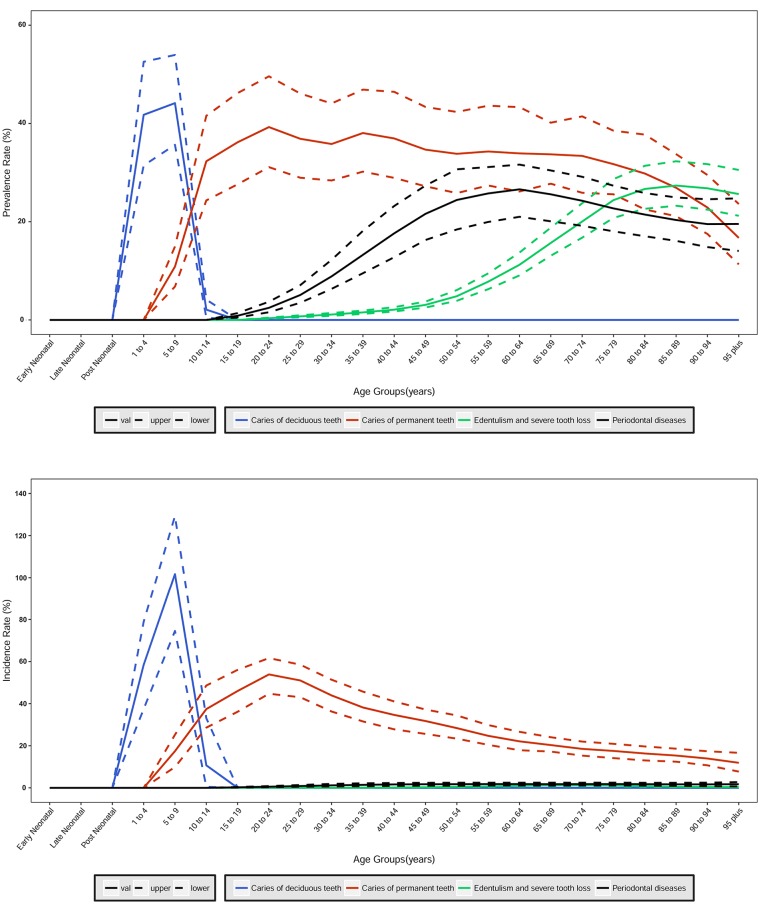
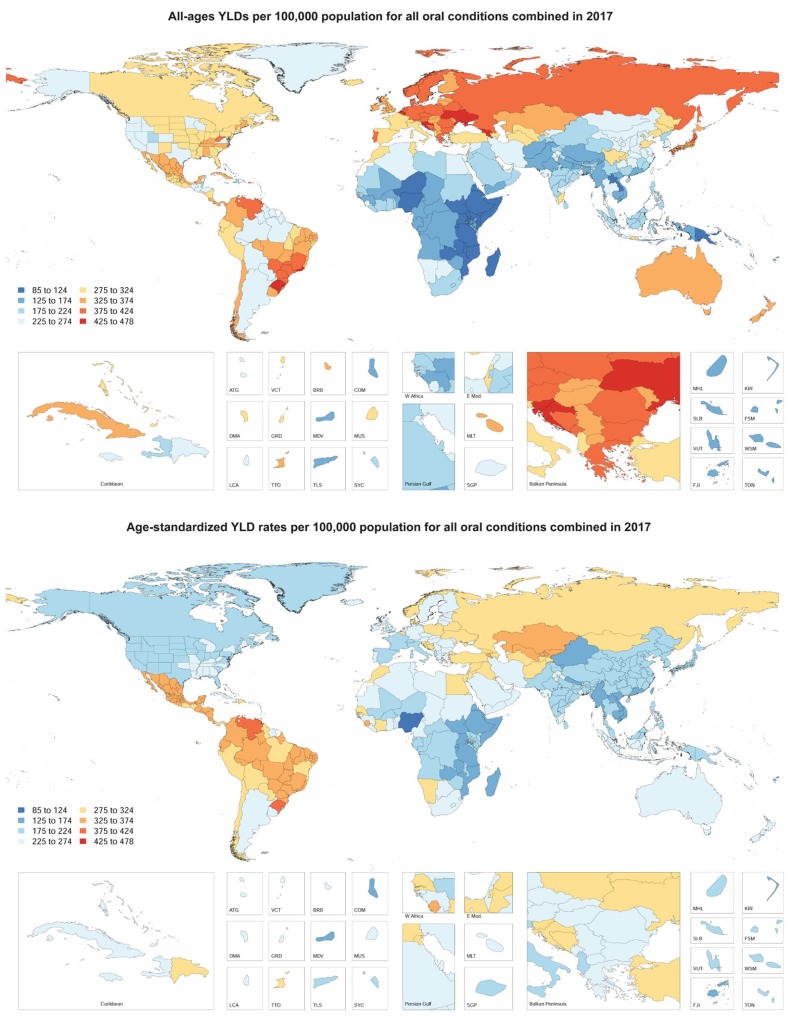
Verification
Claims the paper makes
4 Valid · 0 Not valid · 6 Not checked · 77 Own results and interpretations
A result the paper reports from its own data — it cites no other source for it, so there is none to check. The quote shows it is in the paper.
In the paper
“India, China, Indonesia, Brazil, and United States were in the top 10 countries with the highest normative treatment need associated with all 4 dental conditions assessed in this study.”
§ Global, Regional, and National Levels and Trends in Burden of Oral Conditions from 1990 to 2017: A Systematic Analysis for the Global Burden of Disease 2017 Study > Discussion
plainstates an association- Asserted: passes — The authors put it forward as true.
- Checkable: passes — It can be checked against evidence.
- Load-bearing: unclear — It is unclear whether the paper’s conclusions depend on it.
- Based: passes — The paper gives a reason why it holds.
A result the paper reports from its own data — it cites no other source for it, so there is none to check. The quote shows it is in the paper.
In the paper
“Their corresponding percentage changes between 1990 and 2017 were –7.9% (95% UI, –9.8% to –6.6%) and 1.3% (95% UI, –0.9% to 3.0%; Table 2).”
§ Global, Regional, and National Levels and Trends in Burden of Oral Conditions from 1990 to 2017: A Systematic Analysis for the Global Burden of Disease 2017 Study > Results > Untreated Dental Caries in Deciduous Teeth
plain- Asserted: passes — The authors put it forward as true.
- Checkable: passes — It can be checked against evidence.
- Load-bearing: unclear — It is unclear whether the paper’s conclusions depend on it.
- Based: passes — The paper gives a reason why it holds.
A result the paper reports from its own data — it cites no other source for it, so there is none to check. The quote shows it is in the paper.
In the paper
“Similarly, the lowest age-standardized prevalence and YLD rate were found in high-income countries (6.1% [95% UI, 4.8% to 7.3%] and 2.3 per 100,000 population [95% UI, 1.0 to 4.6], respectively; Table 3).”
§ Global, Regional, and National Levels and Trends in Burden of Oral Conditions from 1990 to 2017: A Systematic Analysis for the Global Burden of Disease 2017 Study > Results > Untreated Dental Caries in Deciduous Teeth
plainn = 41- Asserted: passes — The authors put it forward as true.
- Checkable: passes — It can be checked against evidence.
- Load-bearing: unclear — It is unclear whether the paper’s conclusions depend on it.
- Based: passes — The paper gives a reason why it holds.
A result the paper reports from its own data — it cites no other source for it, so there is none to check. The quote shows it is in the paper.
In the paper
“Their corresponding percentage changes between 1990 and 2017 were 5.8% (95% UI, 4.9% to 6.6%) and 90.1% (95% UI, 87.4% to 92.5%; Table 2).”
§ Global, Regional, and National Levels and Trends in Burden of Oral Conditions from 1990 to 2017: A Systematic Analysis for the Global Burden of Disease 2017 Study > Results > Severe Periodontitis
plain- Asserted: passes — The authors put it forward as true.
- Checkable: passes — It can be checked against evidence.
- Load-bearing: unclear — It is unclear whether the paper’s conclusions depend on it.
- Based: passes — The paper gives a reason why it holds.
A result the paper reports from its own data — it cites no other source for it, so there is none to check. The quote shows it is in the paper.
In the paper
“Their corresponding percentage changes between 1990 and 2017 were –7.9% (95% UI, –9.8% to –6.6%) and 1.3% (95% UI, –0.9% to 3.0%; Table 2).”
§ Global, Regional, and National Levels and Trends in Burden of Oral Conditions from 1990 to 2017: A Systematic Analysis for the Global Burden of Disease 2017 Study > Results > Untreated Dental Caries in Deciduous Teeth
plain- Asserted: passes — The authors put it forward as true.
- Checkable: passes — It can be checked against evidence.
- Load-bearing: unclear — It is unclear whether the paper’s conclusions depend on it.
- Based: passes — The paper gives a reason why it holds.
29 more claims
Create a free account to see all 87 claims and to verify the 3 references still open.
- Probably not a substantial claim. 38
- It may state two separate claims as one. 20
Claims other papers make about this one
Each is checked against this paper’s own text: does it say what the citing paper says it does?
In the citing paper
“Cleft lip and/or palate are among the most frequent congenital disorders [1,2,5].”
From Oral health workforce in Africa: a scarce resource (2023) · cites this paper as [2]
Citations
Cites
James, S. L., Abate, D., Abate, K. H., Abay, S. M., Abbafati, C., Abbasi, N., Abbastabar, H., Abd-Allah, F., Abdela, J., Abdelalim, A., et al. (2018) · The Lancet · doi:10.1016/s0140-6736(18)32279-7 · Cited by 13,867
Self-citationVos, T., Abajobir, A. A., Abate, K. H., Abbafati, C., Abbas, K. M., Abd-Allah, F., Abdulkader, R. S., Abdulle, A. M., Abebo, T. A., Abera, S. F., et al. (2017) · The Lancet · doi:10.1016/s0140-6736(17)32154-2 · Cited by 13,220
Self-citationMurray, C. J. L., Vos, T., Lozano, R., Naghavi, M., Flaxman, A. D., Michaud, C., Ezzati, M., Shibuya, K., Salomon, J. A., Abdalla, S., et al. (2012) · The Lancet · doi:10.1016/s0140-6736(12)61689-4 · Cited by 8,888 · cited 1×
“Sugar consumption is the main cause of dental caries (Moynihan and Kelly 2014; Bernabe et al. 2016), and tobacco consumption is a major cause of periodontal diseases (Nociti et al. 2015; Leite et al. 2018).”
Self-citationGlobal nutrition transition and the pandemic of obesity in developing countries
Popkin, B. M., Adair, L. S., & Ng, S. W. (2012) · Nutrition Reviews · doi:10.1111/j.1753-4887.2011.00456.x · Cited by 4,313 · cited 2×
“The nutrition transition has affected the global distribution of the burden of obesity (Popkin et al. 2012), diabetes (Popkin 2015), and untreated caries in permanent teeth (Moynihan and Petersen 2004), as less economically developed countries still have a traditional diet low in carbohydrates and more economically de…”
BackgroundKyu, H. H., Abate, D., Abate, K. H., Abay, S. M., Abbafati, C., Abbasi, N., Abbastabar, H., Abd-Allah, F., Abdela, J., Abdelalim, A., et al. (2018) · The Lancet · doi:10.1016/s0140-6736(18)32335-3 · Cited by 4,081
Self-citationOral diseases: a global public health challenge
Peres, M. A., Macpherson, L. M. D., Weyant, R. J., Daly, B., Venturelli, R., Mathur, M. R., Listl, S., Celeste, R. K., Guarnizo-Herreño, C. C., Kearns, C., et al. (2019) · The Lancet · doi:10.1016/s0140-6736(19)31146-8 · Cited by 4,054 · cited 1×
“The GBD 2015 findings were used to advocate for integrating oral conditions with noncommunicable disease prevention and including dental services in universal health coverage (Peres et al. 2019; Watt et al. 2019).”
MethodSelf-citationGlobal Burden of Severe Periodontitis in 1990-2010: A Systematic Review and Meta-regression
Kassebaum, N. J., Bernabé, E., Dahiya, M., Bhandari, B., Murray, C. J. L., & Marcenes, W. (2014) · Journal of Dental Research · doi:10.1177/0022034514552491 · Cited by 2,209 · cited 1×
“Data Input Data to inform models for oral conditions were from systematic reviews on the epidemiology of each oral condition (Kassebaum et al. 2014a, 2014b, 2015), which were updated for this new iteration of the project.”
MethodSelf-citationKassebaum, N. J., Arora, M., Barber, R. M., Bhutta, Z. A., Brown, J., Carter, A., Casey, D. C., Charlson, F. J., Coates, M. M., Coggeshall, M., et al. (2016) · The Lancet · doi:10.1016/s0140-6736(16)31460-x · Cited by 2,163
Self-citationKassebaum, N. J., Smith, A. G. C., Bernabé, E., Fleming, T. D., Reynolds, A. E., Vos, T., Murray, C. J. L., Marcenes, W., Collaborators, G. 2. O. H., Abyu, G. Y., et al. (2017) · Journal of Dental Research · doi:10.1177/0022034517693566 · Cited by 1,981
Self-citationGuidelines for accurate and transparent health estimates reporting: the GATHER statement
Stevens, G. A., Alkema, L., Black, R. E., Boerma, J. T., Collins, G. S., Ezzati, M., Grove, J. T., Hogan, D. R., Hogan, M. C., Horton, R., et al. (2016) · The Lancet · doi:10.1016/s0140-6736(16)30388-9 · Cited by 1,798 · cited 1×
“This report adheres to the GATHER statement (Guidelines for Accurate and Transparent Health Estimates Reporting; Stevens et al. 2016).”
Research works printed but not linked: 2
- Flaxman AD, Vos T, Murray CJL, Kiyono P. 2015. An integrative metaregression framework for descriptive epidemiology. Seattle (WA): University of Washington Press.
- Qvist V. 2015. Longevity of restorations: the “death spiral.” In: Fejerskov O, Nyvad B, Kidd E, editors. Dental caries: the disease and its clinical management. London (UK): Wiley-Blackwell. p. 443–456.
Cited by
Items 301–400 of 1,518
Han, X., Tang, S., Wang, L., Xu, X., Yan, R., Yan, S. R., Guo, Z., Hu, K., Yu, T., Li, M., et al. (2021) · International Journal of Nanomedicine · doi:10.2147/ijn.s318991 · Cited by 19
Ruff, R. R., Godín, T. J. B., Small, T. M., & Niederman, R. (2022) · BMC Oral Health · doi:10.1186/s12903-022-02159-5 · Cited by 19
“Introduction Dental caries is the most prevalent childhood disease in the world [1], found across all age groups and most prominent among low-income populations [2].”
BackgroundTian, Y., Zhang, Y., Zhang, M., Chen, X., Lei, L., & Hu, T. (2022) · International Journal of Nanomedicine · doi:10.2147/ijn.s334785 · Cited by 18
Clinical Effects of Sugar Substitutes on Cariogenic Bacteria: A Systematic Review and Meta-Analysis
Liang, N. L., Luo, B. W., Sun, I. G., Chu, C. H., & Duangthip, D. (2024) · International Dental Journal · doi:10.1016/j.identj.2024.02.008 · Cited by 25
H 2 S-Scavenging Hydrogel Alleviating Mitochondria Damage to Control Periodontitis
Xie, C., Zhang, Q., Bianco, A., Ge, S., & Ma, B. (2024) · Journal of Dental Research · doi:10.1177/00220345241291540 · Cited by 24
“Periodontitis is one of the most prevalent chronic diseases (Peres et al. 2019; Bernabe et al. 2020) and is characterized by bacterial infection, uncontrollable inflammatory responses, and destructive tooth-supporting tissues (Kinane et al. 2017; Wu et al. 2022).”
Effenberger, S., Greenwall, L. H., Cebula, M., Myburgh, N. G., Simpson, K., Smit, D., Wicht, M. J., & Schwendicke, F. (2021) · Community Dentistry And Oral Epidemiology · doi:10.1111/cdoe.12702 · Cited by 16
Self-citation'Toothless’—the absence of political priority for oral health: a case study of Ireland 1994–2021
McAuliffe, Ú., Whelton, H. P., Harding, M., & Burke, S. (2022) · BMC Oral Health · doi:10.1186/s12903-022-02125-1 · Cited by 22
“5 billion people worldwide with untreated dental caries of permanent teeth the most prevalent condition [2, 3].”
BackgroundCOVID-19 Pandemic Impact on US Childhood Caries and Potential Mitigation
Scherrer, C., Naavaal, S., Lin, M., & Griffin, S. O. (2022) · Journal of Dental Research · doi:10.1177/00220345221090183 · Cited by 18
“Untreated caries affects children’s well-being (GBD 2017 Oral Disorders Collaborators et al. 2020) with spillover effects into learning.”
BackgroundGoldfeld, S. R., Francis, K. L., O’Connor, E. J., Ludvigsson, J., Faresjö, T., Nikièma, B., Gauvin, L. I., Yang‐Huang, J., Awad, Y. A., McGrath, J. J., et al. (2022) · PLoS ONE · doi:10.1371/journal.pone.0268899 · Cited by 19
ARROYO, E. A., Alves, M. G. O., Chamorro-Petronacci, C. M., Marichalar‐Mendía, X., Bravo, S. B., Blanco, J., & Pérez‐Sayáns, M. (2022) · Journal of Taibah University Medical Sciences · doi:10.1016/j.jtumed.2022.12.004 · Cited by 32
Randall, C. L. (2023) · Community Dentistry and Oral Epidemiology · doi:10.1111/cdoe.12841 · Cited by 17
Chang, Q., Cheng, M., Xu, M., Du, S., Wang, X., Feng, X., Tai, B., Hu, D., Lin, H., Wang, B., et al. (2023) · BMC Oral Health · doi:10.1186/s12903-023-03037-4 · Cited by 21
“3 billion people worldwide in 2017 [1].”
BackgroundResearch Progress on Nanomaterials for Tissue Engineering in Oral Diseases
Jiang, T., Su, W., Li, Y., Jiang, M., Zhang, Y., Xian, C. J., & Zhai, Y. (2023) · Journal of Functional Biomaterials · doi:10.3390/jfb14080404 · Cited by 21
Yassin, R., Amer, H., & Tantawi, M. E. (2023) · BMC Oral Health · doi:10.1186/s12903-023-03456-3 · Cited by 31
Self-citationLopes, L. Q. S., Guerim, P. H. F., Maldonado, M. E., Wagner, R. C., Xavier, A. C. H., da Silva, J. L. G., Leal, D. B. D. R., Daudt, N. D. F., Santos, R. C. V., & Marquezan, P. K. (2024) · Journal of Toxicology and Environmental Health · doi:10.1080/15287394.2024.2375731 · Cited by 19
“Dental caries constitutes a highly prevalent oral problem in the population affecting 2.3 billion individuals worldwide in 2017 (Bernabe et al. 2020).”
Influentialde Mello‐Neto, J. M., Nunes, J. G. R., Tadakamadla, S. K., & Figueredo, C. M. (2021) · International Journal of Environmental Research and Public Health · doi:10.3390/ijerph18178958 · Cited by 17
“severe form, which can lead to tooth loss, affects around 796 million people worldwide, making it the 11th most prevalent disease in human beings [10,11].”
BackgroundPetit, C., Anadon-Rosinach, V., Tuzin, N., Davideau, J., & Huck, O. (2021) · International Journal of Environmental Research and Public Health · doi:10.3390/ijerph18179394 · Cited by 23
“This highly prevalent disease impacts the oral-health-related quality of life and its long-term management is at a high cost [2,3].”
BackgroundOral Hygiene Practice among Hospitalized Patients: An Assessment by Dental Hygiene Students
Lupi, S. M., Pascadopoli, M., Maiorani, C., et al. (2022) · Healthcare · doi:10.3390/healthcare10010115 · Cited by 17
Biomolecule-Mediated Therapeutics of the Dentin–Pulp Complex: A Systematic Review
Machla, F., Angelopoulos, I., Epple, M., Chatzinikolaidou, Μ., & Bakopoulou, A. (2022) · Biomolecules · doi:10.3390/biom12020285 · Cited by 18
Biofilm modulatory response of arginine-fluoride varnish on multi-species biofilm
Bijle, M. N., Ashraf, U., Abdalla, M. M., Neelakantan, P., & Yiu, C. K. Y. (2022) · Journal of Dentistry · doi:10.1016/j.jdent.2022.104096 · Cited by 17
Alayash, Z., Baumeister, S., Reckelkamm, S. L., Holtfreter, B., Kocher, T., Baurecht, H., Ehmke, B., & Nolde, M. (2022) · Journal of Periodontology · doi:10.1002/jper.22-0249 · Cited by 19
Nudging oral habits; application of behavioral economics in oral health promotion: a critical review
Kazemian, A., Hoseinzadeh, M., Rad, S. A. B., Jouya, A., & Tahani, B. (2023) · Frontiers in Public Health · doi:10.3389/fpubh.2023.1243246 · Cited by 27
Ghanem, A. S., Baťa, R., Kovács, N., & Nagy, A. C. (2025) · Frontiers in Oral Health · doi:10.3389/froh.2025.1609961 · Cited by 21
A new mixed model of periodontitis‐induced preeclampsia: A pilot study
Mata, K. M., Nobre, Á. V. V., Silva, P. H. F., Oliezer, R. S., Fernandes, C. R., Amaral, J. H., Ramos, J., Del‐Arco, M. C. G., Messora, M. R., Tanus-Santos, J. E., et al. (2021) · Journal of Periodontal Research · doi:10.1111/jre.12869 · Cited by 18
Benzian, H., & Listl, S. (2021) · Bundesgesundheitsblatt - Gesundheitsforschung - Gesundheitsschutz · doi:10.1007/s00103-021-03353-6 · Cited by 23
“Global Burden of Disease 2017 Oral Disorders Collaborators (2020)Global, regional, andnational levels and trends in burden of oral conditions from 1990 to 2017: A systematic analysis for the Global Burden of Disease 2017 study.”
BackgroundLe, N. M., Lu, J., Tang, P., Chung, K., Subhash, H. M., Kilpatrick‐Liverman, L., & Wang, R. K. (2022) · Biomedical Optics Express · doi:10.1364/boe.460575 · Cited by 18
Approaches to minimize tooth staining associated with silver diamine fluoride: A systematic review
Asghar, M., Omar, R. A., Yahya, R. B., Yap, A. U., & Shaikh, M. S. (2023) · Journal of Esthetic and Restorative Dentistry · doi:10.1111/jerd.13013 · Cited by 16
Self-citationChallenges in oral health research for older adults
Allen, P., & Tsakos, G. (2023) · Gerodontology · doi:10.1111/ger.12681 · Cited by 20
“9,10 11– 13 For the foreseeable future, as significant numbers of older adults retain teeth into old age, there will be a high burden of maintenance of heavily restored teeth and root caries.”
Rapid Oral Health Deterioration in Older People—A Narrative Review from a Socio-Economic Perspective
Slack-Smith, L. M., Arena, G., & See, L. (2023) · Journal of Clinical Medicine · doi:10.3390/jcm12062396 · Cited by 28
Nguyen, T. M., Bridge, G., Hall, M., Theodore, K., Lin, C., Scully, B., Heredia, R., Le, L. K.-D., Mihalopoulos, C., & Calache, H. (2023) · Journal of Public Health Policy · doi:10.1057/s41271-023-00414-9 · Cited by 21
Self-citationCzwikla, J., Rothgang, H., Schwendicke, F., & Hoffmann, F. (2023) · Journal of Dentistry · doi:10.1016/j.jdent.2023.104627 · Cited by 16
Self-citationAlterations of oral and gut viromes in hypertension and/or periodontitis
Ye, H.-L., Zhi, M., Chen, B., Lin, W.-Z., Li, Y., Huang, S.-J., Zhou, L.-J., Xu, S., Zhang, J., Zhang, W., et al. (2023) · mSystems · doi:10.1128/msystems.01169-23 · Cited by 19
Orhan, A. I., Alkan, A., Orhan, K., Tezel, A., Karaoğlanoğlu, S., & Öztaş, D. (2024) · Community Dentistry And Oral Epidemiology · doi:10.1111/cdoe.12943 · Cited by 29
Machine learning to predict untreated dental caries in adolescents
Bomfim, R. A. (2024) · BMC Oral Health · doi:10.1186/s12903-024-04073-4 · Cited by 23
“Despite advancements in Brazilian public policy, it is challenging to set priorities on the dental agenda, especially concerning the adolescent population. schedule a dental visit and establish better oral health, and consequently, a better quality of life [9–11].”
BackgroundThirunavukkarasu, A., & Alaqidi, S. F. (2024) · Healthcare · doi:10.3390/healthcare12141376 · Cited by 22
Screening of undiagnosed hyperglycaemia in the dental setting: The DiabetRisk study. A field trial
Montero, E., Matesanz, P., Nobili, A., Herrera-Pombo, J. L., Sanz, M., Guerrero, A., Bujaldón, A., & Herrera, D. (2020) · Journal Of Clinical Periodontology · doi:10.1111/jcpe.13408 · Cited by 19
Caries Experience of Adults with Intellectual Disability in the Western Part of Germany
Schmidt, P., Egermann, M., Sauerland, C., & Schulte, A. G. (2021) · Journal of Clinical Medicine · doi:10.3390/jcm10122602 · Cited by 17
Srisomboon, S., Kettratad‐Pruksapong, M., Pakawanit, P., Rojviriya, C., Phantumvanit, P., & Panpisut, P. (2021) · Dentistry Journal · doi:10.3390/dj9060070 · Cited by 23
The suppression effect of SCH-79797 on Streptococcus mutans biofilm formation
Zhang, L., Shen, Y., Qiu, L., Yu, F., Hu, X., Wang, M., Sun, Y., Pan, Y., & Zhang, K. (2022) · Journal of Oral Microbiology · doi:10.1080/20002297.2022.2061113 · Cited by 17
Tonon, C. C., Ashraf, S., Rastelli, A. N. D. S., Ghosh, G., Hasan, T. G., Xu, Q., Greer, A., & Lyons, A. M. (2022) · Journal of Photochemistry and Photobiology B Biology · doi:10.1016/j.jphotobiol.2022.112458 · Cited by 17
Ribeiro, C. A., Vettore, M. V., Vieira, J. M. R., de Queiroz, A. P. C., de Queiroz, A. C., Pereira, J. V., Herkrath, F. J., & Rebelo, M. A. B. (2022) · BMC Oral Health · doi:10.1186/s12903-022-02372-2 · Cited by 26
Li, J., Zhou, Z., Hao, S., & Zang, L. (2024) · European Journal of Applied Physiology · doi:10.1007/s00421-024-05688-9 · Cited by 30
“Depression and anxiety are among the most common mental health problems worldwide, with approximately 340 million people suffering from them (GBD 2017 Oral Disorders Collaborators et al. 2020).”
Julihn, A., Soares, F. C., Hjern, A., & Dahllöf, G. (2021) · Acta Paediatrica · doi:10.1111/apa.15882 · Cited by 17
Dawson, E. R., Stennett, M., Daly, B., Macpherson, L. M. D., Cannon, P., & Watt, R. G. (2022) · BMJ Open · doi:10.1136/bmjopen-2021-059441 · Cited by 21
Enawgaw, A. S., Alem, G., Tsehay, M., & Kibret, G. D. (2022) · Frontiers in Oral Health · doi:10.3389/froh.2022.938405 · Cited by 32
“It is also the most prevalent oral condition, with 2.3 billion individuals affected, according to the 2015 Global Burdens of Disease Study (6).”
BackgroundInfluentialWong, M. L., Lee, Y. H., Sim, Y. F., Wong, T., Soh, S. H., Goh, B. T., Poon, C. Y., Allen, P., Chia, K. S., & Sim, C. P. C. (2024) · Community Dentistry And Oral Epidemiology · doi:10.1111/cdoe.12947 · Cited by 19
Du, S., Cheng, M., Cui, Z., Wang, X., Feng, X., Tai, B., Hu, D., Lin, H., Wang, B., Wang, C., et al. (2024) · International Dental Journal · doi:10.1016/j.identj.2024.04.001 · Cited by 20
“62,63 Oral health is often seen as separate to children’s general health.”
Küçükosmanoğlu, H. S., Cramer, H., Tavakoly, R., Moosburner, A., & Bîlc, M. I. (2024) · Current Psychiatry Reports · doi:10.1007/s11920-024-01548-7 · Cited by 17
“Depression has become one of the most common mental health problems in the world, affecting approximately 280 million people with a prevalence rate of about 3.4% worldwide [ 1 ].”
InfluentialTwetman, S., & Belstrøm, D. (2025) · International Journal of Environmental Research and Public Health · doi:10.3390/ijerph22010072 · Cited by 25
“According to current estimates, more than 2.8 billion children and adults have untreated caries, while 1.1 billion adults suffer from severe periodontitis and total tooth loss [1].”
InfluentialVitamin D deficiency and oral health: a systematic review of literature
Ziada, S., Wishahe, A., Mabrouk, N. A., & Sahtout, S. (2025) · BMC Oral Health · doi:10.1186/s12903-025-05883-w · Cited by 21
Casanova-Rosado, J., Casanova-Rosado, A., Minaya-Sánchez, M., Casanova-Sarmiento, J. A., Robles-Minaya, J. L., Márquez-Rodríguez, S., Mora-Acosta, M., Islas-Zarazúa, R., Márquez-Corona, M., Ávila-Burgos, L., et al. (2021) · Children · doi:10.3390/children8040289 · Cited by 16
“Socioeconomic inequalities in dental health have been observed between countries, with more developed countries having a lower burden of untreated dental caries [1].”
BackgroundInfluentialProbing the mineralized tissue-adhesive interface for tensile nature and bond strength
Sarikaya, R., Ye, Q., Song, L., Tamerler, C., Spencer, P., & Misra, A. K. (2021) · Journal of the mechanical behavior of biomedical materials/Journal of mechanical behavior of biomedical materials · doi:10.1016/j.jmbbm.2021.104563 · Cited by 13
Shaharyar, S. A., Bernabé, E., & DELGADO-ANGULO, E. K. (2021) · International Journal of Environmental Research and Public Health · doi:10.3390/ijerph181910519 · Cited by 18
Self-citationOliveira, L. M., Pilecco, K. D. S., de Oliveira, C. A., Antoniazzi, R. P., Demarco, F. F., & Zanatta, F. B. (2022) · Alcohol and Alcoholism · doi:10.1093/alcalc/agac023 · Cited by 18
Cariology consensus for undergraduates at dental schools in the Caribbean region
Abreu‐Placeres, N., Grau‐Grullón, P., Naidu, R. S., García-Godoy, F., Newton, T., Ekstrand, K., Pitts, N. B., del Valle, L. M. L., Féliz‐Matos, L., Rivera, Y., et al. (2020) · European Journal Of Dental Education · doi:10.1111/eje.12651 · Cited by 16
Differentially Expressed Salivary Proteins in Dental Caries Patients
Khan, Z. M., Waheed, H., Khurshid, Z., Zafar, M. S., Moin, S. F., & Alam, M. K. (2021) · BioMed Research International · doi:10.1155/2021/5517521 · Cited by 25
“3 billion are those related to permanent teeth while 532 million cases of dental caries related to primary teeth [1, 2].”
BackgroundCheng, T., Wen, P., Yu, R., Zhang, F., Li, H., Xu, X., Zhao, D., Liu, F., Su, W., Zheng, Z., et al. (2024) · Journal of Translational Medicine · doi:10.1186/s12967-024-05579-9 · Cited by 18
Global situation of oral health coverage toward universal health coverage: A scoping review
Ardakani, M. S. Z., & Bayati, M. (2025) · Preventive Medicine Reports · doi:10.1016/j.pmedr.2025.103227 · Cited by 14
“World Health Organization Europe ’ s 2021 oral health resolution highlights this gap, urging integration of oral health into primary care and expanded preventive measures (Collaborators et al., 2020; Organization WH, 2022; Jain et al., 2024; Winkelmann et al., 2022b; Henschke et al., 2023).”
InfluentialGlobal and Regional Burden of Periodontal Disease in Adults (1990-2021)
Wang, Y., Wu, Y., & Song, J. (2025) · International Dental Journal · doi:10.1016/j.identj.2025.103883 · Cited by 21
Beyond antibiotics: advances in photothermal strategies for oral infections
Wang, P., Liang, J., & Liu, F. (2025) · Frontiers in Bioengineering and Biotechnology · doi:10.3389/fbioe.2025.1637941 · Cited by 18
Spanish Curriculum in Cariology for undergraduate dental students: Proceedings and consensus
Cortés-Martinicorena, F. J., Ceballos, L., Martínez‐Pérez, E., Jujol, M. H., Schulte, A. G., Almerich‐Silla, J. M., & the Spanish Curriculum of Cariology Expert Group (2021) · European Journal Of Dental Education · doi:10.1111/eje.12706 · Cited by 15
Chen, R., Schneuer, F. J., Irving, M. J., Chow, C. K., Kumar, H., Tsai, C., Sohn, W., Spallek, H., Bell, J. C., & Nassar, N. (2021) · Community Dentistry And Oral Epidemiology · doi:10.1111/cdoe.12708 · Cited by 16
Difference of income inequalities of denture use by co‐payment rates: A JAGES cross‐sectional study
Hoshi‐Harada, M., Aida, J., Cooray, U., Nakazawa, N., Kondo, K., & Osaka, K. (2022) · Community Dentistry And Oral Epidemiology · doi:10.1111/cdoe.12749 · Cited by 14
Ram, D., Wilensky, A., Zur, D., & Almoznino, G. (2022) · Metabolites · doi:10.3390/metabo12121212 · Cited by 16
The complement system as a key modulator of the oral microbiome in health and disease
Mattos‐Graner, R. O., Klein, M. I., & Alves, L. A. (2023) · Critical Reviews in Microbiology · doi:10.1080/1040841x.2022.2163614 · Cited by 16
“…particular interest are those alterations associated with adult periodontitis and dental caries, highly prevalent diseases worldwide (GBD 2017 Oral Disorders Collaborators et al. 2020), which further contribute to cardiovascular and other common systemic diseases (Nakano et al. 2010;…”
BackgroundInfluentialJashni, Y. K., Emari, F., Morris, M., & Allison, P. J. (2023) · BMC Oral Health · doi:10.1186/s12903-023-02906-2 · Cited by 21
Advances in Electrochemical Biosensors for the Detection of Common Oral Diseases
Liu, C., Guan, C., Li, Y., Li, Y., Wang, Y., & Han, G. (2024) · Critical Reviews in Analytical Chemistry · doi:10.1080/10408347.2024.2315112 · Cited by 22
The Core Curriculum in Cariology: Fiction or Reality? Challenges about Implementation
Santamaría, R. M., Fontana, M., Chałas, R., et al. (2024) · Caries Research · doi:10.1159/000536637 · Cited by 14
A longitudinal study on the impact of breastfeeding with or without formula milk on dental caries
Sritangsirikul, S., Kitsahawong, K., Matangkasombut, O., Seminario, A. L., & Pitiphat, W. (2024) · Scientific Reports · doi:10.1038/s41598-024-60582-w · Cited by 18
Kocher, T., Meisel, P., Baumeister, S. E., & Holtfreter, B. (2024) · Periodontology 2000 · doi:10.1111/prd.12592 · Cited by 24
“15 Although the recent Global Burden of Disease study reported a decrease of the severe periodontitis prevalence by 14.3% between 1990 and 2017, 16 a recent review concluded, that “given the many methodological challenges, no firm conclusions with regard to a declining trend in periodontitis…”
InfluentialGuan, W., Li, J., Liang, Q., Huang, Y., Li, S., Xu, X., Zhang, Y., Wang, F., & Xu, X. (2024) · Clinical Oral Investigations · doi:10.1007/s00784-024-06111-5 · Cited by 21
“According to a previous study, approximately 35.2 million people were suffering from total tooth loss in 2019 [3].”
InfluentialBlanco‐Pintos, T., Regueira‐Iglesias, A., Relvas, M., Alonso‐Sampedro, M., Bravo, S. B., Balsa‐Castro, C., & Tomás, I. (2024) · Journal Of Clinical Periodontology · doi:10.1111/jcpe.14103 · Cited by 18
Tan, M., Cui, Z., Li, Y., Fang, Y., Mei, L., Zhao, Y., Wu, X., Lai, H., Tonetti, M. S., & Shen, D. G. (2025) · Cell Reports Medicine · doi:10.1016/j.xcrm.2025.102186 · Cited by 27
A scoping review of the roles, training, and impact of community health workers in oral health
García, D. T., Lawson, J., Brody, E. R., McKernan, S. C., Raskin, S. E., Arauz, N., Mosavel, M., & Brickhouse, T. H. (2021) · Community Dental Health · doi:10.1922/cdh_00370garcia11 · Cited by 20
“Oral diseases are a major global health burden affecting an estimated 3.5 billion people worldwide (Bernabe et al. , 2020).”
InfluentialKim, N., Elani, H. W., & Kawachi, I. I. (2021) · Journal of Epidemiology · doi:10.2188/jea.je20200596 · Cited by 17
Methuen, M., Kauppinen, S., Suominen, A. L., Eloranta, A., Väistö, J., Lakka, T. A., Vähänikkilä, H., & Anttonen, V. (2021) · BMC Oral Health · doi:10.1186/s12903-021-01690-1 · Cited by 24
“About 31% had untreated caries in permanent teeth and half a billion in primary dentition [1].”
BackgroundMendes, J., Mendes, J. M., Barreiros, P., Aroso, C. M., & Silva, A. S. (2022) · Polymers · doi:10.3390/polym14091749 · Cited by 18
Dual Inhibitory Activity of Petroselinic Acid Enriched in Fennel Against Porphyromonas gingivalis
Yoshino, N., Ikeda, T., & Nakao, R. (2022) · Frontiers in Microbiology · doi:10.3389/fmicb.2022.816047 · Cited by 16
Karl, V., Scholz, K. J., Hiller, K., et al. (2022) · Children · doi:10.3390/children9060855 · Cited by 14
“Introduction Untreated caries of deciduous teeth is among the most prevalent non-communicable diseases and affects 532 million children worldwide [1].”
BackgroundPrevention of Initial Bacterial Attachment by Osteopontin and Other Bioactive Milk Proteins
Kristensen, M. F., Sørensen, E. S., Rey, Y. C. D., & Schlafer, S. (2022) · Biomedicines · doi:10.3390/biomedicines10081922 · Cited by 15
Vélez-León, E. M., Albaladejo, A., Cuenca-León, K., Verdugo, L. S. E., Vega, A. D. C. A., & Melo, M. (2022) · Dentistry Journal · doi:10.3390/dj10100185 · Cited by 37
“Globally, there are significant variations in caries experience between and within countries, especially in school and pre-school children, reflecting the influence of different risk factors on the presence of this disease [6,7].”
BackgroundPeng, L., Chen, H., Wang, Z., He, Y., & Zhang, X. (2022) · Frontiers in Immunology · doi:10.3389/fimmu.2022.1042484 · Cited by 14
Association of COVID-19-imposed lockdown and online searches for toothache in Iran
Sofi‐Mahmudi, A., Shamsoddin, E., Ghasemi, P., Bahar, A. M., Azad, M. S., & Sadeghi, G. (2021) · BMC Oral Health · doi:10.1186/s12903-021-01428-z · Cited by 15
Oral-Hygiene-Related Mobile Apps in the French App Stores: Assessment of Functionality and Quality
Carrouel, F., Bourgeois, D. M., Clément, C., Tardivo, D., Martinon, P., Guiral, S., Lan, R., Viennot, S., Dussart, C., & Fraticelli, L. (2022) · International Journal of Environmental Research and Public Health · doi:10.3390/ijerph19127293 · Cited by 22
“5 billion cases of caries and 796 million people with severe periodontal disease [4].”
BackgroundAmend, S., Boutsiouki, C., Winter, J., Kloukos, D., Frankenberger, R., & Krämer, N. (2024) · European Archives of Paediatric Dentistry · doi:10.1007/s40368-024-00876-9 · Cited by 27
Cardisciani, M., Nicolantonio, S. D., Altamura, S., Ortu, E., Pinto, R. D., & Pietropaoli, D. (2025) · Frontiers in Immunology · doi:10.3389/fimmu.2025.1634622 · Cited by 25
Dental Caries and Oral Health in Children—Special Issue
Tadakamadla, S. K., & Tartaglia, G. M. (2021) · Children · doi:10.3390/children8080674 · Cited by 20
“Particularly, over half a billion children worldwide experience untreated caries in deciduous teeth [1] which could significantly impact their quality of life [2].”
BackgroundAdvances in neoteric modular tissue engineering strategies for regenerative dentistry
Banerjee, K., Radhakrishnan, J., Ayyadurai, N., Ponesakki, G., & Kamini, N. R. (2022) · Journal of Science Advanced Materials and Devices · doi:10.1016/j.jsamd.2022.100491 · Cited by 15
Mitochondrial and Redox Changes in Periodontitis and Type 2 Diabetes Human Blood Mononuclear Cells
Ferreira, I. L., Costa, S., Moraes, B. J., Costa, A., Fokt, O., Marinho, D., Alves, V., Baptista, I., & Rego, A. C. (2023) · Antioxidants · doi:10.3390/antiox12020226 · Cited by 13
“The estimated prevalence of severe periodontitis was around 14% in 2019 [3,4], being considered the 6th most prevalent disease worldwide [5].”
BackgroundStrauß, F. J., Marruganti, C., Romandini, M., Cavalla, F., Neira, P., Jimenez, F. J., Jung, R. E., Sanz, M., & Gamonal, J. A. (2023) · Journal Of Clinical Periodontology · doi:10.1111/jcpe.13847 · Cited by 17
Huang, K. J., Feng, L., Liu, Z., Li, Z., Mao, Y.-C., Wang, X., Zhao, J., Zhang, K.-D., Li, Y.-Q., Wang, J., et al. (2023) · Environmental Geochemistry and Health · doi:10.1007/s10653-023-01705-6 · Cited by 15
“…mete-orological factors on periodontal diseases, many scholars have conducted a series of microbial and epidemiological studies in the past decade (Bernabe et al., 2020; Chen et al., 2021; He et al., 2022; Hus-sein et al., 2022; Kassebaum et al., 2017; Le et al., 2021; Luo et al., 2022; Mutlu et…”
BackgroundTamiya, H., Mitani, A., Abe, M., & Nagase, T. (2023) · Journal of Clinical Medicine · doi:10.3390/jcm12185935 · Cited by 13
“Previous studies found that 50–90% of adults worldwide demonstrate signs of periodontal disease [9,10], with severe disease evident in 9.8% of adults globally [11].”
BackgroundInfluentialVisceral Leishmaniasis in Iran: An Update on Epidemiological Features from 2013 to 2022
Mohebali, M., Edrissian, G., Akhoundi, B., et al. (2023) · Iranian Journal of Parasitology · doi:10.18502/ijpa.v18i3.13751 · Cited by 13
Zasčiurinskienė, E., Bulotaitė, S., Bjerklin, K., Lodienė, G., Šidlauskas, A., & Zaborskis, A. (2023) · BMC Oral Health · doi:10.1186/s12903-023-03605-8 · Cited by 17
“The sample analysis showed that half of the enrolled subjects were older than 40 years, which is probably related to the fact that periodontitis prevalence increases with age [5].”
BackgroundCampos‐Bijit, V., Cohn-Inostroza, N. A., Orellana, R., Rivera, A., Marttens, A. V., Cortéz, C., & Covarrubias, C. (2023) · International Journal of Molecular Sciences · doi:10.3390/ijms242316686 · Cited by 15
Wilensky, A., Frank, N., Mizraji, G., Tzur, D., Goldstein, C., & Almoznino, G. (2023) · Bioengineering · doi:10.3390/bioengineering10121384 · Cited by 25
“According to the Global Burden Study, the prevalence of periodontitis increased from 1990 to 2019 [2], affecting almost 50%, and its severe form affects 9.8% (1990–2017) [41].”
BackgroundInfluentialImpact of periodontitis on type 2 diabetes: a bioinformatic analysis
Wei, X., Zhang, X., Chen, R., Li, Y., Yang, Y., Deng, K., Cai, Z., Lai, H., & Shi, J. (2024) · BMC Oral Health · doi:10.1186/s12903-024-04408-1 · Cited by 22
Jayasinghe, Y. A., Kanmodi, K. K., Jayasinghe, R. M., & Jayasinghe, R. D. (2024) · BMC Public Health · doi:10.1186/s12889-024-19008-5 · Cited by 18
“In the same report, it was estimated that about 29.4% of the world population had untreated caries of the permanent teeth, 9.8% had severe periodontitis, 7.8% had untreated caries of deciduous teeth and about 3.3% had complete edentulism [18].”
BackgroundInfluentialRecommendations on Topical Fluoride Usage for Caries Management in East Asia
Zheng, F. M., Adiatman, M., Chu, C. H., Crystal, Y. O., Featherstone, J. D. B., Hoang, H. T., Kim, B., Ogawa, H., Pitiphat, W., Kadir, R. A., et al. (2024) · International Dental Journal · doi:10.1016/j.identj.2024.04.016 · Cited by 22
Fontana, M., González‐Cabezas, C., & Tenuta, L. M. A. (2024) · The Journal of the American Dental Association · doi:10.1016/j.adaj.2024.09.007 · Cited by 23
Metadata
- Authors
- Collaborators, G. 2. O. D., Bernabe, E., Marcenes, W., Hernandez, C. R., Bailey, J., Abreu, L. G., Alipour, V., Amini, S., Arabloo, J., Arefi, Z., Arora, A., Ayanore, M. A., Bärnighausen, T. W., Bijani, A., Cho, D. Y., Chu, D. T., Crowe, C. S., Demoz, G. T., Demsie, D. G., Dibaji Forooshani, Z. S., Du, M., El Tantawi, M., Fischer, F., Folayan, M. O., Futran, N. D., Geramo, Y. C. D., Haj-Mirzaian, A., Hariyani, N., Hasanzadeh, A., Hassanipour, S., Hay, S. I., Hole, M. K., Hostiuc, S., Ilic, M. D., James, S. L., Kalhor, R., Kemmer, L., Keramati, M., Khader, Y. S., Kisa, S., Kisa, A., Koyanagi, A., Lalloo, R., Le Nguyen, Q., London, S. D., Manohar, N. D., Massenburg, B. B., Mathur, M. R., Meles, H. G., Mestrovic, T., Mohammadian-Hafshejani, A., Mohammadpourhodki, R., Mokdad, A. H., Morrison, S. D., Nazari, J., Nguyen, T. H., Nguyen, C. T., Nixon, M. R., Olagunju, T. O., Pakshir, K., Pathak, M., Rabiee, N., Rafiei, A., Ramezanzadeh, K., Rios-Blancas, M. J., Roro, E. M., Sabour, S., Samy, A. M., Sawhney, M., Schwendicke, F., Shaahmadi, F., Shaikh, M. A., Stein, C., Tovani-Palone, M. R., Tran, B. X., Unnikrishnan, B., Vu, G. T., Vukovic, A., Warouw, T. S. S., Zaidi, Z., Zhang, Z. J., & Kassebaum, N. J.
- Affiliations
- King's College London (GB)
- Corresponding author
- GBD 2017 Oral Disorders Collaborators
- ORCID
- Bernabe, E.
- Marcenes, W.
- Bailey, J.
- Abreu, L.G.
- Amini, S.
- Arabloo, J.
- Arefi, Z.
- Arora, A.
- Ayanore, M.A.
- Bärnighausen, T.W.
- Bijani, A.
- Cho, D.Y.
- Chu, D.T.
- Crowe, C.S.
- Demoz, G.T.
- Demsie, D.G.
- Du, M.
- El Tantawi, M.
- Fischer, F.
- Folayan, M.O.
- Futran, N.D.
- Hariyani, N.
- Hasanzadeh, A.
- Hassanipour, S.
- Hay, S.I.
- Hostiuc, S.
- James, S.L.
- Kalhor, R.
- Kemmer, L.
- Khader, Y.S.
- Kisa, A.
- Lalloo, R.
- Manohar, N.D.
- Massenburg, B.B.
- Mathur, M.R.
- Meles, H.G.
- Mohammadian-Hafshejani, A.
- Mohammadpourhodki, R.
- Morrison, S.D.
- Nazari, J.
- Nguyen, T.H.
- Olagunju, T.O.
- Pakshir, K.
- Pathak, M.
- Rabiee, N.
- Rafiei, A.
- Roro, E.M.
- Sabour, S.
- Samy, A.M.
- Schwendicke, F.
- Shaahmadi, F.
- Shaikh, M.A.
- Stein, C.
- Tran, B.X.
- Unnikrishnan, B.
- Vu, G.T.
- Warouw, T.S.S.
- Zaidi, Z.
- Venue
- Journal of Dental Research
- Publisher
- SAGE Publications
- Published
- 2020-03-02
- Volume
- 99
- Issue
- 4
- Pages
- 362-373
- ISSN
- 0022-0345 (ISSN-L)
- 1544-0591
- PMC
- PMC7088322
- OpenAlex
- W3010457767
- Cited by
- 1,526
- References
- 39
- Citations by year
- 2026: 210 · 2025: 272 · 2024: 317 · 2023: 249 · 2022: 243 · 2021: 183 · 2020: 44
- FWCI
- 182.45
- Type
- journal article
- Language
- en
- Open access
- hybrid
- doi.org
- Licence
- Locations
- Journal of Dental Research (publishedVersion, cc-by-nc)
- Europe PMC (PubMed Central) (publishedVersion, cc-by-nc)
- PubMed Central (publishedVersion, cc-by-nc)
- PubMed (publishedVersion)
- Research Portal (King's College London) (submittedVersion, cc-by-nc)
- NORA - Norwegian Open Research Archives (submittedVersion, cc-by-nc)
- Queen Mary Research Online (Queen Mary University of London) (submittedVersion, cc-by-nc)
- SMILE – School of dental Medicine dIgitaL archivE (University of Belgrade, School of Dental Medicine) (submittedVersion, other-oa)
- Funders
- Sanofi
- Alexander von Humboldt-Stiftung
- Harvard University
- University of Washington
- Iran University of Medical Sciences
- Institute for Health Metrics and Evaluation
- Aksum University
- Kasturba Medical College, Manipal
- King's College London
- Bundesministerium für Bildung und Forschung
- Tehran University of Medical Sciences and Health Services
- Babol University of Medical Sciences
- Arak University of Medical Sciences
- Universidade Federal de Minas Gerais
- Addis Ababa University
- Western Sydney University
- Adigrat University
- University of Health and Allied Sciences
- Sanofi Pasteur
- Đại học Quốc gia Hà Nội
- Topics
- Health Sciences › Dentistry › General Dentistry › Dental Health and Care Utilization
- Health Sciences › Dentistry › Periodontics › Oral microbiology and periodontitis research
- Health Sciences › Medicine › Public Health, Environmental and Occupational Health › Global Health and Epidemiology
- Keywords
- oral diseases, dental caries, untreated dental caries, severe periodontitis, tooth loss, years lived with disability, prevalence, incidence, socioeconomic disparities, World Bank income classification, socio-demographic index, oral health policy, non-communicable disease prevention
- MeSH terms
- Global Burden of Disease, Dental Caries, Humans, Mouth Diseases, Global Health, Incidence, Prevalence, Quality-Adjusted Life Years
About these checks
Registry, retraction, Cites and statistics results are computed, not judged, with one exception: a printed reference that no index lists is read once by a model before it counts as a citation error. Claims are extracted by a model and kept only when their quote appears verbatim in the text; each cited source is then checked, with a model’s help, for whether it says what the claim relies on. Those verdicts can be wrong — read the claim’s quote and the cited source before relying on one.
The claim verdicts this report counts are experimental: their accuracy is not yet measured.
A language model drew the claims from the paper on 2026-10-11, under version 3 of the claim definition (model deepseek-v4.1-flash, prompt extract-v3).
A second model labelled each claim on 2026-10-11 (model jev-1.13-20260917, definition revision gold-guideline-v0.2).
Statistics and arithmetic are recomputed, not judged.
Confidence bands are shown only for fields calibrated on our annotated test set. None is calibrated yet, so no band is shown.
What counts as a claim ›How we measure confidence ›How we check this ›
Are you an author, or do you see a problem with this page? Request a review
Data sources
Bibliographic data: Semantic Scholar, OpenAlex, Crossref.
Contains information from the Semantic Scholar Academic Graph Datasets, made available under the ODC Attribution License (ODC-BY 1.0).
Semantic Scholar’s data is described in: Kinney, R., et al. (2023). The Semantic Scholar Open Data Platform. arXiv:2301.10140.
