

Distinct Microbial Signatures between Periodontal Profile Classes
Open accessThe DOI matches its Crossref record; 33 of the 33 references it cites were found in a registry or an index.
Abstract
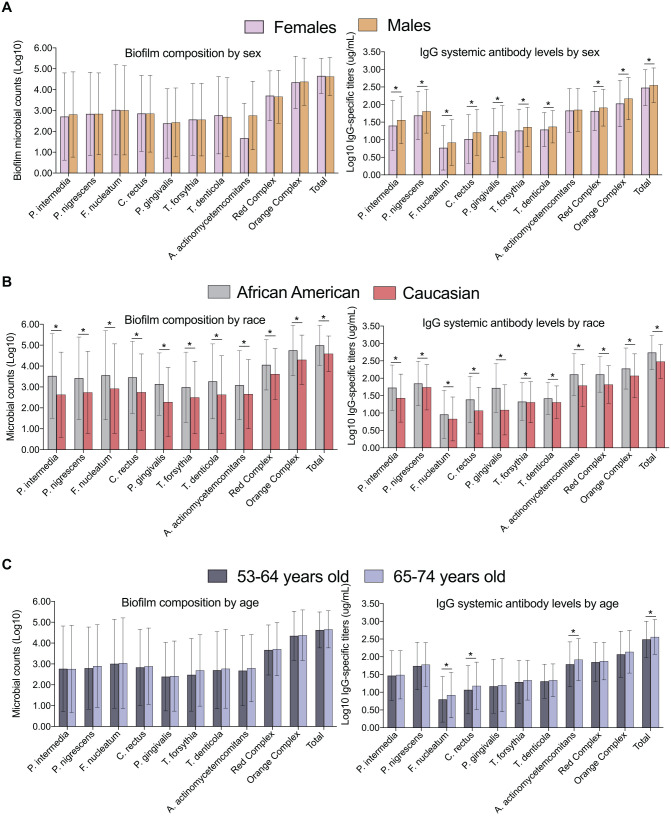
Precise classification of periodontal disease has been the objective of concerted efforts and has led to the introduction of new consensus-based and data-driven classifications. The purpose of this study was to characterize the microbiological signatures of a latent class analysis (LCA)–derived periodontal stratification system, the Periodontal Profile Class (PPC) taxonomy. We used demographic, microbial (subgingival biofilm composition), and immunological data (serum IgG antibody levels, obtained with checkerboard immunoblotting technique) for 1,450 adult participants of the Dental Atherosclerosis Risk in Communities (ARIC) study, with already generated PPC classifications. Analyses relied on t tests and generalized linear models with Bonferroni correction. Men and African Americans had higher systemic antibody levels against most microorganisms compared to women and Caucasians ( P < 0.05). Healthy individuals (PPC-I) had low levels of biofilm bacteria and serum IgG levels against most periodontal pathogens ( P < 0.05). Subjects with mild to moderate disease (PPC-II to PPC-III) showed mild/moderate colonization of multiple biofilm pathogens. Individuals with severe disease (PPC-IV) had moderate/high levels of biofilm pathogens and antibody levels for orange/red complexes. High gingival index individuals (PPC-V) showed moderate/high levels of biofilm Campylobacter rectus and Aggregatibacter actinomycetemcomitans. Biofilm composition in individuals with reduced periodontium (PPC-VI) was similar to health but showed moderate to high antibody responses. Those with severe tooth loss (PPC-VII) had significantly high levels of multiple biofilm pathogens, while the systemic antibody response to these microorganisms was comparable to health. The results support a biologic basis for elevated risk for periodontal disease in men and African Americans. Periodontally healthy individuals showed a low biofilm pathogen and low systemic antibody burden. In the presence of PPC disease, a microbial-host imbalance characterized by higher microbial biofilm colonization and/or systemic IgG responses was identified. These results support the notion that subgroups identified by the PPC system present distinct microbial profiles and may be useful in designing future precise biological treatment interventions.
Overview
The claims and statistics of this paper haven’t been checked yet.
Free: it reads the open-access text and checks the first 5 claims that cite a source we can check. Create a free account to check every claim.
Integrity signals
Registry
Cites
Statistics
Figures
Verification
Claims the paper makes
The claims and statistics of this paper haven’t been checked yet.
Free: it reads the open-access text and checks the first 5 claims that cite a source we can check. Create a free account to check every claim.
Claims other papers make about this one
Each is checked against this paper’s own text: does it say what the citing paper says it does?
The source backs part of the claim, not all of it — or backs it for a different population, condition or comparison.
In the citing paper
“While periodontal health on a reduced periodontium in a periodontitis patient can be reestablished, 46 patients who have a history of periodontitis continue to demonstrate an elevated risk of disease progression and an oral biofilm profile associated with periodontitis. 35-37,47,48”
From A randomized double-blind clinical trial evaluating comparative plaque and gingival health associated with commercially available stannous fluoride-containing dentifrices as compared to a sodium fluoride control dentifrice (2023) · cites this paper as [48]
Experimental — accuracy not yet measured
Self-check
Percentages, sums and reported differences re-computed from the paper’s own numbers.
The self-check needs the paper’s full text.
Citations
Cites
Microbial complexes in subgingival plaque
Socransky, S. S., Haffajee, A. D., Cugini, M. A., Smith, C., & Kent, R. L. (1998) · Journal of Clinical Periodontology · doi:10.1111/j.1600-051x.1998.tb02419.x · Cited by 5,050 · cited 3×
“Periodontal microorganisms selected for the analysis were classic representatives reported to be associated with periodontal infection (Socransky et al. 1998).”
BackgroundTonetti, M. S., Greenwell, H., & Kornman, K. S. (2018) · Journal of Periodontology · doi:10.1002/jper.18-0006 · Cited by 3,239 · cited 2×
“Email: julie_marchesan@unc.edu Keywords: dysbiosis, biofilm, adaptive immunity, periodontitis, sex characteristics, race factors (smoking and diabetes) were included in the current 2017 World Workshop (WW17) disease classification (Tonetti et al. 2018).”
BackgroundCalfee, C. S., Delucchi, K., Parsons, P. E., Thompson, B. T., Ware, L. B., & Matthay, M. A. (2014) · The Lancet Respiratory Medicine · doi:10.1016/s2213-2600(14)70097-9 · Cited by 1,544 · cited 1×
“To enable such applications, latent class analysis (LCA) is a suitable data-driven statistical modeling technique that has been used to identify precise care in other fields (Calfee et al. 2014; Ghanbari et al. 2018; Ahanchi et al. 2019; Petersen et al. 2019).”
Beck, J. D., Elter, J. R., Heiss, G., Couper, D., Mauriello, S. M., & Offenbacher, S. (2001) · Arteriosclerosis, Thrombosis, and Vascular Biology · doi:10.1161/hq1101.097803 · Cited by 414 · cited 2×
“Detailed information about the study is presented in the Appendix and has been previously described (Beck et al. 2001).”
MethodSelf-citationNewly Identified Pathogens Associated with Periodontitis: A Systematic Review
Pérez-Chaparro, P. J., Gonçalves, C., Figueiredo, L. C., Faveri, M., Lobão, E., Tamashiro, N., Duarte, P., & Feres, M. (2014) · Journal of Dental Research · doi:10.1177/0022034514542468 · Cited by 359 · cited 1×
“Microbial characterization by high-throughput methods would improve the evaluation of bacterial community interactions (Perez-Chaparro et al. 2014) and could offer new targets for therapeutic interventions.”
BackgroundHajishengallis, G., & Korostoff, J. M. (2017) · Periodontology 2000 · doi:10.1111/prd.12181 · Cited by 241
Periodontal Disease, Regular Dental Care Use, and Incident Ischemic Stroke
Sen, S., Giamberardino, L. D., Moss, K., Morelli, T., Rosamond, W. D., Gottesman, R. F., Beck, J., & Offenbacher, S. (2018) · Stroke · doi:10.1161/strokeaha.117.018990 · Cited by 208 · cited 2×
“…to >14,500 individuals to address disease comorbidities, genetics, and oral health behavioral questions (Beck et al. 2018a, 2018b; Marchesan et al. 2018; Morelli et al. 2018; Sen et al. 2018; Agler et al. 2019; Marchesan, Byrd, et al. 2020; Marchesan, Girnary, et al. 2020; Morelli et al. 2020).”
BackgroundSelf-citationPetersen, K. J., Qualter, P., & Humphrey, N. (2019) · Frontiers in Psychology · doi:10.3389/fpsyg.2019.01214 · Cited by 195 · cited 1×
“To enable such applications, latent class analysis (LCA) is a suitable data-driven statistical modeling technique that has been used to identify precise care in other fields (Calfee et al. 2014; Ghanbari et al. 2018; Ahanchi et al. 2019; Petersen et al. 2019).”
Host responses in maintaining periodontal health and determining periodontal disease
Schenkein, H. A. (2006) · Periodontology 2000 · doi:10.1111/j.1600-0757.2005.00144.x · Cited by 184
Offenbacher, S., Divaris, K., Barros, S. P., MOSS, K. L., Marchesan, J. T., Morelli, T., Zhang, S., Kim, S., Sun, L., Beck, J. D., et al. (2016) · Human Molecular Genetics · doi:10.1093/hmg/ddw069 · Cited by 164 · cited 3×
“As knowledge in health and disease pathogenesis expands, new classification systems are developed to better represent disease subphenotypes with similar and overlapping clinical presentations (Offenbacher et al. 2016).”
BackgroundSelf-citation
Cited by
Presence of periodontal pathogenic bacteria in blood of patients with coronary artery disease
Corredor, Z., Suárez-Molina, A., Fong, C., Cifuentes-C, L., & Guauque-Olarte, S. (2022) · Scientific Reports · doi:10.1038/s41598-022-05337-1 · Cited by 50
Realizing the clinical utility of saliva for monitoring oral diseases
Ebersole, J. L., Hastürk, H., Huber, M. A., Gellibolian, R., Markaryan, A. N., Zhang, X. D., & Miller, C. S. (2024) · Periodontology 2000 · doi:10.1111/prd.12581 · Cited by 48
Oral Bacterial and Fungal Microbiome and Subsequent Risk for Pancreatic Cancer
Meng, Y., Wu, F. C., Kwak, S., Wang, C., Usyk, M., Freedman, N. D., Huang, W., Um, C. Y., Gonda, T. A., Oberstein, P. E., et al. (2025) · JAMA Oncology · doi:10.1001/jamaoncol.2025.3377 · Cited by 43
Sen, S., Curtis, J., Hicklin, D., Nichols, C., Glover, S. H., Merchant, A. T., Hardin, J. W., Logue, M., Meyer, J., Mason, E., et al. (2023) · Stroke · doi:10.1161/strokeaha.122.042047 · Cited by 27
Self-citationZhou, B., Lu, J., Beck, J. D., MOSS, K. L., Prizment, A. E., Demmer, R. T., Rodriguez, K. A. P., Joshu, C. E., Michaud, D. S., & Platz, E. A. (2022) · Cancer Epidemiology Biomarkers & Prevention · doi:10.1158/1055-9965.epi-22-0601 · Cited by 25
Self-citation
Metadata
- Authors
- Marchesan, J. T., Moss, K., Morelli, T., Teles, F. R., Divaris, K., Styner, M., Ribeiro, A. A., Webster-Cyriaque, J., & Beck, J.
- Affiliations
- University of North Carolina at Chapel Hill (US)
- University of Pennsylvania (US)
- Corresponding author
- Marchesan, J.T.
- Venue
- Journal of Dental Research
- Publisher
- SAGE Publications
- Published
- 2021-04-27
- Volume
- 100
- Issue
- 12
- Pages
- 1405-1413
- ISSN
- 0022-0345 (ISSN-L)
- 1544-0591
- PMC
- PMC8529299
- OpenAlex
- W3159502815
- Cited by
- 25
- References
- 33
- Citations by year
- 2026: 2 · 2025: 6 · 2024: 7 · 2023: 7 · 2022: 3
- FWCI
- 4.40
- Type
- journal article
- Language
- en
- Open access
- hybrid
- doi.org
- Locations
- Journal of Dental Research (publishedVersion, cc-by)
- PubMed Central (publishedVersion, cc-by)
- PubMed (publishedVersion)
- Funders
- National Institutes of Health (National Heart, Lung, and Blood Institute, Nationa)
- National Institute of Dental and Craniofacial Research (DE025093, DE027087)
- Topics
- Health Sciences › Dentistry › Periodontics › Oral microbiology and periodontitis research
- Health Sciences › Dentistry › Periodontics › Periodontal Regeneration and Treatments
- Health Sciences › Dentistry › Periodontics › Oral and gingival health research
- Keywords
- periodontal disease classification, subgingival plaque, periodontal pathogens, Campylobacter rectus, Aggregatibacter actinomycetemcomitans, gingival index, tooth loss, sex differences, racial differences, latent class analysis, Atherosclerosis Risk in Communities Study
- MeSH terms
- Adult, Female, Humans, Male, Periodontal Diseases, Periodontal Index, Periodontium, Tooth Loss, Aggregatibacter actinomycetemcomitans
About these checks
Registry, retraction, Cites and statistics results are computed, not judged, with one exception: a printed reference that no index lists is read once by a model before it counts as a citation error. Claims are extracted by a model and kept only when their quote appears verbatim in the text; each cited source is then checked, with a model’s help, for whether it says what the claim relies on. Those verdicts can be wrong — read the claim’s quote and the cited source before relying on one.
Statistics and arithmetic are recomputed, not judged.
Confidence bands are shown only for fields calibrated on our annotated test set. None is calibrated yet, so no band is shown.
What counts as a claim ›How we measure confidence ›How we check this ›
Are you an author, or do you see a problem with this page? Request a review
Data sources
Bibliographic data: Semantic Scholar, OpenAlex, Crossref.
Contains information from the Semantic Scholar Academic Graph Datasets, made available under the ODC Attribution License (ODC-BY 1.0).
Semantic Scholar’s data is described in: Kinney, R., et al. (2023). The Semantic Scholar Open Data Platform. arXiv:2301.10140.
