

Dental Research Data Availability and Quality According to the FAIR Principles
Open accessThe DOI matches its Crossref record; 31 of the 31 references it cites were found in a registry or an index.
Abstract
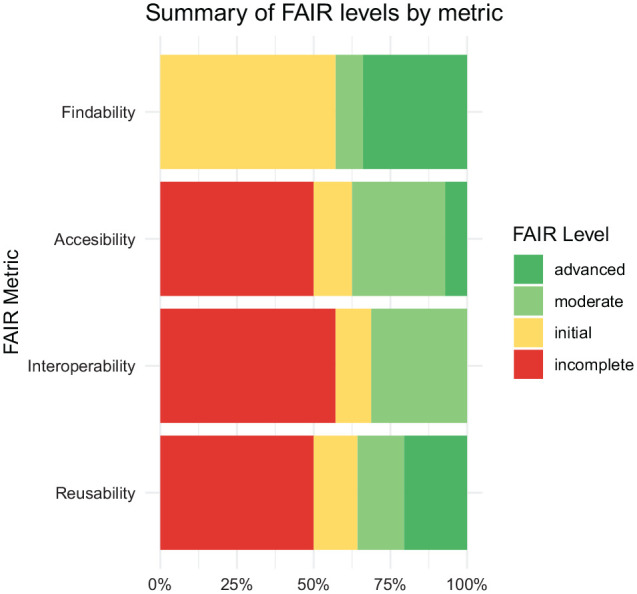
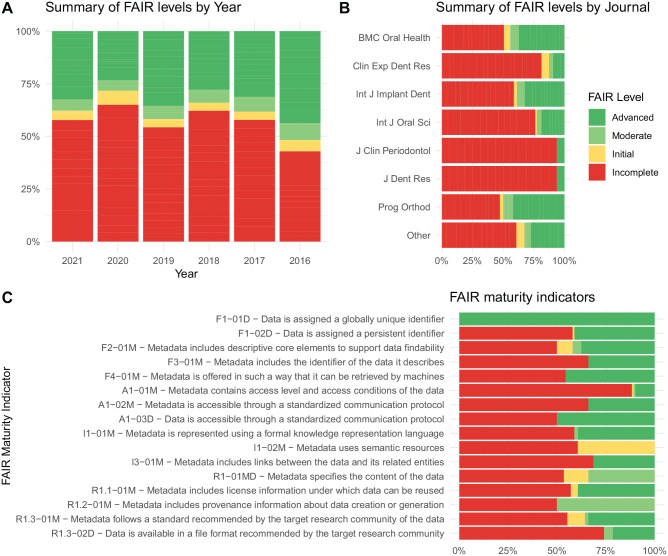
According to the FAIR principles, data produced by scientific research should be findable, accessible, interoperable, and reusable—for instance, to be used in machine learning algorithms. However, to date, there is no estimate of the quantity or quality of dental research data evaluated via the FAIR principles. We aimed to determine the availability of open data in dental research and to assess compliance with the FAIR principles (or FAIRness) of shared dental research data. We downloaded all available articles published in PubMed-indexed dental journals from 2016 to 2021 as open access from Europe PubMed Central. In addition, we took a random sample of 500 dental articles that were not open access through Europe PubMed Central. We assessed data sharing in the articles and compliance of shared data to the FAIR principles programmatically. Results showed that of 7,509 investigated articles, 112 (1.5%) shared data. The average (SD) level of compliance with the FAIR metrics was 32.6% (31.9%). The average for each metric was as follows: findability, 3.4 (2.7) of 7; accessibility, 1.0 (1.0) of 3; interoperability, 1.1 (1.2) of 4; and reusability, 2.4 (2.6) of 10. No considerable changes in data sharing or quality of shared data occurred over the years. Our findings indicated that dental researchers rarely shared data, and when they did share, the FAIR quality was suboptimal. Machine learning algorithms could understand 1% of available dental research data. These undermine the reproducibility of dental research and hinder gaining the knowledge that can be gleaned from machine learning algorithms and applications.
Overview
The claims and statistics of this paper haven’t been checked yet.
Free: it reads the open-access text and checks the first 5 claims that cite a source we can check. Create a free account to check every claim.
Integrity signals
Registry
Cites
Statistics
Figures
Verification
Claims the paper makes
The claims and statistics of this paper haven’t been checked yet.
Free: it reads the open-access text and checks the first 5 claims that cite a source we can check. Create a free account to check every claim.
Claims other papers make about this one
Each is checked against this paper’s own text: does it say what the citing paper says it does?
The source backs part of the claim, not all of it — or backs it for a different population, condition or comparison.
In the citing paper
“and data and code sharing has been the least reported aspect in many studies [25–30, 41].”
From Assessing transparency practices in dental randomized controlled trials (2024) · cites this paper as [41]
Experimental — accuracy not yet measuredThe cited source says what the claim attributes to it.
In the citing paper
“Other articles also found a low prevalence of data sharing in articles published in dentistry, around 2% [20, 21].”
From Do randomised clinical trials on dental caries adopt Open Science practices? (2024) · cites this paper as [21]
Self-check
Percentages, sums and reported differences re-computed from the paper’s own numbers.
The self-check needs the paper’s full text.
Citations
Cites
The FAIR Guiding Principles for scientific data management and stewardship
Wilkinson, M. D., Dumontier, M., Aalbersberg, I. J., Appleton, G., Axton, M., Baak, A., Blomberg, N., Boiten, J.-W., da Silva Santos, L. B., Bourne, P. E., et al. (2016) · Scientific Data · doi:10.1038/sdata.2016.18 · Cited by 18,423 · cited 3×
“Thus, the FAIR principles were established, specifying that data produced by scientific research be findable, accessible, interoperable, and reusable (Wilkinson et al. 2016).”
BackgroundInfluentialvon Elm, E., Altman, D. G., Egger, M., Pocock, S. J., Gøtzsche, P. C., Vandenbroucke, J. P., & Initiative, F. T. S. (2007) · Annals of Internal Medicine · doi:10.7326/0003-4819-147-8-200710160-00010 · Cited by 17,796 · cited 1×
“This descriptive study was prepared with the STROBE guideline (von Elm et al. 2007).”
1,500 scientists lift the lid on reproducibility
Baker, M. (2016) · Nature · doi:10.1038/533452a · Cited by 4,209 · cited 1×
“A large part of these valuable and quality clinical data is lost or kept without being reused (Baker 2016).”
BackgroundEncyclopedia of Survey Research Methods
Lavrakas, P. (2008) · doi:10.4135/9781412963947 · Cited by 2,689
Ardila, D., Kiraly, A. P., Bharadwaj, S., Choi, B., Reicher, J. J., Peng, L., Tse, D., Etemadi, M., Ye, W., Corrado, G., et al. (2019) · Nature Medicine · doi:10.1038/s41591-019-0447-x · Cited by 2,167 · cited 1×
“For example, ML can create knowledge from big data—for example, detecting subtle changes in patterns that can predict pathologic changes before humans can detect them (Ardila et al. 2019)—or find complex relationships between large amounts of data and multidimensional variables (Uddin et al.”
BackgroundReproducibility and Replicability in Science
Committee on Reproducibility and Replicability in Science, Board on Behavioral, C., Committee on National Statistics, Education, D. O. B. A. S. S. A., Nuclear and Radiation Studies Board, Studies, D. O. E. A. L., Board on Mathematical Sciences and Analytics, Committee on Applied and Theoretical Statistics, Sciences, D. O. E. A. P., Board on Research Data and Information, et al. (2019) · doi:10.17226/25303 · Cited by 924
Hood, L., & Flores, M. (2012) · New Biotechnology · doi:10.1016/j.nbt.2012.03.004 · Cited by 648
Privacy preservation in federated learning: An insightful survey from the GDPR perspective
Truong, N., Sun, K., Wang, S., Guitton, F., & Guo, Y. (2021) · Computers & Security · doi:10.1016/j.cose.2021.102402 · Cited by 399 · cited 1×
“Federated learning has emerged as a prospective solution that facilitates distributed collaborative learning without disclosing original training data (Truong et al. 2021).”
BackgroundWallach, J. D., Boyack, K. W., & Ioannidis, J. P. A. (2018) · PLOS Biology · doi:10.1371/journal.pbio.2006930 · Cited by 269
No raw data, no science: another possible source of the reproducibility crisis
Miyakawa, T. (2020) · Molecular Brain · doi:10.1186/s13041-020-0552-2 · Cited by 268 · cited 1×
“However, the raw data generated by research are rarely shared (Miyakawa 2020).”
BackgroundArtificial intelligence for precision medicine in neurodevelopmental disorders
Uddin, M., Wang, Y., & Woodbury-Smith, M. (2019) · npj Digital Medicine · doi:10.1038/s41746-019-0191-0 · Cited by 248 · cited 1×
“2019)—or find complex relationships between large amounts of data and multidimensional variables (Uddin et al. 2019).”
BackgroundPreparing for Responsible Sharing of Clinical Trial Data
Mello, M. M., Francer, J. K., Wilenzick, M., Teden, P., Bierer, B. E., & Barnes, M. (2013) · New England Journal of Medicine · doi:10.1056/nejmhle1309073 · Cited by 175 · cited 1×
“Accordingly, there are guidelines available that detail, among other benefits, improving the monitoring of drug safety and efficacy, accelerating innovation, and facilitating secondary data analysis to explore new scientific questions (Mello et al. 2013).”
BackgroundEvaluating FAIR maturity through a scalable, automated, community-governed framework
Wilkinson, M. D., Dumontier, M., Sansone, S.-A., Bonino da Silva Santos, L. O., Prieto, M., Batista, D., McQuilton, P., Kuhn, T., Rocca-Serra, P., Crosas, M., et al. (2019) · Scientific Data · doi:10.1038/s41597-019-0184-5 · Cited by 173 · cited 2×
“Currently, a consensus has been reached on how the “FAIRness” of research data should be evaluated (Bahim et al. 2020), and validated tools have been developed to assess the FAIR metrics of a given research data set objectively (Wilkinson et al. 2019).”
BackgroundMethodAssessment of transparency indicators across the biomedical literature: How open is open?
Serghiou, S., Contopoulos-Ioannidis, D. G., Boyack, K. W., Riedel, N., Wallach, J. D., & Ioannidis, J. P. A. (2021) · PLOS Biology · doi:10.1371/journal.pbio.3001107 · Cited by 139 · cited 1×
“A survey conducted by Spallek et al. (2019), all 42 dental researchers responded that data sharing should be promoted and facilitated.”
BackgroundData Dentistry: How Data Are Changing Clinical Care and Research
Schwendicke, F., & Krois, J. (2021) · Journal of Dental Research · doi:10.1177/00220345211020265 · Cited by 112 · cited 1×
“, insurance, regulatory and legislative data) that affect clinical care processes (Schwendicke and Krois 2022).”
BackgroundThe FAIR Data Maturity Model: An Approach to Harmonise FAIR Assessments
Bahim, C., Casorrán-Amilburu, C., Dekkers, M., Herczog, E., Loozen, N., Repanas, K., Russell, K., & Stall, S. (2020) · Data Science Journal · doi:10.5334/dsj-2020-041 · Cited by 85 · cited 1×
“Currently, a consensus has been reached on how the “FAIRness” of research data should be evaluated (Bahim et al. 2020), and validated tools have been developed to assess the FAIR metrics of a given research data set objectively (Wilkinson et al. 2019).”
BackgroundThe “A” of FAIR – As Open as Possible, as Closed as Necessary
Landi, A., Thompson, M., Giannuzzi, V., Bonifazi, F., Labastida, I., da Silva Santos, L. O. B., & Roos, M. (2020) · Data Intelligence · doi:10.1162/dint_a_00027 · Cited by 84 · cited 1×
“Although there are privacy constraints in medicine, medical research data should be as open as possible and as closed as necessary (Landi et al. 2020).”
BackgroundPage, M. J., Nguyen, P., Hamilton, D. G., Haddaway, N., Kanukula, R., Moher, D., & McKenzie, J. E. (2022) · Journal of Clinical Epidemiology · doi:10.1016/j.jclinepi.2022.03.003 · Cited by 61
ODDPub – a Text-Mining Algorithm to Detect Data Sharing in Biomedical Publications
Riedel, N., Kip, M., & Bobrov, E. (2020) · Data Science Journal · doi:10.5334/dsj-2020-042 · Cited by 44
Tachalov, V. V., Orekhova, L. Y., Kudryavtseva, T. V., Лобода, Е. С., Pachkoriia, M. G., Berezkina, I. V., & Golubnitschaja, O. (2021) · The EPMA Journal · doi:10.1007/s13167-021-00240-7 · Cited by 42 · cited 1×
“In the cases where dental data are available, the data are complex (Tachalov et al. 2021), have restricted access (Walji et al.”
BackgroundBigMouth: development and maintenance of a successful dental data repository
Walji, M. F., Spallek, H., Kookal, K. K., Barrow, J. R., Magnuson, B. E., Tiwari, T., Oyoyo, U. E., Brandt, M., Howe, B. J., Anderson, G. C., et al. (2022) · Journal of the American Medical Informatics Association · doi:10.1093/jamia/ocac001 · Cited by 37
Levchenko, M., Gou, Y., Graef, F., Hamelers, A., Huang, Z., Ide‐Smith, M., Iyer, A., Kilian, O., Katuri, J., Kim, J.-H., et al. (2017) · Nucleic Acids Research · doi:10.1093/nar/gkx1005 · Cited by 36
Vazquez, E., Gouraud, H., Naudet, F., Gross, C. P., Krumholz, H. M., Ross, J. S., & Wallach, J. D. (2021) · Clinical Trials · doi:10.1177/17407745211038524 · Cited by 33 · cited 1×
“So far, data sharing has had little effect, as reanalysis by other researchers is rare (Vazquez et al. 2021).”
BackgroundUsing Electronic Dental Record Data for Research: A Data-mapping Study
Liu, K., Acharya, A., Ala’i, S. F., & Schleyer, T. (2013) · Journal of Dental Research · doi:10.1177/0022034513487560 · Cited by 25
Pre-application of dentin bonding agent prevents discoloration caused by mineral trioxide aggregate
Choi, Y.-L., Jang, Y.-E., Kim, B. S., Kim, J., & Kim, Y. (2020) · BMC Oral Health · doi:10.1186/s12903-020-01151-1 · Cited by 22 · cited 1×
“Choi et al. (2020) shared the data associated with their publication through a repository (Kim et al. 2020), consisting of the spreadsheet of the raw data hosted in the general Zenodo repository.”
BackgroundPerceptions and Attitudes toward Data Sharing among Dental Researchers
Spallek, H., Weinberg, S. M., Manz, M. C., Nanayakkara, S., Zhou, X., & Johnson, L. A. (2018) · JDR Clinical & Translational Research · doi:10.1177/2380084418790451 · Cited by 19 · cited 1×
“A survey conducted by Spallek et al. (2019), all 42 dental researchers responded that data sharing should be promoted and facilitated.”
BackgroundBig Data and Complex Data Analytics: Breaking Peer Review?
Schwendicke, F., Marazita, M. L., Jakubovics, N. S., & Krois, J. (2022) · Journal of Dental Research · doi:10.1177/00220345211070983 · Cited by 15 · cited 3×
“We downloaded all identified OA journal articles in full text from the EPMC and processed them with the metareadr R package (Serghiou et al. 2021).”
MethodInfluentialLucena, C., López, J. M., Ábalos, C., Gijón, V. R., & Pulgar, R. (2011) · European Journal Of Oral Sciences · doi:10.1111/j.1600-0722.2011.00892.x · Cited by 12 · cited 1×
“A survey of the statistical errors in microleakage studies in operative dentistry found that when the raw data are available for independent validation, the conclusions had to be altered for 15.4% of these reanalyzed studies (Lucena et al. 2011).”
BackgroundInfluentialHealth data research UK (HDR UK): Options and opportunities for health data science
Morris, A. D. (2019) · Clinica Chimica Acta · doi:10.1016/j.cca.2019.03.1352 · Cited by 3
detector: Detect Data Containing Personally Identifiable Information
Hendricks, P. (2015) · doi:10.32614/cran.package.detector · Cited by 3
Pre-application of dentin bonding agent prevents discoloration caused by mineral trioxide aggregatePreprint
Choi, Y.-L., Jang, Y.-E., Kim, B. S., et al. (2020) · Research Square · doi:10.21203/rs.2.20732/v2 · Cited by 1
Research works printed but not linked: 1
- Europe PubMed Central. 2021. About Europe PMC [ accessed 2022 Jan 27]. https://europepmc.org/About
Cited by
Hamilton, D. G., Hong, K., Fraser, H., Rowhani-Farid, A., Fidler, F., & Page, M. J. (2023) · BMJ · doi:10.1136/bmj-2023-075767 · Cited by 86
Mahdi, S. S., Battineni, G., Khawaja, M., Allana, R., Siddiqui, M. K., & Agha, D. (2022) · International Journal of Information Management Data Insights · doi:10.1016/j.jjimei.2022.100144 · Cited by 109
Publicly Available Dental Image Datasets for Artificial Intelligence
Uribe, S. E., Issa, J., Sohrabniya, F., Denny, A., Kim, N. N., Dayo, A. F., Chaurasia, A., Sofi‐Mahmudi, A., Büttner, M., & Schwendicke, F. (2024) · Journal of Dental Research · doi:10.1177/00220345241272052 · Cited by 70
Self-citationBrinz, J., Eslamiamirabadi, N., Salamati, A., Tresp, V., Schwendicke, F., & Tichý, A. (2025) · Journal of Dentistry · doi:10.1016/j.jdent.2025.106130 · Cited by 29
Research transparency in dental research: A programmatic analysis
Raittio, E., Sofi‐Mahmudi, A., & Uribe, S. E. (2023) · European Journal of Oral Sciences · doi:10.1111/eos.12908 · Cited by 15
“However, investigation of biomedical research articles has shown that, in terms of these five transparency indicators, there are only small differences between articles accessible and inaccessible via the EPMC [40, 41].”
Self-citation
Metadata
- Authors
- Uribe, S. E., Sofi-Mahmudi, A., Raittio, E., Maldupa, I., & Vilne, B.
- Affiliations
- Austral University of Chile (CL)
- Seqiz Health Network, Kurdistan University of Medical Sciences, Seqiz, Kurdistan
- University of Eastern Finland (FI)
- Riga Stradiņš University (LV)
- Corresponding author
- Uribe, S.E.
- Venue
- Journal of Dental Research
- Publisher
- SAGE Publications
- Published
- 2022-06-02
- Volume
- 101
- Issue
- 11
- Pages
- 1307-1313
- ISSN
- 0022-0345 (ISSN-L)
- 1544-0591
- PMC
- PMC9516597
- OpenAlex
- W4281708427
- Semantic Scholar
- a062634fe126b992df684a1e79afaaaf9b119807
- Cited by
- 27
- References
- 30
- Citations by year
- 2026: 4 · 2025: 4 · 2024: 12 · 2023: 4 · 2022: 3
- FWCI
- 5.68
- Type
- journal article
- Language
- en
- Open access
- hybrid
- doi.org
- Locations
- Journal of Dental Research (publishedVersion, cc-by)
- PubMed Central (publishedVersion, cc-by)
- PubMed (publishedVersion)
- Scopus (Elsevier) (submittedVersion, other-oa)
- Zenodo (CERN European Organization for Nuclear Research) (submittedVersion, cc-by)
- Funders
- European Commission (HORIZON2020, 857287)
- Topics
- Physical Sciences › Computer Science › Information Systems › Research Data Management Practices
- Social Sciences › Library and Information Sciences › Academic Publishing and Open Access
- Social Sciences › Sociology and Political Science › Data Analysis and Archiving
- Keywords
- FAIR principles, data sharing, data availability, data quality, discoverability, accessibility, interoperability, reusability, reproducibility, open data, machine learning, dental journals
- MeSH terms
- Machine Learning, Europe, Reproducibility of Results, Dental Research, Information Dissemination
About these checks
Registry, retraction, Cites and statistics results are computed, not judged, with one exception: a printed reference that no index lists is read once by a model before it counts as a citation error. Claims are extracted by a model and kept only when their quote appears verbatim in the text; each cited source is then checked, with a model’s help, for whether it says what the claim relies on. Those verdicts can be wrong — read the claim’s quote and the cited source before relying on one.
Statistics and arithmetic are recomputed, not judged.
Confidence bands are shown only for fields calibrated on our annotated test set. None is calibrated yet, so no band is shown.
What counts as a claim ›How we measure confidence ›How we check this ›
Are you an author, or do you see a problem with this page? Request a review
Data sources
Bibliographic data: Semantic Scholar, OpenAlex, Crossref.
Contains information from the Semantic Scholar Academic Graph Datasets, made available under the ODC Attribution License (ODC-BY 1.0).
Semantic Scholar’s data is described in: Kinney, R., et al. (2023). The Semantic Scholar Open Data Platform. arXiv:2301.10140.
