

The DOI matches its Crossref record; 36 of the 36 references it cites were found in a registry or an index; 34 of the 63 sources its claims cite were checked for support.
Assessing transparency practices in dental randomized controlled trials
Open accessAbstract
To evaluate transparency practices in randomized controlled trials (RCTs) in dentistry. This meta-research study included RCTs in dentistry regardless of topic, methods, or level of detail reported. Only studies in English were considered. We searched PubMed for RCTs in dentistry published in English from December 31, 2016, to December 31, 2021. ... A total of 844 RCTs were included. Only 12.86% of studies reported any information about data and code sharing. Protocol registration was reported for 50.36% of RCTs. Conflict of interest (83.41%) and funding (71.68%) declarations were present in most studies. ...
Overview
CoChat Summary
TL;DR
This meta-research study examined transparency practices in 844 dental randomized controlled trials (RCTs) published in English in PubMed from 2017–2021. Reporting was common for conflict of interest (83.41%) and funding (71.68%), but much lower for protocol registration (50.36%) and especially data/code sharing (12.68%).
Key findings
- Of 844 included RCTs, only 12.68% reported any information about data and code sharing; among those, “available upon request” was the most common response (80 studies, 9.48%).
- Protocol registration was reported in 50.36% of RCTs.
- Conflict of interest declarations appeared in 83.41% of studies, and funding declarations in 71.68%.
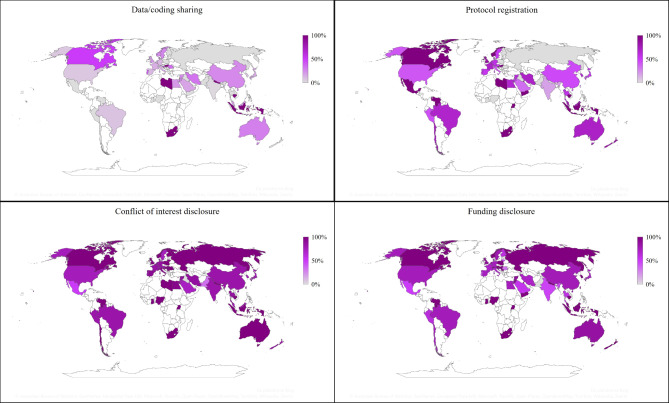
- Reporting of conflicts of interest and funding was consistent across countries and specialties, whereas data/code sharing was low globally and protocol registration varied considerably.
Methods
- Meta-research design: the authors evaluated transparency characteristics in dental RCTs, with the protocol registered on the Open Science Framework.
- Data source/sample: PubMed search for English-language dental RCTs published from December 31, 2016, to December 31, 2021; 5,557 records identified, 3,512 eligible, and 844 randomly selected for analysis.
- Main analysis: duplicate screening, structured data extraction, and descriptive analysis in Excel; transparency items were dichotomized as reported vs not reported, and maps/heat tables were generated by country and dental specialty.
Limitations
- The paper states that only English-language studies from a single database (PubMed) were included, which may limit generalizability.
- The paper states that data extraction was not conducted in duplicate; the authors tried to mitigate this with a pilot test and a third reviewer.
- Evident from the text: some countries/specialties had very small numbers of RCTs, so percentages can be extreme or unstable for those strata.
Model-written summary. Check it against the paper before relying on it.
Integrity signals
Registry
Cites
Statistics
Figures

Verification
Claims the paper makes
17 Valid · 2 Not valid · 7 Not checked · 42 Own results and interpretations
At least one cited source doesn’t support this claim or points to a different paper, and none confirmed it — see the verdicts below.
In the paper
“Prior analyses have shown that dental articles seldom employ multiple transparency practices simultaneously [28]”
§ Assessing transparency practices in dental randomized controlled trials > Discussion
What the sources say
- Disputedcites [28] Raittio E, Sofi-Mahmudi A, Uribe SE. Research transparency in dental research: a programmatic analysis. Eur J Oral Sci. 2023;131(1):e12908. https://doi.org/10.1111/eos.12908. sourceExperimental — accuracy not yet measured
The Results report that 48.2% of sampled articles adhered to two practices, 7.0% to three, and 0.3% to four—a majority adhered to multiple practices. The Discussion says articles rarely adhered to *many* practices simultaneously, but that does not support saying they seldom adhered to *multiple* practices. (LLM, conf=0.86)
Checked by a reasoning model — may be wrong.
plain- Asserted: passes — The authors put it forward as true.
- Checkable: passes — It can be checked against evidence.
- Load-bearing: unclear — It is unclear whether the paper’s conclusions depend on it.
- Based: passes — The paper gives a reason why it holds.
- Disputed
The cited sources support only part of this claim — read each source’s verdict below.
In the paper
“Considering that the statement encourages both the registration of studies and the declaration of funding and conflicts of interest, we can expect higher reporting of these characteristics compared to the sharing of data and codes.”
§ Assessing transparency practices in dental randomized controlled trials > Discussion
What the sources say
- Partly supportedcites [38] Shamseer L, Hopewell S, Altman DG, Moher D, Schulz KF. Update on the endorsement of CONSORT by high impact factor journals: a survey of journal Instructions to Authors in 2014. Trials. 2016;17(1):301. https://doi.org/10.1186/s13063-016-1408-z. sourceExperimental — accuracy not yet measured
The Results section (ICMJE and trial registration; page unavailable) identifies trial registration as CONSORT 2010 checklist item 23 and reports that journals mentioning CONSORT were more likely to mention registration. The paper does not address CONSORT encouragement of funding or conflict-of-interest declarations, or compare reporting of those items with data and code sharing. That expected comparison is the citing authors’ inference, not a finding of this survey. (LLM, conf=0.85)
- Not checked — no full text of the sourcecites [39] Santos WVO, Dotto L, de Góes Mário Ferreira T, Sarkis-Onofre R. Endorsement of open science practices by dental journals: a meta-research study. J Dent. 2024;104869. https://doi.org/10.1016/j.jdent.2024.104869. source
plainstates a possible cause- Asserted: passes — The authors put it forward as true.
- Checkable: passes — It can be checked against evidence.
- Load-bearing: passes — The paper’s conclusions depend on it.
- Based: passes — The paper gives a reason why it holds.
- Partly supported
Every source the paper cites for this claim was checked and supports it.
In the paper
“However, compared to dental research involving other types of studies [29, 34], our analysis revealed the highest value for the reporting of protocol registration (50.36%).”
§ Assessing transparency practices in dental randomized controlled trials > Discussion
What the sources say
- Supportedcites [29] Sofi-Mahmudi A, Raittio E. Transparency of COVID-19-Related Research in Dental journals. Front Oral Health. 2022;3:871033. https://doi.org/10.3389/froh.2022.871033. source
The Results report that 4.2% of the COVID-19-related articles surveyed in dental journals were registered beforehand, supporting this paper's use as a lower-rate comparator. The 50.36% figure is explicitly attributed to the citing authors’ own analysis, not to this source. (LLM, conf=0.91)
- Supportedcites [34] Dos Santos MBF, Agostini BA, Bassani R, Pereira GKR, Sarkis-Onofre R. Protocol registration improves reporting quality of systematic reviews in dentistry. BMC Med Res Methodol. 2020;20(1):57. https://doi.org/10.1186/s12874-020-00939-7. source
The Results report that 149 of 495 dental systematic reviews (30.1%) reported registering a protocol; 162 (32.7%) reported either registration or use of a previously established protocol. Both figures are below the citing authors’ own 50.36%, which is presented as their analysis rather than a result of this source. (LLM, conf=0.88)
plainstates an association- Asserted: passes — The authors put it forward as true.
- Checkable: passes — It can be checked against evidence.
- Load-bearing: passes — The paper’s conclusions depend on it.
- Based: passes — The paper gives a reason why it holds.
- Supported
The sources with a verdict support this claim; the rest weren’t checked yet, have no full text we could read, or their verdicts aren’t rated yet.
In the paper
“Our findings align with previous biomedical and dental research, which reported the presence of more articles with statement of conflict of interest and funding than data and code sharing and protocol registration [27–30].”
§ Assessing transparency practices in dental randomized controlled trials > Discussion
What the sources say
- Supportedcites [27] Serghiou S, Contopoulos-Ioannidis DG, Boyack KW, Riedel N, Wallach JD, Ioannidis JPA. Assessment of transparency indicators across the biomedical literature: how open is open? PLoS Biol. 2021;19(3):e3001107. https://doi.org/10.1371/journal.pbio.3001107. source
The Introduction reports that, among 349 research articles, COI disclosures appeared in 71% and funding disclosures in 81%, compared with data-sharing statements in 20%, code-sharing statements in 1%, and openly registered protocols in 6%. This supports the comparison attributed to this source for biomedical articles; the sentence’s reference to dental research may be supported by its other citations. (LLM, conf=0.94)
- Supportedcites [28] Raittio E, Sofi-Mahmudi A, Uribe SE. Research transparency in dental research: a programmatic analysis. Eur J Oral Sci. 2023;131(1):e12908. https://doi.org/10.1111/eos.12908. source
The Results report that COI disclosures (76.7%) and funding disclosures (61.5%) were much more common in dental articles than protocol registration (6.9%), data sharing (2.0%), or code sharing (0.1%). The Discussion compares these findings with biomedical research, reporting still-low biomedical rates for data sharing (8.9%), code sharing (1.2%), and protocol registration (2.6%), while describing COI and funding disclosures as at least as prevalent there as in dental articles. (LLM, conf=0.91)
- Supportedcites [29] Sofi-Mahmudi A, Raittio E. Transparency of COVID-19-Related Research in Dental journals. Front Oral Health. 2022;3:871033. https://doi.org/10.3389/froh.2022.871033. source
The Results report that, among 650 COVID-19-related articles in dental journals, 73.5% had conflict-of-interest disclosures and 40.2% had funding statements, compared with 4.2% preregistered, one sharing data, and none sharing code. This supports the comparison attributed to this dental-research source; the broader biomedical literature is cited jointly, not established by this paper alone. (LLM, conf=0.94)
- Not checked — no full text of the sourcecites [30] Papageorgiou SN, Antonoglou GN, Martin C, Eliades T. Methods, transparency and reporting of clinical trials in orthodontics and periodontics. J Orthod. 2019;46(2):101–9. https://doi.org/10.1177/1465312519842315. source
plain- Asserted: passes — The authors put it forward as true.
- Checkable: passes — It can be checked against evidence.
- Load-bearing: unclear — It is unclear whether the paper’s conclusions depend on it.
- Based: passes — The paper gives a reason why it holds.
- Supported
The cited sources support only part of this claim — read each source’s verdict below.
In the paper
“Well-planned, well-executed, and well-reported RCTs, which embrace transparent and open science practices, enhance the likelihood that results are accurate, reliable, and applicable [2, 3].”
§ Assessing transparency practices in dental randomized controlled trials > Introduction
What the sources say
- Not checked — no full text of the sourcecites [2] Pihlstrom BL, Curran AE, Voelker HT, Kingman A. Randomized controlled trials: what are they and who needs them? Periodontol 2000. 2012;59(1):14–31. https://doi.org/10.1111/j.1600-0757.2011.00439.x. source
- Partly supportedcites [3] Ioannidis JP. How to make more published research true. PLoS Med. 2014;11(10):e1001747. https://doi.org/10.1371/journal.pmed.1001747. sourceExperimental — accuracy not yet measured
In Box 1 (Effective Interventions; page unavailable), Ioannidis says improved study design and reporting can increase reliability, while trial registration increases transparency and data sharing may improve the credibility of clinical research. This supports the claim’s general direction, but the paper does not specifically establish that these practices make RCT results more applicable. (LLM, conf=0.78)
hedgedstates a possible cause- Asserted: passes — The authors put it forward as true.
- Checkable: passes — It can be checked against evidence.
- Load-bearing: passes — The paper’s conclusions depend on it.
- Based: passes — The paper gives a reason why it holds.
24 more claims · 2 with their cited sources checked
Create a free account to see all 68 claims and every source verdict.
- Probably not a substantial claim. 24
- It may state two separate claims as one. 22
- The quote only partly states this claim. 1
Self-check
Percentages, sums and reported differences re-computed from the paper’s own numbers.
Each contradiction between two passages listed here was confirmed by an independent check.
Rated minor: it would not touch a result — a value no result rests on, a p-value that stays on the same side of the significance level, or a conflict that is clerical, resolved elsewhere in the paper, or outside its own findings.
In the paper
§ Assessing transparency practices in dental randomized controlled trials > Abstract > Results
“Only 12.86% of studies reported any information about data and code sharing.”
§ Assessing transparency practices in dental randomized controlled trials > Results
“As shown by the transparency attributes outlined in Table 1, only 12.68% of RCTs reported any information about sharing data and codes.”
Citations
Cites
Why Most Published Research Findings Are False
Ioannidis, J. P. A. (2005) · PLoS Medicine · doi:10.1371/journal.pmed.0020124 · Cited by 10,505
What Makes Clinical Research Ethical?
Emanuel, E. J. (2000) · JAMA · doi:10.1001/jama.283.20.2701 · Cited by 2,710 · cited 1×
“Achieving this necessitates the translation of study results, particularly those of randomized controlled trials (RCTs), into clinical practice by the biomedical community [1, 2].”
BackgroundFundamentals of Clinical Trials
Friedman, L. M., Furberg, C. D., DeMets, D. L., Reboussin, D. M., & Granger, C. B. (2015) · doi:10.1007/978-3-319-18539-2 · Cited by 2,237
Scope and Impact of Financial Conflicts of Interest in Biomedical Research: A Systematic Review
Bekelman, J. E., Li, Y., & Gross, C. P. (2003) · JAMA · doi:10.1001/jama.289.4.454 · Cited by 1,816 · cited 2×
“These factors can affect RCTs from conception to the reporting of results and conclusions [13, 32, 33].”
BackgroundWhy Most Discovered True Associations Are Inflated
Ioannidis, J. P. A. (2008) · Epidemiology · doi:10.1097/ede.0b013e31818131e7 · Cited by 1,495
Increasing value and reducing waste: addressing inaccessible research
Chan, A.-W., Song, F., Vickers, A., Jefferson, T., Dickersin, K., Gøtzsche, P. C., Krumholz, H. M., Ghersi, D., & van der Worp, H. B. (2014) · The Lancet · doi:10.1016/s0140-6736(13)62296-5 · Cited by 887
How to Make More Published Research True
Ioannidis, J. P. A. (2014) · PLoS Medicine · doi:10.1371/journal.pmed.1001747 · Cited by 760
Foster, E. D., & Deardorff, A. (2017) · Journal of the Medical Library Association · doi:10.5195/jmla.2017.88 · Cited by 715
Empirical Study of Data Sharing by Authors Publishing in PLoS Journals
Savage, C. J., & Vickers, A. J. (2009) · PLoS ONE · doi:10.1371/journal.pone.0007078 · Cited by 411 · cited 1×
“Some authors cite concerns about the confidentiality of data from research participants, the inappropriate use of secondary data, and lower rewards for conducting original research [15, 16].”
BackgroundReproducible Research Practices and Transparency across the Biomedical Literature
Iqbal, S. A., Wallach, J. D., Khoury, M. J., Schully, S. D., & Ioannidis, J. P. A. (2016) · PLOS Biology · doi:10.1371/journal.pbio.1002333 · Cited by 310
Research works printed but not linked: 3
- Committee on Strategies for Responsible Sharing of Clinical Trial Data; Board on Health Sciences Policy; Institute of Medicine. Sharing clinical Trial Data: maximizing benefits, minimizing risk. Washington (DC): National Academies Press (US); 2015 Apr. p. 20.
- Nature Publishing Group. Authors and references, policies: availability of data and materials. www.nature.com/authors/policies/availability.html. Accessed 3 Dec 2023.
- Cochrane Collaboration. Press release: cochrane collaboration statement on access to clinical trial data. www.cochrane.org/features/clinical-trials-statement-press-release. Accessed 3 Dec 2023.
Cited by
Baxmann, M., Zsoldos, M., & Kárpáti, K. (2025) · Journal of Clinical Medicine · doi:10.3390/jcm14248907 · Cited by 3
“The transparency profile observed in this review mirrors earlier meta-research in or-thodontics and related dental fields, where fewer than two-thirds of RCTs disclose funding sources, register protocols, or fully adhere to CONSORT reporting standards [20,21].”
Meade, M. J., Ju, X., & Jamieson, L. (2025) · Journal of Dentistry · doi:10.1016/j.jdent.2025.106312 · Cited by 1
Research transparency in articles published in orthodontic journals: is it clear?
Yii, M. C. H., Cobourne, M. T., Pandis, N., & Seehra, J. (2025) · European Journal of Orthodontics · doi:10.1093/ejo/cjaf028
Lee, D. Y. H., Parker, A. J., Norbury, C., & Shanks, D. R. (2026) · Royal Society Open Science · doi:10.1098/rsos.250381 · Cited by 2
Alkabazi, M. (2026) · The Journal of the American Dental Association · doi:10.1016/j.adaj.2026.05.005
Metadata
- Authors
- Prado, M. C., Dotto, L., Agostini, B., & Sarkis-Onofre, R.
- Affiliations
- Atitus Educação (BR)
- Universidade Regional Integrada do Alto Uruguai e das Missões (BR)
- Venue
- BMC Medical Research Methodology
- Published
- 2024-08-24
- Volume
- 24
- Issue
- 1
- Pages
- 185-185
- ISSN
- 1471-2288 (ISSN-L)
- PMC
- PMC11344353
- OpenAlex
- W4401847280
- Cited by
- 6
- References
- 36
- Citations by year
- 2026: 3 · 2025: 3
- FWCI
- 1.67
- Type
- journal article
- Language
- en
- Open access
- gold
- doi.org
- Licence
- cc-by-nc-nd
- creativecommons.org/licenses/by-nc-nd/4.0 (tdm)
- creativecommons.org/licenses/by-nc-nd/4.0 (vor)
- Locations
- BMC Medical Research Methodology (publishedVersion, cc-by-nc-nd)
- PubMed Central (publishedVersion, cc-by-nc-nd)
- PubMed (publishedVersion)
- DOAJ (DOAJ: Directory of Open Access Journals) (submittedVersion, cc-by-sa)
- Funders
- Coordenação de Aperfeiçoamento de Pessoal de Nível Superior
- Topics
- Social Sciences › Decision Sciences › Statistics, Probability and Uncertainty › Meta-analysis and systematic reviews
- Physical Sciences › Computer Science › Information Systems › Research Data Management Practices
- Social Sciences › Library and Information Sciences › Academic Publishing and Open Access
- Keywords
- research transparency, protocol registration, data sharing, code sharing, conflict of interest disclosure, funding disclosure, dental specialties, evidence-based dentistry
- MeSH terms
- Dentistry, Humans, Research Design, Randomized Controlled Trials as Topic, Conflict of Interest, Information Dissemination
About these checks
Registry, retraction, Cites and statistics results are computed, not judged, with one exception: a printed reference that no index lists is read once by a model before it counts as a citation error. Claims are extracted by a model and kept only when their quote appears verbatim in the text; each cited source is then checked, with a model’s help, for whether it says what the claim relies on. Those verdicts can be wrong — read the claim’s quote and the cited source before relying on one.
The claim verdicts this report counts are experimental: their accuracy is not yet measured.
A language model drew the claims from the paper on 2026-10-11, under version 3 of the claim definition (model deepseek-v4.1-flash, prompt extract-v3).
A second model labelled each claim on 2026-10-11 (model jev-1.13-20260917, definition revision gold-guideline-v0.2).
Cited sources are checked with a language model’s help (gpt-6-sol).
Statistics and arithmetic are recomputed, not judged.
Confidence bands are shown only for fields calibrated on our annotated test set. None is calibrated yet, so no band is shown.
What counts as a claim ›How we measure confidence ›How we check this ›
Are you an author, or do you see a problem with this page? Request a review
How to cite
Cite CoChat for the checks on this page, and the paper for its own findings.
- This page
- CoChat. (2026). Citation check: Assessing transparency practices in dental randomized controlled trials. https://app.cochat.ai/papers/10.1186/s12874-024-02316-0
- The paper
- Prado, M. C., Dotto, L., Agostini, B., & Sarkis-Onofre, R. (2024). Assessing transparency practices in dental randomized controlled trials. BMC Medical Research Methodology. https://doi.org/10.1186/s12874-024-02316-0
Data sources
Bibliographic data: Semantic Scholar, OpenAlex, Crossref.
Contains information from the Semantic Scholar Academic Graph Datasets, made available under the ODC Attribution License (ODC-BY 1.0).
Semantic Scholar’s data is described in: Kinney, R., et al. (2023). The Semantic Scholar Open Data Platform. arXiv:2301.10140.
