

The DOI matches its Crossref record; 59 of the 59 references it cites were found in a registry or an index.
Can Conspiracy Beliefs Be Beneficial? Longitudinal Linkages Between Conspiracy Beliefs, Anxiety, Uncertainty Aversion, and Existential Threat
Open accessAbstract
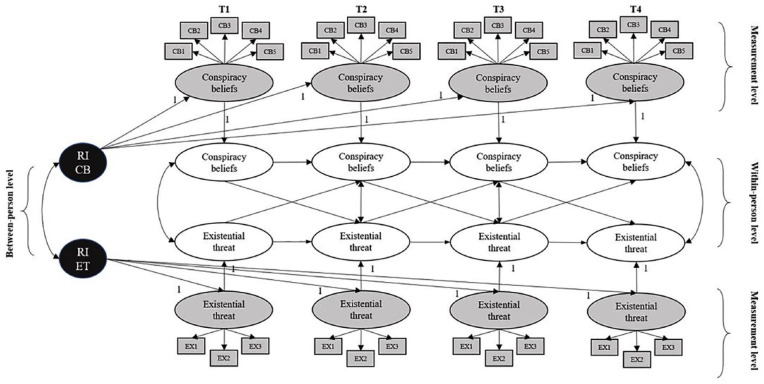
Research suggests that conspiracy beliefs are adopted because they promise to reduce anxiety, uncertainty, and threat. However, little research has investigated whether conspiracy beliefs actually fulfill these promises. We conducted two longitudinal studies ( N Study 1 = 405, N Study 2 = 1,012) to examine how conspiracy beliefs result from, and in turn influence, anxiety, uncertainty aversion, and existential threat. Random intercept cross-lagged panel analyses indicate that people who were, on average, more anxious, uncertainty averse, and existentially threatened held stronger conspiracy beliefs. Increases in conspiracy beliefs were either unrelated to changes in anxiety, uncertainty aversion, and existential threat (Study 2), or even predicted increases in these variables (Study 1). In both studies, increases in conspiracy beliefs predicted subsequent increases in conspiracy beliefs, suggesting a self-reinforcing circle. We conclude that conspiracy beliefs likely do not have beneficial consequences, but may even reinforce the negative experience of anxiety, uncertainty aversion, and existential threat.
Overview
The claims and statistics of this paper haven’t been checked yet.
Run the check — free, no account needed. It reads the open-access text and checks the sources it cites.
Integrity signals
Registry
Cites
Statistics
Figures
Verification
Claims the paper makes
The claims and statistics of this paper haven’t been checked yet.
Run the check — free, no account needed. It reads the open-access text and checks the sources it cites.
Claims other papers make about this one
Each is checked against this paper’s own text: does it say what the citing paper says it does?
The cited source says what the claim attributes to it.
In the citing paper
“Typically, people who turn to conspiracy beliefs in an attempt to alleviate the negative experience of uncertainty do not succeed in this attempt and may even experience short-term increases in uncertainty aversion, anxiety, and existential dread [163].”
From Impact of Media-Induced Uncertainty on Mental Health: Narrative-Based Perspective. (2025) · cites this paper as [163]
Self-check
Percentages, sums and reported differences re-computed from the paper’s own numbers.
The self-check needs the paper’s full text.
Citations
Cites
R: A Language and Environment for Statistical Computing
R Core Team (2000) · doi:10.32614/r.manuals · Cited by 355,893
A Brief Measure for Assessing Generalized Anxiety Disorder: The GAD-7
Spitzer, R. L., Kroenke, K., Williams, J. B. W., & Löwe, B. (2006) · Archives of Internal Medicine · doi:10.1001/archinte.166.10.1092 · Cited by 31,765
lavaan : An R Package for Structural Equation Modeling
Rosseel, Y. (2012) · Journal of Statistical Software · doi:10.18637/jss.v048.i02 · Cited by 27,955
Sensitivity of Goodness of Fit Indexes to Lack of Measurement Invariance
Chen, F. F. (2007) · Structural Equation Modeling: A Multidisciplinary Journal · doi:10.1080/10705510701301834 · Cited by 12,217
Enders, C., & Bandalos, D. (2001) · Structural Equation Modeling: A Multidisciplinary Journal · doi:10.1207/s15328007sem0803_5 · Cited by 4,978
A critique of the cross-lagged panel model
Hamaker, E. L., Kuiper, R. M., & Grasman, R. P. P. P. (2015) · Psychological Methods · doi:10.1037/a0038889 · Cited by 4,005
Dunn, T. J., Baguley, T. S., & Brunsden, V. (2013) · British Journal of Psychology · doi:10.1111/bjop.12046 · Cited by 3,766
When Corrections Fail: The Persistence of Political Misperceptions
Nyhan, B., & Reifler, J. (2010) · Political Behavior · doi:10.1007/s11109-010-9112-2 · Cited by 3,173
Thanks coefficient alpha, we’ll take it from here.
McNeish, D. (2018) · Psychological Methods · doi:10.1037/met0000144 · Cited by 2,533
How to Use a Monte Carlo Study to Decide on Sample Size and Determine Power
Muthén, L. K., & Muthén, B. O. (2002) · Structural Equation Modeling: A Multidisciplinary Journal · doi:10.1207/s15328007sem0904_8 · Cited by 2,362
Research works printed but not linked: 2
- 10.2307/3560240 · DOI
- Nocun K., 2020, Fake Facts—Wie Verschwörungstheorien unser Denken bestimmen
Cited by
Sorted by citations
Douglas, K. M., & Sutton, R. M. (2022) · Annual Review of Psychology · doi:10.1146/annurev-psych-032420-031329 · Cited by 376
Imhoff, R., Bertlich, T., & Frenken, M. (2022) · Current Opinion in Psychology · doi:10.1016/j.copsyc.2022.101349 · Cited by 194
Shining a spotlight on the dangerous consequences of conspiracy theories
Jolley, D., Marques, M. D., & Cookson, D. (2022) · Current Opinion in Psychology · doi:10.1016/j.copsyc.2022.101363 · Cited by 110
Individual, intergroup and nation-level influences on belief in conspiracy theories
Hornsey, M., Bierwiaczonek, K., Sassenberg, K., & Douglas, K. M. (2022) · Nature Reviews Psychology · doi:10.1038/s44159-022-00133-0 · Cited by 86
Psychological benefits of believing conspiracy theories
van Prooijen, J. (2022) · Current Opinion in Psychology · doi:10.1016/j.copsyc.2022.101352 · Cited by 70
Metadata
- Authors
- Liekefett, L., Christ, O., & Becker, J. C.
- Affiliations
- Osnabrück University (DE)
- FernUniversität in Hagen (DE)
- Corresponding author
- Liekefett, Luisa
- Venue
- Personality and Social Psychology Bulletin
- Publisher
- SAGE Publications
- Published
- 2021-12-29
- Volume
- 49
- Issue
- 2
- Pages
- 167-179
- ISSN
- 0146-1672 (ISSN-L)
- 1552-7433
- PMC
- PMC9896259
- OpenAlex
- W4200624585
- Cited by
- 155
- References
- 59
- Citations by year
- 2026: 28 · 2025: 34 · 2024: 36 · 2023: 31 · 2022: 25
- FWCI
- 31.88
- Type
- journal article
- Language
- en
- Open access
- hybrid
- doi.org
- Licence
- Locations
- Personality and Social Psychology Bulletin (publishedVersion, cc-by-nc)
- PubMed Central (publishedVersion, cc-by-nc)
- PubMed (publishedVersion)
- Topics
- Social Sciences › Sociology and Political Science › Misinformation and Its Impacts
- Social Sciences › Psychology › Social Psychology › Paranormal Experiences and Beliefs
- Social Sciences › Sociology and Political Science › Social and Intergroup Psychology
- Keywords
- conspiracy beliefs, anxiety, uncertainty aversion, existential risk, belief persistence, threat mitigation, psychological well-being
- MeSH terms
- Affect, Anxiety, Humans, Health Knowledge, Attitudes, Practice, HIV Infections, Uncertainty
About these checks
Registry, retraction, Cites and statistics results are computed, not judged, with one exception: a printed reference that no index lists is read once by a model before it counts as a citation error. Claims are extracted by a model and kept only when their quote appears verbatim in the text; each cited source is then checked, with a model’s help, for whether it says what the claim relies on. Those verdicts can be wrong — read the claim’s quote and the cited source before relying on one.
Statistics and arithmetic are recomputed, not judged.
Confidence bands are shown only for fields calibrated on our annotated test set. None is calibrated yet, so no band is shown.
What counts as a claim ›How we measure confidence ›How we check this ›
Are you an author, or do you see a problem with this page? Request a review
