

The DOI matches its Crossref record; 59 of the 59 references it cites were found in a registry or an index.
Can Conspiracy Beliefs Be Beneficial? Longitudinal Linkages Between Conspiracy Beliefs, Anxiety, Uncertainty Aversion, and Existential Threat
Open accessAbstract
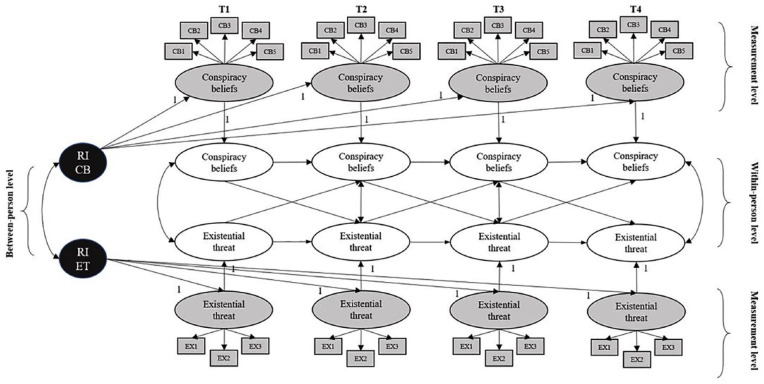
Research suggests that conspiracy beliefs are adopted because they promise to reduce anxiety, uncertainty, and threat. However, little research has investigated whether conspiracy beliefs actually fulfill these promises. We conducted two longitudinal studies ( N Study 1 = 405, N Study 2 = 1,012) to examine how conspiracy beliefs result from, and in turn influence, anxiety, uncertainty aversion, and existential threat. Random intercept cross-lagged panel analyses indicate that people who were, on average, more anxious, uncertainty averse, and existentially threatened held stronger conspiracy beliefs. Increases in conspiracy beliefs were either unrelated to changes in anxiety, uncertainty aversion, and existential threat (Study 2), or even predicted increases in these variables (Study 1). In both studies, increases in conspiracy beliefs predicted subsequent increases in conspiracy beliefs, suggesting a self-reinforcing circle. We conclude that conspiracy beliefs likely do not have beneficial consequences, but may even reinforce the negative experience of anxiety, uncertainty aversion, and existential threat.
Overview
The claims and statistics of this paper haven’t been checked yet.
Run the check — free, no account needed. It reads the open-access text and checks the sources it cites.
Integrity signals
Registry
Cites
Statistics
Figures
Verification
Claims the paper makes
The claims and statistics of this paper haven’t been checked yet.
Run the check — free, no account needed. It reads the open-access text and checks the sources it cites.
Claims other papers make about this one
Each is checked against this paper’s own text: does it say what the citing paper says it does?
The cited source says what the claim attributes to it.
In the citing paper
“Typically, people who turn to conspiracy beliefs in an attempt to alleviate the negative experience of uncertainty do not succeed in this attempt and may even experience short-term increases in uncertainty aversion, anxiety, and existential dread [163].”
From Impact of Media-Induced Uncertainty on Mental Health: Narrative-Based Perspective. (2025) · cites this paper as [163]
Self-check
Percentages, sums and reported differences re-computed from the paper’s own numbers.
The self-check needs the paper’s full text.
Citations
Cites
R: A Language and Environment for Statistical Computing
R Core Team (2000) · doi:10.32614/r.manuals · Cited by 355,893
A Brief Measure for Assessing Generalized Anxiety Disorder: The GAD-7
Spitzer, R. L., Kroenke, K., Williams, J. B. W., & Löwe, B. (2006) · Archives of Internal Medicine · doi:10.1001/archinte.166.10.1092 · Cited by 31,765
lavaan : An R Package for Structural Equation Modeling
Rosseel, Y. (2012) · Journal of Statistical Software · doi:10.18637/jss.v048.i02 · Cited by 27,955
Sensitivity of Goodness of Fit Indexes to Lack of Measurement Invariance
Chen, F. F. (2007) · Structural Equation Modeling: A Multidisciplinary Journal · doi:10.1080/10705510701301834 · Cited by 12,217
Enders, C., & Bandalos, D. (2001) · Structural Equation Modeling: A Multidisciplinary Journal · doi:10.1207/s15328007sem0803_5 · Cited by 4,978
A critique of the cross-lagged panel model
Hamaker, E. L., Kuiper, R. M., & Grasman, R. P. P. P. (2015) · Psychological Methods · doi:10.1037/a0038889 · Cited by 4,005
Dunn, T. J., Baguley, T. S., & Brunsden, V. (2013) · British Journal of Psychology · doi:10.1111/bjop.12046 · Cited by 3,766
When Corrections Fail: The Persistence of Political Misperceptions
Nyhan, B., & Reifler, J. (2010) · Political Behavior · doi:10.1007/s11109-010-9112-2 · Cited by 3,173
Thanks coefficient alpha, we’ll take it from here.
McNeish, D. (2018) · Psychological Methods · doi:10.1037/met0000144 · Cited by 2,533
How to Use a Monte Carlo Study to Decide on Sample Size and Determine Power
Muthén, L. K., & Muthén, B. O. (2002) · Structural Equation Modeling: A Multidisciplinary Journal · doi:10.1207/s15328007sem0904_8 · Cited by 2,362
Research works printed but not linked: 2
- 10.2307/3560240 · DOI
- Nocun K., 2020, Fake Facts—Wie Verschwörungstheorien unser Denken bestimmen
Cited by
Sorted by citations
Douglas, K. M., & Sutton, R. M. (2022) · Annual Review of Psychology · doi:10.1146/annurev-psych-032420-031329 · Cited by 376
Imhoff, R., Bertlich, T., & Frenken, M. (2022) · Current Opinion in Psychology · doi:10.1016/j.copsyc.2022.101349 · Cited by 194
Shining a spotlight on the dangerous consequences of conspiracy theories
Jolley, D., Marques, M. D., & Cookson, D. (2022) · Current Opinion in Psychology · doi:10.1016/j.copsyc.2022.101363 · Cited by 110
Individual, intergroup and nation-level influences on belief in conspiracy theories
Hornsey, M., Bierwiaczonek, K., Sassenberg, K., & Douglas, K. M. (2022) · Nature Reviews Psychology · doi:10.1038/s44159-022-00133-0 · Cited by 86
Psychological benefits of believing conspiracy theories
van Prooijen, J. (2022) · Current Opinion in Psychology · doi:10.1016/j.copsyc.2022.101352 · Cited by 70
Contemporary trends in psychological research on conspiracy beliefs. A systematic review
Pilch, I., Turska–Kawa, A., Wardawy-Dudziak, P., Olszanecka-Marmola, A., & Smołkowska-Jędo, W. (2023) · Frontiers in Psychology · doi:10.3389/fpsyg.2023.1075779 · Cited by 76
Rabbit Hole Syndrome: Inadvertent, accelerating, and entrenched commitment to conspiracy beliefs
Sutton, R. M., & Douglas, K. M. (2022) · Current Opinion in Psychology · doi:10.1016/j.copsyc.2022.101462 · Cited by 60
Biddlestone, M., Green, R., Douglas, K. M., Azevedo, F., Sutton, R. M., & Cichocka, A. K. (2022) · doi:10.31234/osf.io/rxjqc · Cited by 55
de Zavala, A. G., Bierwiaczonek, K., & Ciesielski, P. (2022) · Current Opinion in Psychology · doi:10.1016/j.copsyc.2022.101360 · Cited by 64
Paranoia and conspiracy thinking
Greenburgh, A., & Raihani, N. (2022) · Current Opinion in Psychology · doi:10.1016/j.copsyc.2022.101362 · Cited by 44
Emotion dysregulation and belief in conspiracy theories
Molenda, Z., Green, R., Marchlewska, M., Cichocka, A., & Douglas, K. M. (2023) · Personality and Individual Differences · doi:10.1016/j.paid.2022.112042 · Cited by 38
Thomas, E. F., Bird, L. H., O'Donnell, A. W., Osborne, D., Buonaiuto, E., Yip, L., Lizzio‐Wilson, M., Wenzel, M., & Skitka, L. J. (2024) · British Journal of Social Psychology · doi:10.1111/bjso.12727 · Cited by 39
Economic inequality and conspiracy theories
Jetten, J., Peters, K., & Casara, B. G. S. (2022) · Current Opinion in Psychology · doi:10.1016/j.copsyc.2022.101358 · Cited by 39
Salvati, M., Pellegrini, V., Cristofaro, V. D., & Giacomantonio, M. (2023) · British Journal of Social Psychology · doi:10.1111/bjso.12678 · Cited by 36
Making an impression: The effects of sharing conspiracy theories
Green, R., Toribio‐Flórez, D., Douglas, K. M., Brunkow, J. W., & Sutton, R. M. (2022) · Journal of Experimental Social Psychology · doi:10.1016/j.jesp.2022.104398 · Cited by 40
Coelho, P., Foster, K., Nedri, M., & Marques, M. D. (2022) · Social Science & Medicine · doi:10.1016/j.socscimed.2022.115522 · Cited by 36
Hippies Next to Right-Wing Extremists?
Liekefett, L., Bürner, A.-K., & Becker, J. C. (2023) · Social Psychology · doi:10.1027/1864-9335/a000509 · Cited by 17
Self-citationMastroni, L., & Mooney, R. (2024) · Journal of Social and Personal Relationships · doi:10.1177/02654075241246124 · Cited by 29
People do change their beliefs about conspiracy theories—but not often
Williams, M. N., Ling, M., Kerr, J. R., Hill, S., Marques, M. D., Mawson, H., & Clarke, E. J. R. (2024) · Scientific Reports · doi:10.1038/s41598-024-51653-z · Cited by 27
Loneliness trajectories over three decades are associated with conspiracist worldviews in midlife
Bierwiaczonek, K., Fluit, S., von Soest, T., Hornsey, M. J., & Kunst, J. R. (2024) · Nature Communications · doi:10.1038/s41467-024-47113-x · Cited by 26
Impact of Media-Induced Uncertainty on Mental Health: Narrative-Based Perspective.
Kesner, L., Juríčková, V., Grygarová, D., & Horáček, J. (2025) · JMIR Mental Health · doi:10.2196/68640 · Cited by 23
“Typically, people who turn to conspiracy beliefs in an attempt to alleviate the negative experience of uncertainty do not succeed in this attempt and may even experience short-term increases in uncertainty aversion, anxiety, and existential dread [163].”
Doyle, E., Thompson, J., Hill, S., Williams, M., Paton, D., Harrison, S., Bostrom, A., & Becker, J. (2023) · International Journal of Disaster Risk Reduction · doi:10.1016/j.ijdrr.2023.103948 · Cited by 18
Self-citationInsight in the Conspiracist’s Mind
de Cruys, S. V., Bervoets, J., Gadsby, S., Gijbels, D., & Poels, K. (2023) · Personality and Social Psychology Review · doi:10.1177/10888683231203145 · Cited by 22
Conspiracy theory beliefs in the adolescent population: A systematic review
Byrne, A., Martin, D., Jones, C., Galbraith, N. D., & Mercer, T. (2024) · Journal of Adolescence · doi:10.1002/jad.12316 · Cited by 20
Engaging with conspiracy theories: Causes and consequences
Sassenberg, K., Bertin, P., Douglas, K. M., & Hornsey, M. J. (2022) · Journal of Experimental Social Psychology · doi:10.1016/j.jesp.2022.104425 · Cited by 20
Education and conspiracy beliefs: A replication of van Prooijen (2017)
Mikušková, E. B. (2022) · Applied Cognitive Psychology · doi:10.1002/acp.4037 · Cited by 20
Do conspiracy theorists think too much or too little?
Brashier, N. M. (2022) · Current Opinion in Psychology · doi:10.1016/j.copsyc.2022.101504 · Cited by 19
Szymaniak, K., Zajenkowski, M., Fronczyk, K., Leung, S. J., & Harmon‐Jones, E. (2023) · Journal of Research in Personality · doi:10.1016/j.jrp.2023.104374 · Cited by 17
A Panel Study on the Dynamics of Social Media Use and Conspiracy Thinking
Valenzuela, S., Diehl, T., Lee, S., & Halpern, D. M. (2023) · Media Psychology · doi:10.1080/15213269.2023.2295522 · Cited by 18
Schöpfer, C., Abatista, A., Fuhrer, J., & Cova, F. (2022) · Personality and Individual Differences · doi:10.1016/j.paid.2022.111900 · Cited by 16
Travaglino, G. A., Friehs, M., Kotzur, P. F., & Abrams, D. (2022) · European Journal of Social Psychology · doi:10.1002/ejsp.2926 · Cited by 18
Fournier, V., & Varet, F. (2023) · British Journal of Health Psychology · doi:10.1111/bjhp.12702 · Cited by 17
Introducing conspiracy intuitions to better understand conspiracy beliefs.
Roberts, R., & Risen, J. L. (2022) · Current Opinion in Psychology · doi:10.1016/j.copsyc.2022.101395 · Cited by 15
Determinants of belief in conspiracy theories about the war in Ukraine among youth
Schuster, J., Fobel, L., & Kolleck, N. (2023) · Political Psychology · doi:10.1111/pops.12949 · Cited by 11
Albath, E. A., Greifeneder, R., Douglas, K. M., Cichocka, A. K., Marques, M. D., Wilson, M., Kerr, J. R., Sibley, C. G., & Osborne, D. (2024) · Personality and Social Psychology Bulletin · doi:10.1177/01461672241292841 · Cited by 17
Hanna, F., Andre, L., & Zee, M. (2023) · Teaching and Teacher Education · doi:10.1016/j.tate.2023.104382 · Cited by 16
Wabnegger, A., Potthoff, J., & Schienle, A. (2024) · Applied Cognitive Psychology · doi:10.1002/acp.4198 · Cited by 13
Kim, S., Stavrova, O., & Vohs, K. D. (2022) · Journal of Experimental Social Psychology · doi:10.1016/j.jesp.2022.104396 · Cited by 13
The role of perceived minority-group status in the conspiracy beliefs of factual majority groups
Gundersen, A. B., van der Linden, S., Piksa, M., Morzy, M., Piasecki, J., Ryguła, R., Gwiaździński, P., Noworyta, K., & Kunst, J. R. (2023) · Royal Society Open Science · doi:10.1098/rsos.221036 · Cited by 12
Williams, M. N., Marques, M. D., Kerr, J. R., Hill, S. R., Ling, M., & Clarke, E. J. R. (2025) · European Journal of Social Psychology · doi:10.1002/ejsp.3153 · Cited by 12
Engaging with Conspiracy Believers
Douglas, K. M., Sutton, R. M., Biddlestone, M., Green, R., & Toribio‐Flórez, D. (2024) · Review of Philosophy and Psychology · doi:10.1007/s13164-024-00741-0 · Cited by 14
Trang, S. T.-N., Kraemer, T., Trenz, M., & Weiger, W. H. (2024) · Information Systems Research · doi:10.1287/isre.2022.0494 · Cited by 17
Scandurra, C., Pizzo, R., Pinto, L. E., Cafasso, C., Pellegrini, R., Cafaggi, F., D’Anna, O., Muzii, B., Bochicchio, V., & Maldonato, M. N. (2022) · European Journal of Investigation in Health Psychology and Education · doi:10.3390/ejihpe12100109 · Cited by 16
Coping capacity attenuates the effect of natural disaster risk on conspiracy beliefs
Zhao, Q., van Prooijen, J., & Spadaro, G. (2024) · Journal of Environmental Psychology · doi:10.1016/j.jenvp.2024.102363 · Cited by 11
The effect of scientific conspiracy theories on scepticism towards biotechnologies
Marques, M. D., Kerr, J. R., Stukas, A. A., & McLennan, J. (2024) · Public Understanding of Science · doi:10.1177/09636625241300896 · Cited by 9
Fousiani, K., Xu, S., & van Prooijen, J. (2025) · Journal of Occupational and Organizational Psychology · doi:10.1111/joop.70005 · Cited by 9
Thomas, E. F., O'Donnell, A. W., Osborne, D., Bird, L. H., Yip, L., Buonaiuto, E., Lizzio‐Wilson, M., Skitka, L. J., & Wenzel, M. (2025) · Political Psychology · doi:10.1111/pops.13075 · Cited by 9
Coping strategies and belief in COVID ‐19 conspiracy theories
Molenda, Z., Marchlewska, M., Karakula, A., Szczepańska, D., Rogoza, M., Green, R., Cisłak, A., & Douglas, K. M. (2023) · British Journal of Social Psychology · doi:10.1111/bjso.12684 · Cited by 9
Poier, S., & Suchanek, M. (2024) · Journal of Public Health · doi:10.1007/s10389-024-02210-5 · Cited by 12
Bertlich, T., Bräscher, A., Germer, S., Witthöft, M., & Imhoff, R. (2025) · British Journal of Social Psychology · doi:10.1111/bjso.12865 · Cited by 8
The Effect of Brooding About Societal Problems on Conspiracy Beliefs: A Registered Report
Liekefett, L., Sebben, S., & Becker, J. C. (2024) · Collabra Psychology · doi:10.1525/collabra.92995 · Cited by 9
Self-citationAlper, S., Toribio‐Flórez, D., Capraro, V., & Douglas, K. M. (2024) · Social Psychological and Personality Science · doi:10.1177/19485506241302878 · Cited by 9
Romer, D., & Jamieson, K. (2023) · Frontiers in Psychology · doi:10.3389/fpsyg.2023.1175571 · Cited by 8
Chan, H., Hong, Y., & Lin, L. (2023) · Social and Personality Psychology Compass · doi:10.1111/spc3.12807 · Cited by 8
Curious about threats: Morbid curiosity and interest in conspiracy theories in US adults
Scrivner, C., & Stubbersfield, J. (2023) · British Journal of Psychology · doi:10.1111/bjop.12682 · Cited by 7
Adamus, M., Chayinska, M., Šrol, J., Adam‐Troian, J., Mikušková, E. B., & Teličák, P. (2025) · Political Psychology · doi:10.1111/pops.70003 · Cited by 8
Vachhrajani, M., Mishra, S. K., Rai, H., & Paliwal, A. (2022) · Frontiers in Psychology · doi:10.3389/fpsyg.2022.947887 · Cited by 10
Jiao, L.-Y., Jiang, W.-J., Guo, Z., Xiao, Y., Yu, M.-K., & Xu, Y. (2022) · Journal of Happiness Studies · doi:10.1007/s10902-022-00610-6 · Cited by 7
Nejat, P., Heirani-Tabas, A., & Nazarpour, M. M. (2023) · Frontiers in Psychology · doi:10.3389/fpsyg.2023.1201695 · Cited by 12
Pummerer, L. (2024) · Zeitschrift für Psychologie · doi:10.1027/2151-2604/a000547 · Cited by 7
The influence relationship among variables and types of multiple influence factors working together
Zhonglin, W. E. N., Wang, Y., Peng, M. A., Meng, J., & Liu, X. (2024) · Acta Psychologica Sinica · doi:10.3724/sp.j.1041.2024.01462 · Cited by 7
Alfasi, Y. (2023) · Journal of Social Psychology · doi:10.1080/00224545.2023.2286592 · Cited by 5
O'Brien, C., Georgiou, N., & Bartholomaeus, J. D. (2024) · Personality and Individual Differences · doi:10.1016/j.paid.2024.112885 · Cited by 8
Suspicious of AI ? Perceived autonomy and interdependence predict AI ‐related conspiracy beliefs
Zhao, Q., van Prooijen, J., Jiang, X., & Spadaro, G. (2025) · British Journal of Social Psychology · doi:10.1111/bjso.12883 · Cited by 6
How belief in conspiracy theories could harm sustainability
van Prooijen, J., Šrol, J., & Maglić, M. (2025) · Nature Human Behaviour · doi:10.1038/s41562-025-02243-0 · Cited by 6
de Zavala, A. G., Bierwiaczonek, K., & Ciesielski, P. (2022) · doi:10.31234/osf.io/2rku3 · Cited by 6
The Language of Conspiracy Theories: Negative Emotions and Themes Facilitate Diffusion Online
Cosgrove, T. J., & Bahr, M. (2024) · SAGE Open · doi:10.1177/21582440241290413 · Cited by 5
Frenken, M., & Imhoff, R. (2025) · Political Psychology · doi:10.1111/pops.70034 · Cited by 5
Do Stress, Depression, and Anxiety Lead to Beliefs in Conspiracy Theories?
Fox, N. D., Williams, M., & Hill, S. R. (2025) · Clinical psychological science : a journal of the Association for Psychological Science · doi:10.1177/21677026251370092 · Cited by 4
Sik, E., & Krekó, P. (2025) · Central and Eastern European Migration Review · doi:10.54667/ceemr.2025.21 · Cited by 5
Sambol, S., Sans, E., Scarfo, J., Kirkovski, M., & Ball, M. (2023) · Personality and Individual Differences · doi:10.1016/j.paid.2023.112537 · Cited by 7
Conspiracy belief and opposition to wind farms: A longitudinal study
Winter, K., Pummerer, L., von Oertzen, T., Hornsey, M. J., & Sassenberg, K. (2025) · Journal of Environmental Psychology · doi:10.1016/j.jenvp.2025.102620 · Cited by 5
Kamitz, L. C., Green, R., Rowden, C., Toribio‐Flórez, D., Biddlestone, M., & Douglas, K. M. (2025) · British Journal of Social Psychology · doi:10.1111/bjso.70033 · Cited by 5
Winter, K., Pummerer, L., & Sassenberg, K. (2025) · British Journal of Psychology · doi:10.1111/bjop.70030 · Cited by 5
Differentiating paranoia and conspiracy mentality using a network approach
Denecke, S., Schlier, B., Kingston, J. L., Ellett, L., So, S. H., Gaudiano, B. A., Morris, E. M. J., & Lincoln, T. M. (2023) · Scientific Reports · doi:10.1038/s41598-023-47923-x · Cited by 5
Mouafo, A. V. D., Nzekaih, H. K. E., & Messanga, G. A. (2023) · Current Research in Psychology · doi:10.3844/crpsp.2023.10.23 · Cited by 4
Rabinovitch, A., Bliuc, A., Strani, K., Łycyniak, E., & Cristea, M. (2024) · Current Psychology · doi:10.1007/s12144-024-06475-7 · Cited by 4
The social psychology of conspiracy theories: Key insights and future challenges
Douglas, K. M., & Sutton, R. M. (2025) · Advances in experimental social psychology · doi:10.1016/bs.aesp.2024.10.004 · Cited by 6
Investigating the link between sleep quality and belief in conspiracy theories
Jolley, D., Dinnick, I., Burgin, L., Ryan, S., Morgan-Finn, O., & Muncer, S. (2025) · Journal of Health Psychology · doi:10.1177/13591053251320598 · Cited by 4
Pummerer, L., Gkinopoulos, T., Douglas, K. M., Jolley, D., & Sassenberg, K. (2024) · Psychological Inquiry · doi:10.1080/1047840x.2024.2442906 · Cited by 8
Thomas, E. F., Bird, L. H., & Quarisa, C. M. (2024) · Psychological Inquiry · doi:10.1080/1047840x.2024.2442937 · Cited by 4
Do stress and anxiety lead to belief in conspiracy theories?
Fox, N., & Williams, M. N. (2023) · Routledge Open Research · doi:10.12688/routledgeopenres.17925.1 · Cited by 4
Wang, H., & Huang, D. (2024) · Personality and Individual Differences · doi:10.1016/j.paid.2024.112622 · Cited by 3
Losers’ Conspiracy: Elections and Conspiracism
Miller, J. M., Farhart, C. E., & Saunders, K. L. (2025) · Political Behavior · doi:10.1007/s11109-025-10063-1 · Cited by 3
The psychology of conspiracy mentality
Imhoff, R. (2025) · Advances in experimental social psychology · doi:10.1016/bs.aesp.2025.10.002 · Cited by 3
Williams, M., Marques, M. D., Ling, M., Hill, S. R., Kerr, J. R., Clarke, E., Martin, A., & Ross, R. M. (2026) · Royal Society Open Science · doi:10.1098/rsos.260163 · Cited by 2
Zhao, S., Zhou, J., & Wang, T. (2023) · PLoS ONE · doi:10.1371/journal.pone.0294681 · Cited by 3
The Pandemics of Mass Destruction: A Comparative Analysis of HIV/AIDS and Coronavirus (COVID-19)
Kajiita, R. M., & Kang’ethe, S. M. (2024) · Journal of Multidisciplinary Healthcare · doi:10.2147/jmdh.s440243 · Cited by 3
Isolated But Not Necessarily Lonely
Galgali, M. S., Helm, P. J., & Arndt, J. (2024) · Journal of Individual Differences · doi:10.1027/1614-0001/a000420 · Cited by 4
Unfounded beliefs, distress and powerlessness: A three‐wave longitudinal study
Mikušková, E. B., & Teličák, P. (2024) · Applied Psychology Health and Well-Being · doi:10.1111/aphw.12542 · Cited by 3
Mao, J., Zeng, Z., Yang, S., Guo, Y., Wang, B., & van Prooijen, J. (2025) · British Journal of Psychology · doi:10.1111/bjop.70016 · Cited by 3
The roles of need frustration and regulatory focus in conspiratorial thinking
Hunsinger, M., & Parker, M. (2025) · Learning and Motivation · doi:10.1016/j.lmot.2025.102188 · Cited by 3
Kovář, D., Filip, M., & Kovářová, M. (2023) · Journal of Constructivist Psychology · doi:10.1080/10720537.2023.2294323 · Cited by 5
How Epistemic Beliefs about Climate Change Predict Climate Change Conspiracy Beliefs
Nöth, L., & Zander, L. (2025) · Frontiers in Psychology · doi:10.3389/fpsyg.2025.1523143 · Cited by 5
Thought contagion? Conspiracy beliefs boost paranoid thoughts
Molenda, Z., Marchlewska, M., Karakula, A., Podsiadłowski, W., Rogoza, M., Bagrowska, P., & Szczepańska, D. (2024) · Applied Psychology Health and Well-Being · doi:10.1111/aphw.12577 · Cited by 3
Jutzi, C., Möller, J., Klackl, J., Rosenzweig, T., Reiss, S., Franchina, V., & Jonas, E. (2025) · Journal of Applied Social Psychology · doi:10.1111/jasp.13087 · Cited by 2
Adamus, M., Šrol, J., Mikušková, E. B., Adam‐Troian, J., & Chayinska, M. (2025) · British Journal of Social Psychology · doi:10.1111/bjso.70036 · Cited by 2
Diržytė, A. (2023) · Sustainability · doi:10.3390/su152215722 · Cited by 2
Pummerer, L., Gkinopoulos, T., Douglas, K. M., Jolley, D., & Sassenberg, K. (2024) · Psychological Inquiry · doi:10.1080/1047840x.2025.2454118 · Cited by 4
Metadata
- Authors
- Liekefett, L., Christ, O., & Becker, J. C.
- Affiliations
- Osnabrück University (DE)
- FernUniversität in Hagen (DE)
- Corresponding author
- Liekefett, Luisa
- Venue
- Personality and Social Psychology Bulletin
- Publisher
- SAGE Publications
- Published
- 2021-12-29
- Volume
- 49
- Issue
- 2
- Pages
- 167-179
- ISSN
- 0146-1672 (ISSN-L)
- 1552-7433
- PMC
- PMC9896259
- OpenAlex
- W4200624585
- Cited by
- 155
- References
- 59
- Citations by year
- 2026: 28 · 2025: 34 · 2024: 36 · 2023: 31 · 2022: 25
- FWCI
- 31.88
- Type
- journal article
- Language
- en
- Open access
- hybrid
- doi.org
- Licence
- Locations
- Personality and Social Psychology Bulletin (publishedVersion, cc-by-nc)
- PubMed Central (publishedVersion, cc-by-nc)
- PubMed (publishedVersion)
- Topics
- Social Sciences › Sociology and Political Science › Misinformation and Its Impacts
- Social Sciences › Psychology › Social Psychology › Paranormal Experiences and Beliefs
- Social Sciences › Sociology and Political Science › Social and Intergroup Psychology
- Keywords
- conspiracy beliefs, anxiety, uncertainty aversion, existential risk, belief persistence, threat mitigation, psychological well-being
- MeSH terms
- Affect, Anxiety, Humans, Health Knowledge, Attitudes, Practice, HIV Infections, Uncertainty
About these checks
Registry, retraction, Cites and statistics results are computed, not judged, with one exception: a printed reference that no index lists is read once by a model before it counts as a citation error. Claims are extracted by a model and kept only when their quote appears verbatim in the text; each cited source is then checked, with a model’s help, for whether it says what the claim relies on. Those verdicts can be wrong — read the claim’s quote and the cited source before relying on one.
Statistics and arithmetic are recomputed, not judged.
Confidence bands are shown only for fields calibrated on our annotated test set. None is calibrated yet, so no band is shown.
What counts as a claim ›How we measure confidence ›How we check this ›
Are you an author, or do you see a problem with this page? Request a review
