

White paper defining optimal palliative care in older people with dementia: a Delphi study and recommendations from the European Association for Palliative Care.
Open accessThe DOI matches its Crossref record; 57 of the 57 references it cites were found in a registry or an index.
Abstract
Background: Dementia is a life-limiting disease without curative treatments. Patients and families may need palliative care specific to dementia. Aim: To define optimal palliative care in dementia. Methods: Five-round Delphi study. Based on literature, a core group of 12 experts from 6 countries drafted a set of core domains with salient recommendations for each domain. We invited 89 experts from 27 countries to evaluate these in a two-round online survey with feedback. Consensus was determined according to predefined criteria. The fourth round involved decisions by the core team, and the fifth involved input from the European Association for Palliative Care. Results: A total of 64 (72%) experts from 23 countries evaluated a set of 11 domains and 57 recommendations. There was immediate and full consensus on the following eight domains, including the recommendations: person-centred care, communication and shared decision-making; optimal treatment of symptoms and providing comfort (these two identified as central to care and research); setting care goals and advance planning; continuity of care; psychosocial and spiritual support; family care and involvement; education of the health care team; and societal and ethical issues. After revision, full consensus was additionally reached for prognostication and timely recognition of dying. Recommendations on nutrition and dehydration (avoiding overly aggressive, burdensome or futile treatment) and on dementia stages in relation to care goals (applicability of palliative care) achieved moderate consensus. Conclusion: We have provided the first definition of palliative care in dementia based on evidence and consensus, a framework to provide guidance for clinical practice, policy and research.
Overview
The claims and statistics of this paper haven’t been checked yet.
Free: it reads the open-access text and checks the first 5 claims that cite a source we can check. Create a free account to check every claim.
Integrity signals
Registry
Cites
Statistics
Figures
Verification
Claims the paper makes
The claims and statistics of this paper haven’t been checked yet.
Free: it reads the open-access text and checks the first 5 claims that cite a source we can check. Create a free account to check every claim.
Claims other papers make about this one
Each is checked against this paper’s own text: does it say what the citing paper says it does?
The source backs part of the claim, not all of it — or backs it for a different population, condition or comparison.
In the citing paper
“While diagnostic disclosure has been a focus of dementia research and palliative dementia care has emerged as a critical domain that focuses on improving care at end-of-life, 25 those CPs who find themselves caregiving between or into these stages remain understudied.”
From Care setting transitions for people with dementia: Qualitative perspectives of current and former care partners (2023) · cites this paper as [25]
Experimental — accuracy not yet measuredThe cited source says what the claim attributes to it.
In the citing paper
“ACP is recommended for individuals living with dementia”
From Acceptability of the voice your values, an advance care planning intervention in persons living with mild dementia using videoconferencing technology (2022) · cites this paper as [5]
The check wasn’t confident either way, so it gives no verdict — never disputed.
In the citing paper
“ACP is recommended for individuals living with dementia, yet it is uncommon in clinical practice [5–7].”
From Acceptability of the voice your values, an advance care planning intervention in persons living with mild dementia using videoconferencing technology (2022) · cites this paper as [5]
Experimental — accuracy not yet measured
Self-check
Percentages, sums and reported differences re-computed from the paper’s own numbers.
The self-check needs the paper’s full text.
Citations
Cites
Early Palliative Care for Patients with Metastatic Non–Small-Cell Lung Cancer
Temel, J. S., Greer, J. A., Muzikansky, A., Gallagher, E. R., Admane, S., Jackson, V. A., Dahlin, C. M., Blinderman, C. D., Jacobsen, J., Pirl, W. F., et al. (2010) · New England Journal of Medicine · doi:10.1056/nejmoa1000678 · Cited by 7,482
Research guidelines for the Delphi survey technique
Hasson, F. (2000) · Journal of Advanced Nursing · doi:10.1046/j.1365-2648.2000.01567.x · Cited by 5,951
The Delphi technique: myths and realities
Powell, C. (2003) · Journal of Advanced Nursing · doi:10.1046/j.1365-2648.2003.02537.x · Cited by 2,584
Steinhauser, K. E. (2000) · JAMA · doi:10.1001/jama.284.19.2476 · Cited by 2,514
Dementia: a public health priority
Acosta, D. M., Krishnamoorthy, E. S., Wortmann, M., Prince, M. J., & Saxena, S. (2012) · Cited by 1,955
The Clinical Course of Advanced Dementia.
Mitchell, S. L., Teno, J. M., Kiely, D. K., Shaffer, M. L., Jones, R. N., Prigerson, H. G., Volicer, L., Givens, J. L., & Hamel, M. B. (2009) · New England Journal of Medicine · doi:10.1056/nejmoa0902234 · Cited by 1,618
Self-citationPatterns of Functional Decline at the End of Life
Lunney, J. R. (2003) · JAMA · doi:10.1001/jama.289.18.2387 · Cited by 1,416
CRISP, J., PELLETIER, D., DUFFIELD, C., ADAMS, A., & NAGY, S. (1997) · Nursing Research · doi:10.1097/00006199-199703000-00010 · Cited by 1,388
Trajectories of disability in the last year of life
Gill, T. M., Gahbauer, E. A., Han, L., & Allore, H. G. (2010) · New England Journal of Medicine · doi:10.1056/nejmoa0909087 · Cited by 894
ALZHEIMER'S DISEASE INTERNATIONAL
Graham, N., & Brodaty, H. (1997) · International Journal of Geriatric Psychiatry · doi:10.1002/(sici)1099-1166(199707)12:7<737::aid-gps625>3.0.co;2-b · Cited by 851
Research works printed but not linked: 4
- 33. Herr K, Bursch H, Ersek M, et al. Use of pain-behavioral assessment tools in the nursing home: expert consensus recommendations for practice. J Gerontol Nurs 2010; 36(3): 18-29; quiz 30-31.
- 35. UK Central Office of Information (COI). End of Life Care Strategy - promoting high quality care for all adults at the end of life . London: Department of Health, 2008.
- 45. National Council for Palliative Care (NCPC). Out of the shadows: end of life care for people with dementia . London: National Council for Palliative Care (NCPC), 2009.
- 48. Tilly J. Quality end of life care for individuals with dementia in assisted living and nursing homes and public policy barriers to delivering this care . Chicago, IL: US Alzheimer's Association, 2006.
Cited by
Items 401–500 of 1,000
Sussman, T., Lawrence, J., & Pimienta, R. (2022) · Dementia · doi:10.1177/14713012221127358 · Cited by 14
Smit, K. D., Bolt, S., de Boer, B., Verbeek, H., & Meijers, J. M. M. (2022) · BMC Geriatrics · doi:10.1186/s12877-022-03584-5 · Cited by 15
Kochems, K., de Graaf, E., Hesselmann, G. M., Ausems, M., & Teunissen, S. C. C. M. (2023) · Palliative Care and Social Practice · doi:10.1177/26323524231216994 · Cited by 17
“51 59 Furthermore, elderly-care physicians stated that they lack competence in palliative care and that they need more education, 52 and that national standardization of methodologies and palliative care tools and systems lacking.”
BackgroundSong, D., Yu, T., Zhi, S., Chang, C., Sun, J., Gao, S., Gu, Y., & Sun, J. (2024) · International Journal of Nursing Studies · doi:10.1016/j.ijnurstu.2024.104762 · Cited by 15
Caramel, V. M. B., van der Steen, J. T., Vink, A. C., Janus, S. I. M., Twisk, J. W. R., Scherder, E., & Zuidema, S. U. (2024) · BMC Geriatrics · doi:10.1186/s12877-024-04863-z · Cited by 17
“Improving quality of life and maximizing comfort are goals of palliative care in dementia [77].”
BackgroundNishimura, M., Dening, K. H., Sampson, E. L., Vidal, E. I. D. O., Nakanishi, M., Davies, N., Abreu, W., Kaasalainen, S., Eisenmann, Y., Dempsey, L., et al. (2024) · Palliative Medicine · doi:10.1177/02692163241234579 · Cited by 16
“10,17,37,52 Coping with grief and loss − person and family supported and Bereavement support Family emotional and practical support needs may change over time in various ways, and so may support needs in coping with grief and loss of the family and the person with dementia.”
BackgroundMethodInfluentialDurepos, P., Kaasalainen, S., Carroll, S. L., & Παπαϊωάννου, Α. (2017) · Aging & Mental Health · doi:10.1080/13607863.2017.1399347 · Cited by 16
“This program aligns with the optimal palliative care guidelines for PWD and CGs suggested by the European Association for Palliative Care’s White paper, and is translatable to other settings including LTC (Van der Steen et al., 2013).”
MethodPalliative Care: A Systematic Review of Evidence-Based Interventions
Riahi, S., & Khajehei, M. (2019) · Critical Care Nursing Quarterly · doi:10.1097/cnq.0000000000000269 · Cited by 14
Lasmarías, C., Girón, S. D., Rietjens, J. A. C., Korfage, I. J., & Gómez‐Batiste, X. (2019) · Medicina Paliativa · doi:10.20986/medpal.2019.1019/2018 · Cited by 23
Ito, E., Berge, L. I., Husebo, B. S., Nouchi, R., & Sandvik, R. K. N. M. (2020) · Journal of the American Medical Directors Association · doi:10.1016/j.jamda.2020.03.028 · Cited by 14
Frey, R. A., Robinson, J., Old, A., Raphael, D. L., & Gott, M. (2020) · Health & Social Care in the Community · doi:10.1111/hsc.13053 · Cited by 14
O’Malley, M., Parkes, J. H., Stamou, V., Fontaine, J. L., Oyebode, J. R., & Carter, J. (2020) · International Journal of Geriatric Psychiatry · doi:10.1002/gps.5368 · Cited by 18
“Earlier studies have also used the certain level of 80% agreement to identify very high levels of consensus.(14)”
Family involvement with care homes following placement of a relative living with dementia: a review
Hayward, J. K., Gould, C., Palluotto, E., Kitson, E., & Spector, A. E. (2021) · Ageing and Society · doi:10.1017/s0144686x21000957 · Cited by 17
“…(The Mid-Staffordshire NHS Foundation Trust, 2013) reports, FI is central to ensuring increased transparency and partnership between care provider and client (Department of Health, 2013; van der Steen et al., 2014; Care Quality Commission (CQC), 2015) alongside national care quality assessment.”
BackgroundSoares, L. G., Japiassú, A. M., Gomes, L. C., Pereira, R., Peçanha, C., & Goldgaber, T. (2018) · Annals of Palliative Medicine · doi:10.21037/apm.2018.05.06 · Cited by 16
“Although cancer remains the most common condition among patients referred to specialized palliative care programs (2,3), the importance to extend palliative care services to people with non-malignant diseases such as dementia has been widely recognized (4).”
BackgroundKohne, Z. A. M., Nikpeyma, N., Bayat, F., Salsali, M., Hunter, P. V., Kaasalainen, S., Khavasi, M., Shahrestanaki, S. K., & Rezaei, M. (2020) · Geriatric Nursing · doi:10.1016/j.gerinurse.2020.11.009 · Cited by 14
When to initiate palliative care in neurology
Dawson, B. K., McConvey, K., & Gofton, T. E. (2022) · Handbook of clinical neurology · doi:10.1016/b978-0-323-85029-2.00011-7 · Cited by 19
Brattgjerd, M., & Olsen, R. M. (2016) · Tidsskrift for omsorgsforskning · doi:10.18261/issn.2387-5984-2016-03-05 · Cited by 13
Aworinde, J., Evans, C., Gillam, J., Ramsenthaler, C., Davies, N., Ellis-Smith, C. I., & EMBED‐Care Programme (2024) · Health Expectations · doi:10.1111/hex.13987 · Cited by 15
“4,5 9 Shared decision ‐ making is the exchange of information between patients and practitioners (health and social care professionals) about the needs of the patient and the agreement about care and treatment priorities.”
Measuring and monitoring the quality of dying in the UN Decade of Healthy Ageing
Harwood, R., Thiyagarajan, J. A., Bhadelia, A., Foebel, A. D., Mayland, C. R., Malhotra, C., Blacker, D., Sampson, E. L., Finkelstein, E. A., Sekhon, H., et al. (2025) · The Lancet Healthy Longevity · doi:10.1016/j.lanhl.2025.100739 · Cited by 13
Palliative care for people with dementia: a literature review
Lillyman, S., & Bruce, M. E. C. (2016) · International Journal of Palliative Nursing · doi:10.12968/ijpn.2016.22.2.76 · Cited by 13
“According to Denning et al (2013), van der Steen et al (2013) and Vandervoort et al (2014) advanced care plans (ACPs) and directives are central to good palliative care, facilitating choice and quality of dying.”
International reflections on caring for people with advanced dementia
Yumoto, Y., Kernohan, G. W., Morioka, N., & Ogata, Y. (2018) · Public Health Nursing · doi:10.1111/phn.12572 · Cited by 13
Nurses’ needs when collaborating with other healthcare professionals in palliative dementia care
Khemai, C., Janssen, D. J. A., Schols, J. M. G. A., Naus, L., Kemper, S., Jole, I., Bolt, S., & Meijers, J. M. M. (2020) · Nurse Education in Practice · doi:10.1016/j.nepr.2020.102866 · Cited by 15
Interventions to Promote End-of-Life Conversations: A Systematic Review and Meta-Analysis
Gonella, S., Dimonte, V., Arnone, Y., Albanesi, B., Berchialla, P., Giulio, P. D., & van der Steen, J. T. (2023) · Journal of Pain and Symptom Management · doi:10.1016/j.jpainsymman.2023.05.001 · Cited by 17
Mitchell, R. J., Wijekulasuriya, S., du Preez, J., Lystad, R. P., Chauhan, A., Harrison, R., Curtis, K. A., & Braithwaite, J. (2023) · Archives of Gerontology and Geriatrics · doi:10.1016/j.archger.2023.105130 · Cited by 13
Nakanishi, M., Yamasaki, S., & Nishida, A. (2018) · BMJ Open · doi:10.1136/bmjopen-2018-023172 · Cited by 14
“5 Therefore, a palliative care approach should be applied across the disease course in dementia.(6) In addition, death in hospital could result from the provision of poor-quality care for patients with dementia.”
BackgroundKonttila, T., Finne-Soveri, U. H., Leskinen, R., Niemelä, K., & Antikaínen, R. (2019) · Archives of Gerontology and Geriatrics · doi:10.1016/j.archger.2019.103955 · Cited by 15
Durepos, P., Ploeg, J., Sussman, T., Akhtar‐Danesh, N., & Kaasalainen, S. (2020) · SAGE Open Nursing · doi:10.1177/2377960820949111 · Cited by 16
“The early introduction of a palliative approach focused on optimizing quality-of-life while preparing for end-oflife [EOL] is recommended (van der Steen et al., 2014).”
BackgroundGonella, S., Basso, I., Clari, M., & Giulio, P. D. (2020) · Annali dell Istituto Superiore di Sanità · doi:10.4415/ann_20_03_09 · Cited by 15
“…communication about end-of-life care improves the quality of dying [6], literature stresses the importance of continuous communication with family carers about care and prognosis, involvement of family carers in care, assessment of their needs, and acknowledgment of their care role [7].”
Miranda, R., Smets, T., Noortgate, N. J. V. D., Deliëns, L., & den Block, L. V. (2021) · International Journal of Environmental Research and Public Health · doi:10.3390/ijerph18042160 · Cited by 13
“These findings underscore the persistent lack of attention given to the comprehensive care encompassing physical, psychosocial, and spiritual support, which are paramount to improving residents’ overall comfort at the end-of-life [1].”
BackgroundInfluentialFeedback on end-of-life care in dementia: the study protocol of the FOLlow-up project
Boogaard, J. A., van Soest‐Poortvliet, M. C., Anema, J. R., Achterberg, W. P., Hertogh, C. M. P. M., de Vet, H. C. W., & van der Steen, J. T. (2013) · BMC Palliative Care · doi:10.1186/1472-684x-12-29 · Cited by 15
Self-citationPenders, Y. W. H., Albers, G., Deliëns, L., Miccinesi, G., Alonso, T. V., Miralles, M., Moreels, S., den Block, L. V., & EUROIMPACT, O. B. O. (2017) · Geriatrics and gerontology international/Geriatrics & gerontology international · doi:10.1111/ggi.12948 · Cited by 14
Janssens, J. F. A. M., de Kort, S. J., Achterberg, W. P., Kurrle, S. E., Kerse, N. M., Cameron, I. D., & Touwen, D. P. (2018) · BMC Geriatrics · doi:10.1186/s12877-018-0707-5 · Cited by 13
Schultz, S. K., Llorente, M. D., Sanders, A. E., Tai, W. A., Bennett, A., Shugarman, S. A., & Roca, R. P. (2020) · Neurology · doi:10.1212/wnl.0000000000008678 · Cited by 14
“Recent studies have made considerable progress in defining the scope and definition of optimal palliative care in dementia.(15) Furthermore, advances have occurred in developing guidelines for specific circumstances such as feeding and swallowing issues.”
BackgroundMaters, J., van der Steen, J. T., de Vugt, M. E., Bakker, C., & Koopmans, R. T. C. M. (2024) · Journal of Alzheimer s Disease · doi:10.3233/jad-230486 · Cited by 14
Self-citationMaters, J., Perry, M., de Wit, T., Koopmans, R. T. C. M., de Vugt, M. E., Bakker, C., & van der Steen, J. T. (2025) · Palliative Medicine · doi:10.1177/02692163251324796 · Cited by 13
Self-citationComponents of a community model of dementia palliative care
Fox, S., O’Connor, N., Drennan, J., Guérin, S., Kernohan, G. W., Murphy, A., & Timmons, S. (2020) · Journal of Integrated Care · doi:10.1108/jica-02-2020-0013 · Cited by 12
Health Outcome Prioritization in Alzheimer’s Disease: Understanding the Ethical Landscape
McKeown, A., Turner, A. J., Angehrn, Z., Gove, D., Ly, A., Nordon, C., Nelson, M., Tochel, C., Mittelstadt, B., Keenan, A., et al. (2020) · Journal of Alzheimer s Disease · doi:10.3233/jad-191300 · Cited by 15
“However, these are not without potential ethical problems; for example that they are often left incomplete such that the individual’s wishes are uncertain or unknown to carers and others [95]; and the validity of advance directives can be disputed or undermined given that it is possible an individual’s preferences cha…”
Self-citationAshrafizadeh, H., Gheibizadeh, M., Rassouli, M., Hajibabaee, F., & Rostami, S. (2021) · Frontiers in Psychology · doi:10.3389/fpsyg.2021.707913 · Cited by 14
Bavelaar, L., Nicula, M., Morris, S., Kaasalainen, S., Achterberg, W. P., Loučka, M., Vlckova, K. H., Thompson, G. N., Cornally, N., Hartigan, I., et al. (2021) · Patient Education and Counseling · doi:10.1016/j.pec.2021.07.031 · Cited by 12
Nakanishi, M., Nakashima, T., Miyamoto, Y., Yamasaki, S., & Nishida, A. (2022) · BMC Palliative Care · doi:10.1186/s12904-022-01008-0 · Cited by 14
de Wolf‐Linder, S., Reisinger, M., Gohles, E., Wolverson, E., Schubert, M., & Murtagh, F. E. (2022) · BMC Nursing · doi:10.1186/s12912-022-00947-6 · Cited by 14
Coers, D. O., de Boer, M. E., Sizoo, E. M., Smalbrugge, M., Leget, C. J. W., & Hertogh, C. M. P. M. (2023) · Age and Ageing · doi:10.1093/ageing/afac310 · Cited by 12
Self-citationMonnet, F., Dupont, C., Smets, T., Vleminck, A. D., Audenhove, C. V., den Block, L. V., & Pivodic, L. (2023) · JMIR Research Protocols · doi:10.2196/46935 · Cited by 13
Dupont, C., Smets, T., Monnet, F., Pivodic, L., Vleminck, A. D., Audenhove, C. V., & den Block, L. V. (2024) · Patient Education and Counseling · doi:10.1016/j.pec.2024.108357 · Cited by 12
Sutherland, N. (2020) · Journal of Aging Studies · doi:10.1016/j.jaging.2020.100874 · Cited by 13
Palmer, J. A., Hilgeman, M. M., Balboni, T. A., Paasche‐Orlow, S., & Sullivan, J. L. (2021) · The Gerontologist · doi:10.1093/geront/gnab134 · Cited by 12
Enteral tube feeding for people with severe dementia
Davies, N., Barrado‐Martín, Y., Rait, G., Fukui, A., Candy, B., Smith, C. H., Manthorpe, J., Moore, K. J., Vickerstaff, V., & Sampson, E. L. (2019) · Cochrane Database of Systematic Reviews · doi:10.1002/14651858.cd013503 · Cited by 12
“Archives of Internal Medicine 2012;172(9):697-701. van der Steen 2014 van der Steen JT, Radbruch L, Hertogh CM, de Boer ME, Hughes JC, Larkin P, et al. White paper defining optimal palliative care in older people with dementia: a Delphi study and recommendations from the European Association for…”
BackgroundPinto, S. M. O., Caldeira, S., & Martins, J. C. (2017) · Journal of Nursing Education and Practice · doi:10.5430/jnep.v7n8p37 · Cited by 12
“DISCUSSION Comfort is basilar to palliative care.[1, 2] Nevertheless, there are many questions about the concept, its definition, implementation, measurement and evaluation remaining unclear.”
BackgroundHunt, L. J., Lee, S. J., Harrison, K. L., & Smith, A. K. (2017) · Journal of Palliative Medicine · doi:10.1089/jpm.2017.0309 · Cited by 14
“9,10 There is an urgent need to develop evidence-based palliative treatments tailored to people with dementia.”
The last week of life of nursing home residents with advanced dementia: a retrospective study
Toscani, F., Finetti, S., Giunco, F., Basso, I., Rosa, D., Pettenati, F., Bussotti, A., Villani, D., Gentile, S., Boncinelli, L., et al. (2019) · BMC Palliative Care · doi:10.1186/s12904-019-0510-x · Cited by 14
Supporting self-management in early dementia: a contribution towards ‘living well’?
Cheffey, J., Hill, L., Roberts, G. A., & Marlow, R. (2013) · Advances in Psychiatric Treatment · doi:10.1192/apt.bp.112.011023 · Cited by 12
Improving End-of-Life Care and Advance Care Planning for Frail Older Adults in Canada
Downar, J., Moorhouse, P. A., Goldman, R., Grossman, D. L., Sinha, S. K., Sussman, T., Kaasalainen, S., MacDonald, S. E., Moser, A. L., & You, J. J. (2018) · The Journal of Frailty & Aging · doi:10.14283/jfa.2018.33 · Cited by 14
Pharmacotherapeutic combinations for the treatment of Alzheimer’s disease.
Nagata, T., Shinagawa, S., Nakajima, S., Noda, Y., & Mimura, M. (2022) · Expert Opinion on Pharmacotherapy · doi:10.1080/14656566.2022.2042514 · Cited by 11
“life in the long-term course of dementia, clinicians would need to take a humanistic approach to patients, caregivers, and families to modify the end-of-life prognosis of AD in the future [44].”
Background“Mr. Smith Has No Mealtimes”: Minimal Comfort Feeding for Patients with Advanced Dementia
Wechkin, H. A., Menzel, P. T., Loggers, E. T., Macauley, R. C., Pope, T. M., Reagan, P. L., & Quill, T. E. (2024) · Journal of Pain and Symptom Management · doi:10.1016/j.jpainsymman.2024.11.001 · Cited by 12
Effects of Staff Training on Nursing Home Residents’ End-Of-Life Care: A Randomized Controlled Trial
Lamppu, P. J., Finne‐Soveri, H., Kautiainen, H., Laakkonen, M., Laurila, J., & Pitkälä, K. H. (2021) · Journal of the American Medical Directors Association · doi:10.1016/j.jamda.2021.05.019 · Cited by 13
Erel, M., Marcus, E., & Ganz, F. D. (2022) · Dementia · doi:10.1177/14713012221077533 · Cited by 13
Kingdon, A., Spathis, A., Antunes, B., & Barclay, S. I. G. (2022) · Palliative Medicine · doi:10.1177/02692163221097309 · Cited by 11
Tay, R., Tan, J. Y. S., Lim, B., Hum, A. Y., Simpson, J., & Preston, N. J. (2024) · Palliative Medicine · doi:10.1177/02692163241265231 · Cited by 12
“114”
Hodgson Nancy, A. (2014) · Journal of Geriatrics and Palliative Care · doi:10.13188/2373-1133.1000010 · Cited by 21
“Palliative dementia care requires a specialized knowledge base since the trajectory and symptoms differ in important ways from other conditions [26].”
BackgroundAnnear, M. J., Lucas, P., WILKINSON, T. J., & Shimizu, Y. (2019) · Australian Journal of Primary Health · doi:10.1071/py18171 · Cited by 13
Pessoa, A., Almeida, P., Marinho, R. C., Duque, S., do Amaral, T. F., Pinho, J., Santos, M., Parentérica, 2. P. D. N. E. E., Freire, E., Mendes, L., et al. (2020) · Medicina Interna · doi:10.24950/guidelines/consensus/1/2020 · Cited by 21
Haapasalmi, S., Piili, R. P., Metsänoja, R., Kellokumpu-Lehtinen, P.-L. I., & Lehto, J. T. (2021) · BMC Palliative Care · doi:10.1186/s12904-021-00811-5 · Cited by 12
“Older people should also be encouraged to express their wishes in written format before they become seriously ill [4, 32, 69, 70].”
BackgroundQuality of End-of-Life in Cancer Patients With Dementia: Using A Nationwide Inpatient Database
Hirooka, K., Okumura, Y., Matsumoto, S., Fukahori, H., & Ogawa, A. (2022) · Journal of Pain and Symptom Management · doi:10.1016/j.jpainsymman.2022.03.016 · Cited by 12
Radbruch, L., Ling, J., Hegedüs, K., & Larkin, P. J. (2017) · Journal of Pain and Symptom Management · doi:10.1016/j.jpainsymman.2017.03.022 · Cited by 11
Self-citationJung, J. H., Kim, M. J., Choi, S., Han, N. Y., Park, J. E., Park, H. Y., Han, J. W., Lee, D. Y., & Park, H. Y. (2017) · Psychiatry Investigation · doi:10.4306/pi.2017.14.6.779 · Cited by 11
Scaccabarozzi, G., Amodio, E., Riva, L., Corli, O., Maltoni, M. C., Silvestre, G. D., Turriziani, A., Morino, P., Pellegrini, G., & Crippa, M. (2020) · Healthcare · doi:10.3390/healthcare8030221 · Cited by 11
“One of the needed improvements is the definition of programs that are as customized as possible, particularly in the last months of the disease, when there is a progressive loss of independence and an exacerbation of physical and mental symptoms, affecting not only the patient but also the family nucleus that faces th…”
BackgroundThe crossover artist: consensus methods in health research
Jünger, S., & Payne, S. A. (2020) · Edward Elgar Publishing eBooks · doi:10.4337/9781785363214.00017 · Cited by 16
Self-citationMedicare Hospice Policy Changes and Beneficiaries’ Rate of Live Discharge and Length-of-Stay
Gianattasio, K. Z., Power, M. C., Lupu, D., Prather, C. P., & Moghtaderi, A. (2022) · Journal of Pain and Symptom Management · doi:10.1016/j.jpainsymman.2022.12.001 · Cited by 11
Chan, C. W. H., Choi, K. C., Chan, H. Y. L., Wong, M. M. H., Ling, G. C. C., Chow, K. M., Chow, A. Y. M., Lo, R. S. K., & Sham, M. M. K. (2019) · Journal of Advanced Nursing · doi:10.1111/jan.14017 · Cited by 11
Enhancing early detection of cognitive impairment in primary care with the TabCAT-BHA
Breithaupt, A. G., Sideman, A. B., Goode, C., Hill‐Sakurai, L., Premkumar, M., Scheffler, A. W., Chodos, A., Tsoy, E., Rankin, K. P., Kramer, J. H., et al. (2025) · Alzheimer's & Dementia · doi:10.1002/alz.70437 · Cited by 10
Radcliffe, K. G., Halim, M., Ritchie, C. S., Maus, M., & Harrison, K. L. (2023) · American Journal of Hospice and Palliative Medicine® · doi:10.1177/10499091231155601 · Cited by 10
Improving end-of-life care for people with dementia: a mixed-methods study
Triandafilidis, Z., Carr, S., Davis, D., Jeong, S., Hensby, J., Wong, D., Attia, J., & Goodwin, N. (2024) · BMC Palliative Care · doi:10.1186/s12904-023-01335-w · Cited by 10
Davies, N., Sampson, E. L., Aworinde, J., Gillam, J., Kenten, C., Moore, K. J., Phillips, B., Harvey, C., Anderson, J. E., Ward, J., et al. (2024) · Health Expectations · doi:10.1111/hex.70011 · Cited by 10
Enteral tube feeding in people with advanced dementia
Stall, N. M., Quinn, K. L., van der Steen, J. T., Trimble, J., Clarfield, A. M., & Mitchell, S. L. (2025) · BMJ · doi:10.1136/bmj-2023-075326 · Cited by 10
“…planning 4 that anticipates feeding problems • Start early and actively involve patients while they are capable of expressing their values and goals 37 50 53 • Designateasubstituteorsurrogatedecisionmakerinanticipationofthepersonwithdementialosingcapacity • Encourage regular review of goals and…”
InfluentialNational dementia plans to address escalating global palliative care needs
Nakanishi, M., & van der Steen, J. T. (2020) · Palliative Medicine · doi:10.1177/0269216320913466 · Cited by 10
Bavelaar, L., van der Steen, H. T. A., de Jong, H., Carter, G., Brazil, K., Achterberg, W. P., & van der Steen, J. T. (2021) · The Journal of Nursing Home Research Sciences · doi:10.14283/jnhrs.2021.5 · Cited by 10
Hunter, P. V., McCleary, L., Qiao, T., Sussman, T., Venturato, L., Thompson, G. N., Wickson‐Griffiths, A., & Kaasalainen, S. (2022) · Ageing and Society · doi:10.1017/s0144686x22000459 · Cited by 10
“Three subscales have high overlap with palliative care domains (Van der Steen et al ., 2014): Knowing the Person (seven items), Comfort Care (eight items) and Support for Relationships (six items).”
BackgroundNagata, T., Shinagawa, S., Inamura, K., & Shigeta, M. (2022) · Journal of Personalized Medicine · doi:10.3390/jpm12091365 · Cited by 11
“The need to treat apathy arising from a terminal stage in a consistently progressive dementia course has been discussed [109].”
BackgroundHome-based care for people living with dementia at the end of life: the perspective of experts
Pinkert, C., & Holle, B. (2023) · BMC Palliative Care · doi:10.1186/s12904-023-01251-z · Cited by 13
The process of pain assessment in people with dementia living in nursing homes: a scoping review
Overen, C. K., Larsson, M., Hillestad, A. H., Karlsson, I., & Eriksen, S. (2025) · Palliative Care and Social Practice · doi:10.1177/26323524241308589 · Cited by 10
UK quality statements on end of life care in dementia: a systematic review of research evidence
Candy, B., Elliott, M., Moore, K. J., Vickerstaff, V., Sampson, E. L., & Jones, L. (2015) · BMC Palliative Care · doi:10.1186/s12904-015-0047-6 · Cited by 11
Gristina, G. R., Orsi, L., Carlucci, A., Causarano, R., Formica, M., Romanò, M., & d’Organo, P. I. G. D. L. I. C. (2014) · Recenti Progressi in Medicina · doi:10.1701/1398.15554 · Cited by 25
Diehl‐Schmid, J., Hartmann, J., Roßmeier, C., Riedl, L., Förstl, H., Egert-Schwender, S., Kehl, V., Schneider‐Schelte, H., & Jox, R. J. (2018) · BMC Psychiatry · doi:10.1186/s12888-018-1846-0 · Cited by 10
Dimech, J., Agius, E., Hughes, J. C., & Bartolo, P. A. (2020) · Journal of Medical Ethics · doi:10.1136/medethics-2020-106222 · Cited by 10
Self-citationLech, S., O’Sullivan, J. L., Drewelies, J., Herrmann, W., Spang, R. P., Voigt‐Antons, J., Nordheim, J., & Gellert, P. R. (2021) · BMC Geriatrics · doi:10.1186/s12877-021-02650-8 · Cited by 10
Bavelaar, L., Visser, M., Schlicksupp, P., Tilburgs, B., van der Maaden, T., Achterberg, W. P., & van der Steen, J. T. (2022) · Journal of the American Medical Directors Association · doi:10.1016/j.jamda.2022.06.024 · Cited by 11
“close the resident was to the end of life at the time of pneumonia diagnosis in (1) less than 1 week, (2) 1 to 6 weeks, (3) 6 weeks to 3 months, (4) 3 months to 6 months, (5) 6 months to 1 year, (6) more than 1 year, and (7) unclear.”
BackgroundHaufe, M., Leget, C. J. W., Potma, M., & Teunissen, S. C. C. M. (2023) · Dementia · doi:10.1177/14713012231213907 · Cited by 11
Robinson, L. A., Poole, M., McLellan, E., Lee, R. P., Amador, S., Bhattarai, N., Bryant, A., Coe, D., Corbett, A., Exley, C., et al. (2020) · Programme Grants for Applied Research · doi:10.3310/pgfar08080 · Cited by 12
Self-citationBuilding the evidence base for palliative care and dementia
Torke, A. M. (2014) · Palliative Medicine · doi:10.1177/0269216314521354 · Cited by 12
Complexity and gaps: The high-hanging fruit of dementia and palliative care research
Hughes, J. C., Volicer, L., & van der Steen, J. T. (2018) · Palliative Medicine · doi:10.1177/0269216318755280 · Cited by 10
“In the White Paper developed for the European Association for Palliative Care (EAPC), optimal care for people with dementia was defined in terms of 11 domains and 57 specific recommendations (3).”
BackgroundSelf-citationFarnood, A., Johnston, B. M., & Evans, C. (2024) · Current Opinion in Supportive and Palliative Care · doi:10.1097/spc.0000000000000734 · Cited by 9
Handley, M., Parker, D., Bunn, F., & Goodman, C. M. (2021) · Palliative Medicine · doi:10.1177/02692163211043374 · Cited by 9
Molist‐Brunet, N., Sevilla‐Sánchez, D., Juvanteny, E. P., Espaulella-Ferrer, M., Amblàs-Novellas, J., & Espaulella‐Panicot, J. (2021) · International Journal of Environmental Research and Public Health · doi:10.3390/ijerph182111310 · Cited by 9
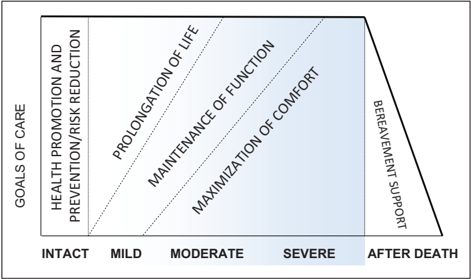
“Mental Health and Dementia: The European Association of Palliative Care’s recommendations were used to make decisions; they propose a different therapeutic main goal in patients with dementia according to the stage of their pathology, based on evidence and consensus among experts [42].”
BackgroundMethodBartley, M. M., Manggaard, J. M., Fischer, K. M., Holland, D. E., & Takahashi, P. Y. (2022) · Journal of Palliative Care · doi:10.1177/08258597221125607 · Cited by 12
“ACP has been identified as a priority in dementia care to help communicate individual goals and preferences for medical treatments and identify surrogate decision-makers.(14) For older adults living with dementia, ACP rates vary widely, and ACP often is addressed only at times of crisis and is poorly communicated.”
BackgroundBronner, K., Bodner, L., Jox, R. J., Marckmann, G., Diehl‐Schmid, J., & Hamann, J. (2020) · Der Nervenarzt · doi:10.1007/s00115-020-00911-2 · Cited by 10
O’Sullivan, A., Alvariza, A., Öhlén, J., & Håkanson, C. (2021) · Palliative & Supportive Care · doi:10.1017/s147895152100016x · Cited by 9
“The illness trajectory might be clearer in cancer than in, e.g., some chronic diseases or in the case of older persons (van der Steen et al., 2014; Hendriks et al., 2017).”
BackgroundPsychometric Testing of the Spanish Modified Version of the Mini-Suffering State Examination
Sánchez, D. G., García, R. G., López‐Medina, I. M., & Vargas, A. I. C. (2021) · International Journal of Environmental Research and Public Health · doi:10.3390/ijerph18157821 · Cited by 9
“While PC has traditionally been an approach globally associated with people with cancer, there is support for expanding PC early in the course of chronic conditions, including for people with dementia [16].”
BackgroundEicher, S., Theill, N., Geschwindner, H. M., Moor, C., Wettstein, A., Bieri-Brüning, G., Höck, C., Martin, M., Wolf, H., & Riese, F. (2016) · BMC Palliative Care · doi:10.1186/s12904-016-0151-2 · Cited by 8
Palliative care for people with advanced major neuro-cognitive disorders
Crowther, J., & Costello, J. (2017) · International Journal of Palliative Nursing · doi:10.12968/ijpn.2017.23.10.502 · Cited by 11
The role of the district nurse in caring for patients with dementia
Dixon, L., & Thompson, H. (2018) · British Journal of Community Nursing · doi:10.12968/bjcn.2018.23.7.348 · Cited by 10
Metadata
- Authors
- van der Steen, J. T., Radbruch, L., Hertogh, C. M., de Boer, M. E., Hughes, J. C., Larkin, P., Francke, A. L., Jünger, S., Gove, D., Firth, P., Koopmans, R. T., Volicer, L., & on behalf of the European Association for Palliative Care (EAPC)
- Affiliations
- Department of General Practice & Elderly Care Medicine, EMGO Institute for Health and Care Research, VU University Medical Center, Amsterdam, the Netherlands
- University Hospital Bonn (DE)
- Amsterdam Public Health (NL)
- Northumbria Healthcare NHS Foundation Trust (GB)
- University College Dublin (IE)
- Netherlands Institute for Health Services Research (NL)
- Alzheimer Europe (LU)
- Lancaster University (GB)
- Radboud University Medical Center (NL)
- University of South Florida (US)
- ORCID
- Venue
- Palliative Medicine
- Publisher
- SAGE Publications
- Published
- 2013-07-04
- Volume
- 28
- Issue
- 3
- Pages
- 197-209
- ISSN
- 0269-2163 (ISSN-L)
- 1477-030X
- OpenAlex
- W2137200701
- Cited by
- 997
- References
- 57
- Citations by year
- 2026: 36 · 2025: 70 · 2024: 95 · 2023: 68 · 2022: 105 · 2021: 97 · 2020: 132 · 2019: 90 · 2018: 72 · 2017: 79 · 2016: 58 · 2015: 50 · 2014: 34 · 2013: 6
- FWCI
- 50.45
- Type
- journal article
- Language
- en
- Open access
- hybrid
- doi.org
- Licence
- cc-by-nc
- journals.sagepub.com/page/policies/text-and-data-mining-license (tdm)
- Locations
- Palliative Medicine (publishedVersion, cc-by-nc)
- PubMed (publishedVersion)
- Pure Amsterdam UMC (publishedVersion)
- Amsterdam UMC (VU Amsterdam) - Institutional Repository (publishedVersion)
- Radboud Repository (Radboud University) (submittedVersion)
- Data Archiving and Networked Services (DANS) (submittedVersion, other-oa)
- Bristol Research (University of Bristol) (submittedVersion)
- Lenus, The Irish Health Repository (Dr Steevens Hospital Library) (submittedVersion)
- Radboud Repository (Radboud University) (submittedVersion, other-oa)
- Data Archiving and Networked Services (DANS) (submittedVersion)
- Newcastle University ePrints (Newcastle Univesity) (cc-by-nc)
- Funders
- Ministerie van Volksgezondheid, Welzijn en Sport
- Nederlandse Organisatie voor Wetenschappelijk Onderzoek (916.66.073, 91711339)
- Topics
- Health Sciences › Medicine › Public Health, Environmental and Occupational Health › Palliative Care and End-of-Life Issues
- Health Sciences › Medicine › Public Health, Environmental and Occupational Health › Palliative and Oncologic Care
- Health Sciences › Medicine › Psychiatry and Mental health › Dementia and Cognitive Impairment Research
- Keywords
- palliative care, dementia, older adults, person-centred care, shared decision-making, symptom management, advance care planning, continuity of care, family involvement, outcome prediction, treatment goals, European Association for Palliative Care
- MeSH terms
- Adult, Aged, Aged, 80 and over, Delphi Technique, Dementia, Europe, Humans, Middle Aged, Palliative Care, Practice Guidelines as Topic, Consensus
About these checks
Registry, retraction, Cites and statistics results are computed, not judged, with one exception: a printed reference that no index lists is read once by a model before it counts as a citation error. Claims are extracted by a model and kept only when their quote appears verbatim in the text; each cited source is then checked, with a model’s help, for whether it says what the claim relies on. Those verdicts can be wrong — read the claim’s quote and the cited source before relying on one.
Statistics and arithmetic are recomputed, not judged.
Confidence bands are shown only for fields calibrated on our annotated test set. None is calibrated yet, so no band is shown.
What counts as a claim ›How we measure confidence ›How we check this ›
Are you an author, or do you see a problem with this page? Request a review
Data sources
Bibliographic data: Semantic Scholar, OpenAlex, Crossref.
Contains information from the Semantic Scholar Academic Graph Datasets, made available under the ODC Attribution License (ODC-BY 1.0).
Semantic Scholar’s data is described in: Kinney, R., et al. (2023). The Semantic Scholar Open Data Platform. arXiv:2301.10140.
