

Does facilitated Advance Care Planning reduce the costs of care near the end of life? Systematic review and ethical considerations
Open accessThe DOI matches its Crossref record; 56 of the 58 references it cites were found in a registry or an index.
Abstract
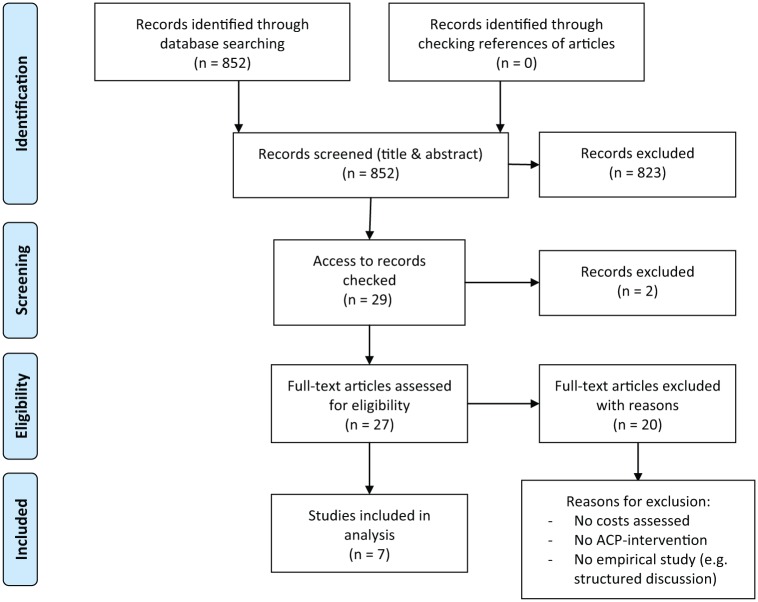
Background: While there is increasing evidence that Advance Care Planning has the potential to strengthen patient autonomy and improve quality of care near the end of life, it remains unclear whether it could also reduce net costs of care. Aim: This study aims to describe the cost implications of Advance Care Planning programmes and discusses ethical conflicts arising in this context. Design: We conducted a systematic review based on the Preferred Reporting Items for Systematic Reviews and Meta-Analyses statement. Data sources: We systematically searched the databases PubMed, NHS EED, EURONHEED, Cochrane Library and EconLit. We included empirical studies (no limitation to study type) that investigated the cost implications of Advance Care Planning programmes involving professionally facilitated end-of-life discussions. Results and discussion: Seven studies met our inclusion criteria. Four of them used a randomised controlled design, one used a before-after design and two were observational studies. Six studies found reductions in costs of care ranging from USD1041 to USD64,827 per patient, depending on the study period and the cost measurement. One study detected no differences in costs. Studies varied considerably regarding the Advance Care Planning intervention, patient selection and costs measured which may explain some of the variations in findings. Normative appraisal: Looking at the impact of Advance Care Planning on costs raises delicate ethical issues. Given the increasing pressure to reduce expenditures, there may be concerns that cost considerations could unduly influence the sensitive communication process, thus jeopardising patient autonomy. Safeguards are proposed to reduce these risks. Conclusion: The limited data indicate net cost savings may be realised with Advance Care Planning. Methodologically robust trials with clearly defined Advance Care Planning interventions are needed to make the costs and returns of Advance Care Planning transparent.
Overview
The claims and statistics of this paper haven’t been checked yet.
Free: it reads the open-access text and checks the first 5 claims that cite a source we can check. Create a free account to check every claim.
Integrity signals
Registry
Cites
Statistics
Figures
Verification
Claims the paper makes
The claims and statistics of this paper haven’t been checked yet.
Free: it reads the open-access text and checks the first 5 claims that cite a source we can check. Create a free account to check every claim.
Claims other papers make about this one
Each is checked against this paper’s own text: does it say what the citing paper says it does?
The cited source says what the claim attributes to it.
In the citing paper
“Findings of the systematic review by Klingler, in der Schmitten and Marckmann [8] even showed that facilitated ACP has the potential to reduce the net costs of care.”
From A systematic review of the effects of advance care planning facilitators training programs. (2019) · cites this paper as [8]
Self-check
Percentages, sums and reported differences re-computed from the paper’s own numbers.
The self-check needs the paper’s full text.
Citations
Cites
Preferred Reporting Items for Systematic Reviews and Meta-Analyses: the PRISMA statement
Moher, D., Liberati, A., Tetzlaff, J., Altman, D. G., & for the PRISMA Group (2009) · BMJ · doi:10.1136/bmj.b2535 · Cited by 83,823
Preferred reporting items for systematic reviews and meta-analyses: The PRISMA statement
Moher, D., Liberati, A., Tetzlaff, J., Altman, D. G., & the PRISMA Group* (2009) · Annals of Internal Medicine · doi:10.7326/0003-4819-151-4-200908180-00135 · Cited by 37,554
Methods for the Economic Evaluation of Health Care Programmes
Drummond, M. E., Sculpher, M. J., Torrance, G. W., O’Brien, B. J., & Stoddart, G. L. (2005) · doi:10.1093/oso/9780198529446.001.0001 · Cited by 13,648
Connors, A. F., Dawson, N. V., Desbiens, N. A., Fulkerson, W. J., Goldman, L., Knaus, W. A., Lynn, J., Oye, R. K., Bergner, M., Damiano, A., et al. (1995) · JAMA · doi:10.1001/jama.274.20.1591 · Cited by 2,764
Detering, K. M., Hancock, A. D., Reade, M. C., & Silvester, W. (2010) · BMJ · doi:10.1136/bmj.c1345 · Cited by 2,332
Consolidated Health Economic Evaluation Reporting Standards (CHEERS) statement
Husereau, D., Drummond, M., Petrou, S., Carswell, C., Moher, D., Greenberg, D., Augustovski, F., Briggs, A. H., Mauskopf, J., Loder, E., et al. (2013) · BMJ · doi:10.1136/bmj.f1049 · Cited by 1,776
The effects of advance care planning on end-of-life care: A systematic review
Brinkman-Stoppelenburg, A., Rietjens, J. A., & van der Heide, A. (2014) · Palliative Medicine · doi:10.1177/0269216314526272 · Cited by 1,480
Advance Directives and Outcomes of Surrogate Decision Making before Death
Silveira, M. J., Kim, S. Y. H., & Langa, K. M. (2010) · New England Journal of Medicine · doi:10.1056/nejmsa0907901 · Cited by 1,292
Methods for the economic evaluation of health care programmes, 3rd ed
Adamiak, G. T. (2006) · PubMed Central · Cited by 953
Ageing of population and health care expenditure: a red herring?
Zweifel, P., Felder, S., & Meiers, M. (1999) · Health Economics · doi:10.1002/(sici)1099-1050(199909)8:6<485::aid-hec461>3.0.co;2-4 · Cited by 910
Cited by
Items 201–216 of 216
Improving Older Adult Patient Education Regarding Advance Directives
Valencia, Y., & Valencia, Y. (2024) · UA Campus Repository (The University of Arizona)
Singkheaw, P., Tonboot, S., Raksasataya, A., Wannapira, W., & Pannarunothai, S. (2025) · Journal of Community Development Research (Humanities and Social Sciences) · doi:10.69650/jcdrhs.2025.1159
Christine, H. O., Dahye, K. I. M., Neo, P. H. M., & Teerawichitchainan, B. (2026) · Singapore Management University Institutional Knowledge (InK) (Singapore Management University)
Intervention to increase advanced care planning: a quality improvement project
Salley-Rains, B. E. (2024) · Montana State University ScholarWorks (Montana State University)
Rahman, H., Numata, K., Lai, E. T., Cheriyan, M., Haimovich, A. D., Ouchi, K., & Desai, S. (2026) · ACM Interactive Health Conference · doi:10.1145/3786579.3804967 · Cited by 1
“When conducted effectively, SICs support care that aligns with patient priorities, reducing unwanted aggressive interventions and improving quality of life [22, 55].”
Barnes, E., Ainsworth, M., & Wiggins, N. (2026) · BMJ Supportive & Palliative Care · doi:10.1136/spcare-2026-006194
Welton, L. L., Sudore, R. L., Botsford, C., O'Brien, S., Carmichael, J. C., Melton, G. B., & Wick, E. (2026) · The Joint Commission Journal on Quality and Patient Safety · doi:10.1016/j.jcjq.2026.03.002
Race-Stratified Randomized Trial Examining Advance Care Planning Engagement Among Older Adults
Creamer, R., Paulson, D., Maynard, M. H., Churchill, E. G., Lysandrou, A. E., & McClure, N. V. (2026) · Journal of Applied Gerontology · doi:10.1177/07334648261444783
Advance care planning uptake in the severely frail
Lim, K. S., Htin, K. K., & Rosario, B. H. (2026) · BMC Palliative Care · doi:10.1186/s12904-026-02133-w
“Beyond individual benefit, home-based end-of-life care has been associated with better bereavement outcomes for family members, [62, 63] and ACP more broadly with more efficient use of healthcare resources through reductions in unwanted intensive care treatments and hospitalisations [64, 65].”
Morton, C. R., Reich, A. J., Sun, W., Dhanani, H., Comrie, C. E., Suh, L., Farber, O. N., Tabata‐Kelly, M., Dohan, D., & Cooper, Z. R. (2026) · Annals of Surgery · doi:10.1097/sla.0000000000007098
Piza, P. N. S., Cabra, J. D., Fernandez, L. M. L., Marin, M. A. V., & Rincón, E. H. H. (2026) · American Journal of Hospice and Palliative Medicine® · doi:10.1177/10499091261463656
Cha, H. (2026) · Korean Journal of Medical Ethics · doi:10.35301/ksme.2026.29.2.73
Fuchs, T., & Gremsl, T. (2026) · Wiener klinische Wochenschrift · doi:10.1007/s00508-026-02799-5
Gleeson, T., McQuillan, R., & Pilch, M. (2026) · Journal of Health Psychology · doi:10.1177/13591053261477733
Lim, C. L., Phua, V. J. X., Goh, Y. X. S., Lee, S., Teo, V. H. Y., & Tang, W. E. (2026) · PLoS ONE · doi:10.1371/journal.pone.0359632
“Systematic reviews and observational studies further suggest that facilitated ACP may lower net healthcare costs and that extensive end-of-life discussions are associated with fewer aggressive interventions, reduced costs, and better quality of end-of-life care [9–11].”
Guaracha-Basáñez, G. A., Contreras-Yáñez, I., Jiménez‐Decle, J. G., Vargas-Sánchez, L. V., Mendoza‐Vigueras, A. V., Medina, F. C., López-Ávila, M. L., Rivera-Moscoso, R., & Pascual‐Ramos, V. (2026) · Journal of Evaluation in Clinical Practice · doi:10.1111/jep.70716
Metadata
- Authors
- Klingler, C., in der Schmitten, J., & Marckmann, G.
- Affiliations
- Institut für Ethik, Geschichte und Theorie der Medizin (DE)
- Institute of General Practice, Medical Faculty, Heinrich-Heine-University, Düsseldorf, Germany
- Corresponding author
- Marckmann, Georg
- Venue
- Palliative Medicine
- Publisher
- SAGE Publications
- Published
- 2015-08-20
- Volume
- 30
- Issue
- 5
- Pages
- 423-433
- ISSN
- 0269-2163 (ISSN-L)
- 1477-030X
- PMC
- PMC4838173
- OpenAlex
- W1662557517
- Cited by
- 201
- References
- 58
- Citations by year
- 2026: 11 · 2025: 7 · 2024: 20 · 2023: 15 · 2022: 23 · 2021: 34 · 2020: 24 · 2019: 20 · 2018: 17 · 2017: 18 · 2016: 10 · 2015: 2
- FWCI
- 2.27
- Type
- journal article
- Language
- en
- Open access
- hybrid
- doi.org
- Licence
- cc-by-nc
- journals.sagepub.com/page/policies/text-and-data-mining-license (tdm)
- Locations
- Palliative Medicine (publishedVersion, cc-by-nc)
- Europe PMC (PubMed Central) (publishedVersion, cc-by-nc)
- PubMed Central (publishedVersion, cc-by-nc)
- PubMed (publishedVersion)
- Open access LMU (Ludwid Maxmilian's Universitat Munchen) (submittedVersion)
- Topics
- Health Sciences › Medicine › Public Health, Environmental and Occupational Health › Palliative Care and End-of-Life Issues
- Health Sciences › Medicine › Public Health, Environmental and Occupational Health › Ethics and bioethics in healthcare
- Health Sciences › Medicine › Public Health, Environmental and Occupational Health › Palliative and Oncologic Care
- Keywords
- advance care planning, end-of-life care, health care costs, cost reduction, end-of-life discussions, patient autonomy, ethical conflicts, cost-effectiveness, palliative care
- MeSH terms
- Cost-Benefit Analysis, Cost Control, Humans, Terminal Care, Health Care Costs, Advance Care Planning
About these checks
Registry, retraction, Cites and statistics results are computed, not judged, with one exception: a printed reference that no index lists is read once by a model before it counts as a citation error. Claims are extracted by a model and kept only when their quote appears verbatim in the text; each cited source is then checked, with a model’s help, for whether it says what the claim relies on. Those verdicts can be wrong — read the claim’s quote and the cited source before relying on one.
Statistics and arithmetic are recomputed, not judged.
Confidence bands are shown only for fields calibrated on our annotated test set. None is calibrated yet, so no band is shown.
What counts as a claim ›How we measure confidence ›How we check this ›
Are you an author, or do you see a problem with this page? Request a review
Data sources
Bibliographic data: Semantic Scholar, OpenAlex, Crossref.
Contains information from the Semantic Scholar Academic Graph Datasets, made available under the ODC Attribution License (ODC-BY 1.0).
Semantic Scholar’s data is described in: Kinney, R., et al. (2023). The Semantic Scholar Open Data Platform. arXiv:2301.10140.
