

Does facilitated Advance Care Planning reduce the costs of care near the end of life? Systematic review and ethical considerations
Open accessThe DOI matches its Crossref record; 56 of the 58 references it cites were found in a registry or an index.
Abstract
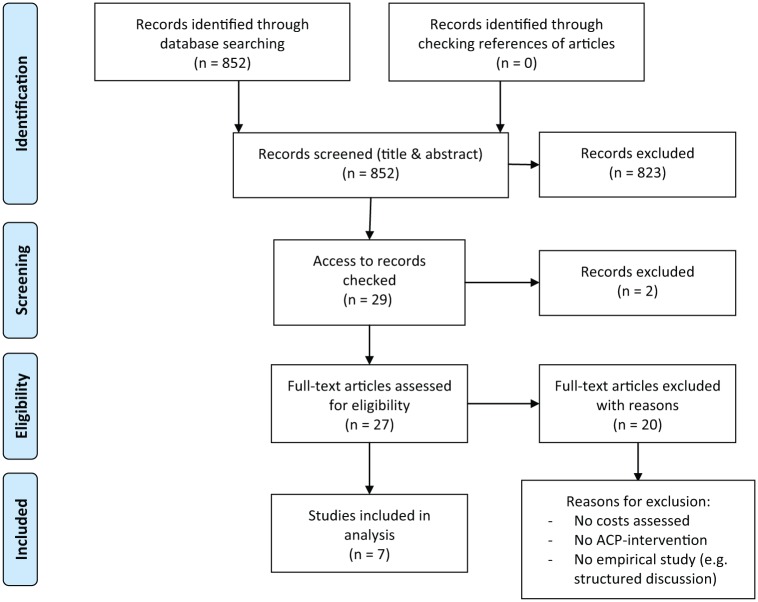
Background: While there is increasing evidence that Advance Care Planning has the potential to strengthen patient autonomy and improve quality of care near the end of life, it remains unclear whether it could also reduce net costs of care. Aim: This study aims to describe the cost implications of Advance Care Planning programmes and discusses ethical conflicts arising in this context. Design: We conducted a systematic review based on the Preferred Reporting Items for Systematic Reviews and Meta-Analyses statement. Data sources: We systematically searched the databases PubMed, NHS EED, EURONHEED, Cochrane Library and EconLit. We included empirical studies (no limitation to study type) that investigated the cost implications of Advance Care Planning programmes involving professionally facilitated end-of-life discussions. Results and discussion: Seven studies met our inclusion criteria. Four of them used a randomised controlled design, one used a before-after design and two were observational studies. Six studies found reductions in costs of care ranging from USD1041 to USD64,827 per patient, depending on the study period and the cost measurement. One study detected no differences in costs. Studies varied considerably regarding the Advance Care Planning intervention, patient selection and costs measured which may explain some of the variations in findings. Normative appraisal: Looking at the impact of Advance Care Planning on costs raises delicate ethical issues. Given the increasing pressure to reduce expenditures, there may be concerns that cost considerations could unduly influence the sensitive communication process, thus jeopardising patient autonomy. Safeguards are proposed to reduce these risks. Conclusion: The limited data indicate net cost savings may be realised with Advance Care Planning. Methodologically robust trials with clearly defined Advance Care Planning interventions are needed to make the costs and returns of Advance Care Planning transparent.
Overview
The claims and statistics of this paper haven’t been checked yet.
Free: it reads the open-access text and checks the first 5 claims that cite a source we can check. Create a free account to check every claim.
Integrity signals
Registry
Cites
Statistics
Figures
Verification
Claims the paper makes
The claims and statistics of this paper haven’t been checked yet.
Free: it reads the open-access text and checks the first 5 claims that cite a source we can check. Create a free account to check every claim.
Claims other papers make about this one
Each is checked against this paper’s own text: does it say what the citing paper says it does?
The cited source says what the claim attributes to it.
In the citing paper
“Findings of the systematic review by Klingler, in der Schmitten and Marckmann [8] even showed that facilitated ACP has the potential to reduce the net costs of care.”
From A systematic review of the effects of advance care planning facilitators training programs. (2019) · cites this paper as [8]
Self-check
Percentages, sums and reported differences re-computed from the paper’s own numbers.
The self-check needs the paper’s full text.
Citations
Cites
Preferred Reporting Items for Systematic Reviews and Meta-Analyses: the PRISMA statement
Moher, D., Liberati, A., Tetzlaff, J., Altman, D. G., & for the PRISMA Group (2009) · BMJ · doi:10.1136/bmj.b2535 · Cited by 83,823
Preferred reporting items for systematic reviews and meta-analyses: The PRISMA statement
Moher, D., Liberati, A., Tetzlaff, J., Altman, D. G., & the PRISMA Group* (2009) · Annals of Internal Medicine · doi:10.7326/0003-4819-151-4-200908180-00135 · Cited by 37,554
Methods for the Economic Evaluation of Health Care Programmes
Drummond, M. E., Sculpher, M. J., Torrance, G. W., O’Brien, B. J., & Stoddart, G. L. (2005) · doi:10.1093/oso/9780198529446.001.0001 · Cited by 13,648
Connors, A. F., Dawson, N. V., Desbiens, N. A., Fulkerson, W. J., Goldman, L., Knaus, W. A., Lynn, J., Oye, R. K., Bergner, M., Damiano, A., et al. (1995) · JAMA · doi:10.1001/jama.274.20.1591 · Cited by 2,764
Detering, K. M., Hancock, A. D., Reade, M. C., & Silvester, W. (2010) · BMJ · doi:10.1136/bmj.c1345 · Cited by 2,332
Consolidated Health Economic Evaluation Reporting Standards (CHEERS) statement
Husereau, D., Drummond, M., Petrou, S., Carswell, C., Moher, D., Greenberg, D., Augustovski, F., Briggs, A. H., Mauskopf, J., Loder, E., et al. (2013) · BMJ · doi:10.1136/bmj.f1049 · Cited by 1,776
The effects of advance care planning on end-of-life care: A systematic review
Brinkman-Stoppelenburg, A., Rietjens, J. A., & van der Heide, A. (2014) · Palliative Medicine · doi:10.1177/0269216314526272 · Cited by 1,480
Advance Directives and Outcomes of Surrogate Decision Making before Death
Silveira, M. J., Kim, S. Y. H., & Langa, K. M. (2010) · New England Journal of Medicine · doi:10.1056/nejmsa0907901 · Cited by 1,292
Methods for the economic evaluation of health care programmes, 3rd ed
Adamiak, G. T. (2006) · PubMed Central · Cited by 953
Ageing of population and health care expenditure: a red herring?
Zweifel, P., Felder, S., & Meiers, M. (1999) · Health Economics · doi:10.1002/(sici)1099-1050(199909)8:6<485::aid-hec461>3.0.co;2-4 · Cited by 910
Cited by
Overview of Systematic Reviews of Advance Care Planning: Summary of Evidence and Global Lessons
Jimenez, G., Tan, W. S., Virk, A. K., Low, C. K., Car, J., & Ho, A. H. Y. (2018) · Journal of Pain and Symptom Management · doi:10.1016/j.jpainsymman.2018.05.016 · Cited by 545
McMahan, R. D., Tellez, I., & Sudore, R. L. (2021) · Journal of the American Geriatrics Society · doi:10.1111/jgs.16801 · Cited by 506
“Data on reduced costs and healthcare utilization have also been mixed.(24,70,71) Furthermore, studies of different singular intervention modalities, combined intervention modalities, and implementation strategies have resulted in varying outcomes.”
BackgroundSystematic review of high-cost patients’ characteristics and healthcare utilisation
Wammes, J. J. G., van der Wees, P. J., Tanke, M. A. C., Westert, G. P., & Jeurissen, P. P. T. (2018) · BMJ Open · doi:10.1136/bmjopen-2018-023113 · Cited by 270
European Resuscitation Council Guidelines 2021: Ethics of resuscitation and end of life decisions
Mentzelopoulos, S. D., Couper, K., Voorde, P. V. D., Druwé, P., Blom, M., Perkins, G. D., Lulic, I., Djakow, J., Raffay, V., Lilja, G., et al. (2021) · Resuscitation · doi:10.1016/j.resuscitation.2021.02.017 · Cited by 246
Dixon, J., Karagiannidou, M., & Knapp, M. (2018) · Journal of Pain and Symptom Management · doi:10.1016/j.jpainsymman.2017.04.009 · Cited by 245
Measuring Advance Care Planning: Optimizing the Advance Care Planning Engagement Survey
Sudore, R. L., Heyland, D. K., Barnes, D. E., Howard, M., Fassbender, K., Robinson, C. A., Boscardin, J., & You, J. J. (2017) · Journal of Pain and Symptom Management · doi:10.1016/j.jpainsymman.2016.10.367 · Cited by 236
Martina, D., Lin, C.-P., Kristanti, M. S., Bramer, W. M., Mori, M., Korfage, I. J., van der Heide, A., van der Rijt, C. C. D., & Rietjens, J. A. C. (2021) · Journal of the American Medical Directors Association · doi:10.1016/j.jamda.2020.12.018 · Cited by 160
“Chao CS. Physicians attitudes toward DNR of terminally ill cancer patients in Taiwan.”
BackgroundMethodInfluentialPreconditions for successful advance care planning in nursing homes: A systematic review.
Gilissen, J., Pivodic, L., Smets, T., Gastmans, C., Vander Stichele, R., Deliens, L., & Van den Block, L. (2017) · International Journal of Nursing Studies · doi:10.1016/j.ijnurstu.2016.12.003 · Cited by 156
A systematic review of the effects of advance care planning facilitators training programs.
Chan, C. W. H., Ng, N. H. Y., Chan, H. Y. L., Wong, M. M. H., & Chow, K. M. (2019) · BMC Health Services Research · doi:10.1186/s12913-019-4192-0 · Cited by 135
Starr, L. T., Ulrich, C. M., Corey, K. L., & Meghani, S. H. (2019) · American Journal of Hospice and Palliative Medicine® · doi:10.1177/1049909119848148 · Cited by 132
“Evidence suggests patient–provider discussions about EOL preferences are associated with less aggressive treatment near death(6,22,23) and that interventions involving GOC discussions may reduce costs.(24,25) Cancer is the second leading cause of mortality in the United States and globally(26,27) and one of the most e…”
Luta, X., Ottino, B., Hall, P. S., Bowden, J., Wee, B., Droney, J., Riley, J., & Marti, J. (2021) · BMC Palliative Care · doi:10.1186/s12904-021-00782-7 · Cited by 121
“We found some evidence of the effectiveness of ACP for reducing resource use.”
BackgroundInfluentialTaylor, S. P., Murphy, S., Rios, A., McWilliams, A. D., McCurdy, L., Chou, S., Hetherington, T. C., Rossman, W., Russo, M. J., Gibbs, M. A., et al. (2021) · Critical Care Medicine · doi:10.1097/ccm.0000000000005300 · Cited by 105
“Don’t Talk to Them About Goals of Care”: Understanding Disparities in Advance Care Planning
Ashana, D. C., D’Arcangelo, N., GAZARIAN, P. K., Gupta, A., Perez, S. M., Reich, A. J., Tjia, J., Halpern, S. D., Weissman, J. S., & Ladin, K. (2021) · The Journals of Gerontology Series A · doi:10.1093/gerona/glab091 · Cited by 103
Bond, W. F., Kim, M., Franciskovich, C. M., Weinberg, J. E., Svendsen, J. D., Fehr, L. S., Funk, A., Sawicki, R., & Asche, C. V. (2017) · Journal of Palliative Medicine · doi:10.1089/jpm.2017.0566 · Cited by 92
“Also, studies have been heterogeneous in the patient populations and disease groupings studied, and the costs considered.(29) We examined the association of outpatient ACP with advance directive documentation rates, utilization, and costs in a cohort of patients who died compared to matched controls using accountable…”
Backgroundde Vries, K., Banister, E. M., Dening, K. H., & Ochieng, B. M. N. (2019) · Nursing Ethics · doi:10.1177/0969733019833130 · Cited by 89
“This raises ethical concerns that cost considerations could disproportionately influence transparency and the sensitive communication process and jeopardise patient autonomy.(12) In the United States, this rhetoric positions ACP as being encouraged to allow older patients to reject costly, intensive and futile medical…”
BackgroundAdvance Care Planning in Chinese Seniors: Cultural Perspectives
Cheng, H. W. B. (2018) · Journal of Palliative Care · doi:10.1177/0825859718763644 · Cited by 76
Kernick, L. A., Hogg, K. J., Millerick, Y., Murtagh, F. E. M., Djahit, A., & Johnson, M. (2018) · Palliative Medicine · doi:10.1177/0269216318801162 · Cited by 68
Definition and recommendations of advance care planning: A Delphi study in five Asian sectors
Mori, M., Chan, H. Y. L., Lin, C., Kim, S., Ng, R. H. L., Martina, D., Yuen, K., Cheng, S., Takenouchi, S., Suh, S., et al. (2024) · Palliative Medicine · doi:10.1177/02692163241284088 · Cited by 67
Palmer, M. K., Jacobson, M., & Enguidanos, S. (2021) · Health Affairs · doi:10.1377/hlthaff.2020.01895 · Cited by 61
State of advance care planning research: A descriptive overview of systematic reviews
Jimenez, G., Tan, W. S., Virk, A. K., Low, C. K., Car, J., & Ho, A. H. Y. (2019) · Palliative and Supportive Care · doi:10.1017/s1478951518000500 · Cited by 59
Challenges In Understanding And Respecting Patients’ Preferences
Barnato, A. E. (2017) · Health Affairs · doi:10.1377/hlthaff.2017.0177 · Cited by 58
Goswami, P. (2021) · Journal of the Advanced Practitioner in Oncology · doi:10.6004/jadpro.2021.12.1.7 · Cited by 58
Ashana, D. C., Chen, X., Agiro, A., Sridhar, G., Nguyen, A., Barron, J., Haynes, K., Fisch, M., Debono, D., Halpern, S. D., et al. (2019) · JAMA Network Open · doi:10.1001/jamanetworkopen.2019.14471 · Cited by 50
A systematic evaluation of advance care planning patient educational resources
GAZARIAN, P. K., Cronin, J., Dalto, J. L., Baker, K. M., Friel, B. J., Bruce-Baiden, W., & Rodriguez, L. Y. (2018) · Geriatric Nursing · doi:10.1016/j.gerinurse.2018.09.011 · Cited by 52
Rosca, A., Karzig-Roduner, I., Kasper, J., Rogger, N., Drewniak, D., & Krones, T. (2023) · BMC Medical Ethics · doi:10.1186/s12910-023-00944-7 · Cited by 53
Goldhagen, J. L., Fafard, M., Komatz, K., Eason, T., & Livingood, W. C. (2016) · BMC Palliative Care · doi:10.1186/s12904-016-0138-z · Cited by 51
“Moreover, these findings indicate the potential value of empowerment and the quality community-based support in care planning process [43].”
BackgroundPatterns of Care in Hospitalized Vascular Surgery Patients at End of Life
Wilson, D. G., Harris, S. K., Peck, H., Hart, K. D., Jung, E., Azarbal, A. F., Mitchell, E. L., Landry, G. J., & Moneta, G. L. (2016) · JAMA Surgery · doi:10.1001/jamasurg.2016.3970 · Cited by 45
“Theymayalso reduceoverall costs at the end of life.(5) According to the Centers for Disease Control and Prevention, by 2030, individuals 65 years and older will account for roughly 20%of theUS population.”
MethodPalliative Care for Cancer Survivors
Dy, S. M., Isenberg, S. R., & Hamayel, N. A. A. (2017) · Medical Clinics of North America · doi:10.1016/j.mcna.2017.06.009 · Cited by 52
Pajka, S. E., Hasdianda, M. A., George, N. R., Sudore, R. L., Schonberg, M. A., Bernstein, E., Tulsky, J. A., Block, S. D., & Ouchi, K. (2020) · Journal of Palliative Medicine · doi:10.1089/jpm.2020.0067 · Cited by 45
Ethik der Reanimation und Entscheidungen am Lebensende
Bossaert, L. L., Perkins, G. D., Askitopoulou, H., Raffay, V. I., Greif, R., Haywood, K. L., Mentzelopoulos, S. D., Nolan, J. P., de Voorde, P. V., & Xanthos, T. T. (2015) · Notfall + Rettungsmedizin · doi:10.1007/s10049-015-0083-z · Cited by 45
Nguyen, K., Sellars, M., Agar, M. R., Kurrle, S., Kelly, A., & Comans, T. A. (2017) · BMC Health Services Research · doi:10.1186/s12913-017-2748-4 · Cited by 46
“(2015) showed that facilitated ACP had the potential to reduce net costs of care [16], while Dixon et al.”
BackgroundAdvance Care Planning: is quality end of life care really that simple?
Johnson, S. B., Kerridge, I., Butow, P. N., & Tattersall, M. H. N. (2017) · Internal Medicine Journal · doi:10.1111/imj.13389 · Cited by 43
Sævareid, T. J. L., Thoresen, L., Gjerberg, E., Lillemoen, L., & Pedersen, R. (2019) · Patient Education and Counseling · doi:10.1016/j.pec.2019.06.001 · Cited by 39
Palliative care for people with COPD: effective but underused
Halpin, D. M. G. (2018) · European Respiratory Journal · doi:10.1183/13993003.02645-2017 · Cited by 39
Advance Care Planning for People with Dementia: The Role of General Practitioners
Bally, K., Krones, T., & Jox, R. J. (2019) · Gerontology · doi:10.1159/000500809 · Cited by 37
Attitudes and Beliefs Toward Advance Care Planning Among Underserved Chinese-American Immigrants
Dhingra, L. K., Cheung, W., Breuer, B., Huang, P. P., Lam, K., Chen, J., Zhou, X., Chang, V. T.-S., Chui, T., Hicks, S., et al. (2020) · Journal of Pain and Symptom Management · doi:10.1016/j.jpainsymman.2020.04.013 · Cited by 37
Gieniusz, M., Nunes, R., Saha, V., Renson, A., Schubert, F. D., & Carey, J. M. (2016) · American Journal of Hospice and Palliative Medicine® · doi:10.1177/1049909116682470 · Cited by 37
“Previous studies have demonstrated a link between GOCD and fewer aggressive measures at EOL,1,2,8-10,15-17 fewer in-hospital deaths and a greater use of hospice,1,5,8,10,19,21 and fewer ICU admissions and shorter ICU LOS.9,10,19,23,24 Our study’s results are consistent with these findings and offer new insights into t…”
BackgroundResultInfluentialSævareid, T. J. L., Førde, R., Thoresen, L., Lillemoen, L., & Pedersen, R. (2019) · Clinical Interventions in Aging · doi:10.2147/cia.s203298 · Cited by 36
Mentzelopoulos, S. D., Couper, K., de Voorde, P. V., Druwé, P., Blom, M. T., Perkins, G. D., Lulić, I., Djakow, J., Raffay, V. I., Lilja, G., et al. (2021) · Notfall + Rettungsmedizin · doi:10.1007/s10049-021-00888-8 · Cited by 36
Bekker, Y. A. C., Suntjens, A. F., Engels, Y., Schers, H., Westert, G. P., & Groenewoud, S. (2022) · BMC Palliative Care · doi:10.1186/s12904-022-00907-6 · Cited by 35
Crooks, J., Rizk, N., Greene, C., Hopwood, G., Smith, O., Seddon, K., & Hudson, B. F. (2025) · Palliative Medicine · doi:10.1177/02692163251344428 · Cited by 33
“63,64 Evidence regarding impact on patients’ wellbeing was mixed; but no advance care planning interventions were found to increase depression or negatively impact wellbeing.”
Klemmt, M., Henking, T., Heizmann, E., Best, L., van Oorschot, B., & Neuderth, S. (2020) · Journal of Clinical Nursing · doi:10.1111/jocn.15291 · Cited by 33
Brief English and Spanish Survey Detects Change in Response to Advance Care Planning Interventions
Shi, Y., Barnes, D. E., Boscardin, W. J., You, J. J., Heyland, D. K., Volow, A. M., Howard, M., & Sudore, R. L. (2019) · Journal of Pain and Symptom Management · doi:10.1016/j.jpainsymman.2019.09.004 · Cited by 34
Radhakrishnan, K., Scoy, L. J. V., Jillapalli, R., Saxena, S., & Kim, M. T. (2017) · Ethnicity and Health · doi:10.1080/13557858.2017.1357068 · Cited by 33
Islam, Z., Pollock, K., Patterson, A., Hanjari, M., Wallace, L., Mururajani, I., Conroy, S., & Faull, C. (2023) · Health and Social Care Delivery Research · doi:10.3310/jvfw4781 · Cited by 33
The Financial Impact of Palliative Care and Aggressive Cancer Care on End-of-Life Health Care Costs
Davis, M. P., Vanenkevort, E. A., Elder, A., Young, A. J., Ordonez, I. D. C., Wojtowicz, M. J., Ellison, H. B., Fernandez, C., Mehta, Z. Y., Behm, B., et al. (2022) · American Journal of Hospice and Palliative Medicine® · doi:10.1177/10499091221098062 · Cited by 28
“A systematic review of 7 studies which compared healthcare costs with advanced care planning found that advanced care planning reduced costs ranging from $1041 to $64,827.(64) Relative cost reductions ranged from 5-68% when compared with individuals who had not undergone advanced care planning.”
BackgroundThe Affordable Care Act and End-of-Life Care for Patients With Cancer
Parikh, R. B., & Wright, A. A. (2017) · The Cancer Journal · doi:10.1097/ppo.0000000000000264 · Cited by 28
“A recent systematic review suggests that facilitated advanced care planning reduces costs of care at the end of life for inpatients by up to $65,000 per patient.(37) However, there are few prospective evaluations of alternative payment mechanisms in end-of-life cancer care.”
Siconolfi, D. E., Bandini, J. I., & Chen, E. (2020) · Patient Education and Counseling · doi:10.1016/j.pec.2020.12.023 · Cited by 27
Sellars, M., Clayton, J. M., Detering, K. M., Tong, A., Power, D., & Morton, R. L. (2019) · PLoS ONE · doi:10.1371/journal.pone.0217787 · Cited by 28
“This was contrary to our expectations, as we anticipated that ACP would reduce the hospital costs of care, consistent with data from economic analysis of ACP interventions in other settings [15, 26].”
ResultHealthcare professionals’ perceptions about the Italian law on advance directives
Maffoni, M., Argentero, P., Giorgi, I., & Giardini, A. (2019) · Nursing Ethics · doi:10.1177/0969733019878831 · Cited by 28
“Despite these drawbacks, advance directive(s) are reported to improve the patient’s quality of life in the last days(16) and may potentially reduce costs of care too.(17) Hence, planning medical care treatments in advance merits the attention of healthcare systems.”
BackgroundStarr, L. T., Ulrich, C. M., Appel, S. M., Junker, P., O’Connor, N. R., & Meghani, S. H. (2020) · Journal of Palliative Medicine · doi:10.1089/jpm.2019.0522 · Cited by 25
“Finally, although health systems benefit from reducing costs, saving money should never be the primary reason for engaging patients in PCC or making clinical decisions.(55) Limitations”
BackgroundEarly Integrated Palliative Care Within a Surgical Oncology Clinic
Bansal, V. V., Kim, D., Reddy, B., Witmer, H. D. D., Dhiman, A., Godley, F. A., Ong, C. T., Clark, S., Ulrich, L., Polite, B. N., et al. (2023) · JAMA Network Open · doi:10.1001/jamanetworkopen.2023.41928 · Cited by 27
Quenot, J., Ecarnot, F., Meunier‐Beillard, N., Dargent, A., Large, A., Andreu, P., & Rigaud, J. (2017) · Annals of Translational Medicine · doi:10.21037/atm.2017.08.08 · Cited by 25
A Framework to Guide Economic Analysis of Advance Care Planning
O’Hanlon, C. E., Walling, A. M., Okeke, E. N., Stevenson, S., & Wenger, N. S. (2018) · Journal of Palliative Medicine · doi:10.1089/jpm.2018.0041 · Cited by 23
“7,8 Evidence has been mixed regarding the effect of one element of ACP, advance directives, on expenditures and treatment at EOL; however, recent studies using large data sets have shown treatment limitation and cost savings associated with advance directives, with the largest effects in high…”
Burghout, C., van Venrooij, L. M. W., Bolt, S., Smilde, T. J., & Wouters, E. (2022) · Journal of Palliative Care · doi:10.1177/08258597221119660 · Cited by 25
“In addition to the quality of life benefits, less overtreatment due a timely initiated ACPT may also contribute to reallocation of health care costs.(46,47) Table 5.”
BackgroundConocimientos y actitudes sobre voluntades anticipadas en profesionales sanitarios
Martínez‐Gimeno, M. L., Escribano, C. C., Fernandez, T. H., García, M. C. O., Benito, D. H. T., Arenas, T. B.-G., & Almagro, P. R. (2018) · Journal of Healthcare Quality Research · doi:10.1016/j.jhqr.2018.05.005 · Cited by 23
Schnakenberg, R., Silies, K., Berg, A., Kirchner, Ä., Langner, H., Chuvayaran, Y., Köberlein–Neu, J., Haastert, B., Wiese, B., Meyer, G., et al. (2020) · BMC Geriatrics · doi:10.1186/s12877-020-01537-4 · Cited by 24
Advance Directive Completion and Its Associated Factors Among Older Chinese Americans
Wang, K., Liu, Y., Sun, F., Kong, D., Jiang, L. H., & Wu, B. (2020) · Journal of the American Medical Directors Association · doi:10.1016/j.jamda.2020.06.049 · Cited by 23
A European multicenter study on systematic ethics work in nursing homes
Bollig, G., Rosland, J. H., Gjengedal, E., Schmidt, G., May, A. T., & Heller, A. (2016) · Scandinavian Journal of Caring Sciences · doi:10.1111/scs.12373 · Cited by 24
Ohr, S. O., Cleasby, P., Jeong, S., & Barrett, T. (2021) · BMC Palliative Care · doi:10.1186/s12904-021-00835-x · Cited by 24
Building on sand: digital technologies for care coordination and advance care planning
Allsop, M. J., Chumbley, K., Birtwistle, J. C., Bennett, M., & Pocock, L. V. (2021) · BMJ Supportive & Palliative Care · doi:10.1136/bmjspcare-2021-003304 · Cited by 22
Managing ethical aspects of advance directives in emergency care services
Poveda‐Moral, S., Rodríguez‐Martín, D., Codern‐Bové, N., de la Casa, P. J.-M., Sánchez-Valero, P., Pomares-Quintana, N., Vicente-García, M., & Falcó‐Pegueroles, A. (2020) · Nursing Ethics · doi:10.1177/0969733020952112 · Cited by 20
“With these measures, the number of referrals and deaths in hospitals might be reduced.(52) Poveda-Moral et al.”
BackgroundImpact of advance care planning on end-of-life management
Lunder, U., Červ, B., & Čeh, H. K. (2017) · Current Opinion in Supportive and Palliative Care · doi:10.1097/spc.0000000000000306 · Cited by 21
Goldhagen, J. L., Fafard, M., Komatz, K., Eason, T., & Livingood, W. C. (2016) · BMC Palliative Care · doi:10.1186/s12904-016-0154-z · Cited by 21
“Moreover, these findings indicate the potential value of empowerment and the quality community-based support in care planning process [43].”
BackgroundVolunteer Involvement in Advance Care Planning: A Scoping Review
Sellars, M., Simpson, J., Kelly, H., Chung, O. S., Nolte, L., Tran, J., & Detering, K. M. (2019) · Journal of Pain and Symptom Management · doi:10.1016/j.jpainsymman.2019.02.031 · Cited by 18
Advance directives and real-world end-of-life clinical practice: a case–control study
Dalmau-Bueno, A., Saura‐Lázaro, A., Busquets, J. M., Bullich, I., & García‐Altés, A. (2021) · BMJ Supportive & Palliative Care · doi:10.1136/bmjspcare-2020-002851 · Cited by 19
“30 Although some cost savings may be realised, 31 32 looking at the impact of advance care planning on costs raises delicate ethical issues and unduly influences the sensitive communication process, thus jeopardising patient autonomy.”
Deprescribing: A Prime Opportunity to Optimize Care of Cancer Patients
Chaput, G., & Bhanabhai, H. (2023) · Current Oncology · doi:10.3390/curroncol30110704 · Cited by 17
“The benefits of advance care planning discussions are well-known and include greater patient autonomy, decreased length and number of hospitalizations, and reduced unwanted and unnecessary treatments [48,49].”
BackgroundSpending Analysis of Machine Learning–Based Communication Nudges in Oncology
Patel, T. A., Heintz, J. R., Chen, J., LaPergola, M., Bilker, W. B., Patel, M. S., Arya, L. A., Patel, M. I., Bekelman, J. E., Manz, C. R., et al. (2024) · NEJM AI · doi:10.1056/aioa2300228 · Cited by 14
Developing an Instrument to Assess the Readiness for Advance Care Planning
Sakai, S., Nagae, H., Miyashita, M., Harasawa, N., Iwasaki, T., Katayama, Y., Takenouchi, S., Ikeda, M., Ito, M. N., & Tamura, K. (2021) · Journal of Pain and Symptom Management · doi:10.1016/j.jpainsymman.2021.10.009 · Cited by 16
Factors Influencing the Implementation of Digital Advance Care Planning: Qualitative Interview Study
Bradshaw, A., Birtwistle, J. C., Evans, C., Sleeman, K. E., Richards, S. H., Foy, R., Martin, P. M., Carder, P., Allsop, M. J., & Twiddy, M. (2024) · Journal of Medical Internet Research · doi:10.2196/50217 · Cited by 13
Promoting advance care planning via mediated health resources: A systematic mixed studies review
Diegelmann, S., Bidmon, S., & Terlutter, R. (2021) · Patient Education and Counseling · doi:10.1016/j.pec.2021.06.008 · Cited by 13
Exploiting Technology to Popularize Goals-of-Care Conversations and Advance Care Planning
Esfahani, S., Yi, C., Madani, C., Davidson, J. E., Edmonds, K. P., & Wynn, S. (2020) · Critical Care Nurse · doi:10.4037/ccn2020576 · Cited by 13
Death vs. Data Science: Predicting End of Life
Ahmad, M. I., Eckert, C., McKelvey, T. G., Zolfagar, K., Zahid, A., & Teredesai, A. M. (2018) · Proceedings of the AAAI Conference on Artificial Intelligence · doi:10.1609/aaai.v32i1.11429 · Cited by 19
“…may refer to all the components of the model being amenable to intuiative explanations (Lou, Caruana, and Gehrke 2012) (Turner 2016) (Lakkaraju, Bach, and Leskovec 2016) e.g., the relative strength of parameters in linear models correspond to strengths of associations between the…”
BackgroundMayers, T., Sakamoto, A., Inokuchi, R., Hanari, K., Ring, H. Z., & Tamiya, N. (2024) · Healthcare · doi:10.3390/healthcare12060667 · Cited by 11
“ACP can aid in reducing this burden on healthcare systems by promoting effective resource utilization and preventing unnecessary or unwanted medical interventions [9,10,26].”
BackgroundKim, J., Heo, S., Hong, S. W., Kim, H. R., Jung, A., An, M., & Shim, J. L. (2020) · Healthcare · doi:10.3390/healthcare8010062 · Cited by 11
“Use of ADs or ACP can result in several positive health outcomes, including less use of aggressive treatments, more patient and caregiver satisfaction, and reduced unnecessary costs [18,19].”
BackgroundProactive advance care planning conversations in general practice: a quality improvement project
Winnifrith, T., Millington‐Sanders, C., Husbands, E., Haros, J., & Ballinger, H. (2024) · BMJ Open Quality · doi:10.1136/bmjoq-2023-002679 · Cited by 11
Financial Toxicity of Cancer Drugs: Possible Remedies from an Ethical Perspective
Marckmann, G., & der Schmitten, J. I. (2017) · Breast Care · doi:10.1159/000471506 · Cited by 11
Self-citationSimmons, D. B., Levi, B. H., Green, M. J., La, I. S., Lipnick, D., Smith, T. J., Thiede, E., Wiegand, D. L.-M., & Scoy, L. J. V. (2021) · American Journal of Hospice and Palliative Medicine® · doi:10.1177/10499091211026674 · Cited by 11
der Schmitten, J. I., Rixen, S., & Marckmann, G. (2022) · Springer eBooks · doi:10.1007/978-3-662-65204-6_6 · Cited by 14
Self-citationGötze, K., Bausewein, C., Feddersen, B., Fuchs, Â., Hot, A., Hummers, E., Icks, A., Kirchner, Ä., Kleinert, E., Klosterhalfen, S., et al. (2022) · Trials · doi:10.1186/s13063-022-06576-3 · Cited by 11
“For example, excess hospitalization rates of nursing home (NH) residents in their final year of life have severe medical, ethical, and economic implications: poor prognosis, severe course of disease, frequent hospital readmissions without informed consent, disregard of autonomous choices, and high costs [2] of unwante…”
BackgroundSelf-citationAdvance Care Planning interventions for older people with early-stage dementia: A scoping review
Tetrault, A., Nyback, M.-H., Vaartio‐Rajalin, H., & Fagerström, L. (2021) · Nordic journal of nursing research · doi:10.1177/20571585211014005 · Cited by 13
“Klingler et al.(64) studied the cost implications of ACP and the associated ethical conflicts.”
BackgroundScott, I. A., Reymond, L., Sansome, X., & Carter, H. E. (2024) · BMJ Open · doi:10.1136/bmjopen-2023-082766 · Cited by 10
Matthieu, M. M., Ounpraseuth, S., Painter, J. T., Waliski, A., Williams, J. S., Hu, B., Smith, R. M., & Garner, K. K. (2020) · Implementation Science Communications · doi:10.1186/s43058-020-00016-6 · Cited by 10
“The lack of ACP discussions increases the risk that veterans will receive care different from what they prefer and may experience unnecessary interventions leading to increased suffering and higher health care costs [4, 5].”
BackgroundDing, J., Cook, A. G., Saunders, C. M., Chua, D., Licqurish, S., Mitchell, G. K., & Johnson, C. E. (2021) · Health & Social Care in the Community · doi:10.1111/hsc.13570 · Cited by 12
Carney, M. T., Williams, M. S., Zhang, M., Kozikowski, A., Dolgin, J. L., Kahn, A., Walerstein, S., Kessler, M., & Pekmezaris, R. (2020) · Gerontology & Geriatrics Education · doi:10.1080/02701960.2020.1739670 · Cited by 10
Perceptions of Futility in Interventional Radiology: A Multipractice Systematic Qualitative Analysis
Keller, E. J., Rabei, R., Heller, M., & Kothary, N. (2020) · CardioVascular and Interventional Radiology · doi:10.1007/s00270-020-02675-3 · Cited by 10
Howard, M., Robinson, C. A., McKenzie, M. R., Fyles, G., Hanvey, L., Barwich, D., Bernard, C., Elston, D., Tan, A., Yeung, L., et al. (2020) · Patient Education and Counseling · doi:10.1016/j.pec.2020.11.028 · Cited by 11
50 Years of advance care planning: what do we call success?
Knight, K. (2021) · Bioethics News · doi:10.1007/s40592-021-00127-3 · Cited by 10
Bauer, A., Dixon, J., Knapp, M. R. J., & Wittenberg, R. (2020) · Health & Social Care in the Community · doi:10.1111/hsc.13131 · Cited by 11
Why is end‐of‐life inpatient cost high among cancer patients? A prospective cohort study
Balasubramanian, I., Malhotra, C., & the COMPASS study group (2024) · Cancer Medicine · doi:10.1002/cam4.7057 · Cited by 9
“8,9 Others have argued that higher inpatient cost at EOL is due to inpatient services aimed at managing patients' symptoms, 10–12 and that substantial reduction in cost savings may not be possible by reducing use of aggressive treatments.”
Choi, H. R., Chu, H. N., Jia, S., Liu, X., Wang, T., & Lin, C. C. (2024) · Journal of Advanced Nursing · doi:10.1111/jan.16383 · Cited by 10
Mehlis, K., & Winkler, E. C. (2016) · Der Onkologe · doi:10.1007/s00761-016-0109-2 · Cited by 9
Frush, B. W., Brauer, S. G., Yoon, J. D., & Curlin, F. A. (2017) · Journal of Pain and Symptom Management · doi:10.1016/j.jpainsymman.2017.10.018 · Cited by 9
Littlewood, J., Hinchcliff, R., Lo, W., & Rhee, J. (2019) · Australian Journal of Rural Health · doi:10.1111/ajr.12525 · Cited by 8
Using Advance Care Planning to Inform and Improve Practice
Hare, D. J. P. C., & Jerome-D’Emilia, B. (2018) · The Journal for Nurse Practitioners · doi:10.1016/j.nurpra.2018.09.020 · Cited by 8
Oh, D. H. W., Conell, C. A., Lyon, L. L., Ramalingam, N. D., Virk, L., & González, R. (2022) · Journal of General Internal Medicine · doi:10.1007/s11606-022-07911-9 · Cited by 7
Mirarchi, F. L., & Pope, T. M. (2023) · Journal of Patient Safety · doi:10.1097/pts.0000000000001137 · Cited by 7
Characterization of patients with brain metastases referred to palliative care
Harrison, R. A., Tang, M. J., Shih, K. K., Khan, M. R., Pham, L., de Moraes, A. R., O'Brien, B. J., Bassett, R. L., & Bruera, E. D. (2024) · BMC Palliative Care · doi:10.1186/s12904-023-01320-3 · Cited by 8
“The institution of advanced care planning has also been associated with reduced medical care costs towards end of life [41], high-lighting their potential economic advantages.”
BackgroundIida, K., Ishimaru, M., Tsujimura, M., & Wakasugi, A. (2025) · JBI Evidence Synthesis · doi:10.11124/jbies-23-00221 · Cited by 7
“17 For example, Klingler et al. 16 reported that related cost reductions ranged from US$1041 to US$64,827 per patient.”
“Advancing” Advance Care Planning to Veterans in the Veterans Health Administration
Matthieu, M. M., Ounpraseuth, S., Williams, J., Hu, B., Adkins, D. A., Taylor, L. D., Oliver, C. M., Smith, R. M., Painter, J. T., McCullough, J. A., et al. (2022) · Military Medicine · doi:10.1093/milmed/usac196 · Cited by 7
Metadata
- Authors
- Klingler, C., in der Schmitten, J., & Marckmann, G.
- Affiliations
- Institut für Ethik, Geschichte und Theorie der Medizin (DE)
- Institute of General Practice, Medical Faculty, Heinrich-Heine-University, Düsseldorf, Germany
- Corresponding author
- Marckmann, Georg
- Venue
- Palliative Medicine
- Publisher
- SAGE Publications
- Published
- 2015-08-20
- Volume
- 30
- Issue
- 5
- Pages
- 423-433
- ISSN
- 0269-2163 (ISSN-L)
- 1477-030X
- PMC
- PMC4838173
- OpenAlex
- W1662557517
- Cited by
- 201
- References
- 58
- Citations by year
- 2026: 11 · 2025: 7 · 2024: 20 · 2023: 15 · 2022: 23 · 2021: 34 · 2020: 24 · 2019: 20 · 2018: 17 · 2017: 18 · 2016: 10 · 2015: 2
- FWCI
- 2.27
- Type
- journal article
- Language
- en
- Open access
- hybrid
- doi.org
- Licence
- cc-by-nc
- journals.sagepub.com/page/policies/text-and-data-mining-license (tdm)
- Locations
- Palliative Medicine (publishedVersion, cc-by-nc)
- Europe PMC (PubMed Central) (publishedVersion, cc-by-nc)
- PubMed Central (publishedVersion, cc-by-nc)
- PubMed (publishedVersion)
- Open access LMU (Ludwid Maxmilian's Universitat Munchen) (submittedVersion)
- Topics
- Health Sciences › Medicine › Public Health, Environmental and Occupational Health › Palliative Care and End-of-Life Issues
- Health Sciences › Medicine › Public Health, Environmental and Occupational Health › Ethics and bioethics in healthcare
- Health Sciences › Medicine › Public Health, Environmental and Occupational Health › Palliative and Oncologic Care
- Keywords
- advance care planning, end-of-life care, health care costs, cost reduction, end-of-life discussions, patient autonomy, ethical conflicts, cost-effectiveness, palliative care
- MeSH terms
- Cost-Benefit Analysis, Cost Control, Humans, Terminal Care, Health Care Costs, Advance Care Planning
About these checks
Registry, retraction, Cites and statistics results are computed, not judged, with one exception: a printed reference that no index lists is read once by a model before it counts as a citation error. Claims are extracted by a model and kept only when their quote appears verbatim in the text; each cited source is then checked, with a model’s help, for whether it says what the claim relies on. Those verdicts can be wrong — read the claim’s quote and the cited source before relying on one.
Statistics and arithmetic are recomputed, not judged.
Confidence bands are shown only for fields calibrated on our annotated test set. None is calibrated yet, so no band is shown.
What counts as a claim ›How we measure confidence ›How we check this ›
Are you an author, or do you see a problem with this page? Request a review
Data sources
Bibliographic data: Semantic Scholar, OpenAlex, Crossref.
Contains information from the Semantic Scholar Academic Graph Datasets, made available under the ODC Attribution License (ODC-BY 1.0).
Semantic Scholar’s data is described in: Kinney, R., et al. (2023). The Semantic Scholar Open Data Platform. arXiv:2301.10140.
