

Efficacy and safety of psilocybin-assisted treatment for major depressive disorder: prospective 12-month follow-up.
Open accessThe DOI matches its Crossref record; 39 of the 39 references it cites were found in a registry or an index.
Abstract
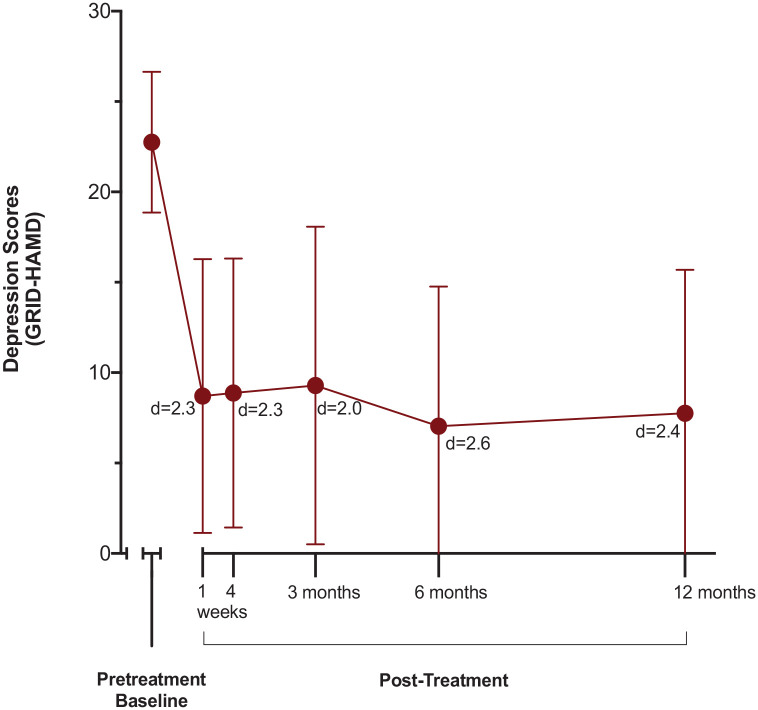
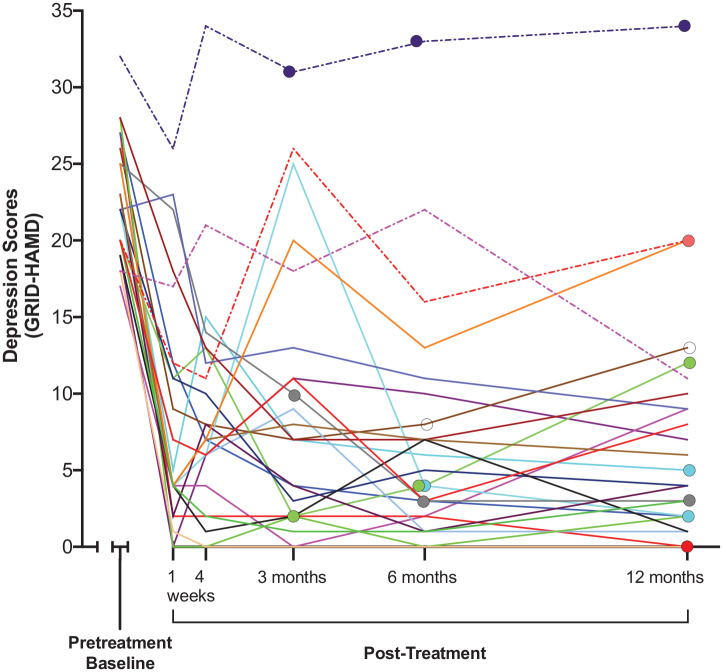
Background: Preliminary data suggest that psilocybin-assisted treatment produces substantial and rapid antidepressant effects in patients with major depressive disorder (MDD), but little is known about long-term outcomes. Aims: This study sought to examine the efficacy and safety of psilocybin through 12 months in participants with moderate to severe MDD who received psilocybin. Methods: This randomized, waiting-list controlled study enrolled 27 patients aged 21–75 with moderate to severe unipolar depression (GRID-Hamilton Depression Rating Scale (GRID-HAMD) ⩾ 17). Participants were randomized to an immediate or delayed (8 weeks) treatment condition in which they received two doses of psilocybin with supportive psychotherapy. Twenty-four participants completed both psilocybin sessions and were followed through 12 months following their second dose. Results: All 24 participants attended all follow-up visits through the 12-month timepoint. Large decreases from baseline in GRID-HAMD scores were observed at 1-, 3-, 6-, and 12-month follow-up (Cohen d = 2.3, 2.0, 2.6, and 2.4, respectively). Treatment response (⩾50% reduction in GRID-HAMD score from baseline) and remission were 75% and 58%, respectively, at 12 months. There were no serious adverse events judged to be related to psilocybin in the long-term follow-up period, and no participants reported psilocybin use outside of the context of the study. Participant ratings of personal meaning, spiritual experience, and mystical experience after sessions predicted increased well-being at 12 months, but did not predict improvement in depression. Conclusions: These findings demonstrate that the substantial antidepressant effects of psilocybin-assisted therapy may be durable at least through 12 months following acute intervention in some patients.
Overview
The claims and statistics of this paper haven’t been checked yet.
Free: it reads the open-access text and checks the first 5 claims that cite a source we can check. Create a free account to check every claim.
Integrity signals
Registry
Cites
Statistics
Figures
Verification
Claims the paper makes
The claims and statistics of this paper haven’t been checked yet.
Free: it reads the open-access text and checks the first 5 claims that cite a source we can check. Create a free account to check every claim.
Claims other papers make about this one
Each is checked against this paper’s own text: does it say what the citing paper says it does?
The source backs part of the claim, not all of it — or backs it for a different population, condition or comparison.
In the citing paper
“Psychedelics such as psilocybin and lysergic acid diethylamide (LSD) are also novel therapeutics for MDD that show promise in clinical trials [124-126].”
From Beyond the serotonin deficit hypothesis: Communicating a neuroplasticity framework of major depressive disorder (2024) · cites this paper as [124]
Experimental — accuracy not yet measuredThe source backs part of the claim, not all of it — or backs it for a different population, condition or comparison.
In the citing paper
“Weunderline that the available studies have a maximum follow-up duration of 12 months, 60”
From The revival of psilocybin between scientific excitement, evidence of efficacy, and real-world challenges (2024) · cites this paper as [60]
Experimental — accuracy not yet measuredThe source backs part of the claim, not all of it — or backs it for a different population, condition or comparison.
In the citing paper
“Blinding procedures were not consistently robust, 26,32,60,72-76 and comparison with placebo or standard treatments was lacking in many studies. 25,26,31-33,39,57,60,72,73,75-81”
From The revival of psilocybin between scientific excitement, evidence of efficacy, and real-world challenges (2024) · cites this paper as [60]
Experimental — accuracy not yet measuredThe cited source says what the claim attributes to it.
In the citing paper
“However, other studies have not found associations between symptom improvement and mystical-type experiences”
From Naturalistic psychedelic therapy: The role of relaxation and subjective drug effects in antidepressant response (2024) · cites this paper as Gukasyan et al., 2022
The cited source says what the claim attributes to it.
In the citing paper
“Only one RCT has a 12-month follow-up. 60”
From The revival of psilocybin between scientific excitement, evidence of efficacy, and real-world challenges (2024) · cites this paper as [60]
3 more claims about this paper
Create a free account to see every claim other papers make about this one.
Self-check
Percentages, sums and reported differences re-computed from the paper’s own numbers.
The self-check needs the paper’s full text.
Citations
Cites
James, S. L., Abate, D., Abate, K. H., Abay, S. M., Abbafati, C., Abbasi, N., Abbastabar, H., Abd-Allah, F., Abdela, J., Abdelalim, A., et al. (2018) · The Lancet · doi:10.1016/s0140-6736(18)32279-7 · Cited by 13,867
Self-citationJournal of Clinical Psychiatry
(2018) · Journal of Clinical Psychiatry · doi:10.5505/kpd · Cited by 13,651
Comparison of Beck Depression Inventories -IA and -II in psychiatric outpatients
Beck, A. T., Steer, R. A., Ball, R., & Ranieri, W. F. (1996) · Journal of Personality Assessment · doi:10.1207/s15327752jpa6703_13 · Cited by 5,965
Trivedi, M. H., Rush, A. J., Wisniewski, S. R., Nierenberg, A. A., Warden, D., Ritz, L., Norquist, G., Howland, R. H., Lebowitz, B., McGrath, P. J., et al. (2006) · American Journal of Psychiatry · doi:10.1176/appi.ajp.163.1.28 · Cited by 3,879 · cited 1×
“The majority of recent studies of long-term antidepressant efficacy drop non-responders from follow-up and focus on rate of relapse among those who respond to a particular drug, which is often a minority of the intention-totreat sample (McGrath et al., 2006; Trivedi et al., 2006).”
BackgroundRush, A. J., Trivedi, M. H., Ibrahim, H. M., Carmody, T. J., Arnow, B., Klein, D. N., Markowitz, J. C., Ninan, P. T., Kornstein, S., Manber, R., et al. (2003) · Biological Psychiatry · doi:10.1016/s0006-3223(02)01866-8 · Cited by 3,829 · cited 7×
“Notably, the remission rate and magnitude of the effect in the current study at both 6 and 12 months were substantially greater than those in a previous study at 6 months (QIDS, remission rate 67% and 67% vs 32%, Cohen d 2.2 and 2.3 vs 1.6, respectively) (Carhart-Harris et al., 2018).”
MethodInfluentialGriffiths, R. R., Johnson, M. W., Carducci, M. A., Umbricht, A., Richards, W. A., Richards, B. D., Cosimano, M. P., & Klinedinst, M. A. (2016) · Journal of Psychopharmacology · doi:10.1177/0269881116675513 · Cited by 2,201 · cited 2×
“…measures and subsequent positive effects in healthy and patient samples (Bogenschutz et al., 2015; Davis et al., 2020; Garcia-Romeu et al., 2014; Griffiths et al., 2008, 2016, 2018), the following measures were examined: the Mystical Experience Questionnaire (MEQ30) (Barrett et al., 2015) and…”
BackgroundMethodSelf-citationRoss, S., Bossis, A., Guss, J., Agin-Liebes, G., Malone, T., Cohen, B., Mennenga, S. E., Belser, A., Kalliontzi, K., Babb, J., et al. (2016) · Journal of Psychopharmacology · doi:10.1177/0269881116675512 · Cited by 1,698
Trial of Psilocybin versus Escitalopram for Depression
Carhart-Harris, R., Giribaldi, B., Watts, R., Baker-Jones, M., Murphy-Beiner, A., Murphy, R., Martell, J., Blemings, A., Erritzoe, D., & Nutt, D. J. (2021) · New England Journal of Medicine · doi:10.1056/nejmoa2032994 · Cited by 1,391 · cited 7×
“…enduring antidepressant effects of psilocybin 1 year after treatment significantly extend the previous results in this and two other trials that showed antidepressant effects through 4 weeks (Davis et al., 2021), 6 weeks (Carhart-Harris et al., 2021), and 6 months (Carhart-Harris et al., 2018).”
BackgroundResultInfluentialEffects of Psilocybin-Assisted Therapy on Major Depressive Disorder: A Randomized Clinical Trial
Davis, A. K., Barrett, F. S., May, D. G., Cosimano, M. P., Sepeda, N. D., Johnson, M. W., Finan, P. H., & Griffiths, R. R. (2021) · JAMA Psychiatry · doi:10.1001/jamapsychiatry.2020.3285 · Cited by 1,301 · cited 11×
“As described in more detail previously (Davis et al., 2021), 27 participants were randomized and 24 completed both psilocybin sessions, with 13 and 11 assigned to the immediate and delayed treatment groups, respectively.”
BackgroundMethodResultInfluentialSelf-citationHuman hallucinogen research: guidelines for safety
Johnson, M., Richards, W., & Griffiths, R. (2008) · Journal of Psychopharmacology · doi:10.1177/0269881108093587 · Cited by 1,203
Self-citationSeverity classification on the Hamilton depression rating scale
Zimmerman, M., Martinez, J. H., Young, D., Chelminski, I., & Dalrymple, K. (2013) · Journal of Affective Disorders · doi:10.1016/j.jad.2013.04.028 · Cited by 1,199 · cited 4×
“Descriptive statistics of follow-up measures were calculated, including treatment response (⩾50% reduction in depression scores from baseline) and remission (GRID-HAMD ⩽ 7, QIDS ⩽ 5, BDI-II ⩽ 9) for measures of depression (Beck et al., 1996; Rush et al., 2003; Zimmerman et al., 2013).”
BackgroundMethodInfluentialPsilocybin-assisted treatment for alcohol dependence: A proof-of-concept study
Bogenschutz, M. P., Forcehimes, A. A., Pommy, J. A., Wilcox, C. E., Barbosa, P., & Strassman, R. J. (2015) · Journal of Psychopharmacology · doi:10.1177/0269881114565144 · Cited by 1,151 · cited 1×
“Based on previous studies showing associations between acute psilocybin measures and subsequent positive effects in healthy and patient samples (Bogenschutz et al., 2015; Davis et al., 2020; Garcia-Romeu et al., 2014; Griffiths et al., 2008, 2016, 2018), the following measures were examined: the…”
BackgroundPsychotherapy for depression in adults: A meta-analysis of comparative outcome studies.
Cuijpers, P., van Straten, A., Andersson, G., & van Oppen, P. (2008) · Journal of Consulting and Clinical Psychology · doi:10.1037/a0013075 · Cited by 1,050 · cited 1×
“First-line treatments, including pharmacotherapy and psychotherapy, may take weeks or months to produce clinically meaningful symptom reduction, and patients can have difficulty with treatment adherence (Cuijpers et al., 2008; Kolovos et al., 2017; Lam, 2012).”
BackgroundPsilocybin with psychological support for treatment-resistant depression: six-month follow-up
Carhart-Harris, R. L., Bolstridge, M., Day, C. M. J., Rucker, J., Watts, R., Erritzoe, D. E., Kaelen, M., Giribaldi, B., Bloomfield, M., Pilling, S., et al. (2018) · Psychopharmacology · doi:10.1007/s00213-017-4771-x · Cited by 970 · cited 2×
“This latter observation contrasts with a previous study in which 5 of 19 participants reported use of psilocybin outside of the research setting by the end of the 6-month follow-up period (Carhart-Harris et al., 2018).”
BackgroundResultGriffiths, R., Richards, W., Johnson, M., McCann, U., & Jesse, R. (2008) · Journal of Psychopharmacology · doi:10.1177/0269881108094300 · Cited by 905
Self-citationMultiple recurrences of major depressive disorder
Solomon, D. A., Keller, M. B., Leon, A. C., Mueller, T. I., Lavori, P. W., Shea, M. T., Coryell, W., Warshaw, M., Turvey, C., Maser, J. D., et al. (2000) · American Journal of Psychiatry · doi:10.1176/appi.ajp.157.2.229 · Cited by 835 · cited 1×
“MDD also has a highly recurrent course, with 40–60% of those diagnosed with a single episode eventually relapsing, and rate of relapse increasing with each subsequent episode (Richards, 2011; Solomon et al., 2000).”
BackgroundMcIntyre, R. S., Rosenblat, J. D., Nemeroff, C. B., Sanacora, G., Murrough, J. W., Berk, M., Brietzke, E., Dodd, S., Gorwood, P., Ho, R., et al. (2021) · American Journal of Psychiatry · doi:10.1176/appi.ajp.2020.20081251 · Cited by 731 · cited 2×
“…treatment over ketamine in that antidepressant effects after just two administrations of psilocybin paired with psychological support appear to be sustained through 12 months, which is well beyond the duration of effects reported with ketamine (McIntyre et al., 2021; Salloum et al., 2020).”
BackgroundPsychedelics and Psychedelic-Assisted Psychotherapy
Reiff, C. M., Richman, E. E., Nemeroff, C. B., Carpenter, L. L., Widge, A. S., Rodriguez, C. I., Kalin, N. H., McDonald, W. M., & and the Work Group on Biomarkers and Novel Treatments, A. D. O. T. A. P. A. C. O. R. (2020) · American Journal of Psychiatry · doi:10.1176/appi.ajp.2019.19010035 · Cited by 649 · cited 2×
“, 2018), there remains concern for its potential to cause harm or encourage substance misuse in vulnerable populations (Reiff et al., 2020; Schatzberg, 2020).”
BackgroundValidation of the revised Mystical Experience Questionnaire in experimental sessions with psilocybin
Barrett, F. S., Johnson, M. W., & Griffiths, R. R. (2015) · Journal of Psychopharmacology · doi:10.1177/0269881115609019 · Cited by 637
Self-citationPrevalence and clinical course of depression: a review
Richards, D. (2011) · Clinical Psychology Review · doi:10.1016/j.cpr.2011.07.004 · Cited by 623
Griffiths, R. R., Johnson, M. W., Richards, W. A., Richards, B. D., Jesse, R., MacLean, K. A., Barrett, F. S., Cosimano, M. P., & Klinedinst, M. A. (2018) · Journal of Psychopharmacology · doi:10.1177/0269881117731279 · Cited by 520
Self-citationPsilocybin-Occasioned mystical experiences in the treatment of tobacco addiction.
Garcia-Romeu, A., Griffiths, R., & Johnson, M. (2015) · Current Drug Abuse Reviews · doi:10.2174/1874473708666150107121331 · Cited by 476
Self-citation(2007) · PubMed · Cited by 453
Columbia-Suicide Severity Rating Scale (C-SSRS)
Shahid, A., Wilkinson, K., Marcu, S., & Shapiro, C. M. (2011) · STOP, THAT and One Hundred Other Sleep Scales · doi:10.1007/978-1-4419-9893-4_24 · Cited by 384
Davis, A. K., Barrett, F. S., & Griffiths, R. R. (2020) · Journal of Contextual Behavioral Science · doi:10.1016/j.jcbs.2019.11.004 · Cited by 375 · cited 2×
“…showing associations between acute psilocybin measures and subsequent positive effects in healthy and patient samples (Bogenschutz et al., 2015; Davis et al., 2020; Garcia-Romeu et al., 2014; Griffiths et al., 2008, 2016, 2018), the following measures were examined: the Mystical Experience…”
BackgroundSelf-citationAgin-Liebes, G. I., Malone, T., Yalch, M. M., Mennenga, S. E., Ponté, K. L., Guss, J., Bossis, A. P., Grigsby, J., Fischer, S., & Ross, S. (2020) · Journal of Psychopharmacology · doi:10.1177/0269881119897615 · Cited by 360
Doss, M. K., Považan, M., Rosenberg, M. D., Sepeda, N. D., Davis, A. K., Finan, P. H., Smith, G. S., Pekar, J. J., Barker, P. B., Griffiths, R. R., et al. (2021) · Translational Psychiatry · doi:10.1038/s41398-021-01706-y · Cited by 356
Self-citationJohnson, M. W., Griffiths, R. R., Hendricks, P. S., & Henningfield, J. E. (2018) · Neuropharmacology · doi:10.1016/j.neuropharm.2018.05.012 · Cited by 354 · cited 1×
“Although evidence to date suggests that psilocybin has relatively low abuse potential (Johnson et al., 2018), there remains concern for its potential to cause harm or encourage substance misuse in vulnerable populations (Reiff et al., 2020; Schatzberg, 2020).”
BackgroundSelf-citationKetamine abuse potential and use disorder
Liu, Y., Lin, D., Wu, B., & Zhou, W. (2016) · Brain Research Bulletin · doi:10.1016/j.brainresbull.2016.05.016 · Cited by 256
Shalit, N., Rehm, J., & Lev-Ran, S. (2019) · Addictive Behaviors · doi:10.1016/j.addbeh.2018.09.020 · Cited by 129
Predictors of Relapse in a Prospective Study of Fluoxetine Treatment of Major Depression
McGrath, P. J., Stewart, J. W., Quitkin, F. M., Chen, Y., Alpert, J. E., Nierenberg, A. A., Fava, M., Cheng, J., & Petkova, E. (2006) · American Journal of Psychiatry · doi:10.1176/ajp.2006.163.9.1542 · Cited by 111
Potential Risks of Poorly Monitored Ketamine Use in Depression Treatment
Schak, K. M., Voort, J. L. V., Johnson, E. K., Kung, S., Leung, J. G., Rasmussen, K. G., Palmer, B. A., & Frye, M. A. (2016) · American Journal of Psychiatry · doi:10.1176/appi.ajp.2015.15081082 · Cited by 100
Onset, time course and trajectories of improvement with antidepressants
Lam, R. W. M. (2012) · European Neuropsychopharmacology · doi:10.1016/j.euroneuro.2012.07.005 · Cited by 92
The effect of treatment as usual on major depressive disorder: A meta-analysis
Kolovos, S., van Tulder, M. W., Cuijpers, P., Prigent, A., Chevreul, K., Riper, H., & Bosmans, J. E. (2017) · Journal of Affective Disorders · doi:10.1016/j.jad.2016.12.013 · Cited by 79 · cited 1×
“First-line treatments, including pharmacotherapy and psychotherapy, may take weeks or months to produce clinically meaningful symptom reduction, and patients can have difficulty with treatment adherence (Cuijpers et al., 2008; Kolovos et al., 2017; Lam, 2012).”
BackgroundThe persistence of the placebo response in antidepressant clinical trials
Khan, A., Redding, N., & Brown, W. A. (2007) · Journal of Psychiatric Research · doi:10.1016/j.jpsychires.2007.10.004 · Cited by 72
Kokane, S. S., Armant, R. J., Bolaños-Guzmán, C. A., & Perrotti, L. I. (2020) · Behavioural Brain Research · doi:10.1016/j.bbr.2020.112548 · Cited by 61
Carbonaro, T. M., Johnson, M. W., & Griffiths, R. R. (2020) · Psychopharmacology · doi:10.1007/s00213-020-05533-9 · Cited by 49
Self-citationSalloum, N. C., Fava, M., Hock, R. S., Freeman, M. P., Flynn, M., Hoeppner, B., Cusin, C., Iosifescu, D. V., Trivedi, M. H., Sanacora, G., et al. (2020) · Journal of Affective Disorders · doi:10.1016/j.jad.2019.09.017 · Cited by 34
Some Comments on Psychedelic Research
Schatzberg, A. F. (2020) · American Journal of Psychiatry · doi:10.1176/appi.ajp.2020.20030272 · Cited by 21
Research works printed but not linked: 1
- Depression Rating Scale Standardization Team, 2003, GRID-HAMD-17, GRID-HAMD-21 structured interview guide
Cited by
Single-Dose Psilocybin Treatment for Major Depressive Disorder: A Randomized Clinical Trial
Raison, C. L., Sanacora, G., Woolley, J., Heinzerling, K., Dunlop, B. W., Brown, R. T., Kakar, R., Hassman, M., Trivedi, R. P., Robison, R., et al. (2023) · JAMA · doi:10.1001/jama.2023.14530 · Cited by 545
Self-citationvon Rotz, R., Schindowski, E. M., Jungwirth, J., Schuldt, A., Rieser, N. M., Zahoranszky, K., Seifritz, E., Nowak, A., Nowak, P., Jäncke, L., et al. (2023) · eClinicalMedicine · doi:10.1016/j.eclinm.2022.101809 · Cited by 354
Must Psilocybin Always “Assist Psychotherapy”?
Goodwin, G. M., Malievskaia, E., Fonzo, G. A., & Nemeroff, C. B. (2024) · American Journal of Psychiatry · doi:10.1176/appi.ajp.20221043 · Cited by 189
Yao, Y., Guo, D., Lu, T., Liu, F.-L., Huang, S., Diao, M.-Q., Li, S., Zhang, X.-J., Kosten, T. R., Shi, J., et al. (2024) · Psychiatry Research · doi:10.1016/j.psychres.2024.115886 · Cited by 174
Sloshower, J., Skosnik, P. D., Safi-Aghdam, H., Pathania, S., Syed, S., Pittman, B., & D’Souza, D. C. (2023) · Journal of Psychopharmacology · doi:10.1177/02698811231154852 · Cited by 165
Metadata
- Authors
- Gukasyan, N., Davis, A. K., Barrett, F. S., Cosimano, M. P., Sepeda, N. D., Johnson, M. W., & Griffiths, R. R.
- Affiliations
- Johns Hopkins University (US)
- Corresponding author
- Gukasyan, Natalie
- Griffiths, Roland R
- ORCID
- Venue
- Journal of Psychopharmacology
- Publisher
- SAGE Publications
- Published
- 2022-02
- Volume
- 36
- Issue
- 2
- Pages
- 151-158
- ISSN
- 0269-8811 (ISSN-L)
- 1461-7285
- PMC
- PMC8864328
- OpenAlex
- W4212903385
- Semantic Scholar
- f5e4b6267d3f36d639128dcedd4ccc1f543555ef
- Cited by
- 425
- References
- 39
- Citations by year
- 2026: 61 · 2025: 88 · 2024: 136 · 2023: 106 · 2022: 33
- FWCI
- 82.76
- Type
- journal article
- Language
- en
- Open access
- hybrid
- doi.org
- Licence
- Locations
- Journal of Psychopharmacology (publishedVersion, cc-by-nc)
- PubMed Central (publishedVersion, cc-by-nc)
- PubMed (publishedVersion)
- Funders
- National Institute on Drug Abuse (T32DA07209)
- Crowdfunding campaign organized by Tim Ferriss
- Philanthropic support from the Steven and Alexandra Cohen Foundation, Tim Ferriss, Matt Mullenweg, Craig Nerenberg, and Blake Mycoskie
- Dave Morin
- Riverstyx Foundation
- Topics
- Social Sciences › Psychology › Clinical Psychology › Psychedelics and Drug Studies
- Health Sciences › Medicine › Pharmacology (medical) › Treatment of Major Depression
- Social Sciences › Psychology › Clinical Psychology › Psychotherapy Techniques and Applications
- Keywords
- psilocybin, psilocybin-assisted therapy, major depressive disorder, antidepressant efficacy, long-term follow-up, remission, supportive therapy, adverse events, mystical experience, spiritual experience, personal meaning, well-being
- MeSH terms
- Adult, Aged, Antidepressive Agents, Combined Modality Therapy, Major Depressive Disorder, Female, Follow-Up Studies, Hallucinogens, Humans, Male, Middle Aged, Prospective Studies, Psilocybin, Psychiatric Status Rating Scales, Psychotherapy, Time Factors, Treatment Outcome, Young Adult
About these checks
Registry, retraction, Cites and statistics results are computed, not judged, with one exception: a printed reference that no index lists is read once by a model before it counts as a citation error. Claims are extracted by a model and kept only when their quote appears verbatim in the text; each cited source is then checked, with a model’s help, for whether it says what the claim relies on. Those verdicts can be wrong — read the claim’s quote and the cited source before relying on one.
Statistics and arithmetic are recomputed, not judged.
Confidence bands are shown only for fields calibrated on our annotated test set. None is calibrated yet, so no band is shown.
What counts as a claim ›How we measure confidence ›How we check this ›
Are you an author, or do you see a problem with this page? Request a review
Data sources
Bibliographic data: Semantic Scholar, OpenAlex, Crossref.
Contains information from the Semantic Scholar Academic Graph Datasets, made available under the ODC Attribution License (ODC-BY 1.0).
Semantic Scholar’s data is described in: Kinney, R., et al. (2023). The Semantic Scholar Open Data Platform. arXiv:2301.10140.
