

The DOI matches its Crossref record; 18 of the 24 references it cites were found in a registry or an index.
Older People’s Use of Digital Technology During the COVID-19 Pandemic
Open accessAbstract
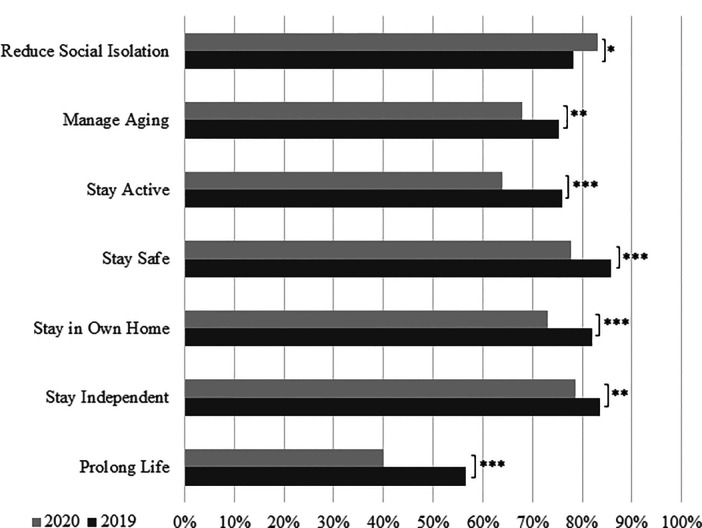
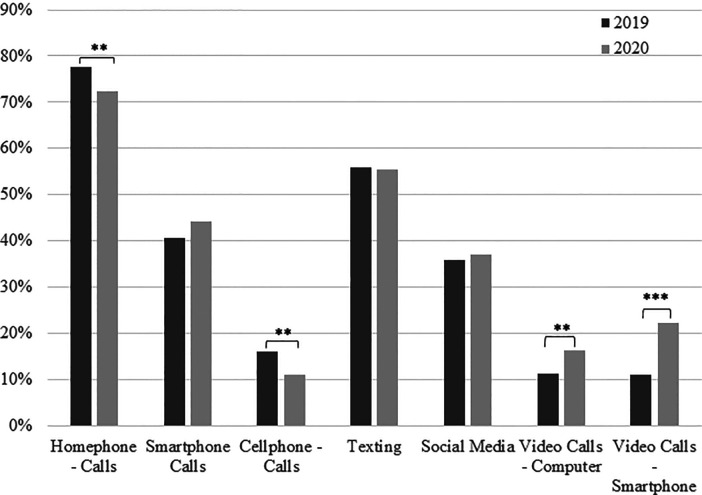
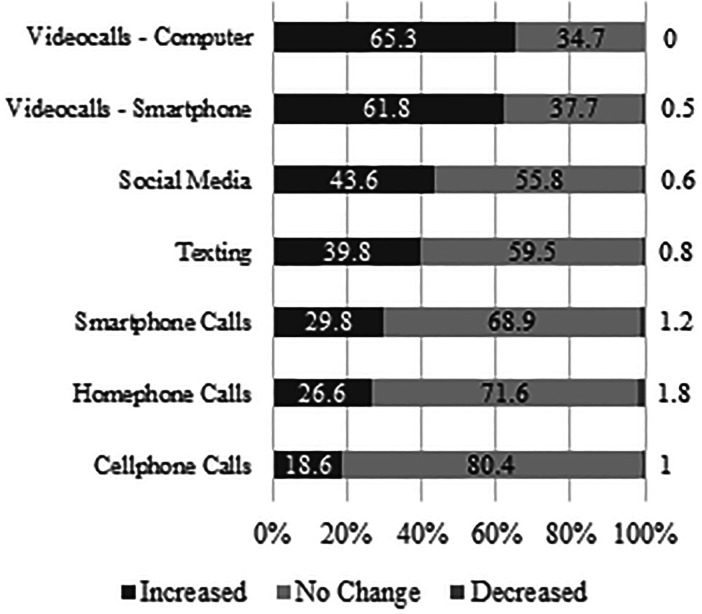
Objectives: The COVID-19 pandemic is having a major impact on the lives of everyone, but in particular on the health and well-being of older people. It has also disrupted the way that individuals access services and interact with one another, and physical distancing and “Stay at Home” orders have seen digital interaction become a necessity. While these restrictions have highlighted the importance of technology in everyday life, little is known about how older adults have responded to this change. Methods: Two surveys, one in 2019 and another in 2020 collected data on a combined total of 1923 older adults aged 65 years and older in Canada. These looked at how older adults think about and use technology, with the 2020 survey additionally questioning how COVID-19 has impacted their use and attitudes towards technology. Results: While older adults feel more isolated in 2020, many feel positive about the benefits of technology and have increased technology use during the pandemic to support their health, wellness, and communication needs. Discussion: The results highlight the potential of technology for supporting older adults in various aspects of healthy aging. While these results point to the opportunities afforded by technology, challenges remain, such as how social and economic factors influence technology uptake.
Overview
The claims and statistics of this paper haven’t been checked yet.
Run the check — free, no account needed. It reads the open-access text and checks the sources it cites.
Integrity signals
Registry
Cites
Statistics
Figures
Verification
Claims the paper makes
The claims and statistics of this paper haven’t been checked yet.
Run the check — free, no account needed. It reads the open-access text and checks the sources it cites.
Claims other papers make about this one
Each is checked against this paper’s own text: does it say what the citing paper says it does?
The source backs part of the claim, not all of it — or backs it for a different population, condition or comparison.
In the citing paper
“More recent studies, particularly those conducted during or after the COVID-19 pandemic, were shaped by accelerated digital adoption, heightened reliance on remote communication, and growing familiarity with AI-driven devices [40].”
From Smart Speakers for Health and Well-Being of Older Adults: A Mixed-Methods Review (2025) · cites this paper as [40]
Experimental — accuracy not yet measured
Self-check
Percentages, sums and reported differences re-computed from the paper’s own numbers.
The self-check needs the paper’s full text.
Citations
Cites
Older Adults' Reasons for Using Technology while Aging in Place
Peek, S. T. M., Luijkx, K. G., Rijnaard, M. D., Nieboer, M. E., van der Voort, C. S., Aarts, S., van Hoof, J., Vrijhoef, H. J., & Wouters, E. (2015) · Gerontology · doi:10.1159/000430949 · Cited by 19,852
Czaja, S. J., Charness, N., Fisk, A. D., Hertzog, C., Nair, S. N., Rogers, W. A., & Sharit, J. (2006) · Psychology and Aging · doi:10.1037/0882-7974.21.2.333 · Cited by 2,113 · cited 1×
“However, these trends may not be equal across different demographic groups, especially older adults who may have additional barriers in using technology (Czaja et al., 2006; Gitlow, 2014).”
BackgroundSocial Isolation, Loneliness and Health Among Older Adults
Coyle, C. E., & Dugan, E. (2012) · Journal of Aging and Health · doi:10.1177/0898264312460275 · Cited by 875 · cited 1×
“For example, more older adults in 2020 agreed that technology can be used to help combat social isolation, which is known to lead to stress, depression, and poor health outcomes (Coyle & Dugan, 2012).”
BackgroundA review of Internet use among older adults
Hunsaker, A., & Hargittai, E. (2018) · New Media & Society · doi:10.1177/1461444818787348 · Cited by 770 · cited 1×
“Yet, historically older adults have been less likely to use technology for everyday services and communication than younger cohorts, due to factors such as digital literacy and access to the internet (Anderson et al., 2021; Hunsaker & Hargittai, 2018).”
BackgroundExploring Privilege in the Digital Divide: Implications for Theory, Policy, and Practice
Fang, M. L., Canham, S. L., Battersby, L., Sixsmith, J., Wada, M., & Sixsmith, A. (2019) · The Gerontologist · doi:10.1093/geront/gny037 · Cited by 353
Self-citationPerceptions of Technology among Older Adults
Heinz, M., Martin, P., Margrett, J. A., Yearns, M., Franke, W., Yang, H.-I., Wong, J., & Chang, C. K. (2013) · Journal of Gerontological Nursing · doi:10.3928/00989134-20121204-04 · Cited by 300 · cited 1×
“Older adults are often reported as being resistant to adopting new technologies unless the feelings of usefulness and usability of the technology are greater than feelings of inadequacy (Heinz et al., 2013).”
BackgroundSzabo, A., Allen, J., Stephens, C., & Alpass, F. (2019) · The Gerontologist · doi:10.1093/geront/gny036 · Cited by 291 · cited 1×
“…positively contributes to older adults ’ subjective well-being and healthy aging (Nimrod, 2019; 1 Simon Fraser University, Department of Gerontology 2 Western University, Department of Neuroscience 3 AGE-WELL NCE 4 University of Toronto, AGE-WELL NCE Ollevier et al., 2020; Szabo et al., 2019).”
BackgroundRethinking social relationships in old age: Digitalization and the social lives of older adults
Hülür, G., & Macdonald, B. (2020) · American Psychologist · doi:10.1037/amp0000604 · Cited by 200 · cited 1×
“…use as the younger cohort under pandemic restrictions, despite being an age group that typically reports slower uptake and less use of technology in general (Anderson & Perrin, 2017; Davidson & Schimmele, 2019; Hülür & Macdonald, 2020; Mariano et al., 2021; Siren & Grønborg Knudsen, 2017).”
BackgroundToo old for technology? Stereotype threat and technology use by older adults
Mariano, J., Marques, S., Ramos, M. R., Gerardo, F., da Cunha, C. L., Girenko, A., Alexandersson, J., Stree, B., Lamanna, M., Lorenzatto, M., et al. (2021) · Behaviour and Information Technology · doi:10.1080/0144929x.2021.1882577 · Cited by 196
Technology Use by Older Adults and Barriers to Using Technology
Gitlow, L. (2014) · Physical & Occupational Therapy In Geriatrics · doi:10.3109/02703181.2014.946640 · Cited by 178 · cited 1×
“However, these trends may not be equal across different demographic groups, especially older adults who may have additional barriers in using technology (Czaja et al., 2006; Gitlow, 2014).”
BackgroundHow can technology support ageing in place in healthy older adults? A systematic review
Ollevier, A., Noury, G. A., Palomino, M. A., & Simpelaere, I. S. (2020) · Public health reviews · doi:10.1186/s40985-020-00143-4 · Cited by 156
Ageing together: Steps towards evolutionary co-design in everyday practices
Botero, A., & Hyysalo, S. (2013) · CoDesign · doi:10.1080/15710882.2012.760608 · Cited by 152 · cited 2×
“Re fi ning and using co-design principles on existing technologies that older adults are using during the pandemic could lead to higher levels of engagement and uptake of other older adults to support their wellness and independence (Botero and Hyysalo, 2013; Wherton et al., 2015).”
BackgroundWherton, J. P., Sugarhood, P., Procter, R., Hinder, S., & Greenhalgh, T. (2015) · Implementation Science · doi:10.1186/s13012-015-0271-8 · Cited by 145 · cited 2×
“Re fi ning and using co-design principles on existing technologies that older adults are using during the pandemic could lead to higher levels of engagement and uptake of other older adults to support their wellness and independence (Botero and Hyysalo, 2013; Wherton et al., 2015).”
BackgroundAging Well in the Digital Age: Technology in Processes of Selective Optimization with Compensation
Nimrod, G. (2019) · The Journals of Gerontology Series B · doi:10.1093/geronb/gbz111 · Cited by 129 · cited 1×
“…use of various information and communication technologies positively contributes to older adults ’ subjective well-being and healthy aging (Nimrod, 2019; 1 Simon Fraser University, Department of Gerontology 2 Western University, Department of Neuroscience 3 AGE-WELL NCE 4 University of…”
BackgroundSiren, A., & Knudsen, S. G. (2017) · Journal of Aging & Social Policy · doi:10.1080/08959420.2016.1187036 · Cited by 91 · cited 1×
“…use as the younger cohort under pandemic restrictions, despite being an age group that typically reports slower uptake and less use of technology in general (Anderson & Perrin, 2017; Davidson & Schimmele, 2019; Hülür & Macdonald, 2020; Mariano et al., 2021; Siren & Grønborg Knudsen, 2017).”
BackgroundTechnology and Aging: An Evolving Partnership.
Pruchno, R. (2019) · The gerontologist · doi:10.1093/geront/gny153 · Cited by 85
Bulletin of SCIENCE, TECHNOLOGY & SOCIETY
Deitrich, R. (1998) · doi:10.1177/027046769801800448 · Cited by 11
Mariano, J. (2021) · Research Publications (Maastricht University) · doi:10.26481/dis.20211102jm · Cited by 1
Research works printed but not linked: 2
- Ollevier A., 2020, Public Health Reviews, 41
- Wherton J., 2015, Implementation Science, 10
Cited by
Sorted by citations
Sarcopenic obesity in older adults: a clinical overview
Prado, C. M., Batsis, J. A., Donini, L. M., Gonzalez, M. C., & Siervo, M. (2024) · Nature Reviews Endocrinology · doi:10.1038/s41574-023-00943-z · Cited by 355
“Specifically, digital technology has a crucial role in facilitating the delivery of nutritional and exercise interventions that are well accepted among older adults 134,135 .”
Finkelstein, R., Wu, Y., & Brennan‐Ing, M. (2023) · Frontiers in Psychology · doi:10.3389/fpsyg.2023.1129512 · Cited by 73
“These findings are consistent with several studies, suggesting strongly that the belief that most older adults lack the ability and desire to learn ICTs is simply not accurate (Vaportzis et al., 2017; Sixsmith et al., 2022).”
BackgroundResultThe effectiveness of community-based palliative care programme components: a systematic review
Hughes, M., Vernon, E., & Hainstock, A. (2023) · Age and Ageing · doi:10.1093/ageing/afad175 · Cited by 51
“While there has been increasing reliance on telehealth for health care services during the COVID-19 pandemic [76] and greater acceptance of technology among older adults [77], few studies on telehealth are included here.”
BackgroundBalki, E., Holland, C., & Hayes, N. (2023) · Journal of Medical Internet Research · doi:10.2196/41535 · Cited by 57
“Indeed, technology use is associated with perceived social capital [20] and may have helped older adults with restricted social mobility to connect more efficiently with their social contacts [21].”
Bavli, I., Ho, A., Mahal, R., & McKeown, M. J. (2024) · AI & Society · doi:10.1007/s00146-023-01843-6 · Cited by 47
“…tends to view technological monitoring positively, possibly due to their concerns about frailty and potential health decline (Bian et al. 2021; Sixsmith et al. 2022), and participants may have been self-selective due to their interest in these technologies, which might explain their focus…”
Metadata
- Authors
- Sixsmith, A., Horst, B. R., Simeonov, D., & Mihailidis, A.
- Affiliations
- Simon Fraser University (CA)
- Western University (CA)
- AGE-WELL (CA)
- University of Toronto (CA)
- Corresponding author
- Sixsmith, Andrew
- Venue
- Bulletin of Science, Technology & Society
- Publisher
- SAGE Publications
- Published
- 2022-04-21
- Volume
- 42
- Issue
- 1-2
- Pages
- 19-24
- ISSN
- 0270-4676 (ISSN-L)
- 1552-4183
- PMC
- PMC9038938
- OpenAlex
- W4224228754
- Cited by
- 205
- References
- 24
- Citations by year
- 2026: 33 · 2025: 59 · 2024: 65 · 2023: 40 · 2022: 8
- FWCI
- 71.75
- Type
- journal article
- Language
- en
- Open access
- hybrid
- doi.org
- Locations
- Bulletin of Science Technology & Society (publishedVersion, cc-by)
- PubMed Central (publishedVersion, cc-by)
- PubMed (publishedVersion)
- Topics
- Health Sciences › Medicine › Geriatrics and Gerontology › Technology Use by Older Adults
- Social Sciences › Life-span and Life-course Studies › Aging, Elder Care, and Social Issues
- Social Sciences › Psychology › Developmental and Educational Psychology › Aging and Gerontology Research
- Keywords
- older adults, digital technology use, COVID-19 pandemic, technology adoption, social isolation, healthy aging, telemedicine, social communication, stay-at-home orders, social distancing, attitudes toward technology, socioeconomic factors
About these checks
Registry, retraction, Cites and statistics results are computed, not judged, with one exception: a printed reference that no index lists is read once by a model before it counts as a citation error. Claims are extracted by a model and kept only when their quote appears verbatim in the text; each cited source is then checked, with a model’s help, for whether it says what the claim relies on. Those verdicts can be wrong — read the claim’s quote and the cited source before relying on one.
Statistics and arithmetic are recomputed, not judged.
Confidence bands are shown only for fields calibrated on our annotated test set. None is calibrated yet, so no band is shown.
What counts as a claim ›How we measure confidence ›How we check this ›
Are you an author, or do you see a problem with this page? Request a review
