

Aberrant functional connectivity density in patients with treatment-refractory obsessive-compulsive disorder: a pilot study
Open accessThe DOI matches its Crossref record; 54 of the 54 references it cites were found in a registry or an index.
Abstract
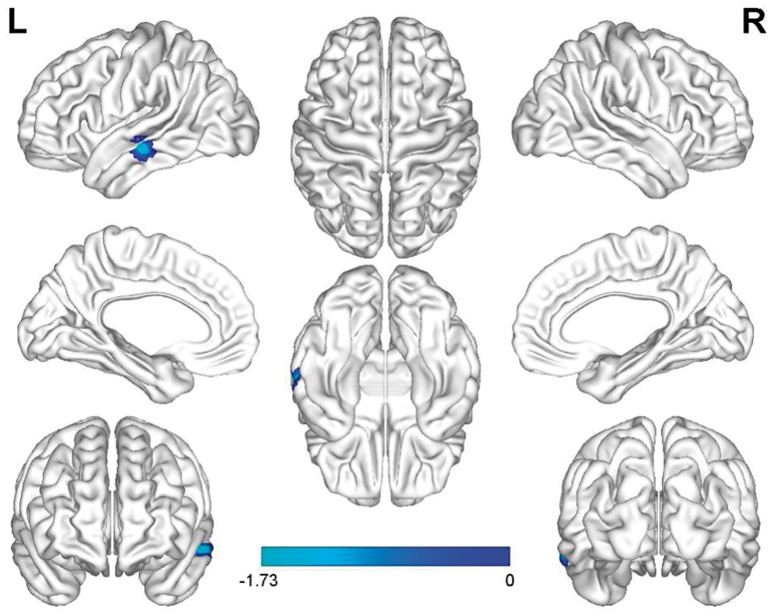
Objective: Functional connectivity (FC) is altered in patients with obsessive-compulsive disorder (OCD). Most previous studies have focused on the strength of FC in patients with OCD; few have examined the number of functional connections in these patients. The number of functional connections is an important index for assessing aberrant FC. In the present study, we used FC density (FCD) mapping to explore alterations in the number of functional connections in patients with treatment-refractory OCD (TROCD) using the FCD index. Methods: Twenty patients with TROCD and 20 patients with OCD in clinical remission were enrolled in the study. Global FCD (gFCD) was adopted to compare the differences between the two groups of patients. Results: The gFCD in the left middle temporal gyrus was lower in the patients with TROCD than in those with remitted OCD, suggesting that decreased information processing ability may play a significant role in TROCD. Conclusion: The left middle temporal gyrus is a key component of the emotional processing circuit and attentional processing circuit. Decreased information processing ability in this brain region may play a significant role in TROCD; however, further well-designed follow-up studies are needed to support this hypothesis.
Overview
The claims and statistics of this paper haven’t been checked yet.
Free: it reads the open-access text and checks the first 5 claims that cite a source we can check. Create a free account to check every claim.
Integrity signals
Registry
Cites
Statistics
Figures
Verification
Claims the paper makes
The claims and statistics of this paper haven’t been checked yet.
Free: it reads the open-access text and checks the first 5 claims that cite a source we can check. Create a free account to check every claim.
Claims other papers make about this one
Each is checked against this paper’s own text: does it say what the citing paper says it does?
The cited source says what the claim attributes to it.
In the citing paper
“Resistant patients were found to have fewer functional connections in the left middle temporal gyrus than responders, with no significant relationship between this connection density and symptom severity.”
From Error-Related Brain Potentials as Biomarkers of Pathology Severity and Treatment Resistance in Patients With Obsessive-Compulsive Disorder (2026) · cites this paper as [44]
The cited source says what the claim attributes to it.
In the citing paper
“Shan et al. [44] compared the functional brain connectivity of 20 treatment‐resistant OCD patients and 20 responders.”
From Error-Related Brain Potentials as Biomarkers of Pathology Severity and Treatment Resistance in Patients With Obsessive-Compulsive Disorder (2026) · cites this paper as [44]
The cited source says what the claim attributes to it.
In the citing paper
“These potentials may be related to the activation of neurons in the left middle temporal gyrus (at electrodes T7 and TP7), where functional imaging has shown an association between brain activity and treatment resistance in OCD patients [44, 45].”
From Error-Related Brain Potentials as Biomarkers of Pathology Severity and Treatment Resistance in Patients With Obsessive-Compulsive Disorder (2026) · cites this paper as [44]
Self-check
Percentages, sums and reported differences re-computed from the paper’s own numbers.
The self-check needs the paper’s full text.
Citations
Cites
The Yale-Brown Obsessive Compulsive Scale: I. Development, Use, and Reliability
Goodman, W. K. (1989) · Archives of General Psychiatry · doi:10.1001/archpsyc.1989.01810110048007 · Cited by 7,712
Power, J. D., Barnes, K. A., Snyder, A. Z., Schlaggar, B. L., & Petersen, S. E. (2012) · NeuroImage · doi:10.1016/j.neuroimage.2011.10.018 · Cited by 7,429 · cited 1×
“A recent study showed that the signal spike induced by head motion significantly contaminates the final resting-state fMRI results even after regression of the linear motion parameters.(34) We regressed spike volumes when the frame-wise displacement of the specific volume exceeded 0.”
BackgroundThree-Year Outcomes in Deep Brain Stimulation for Highly Resistant Obsessive–Compulsive Disorder
Greenberg, B. D., Malone, D. A., Friehs, G. M., Rezai, A. R., Kubu, C. S., Malloy, P. F., Salloway, S. P., Okun, M. S., Goodman, W. K., & Rasmussen, S. A. (2006) · Neuropsychopharmacology · doi:10.1038/sj.npp.1301165 · Cited by 829
Association between Functional Connectivity Hubs and Brain Networks
Tomasi, D., & Volkow, N. D. (2011) · Cerebral Cortex · doi:10.1093/cercor/bhq268 · Cited by 439
Davey, J., Thompson, H. E., Hallam, G., Karapanagiotidis, T., Murphy, C., De Caso, I., Krieger-Redwood, K., Bernhardt, B. C., Smallwood, J., & Jefferies, E. (2016) · NeuroImage · doi:10.1016/j.neuroimage.2016.05.051 · Cited by 433
Functional connectivity hubs in the human brain
Tomasi, D., & Volkow, N. D. (2011) · NeuroImage · doi:10.1016/j.neuroimage.2011.05.024 · Cited by 367 · cited 4×
“Each voxel’s resting-state FCD (rsFCD) was calculated using an in-house script that was written in the Linux platform according to the method described by Tomasi and Volkow.(21,22) We adopted Pearson’s linear correlation method to evaluate the strength of the FC between voxels.”
MethodInfluentialOrbital frontal and amygdala volume reductions in obsessive-compulsive disorder
Szeszko, P. R., Robinson, D., Alvir, J. M. J., Bilder, R. M., Lencz, T., Ashtari, M., Wu, H., & Bogerts, B. (1999) · Archives of General Psychiatry · doi:10.1001/archpsyc.56.10.913 · Cited by 346
Resting functional connectivity of language networks: characterization and reproducibility
Tomasi, D., & Volkow, N. D. (2012) · Molecular Psychiatry · doi:10.1038/mp.2011.177 · Cited by 269
Gürsel, D. A., Avram, M., Sorg, C., Brandl, F., & Koch, K. (2018) · Neuroscience & Biobehavioral Reviews · doi:10.1016/j.neubiorev.2018.01.016 · Cited by 231
Posner, J., Marsh, R., Maia, T. V., Peterson, B. S., Gruber, A., & Simpson, H. B. (2014) · Human Brain Mapping · doi:10.1002/hbm.22371 · Cited by 197 · cited 1×
“Several previous studies that focused on FCS reported decreased FC in patients with OCD and even in their close relatives.(35,36) The left middle temporal gyrus is a key component of the emotional, cognitive, and memory processing circuits and plays a key role in the limbic system.”
Multilayer motif analysis of brain networks
Battiston, F., Nicosia, V., Chavez, M., & Latora, V. (2017) · Chaos: An Interdisciplinary Journal of Nonlinear Science · doi:10.1063/1.4979282 · Cited by 189
Corticostriatal functional connectivity in non-medicated patients with obsessive-compulsive disorder
Sakai, Y., Narumoto, J., Nishida, S., Nakamae, T., Yamada, K., Nishimura, T., & Fukui, K. (2011) · European Psychiatry · doi:10.1016/j.eurpsy.2010.09.005 · Cited by 173
(1996) · The Journal of Neuropsychiatry and Clinical Neurosciences · doi:10.1176/jnp.8.2.125 · Cited by 172
Hou, J.-M., Zhao, M., Zhang, W., Song, L.-H., Wu, W.-J., Wang, J., Zhou, D.-Q., Xie, B., He, M., Guo, J.-W., et al. (2014) · Journal of Psychiatry and Neuroscience · doi:10.1503/jpn.130220 · Cited by 163
Welter, M.-L., Burbaud, P., Fernandez-Vidal, S., Bardinet, E., Coste, J., Piallat, B., Borg, M., Besnard, S., Sauleau, P., Devaux, B., et al. (2011) · Translational Psychiatry · doi:10.1038/tp.2011.5 · Cited by 160
Dunlop, K., Woodside, B., Olmsted, M., Colton, P., Giacobbe, P., & Downar, J. (2016) · Neuropsychopharmacology · doi:10.1038/npp.2015.292 · Cited by 147 · cited 2×
“For example, Dunlop et al.9 reported that the treatment efficacy of repetitive transcranial magnetic stimulation to the dorsomedial prefrontal cortex in patients with OCD was correlated with FC reductions between the dorsomedial prefrontal cortex and the ventral striatum.”
BackgroundLopes, A. C., Greenberg, B. D., Norén, G., Canteras, M. M., Busatto, G. F., de Mathis, M. E., Taub, A., D’Alcante, C. C., Hoexter, M. Q., Gouvea, F. S., et al. (2009) · The Journal of Neuropsychiatry and Clinical Neurosciences · doi:10.1176/jnp.2009.21.4.381 · Cited by 139
Sheth, S. A., Neal, J., Tangherlini, F., Mian, M. K., Gentil, A., Cosgrove, G. R., Eskandar, E. N., & Dougherty, D. D. (2013) · Journal of Neurosurgery · doi:10.3171/2012.11.jns12389 · Cited by 136
Disrupted Resting-State Functional Connectivity in Nonmedicated Bipolar Disorder
Wang, Y., Zhong, S., Jia, Y., Sun, Y., Wang, B., Liu, T., Pan, J., & Huang, L. (2016) · Radiology · doi:10.1148/radiol.2016151641 · Cited by 126
Kojori, E. S., Tomasi, D. G., Wiers, C. E., Wang, G.-J., & Volkow, N. D. (2016) · Molecular Psychiatry · doi:10.1038/mp.2016.25 · Cited by 123
Zhao, Y., Chen, L., Zhang, W., Xiao, Y., Shah, C., Zhu, H., Yuan, M., Sun, H., Yue, Q., Jia, Z., et al. (2017) · EBioMedicine · doi:10.1016/j.ebiom.2017.06.013 · Cited by 108
Functional Connectivity Density in Congenitally and Late Blind Subjects
Qin, W., Xuan, Y., Liu, Y., Jiang, T., & Yu, C. (2015) · Cerebral Cortex · doi:10.1093/cercor/bhu051 · Cited by 104
Fan, J., Zhong, M., Gan, J., Liu, W., Niu, C., Liao, H., Zhang, H., Yi, J., Chan, R. C. K., Tan, C., et al. (2017) · Journal of Affective Disorders · doi:10.1016/j.jad.2017.07.041 · Cited by 94
Self-citationTang, W., Zhu, Q., Gong, X., Zhu, C., Wang, Y., & Chen, S. (2016) · Behavioural Brain Research · doi:10.1016/j.bbr.2016.07.004 · Cited by 90 · cited 1×
“Moreover, a recent study showed that the GMVs of the cerebellar anterior lobe, left orbital frontal gyrus, right middle frontal gyrus, left middle temporal gyrus, precentral gyrus, and postcentral gyrus were increased after 12 weeks of treatment with sertraline.(45) The abovementioned studies suggest that structural a…”
ResultFunctional connectivity density alterations in schizophrenia
Zhuo, C., Zhu, J., Qin, W., Qu, H., Ma, X., Tian, H., Xu, Q., & Yu, C. (2014) · Frontiers in Behavioral Neuroscience · doi:10.3389/fnbeh.2014.00404 · Cited by 89
Self-citationVolpato, C., Piccione, F., Cavinato, M., Duzzi, D., Schiff, S., Foscolo, L., & Venneri, A. (2013) · Neurocase · doi:10.1080/13554794.2012.667131 · Cited by 84
Fan, J., Zhong, M., Gan, J., Liu, W., Niu, C., Liao, H., Zhang, H., Tan, C., Yi, J., & Zhu, X. (2017) · Journal of Affective Disorders · doi:10.1016/j.jad.2016.08.027 · Cited by 82 · cited 2×
“Fan et al.(55) reported that reduced spontaneous neural activity in the left middle temporal gyrus is associated with a level of insight Figure 1.”
BackgroundSelf-citationVoon, V., Droux, F., Morris, L., Chabardes, S., Bougerol, T., David, O., Krack, P., & Polosan, M. (2017) · Brain · doi:10.1093/brain/aww309 · Cited by 80
Göttlich, M., Krämer, U. M., Kordon, A., Hohagen, F., & Zurowski, B. (2015) · Biological Psychology · doi:10.1016/j.biopsycho.2015.09.004 · Cited by 73
A Neural Marker of Obsessive-Compulsive Disorder from Whole-Brain Functional Connectivity
Takagi, Y., Sakai, Y., Lisi, G., Yahata, N., Abe, Y., Nishida, S., Nakamae, T., Morimoto, J., Kawato, M., Narumoto, J., et al. (2017) · Scientific Reports · doi:10.1038/s41598-017-07792-7 · Cited by 71
Zou, K., Gao, Q. C., Long, Z., Xu, F., Sun, X. M., Chen, H., & Sun, X. (2016) · Journal of Affective Disorders · doi:10.1016/j.jad.2015.12.081 · Cited by 67
Self-citationDefault network connectivity as a vulnerability marker for obsessive compulsive disorder
Peng, Z. W., Xu, T., He, Q. H., Shi, C. Z., Wei, Z., Miao, G. D., Jing, J., Lim, K. O., Zuo, X. N., & Chan, R. C. K. (2014) · Psychological Medicine · doi:10.1017/s0033291713002250 · Cited by 63
Tian, L., Meng, C., Jiang, Y., Tang, Q., Wang, S., Xie, X., Fu, X., Jin, C., Zhang, F., & Wang, J. (2016) · Progress in Neuro-Psychopharmacology and Biological Psychiatry · doi:10.1016/j.pnpbp.2015.12.003 · Cited by 63
Arbitration between action strategies in obsessive-compulsive disorder
Gruner, P., Anticevic, A., Lee, D., & Pittenger, C. (2016) · The Neuroscientist · doi:10.1177/1073858414568317 · Cited by 62 · cited 1×
“Overall, these findings have provided a basic understanding of the pathological characteristics of OCD.(13) Gürsel et al.”
BackgroundAbe, Y., Sakai, Y., Nishida, S., Nakamae, T., Yamada, K., Fukui, K., & Narumoto, J. (2015) · European Neuropsychopharmacology · doi:10.1016/j.euroneuro.2015.08.017 · Cited by 56
Fan, J., Zhong, M., Zhu, X., Gan, J., Liu, W., Niu, C., Liao, H., Zhang, H., Yi, J., & Tan, C. (2017) · NeuroImage: Clinical · doi:10.1016/j.nicl.2017.04.002 · Cited by 56
Self-citationZhuo, C., Zhu, J., Wang, C., Qu, H., Ma, X., & Qin, W. (2016) · Brain Imaging and Behavior · doi:10.1007/s11682-016-9645-z · Cited by 54
Self-citationBrain structural and functional dissociated patterns in schizophrenia
Zhuo, C., Zhu, J., Wang, C., Qu, H., Ma, X., Tian, H., Liu, M., & Qin, W. (2017) · BMC Psychiatry · doi:10.1186/s12888-017-1194-5 · Cited by 51
Self-citationKnowledge Acquisition during Exam Preparation Improves Memory and Modulates Memory Formation
Brod, G., Lindenberger, U., Wagner, A. D., & Shing, Y. L. (2016) · Journal of Neuroscience · doi:10.1523/jneurosci.0045-16.2016 · Cited by 47
Feusner, J. D., Moody, T., Lai, T. M., Sheen, C., Khalsa, S., Brown, J., Levitt, J., Alger, J., & O’Neill, J. (2015) · Frontiers in Psychiatry · doi:10.3389/fpsyt.2015.00074 · Cited by 46
The neural correlates of cognitive dysfunction in phantom sounds
Vanneste, S., Faber, M. A., Langguth, B., & Ridder, D. D. (2016) · Brain Research · doi:10.1016/j.brainres.2016.03.016 · Cited by 46
Tian, T., Qin, W., Liu, B., Jiang, T., & Yu, C. (2013) · The Journal of Neuroscience · doi:10.1523/jneurosci.2163-13.2013 · Cited by 37
Functional connectivity density mapping: comparing multiband and conventional EPI protocols
Cohen, A. D., Tomasi, D. G., Kojori, E. S., Nencka, A. S., & Wang, Y. (2017) · Brain Imaging and Behavior · doi:10.1007/s11682-017-9742-7 · Cited by 29
Nakaaki, S., Hashimoto, N., Kawaguchi, A., Sato, J., Kasai, H., Nakamae, T., Narumoto, J., Miyata, J., Furukawa, T. A., & Mimura, M. (2014) · Neuropsychiatric Disease and Treatment · doi:10.2147/ndt.s69652 · Cited by 25
Esfahani-Bayerl, N., Finke, C., Braun, M., Düzel, E., Heekeren, H. R., Holtkamp, M., Hasper, D., Storm, C., & Ploner, C. J. (2016) · Neuropsychologia · doi:10.1016/j.neuropsychologia.2015.12.024 · Cited by 22
Study of functional brain homogeneity in female patients with major depressive disorder
Zhang, X., Tang, Y., Zhu, Y., Li, Y., & Tong, S. (2016) · Annual International Conference of the IEEE Engineering in Medicine and Biology Society (EMBC) · doi:10.1109/embc.2016.7591253 · Cited by 21
Liu, H., Yu, H., Li, Y., Qin, W., Xu, L., Yu, C., & Liang, M. (2016) · Behavioural Brain Research · doi:10.1016/j.bbr.2016.08.046 · Cited by 19
Lang, X., Liu, H., Qin, W., Zhang, Y., Xuan, Y., & Yu, C. (2014) · Neuroreport · doi:10.1097/wnr.0000000000000294 · Cited by 18
Aberrant patterns of local and long-range functional connectivity densities in schizophrenia
Liu, C., Zhang, W., Chen, G., Tian, H., Li, J., Qu, H., Cheng, L., Zhu, J., & Zhuo, C. (2017) · Oncotarget · doi:10.18632/oncotarget.18441 · Cited by 16
Self-citationDeep brain stimulation for aggressive behavior and obsessive-compulsive disorder.
Messina, G., Islam, L., Cordella, R., Gambini, O., & Franzini, A. (2016) · PubMed · Cited by 8
Processing of Unattended Emotional Facial Expressions: Correlates of Visual Field Bias in Women
Wittfoth, D., Preibisch, C., & Lanfermann, H. (2017) · Frontiers in Neuroscience · doi:10.3389/fnins.2017.00443 · Cited by 4
[Pathophysiological bases of obsessive-compulsive disorder and therapeutic implications].
Aouizerate, B. (2007) · PubMed · Cited by 2
Linking brain connectivity and behavior after acute and chronic alcohol exposure
Kojori, E. S., Tomasi, D. G., Wiers, C. E., Wang, G.-J., & Volkow, N. D. (2017) · Molecular Psychiatry · doi:10.1038/mp.2017.150 · Cited by 2
Biswal (1997) · doi:10.1002/(sici)1099-1492(199706/08)10:4/5<165::aid-nbm454>3.0.co;2-7
Research works printed but not linked: 1
- First M Spitzer R Gibbon M et al Structured clinical interview for DSM-IV Axis I Disorders (SCID-I), clinician version, administration booklet: American Psychiatric Publishing, Washington DC, 2012.
Cited by
Perera, M. P. N., Gotsis, E. S., Bailey, N. W., Fitzgibbon, B. M., & Fitzgerald, P. B. (2024) · Cerebral Cortex · doi:10.1093/cercor/bhae327 · Cited by 34
Harika‐Germaneau, G., Heit, D., Drapier, D., Sauvaget, A., Bation, R., Chatard, A., Doolub, D., Wassouf, I., Langbour, N., & Jaafari, N. (2024) · Frontiers in Psychiatry · doi:10.3389/fpsyt.2024.1338594 · Cited by 14
Ji, B., Dai, M., Guo, Z., Li, J., Cao, Y., Zhang, Z., Zhang, Y., & Liu, X. (2022) · Neuropsychiatric Disease and Treatment · doi:10.2147/ndt.s338489 · Cited by 14
Liu, L., Jia, D., He, Z., Wen, B., Zhang, X., & Han, S. (2024) · Progress in Neuro-Psychopharmacology and Biological Psychiatry · doi:10.1016/j.pnpbp.2024.111122 · Cited by 13
Wang, Y., Liu, C., Fang, T., Lin, X., Jiang, D., Zhu, J., Zhuo, C., & Ye, J. (2020) · Psychiatry and Clinical Psychopharmacology · doi:10.5455/pcp.20200221124442 · Cited by 1
Self-citation
Metadata
- Authors
- Shan, P. W., Liu, W., Liu, C., Han, Y., Wang, L., Chen, Q., Tian, H., Sun, X., Luan, S., Lin, X., Jiang, D., & Zhuo, C.
- Affiliations
- Department of Psychiatry, Wenzhou Seventh People’s Hospital, Wenzhou, Zhejiang Province, China
- Harbin Medical University (CN)
- Qingdao Mental Health Center (CN)
- Wenzhou Seventh People's Hospital (CN)
- Tianjin Anding Hospital (CN)
- Zoucheng People's Hospital (CN)
- Jilin University (CN)
- Corresponding author
- Liu, Wei
- Venue
- Journal of International Medical Research
- Publisher
- SAGE Publications
- Published
- 2019-04-21
- Volume
- 47
- Issue
- 6
- Pages
- 2434-2445
- ISSN
- 0300-0605 (ISSN-L)
- 1473-2300
- PMC
- PMC6567710
- OpenAlex
- W2942257449
- Cited by
- 12
- References
- 54
- Citations by year
- 2026: 2 · 2025: 4 · 2024: 3 · 2022: 1 · 2020: 2
- FWCI
- 0.88
- Type
- journal article
- Language
- en
- Open access
- gold
- doi.org
- Licence
- Locations
- Journal of International Medical Research (publishedVersion, cc-by-nc)
- PubMed Central (publishedVersion, cc-by-nc)
- PubMed (publishedVersion)
- DOAJ (DOAJ: Directory of Open Access Journals) (submittedVersion, cc-by-sa)
- Funders
- the Heilongjiang Science Foundation (2015KR02 to)
- Topics
- Social Sciences › Psychology › Clinical Psychology › Obsessive-Compulsive Spectrum Disorders
- Life Sciences › Neuroscience › Cognitive Neuroscience › Functional Brain Connectivity Studies
- Social Sciences › Psychology › Clinical Psychology › Psychoanalysis and Psychopathology Research
- Keywords
- treatment-resistant OCD, functional connectivity density, functional connectivity, middle temporal gyrus, information processing, clinical remission
- MeSH terms
- Adult, Brain, Brain Mapping, Female, Follow-Up Studies, Frontal Lobe, Humans, Image Processing, Computer-Assisted, Magnetic Resonance Imaging, Male, Obsessive-Compulsive Disorder, Pilot Projects, Prognosis, Case-Control Studies, Prefrontal Cortex
About these checks
Registry, retraction, Cites and statistics results are computed, not judged, with one exception: a printed reference that no index lists is read once by a model before it counts as a citation error. Claims are extracted by a model and kept only when their quote appears verbatim in the text; each cited source is then checked, with a model’s help, for whether it says what the claim relies on. Those verdicts can be wrong — read the claim’s quote and the cited source before relying on one.
Statistics and arithmetic are recomputed, not judged.
Confidence bands are shown only for fields calibrated on our annotated test set. None is calibrated yet, so no band is shown.
What counts as a claim ›How we measure confidence ›How we check this ›
Are you an author, or do you see a problem with this page? Request a review
Data sources
Bibliographic data: Semantic Scholar, OpenAlex, Crossref.
Contains information from the Semantic Scholar Academic Graph Datasets, made available under the ODC Attribution License (ODC-BY 1.0).
Semantic Scholar’s data is described in: Kinney, R., et al. (2023). The Semantic Scholar Open Data Platform. arXiv:2301.10140.
