

Effects of COVID-19 Mental Health Interventions Among Children, Adolescents, and Adults Not Quarantined or Undergoing Treatment Due to COVID-19 Infection: A Systematic Review of Randomised Controlled Trials
Open accessPublished version of a preprint
The DOI matches its Crossref record; 34 of the 34 references it cites were found in a registry or an index.
Abstract
Objectives: Our objective was to assess the effects of mental health interventions for children, adolescents, and adults not quarantined or undergoing treatment due to COVID-19 infection. Methods: We searched 9 databases (2 Chinese-language) from December 31, 2019, to March 22, 2021. We included randomised controlled trials of interventions to address COVID-19 mental health challenges among people not hospitalised or quarantined due to COVID-19 infection. We synthesized results descriptively due to substantial heterogeneity of populations and interventions and risk of bias concerns. Results: We identified 9 eligible trials, including 3 well-conducted, well-reported trials that tested interventions designed specifically for COVID-19 mental health challenges, plus 6 other trials with high risk of bias and reporting concerns, all of which tested standard interventions (e.g., individual or group therapy, expressive writing, mindfulness recordings) minimally adapted or not specifically adapted for COVID-19. Among the 3 well-conducted and reported trials, 1 ( N = 670) found that a self-guided, internet-based cognitive-behavioural intervention targeting dysfunctional COVID-19 worry significantly reduced COVID-19 anxiety (standardized mean difference [SMD] 0.74, 95% confidence interval [CI], 0.58 to 0.90) and depression symptoms (SMD 0.38, 95% CI, 0.22 to 0.55) in Swedish general population participants. A lay-delivered telephone intervention for homebound older adults in the United States ( N = 240) and a peer-moderated education and support intervention for people with a rare autoimmune condition from 12 countries ( N = 172) significantly improved anxiety (SMD 0.35, 95% CI, 0.09 to 0.60; SMD 0.31, 95% CI, 0.03 to 0.58) and depressive symptoms (SMD 0.31, 95% CI, 0.05 to 0.56; SMD 0.31, 95% CI, 0.07 to 0.55) 6-week post-intervention, but these were not significant immediately post-intervention. No trials in children or adolescents were identified. Conclusions: Interventions that adapt evidence-based strategies for feasible delivery may be effective to address mental health in COVID-19. More well-conducted trials, including for children and adolescents, are needed.
Overview
The claims and statistics of this paper haven’t been checked yet.
Free: it reads the open-access text and checks the first 5 claims that cite a source we can check. Create a free account to check every claim.
Integrity signals
Registry
Cites
Statistics
Figures
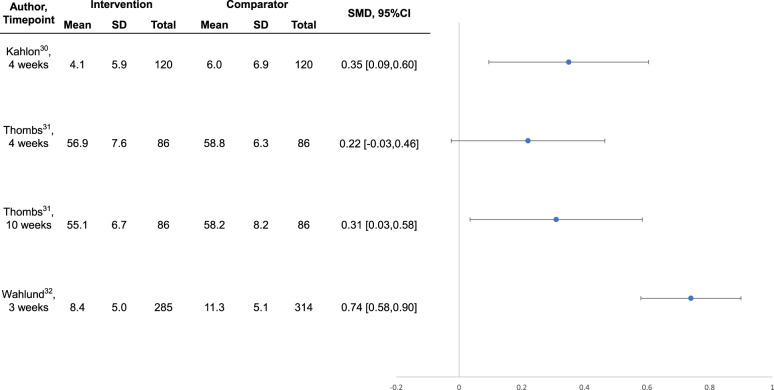
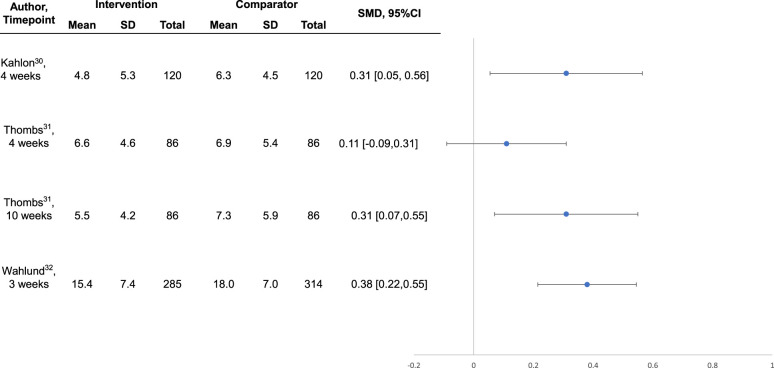
Verification
Claims the paper makes
The claims and statistics of this paper haven’t been checked yet.
Free: it reads the open-access text and checks the first 5 claims that cite a source we can check. Create a free account to check every claim.
Claims other papers make about this one
Each is checked against this paper’s own text: does it say what the citing paper says it does?
The cited source says what the claim attributes to it.
In the citing paper
“A systematic review that included only studies with adults published after the onset of the pandemic found some encouraging results for online interventions targeting anxiety and depression [38].”
The cited source says what the claim attributes to it.
In the citing paper
“the systematic review by Bonardi et al [38] found 3 high-quality studies that were able to decrease different COVID-19–related symptoms like anxiety and depressive symptoms in adults postintervention [71] or at least 6 weeks after the intervention [72,73]”
The check wasn’t confident either way, so it gives no verdict — never disputed.
In the citing paper
“Similarly, findings for interventions that were studied during other epidemics (e.g. Ebola) [22, 23] may also only have limited informative value in the present pandemic context, because of differences in the characteristics of the pathogen and its harmfulness, in the spread of disease, and in containment measures and their duration [23–25].”
From Interventions to build resilience and to ameliorate negative psychosocial effects of the COVID-19 pandemic on children and adolescents: a systematic review and meta-analysis (2024) · cites this paper as [24]
Experimental — accuracy not yet measuredThe check wasn’t confident either way, so it gives no verdict — never disputed.
In the citing paper
“it is important to stress that it is not unusual for interventions to not work simultaneously for both depression and anxiety given their heterogeneity and the fact that there are fundamental differences in the conditions that may require different therapeutic approaches [92].”
From Psychological Interventions and Those With Elements of Positive Psychology for Child and Youth Mental Health During the COVID-19 Pandemic: Literature Review, Lessons Learned, and Areas for Future Knowledge Dissemination (2024) · cites this paper as [92]
Experimental — accuracy not yet measured
Self-check
Percentages, sums and reported differences re-computed from the paper’s own numbers.
The self-check needs the paper’s full text.
Citations
Cites
The PRISMA 2020 statement: An updated guideline for reporting systematic reviews
Page, M. J., McKenzie, J. E., Bossuyt, P. M., Boutron, I., Hoffmann, T. C., Mulrow, C. D., Shamseer, L., Tetzlaff, J. M., Akl, E. A., Brennan, S. E., et al. (2021) · BMJ · doi:10.1136/bmj.n71 · Cited by 108,283
The Cochrane Collaboration's tool for assessing risk of bias in randomised trials
Higgins, J. P. T., Altman, D. G., Gotzsche, P. C., Juni, P., Moher, D., Oxman, A. D., Savovic, J., Schulz, K. F., Weeks, L., Sterne, J. A. C., et al. (2011) · BMJ · doi:10.1136/bmj.d5928 · Cited by 33,817
Dermyshi, E., Wang, Y., Yan, C., Hong, W., Qiu, G., Gong, X., & Zhang, T. (2017) · Neonatology · doi:10.1159/000454668 · Cited by 24,451
Self-citationHoffmann, T. C., Glasziou, P. P., Boutron, I., Milne, R., Perera, R., Moher, D., Altman, D. G., Barbour, V., Macdonald, H., Johnston, M., et al. (2014) · BMJ · doi:10.1136/bmj.g1687 · Cited by 10,548 · cited 1×
“We used the Template for Intervention Description and Replication (TIDieR) checklist to evaluate the degree that interventions were reported adequately for replication in research or practice.(28) The checklist is comprised of 12 items that assess reporting of intervention name; rationale or theory underlying the inte…”
MethodMoher, D., Hopewell, S., Schulz, K. F., Montori, V., Gotzsche, P. C., Devereaux, P. J., Elbourne, D., Egger, M., & Altman, D. G. (2010) · BMJ · doi:10.1136/bmj.c869 · Cited by 8,883
GRADE guidelines: 3. Rating the quality of evidence
Balshem, H., Helfand, M., Schünemann, H. J., Oxman, A. D., Kunz, R., Brozek, J., Vist, G. E., Falck-Ytter, Y., Meerpohl, J., & Norris, S. (2011) · Journal of Clinical Epidemiology · doi:10.1016/j.jclinepi.2010.07.015 · Cited by 8,285
Assessing the quality of controlled clinical trials
Jüni, P., Altman, D. G., & Egger, M. (2001) · BMJ · doi:10.1136/bmj.323.7303.42 · Cited by 3,309
Selective publication of antidepressant trials and its influence on apparent efficacy
Turner, E. H., Matthews, A. M., Linardatos, E., Tell, R. A., & Rosenthal, R. (2008) · New England Journal of Medicine · doi:10.1056/nejmsa065779 · Cited by 2,435
Estimation of effect size from a series of independent experiments.
Hedges, L. V. (1982) · Psychological Bulletin · doi:10.1037//0033-2909.92.2.490 · Cited by 1,062 · cited 1×
“For included trials, if not provided, we calculated between-groups standardized mean differences (SMDs) using Hedges’ g with 95% confidence intervals (CIs).(29) We did not pool results across trials because of substantial heterogeneity of populations, interventions, and outcomes and concerns about the risk of bias.”
MethodMuller, A. E., Hafstad, E. V., Himmels, J. P. W., Smedslund, G., Flottorp, S., Stensland, S. Ø., Stroobants, S., Van de Velde, S., & Vist, G. E. (2020) · Psychiatry Research · doi:10.1016/j.psychres.2020.113441 · Cited by 895
Research works printed but not linked: 4
- Living systematic review of mental health in COVID-19. https://www.depressd.ca/covid-19-mental-health. [accessed 26 October 2021].
- Hernán MA Robins JM. Causal inference. Boca Raton, FL: Chapman & Hall/CRC; 2018.
- Reeves BC Deeks JJ Higgins JPT Shea B Tugwell P Wells GA. Chapter 24: including non-randomized studies on intervention effects. In: Higgins JPT Thomas J Chandler J Cumpston M Li T Page MJ Welch VA, editors. Cochrane handbook for systematic reviews of interventions version 6.1 (updated September 2020). Cochrane; 2020. Available from www.training.cochrane.org/handbook. [accessed 26 October 2021].
- Yang L Ren Z Wang X, et al. 正念减压疗法对“新冠”肺炎疫情时期高校学生的心理状态与睡眠的影响 [Effect of mindfulness-based stress reduction on college students’ mental state and sleep during the epidemic of COVID-19] [Epub ahead of print]. China J Health Psychol.
Cited by
The effects of social isolation stress and discrimination on mental health
Brandt, L., Liu, S., Heim, C., & Heinz, A. (2022) · Translational Psychiatry · doi:10.1038/s41398-022-02178-4 · Cited by 418
COVID-19 and mental health disorders in children and adolescents (Review)
Bai, M., Miao, C., Zhang, Y., Xue, Y., Jia, F., & Du, L. (2022) · Psychiatry Research · doi:10.1016/j.psychres.2022.114881 · Cited by 65
Fischer-Grote, L., Fössing, V., Aigner, M., Fehrmann, E., & Boeckle, M. (2024) · JMIR Mental Health · doi:10.2196/46637 · Cited by 42
“…conducted regarding the effectiveness of online interventions for mental health related to the COVID-19 pandemic [38-41]; a review by Bonardi et al [38] focused on randomized controlled trials (RCTs) explicitly designed to address mental health issues related to COVID-19 and found some with…”
BackgroundInfluentialSockalingam, S., Leung, S., Ma, C., Hawa, R., Wnuk, S., Dash, S., Jackson, T. D., & Cassin, S. E. (2022) · Obesity Surgery · doi:10.1007/s11695-022-05981-6 · Cited by 34
Self-citationMoss, S. J., Mizen, S. J., Stelfox, M., Brundin‐Mather, R., FitzGerald, E. A., Tutelman, P. R., Racine, N. M., Birnie, K. A., Fiest, K. M., Stelfox, H. T., et al. (2023) · BMC Medicine · doi:10.1186/s12916-023-02828-4 · Cited by 33
Metadata
- Authors
- Bonardi, O., Wang, Y., Li, K., Jiang, X., Krishnan, A., He, C., Sun, Y., Wu, Y., Boruff, J. T., Markham, S., Rice, D. B., Thombs-Vite, I., Tasleem, A., Dal Santo, T., Yao, A., Azar, M., Agic, B., Fahim, C., Martin, M. S., Sockalingam, S., Turecki, G., Benedetti, A., & Thombs, B. D.
- Affiliations
- Jewish General Hospital (CA)
- McGill University (CA)
- King's College London (GB)
- Lady Davis Institute for Medical Research, Jewish General Hospital, Montreal, Quebec, Canada
- Centre for Addiction and Mental Health (CA)
- Unity Health Toronto (CA)
- University of Ottawa (CA)
- Douglas Mental Health University Institute (CA)
- McGill University Health Centre (CA)
- Corresponding author
- Thombs, Brett D.
- ORCID
- Venue
- The Canadian Journal of Psychiatry
- Publisher
- SAGE Publications
- Published
- 2022-03-11
- Volume
- 67
- Issue
- 5
- Pages
- 336-350
- ISSN
- 0706-7437 (ISSN-L)
- 1497-0015
- PMC
- PMC9065490
- OpenAlex
- W4220841468
- Cited by
- 43
- References
- 34
- Citations by year
- 2026: 2 · 2025: 4 · 2024: 6 · 2023: 17 · 2022: 12
- FWCI
- 1.63
- Type
- journal article
- Language
- en
- Open access
- hybrid
- doi.org
- Locations
- The Canadian Journal of Psychiatry (publishedVersion, cc-by)
- medRxiv (acceptedVersion, cc-by-nc)
- PubMed Central (publishedVersion, cc-by)
- PubMed (publishedVersion)
- eScholarship@McGill (McGill) (submittedVersion, cc-by)
- Funders
- McGill Interdisciplinary Initiative in Infection and Immunity Emergency COVID-19 Research Fund (R2-42)
- Canadian Institutes of Health Research (CMS-171703, MS1-173070)
- Topics
- Social Sciences › Psychology › Clinical Psychology › COVID-19 and Mental Health
- Social Sciences › Psychology › Applied Psychology › Digital Mental Health Interventions
- Health Sciences › Medicine › Public Health, Environmental and Occupational Health › Maternal Mental Health During Pregnancy and Postpartum
- Keywords
- COVID-19 anxiety, depressive symptoms, peer support programs, autoimmune disease, expressive writing, children and adolescents, general population, telemedicine
- MeSH terms
- COVID-19, Adolescent, Aged, Anxiety, Child, Depression, Humans, Mental Health, Quarantine, Randomized Controlled Trials as Topic
About these checks
Registry, retraction, Cites and statistics results are computed, not judged, with one exception: a printed reference that no index lists is read once by a model before it counts as a citation error. Claims are extracted by a model and kept only when their quote appears verbatim in the text; each cited source is then checked, with a model’s help, for whether it says what the claim relies on. Those verdicts can be wrong — read the claim’s quote and the cited source before relying on one.
Statistics and arithmetic are recomputed, not judged.
Confidence bands are shown only for fields calibrated on our annotated test set. None is calibrated yet, so no band is shown.
What counts as a claim ›How we measure confidence ›How we check this ›
Are you an author, or do you see a problem with this page? Request a review
Data sources
Bibliographic data: Semantic Scholar, OpenAlex, Crossref.
Contains information from the Semantic Scholar Academic Graph Datasets, made available under the ODC Attribution License (ODC-BY 1.0).
Semantic Scholar’s data is described in: Kinney, R., et al. (2023). The Semantic Scholar Open Data Platform. arXiv:2301.10140.
