

Organized Persuasive Communication: A new conceptual framework for research on public relations, propaganda and promotional culture
Open accessThe DOI matches its Crossref record; 49 of the 49 references it cites were found in a registry or an index.
Abstract
Organized persuasive communication is essential to the exercise of power at national and global levels. It has been studied extensively by scholars of public relations, promotional culture and propaganda. There exists, however, considerable confusion and conceptual limitations across these fields: scholars of PR largely focus on what they perceive to be non-manipulative forms of organized persuasive communication; scholars of propaganda focus on manipulative forms but tend either to examine historical cases or non-democratic states; scholars of promotional culture focus on ‘salesmanship’ in public life. All approaches show minimal conceptual development concerning manipulative organized persuasive communication involving deception, incentivization and coercion. As a consequence, manipulative, propagandistic organized persuasive communication within liberal democracies is a blind spot; it is rarely recognized let alone researched with the result that our understanding and grasp of these activities is stunted. To overcome these limitations, we propose a new conceptual framework that theorizes precisely manipulative forms of persuasion, as well as demarcating what might count as non-manipulative or consensual forms of persuasion. This framework advances PR and propaganda scholarship by clarifying our understanding of manipulative and propagandistic forms of organized persuasive communication and by providing a starting point for more fully evaluating the role of deception, incentivization and coercion, within contemporary liberal democracies.
Overview
The claims and statistics of this paper haven’t been checked yet.
Free: it reads the open-access text and checks the first 5 claims that cite a source we can check. Create a free account to check every claim.
Integrity signals
Registry
Cites
Statistics
Figures

Verification
Claims the paper makes
The claims and statistics of this paper haven’t been checked yet.
Free: it reads the open-access text and checks the first 5 claims that cite a source we can check. Create a free account to check every claim.
Claims other papers make about this one
Each is checked against this paper’s own text: does it say what the citing paper says it does?
The source backs part of the claim, not all of it — or backs it for a different population, condition or comparison.
In the citing paper
“Bakir et al. (2019) argue that persuasive communications, to avoid being manipulative, should be both informed (with sufficient information provided, and none of it deceptive) and freely chosen (namely, no coercion, such as threats, and no incentivization, such as subsidies).”
From On manipulation by emotional AI: UK adults’ views and governance implications (2024) · cites this paper as Bakir et al., 2019
Experimental — accuracy not yet measuredIn the citing paper
“Scholars from diverse disciplines agree that manipulation involves undermining of autonomy, or freedom to choose, reflect and deliberate (Sunstein, 2016; Bakir et al., 2019; Susser et al., 2019).”
From On manipulation by emotional AI: UK adults’ views and governance implications (2024) · cites this paper as Bakir et al., 2019
Self-check
Percentages, sums and reported differences re-computed from the paper’s own numbers.
The self-check needs the paper’s full text.
Citations
Cites
Nudge: Improving Decisions About Health, Wealth and Happiness
Adkisson, R. V. (2008) · The Social Science Journal · doi:10.1016/j.soscij.2008.09.003 · Cited by 5,543
Manufacturing Consent: The Political Economy of the Mass Media.
Bennett, J. R., Herman, E. S., & Chomsky, N. (1989) · Contemporary Sociology · doi:10.2307/2074220 · Cited by 5,437 · cited 2×
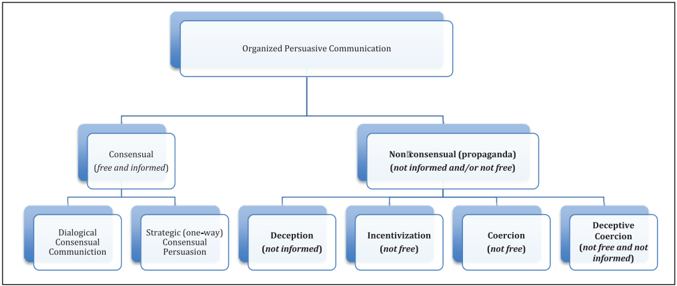
“Although the terms ‘coerced consent’ (Kaplan and Dixon, 1996/97: 74) and ‘manufacture of consent’ (Lippman, 1925; Herman and Chomsky, 1988) are common, we prefer the term non-consensual persuasive communication to emphasize that in neither case is the person truly consenting.”
Backgroundvan Dijk, T. A. (2006) · Discourse & Society · doi:10.1177/0957926506060250 · Cited by 1,339
Defining Strategic Communication
Hallahan, K., Holtzhausen, D., van Ruler, B., Verčič, D., & Sriramesh, K. (2007) · International Journal of Strategic Communication · doi:10.1080/15531180701285244 · Cited by 1,260
Fake News and The Economy of Emotions: Problems, causes, solutions
Bakir, V., & McStay, A. (2018) · Digital Journalism · doi:10.1080/21670811.2017.1345645 · Cited by 765
Self-citationManaging Public Relations: Business Principles and Tools for Strategic Communication, 2e
Smudde, P. M. (2023) · Routledge eBooks · doi:10.4324/9781003208280 · Cited by 678
Detecting and Tracking Political Abuse in Social Media
Ratkiewicz, J., Conover, M., Meiss, M., Goncalves, B., Flammini, A., & Menczer, F. (2021) · Proceedings of the International AAAI Conference on Web and Social Media · doi:10.1609/icwsm.v5i1.14127 · Cited by 579 · cited 1×
“During the 2010 US midterm elections and Massachusetts special election, social bots were reportedly used to support some candidates and smear their opponents, by creating thousands of tweets pointing to websites with fake news (Metaxas and Mustafaraj, 2012; Ratkiewicz et al., 2011).”
BackgroundWernick, A. (1991) · Ideology and Power in the Age of Lenin in Ruins · doi:10.1007/978-1-349-22346-6_17 · Cited by 516
(2013) · Smolensk under the Nazis · doi:10.1515/9781580468299-010 · Cited by 467
Moloney, K. (2006) · Routledge eBooks · doi:10.4324/9780203030592 · Cited by 313
Research works printed but not linked: 28
- Arendt H (1972) Lying in politics: Reflections on The Pentagon Papers . In: Arendt H Crises of the Republic . Orlando, FL: Harcourt Brace, 1-47.
- Bakir V (2013) Torture, Intelligence and Sousveillance in the War on Terror . Farnham: Ashgate.
- Carney JD and Scheer RK (1980) Fundamentals of Logic . 3rd ed. New York, NY: Macmillan.
- Carson TL (2012) Lying and Deception . Oxford: Oxford University Press.
- Coote A and Lenaghan J (1997) Citizens' Juries . London: Institute for Public Policy Research.
- Dearth DH (2002) Shaping the 'information space'. Journal of Information Warfare 1(3): 1-15.
- Ellul J, 1965, Propaganda
- Grunig J and Hunt T (1984) Managing Public Relations . New York, NY: Rinehart.
- Habermas J (1984) The Theory of Communicative Action, Volume 1: Reason and the Rationalization of Society , trans. McCarthyT. Boston, MA: Beacon Press.
- Jowett GS and O'Donnell VJ (2012) Propaganda and Persuasion . 5th ed. London: SAGE.
- Kaplan DS and Dixon L (1996/97) Coerced waiver and coerced consent. Denver University Law Review 74: 941-956.
- Kavanagh D (1995) Election Campaigning . London: Blackwell.
- Lippman W (1922) Public Opinion . New York, NY: Harcourt, Brace.
- Lyotard J-F (1979) The Postmodern Condition , trans. Bennington G and Massumi B. Manchester: Manchester University Press.
- Mearsheimer J (2011) Why Leaders Lie . London: Duckworth Overlook.
- Michaels D (2008) Doubt is Their Product . Oxford: Oxford University Press.
- Miller D and Dinan W (2008) A Century of Spin . London: Pluto Press.
- Oreskes N and Conway EM (2011) Merchants of Doubt . New York, NY: Bloomsbury.
- Sheehan N (1971) The Pentagon Papers . New York, NY: Bantam.
- Simon H (1972) Persuasion in social conflicts. Speech Monographs 39(4): 227-247.
- Simpson C (1994) Science of Coercion . Oxford: Oxford University Press.
- Sokolon M (2006) Political Emotions . DeKalb, IL: Northern Illinois University Press.
- Solorio T, Hasan R and Mizan M (2013) Sockpuppet detection in wikipedia: A corpus of real-world deceptive writing for linking identities. arXiv preprint arXiv:1310.6772 . · arXiv
- Taylor PM (1992) Propaganda from Thucydides to Thatcher: Some problems, perspectives and pitfalls. Opening address to the annual conference of the Social History Society of Great Britain. Available (accessed 22 September 2017) at: https://www.scribd.com/document/57111621/Propaganda-FromThucydides-to-Thatcher
- Taylor PM (2002) Perception management and the 'war' against terrorism. Journal of Information Warfare 1(3): 16-29.
- Wernick A (1988) Promotional culture. Canadian Journal of Political and Social Theory/Revue canadienne de théorie politique et sociale 12(1-2): 180-201.
- Wertheimer A (1987) Coercion . Princeton, NJ: Princeton University Press.
- Woolley, S. C., & Howard, P. N. (2017). Computational propaganda worldwide: Executive summary, Computational propaganda research project, Working Paper No. 2017.11 . Oxford: Oxford University. Available (accessed 25 March 2018) http://275rzy1ul4252pt1hv2dqyuf.wpengine.netdna-cdn.com/wpcontent/uploads/2017/07/Casestudies-ExecutiveSummary-1.pdf
Cited by
Items 201–209 of 209
Future of PR/Comms and their social impact – a metamodern inquiry into PR’s social value and impact
Adi, A., & Stoeckle, T. (2026) · Public Relations Review · doi:10.1016/j.pubrev.2026.102753
Marekwa, M. Z., Mulyadi, A. W. E., & Nugroho, R. A. (2026) · MORFAI JOURNAL · doi:10.5281/zenodo.22005334
Tögel, J. (2026) · Journal of Communication Inquiry · doi:10.1177/01968599261486005
Alabart-Algueró, J. (2026) · Tesis Doctorals en Xarxa (Consorci de Serveis Universitaris de Catalunya)
Comunicação, E. E. (2019) · Estudos em Comunicação
English As An Instrument of Economic Growth: A Systematic Literature Review
Pratiwi, R. J., Khoiriyah, S., Tjatur, C., Sriphol, A., Murwani, F. D., Wardana, L. W., & Wati, A. P. (2025) · International Journal of Technology and Education Research · doi:10.63922/ijeter.v3i02.1809
Godlewski, G., Zalech, M., Augustyniak, A., & Rybka, J. (2026) · Prace Naukowe Uniwersytetu Ekonomicznego we Wrocławiu · doi:10.15611/pn.2026.3.03
Holqi, F. G. F., & A’yun, Q. (2026) · Advances in computational intelligence and robotics book series · doi:10.4018/979-8-3373-9469-5.ch014
Husar, M. (2026) · Research Bulletin Series Philological Sciences · doi:10.32782/2522-4077-2026-218-1
Metadata
- Authors
- Bakir, V., Herring, E., Miller, D., & Robinson, P.
- Affiliations
- Bangor University (GB)
- University of Bristol (GB)
- University of Sheffield (GB)
- Corresponding author
- Miller, David
- Venue
- Critical Sociology
- Publisher
- SAGE Publications
- Published
- 2018-05-15
- Volume
- 45
- Issue
- 3
- Pages
- 311-328
- ISSN
- 0896-9205 (ISSN-L)
- 1569-1632
- OpenAlex
- W2803708382
- Cited by
- 148
- References
- 48
- Citations by year
- 2026: 8 · 2025: 14 · 2024: 45 · 2023: 17 · 2022: 23 · 2021: 7 · 2020: 12 · 2019: 21 · 2018: 1
- FWCI
- 70.21
- Type
- journal article
- Language
- en
- Open access
- hybrid
- doi.org
- Licence
- cc-by
- journals.sagepub.com/page/policies/text-and-data-mining-license (tdm)
- Locations
- Critical Sociology (publishedVersion, cc-by)
- Bristol Research (University of Bristol) (publishedVersion, cc-by)
- White Rose Research Online (University of Leeds, The University of Sheffield, University of York) (acceptedVersion)
- Explore Bristol Research (submittedVersion, cc-by)
- Funders
- Economic and Social Research Council (ES/K000292/1)
- Topics
- Social Sciences › Communication › Rhetoric and Communication Studies
- Social Sciences › Communication › Public Relations and Crisis Communication
- Social Sciences › Sociology and Political Science › Media Influence and Politics
- Keywords
- propaganda, public relations, promotional culture, deception, coercion, liberal democracy, conceptual framework, persuasion theory
About these checks
Registry, retraction, Cites and statistics results are computed, not judged, with one exception: a printed reference that no index lists is read once by a model before it counts as a citation error. Claims are extracted by a model and kept only when their quote appears verbatim in the text; each cited source is then checked, with a model’s help, for whether it says what the claim relies on. Those verdicts can be wrong — read the claim’s quote and the cited source before relying on one.
Statistics and arithmetic are recomputed, not judged.
Confidence bands are shown only for fields calibrated on our annotated test set. None is calibrated yet, so no band is shown.
What counts as a claim ›How we measure confidence ›How we check this ›
Are you an author, or do you see a problem with this page? Request a review
Data sources
Bibliographic data: Semantic Scholar, OpenAlex, Crossref.
Contains information from the Semantic Scholar Academic Graph Datasets, made available under the ODC Attribution License (ODC-BY 1.0).
Semantic Scholar’s data is described in: Kinney, R., et al. (2023). The Semantic Scholar Open Data Platform. arXiv:2301.10140.
