

Fictitious Inhibitory Differences: How Skewness and Slowing Distort the Estimation of Stopping Latencies
Open accessThe DOI matches its Crossref record; 35 of the 36 references it cites were found in a registry or an index.
Abstract
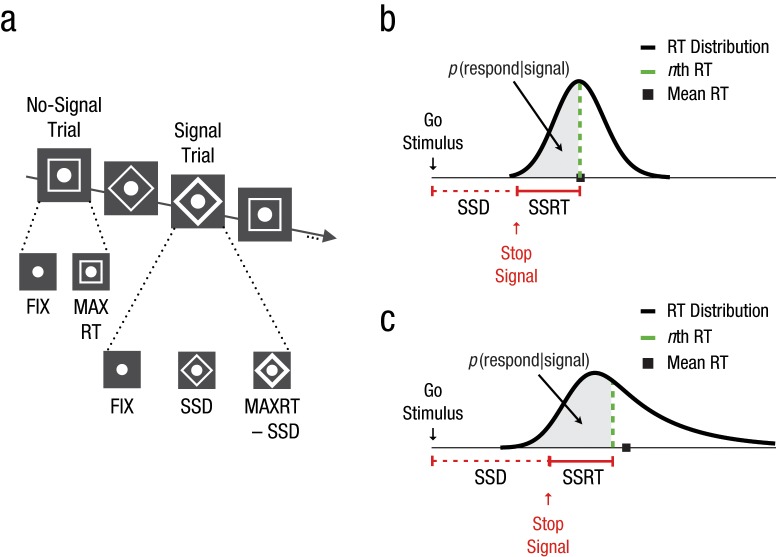
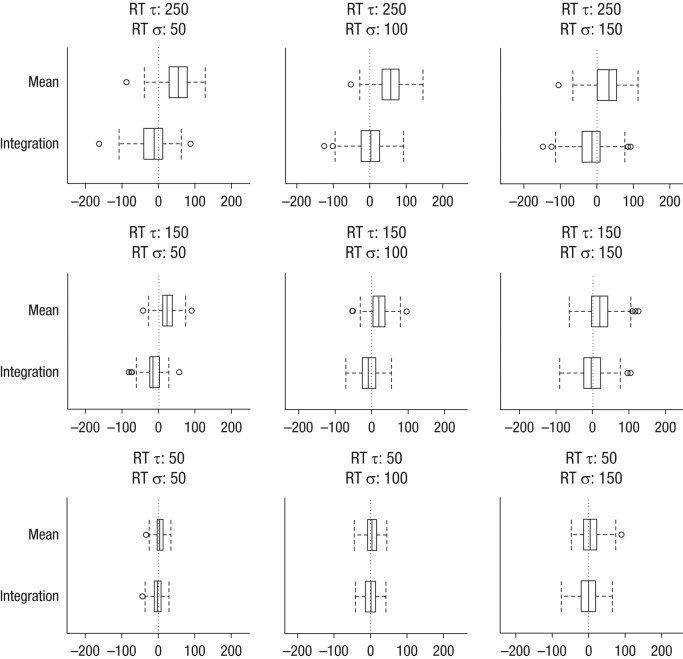
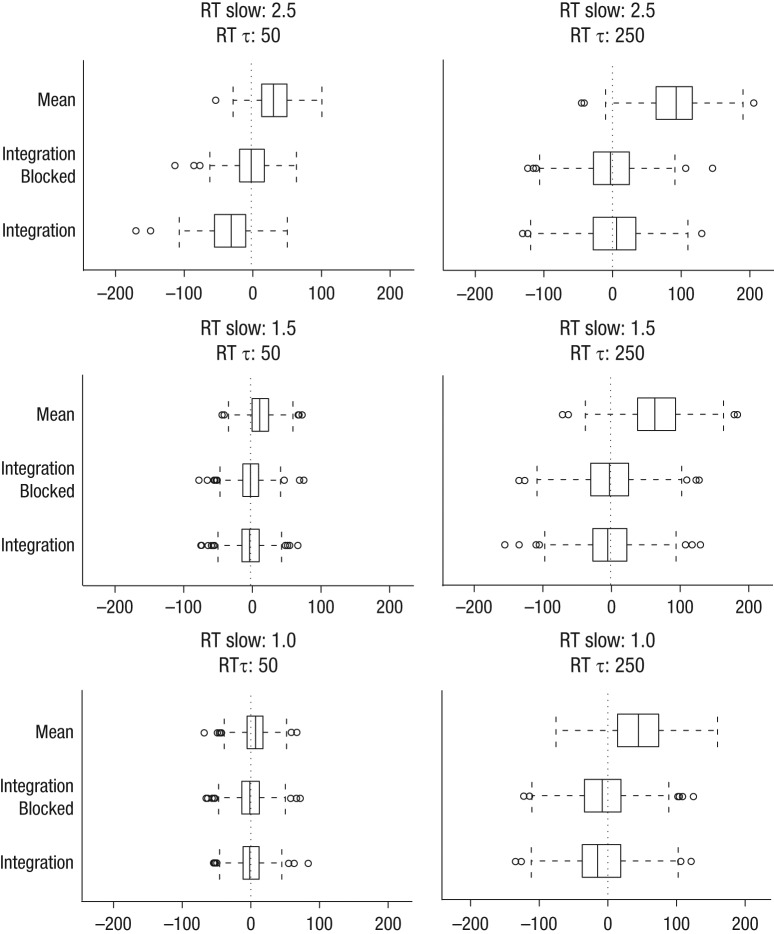
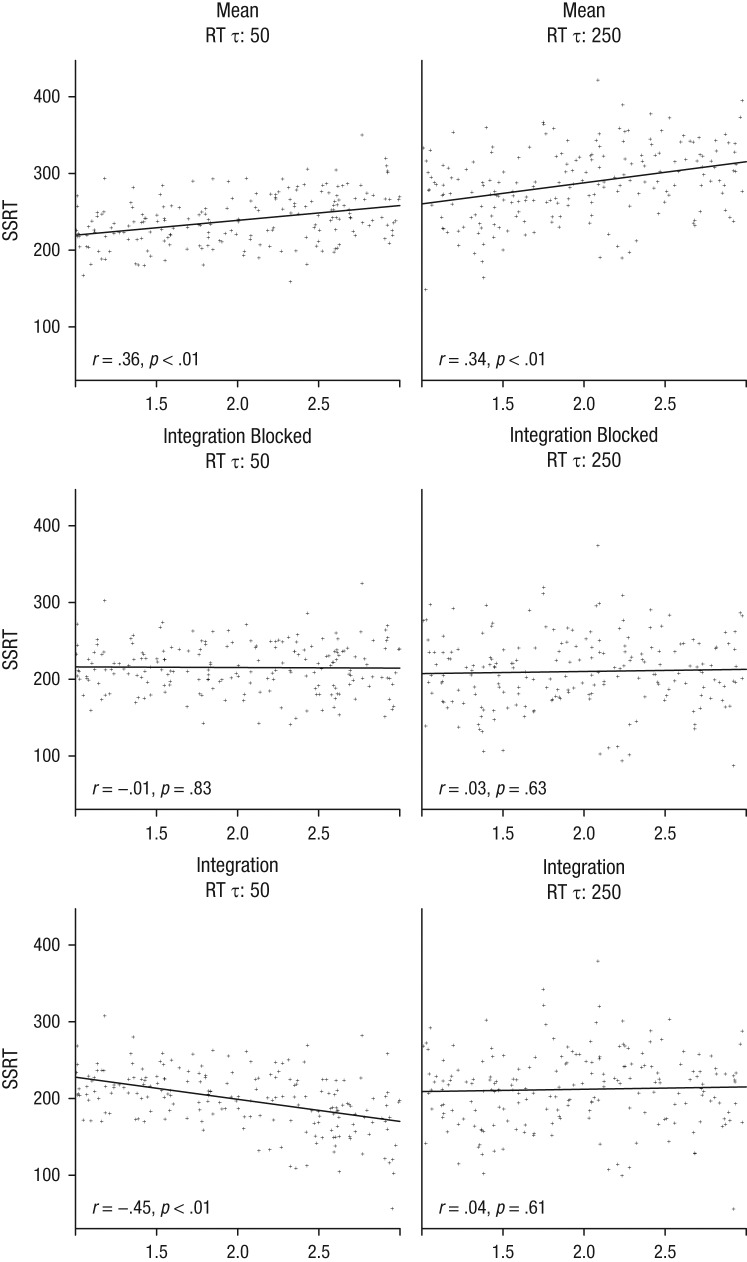
The stop-signal paradigm is a popular method for examining response inhibition and impulse control in psychology, cognitive neuroscience, and clinical domains because it allows the estimation of the covert latency of the stop process: the stop-signal reaction time (SSRT). In three sets of simulations, we examined to what extent SSRTs that were estimated with the popular mean and integration methods were influenced by the skew of the reaction time distribution and the gradual slowing of the response latencies. We found that the mean method consistently overestimated SSRT. The integration method tended to underestimate SSRT when response latencies gradually increased. This underestimation bias was absent when SSRTs were estimated with the integration method for smaller blocks of trials. Thus, skewing and response slowing can lead to spurious inhibitory differences. We recommend that the mean method of estimating SSRT be abandoned in favor of the integration method.
Overview
The claims and statistics of this paper haven’t been checked yet.
Free: it reads the open-access text and checks the first 5 claims that cite a source we can check. Create a free account to check every claim.
Integrity signals
Registry
Cites
Statistics
Figures
Verification
Claims the paper makes
The claims and statistics of this paper haven’t been checked yet.
Free: it reads the open-access text and checks the first 5 claims that cite a source we can check. Create a free account to check every claim.
Claims other papers make about this one
Each is checked against this paper’s own text: does it say what the citing paper says it does?
The cited source says what the claim attributes to it.
In the citing paper
“and the method used in most studies to derive estimates of inhibitory control from the stop-signal task has been criticized for producing spurious results (Verbruggen et al., 2013).”
From Executive Functioning Heterogeneity in Pediatric ADHD (2019) · cites this paper as Verbruggen et al., 2013
Self-check
Percentages, sums and reported differences re-computed from the paper’s own numbers.
The self-check needs the paper’s full text.
Citations
Cites
R: A Language and Environment for Statistical Computing
R Core Team (2025) · doi:10.32614/r.manuals · Cited by 352,181
Yaşlı Kadınlarda Üreme Sağlığı
Kokanalı, D., & Engin Üstün, Y. (n.d.) · DergiPark (Istanbul University) · Cited by 170,090
On the ability to inhibit thought and action: a theory of an act of control
Logan, G. D., & Cowan, W. B. (1984) · Psychological Review · doi:10.1037/0033-295x.91.3.295 · Cited by 2,590 · cited 4×
“SSRT is estimated according to the independent-race model (Logan, 1994; Logan & Cowan, 1984; Verbruggen & Logan, 2009a): Performance in the stop task can be modeled as a race between a go process, which is triggered by the presentation of the go stimulus, and a stop process, which is triggered by the presentation of a…”
InfluentialSelf-citationInhibitory Processes in Attention, Memory and Language
Carr, T. H., & Dagenbach, D. (1994) · Medical Entomology and Zoology · Cited by 2,364
Bergum, B. O., Long, J., & Baddeley, A. (1982) · The American Journal of Psychology · doi:10.2307/1422199 · Cited by 2,226
Methods for dealing with reaction time outliers.
Ratcliff, R. (1993) · Psychological Bulletin · doi:10.1037/0033-2909.114.3.510 · Cited by 2,123
Impulsivity and Inhibitory Control
Logan, G. D., Schachar, R. J., & Tannock, R. (1997) · Psychological Science · doi:10.1111/j.1467-9280.1997.tb00545.x · Cited by 1,394
Self-citationResponse inhibition in the stop-signal paradigm
Verbruggen, F., & Logan, G. D. (2008) · Trends in Cognitive Sciences · doi:10.1016/j.tics.2008.07.005 · Cited by 1,373
Self-citationAron, A. R. (2011) · Biological Psychiatry · doi:10.1016/j.biopsych.2010.07.024 · Cited by 1,236 · cited 3×
“…slow responses either proactively when they expect that stop signals might occur or reactively when they fail to inhibit their responses (e.g., Aron, 2011; Bissett & Logan, 2011; Leotti & Wager, 2010; Verbruggen & Logan, 2009b; Verbruggen, Logan, Liefooghe, & Vandierendonck, 2008; Zandbelt,…”
On the ability to inhibit thought and action: A users' guide to the stop signal paradigm
Logan, G. D. (1994) · UvA-DARE (University of Amsterdam) · Cited by 1,115
Self-citation
Research works printed but not linked: 1
- 10.1016/j .biopsych.2010.07.024 · doi:10.1016/j
Cited by
Items 201–300 of 388
The effects of discrimination on the adoption of different strategies in selective stopping
Sánchez‐Carmona, A. J., Rincón‐Pérez, I., López‐Martín, S., Albert, J., & Hinojosa, J. A. (2020) · Psychonomic Bulletin & Review · doi:10.3758/s13423-020-01797-6 · Cited by 15
Hannah, R., Muralidharan, V., & Aron, A. R. (2022) · Behavior Research Methods · doi:10.3758/s13428-022-02008-x · Cited by 14
Inhibitory Processes and Fluid Intelligence: a Performance at Early Years of Schooling
Aydmune, Y. S., Introzzi, I. M., Zamora, E. V., & Stelzer, F. (2020) · International journal of psychological research · doi:10.21500/20112084.4231 · Cited by 16
Late enhancement of brain-behavior correlations during response inhibition
Jimura, K., Hirose, S., Kunimatsu, A., Ohtomo, K., Koike, Y., & Konishi, S. (2014) · Neuroscience · doi:10.1016/j.neuroscience.2014.05.058 · Cited by 15
Within-Subject Correlation Analysis to Detect Functional Areas Associated With Response Inhibition
Yamasaki, T., Ogawa, A., Osada, T., Jimura, K., & Konishi, S. (2018) · Frontiers in Human Neuroscience · doi:10.3389/fnhum.2018.00208 · Cited by 16
Singh, M., Fuelscher, I. T., He, J. L., Anderson, V. A., Silk, T. J., & Hyde, C. E. (2021) · Cortex · doi:10.1016/j.cortex.2021.06.002 · Cited by 14
Verbal Response Inhibition in Adults Who Stutter
Treleaven, S., & Coalson, G. A. (2021) · Journal of Speech Language and Hearing Research · doi:10.1044/2021_jslhr-20-00739 · Cited by 13
Detecting impairment: Sensitive cognitive measures of dose-related acute alcohol intoxication
Cash, C., Peacock, A., Barrington, H., Sinnett, N., & Bruno, R. (2015) · Journal of Psychopharmacology · doi:10.1177/0269881115570080 · Cited by 18
Stopping movements: when others slow us down
Cavallo, A., Catmur, C., Sowden, S., Ianì, F., & Becchio, C. (2014) · European Journal of Neuroscience · doi:10.1111/ejn.12645 · Cited by 14
Elchlepp, H., & Verbruggen, F. (2016) · Biological Psychology · doi:10.1016/j.biopsycho.2016.10.005 · Cited by 17
Self-citationReactive and proactive control mechanisms of response inhibition in gambling disorder
Sharif-Razi, M., Hodgins, D. C., & Goghari, V. M. (2018) · Psychiatry Research · doi:10.1016/j.psychres.2018.12.049 · Cited by 17
Effects of nicotine and atomoxetine on brain function during response inhibition
Kasparbauer, A., Petrovsky, N., Schmidt, P.-M., Trautner, P., Weber, B., Sträter, B., & Ettinger, U. (2018) · European Neuropsychopharmacology · doi:10.1016/j.euroneuro.2018.12.004 · Cited by 18
Exploring stop signal reaction time over two sessions of the anticipatory response inhibition task
Hall, A., Jenkinson, N., & MacDonald, H. J. (2022) · Experimental Brain Research · doi:10.1007/s00221-022-06480-x · Cited by 18
A cognitive process modeling framework for the ABCD study stop-signal task
Weigard, A. S., Matzke, D., Tanis, C. C., & Heathcote, A. (2022) · Developmental Cognitive Neuroscience · doi:10.1016/j.dcn.2022.101191 · Cited by 19
Dimensional bias and adaptive adjustments in inhibitory control of monkeys
Ghasemian, S., Vardanjani, M. M., Sheibani, V., & Mansouri, F. A. (2021) · Animal Cognition · doi:10.1007/s10071-021-01483-7 · Cited by 13
Irrelevant angry, but not happy, faces facilitate response inhibition in mindfulness meditators
Lodha, S., & Gupta, R. (2023) · Current Psychology · doi:10.1007/s12144-023-04384-9 · Cited by 15
Investigating a race model account of executive control in rats with the countermanding paradigm
Beuk, J., Beninger, R. J., & Paré, M. (2014) · Neuroscience · doi:10.1016/j.neuroscience.2014.01.014 · Cited by 14
Color‐hierarchies in executive control of monkeys' behavior
Ghasemian, S., Vardanjani, M. M., Sheibani, V., & Mansouri, F. A. (2021) · American Journal of Primatology · doi:10.1002/ajp.23231 · Cited by 13
Logemann, H. N. A., Böcker, K. B. E., Deschamps, P. K. H., Kemner, C., & Kenemans, J. L. (2014) · Pharmacology Biochemistry and Behavior · doi:10.1016/j.pbb.2014.03.019 · Cited by 15
Irwin Harper, L. N., Groves, N. B., Marsh, C. L., Cole, A. M., & Kofler, M. J. (2023) · Child Neuropsychology · doi:10.1080/09297049.2022.2138301 · Cited by 12
Stop it! Relationship between sport expertise and response inhibition in elite athletes
Fleddermann, M., Reichert, L., Wieland, B., & Zentgraf, K. (2023) · Frontiers in Psychology · doi:10.3389/fpsyg.2023.1192483 · Cited by 17
Eriksson, L. J. K., Jansson, B., Lisspers, J., & Sundin, Ö. (2016) · Personality and Individual Differences · doi:10.1016/j.paid.2016.03.057 · Cited by 12
The Role of Sleep in the Relationship Between ADHD Symptoms and Stop Signal Task Performance
Wolff, B., Sciberras, E., He, J. L., Youssef, G. J., Anderson, V. A., & Silk, T. J. (2020) · Journal of Attention Disorders · doi:10.1177/1087054720943290 · Cited by 14
Antons, S., Büsche, K., Mallon, L., Wolf, O. T., Diers, M., & Brand, M. (2023) · Sexual Health & Compulsivity · doi:10.1080/26929953.2023.2220003 · Cited by 18
Chan, E. S. M., Barroso, C., Groves, N. B., Marsh, C. L., Black, K., Jaisle, E. M., & Kofler, M. J. (2023) · Research in Developmental Disabilities · doi:10.1016/j.ridd.2023.104568 · Cited by 13
Akıl, A. M., Cserjési, R., Nagy, T., Demetrovics, Z., Németh, D., & Logemann, H. N. A. (2024) · Journal of Neurophysiology · doi:10.1152/jn.00046.2024 · Cited by 12
Beauchamp, K. G., Shaffer, K. A., Fisher, P. A., & Berkman, E. T. (2018) · Applied Neuropsychology Child · doi:10.1080/21622965.2018.1495567 · Cited by 16
Is cortical inhibition in primary motor cortex related to executive control?
Loomes, M., Tran, D. M. D., Chowdhury, N. S., Birney, D. P., Harris, J. A., & Livesey, E. J. (2023) · Cortex · doi:10.1016/j.cortex.2022.12.013 · Cited by 13
Oscillatory brain mechanisms supporting response cancellation in selective stopping strategies
Sánchez‐Carmona, A. J., Santaniello, G., Capilla, A., Hinojosa, J. A., & Albert, J. (2019) · NeuroImage · doi:10.1016/j.neuroimage.2019.04.066 · Cited by 14
RETRACTED ARTICLE: Reward anticipation enhances brain activation during response inhibition
Rosell‐Negre, P., Bustamante, J. C., Fuentes‐Claramonte, P., Costumero, V., Benabarre, S., & Barrós‐Loscertales, A. (2014) · Cognitive Affective & Behavioral Neuroscience · doi:10.3758/s13415-014-0292-9 · Cited by 17
RetractedTsegaye, A., Guo, C., Stoet, G., Cserjési, R., Kökönyei, G., & Logemann, H. N. A. (2022) · BMC Psychology · doi:10.1186/s40359-021-00712-5 · Cited by 17
No training effects of top-down controlled response inhibition by practicing on the stop-signal task
You, Y., Failla, A., & van der Kamp, J. (2023) · Acta Psychologica · doi:10.1016/j.actpsy.2023.103878 · Cited by 13
Salomoni, S. E., Weber, S., & Hinder, M. R. (2025) · Cortex · doi:10.1016/j.cortex.2025.02.006 · Cited by 10
Vardanjani, M. M., Ghasemian, S., Sheibani, V., & Mansouri, F. A. (2021) · Behavioural Brain Research · doi:10.1016/j.bbr.2021.113409 · Cited by 10
Wadsley, C. G., Cirillo, J., Nieuwenhuys, A., & Byblow, W. D. (2023) · Experimental Brain Research · doi:10.1007/s00221-022-06539-9 · Cited by 11
The effect of staircase stopping accuracy and testing environment on stop-signal reaction time
Tran, D. M. D., Chowdhury, N. S., Harris, J. A., & Livesey, E. J. (2023) · Behavior Research Methods · doi:10.3758/s13428-022-02058-1 · Cited by 12
Biggs, A. T. (2017) · The American Journal of Psychology · doi:10.5406/amerjpsyc.130.4.0439 · Cited by 10
Attachment and self-regulation performance in preadolescence
Heylen, J., Raedt, R. D., Verbruggen, F., & Bosmans, G. (2017) · Journal of Social and Personal Relationships · doi:10.1177/0265407517742531 · Cited by 13
Self-citationHasegawa, A., Somatori, K., Nishimura, H., Hattori, Y., & Kunisato, Y. (2019) · Journal of Experimental Psychopathology · doi:10.1177/2043808719861894 · Cited by 14
Motor cortex dysfunction in problem gamblers
Chowdhury, N. S., Livesey, E. J., Blaszczynski, A. P., & Harris, J. A. (2020) · Addiction Biology · doi:10.1111/adb.12871 · Cited by 12
Proactive Interhemispheric Disinhibition Supports Response Preparation during Selective Stopping
Wadsley, C. G., Cirillo, J., Nieuwenhuys, A., & Byblow, W. D. (2023) · Journal of Neuroscience · doi:10.1523/jneurosci.1712-22.2022 · Cited by 9
Cortical network mechanisms of response inhibitionPreprint
Schaum, M., Pinzuti, E., Sebastian, A., Lieb, K., Fries, P., Mobascher, A., Jung, P., Wibral, M., & Tüscher, O. (2020) · bioRxiv (Cold Spring Harbor Laboratory) · doi:10.1101/2020.02.09.940841 · Cited by 10
The effect of cardiac phase on distractor suppression and motor inhibition in a stop-signal task
Marshall, A. C., Ren, Q., Enk, L., Liu, J., & Schütz‐Bosbach, S. (2024) · Scientific Reports · doi:10.1038/s41598-024-80742-2 · Cited by 12
Zhou, H., Tang, Y., Li-juan, S., Wang, S., Guo, J., Xiao, J., Yan, C., & Gong, J. (2025) · Journal of Psychiatric Research · doi:10.1016/j.jpsychires.2025.10.042 · Cited by 14
Paz, A. L., Rosselli, M., & Conniff, J. (2018) · Alcoholism Clinical and Experimental Research · doi:10.1111/acer.13830 · Cited by 13
Decoupling countermands nonselective response inhibition during selective stopping
Wadsley, C. G., Cirillo, J., Nieuwenhuys, A., & Byblow, W. D. (2021) · Journal of Neurophysiology · doi:10.1152/jn.00495.2021 · Cited by 10
Bø, R., & Landrø, N. I. (2017) · Psychopharmacology · doi:10.1007/s00213-017-4578-9 · Cited by 10
Lee, H.-J., Lin, F., & Kuo, W. (2017) · Scientific Reports · doi:10.1038/s41598-017-10539-z · Cited by 9
Emotional Stop Cues Facilitate Inhibitory Control in Schizophrenia
Zheng, Q., Yang, T., & Ye, Z. (2019) · Journal of the International Neuropsychological Society · doi:10.1017/s1355617719001152 · Cited by 11
Wolff, B., Franco, V. R., Magiati, I., Pestell, C., & Glasson, E. J. (2023) · Journal of Clinical and Experimental Neuropsychology · doi:10.1080/13803395.2023.2259042 · Cited by 13
Evidence for spatial tuning of movement inhibition
Wattiez, N., Poitou, T., Rivaud-Péchoux, S., & Pouget, P. (2016) · Experimental Brain Research · doi:10.1007/s00221-016-4594-8 · Cited by 9
Biggs, A. T., Pettijohn, K. A., & Gardony, A. L. (2021) · Quarterly Journal of Experimental Psychology · doi:10.1177/1747021820985819 · Cited by 11
Peckham, A., Sandler, J. P., Dattolico, D., McHugh, R. K., Johnson, D. S., Björgvinsson, Þ., Pizzagalli, D. A., & Beard, C. (2021) · Behaviour Research and Therapy · doi:10.1016/j.brat.2021.103968 · Cited by 8
Feizpour, A., Buckley, M. J., Mundiñano, I.-C., Rosa, M. G. P., & Mansouri, F. A. (2024) · Progress in Neurobiology · doi:10.1016/j.pneurobio.2024.102671 · Cited by 7
Gunten, C. D. V., & Bartholow, B. D. (2019) · International Journal of Psychophysiology · doi:10.1016/j.ijpsycho.2019.08.008 · Cited by 9
Causal Prefrontal Contributions to Stop-Signal Task Performance in Humans
Yeung, M. K.-C., Tsuchida, A., & Fellows, L. K. (2021) · Journal of Cognitive Neuroscience · doi:10.1162/jocn_a_01652 · Cited by 9
Galloway-Long, H., Huang‐Pollock, C. L., & Neely, K. A. (2021) · Journal of the International Neuropsychological Society · doi:10.1017/s1355617721000990 · Cited by 8
Singh, M., Skippen, P., He, J. L., Thomson, P., Fuelscher, I. T., Caeyenberghs, K., Anderson, V. A., Nicholson, J. M., Hyde, C. E., & Silk, T. J. (2022) · Developmental Cognitive Neuroscience · doi:10.1016/j.dcn.2022.101171 · Cited by 8
Eriksson, L. J. K., Sundin, Ö., & Jansson, B. (2023) · International Journal of Environmental Research and Public Health · doi:10.3390/ijerph20146340 · Cited by 11
Beneficial effect of task-irrelevant threat on response inhibition
Choi, J. M., & Cho, Y. S. (2019) · Acta Psychologica · doi:10.1016/j.actpsy.2019.102980 · Cited by 10
Gajsar, H., Titze, C., Konietzny, K., Meyer, M., Vægter, H. B., & Hasenbring, M. I. (2020) · Journal of Pain Research · doi:10.2147/jpr.s238718 · Cited by 10
Logemann-Molnár, Z., Akıl, A. M., Cserjési, R., Nagy, T., Veres-Székely, A., Demetrovics, Z., & Logemann, H. N. A. (2022) · International Journal of Environmental Research and Public Health · doi:10.3390/ijerph19042201 · Cited by 9
Quettier, T., Ippolito, G., Però, L., Cardellicchio, P., Battaglia, S., & Borgomaneri, S. (2024) · Frontiers in Psychology · doi:10.3389/fpsyg.2024.1391723 · Cited by 9
Effects of Diazepam on Reaction Times to Stop and Go
Sarkar, S., Choudhury, S., Islam, N., Chowdhury, M. S. J. H., Chowdhury, M. T. I., Baker, M. R., Baker, S. N., & Kumar, H. (2020) · Frontiers in Human Neuroscience · doi:10.3389/fnhum.2020.567177 · Cited by 8
Albert, J., Rincón‐Pérez, I., Sánchez‐Carmona, A. J., Arroyo‐Lozano, S., Olmos, R., Hinojosa, J. A., Fernández‐Jaén, A., & López‐Martín, S. (2021) · Developmental Science · doi:10.1111/desc.13210 · Cited by 9
The relation between effortful control and executive function training in preschoolers
Dong, P., Li, W., Hu, Q., Wu, T., Jiang, Y., Jin, H. C., Xu, C., Buschkuehl, M., Jaeggi, S. M., & Zhang, Q. (2023) · Journal of Experimental Child Psychology · doi:10.1016/j.jecp.2023.105778 · Cited by 11
Interindividual differences in the capability to change automatized movement patterns
Sperl, L., & Cañal‐Bruland, R. (2020) · Acta Psychologica · doi:10.1016/j.actpsy.2020.103027 · Cited by 12
Behavioral inhibition and reward processing in college binge drinkers with and without marijuana use
Tong, T. T., Vaidya, J. G., Kramer, J., Kuperman, S., Langbehn, D. R., & OʼLeary, D. S. (2020) · Drug and Alcohol Dependence · doi:10.1016/j.drugalcdep.2020.108119 · Cited by 7
Janssen, T. W. P., van Atteveldt, N., & Oosterlaan, J. (2020) · Clinical Neurophysiology · doi:10.1016/j.clinph.2020.06.022 · Cited by 9
Liu, K., Lanlan, Z., Jian, Z., & Wei, J. (2021) · BMJ Open · doi:10.1136/bmjopen-2021-051966 · Cited by 13
Jia, L., Zheng, Q., Cui, J., Shi, H., Ye, J., Yang, T., Wang, Y., & Chan, R. C. K. (2022) · Brain Research · doi:10.1016/j.brainres.2022.148191 · Cited by 8
Shields, G. S., & Hunter, C. L. (2024) · Stress · doi:10.1080/10253890.2024.2341626 · Cited by 8
Antons, S., Boecker, M., Gauggel, S., Gordi, V. M., Patel, H., Binkofski, F., & Drueke, B. (2019) · PLoS ONE · doi:10.1371/journal.pone.0214652 · Cited by 7
Kloft, L., Riesel, A., & Kathmann, N. (2019) · Experimental Brain Research · doi:10.1007/s00221-019-05688-8 · Cited by 8
The influence of dopaminergic polymorphisms on selective stopping
Rincón‐Pérez, I., Echeverry‐Alzate, V., Sánchez‐Carmona, A. J., Bühler, K., Hinojosa, J. A., López‐Moreno, J. A., & Albert, J. (2019) · Behavioural Brain Research · doi:10.1016/j.bbr.2019.112441 · Cited by 8
Hsu, H. M., & Hsieh, S. (2021) · Psychological Research · doi:10.1007/s00426-021-01551-0 · Cited by 7
Marsh, C. L., Harmon, S. L., Cho, S., Chan, E. S. M., Gaye, F., DeGeorge, L., Black, K. E., Irwin, L. N., & Kofler, M. J. (2023) · Research on Child and Adolescent Psychopathology · doi:10.1007/s10802-023-01152-y · Cited by 8
Du, Y., Forrence, A. D., Metcalf, D. M., & Haith, A. M. (2024) · Journal of Neurophysiology · doi:10.1152/jn.00434.2023 · Cited by 8
Castro-Meneses, L. J., & Sowman, P. F. (2018) · PeerJ · doi:10.7717/peerj.5242 · Cited by 6
Hagland, P., Thorsen, A. L., Ousdal, O. T., Gjestad, R., de Wit, S. J., Hansen, B. K. A., Hagen, K., Kvale, G., & van den Heuvel, O. A. (2021) · Frontiers in Psychiatry · doi:10.3389/fpsyt.2021.519727 · Cited by 8
Resisting distraction and response inhibition trigger similar enhancements of future performance
Bissett, P. G., Grant, L. D., & Weissman, D. H. (2017) · Acta Psychologica · doi:10.1016/j.actpsy.2017.08.009 · Cited by 5
Hard to Resist? The Effect of Smartphone Visibility and Notifications on Response InhibitionPreprint
Johannes, N., Veling, H., Verwijmeren, T., & Buijzen, M. (2018) · PsyArXiv (OSF Preprints) · doi:10.31234/osf.io/tnmq3 · Cited by 9
Applying inhibitory control theories to shoot/don't‐shoot decisions
Biggs, A. T. (2021) · Applied Cognitive Psychology · doi:10.1002/acp.3905 · Cited by 6
Marsh, C. L., Groves, N. B., Mehra, L. M., Black, K. E., Irwin Harper, L. N., Meyer, A., & Kofler, M. J. (2023) · Child Neuropsychology · doi:10.1080/09297049.2023.2166029 · Cited by 5
Wang, Y. (2025) · European Journal of Neuroscience · doi:10.1111/ejn.70048 · Cited by 5
On the role of different subdimensions of inhibition for successful motor skill change
Sperl, L., Gergeleit, T., & Cañal‐Bruland, R. (2021) · Human Movement Science · doi:10.1016/j.humov.2021.102801 · Cited by 6
Seeing attractive faces challenges inhibitory control, especially when mindful
Logemann-Molnár, Z., Veres-Székely, A., Demetrovics, Z., & Logemann, H. N. A. (2022) · PLoS ONE · doi:10.1371/journal.pone.0273913 · Cited by 8
Logemann-Molnár, Z., Székely, A., Demetrovics, Z., & Logemann, H. N. A. (2024) · PLoS ONE · doi:10.1371/journal.pone.0303384 · Cited by 9
He, H., Gao, H., Xie, X., Wang, Y., & Zhang, R. (2024) · Journal of Affective Disorders · doi:10.1016/j.jad.2024.11.039 · Cited by 3
Remarkable cognitive catch-up in Chinese Adoptees nine years after adoption
Finet, C., Vermeer, H. J., Juffer, F., Bijttebier, P., & Bosmans, G. (2019) · Journal of Applied Developmental Psychology · doi:10.1016/j.appdev.2019.101071 · Cited by 4
Gooskens, B., Bos, D. J., Naaijen, J., Akkermans, S. E. A., Kaiser, A., Hohmann, S., Bruchhage, M. M. K., Banaschewski, T., Brandeis, D., Williams, S., et al. (2021) · Neuroimage Reports · doi:10.1016/j.ynirp.2021.100015 · Cited by 7
Impaired Reactive Control But Preserved Proactive Control in Hyperactive Children
Huang, Y., Liu, Y., Hu, Q., & Zhang, Q. (2024) · Journal of Attention Disorders · doi:10.1177/10870547241261536 · Cited by 5
Albaladejo‐García, C., Caballero, C., Asencio, P., & Hernández, F. J. M. (2024) · Journal of Sports Sciences · doi:10.1080/02640414.2024.2383071 · Cited by 5
Development and Validation of the Career Counseling Outcome Questionnaire in Two Clinical Settings
Milot‐Lapointe, F., & Corff, Y. L. (2024) · Journal of Career Assessment · doi:10.1177/10690727241299127 · Cited by 4
Cortical Contributions to Attentional Orienting and Response Cancellation in Action Stopping
Kemp, S. A., Salomoni, S. E., Bazin, P., Pash, L., George, R. J. S., & Hinder, M. R. (2026) · Psychophysiology · doi:10.1111/psyp.70397 · Cited by 6
Does Learning Influence the Detection of Signals in a Response-Inhibition Task?
Best, M., & Verbruggen, F. (2019) · Journal of Cognition · doi:10.5334/joc.73 · Cited by 4
Self-citationSelective Inhibitory Control in Middle Childhood
Rincón‐Pérez, I., Sánchez‐Carmona, A. J., Arroyo‐Lozano, S., García‐Rubio, C., Hinojosa, J. A., Fernández‐Jaén, A., López‐Martín, S., & Albert, J. (2021) · International Journal of Environmental Research and Public Health · doi:10.3390/ijerph18126300 · Cited by 4
Gajsar, H., Meyer, M., Hasenbring, M. I., & Vægter, H. B. (2021) · Scandinavian Journal of Pain · doi:10.1515/sjpain-2021-0071 · Cited by 4
Pankok, C., Zahabi, M., Zhang, W., & KABER, D. B. (2015) · IIE Transactions on Occupational Ergonomics and Human Factors · doi:10.1080/21577323.2015.1066278 · Cited by 4
Bissett, P. G. (2014) · Cited by 5
Metadata
- Authors
- Verbruggen, F., Chambers, C. D., & Logan, G. D.
- Affiliations
- University of Exeter (GB)
- Cardiff University
- Vanderbilt University (US)
- Corresponding author
- Verbruggen, Frederick
- Venue
- Psychological Science
- Publisher
- SAGE Publications
- Published
- 2013-02-11
- Volume
- 24
- Issue
- 3
- Pages
- 352-362
- ISSN
- 0956-7976 (ISSN-L)
- 1467-9280
- PMC
- PMC3724271
- OpenAlex
- W2098568287
- Cited by
- 386
- References
- 36
- Citations by year
- 2026: 11 · 2025: 11 · 2024: 29 · 2023: 27 · 2022: 24 · 2021: 41 · 2020: 38 · 2019: 40 · 2018: 47 · 2017: 28 · 2016: 30 · 2015: 24 · 2014: 25 · 2013: 9
- FWCI
- 16.09
- Type
- journal article
- Language
- en
- Open access
- hybrid
- doi.org
- Licence
- cc-by
- journals.sagepub.com/page/policies/text-and-data-mining-license (tdm)
- Locations
- Psychological Science (publishedVersion, cc-by)
- Europe PMC (PubMed Central) (publishedVersion, cc-by-nc)
- PubMed Central (publishedVersion, cc-by-nc)
- PubMed (publishedVersion)
- ORCA Online Research @Cardiff (Cardiff University) (acceptedVersion)
- Open Research Exeter (University of Exeter) (submittedVersion)
- Ghent University Academic Bibliography (Ghent University) (submittedVersion)
- Figshare (submittedVersion)
- Funders
- National Science Foundation (0957074)
- University of Exeter
- Economic and Social Research Council (ES/J00815X/1)
- Topics
- Life Sciences › Neuroscience › Cognitive Neuroscience › Neural and Behavioral Psychology Studies
- Social Sciences › Psychology › Applied Psychology › Behavioral Health and Interventions
- Social Sciences › Decision Sciences › General Decision Sciences › Decision-Making and Behavioral Economics
- Keywords
- stop-signal reaction time, stop-signal task, response inhibition, impulse control, integration techniques, response slowing
- MeSH terms
- Computer Simulation, Humans, Inhibition, Psychological, Models, Psychological, Psychomotor Performance, Reaction Time
About these checks
Registry, retraction, Cites and statistics results are computed, not judged, with one exception: a printed reference that no index lists is read once by a model before it counts as a citation error. Claims are extracted by a model and kept only when their quote appears verbatim in the text; each cited source is then checked, with a model’s help, for whether it says what the claim relies on. Those verdicts can be wrong — read the claim’s quote and the cited source before relying on one.
Statistics and arithmetic are recomputed, not judged.
Confidence bands are shown only for fields calibrated on our annotated test set. None is calibrated yet, so no band is shown.
What counts as a claim ›How we measure confidence ›How we check this ›
Are you an author, or do you see a problem with this page? Request a review
Data sources
Bibliographic data: Semantic Scholar, OpenAlex, Crossref.
Contains information from the Semantic Scholar Academic Graph Datasets, made available under the ODC Attribution License (ODC-BY 1.0).
Semantic Scholar’s data is described in: Kinney, R., et al. (2023). The Semantic Scholar Open Data Platform. arXiv:2301.10140.
