

Fictitious Inhibitory Differences: How Skewness and Slowing Distort the Estimation of Stopping Latencies
Open accessThe DOI matches its Crossref record; 35 of the 36 references it cites were found in a registry or an index.
Abstract
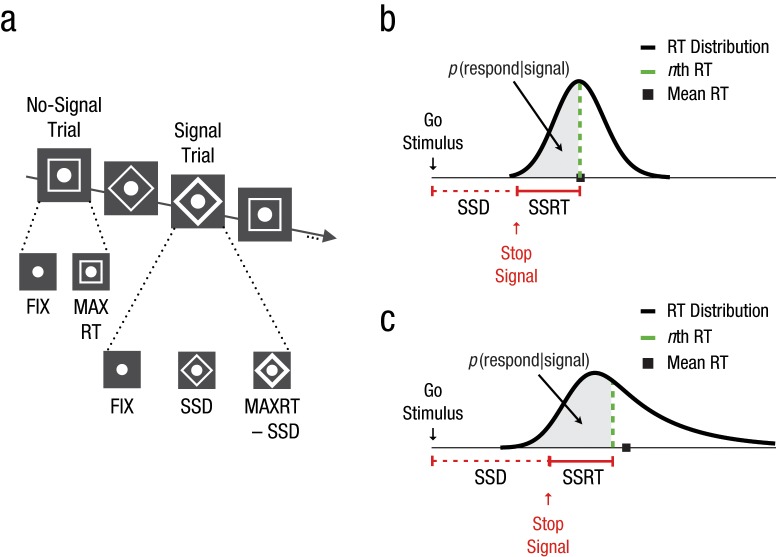
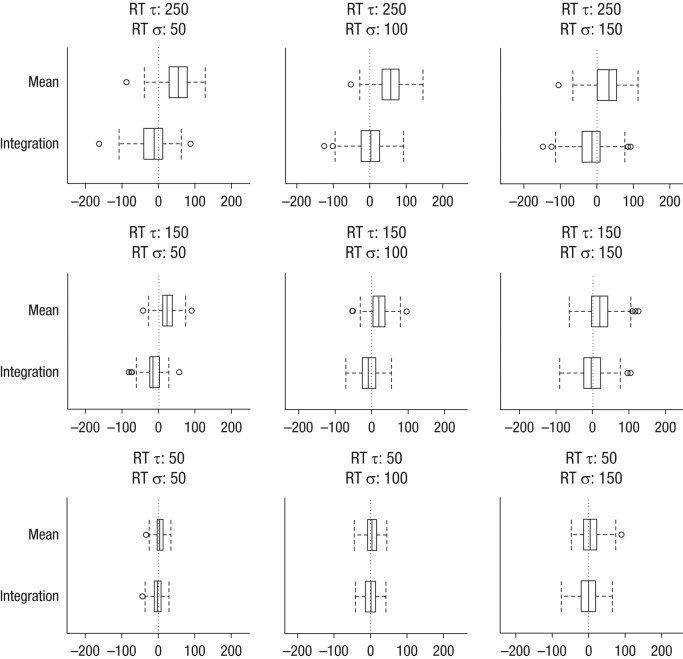
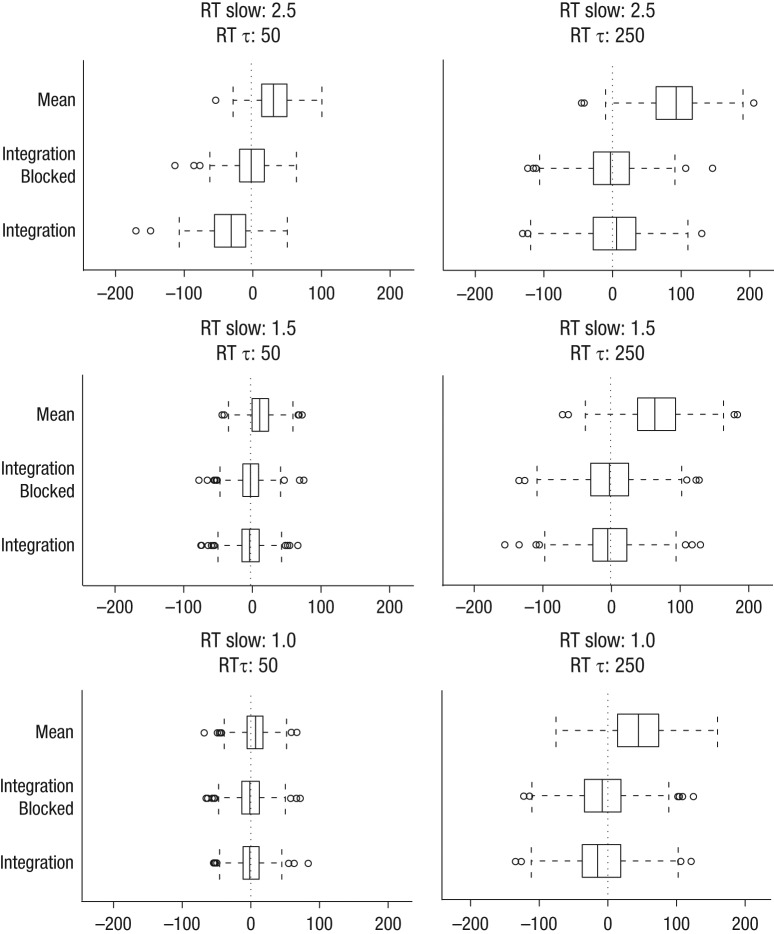
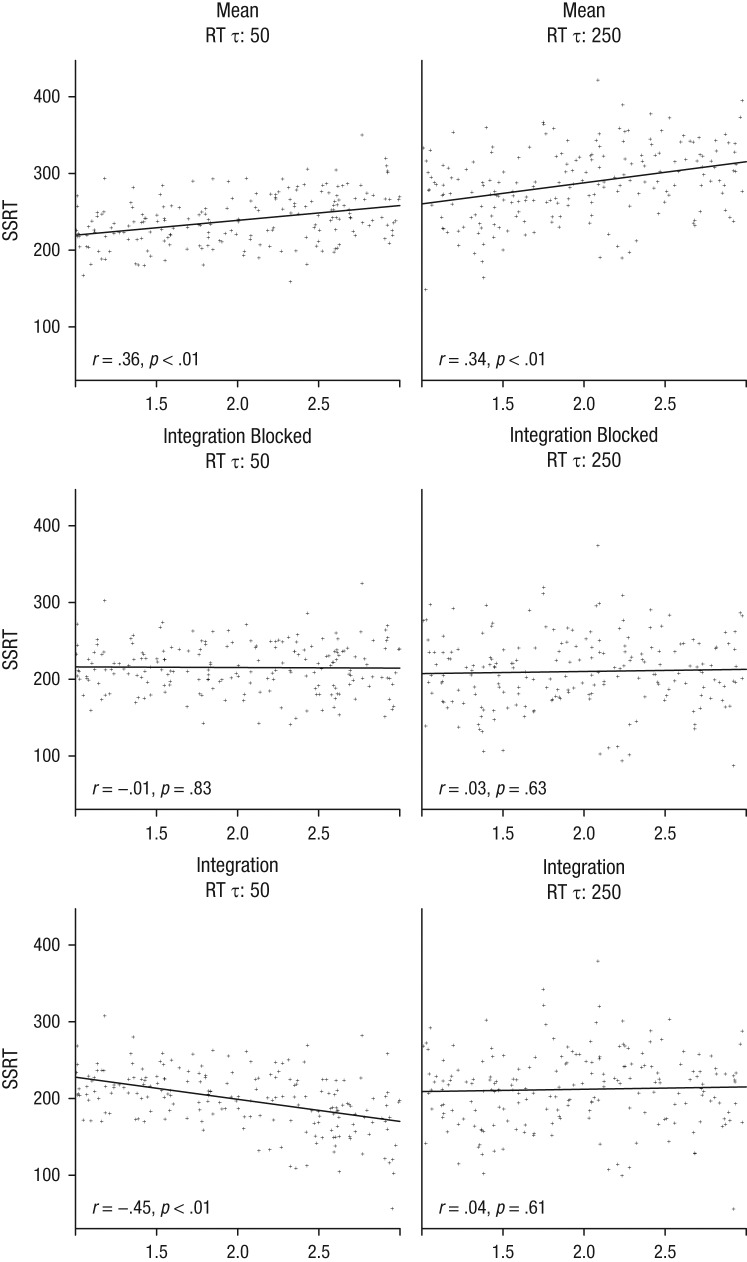
The stop-signal paradigm is a popular method for examining response inhibition and impulse control in psychology, cognitive neuroscience, and clinical domains because it allows the estimation of the covert latency of the stop process: the stop-signal reaction time (SSRT). In three sets of simulations, we examined to what extent SSRTs that were estimated with the popular mean and integration methods were influenced by the skew of the reaction time distribution and the gradual slowing of the response latencies. We found that the mean method consistently overestimated SSRT. The integration method tended to underestimate SSRT when response latencies gradually increased. This underestimation bias was absent when SSRTs were estimated with the integration method for smaller blocks of trials. Thus, skewing and response slowing can lead to spurious inhibitory differences. We recommend that the mean method of estimating SSRT be abandoned in favor of the integration method.
Overview
The claims and statistics of this paper haven’t been checked yet.
Free: it reads the open-access text and checks the first 5 claims that cite a source we can check. Create a free account to check every claim.
Integrity signals
Registry
Cites
Statistics
Figures
Verification
Claims the paper makes
The claims and statistics of this paper haven’t been checked yet.
Free: it reads the open-access text and checks the first 5 claims that cite a source we can check. Create a free account to check every claim.
Claims other papers make about this one
Each is checked against this paper’s own text: does it say what the citing paper says it does?
The cited source says what the claim attributes to it.
In the citing paper
“and the method used in most studies to derive estimates of inhibitory control from the stop-signal task has been criticized for producing spurious results (Verbruggen et al., 2013).”
From Executive Functioning Heterogeneity in Pediatric ADHD (2019) · cites this paper as Verbruggen et al., 2013
Self-check
Percentages, sums and reported differences re-computed from the paper’s own numbers.
The self-check needs the paper’s full text.
Citations
Cites
R: A Language and Environment for Statistical Computing
R Core Team (2025) · doi:10.32614/r.manuals · Cited by 352,181
Yaşlı Kadınlarda Üreme Sağlığı
Kokanalı, D., & Engin Üstün, Y. (n.d.) · DergiPark (Istanbul University) · Cited by 170,090
On the ability to inhibit thought and action: a theory of an act of control
Logan, G. D., & Cowan, W. B. (1984) · Psychological Review · doi:10.1037/0033-295x.91.3.295 · Cited by 2,590 · cited 4×
“SSRT is estimated according to the independent-race model (Logan, 1994; Logan & Cowan, 1984; Verbruggen & Logan, 2009a): Performance in the stop task can be modeled as a race between a go process, which is triggered by the presentation of the go stimulus, and a stop process, which is triggered by the presentation of a…”
InfluentialSelf-citationInhibitory Processes in Attention, Memory and Language
Carr, T. H., & Dagenbach, D. (1994) · Medical Entomology and Zoology · Cited by 2,364
Bergum, B. O., Long, J., & Baddeley, A. (1982) · The American Journal of Psychology · doi:10.2307/1422199 · Cited by 2,226
Methods for dealing with reaction time outliers.
Ratcliff, R. (1993) · Psychological Bulletin · doi:10.1037/0033-2909.114.3.510 · Cited by 2,123
Impulsivity and Inhibitory Control
Logan, G. D., Schachar, R. J., & Tannock, R. (1997) · Psychological Science · doi:10.1111/j.1467-9280.1997.tb00545.x · Cited by 1,394
Self-citationResponse inhibition in the stop-signal paradigm
Verbruggen, F., & Logan, G. D. (2008) · Trends in Cognitive Sciences · doi:10.1016/j.tics.2008.07.005 · Cited by 1,373
Self-citationAron, A. R. (2011) · Biological Psychiatry · doi:10.1016/j.biopsych.2010.07.024 · Cited by 1,236 · cited 3×
“…slow responses either proactively when they expect that stop signals might occur or reactively when they fail to inhibit their responses (e.g., Aron, 2011; Bissett & Logan, 2011; Leotti & Wager, 2010; Verbruggen & Logan, 2009b; Verbruggen, Logan, Liefooghe, & Vandierendonck, 2008; Zandbelt,…”
On the ability to inhibit thought and action: A users' guide to the stop signal paradigm
Logan, G. D. (1994) · UvA-DARE (University of Amsterdam) · Cited by 1,115
Self-citation
Research works printed but not linked: 1
- 10.1016/j .biopsych.2010.07.024 · doi:10.1016/j
Cited by
Items 301–388 of 388
Linkovski, O., Naftalovich, H., David, M., Seror, Y., & Kalanthroff, E. (2023) · Journal of Clinical Medicine · doi:10.3390/jcm12124075 · Cited by 3
Dual-task effects of walking-speed on inhibitory control and decision-making under risk
Maiocchi, C., Milanesi, M., Canessa, N., Sozzi, S., Mattavelli, G. C., Nardone, A., & Gianelli, C. (2025) · Scientific Reports · doi:10.1038/s41598-025-88497-0 · Cited by 5
Response suppression and decision-making in association football referees
Albaladejo‐García, C., Ignoul, E., Demarez, M., Caballero, C., Helsen, W. F., & Moreno, F. J. (2025) · Psychology of sport and exercise · doi:10.1016/j.psychsport.2025.102908 · Cited by 3
Kricheldorff, J., Sauer, T., & Witt, K. (2025) · Brain Communications · doi:10.1093/braincomms/fcaf474 · Cited by 3
Prefrontal and frontostriatal structures mediate academic outcomes associated with ADHD symptoms
Chiu, H., Genc, S., Malpas, C. B., Sciberras, E., Nicholson, J. M., Efron, D., & Silk, T. J. (2021) · Brain Disorders · doi:10.1016/j.dscb.2021.100023 · Cited by 4
Examining Mechanisms of Childhood Cognitive Control
Ganesan, K., Smid, C. R., Thompson, A., Buchberger, E. S., Spowage, J., Iqbal, S., Phillips, H., & Steinbeis, N. (2023) · Journal of Cognition · doi:10.5334/joc.314 · Cited by 6
The point of no return in the Emotional Stop-Signal Task: A matter of affect or method?
Coccaro, A., Maffei, A., Kleffner, K., Carolan, P. L., Vallesi, A., D’Adamo, G., & Liotti, M. (2024) · PLoS ONE · doi:10.1371/journal.pone.0315082 · Cited by 5
Peterson, D. S., Smulders, K., Mancini, M., Nutt, J. G., Horak, F. B., & Fling, B. W. (2020) · Journal of the International Neuropsychological Society · doi:10.1017/s135561772000123x · Cited by 3
Mirajkar, S., & Waring, J. D. (2023) · Cognition & Emotion · doi:10.1080/02699931.2023.2208860 · Cited by 3
Pearce, A. L., Hallisky, K., Rolls, B. J., Wilson, S. J., Rose, E. J., Geier, C. F., Garavan, H., & Keller, K. (2023) · Obesity · doi:10.1002/oby.23892 · Cited by 4
Event-related fields evoked by vocal response inhibition: a comparison of younger and older adults
Castro-Meneses, L. J., Johnson, B. W., & Sowman, P. F. (2016) · Experimental Brain Research · doi:10.1007/s00221-016-4555-2 · Cited by 4
Lifespan Changes in the Countermanding Performance of Young and Middle Aged Adult Rats
Beuk, J., Beninger, R. J., & Paré, M. (2016) · Frontiers in Aging Neuroscience · doi:10.3389/fnagi.2016.00190 · Cited by 3
Reward improves cognitive control by enhancing signal monitoring
Wang, Y., Antao, C. H. E. N., Hu, X., & Yin, S. (2019) · Acta Psychologica Sinica · doi:10.3724/sp.j.1041.2019.00048 · Cited by 8
Electrophysiological correlates underlying interference control in motor tasks
Sperl, L., Ambrus, G. G., Kaufmann, J. M., Schweinberger, S. R., & Cañal‐Bruland, R. (2021) · Biological Psychology · doi:10.1016/j.biopsycho.2021.108138 · Cited by 4
Lehet, M. I., Tso, I. F., Park, S., Neggers, S. F. W., Thompson, I. A., Kahn, R. S., & Thakkar, K. N. (2021) · Brain Sciences · doi:10.3390/brainsci11091228 · Cited by 3
Inomata, K., Suzuki, M., Hoshi, M., & Kurahashi, M. (1990) · PubMed · Cited by 3
Lehet, M. I., Tso, I. F., Neggers, S. F. W., Thompson, I. A., Yao, B., Kahn, R. S., & Thakkar, K. N. (2021) · NeuroImage Clinical · doi:10.1016/j.nicl.2021.102764 · Cited by 3
Hynd, M., Soh, C., Rangel, B. O., & Wessel, J. R. (2020) · bioRxiv (Cold Spring Harbor Laboratory) · doi:10.1101/2020.09.15.298711 · Cited by 3
Proactive, Reactive, and Attentional Dynamics: An Integrative Model of Cognitive ControlPreprint
Mistry, P. K., Warren, S. L., Branigan, N. K., Cai, W., & Menon, V. (2024) · bioRxiv (Cold Spring Harbor Laboratory) · doi:10.1101/2024.10.01.615613 · Cited by 4
Zou, Z., & Chen, B. (2024) · Bilingualism Language and Cognition · doi:10.1017/s1366728924000993 · Cited by 3
Conflict resolution and response inhibition: A simultaneous EEG-EMG-pupillometry study
Bundt, C., Raud, L., Thunberg, C., & Huster, R. J. (2025) · Neuropsychologia · doi:10.1016/j.neuropsychologia.2025.109192 · Cited by 2
Putter, L. M. S. D., & Koster, E. H. W. (2018) · Journal of Behavior Therapy and Experimental Psychiatry · doi:10.1016/j.jbtep.2018.07.007 · Cited by 2
Sex, ADHD symptoms, and CHRNA5 genotype influence reaction time but not response inhibition
Schote, A. B., Sayk, C., Pabst, K., Meier, J. K., Frings, C., & Meyer, J. (2018) · Journal of Neuroscience Research · doi:10.1002/jnr.24342 · Cited by 4
Do Childhood Emotional Lability and ADHD Symptoms Have Shared Neuropsychological Roots?
Liefferinge, D. V., Sonuga-Barke, E. J. S., Danckaerts, M., Broeck, N. V., & der Oord, S. V. (2021) · Journal of Psychopathology and Behavioral Assessment · doi:10.1007/s10862-020-09859-8 · Cited by 5
Motor Imagery Combined With Physical Training Improves Response Inhibition in the Stop Signal Task
Son, S. M., Yun, S. H., & Kwon, J. W. (2022) · Frontiers in Psychology · doi:10.3389/fpsyg.2022.905579 · Cited by 7
Stop affordance task: a measure of the motor interference effect
Casarotto, A., Dolfini, E., & Cardellicchio, P. (2023) · Cognitive Processing · doi:10.1007/s10339-023-01172-y · Cited by 2
Takayose, M., Koshizawa, R., Oki, K., & Kikuchi, T. (2016) · Neuroreport · doi:10.1097/wnr.0000000000000593 · Cited by 2
A reaction-time adjusted PSI method for estimating performance in the stop-signal task
Weise, L., Boecker, M., Gauggel, S., Falkenburger, B. H., & Drueke, B. (2018) · PLoS ONE · doi:10.1371/journal.pone.0210065 · Cited by 2
Contextual response time adaptation in the countermanding performance of rats
Beuk, J., Beninger, R. J., Mechefske, E., & Paré, M. (2016) · Neuroscience · doi:10.1016/j.neuroscience.2016.09.009 · Cited by 2
Do obsessive-compulsive symptoms and contamination-related stimuli affect inhibition capacity?
Putter, L. M. S. D., Cromheeke, S., Anholt, G. E., Mueller, S. C., & Koster, E. H. W. (2017) · Journal of Obsessive-Compulsive and Related Disorders · doi:10.1016/j.jocrd.2017.09.003 · Cited by 4
Emond, F. C., Nolet, K., Rochat, L., Rouleau, J. L., & Gagnon, J. (2019) · Sexual Abuse · doi:10.1177/1079063219825866 · Cited by 4
ImGo: A Novel Tool for Behavioral Impulsivity Assessment Based on Go/NoGo Tasks
Šašinka, Č., Lacko, D., Čeněk, J., Popelka, S., Ugwitz, P., Řádová, H., Fabianová, M., Šašinková, A., Brancik, J. V., & Jankovská, M. (2021) · Psychological Reports · doi:10.1177/00332941211040431 · Cited by 2
Mid-Luteal Olfactory Abilities Reveal Healthy Women’s Emotional and Cognitive Functions
Yao, F., Chen, K., Zhuang, Y., Shen, X., & Wang, X. (2022) · Frontiers in Neuroscience · doi:10.3389/fnins.2022.826547 · Cited by 2
Weigard, A. S., Matzke, D., Tanis, C. C., & Heathcote, A. (2021) · bioRxiv (Cold Spring Harbor Laboratory) · doi:10.1101/2021.07.26.453872 · Cited by 2
Salomoni, S. E., Gronau, Q. F., Heathcote, A., Matzke, D., & Hinder, M. R. (2023) · bioRxiv (Cold Spring Harbor Laboratory) · doi:10.1101/2023.07.11.548624 · Cited by 2
In search for the invisible: motor inhibition in monkey premotor cortex and its RNN replicasPreprint
Alboré, N., Galluzzi, A., Pani, P., Ferraina, S., & Mattia, M. (2025) · bioRxiv (Cold Spring Harbor Laboratory) · doi:10.1101/2025.11.24.690225 · Cited by 5
Cognitive Control of Choices and Actions
Heathcote, A., Verbruggen, F., Boehler, C. N., & Matzke, D. (2024) · Springer eBooks · doi:10.1007/978-3-031-45271-0_14 · Cited by 1
Self-citationAkıl, A. M., Cserjési, R., Nagy, T., Demetrovics, Z., & Logemann, H. N. A. (2024) · Scientific Reports · doi:10.1038/s41598-024-74070-8 · Cited by 1
Waring, J. D., & Hartling, S. (2025) · Frontiers in Psychology · doi:10.3389/fpsyg.2025.1568492 · Cited by 3
Weber, S., Kemp, S. A., & Hinder, M. R. (2026) · Cognitive Affective & Behavioral Neuroscience · doi:10.3758/s13415-026-01440-2 · Cited by 4
Mattavelli, G. C., Pirone, R., Gianelli, C., & Canessa, N. (2026) · Cortex · doi:10.1016/j.cortex.2026.05.011 · Cited by 2
The effects of conscious movement investment on inhibiting a simple response
You, Y., Weng, W.-C., Suprianto, G. B., & van der Kamp, J. (2024) · Frontiers in Psychology · doi:10.3389/fpsyg.2024.1365420 · Cited by 1
Piskin, D., Gokeler, A., Chen, Y.-H., & Baumeister, J. (2024) · Journal of Motor Behavior · doi:10.1080/00222895.2024.2400126 · Cited by 2
Shields, G. S., Hunter, C. L., Buckner, Z., Tolliver, M., & Makhanova, A. (2024) · Psychoneuroendocrinology · doi:10.1016/j.psyneuen.2024.107186 · Cited by 1
Wang, C., Li, W., Zhou, Y., Nan, F., Zhao, G., & Zhang, Q. (2021) · Advances in Cognitive Psychology · doi:10.5709/acp-0319-9 · Cited by 2
Improved response inhibition induced by attentional capture is associated with physical activity
Zhu, H., Xu, J., Zheng, Y., Jiang, G., Huang, X., Tan, X., & Wu, X. (2022) · PeerJ · doi:10.7717/peerj.14083 · Cited by 2
Retraction Note to: Reward anticipation enhances brain activation during response inhibition
Rosell‐Negre, P., Bustamante, J. C., Fuentes‐Claramonte, P., Costumero, V., Benabarre, S., & Barrós‐Loscertales, A. (2016) · Cognitive Affective & Behavioral Neuroscience · doi:10.3758/s13415-016-0472-x · Cited by 1
Functional connectivity alterations in Parkinson’s disease during the stop-signal taskPreprint
Vriend, C., Leffa, D. T., Trujillo, J. P., Gerrits, N. J. H. M., de Boer, F. E., Berendse, H. W., van der Werf, Y. D., & van den Heuvel, O. A. (2018) · bioRxiv (Cold Spring Harbor Laboratory) · doi:10.1101/304584 · Cited by 2
Cortical Silent Period reflects individual differences in action stopping performancePreprint
Paci, M., Cosmo, G. D., Perrucci, M. G., Ferri, F., & Costantini, M. (2020) · bioRxiv (Cold Spring Harbor Laboratory) · doi:10.1101/2020.07.28.219600 · Cited by 1
Ratcliffe, C. E., McAllister, C. J., & MacDonald, H. J. (2022) · bioRxiv (Cold Spring Harbor Laboratory) · doi:10.1101/2022.09.14.507942 · Cited by 1
SSRTcalc: Monte Carlo and Bayesian Stop-Signal Reaction Time Estimation
Leontyev, A. (2021) · doi:10.32614/cran.package.ssrtcalc · Cited by 1
Beuk, J. (2016) · QSpace (Queen's University Library)
Messel, M. S. (2017) · NVA (Nasjonalt vitenarkiv)
The interplay between selective and nonselective inhibition during single word production
Vromans, R., & Jongman, S. R. (2018) · PLoS ONE · doi:10.1371/journal.pone.0197313
Marx, I., Reis, O., & Berger, C. (2019) · BMJ Open · doi:10.1136/bmjopen-2018-027651 · Cited by 1
Executive control and emotion regulation in remitted depression
Aker, M. (2019) · NVA (Nasjonalt vitenarkiv) · Cited by 1
Intracortical Inhibition and Response Inhibition in healthy adults and gamblers
Chowdhury, N. S. (2019) · The Sydney eScholarship Repository (The University of Sydney)
Verbal Response Inhibition and Stuttering in Adults
Treleaven, S. (2020) · Louisiana State University · doi:10.31390/gradschool_dissertations.5380
Goranova, Z. O. (2019) · University of Birmingham Institutional Research Archive (University of Birmingham) · Cited by 1
Inhibitory control in adolescence: Developmental trajectories and relation to delinquent behavior
Fosco, W. D. (2018) · Cited by 1
Proactive inhibition of goal-directed movements involves explicit changes to movement planningPreprint
Pickavance, J., Mon-Williams, M. A., Mushtaq, F., & Morehead, J. R. (2022) · bioRxiv (Cold Spring Harbor Laboratory) · doi:10.1101/2022.06.01.494317
Preparation facilitates response inhibition based on a stop‐signal task
Jia, L., Li, S., Cui, J., Liu, J., Guo, X., & Wang, Y. (2023) · PsyCh Journal · doi:10.1002/pchj.639
The Role of Mechanisms of Inhibition and Attention in Obesity
Tsegaye, A. A. (2022) · Eötvös Loránd Tudományegyetem · doi:10.15476/elte.2022.011
The Effect of Mindfulness-Based Interventions on Children’s Self-Regulation
Vekety, B. (2023) · Eötvös Loránd Tudományegyetem · doi:10.15476/elte.2022.122
The many faces of control: brain-behavior interactions in development
Gooskens, B. (2024) · Utrecht University Repository (Utrecht University) · doi:10.33540/1183
Katz, B. R., Gaalema, D. E., Dumas, J. A., Heil, S. H., Sigmon, S. C., Tidey, J. W., Lee, D. C., DeSarno, M., & Higgins, S. T. (2024) · Experimental and Clinical Psychopharmacology · doi:10.1037/pha0000724
Azhan, M. A. N., Azaman, A. B., Khairizam, S. H. S. M., Miswan, M. S., Hasan, H., & Zainuddin, N. F. (2024) · Lecture notes in bioengineering · doi:10.1007/978-981-97-3741-3_6
ter Horst, J., Cohen, M. X., & Englitz, B. (2024) · bioRxiv (Cold Spring Harbor Laboratory) · doi:10.1101/2024.09.05.611370
Seiffer, B., & Wolf, S. (2025) · German Journal of Exercise and Sport Research · doi:10.1007/s12662-025-01032-1 · Cited by 2
Burton, S. P., & Jones, A. (2025) · Substance Use & Misuse · doi:10.1080/10826084.2025.2553304 · Cited by 1
Omont, S., Knops, A., & Coolen, I. E. J. I. (2026) · Child Development · doi:10.1093/chidev/aacaf009
Zhu, H., Ye, L., Zhang, L., Si, B., Zhou, Y., Wu, X., & Chen, A. (2026) · Brain Structure and Function · doi:10.1007/s00429-026-03084-x
Impairment of Executive Functions in Premenstrual Syndrome: State or Trait?
Gnaiger, A. M., Werlein, P., Gruschwitz, P., Siebers, M., Panzik, A., Comasco, E., Hidalgo‐Lopez, E., & Pletzer, B. A. (2026) · Biological Psychiatry Global Open Science · doi:10.1016/j.bpsgos.2026.100730
John, M. P. G., Earnshaw, L., Shankar, N. G., Raja, J. S., Davies, T. J., Cowen, P. J., Sharp, T., Salmoiraghi, A., & Rogers, R. D. (2026) · Human Psychopharmacology Clinical and Experimental · doi:10.1002/hup.70040
Weng, Y., Boyle, R. T., Lee, C. T., Quinn, D. M., Earley, C., Splittgerber, M., Zhang, L., Franzen, L., Banaschewski, T., Bokde, A. L. W., et al. (2026) · Neuropsychopharmacology · doi:10.1038/s41386-026-02401-6 · Cited by 1
Tubito, A., Ciardiello, A., Capone, C., Bardella, G., Pani, P., Ferraina, S., & Gigante, G. (2026) · bioRxiv (Cold Spring Harbor Laboratory) · doi:10.64898/2026.05.09.723954
Xu, S., Xue, Z., Lu, J., Wang, R., Tan, Y., Gan, J., Zheng, T., Bao, D., & Chen, Y. (2026) · European Journal of Applied Physiology · doi:10.1007/s00421-026-06240-7
Kınay, D., Aydın, E. P., Guney, O., Açıkgöz, S., & Namlı, S. (2026) · Journal of Psychopathology and Behavioral Assessment · doi:10.1007/s10862-026-10338-9
Metadata
- Authors
- Verbruggen, F., Chambers, C. D., & Logan, G. D.
- Affiliations
- University of Exeter (GB)
- Cardiff University
- Vanderbilt University (US)
- Corresponding author
- Verbruggen, Frederick
- Venue
- Psychological Science
- Publisher
- SAGE Publications
- Published
- 2013-02-11
- Volume
- 24
- Issue
- 3
- Pages
- 352-362
- ISSN
- 0956-7976 (ISSN-L)
- 1467-9280
- PMC
- PMC3724271
- OpenAlex
- W2098568287
- Cited by
- 386
- References
- 36
- Citations by year
- 2026: 11 · 2025: 11 · 2024: 29 · 2023: 27 · 2022: 24 · 2021: 41 · 2020: 38 · 2019: 40 · 2018: 47 · 2017: 28 · 2016: 30 · 2015: 24 · 2014: 25 · 2013: 9
- FWCI
- 16.09
- Type
- journal article
- Language
- en
- Open access
- hybrid
- doi.org
- Licence
- cc-by
- journals.sagepub.com/page/policies/text-and-data-mining-license (tdm)
- Locations
- Psychological Science (publishedVersion, cc-by)
- Europe PMC (PubMed Central) (publishedVersion, cc-by-nc)
- PubMed Central (publishedVersion, cc-by-nc)
- PubMed (publishedVersion)
- ORCA Online Research @Cardiff (Cardiff University) (acceptedVersion)
- Open Research Exeter (University of Exeter) (submittedVersion)
- Ghent University Academic Bibliography (Ghent University) (submittedVersion)
- Figshare (submittedVersion)
- Funders
- National Science Foundation (0957074)
- University of Exeter
- Economic and Social Research Council (ES/J00815X/1)
- Topics
- Life Sciences › Neuroscience › Cognitive Neuroscience › Neural and Behavioral Psychology Studies
- Social Sciences › Psychology › Applied Psychology › Behavioral Health and Interventions
- Social Sciences › Decision Sciences › General Decision Sciences › Decision-Making and Behavioral Economics
- Keywords
- stop-signal reaction time, stop-signal task, response inhibition, impulse control, integration techniques, response slowing
- MeSH terms
- Computer Simulation, Humans, Inhibition, Psychological, Models, Psychological, Psychomotor Performance, Reaction Time
About these checks
Registry, retraction, Cites and statistics results are computed, not judged, with one exception: a printed reference that no index lists is read once by a model before it counts as a citation error. Claims are extracted by a model and kept only when their quote appears verbatim in the text; each cited source is then checked, with a model’s help, for whether it says what the claim relies on. Those verdicts can be wrong — read the claim’s quote and the cited source before relying on one.
Statistics and arithmetic are recomputed, not judged.
Confidence bands are shown only for fields calibrated on our annotated test set. None is calibrated yet, so no band is shown.
What counts as a claim ›How we measure confidence ›How we check this ›
Are you an author, or do you see a problem with this page? Request a review
Data sources
Bibliographic data: Semantic Scholar, OpenAlex, Crossref.
Contains information from the Semantic Scholar Academic Graph Datasets, made available under the ODC Attribution License (ODC-BY 1.0).
Semantic Scholar’s data is described in: Kinney, R., et al. (2023). The Semantic Scholar Open Data Platform. arXiv:2301.10140.
